

i prep ▶ 1. at, 2. to
ici 4 class 4
singular: iki-,ic- ▶ (no pl.) dry season, summer
singular: iki-,ic- ▶ (no pl.) dry season, summer
i bwīna n ▶ (no pl.) depths (water)
i muhira adv ▶ (no pl.) at home
i : plural of...
ince (i-) 3 class 3
singular: i-,in-
plural: i-,in- ▶ hymen
singular: i-,in-
plural: i-,in- ▶ hymen
Imāna (i-) 3 class 3
singular: i-,in-
plural: i-,in- ▶ God
singular: i-,in-
plural: i-,in- ▶ God
idono (i-) 3 class 3
singular: i-,in-
plural: i-,in- ▶ large bow like monochord instrument with calabashes as resonance body
singular: i-,in-
plural: i-,in- ▶ large bow like monochord instrument with calabashes as resonance body
ikado (i-) 3 class 3
singular: i-,in-
plural: i-,in- ▶ gift, present (from Fr. cadeau)
singular: i-,in-
plural: i-,in- ▶ gift, present (from Fr. cadeau)
ikawa (i-) 3 class 3
singular: i-,in-
plural: i-,in- ▶ coffee (drink)
singular: i-,in-
plural: i-,in- ▶ coffee (drink)
inaga (i-) 3 class 3
singular: i-,in-
plural: i-,in- ▶ cooking pot
singular: i-,in-
plural: i-,in- ▶ cooking pot
inivo (i-) 3 class 3
singular: i-,in-
plural: i-,in- ▶ niveau, level (from Fr.)
singular: i-,in-
plural: i-,in- ▶ niveau, level (from Fr.)
inoni (i-) 3 class 3
singular: i-,in-
plural: i-,in- ▶ finger snap
singular: i-,in-
plural: i-,in- ▶ finger snap
inoti (i-) 3 class 3
singular: i-,in-
plural: i-,in- ▶ banknote (Fr.)
singular: i-,in-
plural: i-,in- ▶ banknote (Fr.)
inuma (i-) 3 class 3
singular: i-,in-
plural: i-,in- ▶ dove, pigeon
singular: i-,in-
plural: i-,in- ▶ dove, pigeon
ināma (i-) 3 class 3
singular: i-,in-
plural: i-,in- ▶ 1. meeting, council, conference, 2. advice, consultation, counsel, 3. agreement, 4. suggestion
singular: i-,in-
plural: i-,in- ▶ 1. meeting, council, conference, 2. advice, consultation, counsel, 3. agreement, 4. suggestion
irake (i-) 3 class 3
singular: i-,in-
plural: i-,in- ▶ one hundred thousand
singular: i-,in-
plural: i-,in- ▶ one hundred thousand
iraki (i-) 3 class 3
singular: i-,in-
plural: i-,in- ▶ one hundred thousand
singular: i-,in-
plural: i-,in- ▶ one hundred thousand
isiha (i-) 3 class 3
singular: i-,in-
plural: i-,in- ▶ cane rat
singular: i-,in-
plural: i-,in- ▶ cane rat
isima (i-) 3 class 3
singular: i-,in-
plural: i-,in- ▶ cement (Fr. ciment)
singular: i-,in-
plural: i-,in- ▶ cement (Fr. ciment)
isoni (i-) 3 class 3
singular: i-,in-
plural: i-,in- ▶ 1. shame, 2. respect, 3. timidity, 4. bashfulness
singular: i-,in-
plural: i-,in- ▶ 1. shame, 2. respect, 3. timidity, 4. bashfulness
isupu (i-) 3 class 3
singular: i-,in-
plural: i-,in- ▶ soup
singular: i-,in-
plural: i-,in- ▶ soup
urumogi (i-) 6 class 6
singular: uru-
plural: in- ▶ hemp
singular: uru-
plural: in- ▶ hemp
urumuri (i-) 6 class 6
singular: uru-
plural: in- ▶ light (not day light), torch
singular: uru-
plural: in- ▶ light (not day light), torch
urunana (i-) 6 class 6
singular: uru-
plural: in- ▶ 1. small ornamental axe, 2. bracelet worn on hand for special occasion
singular: uru-
plural: in- ▶ 1. small ornamental axe, 2. bracelet worn on hand for special occasion
urunani (i-) 6 class 6
singular: uru-
plural: in- ▶ holding hands to form circle or line (gufatana urunani)
singular: uru-
plural: in- ▶ holding hands to form circle or line (gufatana urunani)
urunāna (i-) 6 class 6
singular: uru-
plural: in- ▶ rolling stone
singular: uru-
plural: in- ▶ rolling stone
urunāri (i-) 6 class 6
singular: uru-
plural: in- ▶ wire (not real coarse or real fine)
singular: uru-
plural: in- ▶ wire (not real coarse or real fine)
urunūka (i-) 6 class 6
singular: uru-
plural: in- ▶ any horrid, hateful thing
singular: uru-
plural: in- ▶ any horrid, hateful thing
igūmba (i-) 3 class 3
singular: i-,in-
plural: i-,in- ▶ sterile female (human or animal)
singular: i-,in-
plural: i-,in- ▶ sterile female (human or animal)
ikembe (i-) 3 class 3
singular: i-,in-
plural: i-,in- ▶ lamellophone composed of a hollowed-out box on which are fixed strips of metal or bamboo of various lengths
singular: i-,in-
plural: i-,in- ▶ lamellophone composed of a hollowed-out box on which are fixed strips of metal or bamboo of various lengths
imamfu (i-) 3 class 3
singular: i-,in-
plural: i-,in- ▶ large monkey
singular: i-,in-
plural: i-,in- ▶ large monkey
ingoga (i-) 3 class 3
singular: i-,in-
plural: i-,in- ▶ 1. quickness, 2. agility, 3. eagerness, 4. speed, haste
singular: i-,in-
plural: i-,in- ▶ 1. quickness, 2. agility, 3. eagerness, 4. speed, haste
inyāma (i-) 3 class 3
singular: i-,in-
plural: i-,in- ▶ 1. meat, 2. flesh, 3. muscle
singular: i-,in-
plural: i-,in- ▶ 1. meat, 2. flesh, 3. muscle
inyōta (i-) 3 class 3
singular: i-,in-
plural: i-,in- ▶ thirst
singular: i-,in-
plural: i-,in- ▶ thirst
ināmbu (i-) 3 class 3
singular: i-,in-
plural: i-,in- ▶ appetite, desire for a certain food
singular: i-,in-
plural: i-,in- ▶ appetite, desire for a certain food
inānga (i-) 3 class 3
singular: i-,in-
plural: i-,in- ▶ burundian zither, harp, musical instrument
singular: i-,in-
plural: i-,in- ▶ burundian zither, harp, musical instrument
iposta (i-) 3 class 3
singular: i-,in-
plural: i-,in- ▶ post office
singular: i-,in-
plural: i-,in- ▶ post office
ipāmpa (i-) 3 class 3
singular: i-,in-
plural: i-,in- ▶ cotton
singular: i-,in-
plural: i-,in- ▶ cotton
itangi (i-) 3 class 3
singular: i-,in-
plural: i-,in- ▶ tank (water)
singular: i-,in-
plural: i-,in- ▶ tank (water)
itumba (i-) 3 class 3
singular: i-,in-
plural: i-,in- ▶ rain season (about February to May)
singular: i-,in-
plural: i-,in- ▶ rain season (about February to May)
urumbēte (i-) 6 class 6
singular: uru-
plural: in- ▶ trumpet
singular: uru-
plural: in- ▶ trumpet
urumāmbo (i-) 6 class 6
singular: uru-
plural: in- ▶ nail, peg
singular: uru-
plural: in- ▶ nail, peg
urunyuzi (i-) 6 class 6
singular: uru-
plural: in- ▶ (Sw.) thread
singular: uru-
plural: in- ▶ (Sw.) thread
idiyama (i-) 3 class 3
singular: i-,in-
plural: i-,in- ▶ diamond
singular: i-,in-
plural: i-,in- ▶ diamond
ifiriti (i-) 3 class 3
singular: i-,in-
plural: i-,in- ▶ french fries, potota chips, pommes frites
singular: i-,in-
plural: i-,in- ▶ french fries, potota chips, pommes frites
inanasi (i-) 3 class 3
singular: i-,in-
plural: i-,in- ▶ pineapple
singular: i-,in-
plural: i-,in- ▶ pineapple
indengo (i-) 3 class 3
singular: i-,in-
plural: i-,in- ▶ milling song
singular: i-,in-
plural: i-,in- ▶ milling song
ipapāyi (i-) 3 class 3
singular: i-,in-
plural: i-,in- ▶ papaya
singular: i-,in-
plural: i-,in- ▶ papaya
iposita (i-) 3 class 3
singular: i-,in-
plural: i-,in- ▶ post office
singular: i-,in-
plural: i-,in- ▶ post office
iradiyo (i-) 3 class 3
singular: i-,in-
plural: i-,in- ▶ radio (plural also amaradiyo)
singular: i-,in-
plural: i-,in- ▶ radio (plural also amaradiyo)
isaradi (i-) 3 class 3
singular: i-,in-
plural: i-,in- ▶ salad
singular: i-,in-
plural: i-,in- ▶ salad
isenema (i-) 3 class 3
singular: i-,in-
plural: i-,in- ▶ cinema, movie theater
singular: i-,in-
plural: i-,in- ▶ cinema, movie theater
isereri (i-) 3 class 3
singular: i-,in-
plural: i-,in- ▶ celery
singular: i-,in-
plural: i-,in- ▶ celery
ishīmwe (i-) 3 class 3
singular: i-,in-
plural: i-,in- ▶ 1. praise, 2. gift of thanks, 3. compliment
singular: i-,in-
plural: i-,in- ▶ 1. praise, 2. gift of thanks, 3. compliment
isinema (i-) 3 class 3
singular: i-,in-
plural: i-,in- ▶ cinema, movie theater
singular: i-,in-
plural: i-,in- ▶ cinema, movie theater
isumaku (i-) 3 class 3
singular: i-,in-
plural: i-,in- ▶ magnet
singular: i-,in-
plural: i-,in- ▶ magnet
ivatiri (i-) 3 class 3
singular: i-,in-
plural: i-,in- ▶ car, automobile (from Fr. voiture)
singular: i-,in-
plural: i-,in- ▶ car, automobile (from Fr. voiture)
ifarmasi (i-) 3 class 3
singular: i-,in-
plural: i-,in- ▶ pharmacy, drugstore, chemist's
singular: i-,in-
plural: i-,in- ▶ pharmacy, drugstore, chemist's
imashīni (i-) 3 class 3
singular: i-,in-
plural: i-,in- ▶ machine (Fr.)
singular: i-,in-
plural: i-,in- ▶ machine (Fr.)
inakwezi (i-) 3 class 3
singular: i-,in-
plural: i-,in- ▶ kind of sweet potato
singular: i-,in-
plural: i-,in- ▶ kind of sweet potato
inangoma (i-) 3 class 3
singular: i-,in-
plural: i-,in- ▶ kind of sweet potato
singular: i-,in-
plural: i-,in- ▶ kind of sweet potato
inanyaru (i-) 3 class 3
singular: i-,in-
plural: i-,in- ▶ kind of sweet potato
singular: i-,in-
plural: i-,in- ▶ kind of sweet potato
inyēgamo (i-) 3 class 3
singular: i-,in-
plural: i-,in- ▶ 1. chair with back, 2. back of chair
singular: i-,in-
plural: i-,in- ▶ 1. chair with back, 2. back of chair
ipansiyo (i-) 3 class 3
singular: i-,in-
plural: i-,in- ▶ pension
singular: i-,in-
plural: i-,in- ▶ pension
urunyerere (i-) 6 class 6
singular: uru-
plural: in- ▶ fine metal bracelet
singular: uru-
plural: in- ▶ fine metal bracelet
idayimoni (i-) 3 class 3
singular: i-,in-
plural: i-,in- ▶ demon
singular: i-,in-
plural: i-,in- ▶ demon
ikompanyi (i-) 3 class 3
singular: i-,in-
plural: i-,in- ▶ company (business)
singular: i-,in-
plural: i-,in- ▶ company (business)
imisiyoni (i-) 3 class 3
singular: i-,in-
plural: i-,in- ▶ mission (station)
singular: i-,in-
plural: i-,in- ▶ mission (station)
inabuderi (i-) 3 class 3
singular: i-,in-
plural: i-,in- ▶ kind of sweet potato
singular: i-,in-
plural: i-,in- ▶ kind of sweet potato
indoromyi (i-) 3 class 3
singular: i-,in-
plural: i-,in- ▶ calling horn or trumpet, musical instrument
singular: i-,in-
plural: i-,in- ▶ calling horn or trumpet, musical instrument
inyakamwe (i-) 3 class 3
singular: i-,in-
plural: i-,in- ▶ person living alone, one by himself
singular: i-,in-
plural: i-,in- ▶ person living alone, one by himself
ipilipili (i-) 3 class 3
singular: i-,in-
plural: i-,in- ▶ (Sw.) pepper
singular: i-,in-
plural: i-,in- ▶ (Sw.) pepper
ipiripiri (i-) 3 class 3
singular: i-,in-
plural: i-,in- ▶ (Sw.) pepper
singular: i-,in-
plural: i-,in- ▶ (Sw.) pepper
ishwagara (i-) 3 class 3
singular: i-,in-
plural: i-,in- ▶ lime
singular: i-,in-
plural: i-,in- ▶ lime
isosiyete (i-) 3 class 3
singular: i-,in-
plural: i-,in- ▶ society, company
singular: i-,in-
plural: i-,in- ▶ society, company
itelefone (i-) 3 class 3
singular: i-,in-
plural: i-,in- ▶ telephone
singular: i-,in-
plural: i-,in- ▶ telephone
iterefone (i-) 3 class 3
singular: i-,in-
plural: i-,in- ▶ telephone
singular: i-,in-
plural: i-,in- ▶ telephone
ivitamini (i-) 3 class 3
singular: i-,in-
plural: i-,in- ▶ vitamin
singular: i-,in-
plural: i-,in- ▶ vitamin
urunyanyaga (i-) 6 class 6
singular: uru-
plural: in- ▶ light, fine rain
singular: uru-
plural: in- ▶ light, fine rain
urunyenyēri (i-) 6 class 6
singular: uru-
plural: in- ▶ star
singular: uru-
plural: in- ▶ star
ihinguriro (i-) 3 class 3
singular: i-,in-
plural: i-,in- ▶ factory
singular: i-,in-
plural: i-,in- ▶ factory
ikaburimbo (i-) 3 class 3
singular: i-,in-
plural: i-,in- ▶ asphalt, tarmac, tar
singular: i-,in-
plural: i-,in- ▶ asphalt, tarmac, tar
irengarenga (i-) 3 class 3
singular: i-,in-
plural: i-,in- ▶ a green leafy vegetable
singular: i-,in-
plural: i-,in- ▶ a green leafy vegetable
-bi adj ▶ 1. bad, 2. dirty, 3. ugly
-iwe adj ▶ his, her
-mpi adj ▶ both (bōmpi, twēmpi, mwēmpi, etc.)
-īza adj ▶ 1. good, nice, fine, better, 2. beautiful, pretty, attractive, handsome, gorgeous, sexy, lovely, 3. clean, 4. correct
-biri adj ▶ two
-bisi adj ▶ 1. raw, uncooked, 2. fresh, 3. cold, cool, 4. wet
-gari adj ▶ 1. wide, broad, 2. spacious
-gufi adj ▶ 1. short, 2. low, 3. shallow
gucisha bugufi to humble
gucisha bugufi to humble
-nini adj ▶ 1. large, 2. big, 3. thick
-vivi adj ▶ gray
-īnshi adj ▶ 1. many, 2. much, 3. several
kenshi often
kenshi often
guca i musozi phr ▶ to go by land rather than cross stream or lake
ndazi phr ▶ I know
ntavyonzi phr ▶ I don't know <i>(from -zi)i>
sinzi phr ▶ I don't know <i>(from -zi)i>
sindabizi phr ▶ I don't know
mfise phr ▶ I have
nītwa phr ▶ my name is ..., I am called ...
friend ▶ umugēnzi
<i>(close ~)i> umukūnzi
<i>(intimate ~, the one you share your last hidden food with)i> somambike
<i>(most intimate ~, ”you die - I die”)i> pfampfe
<i>(to visit a ~)i> kubūngirana
<i>(close ~)i> umukūnzi
<i>(intimate ~, the one you share your last hidden food with)i> somambike
<i>(most intimate ~, ”you die - I die”)i> pfampfe
<i>(to visit a ~)i> kubūngirana
En-En dictionary
vyantamije phr ▶ I can't do it! <i>(from gutamya)i>
misspeak ▶ <i>(err in speaking)i> kuyoba
<i>('excuse me, I said a wrong word, misspoke myself')i> bambe
<i>('excuse me, I said a wrong word, misspoke myself')i> bambe
En-En dictionary
sindūbaka phr ▶ I have not built yet <i>(I am not yet married)i>
ndabitāhūra phr ▶ I don't understand
ndabaramukije phr ▶ I greet you <i>(pl.)i>
sinūmva ikirundi phr ▶ I don't understand Kirundi
earth ▶ <i>(world)i> isi
<i>(soil)i> agataka, ivu
<i>(hard-packed)i> urutare
<i>(interior of)i> ikuzimu, i kuzimu
<i>(of reddish brown color)i> inginagina
<i>(to shake, vi)i> gutigita
<i>(to slide)i> gutemuka, kunyika, gusiduka
<i>(soil)i> agataka, ivu
<i>(hard-packed)i> urutare
<i>(interior of)i> ikuzimu, i kuzimu
<i>(of reddish brown color)i> inginagina
<i>(to shake, vi)i> gutigita
<i>(to slide)i> gutemuka, kunyika, gusiduka
En-En dictionary
hole ▶ <i>(deep ~ in ground in grassy place)i> igihuma
<i>(for planting beans)i> ibāngo
<i>(in paper, cloth, container)i> intoboro, icehere
<i>(in ground)i> ikuzimu, i kuzimu, ikinogo, icōbo, urwōbo, igishimu
<i>(small ones like rats make)i> umwōbo, umwēnge
<i>(to get a ~ in)i> gutoboka
<i>(to ahve ~ from insects)i> kunyengetērwa
<i>(to make ~)i> kunyengetēra
<i>(to make ~ in stone)i> gukorogoshora
<i>(to make a small ~ for setting out tree or plant)i> gukoba
<i>(to tear a big ~, vi)i> kumānyuka
<i>(to tie up ~ in sack)i> gutubika
<i>(to pierce a ~)i> gutobora
<i>(thing with ~ in it)i> umwēnge
<i>(for planting beans)i> ibāngo
<i>(in paper, cloth, container)i> intoboro, icehere
<i>(in ground)i> ikuzimu, i kuzimu, ikinogo, icōbo, urwōbo, igishimu
<i>(small ones like rats make)i> umwōbo, umwēnge
<i>(to get a ~ in)i> gutoboka
<i>(to ahve ~ from insects)i> kunyengetērwa
<i>(to make ~)i> kunyengetēra
<i>(to make ~ in stone)i> gukorogoshora
<i>(to make a small ~ for setting out tree or plant)i> gukoba
<i>(to tear a big ~, vi)i> kumānyuka
<i>(to tie up ~ in sack)i> gutubika
<i>(to pierce a ~)i> gutobora
<i>(thing with ~ in it)i> umwēnge
En-En dictionary
left ▶ ukubāmfu, ububāmfu, ibubāmfu, i bumoso
<i>(~ arm)i> ukuboko kw'ibubamfu, ukubamfu
<i>(~ arm)i> ukuboko kw'ibubamfu, ukubamfu
En-En dictionary
no ▶ oya
<i>(adj.)i> nta, ata
<i>(emphatic)i> oyāye, ishwi, eka, ekāye, wapi
<i>(to say ~)i> guhakana
<i>(euphemism for a polite No)i> nzokubarira <i>(lit. I will let you know)i>
<i>(adj.)i> nta, ata
<i>(emphatic)i> oyāye, ishwi, eka, ekāye, wapi
<i>(to say ~)i> guhakana
<i>(euphemism for a polite No)i> nzokubarira <i>(lit. I will let you know)i>
En-En dictionary
bambe ▶ 1. excuse me <i>(e.g. I said a wrong word, misspoke myself)i>, 2. but rather <i>(when correcting oneself)i>
jēho emph ▶ I in contrast, concerning me
jēwe ▶ I, me
jeho I <i>(in contrast to another)i>
nānje and I <i>(me)i>
nkānje like me
jeho I <i>(in contrast to another)i>
nānje and I <i>(me)i>
nkānje like me
ndagukūmbuye phr ▶ I miss you <i>(from gukūmbura)i>
ntaco phr ▶ 1. I don't mind, 2. never mind, 3. no problem
umēnga ▶ I think, it seems, one might say, probably
umēngo ▶ I think, it seems, one might say, probably
ndūbatse phr ▶ I have built <i>(I am married)i>
ndagēnda phr ▶ I am going to
ndahāze phr ▶ I am full, I am satisfied
ndaje phr ▶ I am coming
ndakomeye phr ▶ I am fine <i>(said as answer to the question: urakomeye?)i>
ndarushe phr ▶ I am tired
ndarwāye phr ▶ I am sick
ndagukūnda phr ▶ I love you, I like you <i>(from gukūnda)i>
nzoza phr ▶ I will come
pfampfe 1 class 1
singular: umu-
plural: aba- ▶ most intimate friend, <i>(lit. ”you die - I die”, from gupfa)i>
singular: umu-
plural: aba- ▶ most intimate friend, <i>(lit. ”you die - I die”, from gupfa)i>
guhāga (-hāze) v ▶ 1. to be satisfied, to be full, 2. to eat a lot
simpaze I am not satisfied
simpaze I am not satisfied
kurēnga (-rēnze) v ▶ 1. to surpass, go beyond, 2. to break <i>(the law)i>, 3. to disappear, to set <i>(of sun)i>, 4. to be more
urēnge i Gitega! pass by Gitega! go beyond Gitega!
urēnge i Gitega! pass by Gitega! go beyond Gitega!
kwūbaka (-ūbatse) v ▶ 1. to build, to construct, 2. to be married <i>(euphemism, to build own house is seen as prerequisite of mariage)i>
Ndubatse, I have built <i>(I am married)i>
Sindubaka, I have not built yet <i>(I am not yet married)i>
Ndubatse, I have built <i>(I am married)i>
Sindubaka, I have not built yet <i>(I am not yet married)i>
ki ▶ what kind? what kind of
si ▶ 1. it is not, 2. he, she is not, 3. there is not
amaki phr ▶ How are you? <i>(greeting)i>
kuvyukuri adv ▶ 1. really, in reality, 2. actually
n'amabi phr ▶ I'm not fine <i>(from -bi)i>
n'amaki phr ▶ How are you? <i>(greeting)i>
amāzi 5 ▶ water
ici 5 class 5
singular: i-,iri- ▶ <i>(no pl.)i> 1. dry season, 2. summer
singular: i-,iri- ▶ <i>(no pl.)i> 1. dry season, 2. summer
imigi 2 ▶ nits
ububi 8 class 8
singular: ubu- ▶ <i>(no pl.)i> 1. evil, 2. ugliness
singular: ubu- ▶ <i>(no pl.)i> 1. evil, 2. ugliness
ubugi 8 class 8
singular: ubu- ▶ tiny egg
singular: ubu- ▶ tiny egg
ubūki 8 class 8
singular: ubu- ▶ <i>(no pl.)i> honey
singular: ubu- ▶ <i>(no pl.)i> honey
ukuri 9 class 9
singular: uku- ▶ 1. truth, 2. <i>(adv.)i> truly, really
singular: uku- ▶ 1. truth, 2. <i>(adv.)i> truly, really
urufi 6 class 6
singular: uru- ▶ big fish
singular: uru- ▶ big fish
utuzi 7 ▶ little water <i>(from amāzi)i>
-ti v ▶ says <i>(verb without infinitive)i>
ati he, she says
avug'ati he, she says that
ati he, she says
avug'ati he, she says that
-zi v ▶ to know <i>(verb without infinitive or past)i>
ati v ▶ he, she says <i>(from -ti)i>
hari v ▶ there is, there are <i>(from -ri)i>
iki ▶ what?
itu ▶ you don't say? is that really so?
iyo ▶ 1. if, 2. when
īno adv ▶ here, this side, this part
ahandi adv ▶ elsewhere, somewhere else
ime ▶ yes
ibwāmi phr ▶ at the king's court, royal court
ubundi adv ▶ another time
ukundi adj ▶ 1. again, 2. otherwise, 3. anymore
urimwīza phr ▶ you are beautiful
akāyi 7 class 7
singular: aka-,aga- ▶ little tea, breakfast tea <i>(diminutive of icāyi)i>
singular: aka-,aga- ▶ little tea, breakfast tea <i>(diminutive of icāyi)i>
amarwi 5 ▶ 1. front teeth, 2. swarm <i>(bees, etc.)i>, 3. piles of grain
amavyi 5 ▶ excrement, dung
ico 3 class 3
singular: i-,in- ▶ <i>(no pl.)i> dirt
singular: i-,in- ▶ <i>(no pl.)i> dirt
ifi (ama-) 3 5 sg. class 3: i-,in-
pl. class 5: ama- ▶ fish <i>(plural sometimes also i-)i>
pl. class 5: ama- ▶ fish <i>(plural sometimes also i-)i>
ifu (ama-) 3 5 sg. class 3: i-,in-
pl. class 5: ama- ▶ flour <i>(pl. used for speaking of different kinds)i>
pl. class 5: ama- ▶ flour <i>(pl. used for speaking of different kinds)i>
igi (ama-) 5 class 5
singular: i-,iri-
plural: ama- ▶ egg
singular: i-,iri-
plural: ama- ▶ egg
ima (ama-) 5 class 5
singular: i-,iri-
plural: ama- ▶ drop of liquid
singular: i-,iri-
plural: ama- ▶ drop of liquid
ino (ama-) 5 class 5
singular: i-,iri-
plural: ama- ▶ toe
singular: i-,iri-
plural: ama- ▶ toe
isi (ama-) 5 class 5
singular: i-,iri-
plural: ama- ▶ 1. earth, ground, 2. world
singular: i-,iri-
plural: ama- ▶ 1. earth, ground, 2. world
itu (ama-) 5 class 5
singular: i-,iri-
plural: ama- ▶ small package
singular: i-,iri-
plural: ama- ▶ small package
ivi (ama-) 5 class 5
singular: i-,iri-
plural: ama- ▶ knee
singular: i-,iri-
plural: ama- ▶ knee
ivu 5 class 5
singular: i-,iri- ▶ <i>(no pl.)i> soil, earth
singular: i-,iri- ▶ <i>(no pl.)i> soil, earth
icīra 4 class 4
singular: iki-,ic- ▶ <i>(no pl.)i> melancholy
singular: iki-,ic- ▶ <i>(no pl.)i> melancholy
indimi 6 ▶ tongues <i>(pl. of ururimi)i>
ubūgi 8 class 8
singular: ubu- ▶ <i>(no pl.)i> edge of sword, knife, etc.
singular: ubu- ▶ <i>(no pl.)i> edge of sword, knife, etc.
ubuswi 8 class 8
singular: ubu- ▶ <i>(no pl.)i> very tiny baby chicks
singular: ubu- ▶ <i>(no pl.)i> very tiny baby chicks
ubwayi 8 class 8
singular: ubu- ▶ alcohol for med. purpose
singular: ubu- ▶ alcohol for med. purpose
ubwāmi 8 class 8
singular: ubu- ▶ kingdom
singular: ubu- ▶ kingdom
ubwība 8 class 8
singular: ubu- ▶ <i>(no pl.)i> 1. thievery, 2. time woman spends in house between birth of child and time she goes out
singular: ubu- ▶ <i>(no pl.)i> 1. thievery, 2. time woman spends in house between birth of child and time she goes out
ubwīra 8 class 8
singular: ubu- ▶ <i>(no pl.)i> 1. twilight, 2. earnestness at a task
singular: ubu- ▶ <i>(no pl.)i> 1. twilight, 2. earnestness at a task
ubwīza 8 class 8
singular: ubu- ▶ <i>(no pl.)i> 1. glory, 2. beauty
singular: ubu- ▶ <i>(no pl.)i> 1. glory, 2. beauty
umwīza 2 class 2
singular: umu-
plural: imi- ▶ <i>(pl. rare)i> darkness, dark
singular: umu-
plural: imi- ▶ <i>(pl. rare)i> darkness, dark
kwība (-īvye) v ▶ 1. to steal, to thieve, 2. to rob
kwīca (-īshe) v ▶ to kill, to slay
kwīga (-īze) v ▶ 1. to learn, to study, 2. to read
kwīha (--haye) v ▶ 1. to give to oneself, get for oneself, 2. to steal
kwīma (-īmye) v ▶ 1. to deny, to refuse to give, to withhold, 2. to become king, to ascend to the throne, 3. to go to male, to copulate <i>(only of female animals)i>
kwīra (-īje) v ▶ 1. to get dark, to be night, 2. to get late
kwīta (-īse) v ▶ to name, to call
-kazi ▶ suffix used to form the feminine <i>(imbwakazi – female dog, inkokokazi – hen)i>
basi excl ▶ enough!, it is enough, that's fine
cumi adj ▶ ten
hogi phr ▶ let's go!
hoji phr ▶ let's go!
hāfi adv ▶ near, nearby, close by, nigh, about, around, approximately, roughly, or so, around
hāsi adv ▶ on the ground, floor, down, below
ingo ▶ come!
kuki adv ▶ why?
kuri ▶ 1. to, 2. at, 3. on, upon, 4. for
muri prep ▶ in, into, within, among
mūsi adv ▶ under, beneath, underneath
nābi adv ▶ badly, poorly
wapi adv ▶ <i>(from Sw. 'where')i> no, no way!, never
hagati adv ▶ between, in the middle, in the midst of, in the center
icumi adj ▶ ten, ten times
indwi ▶ 1. seven, seven times, 2. week
kabiri adj ▶ twice
umunāni adj ▶ eight, eight times
juzi 3 class 3
singular: i-,in-
plural: i-,in- ▶ day before yesterday <i>(Sw.)i>
singular: i-,in-
plural: i-,in- ▶ day before yesterday <i>(Sw.)i>
Ubudagi 8 class 8
singular: ubu- ▶ Germany
singular: ubu- ▶ Germany
agahiri 7 class 7
singular: aka-,aga- ▶ <i>(no pl.)i> cold in head
singular: aka-,aga- ▶ <i>(no pl.)i> cold in head
agatāsi 7 class 7
singular: aka-,aga- ▶ <i>(no pl.)i> season of early rains
singular: aka-,aga- ▶ <i>(no pl.)i> season of early rains
ibiba 3 class 3
singular: i-,in- ▶ <i>(no pl.)i> time for planting small grains
singular: i-,in- ▶ <i>(no pl.)i> time for planting small grains
ibiro 4 ▶ 1. office, 2. desk
ifīra 3 class 3
singular: i-,in- ▶ <i>(no pl.)i> mold
singular: i-,in- ▶ <i>(no pl.)i> mold
ihwa (ama-) 5 class 5
singular: i-,iri-
plural: ama- ▶ thorn
singular: i-,iri-
plural: ama- ▶ thorn
ijwi (ama-) 5 class 5
singular: i-,iri-
plural: ama- ▶ voice
singular: i-,iri-
plural: ama- ▶ voice
ikusi 3 class 3
singular: i-,in- ▶ <i>(no pl.)i> <i>(Sw.)i> south
singular: i-,in- ▶ <i>(no pl.)i> <i>(Sw.)i> south
imisa 5 class 5
singular: i-,iri- ▶ mass <i>(catholic)i>
singular: i-,iri- ▶ mass <i>(catholic)i>
inābi 3 class 3
singular: i-,in-
plural: i-,in- ▶ <i>(no pl.)i> evil <i>(noun)i>
singular: i-,in-
plural: i-,in- ▶ <i>(no pl.)i> evil <i>(noun)i>
ipfa 5 class 5
singular: i-,iri- ▶ <i>(no pl.)i> greed
singular: i-,iri- ▶ <i>(no pl.)i> greed
irima 5 class 5
singular: i-,iri- ▶ <i>(no pl.)i> agriculture
singular: i-,iri- ▶ <i>(no pl.)i> agriculture
isari n ▶ <i>(rare in pl.)i> extreme hunger or thirst, starvation
isho (ama-) 5 class 5
singular: i-,iri-
plural: ama- ▶ flock, herd
singular: i-,iri-
plural: ama- ▶ flock, herd
ishu (ama-) 5 class 5
singular: i-,iri-
plural: ama- ▶ cabbage <i>(Fr. chou)i>
singular: i-,iri-
plural: ama- ▶ cabbage <i>(Fr. chou)i>
iswa 3 class 3
singular: i-,in- ▶ <i>(no pl.)i> flying ants <i>(edible)i>
singular: i-,in- ▶ <i>(no pl.)i> flying ants <i>(edible)i>
itiro 5 class 5
singular: i-,iri- ▶ <i>(no pl.)i> sleep, sleepiness
singular: i-,iri- ▶ <i>(no pl.)i> sleep, sleepiness
ivya (ama-) 5 class 5
singular: i-,iri-
plural: ama- ▶ testicle
singular: i-,iri-
plural: ama- ▶ testicle
ibisazi 4 ▶ craziness, madness, insanity, insaneness, lunacy
ikidagi 4 class 4
singular: iki-,ic- ▶ German language
singular: iki-,ic- ▶ German language
imva (im-) 3 class 3
singular: i-,in-
plural: i-,in- ▶ 1. grave, tomb, 2. funeral mound
singular: i-,in-
plural: i-,in- ▶ 1. grave, tomb, 2. funeral mound
imvi (im-) 3 class 3
singular: i-,in-
plural: i-,in- ▶ white hair <i>(from old age)i>
singular: i-,in-
plural: i-,in- ▶ white hair <i>(from old age)i>
imvo (im-) 3 class 3
singular: i-,in-
plural: i-,in- ▶ cause, reason
singular: i-,in-
plural: i-,in- ▶ cause, reason
imihigo 2 ▶ threats
imihivu 2 ▶ long tassel, raphia
imisozi 2 ▶ elephantiasis
imisuzi 2 ▶ gas passed from body
inda (in-) 3 class 3
singular: i-,in-
plural: i-,in- ▶ 1. stomach, 2. pregnancy, 3. louse
singular: i-,in-
plural: i-,in- ▶ 1. stomach, 2. pregnancy, 3. louse
inka (in-) 3 class 3
singular: i-,in-
plural: i-,in- ▶ cow
singular: i-,in-
plural: i-,in- ▶ cow
inyo (in-) 3 class 3
singular: i-,in-
plural: i-,in- ▶ maggot
singular: i-,in-
plural: i-,in- ▶ maggot
inzu (in-) 3 class 3
singular: i-,in-
plural: i-,in- ▶ house, building <i>(plural sometimes also amazu)i>
singular: i-,in-
plural: i-,in- ▶ house, building <i>(plural sometimes also amazu)i>
iryīnyo 5 class 5
singular: i-,iri-
plural: ama- ▶ tooth <i>(pl. amēnyo)i>
singular: i-,iri-
plural: ama- ▶ tooth <i>(pl. amēnyo)i>
ivyātsi 4 ▶ grass of any kind <i>(sing. rarely used)i>
ubucuti 8 class 8
singular: ubu-
plural: ama- ▶ friendship
singular: ubu-
plural: ama- ▶ friendship
ubugali 8 class 8
singular: ubu- ▶ thick bread-like porridge <i>(Sw.)i>
singular: ubu- ▶ thick bread-like porridge <i>(Sw.)i>
ubugari 8 class 8
singular: ubu- ▶ thick bread-like porridge <i>(from Sw. ugali)i>
singular: ubu- ▶ thick bread-like porridge <i>(from Sw. ugali)i>
ubugāri 8 class 8
singular: ubu- ▶ <i>(no pl.)i> width
singular: ubu- ▶ <i>(no pl.)i> width
ubuhizi 8 class 8
singular: ubu- ▶ 1. handsomeness, 2. praiseworthiness, 3. skill, 4. courage
singular: ubu- ▶ 1. handsomeness, 2. praiseworthiness, 3. skill, 4. courage
ubukumi 8 class 8
singular: ubu- ▶ <i>(no pl.)i> marriageable <i>(trad.)i> age of young girl
singular: ubu- ▶ <i>(no pl.)i> marriageable <i>(trad.)i> age of young girl
ubunini 8 class 8
singular: ubu- ▶ 1. largeness, 2. size, 3. width
singular: ubu- ▶ 1. largeness, 2. size, 3. width
uburagi 8 class 8
singular: ubu- ▶ <i>(no pl.)i> dumbness <i>(of speech)i>
singular: ubu- ▶ <i>(no pl.)i> dumbness <i>(of speech)i>
uburezi 8 class 8
singular: ubu- ▶ <i>(no pl.)i> 1. accusation <i>(old)i>, 2. education
singular: ubu- ▶ <i>(no pl.)i> 1. accusation <i>(old)i>, 2. education
uburozi 8 class 8
singular: ubu- ▶ <i>(no pl.)i> 1. witchcraft, 2. poison, 3. acid
singular: ubu- ▶ <i>(no pl.)i> 1. witchcraft, 2. poison, 3. acid
ubusazi 8 class 8
singular: ubu- ▶ <i>(no pl.)i> folly, willful stirring up of trouble
singular: ubu- ▶ <i>(no pl.)i> folly, willful stirring up of trouble
ubutoni 8 class 8
singular: ubu- ▶ <i>(no pl.)i> favor, favoritism
singular: ubu- ▶ <i>(no pl.)i> favor, favoritism
ubutēri 8 class 8
singular: ubu- ▶ uninhabited place
singular: ubu- ▶ uninhabited place
ubuvuzi 8 class 8
singular: ubu- ▶ 1. medicine <i>(practice of)i>, healthcare, 2. healing
singular: ubu- ▶ 1. medicine <i>(practice of)i>, healthcare, 2. healing
ubwishu 8 class 8
singular: ubu- ▶ <i>(no pl.)i> payment
singular: ubu- ▶ <i>(no pl.)i> payment
ubwānsi 8 class 8
singular: ubu- ▶ <i>(no pl.)i> enmity
singular: ubu- ▶ <i>(no pl.)i> enmity
ubwātsi 8 class 8
singular: ubu- ▶ <i>(no pl.)i> 1. grass, straw <i>(esp. for building)i>, 2. field
singular: ubu- ▶ <i>(no pl.)i> 1. grass, straw <i>(esp. for building)i>, 2. field
ubwīvyi 8 class 8
singular: ubu- ▶ <i>(no pl.)i> robbery, thieving, stealing
singular: ubu- ▶ <i>(no pl.)i> robbery, thieving, stealing
urubu (im-) 6 class 6
singular: uru-
plural: in- ▶ 1. turn, 2. yogurt, sour milk <i>(clabbered, unskimmed)i>, 3. sour taste
singular: uru-
plural: in- ▶ 1. turn, 2. yogurt, sour milk <i>(clabbered, unskimmed)i>, 3. sour taste
urufūri 6 class 6
singular: uru- ▶ bad weather <i>(cloudy but not rainy)i>
singular: uru- ▶ bad weather <i>(cloudy but not rainy)i>
urugo (in-) 6 class 6
singular: uru-
plural: in- ▶ 1. kraal, 2. enclosure about house and yard, 3. household
singular: uru-
plural: in- ▶ 1. kraal, 2. enclosure about house and yard, 3. household
uruhuni 6 class 6
singular: uru- ▶ <i>(no pl.)i> forgetting one's skill or errand
singular: uru- ▶ <i>(no pl.)i> forgetting one's skill or errand
urunigi 6 class 6
singular: uru- ▶ necklace
singular: uru- ▶ necklace
uruti (in-) 6 class 6
singular: uru-
plural: in- ▶ 1. column, pillar 2. shaft <i>(of a spear)i>
singular: uru-
plural: in- ▶ 1. column, pillar 2. shaft <i>(of a spear)i>
urutozi 6 class 6
singular: uru- ▶ pincher ant
singular: uru- ▶ pincher ant
uruvi (im-) 6 class 6
singular: uru-
plural: in- ▶ white hair <i>(from old age)i>
singular: uru-
plural: in- ▶ white hair <i>(from old age)i>
uruvu (im-) 6 class 6
singular: uru-
plural: in- ▶ chameleon
singular: uru-
plural: in- ▶ chameleon
kugira ishari (-gize) phr ▶ to be jealous
kuja impāri (-giye) phr ▶ to argue
kuja mu gashitsi (-giye) phr ▶ to shiver, shudder, tremble
kwīca inyōta (-īshe) phr ▶ to quench one's thirst
kwībwa (-ībwe) v ▶ to be stolen
kwīmba (-īmvye) v ▶ to dig
kwītsa (-īkije) v ▶ 1. to reiterate, 2. reinforce the words of another, 3. to ask oneself
kwītwa (-īswe) v ▶ to be named, to be called
atāri ▶ except
iyaba ▶ if
kāndi conj ▶ and, and then, also, furthermore <i>(used for connecting clauses, not words in a series)i>
mūnsi adv ▶ under
ryari ▶ when? <i>(in questions only)i>
shiti ▶ except, unless
yambi excl ▶ hello <i>(greeting to small children or of women among each other)i>
yambiiii <i>(emphatic greeting to small children or among women)i>
yambiiii <i>(emphatic greeting to small children or among women)i>
īshwī ▶ no! not at all!
itōto adj ▶ 1. fat, 2. healthy <i>(plant or person)i>
kēnshi adv ▶ often, many times
ni mwicare phr ▶ Please sit down
Burundi 8 class 8
singular: ubu- ▶ Urundi, Burundi, <i>(litt. 'the other one', in reference to Rwanda)i>
singular: ubu- ▶ Urundi, Burundi, <i>(litt. 'the other one', in reference to Rwanda)i>
agahanzi 7 class 7
singular: aka-,aga- ▶ migraine
singular: aka-,aga- ▶ migraine
agati (udu-) 7 class 7
singular: aka-,aga-
plural: utu-,udu- ▶ twig, little stick
singular: aka-,aga-
plural: utu-,udu- ▶ twig, little stick
akazi (utu-) 7 class 7
singular: aka-,aga-
plural: utu-,udu- ▶ 1. work, job, 2. task <i>(from Sw. kazi)i>
singular: aka-,aga-
plural: utu-,udu- ▶ 1. work, job, 2. task <i>(from Sw. kazi)i>
amōsozi 5 ▶ tears
ibaba (ama-) 5 class 5
singular: i-,iri-
plural: ama- ▶ wing
singular: i-,iri-
plural: ama- ▶ wing
ibabi (ama-) 5 class 5
singular: i-,iri-
plural: ama- ▶ leaf
singular: i-,iri-
plural: ama- ▶ leaf
ibara (ama-) 5 class 5
singular: i-,iri-
plural: ama- ▶ 1. spot, 2. woe, 3. suffering, 4. dishonor
singular: i-,iri-
plural: ama- ▶ 1. spot, 2. woe, 3. suffering, 4. dishonor
ibase (ama-) 5 class 5
singular: i-,iri-
plural: ama- ▶ basin <i>(Fr. bassin)i>
singular: i-,iri-
plural: ama- ▶ basin <i>(Fr. bassin)i>
ibavu (ama-) 5 class 5
singular: i-,iri-
plural: ama- ▶ callus, blister
singular: i-,iri-
plural: ama- ▶ callus, blister
ibega (ama-) 5 class 5
singular: i-,iri-
plural: ama- ▶ stoop shouldered
guheta amabega to be hunch shouldered
singular: i-,iri-
plural: ama- ▶ stoop shouldered
guheta amabega to be hunch shouldered
ibeto 3 class 3
singular: i-,in-
plural: i-,in- ▶ concrete <i>(Fr.)i>
singular: i-,in-
plural: i-,in- ▶ concrete <i>(Fr.)i>
ibido (ama-) 5 class 5
singular: i-,iri-
plural: ama- ▶ can, canister <i>(from Fr. bidon)i>
singular: i-,iri-
plural: ama- ▶ can, canister <i>(from Fr. bidon)i>
ibisi (ama-) 5 class 5
singular: i-,iri-
plural: ama- ▶ bus, coach
singular: i-,iri-
plural: ama- ▶ bus, coach
iboma n ▶ <i>(Sw.)i> judgment hall, government offices
ibuji (ama-) 5 class 5
singular: i-,iri-
plural: ama- ▶ candle <i>(from Fr. bougie)i>
singular: i-,iri-
plural: ama- ▶ candle <i>(from Fr. bougie)i>
iburi (ama-) 5 class 5
singular: i-,iri-
plural: ama- ▶ hill of earth to plant something in
singular: i-,iri-
plural: ama- ▶ hill of earth to plant something in
ibushi n ▶ very, very far away
ibuye (ama-) 5 class 5
singular: i-,iri-
plural: ama- ▶ stone
singular: i-,iri-
plural: ama- ▶ stone
ibāti (ama-) 5 class 5
singular: i-,iri-
plural: ama- ▶ sheet of metal <i>(for roof)i>
singular: i-,iri-
plural: ama- ▶ sheet of metal <i>(for roof)i>
ibēre (ama-) 5 class 5
singular: i-,iri-
plural: ama- ▶ breast
singular: i-,iri-
plural: ama- ▶ breast
ibōbo (ama-) 5 class 5
singular: i-,iri-
plural: ama- ▶ beseeching
gukoma ibōbo to beg earnestly
singular: i-,iri-
plural: ama- ▶ beseeching
gukoma ibōbo to beg earnestly
icumu (ama-) 5 class 5
singular: i-,iri-
plural: ama- ▶ spear
singular: i-,iri-
plural: ama- ▶ spear
icupa (ama-) 5 class 5
singular: i-,iri-
plural: ama- ▶ <i>(Sw.)i> bottle
singular: i-,iri-
plural: ama- ▶ <i>(Sw.)i> bottle
ideni (ama-) 5 class 5
singular: i-,iri-
plural: ama- ▶ debt
singular: i-,iri-
plural: ama- ▶ debt
idiva (ama-) 5 class 5
singular: i-,iri-
plural: ama- ▶ couch, divan
singular: i-,iri-
plural: ama- ▶ couch, divan
idubu n ▶ bear
iduka (ama-) 5 class 5
singular: i-,iri-
plural: ama- ▶ little shop <i>(Sw.)i>
singular: i-,iri-
plural: ama- ▶ little shop <i>(Sw.)i>
idāri (ama-) 5 class 5
singular: i-,iri-
plural: ama- ▶ 1. ceiling, 2. attic
singular: i-,iri-
plural: ama- ▶ 1. ceiling, 2. attic
idēbe (ama-) 5 class 5
singular: i-,iri-
plural: ama- ▶ <i>(Sw.)i> square tin container
singular: i-,iri-
plural: ama- ▶ <i>(Sw.)i> square tin container
idēri (ama-) 5 class 5
singular: i-,iri-
plural: ama- ▶ pretty girl
singular: i-,iri-
plural: ama- ▶ pretty girl
idīni (ama-) 3 5 sg. class 3: i-,in-
pl. class 5: ama- ▶ religion
pl. class 5: ama- ▶ religion
ifero 3 class 3
singular: i-,in- ▶ iron <i>(for ironing cloths)i>, <i>(Fr.)i>
singular: i-,in- ▶ iron <i>(for ironing cloths)i>, <i>(Fr.)i>
ifoto (ama-) 5 class 5
singular: i-,iri-
plural: ama- ▶ photograph, photo
singular: i-,iri-
plural: ama- ▶ photograph, photo
ifuhe 3 class 3
singular: i-,in- ▶ <i>(no pl.)i> earnestness to accomplish
singular: i-,in- ▶ <i>(no pl.)i> earnestness to accomplish
ifuku (ama-) 5 class 5
singular: i-,iri-
plural: ama- ▶ mole <i>(animal)i>
singular: i-,iri-
plural: ama- ▶ mole <i>(animal)i>
ifuni (ama-) 5 class 5
singular: i-,iri-
plural: ama- ▶ worn out hoe
singular: i-,iri-
plural: ama- ▶ worn out hoe
ifuro (ama-) 5 class 5
singular: i-,iri-
plural: ama- ▶ 1. froth, foam, 2. stove, oven, 3. fireplace
kubīmba ifuro to froth at the mouth
singular: i-,iri-
plural: ama- ▶ 1. froth, foam, 2. stove, oven, 3. fireplace
kubīmba ifuro to froth at the mouth
ifuti (ama-) 5 class 5
singular: i-,iri-
plural: ama- ▶ mistake, error
singular: i-,iri-
plural: ama- ▶ mistake, error
ifēza (ama-) 5 class 5
singular: i-,iri-
plural: ama- ▶ silver
singular: i-,iri-
plural: ama- ▶ silver
igato (ama-) 5 class 5
singular: i-,iri-
plural: ama- ▶ cake <i>(from Fr. gateau)i>
singular: i-,iri-
plural: ama- ▶ cake <i>(from Fr. gateau)i>
igera (ama-) 5 class 5
singular: i-,iri-
plural: ama- ▶ fish hook
singular: i-,iri-
plural: ama- ▶ fish hook
igesa (ama-) 5 class 5
singular: i-,iri-
plural: ama- ▶ time of harvest <i>(millet)i>
singular: i-,iri-
plural: ama- ▶ time of harvest <i>(millet)i>
igezi (ama-) 5 class 5
singular: i-,iri-
plural: ama- ▶ middle of lake or sea or jungle
singular: i-,iri-
plural: ama- ▶ middle of lake or sea or jungle
igono (ama-) 5 class 5
singular: i-,iri-
plural: ama- ▶ grudge
singular: i-,iri-
plural: ama- ▶ grudge
igufa (ama-) 5 class 5
singular: i-,iri-
plural: ama- ▶ bone
singular: i-,iri-
plural: ama- ▶ bone
igugu (ama-) 5 class 5
singular: i-,iri-
plural: ama- ▶ crowd <i>(esp. that's running)i>
singular: i-,iri-
plural: ama- ▶ crowd <i>(esp. that's running)i>
igāre (ama-) 5 class 5
singular: i-,iri-
plural: ama- ▶ 1. bicycle, bike, 2. wagon, carriage
singular: i-,iri-
plural: ama- ▶ 1. bicycle, bike, 2. wagon, carriage
igāri (ama-) 5 class 5
singular: i-,iri-
plural: ama- ▶ 1. bicycle, bike, 2. wagon, carriage, fiacre
singular: i-,iri-
plural: ama- ▶ 1. bicycle, bike, 2. wagon, carriage, fiacre
ihaha (ama-) 5 class 5
singular: i-,iri-
plural: ama- ▶ lung
singular: i-,iri-
plural: ama- ▶ lung
ihasa (ama-) 5 class 5
singular: i-,iri-
plural: ama- ▶ twin
singular: i-,iri-
plural: ama- ▶ twin
ihebe 5 class 5
singular: i-,iri- ▶ ram, billy goat
singular: i-,iri- ▶ ram, billy goat
ihera (ama-) 5 class 5
singular: i-,iri-
plural: ama- ▶ money, currency <i>(from German Heller)i>
singular: i-,iri-
plural: ama- ▶ money, currency <i>(from German Heller)i>
ihero (ama-) 5 class 5
singular: i-,iri-
plural: ama- ▶ end
singular: i-,iri-
plural: ama- ▶ end
ihuba (ama-) 5 class 5
singular: i-,iri-
plural: ama- ▶ dry banana leaf
singular: i-,iri-
plural: ama- ▶ dry banana leaf
ihēma (ama-) 5 class 5
singular: i-,iri-
plural: ama- ▶ <i>(Sw.)i> tent
singular: i-,iri-
plural: ama- ▶ <i>(Sw.)i> tent
ijana (ama-) 5 class 5
singular: i-,iri-
plural: ama- ▶ hundred
singular: i-,iri-
plural: ama- ▶ hundred
ijeri (ama-) 5 class 5
singular: i-,iri-
plural: ama- ▶ <i>(insect)i> cicada
singular: i-,iri-
plural: ama- ▶ <i>(insect)i> cicada
ijigo (ama-) 5 class 5
singular: i-,iri-
plural: ama- ▶ back teeth <i>(all double teeth, bicuspids, molars)i>
gutwengera mw ijigo to be secretly amused, to laugh at secretly
singular: i-,iri-
plural: ama- ▶ back teeth <i>(all double teeth, bicuspids, molars)i>
gutwengera mw ijigo to be secretly amused, to laugh at secretly
ijoro (ama-) 5 class 5
singular: i-,iri-
plural: ama- ▶ night
singular: i-,iri-
plural: ama- ▶ night
ijuru (ama-) 5 class 5
singular: i-,iri-
plural: ama- ▶ 1. heaven, 2. sky
singular: i-,iri-
plural: ama- ▶ 1. heaven, 2. sky
ijīsho 5 class 5
singular: i-,iri- ▶ eye; <i>(pl. amaso)i> face
mu maso hiwe in his face
kuba maso to watch, to be alert, to be on guard
urw'amaso before others but not in private <i>(e.g. being nice to someone)i>
singular: i-,iri- ▶ eye; <i>(pl. amaso)i> face
mu maso hiwe in his face
kuba maso to watch, to be alert, to be on guard
urw'amaso before others but not in private <i>(e.g. being nice to someone)i>
ikara (ama-) 5 class 5
singular: i-,iri-
plural: ama- ▶ charcoal, coals
singular: i-,iri-
plural: ama- ▶ charcoal, coals
ikaye (ama-) 5 class 5
singular: i-,iri-
plural: ama- ▶ notebook, exercise book <i>(Fr. cahier)i>
singular: i-,iri-
plural: ama- ▶ notebook, exercise book <i>(Fr. cahier)i>
ikeki (ama-) 5 class 5
singular: i-,iri-
plural: ama- ▶ cake <i>(from Sw. keki)i>
singular: i-,iri-
plural: ama- ▶ cake <i>(from Sw. keki)i>
ikoma (ama-) 5 class 5
singular: i-,iri-
plural: ama- ▶ framework of branches on which smaller ones are interlaced in building a house
singular: i-,iri-
plural: ama- ▶ framework of branches on which smaller ones are interlaced in building a house
ikosa (ama-) 5 class 5
singular: i-,iri-
plural: ama- ▶ <i>(Sw.)i> mistake
singular: i-,iri-
plural: ama- ▶ <i>(Sw.)i> mistake
ikoti (ama-) 5 class 5
singular: i-,iri-
plural: ama- ▶ coat, jacket
singular: i-,iri-
plural: ama- ▶ coat, jacket
ikuga (ama-) 5 class 5
singular: i-,iri-
plural: ama- ▶ barking
singular: i-,iri-
plural: ama- ▶ barking
ikuta (ama-) 5 class 5
singular: i-,iri-
plural: ama- ▶ ten centime piece
singular: i-,iri-
plural: ama- ▶ ten centime piece
ikāze 3 class 3
singular: i-,in- ▶ <i>(noun, no pl.)i> welcome
singular: i-,in- ▶ <i>(noun, no pl.)i> welcome
ikēba n ▶ 1. jealously <i>(esp. between wives of same husband)i>, 2. speaking evil of another with whom you share work
ikēte (ama-) 5 class 5
singular: i-,iri-
plural: ama- ▶ letter
singular: i-,iri-
plural: ama- ▶ letter
ikīza (ama-) 5 class 5
singular: i-,iri-
plural: ama- ▶ a calamity <i>(such as a bad disease or plague)i>, severe illness
singular: i-,iri-
plural: ama- ▶ a calamity <i>(such as a bad disease or plague)i>, severe illness
ikōfe (ama-) 5 class 5
singular: i-,iri-
plural: ama- ▶ <i>(Sw.)i> slap, punch, jab, hit, thump, thwack, slam
singular: i-,iri-
plural: ama- ▶ <i>(Sw.)i> slap, punch, jab, hit, thump, thwack, slam
ikōri (ama-) 5 class 5
singular: i-,iri-
plural: ama- ▶ taxes
singular: i-,iri-
plural: ama- ▶ taxes
imeya (ama-) 5 class 5
singular: i-,iri-
plural: ama- ▶ -centime piece
singular: i-,iri-
plural: ama- ▶ -centime piece
imeza 3 class 3
singular: i-,in- ▶ <i>(no pl.)i> <i>(Sw.)i> table
singular: i-,in- ▶ <i>(no pl.)i> <i>(Sw.)i> table
imāri (ama-) 5 class 5
singular: i-,iri-
plural: ama- ▶ <i>(Sw.)i> gain, profit, riches
singular: i-,iri-
plural: ama- ▶ <i>(Sw.)i> gain, profit, riches
inota (ama-) 5 class 5
singular: i-,iri-
plural: ama- ▶ score, mark, school grade, point <i>(on grading scale)i>
singular: i-,iri-
plural: ama- ▶ score, mark, school grade, point <i>(on grading scale)i>
inusu (ama-) 5 class 5
singular: i-,iri-
plural: ama- ▶ half <i>(Sw.)i>
singular: i-,iri-
plural: ama- ▶ half <i>(Sw.)i>
inēza 3 class 3
singular: i-,in- ▶ <i>(noun)i> good
singular: i-,in- ▶ <i>(noun)i> good
ipaki (ama-) 5 class 5
singular: i-,iri-
plural: ama- ▶ pack <i>(of goods at market etc.)i>
singular: i-,iri-
plural: ama- ▶ pack <i>(of goods at market etc.)i>
ipanu (ama-) 5 class 5
singular: i-,iri-
plural: ama- ▶ frying pan
singular: i-,iri-
plural: ama- ▶ frying pan
ipata (ama-) 5 class 5
singular: i-,iri-
plural: ama- ▶ hinge
singular: i-,iri-
plural: ama- ▶ hinge
ipepu (ama-) 5 class 5
singular: i-,iri-
plural: ama- ▶ pressure <i>(as in tyre of car, etc.)i>
singular: i-,iri-
plural: ama- ▶ pressure <i>(as in tyre of car, etc.)i>
ipera (ama-) 5 class 5
singular: i-,iri-
plural: ama- ▶ guave
singular: i-,iri-
plural: ama- ▶ guave
ipine (ama-) 5 class 5
singular: i-,iri-
plural: ama- ▶ tire <i>(Fr. pneu)i>
singular: i-,iri-
plural: ama- ▶ tire <i>(Fr. pneu)i>
ipāsi (ama-) 5 class 5
singular: i-,iri-
plural: ama- ▶ <i>(Sw.)i> iron <i>(for ironing clothes)i>
singular: i-,iri-
plural: ama- ▶ <i>(Sw.)i> iron <i>(for ironing clothes)i>
iragi (ama-) 5 class 5
singular: i-,iri-
plural: ama- ▶ 1. promise, 2. heritage
singular: i-,iri-
plural: ama- ▶ 1. promise, 2. heritage
iriba (ama-) 5 class 5
singular: i-,iri-
plural: ama- ▶ well, valley with water
singular: i-,iri-
plural: ama- ▶ well, valley with water
irido (ama-) 5 class 5
singular: i-,iri-
plural: ama- ▶ curtain <i>(Fr.)i>
singular: i-,iri-
plural: ama- ▶ curtain <i>(Fr.)i>
irobe (ama-) 5 class 5
singular: i-,iri-
plural: ama- ▶ loaf of bread, big portion of food
singular: i-,iri-
plural: ama- ▶ loaf of bread, big portion of food
irobo (ama-) 5 class 5
singular: i-,iri-
plural: ama- ▶ a quarter <i>(Sw.)i>
singular: i-,iri-
plural: ama- ▶ a quarter <i>(Sw.)i>
irore (ama-) 5 class 5
singular: i-,iri-
plural: ama- ▶ 1. mirror, 2. <i>(in pl.)i> glasses, spectacles
singular: i-,iri-
plural: ama- ▶ 1. mirror, 2. <i>(in pl.)i> glasses, spectacles
irozi (ama-) 5 class 5
singular: i-,iri-
plural: ama- ▶ <i>(used in pl.)i> spell, charm, hex, magic formula, conjuration
singular: i-,iri-
plural: ama- ▶ <i>(used in pl.)i> spell, charm, hex, magic formula, conjuration
irugu (ama-) 5 class 5
singular: i-,iri-
plural: ama- ▶ nape of neck
singular: i-,iri-
plural: ama- ▶ nape of neck
irāro (ama-) 5 class 5
singular: i-,iri-
plural: ama- ▶ 1. dormitory, 2. accommodation, 3. shelter for cows
singular: i-,iri-
plural: ama- ▶ 1. dormitory, 2. accommodation, 3. shelter for cows
irīnde n ▶ <i>(no pl.)i> danger
irīro (ama-) 5 class 5
singular: i-,iri-
plural: ama- ▶ 1. dining room, 2. eating place
singular: i-,iri-
plural: ama- ▶ 1. dining room, 2. eating place
isage (ama-) 5 class 5
singular: i-,iri-
plural: ama- ▶ pistil of flower
singular: i-,iri-
plural: ama- ▶ pistil of flower
isaha (ama-) 3 5 sg. class 3: i-,in-
pl. class 5: ama- ▶ hour, clock
pl. class 5: ama- ▶ hour, clock
isaho (ama-) 3 5 sg. class 3: i-,in-
pl. class 5: ama- ▶ sack, bag
pl. class 5: ama- ▶ sack, bag
isahu (ama-) 5 class 5
singular: i-,iri-
plural: ama- ▶ spoil, plunder
singular: i-,iri-
plural: ama- ▶ spoil, plunder
isano 5 class 5
singular: i-,iri- ▶ 1. resemblance, similarity, 2. relationship
singular: i-,iri- ▶ 1. resemblance, similarity, 2. relationship
isasa (ama-) 5 class 5
singular: i-,iri-
plural: ama- ▶ floor tile
singular: i-,iri-
plural: ama- ▶ floor tile
isase (ama-) 5 class 5
singular: i-,iri-
plural: ama- ▶ spark
singular: i-,iri-
plural: ama- ▶ spark
isaso (ama-) 3 5 sg. class 3: i-,in-
pl. class 5: ama- ▶ 1. grass mattress, 2. tiling <i>(of floor)i>
pl. class 5: ama- ▶ 1. grass mattress, 2. tiling <i>(of floor)i>
isata (ama-) 5 class 5
singular: i-,iri-
plural: ama- ▶ ~ burēnge word that remains in heart causing sorrow or anger, lasting grudge
singular: i-,iri-
plural: ama- ▶ ~ burēnge word that remains in heart causing sorrow or anger, lasting grudge
isato (ama-) 5 class 5
singular: i-,iri-
plural: ama- ▶ python
singular: i-,iri-
plural: ama- ▶ python
isefu (ama-) 5 class 5
singular: i-,iri-
plural: ama- ▶ hiccough
singular: i-,iri-
plural: ama- ▶ hiccough
isega (ama-) 5 class 5
singular: i-,iri-
plural: ama- ▶ early corn
singular: i-,iri-
plural: ama- ▶ early corn
isesa 5 class 5
singular: i-,iri- ▶ research
singular: i-,iri- ▶ research
isevu (ama-) 5 class 5
singular: i-,iri-
plural: ama- ▶ hiccough, hiccup
singular: i-,iri-
plural: ama- ▶ hiccough, hiccup
ishari 5 class 5
singular: i-,iri- ▶ jealousy
singular: i-,iri- ▶ jealousy
isoko (ama-) 5 class 5
singular: i-,iri-
plural: ama- ▶ market, general marketplace
singular: i-,iri-
plural: ama- ▶ market, general marketplace
isosi (ama-) 5 class 5
singular: i-,iri-
plural: ama- ▶ sauce
singular: i-,iri-
plural: ama- ▶ sauce
isoya 3 class 3
singular: i-,in- ▶ soy
singular: i-,in- ▶ soy
isozi (ama-) 5 class 5
singular: i-,iri-
plural: ama- ▶ neck
singular: i-,iri-
plural: ama- ▶ neck
isuka (ama-) 3 5 sg. class 3: i-,in-
pl. class 5: ama- ▶ hoe
pl. class 5: ama- ▶ hoe
isuku (ama-) 5 class 5
singular: i-,iri-
plural: ama- ▶ 1. hygiene, 2. cleanliness, 3. care of something <i>(body, house, etc.)i>
singular: i-,iri-
plural: ama- ▶ 1. hygiene, 2. cleanliness, 3. care of something <i>(body, house, etc.)i>
isumu 3 class 3
singular: i-,in- ▶ acid
singular: i-,in- ▶ acid
isāke (ama-) 5 class 5
singular: i-,iri-
plural: ama- ▶ rooster
singular: i-,iri-
plural: ama- ▶ rooster
isāzi (ama-) 3 5 sg. class 3: i-,in-
pl. class 5: ama- ▶ fly <i>(insect)i>
pl. class 5: ama- ▶ fly <i>(insect)i>
isōgi (ama-) 5 class 5
singular: i-,iri-
plural: ama- ▶ edible weed <i>(for greens)i>
singular: i-,iri-
plural: ama- ▶ edible weed <i>(for greens)i>
isōko (ama-) 5 class 5
singular: i-,iri-
plural: ama- ▶ fountain, spring, source
singular: i-,iri-
plural: ama- ▶ fountain, spring, source
isūmo (ama-) 5 class 5
singular: i-,iri-
plural: ama- ▶ waterfall
singular: i-,iri-
plural: ama- ▶ waterfall
itako (ama-) 5 class 5
singular: i-,iri-
plural: ama- ▶ buttocks, thighs
singular: i-,iri-
plural: ama- ▶ buttocks, thighs
itama (ama-) 5 class 5
singular: i-,iri-
plural: ama- ▶ cheek
kwitangira itama put one's face in one's hands in deep thought
singular: i-,iri-
plural: ama- ▶ cheek
kwitangira itama put one's face in one's hands in deep thought
itara (ama-) 5 class 5
singular: i-,iri-
plural: ama- ▶ 1. lamp, lantern, 2. light <i>(not natural daylight)i>
singular: i-,iri-
plural: ama- ▶ 1. lamp, lantern, 2. light <i>(not natural daylight)i>
iteke (ama-) 5 class 5
singular: i-,iri-
plural: ama- ▶ small edible root similar to yams
singular: i-,iri-
plural: ama- ▶ small edible root similar to yams
itike (ama-) 5 class 5
singular: i-,iri-
plural: ama- ▶ ticket
singular: i-,iri-
plural: ama- ▶ ticket
itoci (ama-) 5 class 5
singular: i-,iri-
plural: ama- ▶ torch, flashlight <i>(from Fr. torche)i>
singular: i-,iri-
plural: ama- ▶ torch, flashlight <i>(from Fr. torche)i>
itora (ama-) 5 class 5
singular: i-,iri-
plural: ama- ▶ vote, <i>(pl.)i> elections
singular: i-,iri-
plural: ama- ▶ vote, <i>(pl.)i> elections
itupa n ▶ <i>(no pl.)i> file <i>(tool)i>
itābi (ama-) 5 class 5
singular: i-,iri-
plural: ama- ▶ 1. tobacco, 2. cigarette
singular: i-,iri-
plural: ama- ▶ 1. tobacco, 2. cigarette
itēka (ama-) 5 class 5
singular: i-,iri-
plural: ama- ▶ 1. law, decree, order, 2. judgment, justice, 3. <i>(pl.)i> amateka word <i>(or commands)i> sent out by king and spread by chiefs, subchiefs, etc., 4. prescription
singular: i-,iri-
plural: ama- ▶ 1. law, decree, order, 2. judgment, justice, 3. <i>(pl.)i> amateka word <i>(or commands)i> sent out by king and spread by chiefs, subchiefs, etc., 4. prescription
itūro (ama-) 5 class 5
singular: i-,iri-
plural: ama- ▶ offering, gift, present
singular: i-,iri-
plural: ama- ▶ offering, gift, present
ivoka (ama-) 5 class 5
singular: i-,iri-
plural: ama- ▶ avocado
singular: i-,iri-
plural: ama- ▶ avocado
ivuka 3 class 3
singular: i-,in- ▶ birth, delivery
singular: i-,in- ▶ birth, delivery
ivutu 3 class 3
singular: i-,in- ▶ <i>(no pl.)i> 1. terror, 2. horror
gucika ivutu 1. to lose one's head, 2. to be terrified
singular: i-,in- ▶ <i>(no pl.)i> 1. terror, 2. horror
gucika ivutu 1. to lose one's head, 2. to be terrified
ivūbi (ama-) 5 class 5
singular: i-,iri-
plural: ama- ▶ wasp
singular: i-,iri-
plural: ama- ▶ wasp
iwabo n ▶ at their home, their home
iwācu 3 class 3
singular: i-,in- ▶ at our place, our home
singular: i-,in- ▶ at our place, our home
iyebe (ama-) 5 class 5
singular: i-,iri-
plural: ama- ▶ rattle, musical instrument
singular: i-,iri-
plural: ama- ▶ rattle, musical instrument
iyera 3 class 3
singular: i-,in- ▶ <i>(no pl.)i> harvest time
singular: i-,in- ▶ <i>(no pl.)i> harvest time
iyugi (ama-) 5 class 5
singular: i-,iri-
plural: ama- ▶ 1. copper or leather shells at the ankles of intōre dancers, 2. white shell charm worn around the neck by eight-born child <i>(called Mayugi)i>
singular: i-,iri-
plural: ama- ▶ 1. copper or leather shells at the ankles of intōre dancers, 2. white shell charm worn around the neck by eight-born child <i>(called Mayugi)i>
izeze (ama-) 5 class 5
singular: i-,iri-
plural: ama- ▶ traditional fiddle, small monochord instrument played with a bow
singular: i-,iri-
plural: ama- ▶ traditional fiddle, small monochord instrument played with a bow
iziko (ama-) 5 class 5
singular: i-,iri-
plural: ama- ▶ burial, funeral
singular: i-,iri-
plural: ama- ▶ burial, funeral
izina (ama-) 5 class 5
singular: i-,iri-
plural: ama- ▶ name
umunsi ur'izina on a certain day
amazina y'inka poetry praising cattle
amazina y'ubuhizi poetry praising courageousness
amazina y'urugamba war poetry
singular: i-,iri-
plural: ama- ▶ name
umunsi ur'izina on a certain day
amazina y'inka poetry praising cattle
amazina y'ubuhizi poetry praising courageousness
amazina y'urugamba war poetry
izosi (ama-) 5 class 5
singular: i-,iri-
plural: ama- ▶ neck
kugōnda izosi to bow the neck, to be submissive
singular: i-,iri-
plural: ama- ▶ neck
kugōnda izosi to bow the neck, to be submissive
izīko (ama-) 5 class 5
singular: i-,iri-
plural: ama- ▶ 1. traditional fireplace, consisting of three stones <i>(see amashiga)i>, 2. stove, cooker
singular: i-,iri-
plural: ama- ▶ 1. traditional fireplace, consisting of three stones <i>(see amashiga)i>, 2. stove, cooker
izūba (ama-) 5 class 5
singular: i-,iri-
plural: ama- ▶ sun
singular: i-,iri-
plural: ama- ▶ sun
izūru (ama-) 5 class 5
singular: i-,iri-
plural: ama- ▶ nose
singular: i-,iri-
plural: ama- ▶ nose
ibija 4 ▶ <i>(no pl.)i> servitude, bondage
ibirashi 4 ▶ <i>(no sing.)i> stuff in eyes when one wakes up, 'sand'
ibirimwa 4 ▶ produce, harvest
ibise 4 ▶ 1. childbirth, travail, 2. giving up after trying several times
ibīse 4 ▶ a lot of manure
icāgo (ivy-) 4 class 4
singular: iki-,ic-
plural: ibi-,ivy- ▶ 1. trouble, 2. misfortune, 3. bad luck, 4. accident, 5. risk
singular: iki-,ic-
plural: ibi-,ivy- ▶ 1. trouble, 2. misfortune, 3. bad luck, 4. accident, 5. risk
icāha (ivy-) 4 class 4
singular: iki-,ic-
plural: ibi-,ivy- ▶ 1. sin, fault, 2. crime
singular: iki-,ic-
plural: ibi-,ivy- ▶ 1. sin, fault, 2. crime
icāna (ivy-) 4 class 4
singular: iki-,ic-
plural: ibi-,ivy- ▶ 1. colt, 2. young of some large animals
singular: iki-,ic-
plural: ibi-,ivy- ▶ 1. colt, 2. young of some large animals
icāri (ivy-) 4 class 4
singular: iki-,ic-
plural: ibi-,ivy- ▶ nest
singular: iki-,ic-
plural: ibi-,ivy- ▶ nest
icāyi (ivy-) 4 class 4
singular: iki-,ic-
plural: ibi-,ivy- ▶ tea <i>(pl. used for different kinds of tea)i>
singular: iki-,ic-
plural: ibi-,ivy- ▶ tea <i>(pl. used for different kinds of tea)i>
icēma (ivy-) 4 class 4
singular: iki-,ic-
plural: ibi-,ivy- ▶ peanut, groundnut
singular: iki-,ic-
plural: ibi-,ivy- ▶ peanut, groundnut
icēte (ivy-) 4 class 4
singular: iki-,ic-
plural: ibi-,ivy- ▶ letter
singular: iki-,ic-
plural: ibi-,ivy- ▶ letter
icēyi (ivy-) 4 class 4
singular: iki-,ic-
plural: ibi-,ivy- ▶ 1. spot <i>(in sense of dirt)i>, 2. disgrace
singular: iki-,ic-
plural: ibi-,ivy- ▶ 1. spot <i>(in sense of dirt)i>, 2. disgrace
icībo (ivy-) 4 class 4
singular: iki-,ic-
plural: ibi-,ivy- ▶ flat, small basket
singular: iki-,ic-
plural: ibi-,ivy- ▶ flat, small basket
icīru (ivy-) 4 class 4
singular: iki-,ic-
plural: ibi-,ivy- ▶ reparations, gift to make up for offending someone
singular: iki-,ic-
plural: ibi-,ivy- ▶ reparations, gift to make up for offending someone
icīto (ivy-) 4 class 4
singular: iki-,ic-
plural: ibi-,ivy- ▶ place of another
singular: iki-,ic-
plural: ibi-,ivy- ▶ place of another
icīza (ivy-) 4 class 4
singular: iki-,ic-
plural: ibi-,ivy- ▶ the good
singular: iki-,ic-
plural: ibi-,ivy- ▶ the good
icōbo (ivy-) 4 class 4
singular: iki-,ic-
plural: ibi-,ivy- ▶ 1. hole in ground, 2. grave
singular: iki-,ic-
plural: ibi-,ivy- ▶ 1. hole in ground, 2. grave
icōgo (ivy-) 4 class 4
singular: iki-,ic-
plural: ibi-,ivy- ▶ large deep place of water, stream
singular: iki-,ic-
plural: ibi-,ivy- ▶ large deep place of water, stream
icūbi (ivy-) 4 class 4
singular: iki-,ic-
plural: ibi-,ivy- ▶ wing <i>(of chicken)i>
singular: iki-,ic-
plural: ibi-,ivy- ▶ wing <i>(of chicken)i>
icūma (ivy-) 4 class 4
singular: iki-,ic-
plural: ibi-,ivy- ▶ 1. knife, 2. metal, iron, 3. tool
singular: iki-,ic-
plural: ibi-,ivy- ▶ 1. knife, 2. metal, iron, 3. tool
icūya (ivy-) 4 class 4
singular: iki-,ic-
plural: ibi-,ivy- ▶ 1. civet cat, 2. perspiration, sweat
kubira icuya to perspire
singular: iki-,ic-
plural: ibi-,ivy- ▶ 1. civet cat, 2. perspiration, sweat
kubira icuya to perspire
igice (ibi-) 4 class 4
singular: iki-,ic-
plural: ibi-,ivy- ▶ 1. half, 2. part, fraction, division, 3. piece, slice, 4. chapter
singular: iki-,ic-
plural: ibi-,ivy- ▶ 1. half, 2. part, fraction, division, 3. piece, slice, 4. chapter
igico (ibi-) 4 class 4
singular: iki-,ic-
plural: ibi-,ivy- ▶ division, section, segment, group, troop
singular: iki-,ic-
plural: ibi-,ivy- ▶ division, section, segment, group, troop
igicu (ibi-) 4 class 4
singular: iki-,ic-
plural: ibi-,ivy- ▶ cloud
singular: iki-,ic-
plural: ibi-,ivy- ▶ cloud
igihe (ibi-) 4 class 4
singular: iki-,ic-
plural: ibi-,ivy- ▶ 1. time, 2. season, time period, 3. circumstance <i>(in pl.)i>
singular: iki-,ic-
plural: ibi-,ivy- ▶ 1. time, 2. season, time period, 3. circumstance <i>(in pl.)i>
igika (ibi-) 4 class 4
singular: iki-,ic-
plural: ibi-,ivy- ▶ paragraph
singular: iki-,ic-
plural: ibi-,ivy- ▶ paragraph
igise (ibi-) 4 class 4
singular: iki-,ic-
plural: ibi-,ivy- ▶ ardour, fervour
singular: iki-,ic-
plural: ibi-,ivy- ▶ ardour, fervour
igiti (ibi-) 4 class 4
singular: iki-,ic-
plural: ibi-,ivy- ▶ 1. tree, 2. strong stick, 3. rank, position
singular: iki-,ic-
plural: ibi-,ivy- ▶ 1. tree, 2. strong stick, 3. rank, position
igito 4 class 4
singular: iki-,ic- ▶ concrete
singular: iki-,ic- ▶ concrete
ikibi (ibi-) 4 class 4
singular: iki-,ic-
plural: ibi-,ivy- ▶ that which is bad, evil
singular: iki-,ic-
plural: ibi-,ivy- ▶ that which is bad, evil
ikigo (ibi-) 4 class 4
singular: iki-,ic-
plural: ibi-,ivy- ▶ enclosed backyard <i>(private place)i>
singular: iki-,ic-
plural: ibi-,ivy- ▶ enclosed backyard <i>(private place)i>
ikija (ibi-) 4 class 4
singular: iki-,ic-
plural: ibi-,ivy- ▶ thing of no value
singular: iki-,ic-
plural: ibi-,ivy- ▶ thing of no value
ikime 4 class 4
singular: iki-,ic- ▶ <i>(no pl.)i> dew
singular: iki-,ic- ▶ <i>(no pl.)i> dew
ikiro (ibi-) 4 class 4
singular: iki-,ic-
plural: ibi-,ivy- ▶ kilo, kilogram
singular: iki-,ic-
plural: ibi-,ivy- ▶ kilo, kilogram
ikirundi 4 class 4
singular: iki-,ic- ▶ Burundian language, Kirundi
singular: iki-,ic- ▶ Burundian language, Kirundi
ikivi (ibi-) 4 class 4
singular: iki-,ic-
plural: ibi-,ivy- ▶ 1. piece of land, 2. certain measure of time or place <i>(e.g. that a person is to work, so long, or so big a place)i>, 3. moment
singular: iki-,ic-
plural: ibi-,ivy- ▶ 1. piece of land, 2. certain measure of time or place <i>(e.g. that a person is to work, so long, or so big a place)i>, 3. moment
ikiza (ibi-) 4 class 4
singular: iki-,ic-
plural: ibi-,ivy- ▶ disaster, famine, epidemic
singular: iki-,ic-
plural: ibi-,ivy- ▶ disaster, famine, epidemic
imbwa (im-) 3 class 3
singular: i-,in-
plural: i-,in- ▶ dog
imbwakazi female dog
singular: i-,in-
plural: i-,in- ▶ dog
imbwakazi female dog
impisho n ▶ <i>(no pl.)i> secretly, in hiding
imico 2 ▶ <i>(no pl.)i> 1. character, 2. habits, 3. mood
imisambi 2 ▶ women's dance, imitating the movements of the crowned crane, Kirimiro region
indya (in-) 3 class 3
singular: i-,in-
plural: i-,in- ▶ food
singular: i-,in-
plural: i-,in- ▶ food
ingwa (in-) 3 class 3
singular: i-,in-
plural: i-,in- ▶ chalk, chalky rock
singular: i-,in-
plural: i-,in- ▶ chalk, chalky rock
ingwe (in-) 3 class 3
singular: i-,in-
plural: i-,in- ▶ leopard
singular: i-,in-
plural: i-,in- ▶ leopard
ingwīza 3 class 3
singular: i-,in- ▶ multiplier
singular: i-,in- ▶ multiplier
inkwi (in-) 3 class 3
singular: i-,in-
plural: i-,in- ▶ firewood
singular: i-,in-
plural: i-,in- ▶ firewood
innyo (in-) 3 class 3
singular: i-,in-
plural: i-,in- ▶ anus
singular: i-,in-
plural: i-,in- ▶ anus
inshi (in-) 5 class 5
singular: i-,iri-
plural: ama- ▶ slap on the face
singular: i-,iri-
plural: ama- ▶ slap on the face
insya (in-) 3 class 3
singular: i-,in-
plural: i-,in- ▶ grinding
singular: i-,in-
plural: i-,in- ▶ grinding
inuma (in-) 3 class 3
singular: i-,in-
plural: i-,in- ▶ dove, pigeon
singular: i-,in-
plural: i-,in- ▶ dove, pigeon
inzya (in-) 3 class 3
singular: i-,in-
plural: i-,in- ▶ pubic hair
singular: i-,in-
plural: i-,in- ▶ pubic hair
inyeri (in-) 3 class 3
singular: i-,in-
plural: i-,in- ▶ 1. spit, spurted from between teeth as indication of scorn, 2. contempt, scorn
singular: i-,in-
plural: i-,in- ▶ 1. spit, spurted from between teeth as indication of scorn, 2. contempt, scorn
irigi (ama-) 5 class 5
singular: i-,iri-
plural: ama- ▶ egg
singular: i-,iri-
plural: ama- ▶ egg
ububēshi 8 class 8
singular: ubu- ▶ <i>(no pl.)i> lying
singular: ubu- ▶ <i>(no pl.)i> lying
ubugavyi 8 class 8
singular: ubu- ▶ government
singular: ubu- ▶ government
ubuhanzi 8 class 8
singular: ubu- ▶ <i>(no pl.)i> bald headedness
singular: ubu- ▶ <i>(no pl.)i> bald headedness
ubukūmbi 8 class 8
singular: ubu- ▶ <i>(no pl.)i> pile of mixed grain and chaff
singular: ubu- ▶ <i>(no pl.)i> pile of mixed grain and chaff
ubukūnzi 8 class 8
singular: ubu- ▶ <i>(no pl.)i> affection, charity
singular: ubu- ▶ <i>(no pl.)i> affection, charity
ubumenyi 8 class 8
singular: ubu- ▶ 1. science, knowledge, 2. acquaintance, 3. education
singular: ubu- ▶ 1. science, knowledge, 2. acquaintance, 3. education
uburimyi 8 class 8
singular: ubu- ▶ <i>(no pl.)i> agriculture
singular: ubu- ▶ <i>(no pl.)i> agriculture
ubutumbi 8 class 8
singular: ubu- ▶ <i>(med.)i> swelling
singular: ubu- ▶ <i>(med.)i> swelling
ubutūnzi 8 class 8
singular: ubu- ▶ <i>(no pl.)i> 1. wealth, possessions, riches, 2. economy, 3. treasure
singular: ubu- ▶ <i>(no pl.)i> 1. wealth, possessions, riches, 2. economy, 3. treasure
ubweruzi 8 class 8
singular: ubu- ▶ <i>(no pl.)i> evil language <i>(esp. of young girl)i>
singular: ubu- ▶ <i>(no pl.)i> evil language <i>(esp. of young girl)i>
ubworozi 8 class 8
singular: ubu- ▶ <i>(no pl.)i> livestock farming, animal husbandry
singular: ubu- ▶ <i>(no pl.)i> livestock farming, animal husbandry
ubwībone 8 class 8
singular: ubu- ▶ <i>(no pl.)i> pride
singular: ubu- ▶ <i>(no pl.)i> pride
udushami 7 ▶ branches
udutonzi 7 ▶ feeler, antenna <i>(of insect)i>
ukwēzi (am-) 9 class 9
singular: uku-
plural: ama- ▶ 1. moon, 2. month, 3. cycle
singular: uku-
plural: ama- ▶ 1. moon, 2. month, 3. cycle
ukwīzera 9 class 9
singular: uku- ▶ faith, belief
singular: uku- ▶ faith, belief
umubi (aba-) 1 class 1
singular: umu-
plural: aba- ▶ bad person
singular: umu-
plural: aba- ▶ bad person
umubu (imi-) 2 class 2
singular: umu-
plural: imi- ▶ mosquito
singular: umu-
plural: imi- ▶ mosquito
umuce (imi-) 2 class 2
singular: umu-
plural: imi- ▶ division, section, group
singular: umu-
plural: imi- ▶ division, section, group
umuco (imi-) 2 class 2
singular: umu-
plural: imi- ▶ 1. light, daylight <i>(sunny)i>, 2. division, section, group, troop
singular: umu-
plural: imi- ▶ 1. light, daylight <i>(sunny)i>, 2. division, section, group, troop
umuga (imi-) 2 class 2
singular: umu-
plural: imi- ▶ crack
singular: umu-
plural: imi- ▶ crack
umuji (imi-) 2 class 2
singular: umu-
plural: imi- ▶ city <i>(from Sw. mji)i>
singular: umu-
plural: imi- ▶ city <i>(from Sw. mji)i>
umusi (imi-) 2 class 2
singular: umu-
plural: imi- ▶ day
uyumusi today
uyumusi uyumusi this very day
singular: umu-
plural: imi- ▶ day
uyumusi today
uyumusi uyumusi this very day
umuti (imi-) 2 class 2
singular: umu-
plural: imi- ▶ 1. medicine, medical drug, medication, 2. cure
singular: umu-
plural: imi- ▶ 1. medicine, medical drug, medication, 2. cure
umuvo (imi-) 2 class 2
singular: umu-
plural: imi- ▶ ditch, path of water in heavy rain
singular: umu-
plural: imi- ▶ ditch, path of water in heavy rain
umuza (imi-) 2 class 2
singular: umu-
plural: imi- ▶ line of cream left on sides of container
singular: umu-
plural: imi- ▶ line of cream left on sides of container
umuzi (imi-) 2 class 2
singular: umu-
plural: imi- ▶ root
singular: umu-
plural: imi- ▶ root
umwāmi (ab-) 1 class 1
singular: umu-
plural: aba- ▶ king, lord
singular: umu-
plural: aba- ▶ king, lord
umwījima 2 class 2
singular: umu- ▶ darkness, dark
singular: umu- ▶ darkness, dark
urūgi (inz-) 6 class 6
singular: uru-
plural: in- ▶ door
singular: uru-
plural: in- ▶ door
urūzi (inz-) 6 class 6
singular: uru-
plural: in- ▶ river, stream
singular: uru-
plural: in- ▶ river, stream
uruhu (impu) 6 class 6
singular: uru-
plural: in- ▶ skin
singular: uru-
plural: in- ▶ skin
uruhumyi 6 class 6
singular: uru- ▶ shortsightedness
singular: uru- ▶ shortsightedness
urukwi (in-) 6 class 6
singular: uru-
plural: in- ▶ firewood
singular: uru-
plural: in- ▶ firewood
urupfu (im-) 6 class 6
singular: uru-
plural: in- ▶ death
singular: uru-
plural: in- ▶ death
urusyo (in-) 6 class 6
singular: uru-
plural: in- ▶ grinding stone
singular: uru-
plural: in- ▶ grinding stone
guhīnda agashitsi (-hīnze) phr ▶ 1. to tremble, shake, shiver, shudder, quiver, 2. to have a chill
kwītsa umutima (-īkije) phr ▶ to have grief, be grieved
kwikira (-ikiye) v ▶ to intervene
kwirora (-iroye) v ▶ to look at
kwitaho (-itayeho) v ▶ to interest, to be interested <i>(vi, vt)i>
kwībana (-ībanye) v ▶ to steal from each other
kwībaza (-ībajije) v ▶ 1. to ask oneself, 2. to wonder
kwībira (-ībiye) v ▶ 1. to sink, plunge in, 2. to steal at, for
kwībiza (-ībije) v ▶ to submerge, plunge <i>(vt)i>
kwīboha (-īboshe) v ▶ to tie oneself
kwībona (-ībonye) v ▶ to be proud
kwībuka (-ībutse) v ▶ to remember
kwībuza (-ībujije) v ▶ 1. to hinder oneself, 2. deprive oneself
kwībāna (-ībānye) v ▶ to live alone, by oneself
kwībūra (-ībūye) v ▶ 1. to reveal oneself, 2. announce oneself
kwīcana (-īcanye) v ▶ to kill each other
kwīcara (-īcaye) v ▶ to sit
kwīcira (-īciye) v ▶ to kill at, for
kwīcura (-īcuye) v ▶ to dread
kwīcuza (-īcujije) v ▶ to regret
kwīdōga (-īdōze) v ▶ 1. to fume and fret, 2. to be cross, 3. to gripe, 4. hold hard feelings
kwīfata (-īfashe) v ▶ 1. to treat oneself, conduct oneself, have a certain bearing, 2. to control onself
kwīfuba (-īfuvye) v ▶ to clothe oneself
kwīfūza (-īfūje) v ▶ 1. to wish, 2. to desire, 3. to covet, to envy
kwīgaba (-īgavye) v ▶ 1. to rule oneself, be independent, 2. to do as one pleases
kwīgaya (-īgaye) v ▶ 1. to hate oneself, 2. to regret
kwīgera (-īgeze) v ▶ 1. to try on clothes, 2. to have done, 3. to arrive at <i>(e.g. har'aho wigeze kumubona? – have you ever seen him?)i>
kwīgina (-īginnye) v ▶ 1. to rejoice in coming of another, 2. be very happy
kwīgora (-īgoye) v ▶ to make it hard for oneself
kwīgura (-īguze) v ▶ 1. to sacrifice for, 2. give up everything
kwīgāna (-īgānye) v ▶ 1. to imitate, 2. to replicate, to reproduce, to copy, 3. to study with
kwīgīra (-īgīye) v ▶ 1. to go, 2. to depart, 3. make oneself to go, to depart
kwīhana (-īhannye) v ▶ 1. to confess, 2. to correct oneself, to discipline oneself, be converted, 3. to repent
kwīhata (-īhase) v ▶ to force oneself
kwīhaya (-īhaye) v ▶ to praise oneself
kwīheba (-īhevye) v ▶ 1. to be discouraged completely, to despair, to be desperate, 2. to sacrifice oneself to or for
kwīhēra (-īhēreye) v ▶ to give of one's own accord
kwīhūta (-īhūse) v ▶ to hurry, to speed, to be faster
kwīkiza (-īkijije) v ▶ to save oneself
kwīkora (-īkoze) v ▶ 1. to prepare to go, 2. to touch oneself
kwīkūra (-īkūye) v ▶ 1. to take oneself away, 2. to free oneself
kwīmana (-īmanye) v ▶ to be selfish, to refuse to give to another
kwīmbwa (-īmbwe) v ▶ to be dug
kwīmeza (-īmejeje) v ▶ to come up of itself <i>(plant)i>
kwīmika (-īmitse) v ▶ to make king, place on throne, to enthrone
kwīmira (-īmiye) v ▶ to refuse for <i>(a certain reason)i>
kwīmuka (-īmutse) v ▶ to move to new locality
kwīmura (-īmuye) v ▶ 1. to move <i>(vt)i>, 2. to copy, 3. to take grain out of water
kwīmurwa (-īmuwe) v ▶ to be moved, copied
kwīniga (-īnize) v ▶ to strangle oneself, hang oneself
kwīnika (-īnitse) v ▶ 1. to put to soak <i>(esp. grain)i>, 2. to cause to sprout
kwīnura v ▶ to take grain out of water
kwīpima (-īpimye) v ▶ to test oneself
kwīraba (-īravye) v ▶ to paint oneself
kwīrasa (-īrashe) v ▶ to shoot at oneself
kwīrega (-īreze) v ▶ 1. to accuse oneself, 2. to confess
kwīriza (-īrijije) v ▶ to cause oneself to weep, weep without reason
kwīroha (-īroshe) v ▶ 1. to go into danger without regard to oneself, 2. to put into the water <i>(river)i>
kwīruka (-īrutse) v ▶ 1. to run, to hurry, 2. to have diarrhea
kwīrāba (-īrāvye) v ▶ to look at oneself
kwīrāta (-īrāse) v ▶ to glory in, to boast, to tell how one's affairs are going
kwīrāza (-īrāje) v ▶ to spend the night alone
kwīrīra (-īrīye) v ▶ to be overtaken by nightfall
kwīrūra (-īrūye) v ▶ 1. to comfort, assist one in trouble of grief, 2. to encourage oneself
kwīrūza (-īrūje) v ▶ to encourage, strengthen
kwīsiba (-īsivye) v ▶ 1. to swear, 2. to vow
kwīsīga (-īsīze) v ▶ 1. to rub, 2. anoint oneself
kwītaba (-ītavye) v ▶ to answer when called
kwītako (-ītayeko) v ▶ to do with vigor, to devote oneself to a task
kwītara (-ītaye) v ▶ to warm oneself by the fire <i>(lit., roast oneself)i>
kwītega (-īteze) v ▶ 1. to hope for, 2. to wait for
kwītira (-ītiye) v ▶ to name for
kwītuna (-ītunnye) v ▶ 1. to be wrinkled, 2. to shrink, to shrivel up
kwītura (-ītuye) v ▶ to take load off one's own head
kwītāra (-ītāze) v ▶ 1. to be determined to get what you want, 2. to be presumptous, 3. put yourself above where you belong
kwīvuga (-īvuze) v ▶ 1. to talk of oneself, 2. to be proud
kwīvura (-īvuye) v ▶ to treat oneself
kwīvuza (-īvuje) v ▶ to go for treatment
kwīyama (-īyamye) v ▶ kwīyama isazi to switch off flies <i>(cow)i>
kwīyica (-īyishe) v ▶ to kill oneself
kwīyoga (-īyoze) v ▶ to bathe <i>(esp. the legs)i>
kwīyoza (--geje) v ▶ to bath oneself
kwīyāga (-īyāze) v ▶ to scratch oneself
kwīyōra (-īyōye) v ▶ to vomit, make oneself vomit
kwīyōrwa (-īyōwe) v ▶ to vomit, make oneself vomit
kwīzera (-īzeye) v ▶ 1. to trust, 2. to believe, 3. to hope
kwīzerwa (-īzewe) v ▶ to be trusted
kwīzēza (-īzējeje) v ▶ to cause to believe
kwīzūra (-īzūye) v ▶ to resurrect oneself, to rise from the dead
evyiri adj ▶ two <i>(Rw.)i>
iburyo adv ▶ to the right, right-hand
imbere prep ▶ before, inside, in front of
imuhira adv ▶ <i>(no pl.)i> at home
inyuma adv ▶ 1. behind, 2. outside, 3. at the back, 4. after
icēnda adj ▶ nine, nine times
ingene ▶ how, as <i>(not in questions)i>
Noheli 3 class 3
singular: i-,in-
plural: i-,in- ▶ Christmas <i>(Fr. noel)i>
singular: i-,in-
plural: i-,in- ▶ Christmas <i>(Fr. noel)i>
hotēri (ama-) 3 5 sg. class 3: i-,in-
pl. class 5: ama- ▶ hotel
pl. class 5: ama- ▶ hotel
sayiri 3 class 3
singular: i-,in- ▶ barley
singular: i-,in- ▶ barley
tagisi n ▶ taxicab
tifusi 3 class 3
singular: i-,in-
plural: i-,in- ▶ typhus
singular: i-,in-
plural: i-,in- ▶ typhus
agashitsi 7 class 7
singular: aka-,aga- ▶ <i>(no pl.)i> 1. chill, 2. trembling
guhīnda agashitsi to tremble, shake, shiver, to have a chill
singular: aka-,aga- ▶ <i>(no pl.)i> 1. chill, 2. trembling
guhīnda agashitsi to tremble, shake, shiver, to have a chill
akarwi (utu-) 7 class 7
singular: aka-,aga-
plural: utu-,udu- ▶ group of people, pile of wood
singular: aka-,aga-
plural: utu-,udu- ▶ group of people, pile of wood
amāngati 5 ▶ belching
amahereni 5 ▶ earrings
ibanki (ama-) 5 class 5
singular: i-,iri-
plural: ama- ▶ Bank
singular: i-,iri-
plural: ama- ▶ Bank
ibwēna (ama-) 5 class 5
singular: i-,iri-
plural: ama- ▶ cuspid tooth
singular: i-,iri-
plural: ama- ▶ cuspid tooth
ibāmba (ama-) 5 class 5
singular: i-,iri-
plural: ama- ▶ anything bitter, cross person
singular: i-,iri-
plural: ama- ▶ anything bitter, cross person
ibāmfu 3 class 3
singular: i-,in- ▶ left hand, left side, left
singular: i-,in- ▶ left hand, left side, left
ibānga (ama-) 5 class 5
singular: i-,iri-
plural: ama- ▶ secret, mystery
singular: i-,iri-
plural: ama- ▶ secret, mystery
ibāngo (ama-) 5 class 5
singular: i-,iri-
plural: ama- ▶ 1. hole as for planting beans in, 2. mark made by hoe or axe, 3. chips, 4. assigned task
singular: i-,iri-
plural: ama- ▶ 1. hole as for planting beans in, 2. mark made by hoe or axe, 3. chips, 4. assigned task
ibēnga (ama-) 5 class 5
singular: i-,iri-
plural: ama- ▶ gulf
singular: i-,iri-
plural: ama- ▶ gulf
ibūmba (ama-) 5 class 5
singular: i-,iri-
plural: ama- ▶ clay
singular: i-,iri-
plural: ama- ▶ clay
icumbi (ama-) 5 class 5
singular: i-,iri-
plural: ama- ▶ 1. dormitory, 2. guest room
singular: i-,iri-
plural: ama- ▶ 1. dormitory, 2. guest room
icunga (ama-) 5 class 5
singular: i-,iri-
plural: ama- ▶ orange <i>(fruit)i>
singular: i-,iri-
plural: ama- ▶ orange <i>(fruit)i>
idonzi (ama-) 5 class 5
singular: i-,iri-
plural: ama- ▶ deep jungle
singular: i-,iri-
plural: ama- ▶ deep jungle
idāmba 3 class 3
singular: i-,in- ▶ <i>(no pl.)i> in the middle <i>(lake, river)i>
singular: i-,in- ▶ <i>(no pl.)i> in the middle <i>(lake, river)i>
idūshi (ama-) 5 class 5
singular: i-,iri-
plural: ama- ▶ slate pencil
singular: i-,iri-
plural: ama- ▶ slate pencil
ifanta (ama-) 5 class 5
singular: i-,iri-
plural: ama- ▶ Fanta, soft drink
singular: i-,iri-
plural: ama- ▶ Fanta, soft drink
ifundi (ama-) 5 class 5
singular: i-,iri-
plural: ama- ▶ small sparrow <i>(red or blue)i>
singular: i-,iri-
plural: ama- ▶ small sparrow <i>(red or blue)i>
ifyigo (ama-) 5 class 5
singular: i-,iri-
plural: ama- ▶ kidney, hips
singular: i-,iri-
plural: ama- ▶ kidney, hips
iganya (ama-) 5 class 5
singular: i-,iri-
plural: ama- ▶ 1. trouble, 2. anxiety, 3. grief
singular: i-,iri-
plural: ama- ▶ 1. trouble, 2. anxiety, 3. grief
igenya (ama-) 5 class 5
singular: i-,iri-
plural: ama- ▶ harvest <i>(esp. millet)i>
singular: i-,iri-
plural: ama- ▶ harvest <i>(esp. millet)i>
ihonda (ama-) 5 class 5
singular: i-,iri-
plural: ama- ▶ sorghum
singular: i-,iri-
plural: ama- ▶ sorghum
ihunja 5 class 5
singular: i-,iri- ▶ spectacular women's dance, with sudden rapid movement in an arc, led by the head and shoulders, Mugamba and Kirimiro region
singular: i-,iri- ▶ spectacular women's dance, with sudden rapid movement in an arc, led by the head and shoulders, Mugamba and Kirimiro region
ihānga (ama-) 5 class 5
singular: i-,iri-
plural: ama- ▶ 1. nation, 2. foreign country
singular: i-,iri-
plural: ama- ▶ 1. nation, 2. foreign country
ihēmbe (ama-) 5 class 5
singular: i-,iri-
plural: ama- ▶ 1. horn <i>(of animal)i>, 2. lot <i>(in casting lots)i>
kurwara amahembe illness resembling demon possession
singular: i-,iri-
plural: ama- ▶ 1. horn <i>(of animal)i>, 2. lot <i>(in casting lots)i>
kurwara amahembe illness resembling demon possession
ihūmbi (ama-) 5 class 5
singular: i-,iri-
plural: ama- ▶ materials for building a house
singular: i-,iri-
plural: ama- ▶ materials for building a house
ihūndo (ama-) 5 class 5
singular: i-,iri-
plural: ama- ▶ sorghum <i>(sing. refers to one grain)i>
singular: i-,iri-
plural: ama- ▶ sorghum <i>(sing. refers to one grain)i>
ijāmbo (ama-) 5 class 5
singular: i-,iri-
plural: ama- ▶ 1. word, 2. term, <i>(pl. also amagambo)i>, 3. good discursive condition
singular: i-,iri-
plural: ama- ▶ 1. word, 2. term, <i>(pl. also amagambo)i>, 3. good discursive condition
ijānja (ama-) 5 class 5
singular: i-,iri-
plural: ama- ▶ paw, foot of animal <i>(also used of person carrying something in one hand when it should be two: urafashe mw ijanja)i>
singular: i-,iri-
plural: ama- ▶ paw, foot of animal <i>(also used of person carrying something in one hand when it should be two: urafashe mw ijanja)i>
ijūnja (ama-) 5 class 5
singular: i-,iri-
plural: ama- ▶ 1. size, height, 2. value, 3. good physical condition
singular: i-,iri-
plural: ama- ▶ 1. size, height, 2. value, 3. good physical condition
ikamyo (ama-) 5 class 5
singular: i-,iri-
plural: ama- ▶ lorry, truck <i>(Fr. camion)i>
singular: i-,iri-
plural: ama- ▶ lorry, truck <i>(Fr. camion)i>
ikanya (ama-) 5 class 5
singular: i-,iri-
plural: ama- ▶ <i>(Sw.)i> fork
singular: i-,iri-
plural: ama- ▶ <i>(Sw.)i> fork
ikinga (ama-) 5 class 5
singular: i-,iri-
plural: ama- ▶ <i>(Sw.)i> bicycle
singular: i-,iri-
plural: ama- ▶ <i>(Sw.)i> bicycle
ikonje (ama-) 5 class 5
singular: i-,iri-
plural: ama- ▶ vacation, holidays <i>(from Fr. congé)i>
singular: i-,iri-
plural: ama- ▶ vacation, holidays <i>(from Fr. congé)i>
ikosha (ama-) 5 class 5
singular: i-,iri-
plural: ama- ▶ <i>(Sw.)i> mistake
singular: i-,iri-
plural: ama- ▶ <i>(Sw.)i> mistake
ikuzimu n ▶ hole in ground, interior of earth
ikānda (ama-) 5 class 5
singular: i-,iri-
plural: ama- ▶ footprint, track
singular: i-,iri-
plural: ama- ▶ footprint, track
ikānzu (ama-) 5 class 5
singular: i-,iri-
plural: ama- ▶ <i>(Sw.)i> 1. dress, 2. robe, 3. gown
singular: i-,iri-
plural: ama- ▶ <i>(Sw.)i> 1. dress, 2. robe, 3. gown
ikēkwe 3 class 3
singular: i-,in- ▶ <i>(no pl.)i> mistrust, doubt
singular: i-,in- ▶ <i>(no pl.)i> mistrust, doubt
ikōmbe (ama-) 5 class 5
singular: i-,iri-
plural: ama- ▶ in center of the council
singular: i-,iri-
plural: ama- ▶ in center of the council
imoketi 3 class 3
singular: i-,in- ▶ fitted carpet, wall-to-wall carpet
singular: i-,in- ▶ fitted carpet, wall-to-wall carpet
imānga (ama-) 5 class 5
singular: i-,iri-
plural: ama- ▶ cliff, ravine
singular: i-,iri-
plural: ama- ▶ cliff, ravine
inombe 3 class 3
singular: i-,in-
plural: i-,in- ▶ <i>(no pl.)i> soil with much clay in it
singular: i-,in-
plural: i-,in- ▶ <i>(no pl.)i> soil with much clay in it
iperemi 3 class 3
singular: i-,in-
plural: i-,in- ▶ permit, licence
singular: i-,in-
plural: i-,in- ▶ permit, licence
ipfūhe n ▶ <i>(no pl.)i> anger <i>(rarely used)i>
ipirire 3 class 3
singular: i-,in- ▶ pill
singular: i-,in- ▶ pill
irasiyo 3 class 3
singular: i-,in- ▶ ration <i>(from Fr.)i>
singular: i-,in- ▶ ration <i>(from Fr.)i>
iresho (ama-) 5 class 5
singular: i-,iri-
plural: ama- ▶ portable stove
singular: i-,iri-
plural: ama- ▶ portable stove
irungu (ama-) 5 class 5
singular: i-,iri-
plural: ama- ▶ loneliness, solitude
singular: i-,iri-
plural: ama- ▶ loneliness, solitude
irāngi (ama-) 5 class 5
singular: i-,iri-
plural: ama- ▶ color, ink, paint
singular: i-,iri-
plural: ama- ▶ color, ink, paint
irāngo (ama-) 5 class 5
singular: i-,iri-
plural: ama- ▶ 1. path, road, street, 2. whistle
singular: i-,iri-
plural: ama- ▶ 1. path, road, street, 2. whistle
irēmbo (ama-) 5 class 5
singular: i-,iri-
plural: ama- ▶ gate, entrance
singular: i-,iri-
plural: ama- ▶ gate, entrance
irēnga (ama-) 5 class 5
singular: i-,iri-
plural: ama- ▶ reed
singular: i-,iri-
plural: ama- ▶ reed
isabagi 5 class 5
singular: i-,iri- ▶ galaxy
singular: i-,iri- ▶ galaxy
isederi 3 class 3
singular: i-,in- ▶ cedar
singular: i-,in- ▶ cedar
isenga (ama-) 5 class 5
singular: i-,iri-
plural: ama- ▶ 1. cave, 2. perfume, nice-smelling oil
singular: i-,iri-
plural: ama- ▶ 1. cave, 2. perfume, nice-smelling oil
ishami (ama-) 5 class 5
singular: i-,iri-
plural: ama- ▶ branch
singular: i-,iri-
plural: ama- ▶ branch
ishano (ama-) 5 class 5
singular: i-,iri-
plural: ama- ▶ poison
singular: i-,iri-
plural: ama- ▶ poison
ishati (ama-) 5 class 5
singular: i-,iri-
plural: ama- ▶ shirt <i>(Sw. shati)i>
singular: i-,iri-
plural: ama- ▶ shirt <i>(Sw. shati)i>
ishavu (ama-) 5 class 5
singular: i-,iri-
plural: ama- ▶ grudge, crossness, anger, sorrow
singular: i-,iri-
plural: ama- ▶ grudge, crossness, anger, sorrow
isheki (ama-) 5 class 5
singular: i-,iri-
plural: ama- ▶ cheque, check
singular: i-,iri-
plural: ama- ▶ cheque, check
ishiga (ama-) 5 class 5
singular: i-,iri-
plural: ama- ▶ <i>(usually used in pl., amashiga)i> three stones of traditional fireplace
singular: i-,iri-
plural: ama- ▶ <i>(usually used in pl., amashiga)i> three stones of traditional fireplace
ishike (ama-) 5 class 5
singular: i-,iri-
plural: ama- ▶ yellow daisy
singular: i-,iri-
plural: ama- ▶ yellow daisy
ishinga 3 class 3
singular: i-,in-
plural: i-,in- ▶ continent
singular: i-,in-
plural: i-,in- ▶ continent
ishuka (ama-) 5 class 5
singular: i-,iri-
plural: ama- ▶ bedsheet, sheet, blanket
singular: i-,iri-
plural: ama- ▶ bedsheet, sheet, blanket
ishāka (ama-) 5 class 5
singular: i-,iri-
plural: ama- ▶ 1. desire, 2. zeal
singular: i-,iri-
plural: ama- ▶ 1. desire, 2. zeal
ishāyo n ▶ <i>(no pl.)i> muddy place <i>(deep mud)i>
ishūle (ama-) 5 class 5
singular: i-,iri-
plural: ama- ▶ school <i>(from German, Schule)i>
singular: i-,iri-
plural: ama- ▶ school <i>(from German, Schule)i>
ishūli (ama-) 5 class 5
singular: i-,iri-
plural: ama- ▶ school <i>(from German, Schule)i>
singular: i-,iri-
plural: ama- ▶ school <i>(from German, Schule)i>
ishūre (ama-) 5 class 5
singular: i-,iri-
plural: ama- ▶ school
singular: i-,iri-
plural: ama- ▶ school
ishūri (ama-) 5 class 5
singular: i-,iri-
plural: ama- ▶ young bull
singular: i-,iri-
plural: ama- ▶ young bull
ishūri (ama-) 5 class 5
singular: i-,iri-
plural: ama- ▶ school <i>(from German, Schule)i>
singular: i-,iri-
plural: ama- ▶ school <i>(from German, Schule)i>
isomwa (ama-) 5 class 5
singular: i-,iri-
plural: ama- ▶ reading
singular: i-,iri-
plural: ama- ▶ reading
isukari 3 class 3
singular: i-,in- ▶ <i>(no pl.)i> sugar
singular: i-,in- ▶ <i>(no pl.)i> sugar
iswingi 3 class 3
singular: i-,in- ▶ tipsyness <i>(see kwumva iswingi)i>
singular: i-,in- ▶ tipsyness <i>(see kwumva iswingi)i>
isēnge (ama-) 5 class 5
singular: i-,iri-
plural: ama- ▶ 1. ivory, 2. five centime piece
singular: i-,iri-
plural: ama- ▶ 1. ivory, 2. five centime piece
isīnzi (ama-) 5 class 5
singular: i-,iri-
plural: ama- ▶ a great number <i>(about ten thousand and above)i>
singular: i-,iri-
plural: ama- ▶ a great number <i>(about ten thousand and above)i>
isōnga (ama-) 5 class 5
singular: i-,iri-
plural: ama- ▶ tip, point
singular: i-,iri-
plural: ama- ▶ tip, point
isūnzu (ama-) 5 class 5
singular: i-,iri-
plural: ama- ▶ 1. topknot, bit of hair on top of head, hair tuft, 2. bunch of grass at top of hut, 3. crest of birds
singular: i-,iri-
plural: ama- ▶ 1. topknot, bit of hair on top of head, hair tuft, 2. bunch of grass at top of hut, 3. crest of birds
itomati 3 class 3
singular: i-,in-
plural: i-,in- ▶ tomato
singular: i-,in-
plural: i-,in- ▶ tomato
itonde (ama-) 5 class 5
singular: i-,iri-
plural: ama- ▶ nostril, nose
singular: i-,iri-
plural: ama- ▶ nostril, nose
itsina (ama-) 5 class 5
singular: i-,iri-
plural: ama- ▶ <i>(gram.)i> root or stem of word
singular: i-,iri-
plural: ama- ▶ <i>(gram.)i> root or stem of word
itunda (ama-) 5 class 5
singular: i-,iri-
plural: ama- ▶ 1. passion fruit, 2. tree tomato
singular: i-,iri-
plural: ama- ▶ 1. passion fruit, 2. tree tomato
itōngo (ama-) 5 class 5
singular: i-,iri-
plural: ama- ▶ 1. cultivated field, 2. property, 3. real estate
singular: i-,iri-
plural: ama- ▶ 1. cultivated field, 2. property, 3. real estate
itūnga (ama-) 5 class 5
singular: i-,iri-
plural: ama- ▶ possessions, riches
singular: i-,iri-
plural: ama- ▶ possessions, riches
itūntu (ama-) 5 class 5
singular: i-,iri-
plural: ama- ▶ 1. one who rules others, 2. cheekiness, 3. unwillingness to be told, 4. meanness
singular: i-,iri-
plural: ama- ▶ 1. one who rules others, 2. cheekiness, 3. unwillingness to be told, 4. meanness
ivyāra 3 class 3
singular: i-,in-
plural: i-,in- ▶ delivery <i>(of a child)i>, birth
singular: i-,in-
plural: i-,in- ▶ delivery <i>(of a child)i>, birth
ivūnja (ama-) 5 class 5
singular: i-,iri-
plural: ama- ▶ jigger, chigoe flea, sand flea
singular: i-,iri-
plural: ama- ▶ jigger, chigoe flea, sand flea
iwanyu n ▶ at your home, your home
iyīnga (ama-) 5 class 5
singular: i-,iri-
plural: ama- ▶ week, Sunday
singular: i-,iri-
plural: ama- ▶ week, Sunday
izīnga (ama-) 5 class 5
singular: i-,iri-
plural: ama- ▶ island
singular: i-,iri-
plural: ama- ▶ island
icansi (ivy-) 4 class 4
singular: iki-,ic-
plural: ibi-,ivy- ▶ milk cup
singular: iki-,ic-
plural: ibi-,ivy- ▶ milk cup
icigwa (ivy-) 4 class 4
singular: iki-,ic-
plural: ibi-,ivy- ▶ lecture, course
singular: iki-,ic-
plural: ibi-,ivy- ▶ lecture, course
icāmba (ivy-) 4 class 4
singular: iki-,ic-
plural: ibi-,ivy- ▶ bait
singular: iki-,ic-
plural: ibi-,ivy- ▶ bait
icāmbu (ivy-) 4 class 4
singular: iki-,ic-
plural: ibi-,ivy- ▶ ford <i>(in river)i>
singular: iki-,ic-
plural: ibi-,ivy- ▶ ford <i>(in river)i>
icāmwa (ivy-) 4 class 4
singular: iki-,ic-
plural: ibi-,ivy- ▶ fruit, piece of fruit
singular: iki-,ic-
plural: ibi-,ivy- ▶ fruit, piece of fruit
icānga (ivy-) 4 class 4
singular: iki-,ic-
plural: ibi-,ivy- ▶ taste, flavor
singular: iki-,ic-
plural: ibi-,ivy- ▶ taste, flavor
icānya (ivy-) 4 class 4
singular: iki-,ic-
plural: ibi-,ivy- ▶ place surrounding great chief's kraal, good pastures
singular: iki-,ic-
plural: ibi-,ivy- ▶ place surrounding great chief's kraal, good pastures
icānzo (ivy-) 4 class 4
singular: iki-,ic-
plural: ibi-,ivy- ▶ small opening in backyard enclosure for emergency exits or used by women and children
singular: iki-,ic-
plural: ibi-,ivy- ▶ small opening in backyard enclosure for emergency exits or used by women and children
icārimwe 4 class 4
singular: iki-,ic- ▶ <i>(no pl.)i> all together, in unison
singular: iki-,ic- ▶ <i>(no pl.)i> all together, in unison
icātsi (ivy-) 4 class 4
singular: iki-,ic-
plural: ibi-,ivy- ▶ grass of any kind <i>(sing. rarely used)i>
singular: iki-,ic-
plural: ibi-,ivy- ▶ grass of any kind <i>(sing. rarely used)i>
icōmba (ivy-) 4 class 4
singular: iki-,ic-
plural: ibi-,ivy- ▶ big boat, ship
singular: iki-,ic-
plural: ibi-,ivy- ▶ big boat, ship
icōmbo (ivy-) 4 class 4
singular: iki-,ic-
plural: ibi-,ivy- ▶ cooking utensil
singular: iki-,ic-
plural: ibi-,ivy- ▶ cooking utensil
icūmba (ivy-) 4 class 4
singular: iki-,ic-
plural: ibi-,ivy- ▶ room <i>(in house)i>
singular: iki-,ic-
plural: ibi-,ivy- ▶ room <i>(in house)i>
igipfu (ibi-) 4 class 4
singular: iki-,ic-
plural: ibi-,ivy- ▶ foolish person
singular: iki-,ic-
plural: ibi-,ivy- ▶ foolish person
igishinwa 4 class 4
singular: iki-,ic- ▶ Chinese language <i>(from Fr. chinois)i>
singular: iki-,ic- ▶ Chinese language <i>(from Fr. chinois)i>
ikigereki 4 class 4
singular: iki-,ic- ▶ Greek language
singular: iki-,ic- ▶ Greek language
ikintu (ibi-) 4 class 4
singular: iki-,ic-
plural: ibi-,ivy- ▶ 1. thing, item, 2. something
singular: iki-,ic-
plural: ibi-,ivy- ▶ 1. thing, item, 2. something
imbata (im-) 3 class 3
singular: i-,in-
plural: i-,in- ▶ duck <i>(Sw. bata)i>
singular: i-,in-
plural: i-,in- ▶ duck <i>(Sw. bata)i>
imbazi (im-) 3 class 3
singular: i-,in-
plural: i-,in- ▶ leaves used for perfume
singular: i-,in-
plural: i-,in- ▶ leaves used for perfume
imbeba (im-) 3 class 3
singular: i-,in-
plural: i-,in- ▶ mouse, rat
singular: i-,in-
plural: i-,in- ▶ mouse, rat
imbeho (im-) 3 class 3
singular: i-,in-
plural: i-,in- ▶ 1. cold <i>(weather)i>, 2. winter
singular: i-,in-
plural: i-,in- ▶ 1. cold <i>(weather)i>, 2. winter
imbiga (im-) 3 class 3
singular: i-,in-
plural: i-,in- ▶ edge, brim <i>(of dish, container)i>
singular: i-,in-
plural: i-,in- ▶ edge, brim <i>(of dish, container)i>
imbizi (im-) 3 class 3
singular: i-,in-
plural: i-,in- ▶ 1. tiny stream of water, 2. spring, source
singular: i-,in-
plural: i-,in- ▶ 1. tiny stream of water, 2. spring, source
imboga (im-) 3 class 3
singular: i-,in-
plural: i-,in- ▶ leafy vegetable
singular: i-,in-
plural: i-,in- ▶ leafy vegetable
imbogo (im-) 3 class 3
singular: i-,in-
plural: i-,in- ▶ buffalo
singular: i-,in-
plural: i-,in- ▶ buffalo
imbohe (im-) 3 class 3
singular: i-,in-
plural: i-,in- ▶ prisoner
singular: i-,in-
plural: i-,in- ▶ prisoner
imboni (im-) 3 class 3
singular: i-,in-
plural: i-,in- ▶ pupil of eye
singular: i-,in-
plural: i-,in- ▶ pupil of eye
imboro (im-) 3 class 3
singular: i-,in-
plural: i-,in- ▶ penis <i>(Sw.)i>
singular: i-,in-
plural: i-,in- ▶ penis <i>(Sw.)i>
imbuga (im-) 3 class 3
singular: i-,in-
plural: i-,in- ▶ place for spreading out grain
singular: i-,in-
plural: i-,in- ▶ place for spreading out grain
imbugu (im-) 3 class 3
singular: i-,in-
plural: i-,in- ▶ vaccination
singular: i-,in-
plural: i-,in- ▶ vaccination
imbuto (im-) 3 class 3
singular: i-,in-
plural: i-,in- ▶ 1. seed, 2. plant, 3. fruit
singular: i-,in-
plural: i-,in- ▶ 1. seed, 2. plant, 3. fruit
imbāti (im-) 3 class 3
singular: i-,in-
plural: i-,in- ▶ duck
singular: i-,in-
plural: i-,in- ▶ duck
imfizi (im-) 3 class 3
singular: i-,in-
plural: i-,in- ▶ 1. bull, 2. male animal
singular: i-,in-
plural: i-,in- ▶ 1. bull, 2. male animal
imfura (im-) 3 class 3
singular: i-,in-
plural: i-,in- ▶ first-born child
singular: i-,in-
plural: i-,in- ▶ first-born child
impaka (im-) 3 class 3
singular: i-,in-
plural: i-,in- ▶ 1. discussion, dispute, 2. questioning
kubigira ku mpaka to do it on purpose
singular: i-,in-
plural: i-,in- ▶ 1. discussion, dispute, 2. questioning
kubigira ku mpaka to do it on purpose
impamo (im-) 3 class 3
singular: i-,in-
plural: i-,in- ▶ 1. truth, 2. reality
singular: i-,in-
plural: i-,in- ▶ 1. truth, 2. reality
impeke (im-) 3 class 3
singular: i-,in-
plural: i-,in- ▶ grain
singular: i-,in-
plural: i-,in- ▶ grain
impene (im-) 3 class 3
singular: i-,in-
plural: i-,in- ▶ goat
singular: i-,in-
plural: i-,in- ▶ goat
impera (im-) 3 class 3
singular: i-,in-
plural: i-,in- ▶ end
singular: i-,in-
plural: i-,in- ▶ end
impeta (im-) 3 class 3
singular: i-,in-
plural: i-,in- ▶ ring
singular: i-,in-
plural: i-,in- ▶ ring
impete (im-) 3 class 3
singular: i-,in-
plural: i-,in- ▶ partition of reeds
singular: i-,in-
plural: i-,in- ▶ partition of reeds
impore (im-) 3 class 3
singular: i-,in-
plural: i-,in- ▶ peace
singular: i-,in-
plural: i-,in- ▶ peace
impāno (im-) 3 class 3
singular: i-,in-
plural: i-,in- ▶ gift <i>(nothing expected in return)i>, donation
singular: i-,in-
plural: i-,in- ▶ gift <i>(nothing expected in return)i>, donation
impāri (im-) 3 class 3
singular: i-,in-
plural: i-,in- ▶ 1. argument, 2. discussion
singular: i-,in-
plural: i-,in- ▶ 1. argument, 2. discussion
impēra (im-) 3 class 3
singular: i-,in-
plural: i-,in- ▶ reward
singular: i-,in-
plural: i-,in- ▶ reward
impūha (im-) 3 class 3
singular: i-,in-
plural: i-,in- ▶ news
singular: i-,in-
plural: i-,in- ▶ news
impūzu (im-) 3 class 3
singular: i-,in-
plural: i-,in- ▶ clothing
singular: i-,in-
plural: i-,in- ▶ clothing
imvaho (im-) 3 class 3
singular: i-,in-
plural: i-,in- ▶ one who's been there, eyewitness <i>(inkuru z'imvaho)i>
singular: i-,in-
plural: i-,in- ▶ one who's been there, eyewitness <i>(inkuru z'imvaho)i>
imvubu (im-) 3 class 3
singular: i-,in-
plural: i-,in- ▶ hippopotamus
singular: i-,in-
plural: i-,in- ▶ hippopotamus
imvugo (im-) 3 class 3
singular: i-,in-
plural: i-,in- ▶ 1. speech, 2. rhetoric
singular: i-,in-
plural: i-,in- ▶ 1. speech, 2. rhetoric
imvune (im-) 3 class 3
singular: i-,in-
plural: i-,in- ▶ 1. long garment <i>(trails on ground)i>, 2. break <i>(as bone)i>, fracture
singular: i-,in-
plural: i-,in- ▶ 1. long garment <i>(trails on ground)i>, 2. break <i>(as bone)i>, fracture
imvura (im-) 3 class 3
singular: i-,in-
plural: i-,in- ▶ rain
singular: i-,in-
plural: i-,in- ▶ rain
imvure (im-) 3 class 3
singular: i-,in-
plural: i-,in- ▶ cow without horns
singular: i-,in-
plural: i-,in- ▶ cow without horns
imvuru (im-) 3 class 3
singular: i-,in-
plural: i-,in- ▶ huge fish
singular: i-,in-
plural: i-,in- ▶ huge fish
imvuto (im-) 3 class 3
singular: i-,in-
plural: i-,in- ▶ ropes or whatever is used to bind a thief or criminal
singular: i-,in-
plural: i-,in- ▶ ropes or whatever is used to bind a thief or criminal
imvuzi (im-) 3 class 3
singular: i-,in-
plural: i-,in- ▶ spokesman
singular: i-,in-
plural: i-,in- ▶ spokesman
imvūkira 3 class 3
singular: i-,in- ▶ native, indigenous
singular: i-,in- ▶ native, indigenous
imisabiko 2 ▶ herbal tea
imyīgīshe 2 ▶ teaching, doctrine
incuti (in-) 3 class 3
singular: i-,in-
plural: i-,in- ▶ 1. relative, 2. close friend <i>(old)i>
singular: i-,in-
plural: i-,in- ▶ 1. relative, 2. close friend <i>(old)i>
indabe (in-) 3 class 3
singular: i-,in-
plural: i-,in- ▶ barkcloth with painted spots, used as a thing of worship
singular: i-,in-
plural: i-,in- ▶ barkcloth with painted spots, used as a thing of worship
indagu (in-) 3 class 3
singular: i-,in-
plural: i-,in- ▶ divination
singular: i-,in-
plural: i-,in- ▶ divination
indaha (in-) 3 class 3
singular: i-,in-
plural: i-,in- ▶ big bag
singular: i-,in-
plural: i-,in- ▶ big bag
indero (in-) 3 class 3
singular: i-,in-
plural: i-,in- ▶ 1. education, teaching, instruction, training, 2. rearing of children, 3. discipline
singular: i-,in-
plural: i-,in- ▶ 1. education, teaching, instruction, training, 2. rearing of children, 3. discipline
indigiti 3 class 3
singular: i-,in- ▶ traditional monochord fiddle
singular: i-,in- ▶ traditional monochord fiddle
indimu (in-) 3 class 3
singular: i-,in-
plural: i-,in- ▶ <i>(Sw.)i> lemon
singular: i-,in-
plural: i-,in- ▶ <i>(Sw.)i> lemon
indobo (in-) 3 class 3
singular: i-,in-
plural: i-,in- ▶ bucket, pail
singular: i-,in-
plural: i-,in- ▶ bucket, pail
indome (in-) 3 class 3
singular: i-,in-
plural: i-,in- ▶ 1. dot, spot, 2. letter, 3. spotted barkcloth used as a thing of worship
singular: i-,in-
plural: i-,in- ▶ 1. dot, spot, 2. letter, 3. spotted barkcloth used as a thing of worship
indono (in-) 3 class 3
singular: i-,in-
plural: i-,in- ▶ large bow like monochord instrument with calabashes as resonance body
singular: i-,in-
plural: i-,in- ▶ large bow like monochord instrument with calabashes as resonance body
indāro (in-) 3 class 3
singular: i-,in-
plural: i-,in- ▶ inn, lodging, accommodation
singular: i-,in-
plural: i-,in- ▶ inn, lodging, accommodation
indāva (in-) 3 class 3
singular: i-,in-
plural: i-,in- ▶ 1. footstool, 2. very nice mat <i>(used by king or chief)i>
singular: i-,in-
plural: i-,in- ▶ 1. footstool, 2. very nice mat <i>(used by king or chief)i>
indēge (in-) 3 class 3
singular: i-,in-
plural: i-,in- ▶ <i>(Sw.)i> airplane
singular: i-,in-
plural: i-,in- ▶ <i>(Sw.)i> airplane
indōto (in-) 3 class 3
singular: i-,in-
plural: i-,in- ▶ dream
singular: i-,in-
plural: i-,in- ▶ dream
indūru (in-) 3 class 3
singular: i-,in-
plural: i-,in- ▶ shout of alarm, wail
gukoma induru to wail, give cry of alarm
singular: i-,in-
plural: i-,in- ▶ shout of alarm, wail
gukoma induru to wail, give cry of alarm
inenge 3 class 3
singular: i-,in-
plural: i-,in- ▶ secretly
kugenda ku nenge <i>(in reference to eating)i>
singular: i-,in-
plural: i-,in- ▶ secretly
kugenda ku nenge <i>(in reference to eating)i>
ingabo (in-) 3 class 3
singular: i-,in-
plural: i-,in- ▶ 1. soldier, 2. army
singular: i-,in-
plural: i-,in- ▶ 1. soldier, 2. army
ingafe (in-) 3 class 3
singular: i-,in-
plural: i-,in- ▶ oar
singular: i-,in-
plural: i-,in- ▶ oar
ingano (in-) 3 class 3
singular: i-,in-
plural: i-,in- ▶ wheat
singular: i-,in-
plural: i-,in- ▶ wheat
ingata (in-) 3 class 3
singular: i-,in-
plural: i-,in- ▶ grass ring or pad worn on head when carrying load
singular: i-,in-
plural: i-,in- ▶ grass ring or pad worn on head when carrying load
ingazi (in-) 3 class 3
singular: i-,in-
plural: i-,in- ▶ ladder, stairs
singular: i-,in-
plural: i-,in- ▶ ladder, stairs
ingemu (in-) 3 class 3
singular: i-,in-
plural: i-,in- ▶ 1. remuneration, gift, 2. fee payed to shaman
singular: i-,in-
plural: i-,in- ▶ 1. remuneration, gift, 2. fee payed to shaman
ingero (in-) 3 class 3
singular: i-,in-
plural: i-,in- ▶ 1. measure, 2. pay, 3. reward
singular: i-,in-
plural: i-,in- ▶ 1. measure, 2. pay, 3. reward
ingese (in-) 3 class 3
singular: i-,in-
plural: i-,in- ▶ rust
singular: i-,in-
plural: i-,in- ▶ rust
ingeso (in-) 3 class 3
singular: i-,in-
plural: i-,in- ▶ 1. habit, 2. custom, 3. trait
singular: i-,in-
plural: i-,in- ▶ 1. habit, 2. custom, 3. trait
ingoga (in-) 3 class 3
singular: i-,in-
plural: i-,in- ▶ 1. quickness, 2. agility, 3. eagerness, 4. speed, haste
singular: i-,in-
plural: i-,in- ▶ 1. quickness, 2. agility, 3. eagerness, 4. speed, haste
ingohe (in-) 3 class 3
singular: i-,in-
plural: i-,in- ▶ eyelashes
singular: i-,in-
plural: i-,in- ▶ eyelashes
ingoma (in-) 3 class 3
singular: i-,in-
plural: i-,in- ▶ 1. drum, 2. royalty, reign, kingship
kwima ku ngoma to come to the throne
singular: i-,in-
plural: i-,in- ▶ 1. drum, 2. royalty, reign, kingship
kwima ku ngoma to come to the throne
ingoro (in-) 3 class 3
singular: i-,in-
plural: i-,in- ▶ house of a king
singular: i-,in-
plural: i-,in- ▶ house of a king
ingoyi (in-) 3 class 3
singular: i-,in-
plural: i-,in- ▶ rope, chain, bonds
singular: i-,in-
plural: i-,in- ▶ rope, chain, bonds
inguru (in-) 3 class 3
singular: i-,in-
plural: i-,in- ▶ little stones taken from bottom of stream and offered to spirits in a little house
singular: i-,in-
plural: i-,in- ▶ little stones taken from bottom of stream and offered to spirits in a little house
ingwīzwa 3 class 3
singular: i-,in- ▶ multiplicand
singular: i-,in- ▶ multiplicand
ingāge (in-) 3 class 3
singular: i-,in-
plural: i-,in- ▶ short stick, club
singular: i-,in-
plural: i-,in- ▶ short stick, club
ingāma (in-) 3 class 3
singular: i-,in-
plural: i-,in- ▶ tall, straight thing <i>(esp. person)i> <i>(e.g. umuntu w'ingama)i>
singular: i-,in-
plural: i-,in- ▶ tall, straight thing <i>(esp. person)i> <i>(e.g. umuntu w'ingama)i>
ingāre (in-) 3 class 3
singular: i-,in-
plural: i-,in- ▶ one who gets cross easily but who gets over it quickly, one who talks a lot <i>(esp. to tell others what to do)i>
singular: i-,in-
plural: i-,in- ▶ one who gets cross easily but who gets over it quickly, one who talks a lot <i>(esp. to tell others what to do)i>
ingōho (in-) 3 class 3
singular: i-,in-
plural: i-,in- ▶ gun
singular: i-,in-
plural: i-,in- ▶ gun
ingōna (in-) 3 class 3
singular: i-,in-
plural: i-,in- ▶ crocodile
singular: i-,in-
plural: i-,in- ▶ crocodile
ingūge (in-) 3 class 3
singular: i-,in-
plural: i-,in- ▶ ape, primate, monkey
singular: i-,in-
plural: i-,in- ▶ ape, primate, monkey
inkara (in-) 3 class 3
singular: i-,in-
plural: i-,in- ▶ crab
singular: i-,in-
plural: i-,in- ▶ crab
inkari (in-) 3 class 3
singular: i-,in-
plural: i-,in- ▶ 1. urine, 2. piss, pee <i>(slang)i>
singular: i-,in-
plural: i-,in- ▶ 1. urine, 2. piss, pee <i>(slang)i>
inkazi (in-) 3 class 3
singular: i-,in-
plural: i-,in- ▶ sharp instrument or person
singular: i-,in-
plural: i-,in- ▶ sharp instrument or person
inkoko (in-) 3 class 3
singular: i-,in-
plural: i-,in- ▶ chicken
singular: i-,in-
plural: i-,in- ▶ chicken
inkomi (in-) 3 class 3
singular: i-,in-
plural: i-,in- ▶ walking stick
singular: i-,in-
plural: i-,in- ▶ walking stick
inkone (in-) 3 class 3
singular: i-,in-
plural: i-,in- ▶ eunuch, castrated male
singular: i-,in-
plural: i-,in- ▶ eunuch, castrated male
inkoni (in-) 3 class 3
singular: i-,in-
plural: i-,in- ▶ walking stick
singular: i-,in-
plural: i-,in- ▶ walking stick
inkono (in-) 3 class 3
singular: i-,in-
plural: i-,in- ▶ clay cooking pot
singular: i-,in-
plural: i-,in- ▶ clay cooking pot
inkovu (in-) 3 class 3
singular: i-,in-
plural: i-,in- ▶ scar
singular: i-,in-
plural: i-,in- ▶ scar
inkuba (in-) 3 class 3
singular: i-,in-
plural: i-,in- ▶ thunder <i>(actually, the imaginary animal that makes the thunder)i>
singular: i-,in-
plural: i-,in- ▶ thunder <i>(actually, the imaginary animal that makes the thunder)i>
inkumi (in-) 3 class 3
singular: i-,in-
plural: i-,in- ▶ 1. girl of marriageable age, 2. teenage girl
singular: i-,in-
plural: i-,in- ▶ 1. girl of marriageable age, 2. teenage girl
inkura 3 class 3
singular: i-,in-
plural: i-,in- ▶ rhinoceros
singular: i-,in-
plural: i-,in- ▶ rhinoceros
inkuru (ama-) 5 class 5
singular: i-,iri-
plural: ama- ▶ 1. news, 2. story, 3. fame <i>(usually in pl.)i>
singular: i-,iri-
plural: ama- ▶ 1. news, 2. story, 3. fame <i>(usually in pl.)i>
inkēre (in-) 3 class 3
singular: i-,in-
plural: i-,in- ▶ 1. berries, esp. blackberry, 2. strawberry
singular: i-,in-
plural: i-,in- ▶ 1. berries, esp. blackberry, 2. strawberry
inkēri (in-) 3 class 3
singular: i-,in-
plural: i-,in- ▶ 1. berries, esp. blackberry, 2. strawberry
singular: i-,in-
plural: i-,in- ▶ 1. berries, esp. blackberry, 2. strawberry
inkīko (in-) 3 class 3
singular: i-,in-
plural: i-,in- ▶ boundaries of country
singular: i-,in-
plural: i-,in- ▶ boundaries of country
inkōko (in-) 3 class 3
singular: i-,in-
plural: i-,in- ▶ flat basket with lid
singular: i-,in-
plural: i-,in- ▶ flat basket with lid
inkōta (in-) 3 class 3
singular: i-,in-
plural: i-,in- ▶ sword, long knife
singular: i-,in-
plural: i-,in- ▶ sword, long knife
inkūbi (in-) 3 class 3
singular: i-,in-
plural: i-,in- ▶ storm <i>(wind and rain)i>
singular: i-,in-
plural: i-,in- ▶ storm <i>(wind and rain)i>
inkūka (in-) 3 class 3
singular: i-,in-
plural: i-,in- ▶ 1. slope of hill, 2. beach, shore, strand, coast, 3. ransom, redemption price
singular: i-,in-
plural: i-,in- ▶ 1. slope of hill, 2. beach, shore, strand, coast, 3. ransom, redemption price
intare (in-) 3 class 3
singular: i-,in-
plural: i-,in- ▶ lion
singular: i-,in-
plural: i-,in- ▶ lion
intebe (in-) 3 class 3
singular: i-,in-
plural: i-,in- ▶ chair, stool
singular: i-,in-
plural: i-,in- ▶ chair, stool
intege (in-) 3 class 3
singular: i-,in-
plural: i-,in- ▶ 1. calf of leg, back of knee 2. strength
singular: i-,in-
plural: i-,in- ▶ 1. calf of leg, back of knee 2. strength
intere 3 class 3
singular: i-,in-
plural: i-,in- ▶ 1. unconsciousness, 2. half-dead
singular: i-,in-
plural: i-,in- ▶ 1. unconsciousness, 2. half-dead
intete (in-) 3 class 3
singular: i-,in-
plural: i-,in- ▶ grain, seed
singular: i-,in-
plural: i-,in- ▶ grain, seed
intore (in-) 3 class 3
singular: i-,in-
plural: i-,in- ▶ 1. plant with fruit like eggplant, aubergine, 2. lump of bread
singular: i-,in-
plural: i-,in- ▶ 1. plant with fruit like eggplant, aubergine, 2. lump of bread
intozi (in-) 3 class 3
singular: i-,in-
plural: i-,in- ▶ pincher ant
singular: i-,in-
plural: i-,in- ▶ pincher ant
intozo (in-) 3 class 3
singular: i-,in-
plural: i-,in- ▶ hunting dog
singular: i-,in-
plural: i-,in- ▶ hunting dog
intāhe (in-) 3 class 3
singular: i-,in-
plural: i-,in- ▶ witness, judgment, oath
singular: i-,in-
plural: i-,in- ▶ witness, judgment, oath
intāma (in-) 3 class 3
singular: i-,in-
plural: i-,in- ▶ sheep
singular: i-,in-
plural: i-,in- ▶ sheep
intāra (in-) 3 class 3
singular: i-,in-
plural: i-,in- ▶ country, region, province
singular: i-,in-
plural: i-,in- ▶ country, region, province
intēko (in-) 3 class 3
singular: i-,in-
plural: i-,in- ▶ group <i>(esp. of people)i>, multitude
singular: i-,in-
plural: i-,in- ▶ group <i>(esp. of people)i>, multitude
intōre (in-) 3 class 3
singular: i-,in-
plural: i-,in- ▶ 1. dancer, 2. youth, 3. traditional young warrior, 2. handsomeness and good character
singular: i-,in-
plural: i-,in- ▶ 1. dancer, 2. youth, 3. traditional young warrior, 2. handsomeness and good character
inyōta (in-) 3 class 3
singular: i-,in-
plural: i-,in- ▶ thirst
singular: i-,in-
plural: i-,in- ▶ thirst
inzara (in-) 3 class 3
singular: i-,in-
plural: i-,in- ▶ 1. hunger, 2. famine
singular: i-,in-
plural: i-,in- ▶ 1. hunger, 2. famine
inzigo (in-) 3 class 3
singular: i-,in-
plural: i-,in- ▶ grudge
singular: i-,in-
plural: i-,in- ▶ grudge
inzika (in-) 3 class 3
singular: i-,in-
plural: i-,in- ▶ resentment, grudge, bitterness
singular: i-,in-
plural: i-,in- ▶ resentment, grudge, bitterness
inzira (in-) 3 class 3
singular: i-,in-
plural: i-,in- ▶ 1. path, way, 2. direction, 3. process
singular: i-,in-
plural: i-,in- ▶ 1. path, way, 2. direction, 3. process
inzobe (in-) 3 class 3
singular: i-,in-
plural: i-,in- ▶ light colored African
singular: i-,in-
plural: i-,in- ▶ light colored African
inzovu (in-) 3 class 3
singular: i-,in-
plural: i-,in- ▶ elephant
singular: i-,in-
plural: i-,in- ▶ elephant
inzozi (in-) 3 class 3
singular: i-,in-
plural: i-,in- ▶ dream
singular: i-,in-
plural: i-,in- ▶ dream
inzāra (in-) 3 class 3
singular: i-,in-
plural: i-,in- ▶ fingernail
singular: i-,in-
plural: i-,in- ▶ fingernail
inzōga (in-) 3 class 3
singular: i-,in-
plural: i-,in- ▶ beer
singular: i-,in-
plural: i-,in- ▶ beer
inzōka (in-) 3 class 3
singular: i-,in-
plural: i-,in- ▶ snake, worm
singular: i-,in-
plural: i-,in- ▶ snake, worm
inzūzi (in-) 3 class 3
singular: i-,in-
plural: i-,in- ▶ grass poisonous to cows
singular: i-,in-
plural: i-,in- ▶ grass poisonous to cows
ināmbu (in-) 3 class 3
singular: i-,in-
plural: i-,in- ▶ appetite, desire for a certain food
singular: i-,in-
plural: i-,in- ▶ appetite, desire for a certain food
inyoni (iny-) 3 class 3
singular: i-,in-
plural: i-,in- ▶ bird <i>(small one)i>
singular: i-,in-
plural: i-,in- ▶ bird <i>(small one)i>
inyāma (iny-) 3 class 3
singular: i-,in-
plural: i-,in- ▶ 1. meat, 2. flesh
singular: i-,in-
plural: i-,in- ▶ 1. meat, 2. flesh
inyāmo (iny-) 3 class 3
singular: i-,in-
plural: i-,in- ▶ 1. race, 2. ancestry, 3. origin
singular: i-,in-
plural: i-,in- ▶ 1. race, 2. ancestry, 3. origin
inyāna (iny-) 3 class 3
singular: i-,in-
plural: i-,in- ▶ calf
singular: i-,in-
plural: i-,in- ▶ calf
iryōya (am-) 5 class 5
singular: i-,iri-
plural: ama- ▶ feather
singular: i-,iri-
plural: ama- ▶ feather
ivyīnjira 4 ▶ income, revenue
mutoyi (ba-) 1 class 1
singular: umu-
plural: aba- ▶ younger brother of boy, younger sister of girl
singular: umu-
plural: aba- ▶ younger brother of boy, younger sister of girl
ubuherezi 8 class 8
singular: ubu- ▶ <i>(no pl.)i> priesthood
singular: ubu- ▶ <i>(no pl.)i> priesthood
ubuhēhēsi 8 class 8
singular: ubu- ▶ <i>(no pl.)i> lustful thinking and practices
singular: ubu- ▶ <i>(no pl.)i> lustful thinking and practices
ubuhūmvyi 8 class 8
singular: ubu- ▶ <i>(no pl.)i> deceit
singular: ubu- ▶ <i>(no pl.)i> deceit
ubukomezi 8 class 8
singular: ubu- ▶ 1. consistency, 2. strength
singular: ubu- ▶ 1. consistency, 2. strength
ubupagani 8 class 8
singular: ubu- ▶ <i>(no pl.)i> heathenism
singular: ubu- ▶ <i>(no pl.)i> heathenism
uburakari 8 class 8
singular: ubu- ▶ <i>(no pl.)i> anger
singular: ubu- ▶ <i>(no pl.)i> anger
ubusahuzi 8 class 8
singular: ubu- ▶ 1. pillage, 2. thievery, 3. plundering
singular: ubu- ▶ 1. pillage, 2. thievery, 3. plundering
ubuyobozi 8 class 8
singular: ubu- ▶ leadership, administration, management
singular: ubu- ▶ leadership, administration, management
ubwigēnge 8 class 8
singular: ubu- ▶ 1. freedom, 2. independence
singular: ubu- ▶ 1. freedom, 2. independence
ubwāmbuzi 8 class 8
singular: ubu- ▶ <i>(no pl.)i> thievery, theft
singular: ubu- ▶ <i>(no pl.)i> thievery, theft
ubwīcanyi 8 class 8
singular: ubu- ▶ <i>(no pl.)i> murder
singular: ubu- ▶ <i>(no pl.)i> murder
ubwīhisho 8 class 8
singular: ubu- ▶ <i>(no pl.)i> hiding place
singular: ubu- ▶ <i>(no pl.)i> hiding place
ubwīkūnzi 8 class 8
singular: ubu- ▶ self-respect
singular: ubu- ▶ self-respect
ubwīshaza 8 class 8
singular: ubu- ▶ <i>(no pl.)i> peas
singular: ubu- ▶ <i>(no pl.)i> peas
ubwīshime 8 class 8
singular: ubu- ▶ <i>(no pl.)i> pride
singular: ubu- ▶ <i>(no pl.)i> pride
ubwōnōnyi 8 class 8
singular: ubu- ▶ <i>(no pl.)i> destruction, damage
singular: ubu- ▶ <i>(no pl.)i> destruction, damage
ugutwi (ama-) 9 class 9
singular: uku-
plural: ama- ▶ ear
singular: uku-
plural: ama- ▶ ear
ukwīpfūza 9 class 9
singular: uku-
plural: ama- ▶ envy, jealousy, enviousness, covetousness
singular: uku-
plural: ama- ▶ envy, jealousy, enviousness, covetousness
umuhwi (imi-) 2 class 2
singular: umu-
plural: imi- ▶ ripe banana
singular: umu-
plural: imi- ▶ ripe banana
umunanasi 2 class 2
singular: umu- ▶ pineapple spirit
singular: umu- ▶ pineapple spirit
umunsi (imi-) 2 class 2
singular: umu-
plural: imi- ▶ day
uyumunsi today
uyumunsi uyumunsi this very day
umunsi ur'izina on a certain day
singular: umu-
plural: imi- ▶ day
uyumunsi today
uyumunsi uyumunsi this very day
umunsi ur'izina on a certain day
umunwa (imi-) 2 class 2
singular: umu-
plural: imi- ▶ lip
singular: umu-
plural: imi- ▶ lip
umunwe (imi-) 2 class 2
singular: umu-
plural: imi- ▶ hand <i>(esp. palm)i>
singular: umu-
plural: imi- ▶ hand <i>(esp. palm)i>
umunya (imi-) 2 class 2
singular: umu-
plural: imi- ▶ wrinkle <i>(as in face)i>, excessive thinness
singular: umu-
plural: imi- ▶ wrinkle <i>(as in face)i>, excessive thinness
umunyu (imi-) 2 class 2
singular: umu-
plural: imi- ▶ salt
singular: umu-
plural: imi- ▶ salt
umupfu (imi-) 2 class 2
singular: umu-
plural: imi- ▶ fresh corpse
singular: umu-
plural: imi- ▶ fresh corpse
umurwa (imi-) 2 class 2
singular: umu-
plural: imi- ▶ slope of hill, royal place
singular: umu-
plural: imi- ▶ slope of hill, royal place
umurwi (imi-) 2 class 2
singular: umu-
plural: imi- ▶ group, team
singular: umu-
plural: imi- ▶ group, team
umurya (imi-) 2 class 2
singular: umu-
plural: imi- ▶ tendon
singular: umu-
plural: imi- ▶ tendon
umuswa (imi-) 2 class 2
singular: umu-
plural: imi- ▶ 1. white ant, 2. termite
singular: umu-
plural: imi- ▶ 1. white ant, 2. termite
umuswi (imi-) 2 class 2
singular: umu-
plural: imi- ▶ baby chick
singular: umu-
plural: imi- ▶ baby chick
umutsi (imi-) 2 class 2
singular: umu-
plural: imi- ▶ 1. blood vessel, 2. nerve, 3. muscle, 4. tendon
singular: umu-
plural: imi- ▶ 1. blood vessel, 2. nerve, 3. muscle, 4. tendon
umutwe (imi-) 2 class 2
singular: umu-
plural: imi- ▶ 1. head, 2. mind
singular: umu-
plural: imi- ▶ 1. head, 2. mind
umwero (imy-) 2 class 2
singular: umu-
plural: imi- ▶ harvest time
singular: umu-
plural: imi- ▶ harvest time
umweza (imy-) 2 class 2
singular: umu-
plural: imi- ▶ stamen of flower
singular: umu-
plural: imi- ▶ stamen of flower
umwiko (imy-) 2 class 2
singular: umu-
plural: imi- ▶ trowel
singular: umu-
plural: imi- ▶ trowel
umwāka (imy-) 2 class 2
singular: umu-
plural: imi- ▶ year
singular: umu-
plural: imi- ▶ year
umwānsi (ab-) 1 class 1
singular: umu-
plural: aba- ▶ enemy
singular: umu-
plural: aba- ▶ enemy
umwāvu (imy-) 2 class 2
singular: umu-
plural: imi- ▶ discarded things, trash, garbage
singular: umu-
plural: imi- ▶ discarded things, trash, garbage
umwēru (imy-) 2 class 2
singular: umu-
plural: imi- ▶ brilliance, something spotlessly white
singular: umu-
plural: imi- ▶ brilliance, something spotlessly white
umwīvyi (ab-) 1 class 1
singular: umu-
plural: aba- ▶ thief
singular: umu-
plural: aba- ▶ thief
umwōbo (imy-) 2 class 2
singular: umu-
plural: imi- ▶ hole <i>(esp. small one like rat hole)i>
singular: umu-
plural: imi- ▶ hole <i>(esp. small one like rat hole)i>
umwōgo (imy-) 2 class 2
singular: umu-
plural: imi- ▶ long tie worn at shoulder at certain dances
singular: umu-
plural: imi- ▶ long tie worn at shoulder at certain dances
umwūga (imy-) 2 class 2
singular: umu-
plural: imi- ▶ 1. craft, art, special skill, 2. occupation, profession
singular: umu-
plural: imi- ▶ 1. craft, art, special skill, 2. occupation, profession
umwūka (imy-) 2 class 2
singular: umu-
plural: imi- ▶ steam
singular: umu-
plural: imi- ▶ steam
umwūna (imy-) 2 class 2
singular: umu-
plural: imi- ▶ nose bleed, epistaxis
singular: umu-
plural: imi- ▶ nose bleed, epistaxis
urubari (im-) 6 class 6
singular: uru-
plural: in- ▶ 1. screen, 2. wire
singular: uru-
plural: in- ▶ 1. screen, 2. wire
urubavu (im-) 6 class 6
singular: uru-
plural: in- ▶ side <i>(of person)i>
singular: uru-
plural: in- ▶ side <i>(of person)i>
urubeya (im-) 6 class 6
singular: uru-
plural: in- ▶ flame
singular: uru-
plural: in- ▶ flame
urubibe (im-) 6 class 6
singular: uru-
plural: in- ▶ 1. limit, 2. boundary
singular: uru-
plural: in- ▶ 1. limit, 2. boundary
urubiga (im-) 6 class 6
singular: uru-
plural: in- ▶ edge, brim <i>(of dish, container)i>
singular: uru-
plural: in- ▶ edge, brim <i>(of dish, container)i>
urubobi (im-) 6 class 6
singular: uru-
plural: in- ▶ scum
singular: uru-
plural: in- ▶ scum
uruboho (im-) 6 class 6
singular: uru-
plural: in- ▶ package, packet
singular: uru-
plural: in- ▶ package, packet
urubona (im-) 6 class 6
singular: uru-
plural: in- ▶ transparent, shiny thing
singular: uru-
plural: in- ▶ transparent, shiny thing
urububi (im-) 6 class 6
singular: uru-
plural: in- ▶ scum
singular: uru-
plural: in- ▶ scum
urubuga (im-) 6 class 6
singular: uru-
plural: in- ▶ 1. web, 2. website
singular: uru-
plural: in- ▶ 1. web, 2. website
urubāho (im-) 6 class 6
singular: uru-
plural: in- ▶ board, slate
singular: uru-
plural: in- ▶ board, slate
urubōyi (im-) 6 class 6
singular: uru-
plural: in- ▶ bee sting
singular: uru-
plural: in- ▶ bee sting
urudadi (in-) 6 class 6
singular: uru-
plural: in- ▶ syllable
singular: uru-
plural: in- ▶ syllable
urudubi (in-) 6 class 6
singular: uru-
plural: in- ▶ that which a person says or does for which he may be convicted, result of failure to keep promise, dilemma, difficulty
singular: uru-
plural: in- ▶ that which a person says or does for which he may be convicted, result of failure to keep promise, dilemma, difficulty
urugata (in-) 6 class 6
singular: uru-
plural: in- ▶ big pad for pots of beer
singular: uru-
plural: in- ▶ big pad for pots of beer
urugero (in-) 6 class 6
singular: uru-
plural: in- ▶ 1. measure, 2. pay, 3. reward
singular: uru-
plural: in- ▶ 1. measure, 2. pay, 3. reward
urugezo (in-) 6 class 6
singular: uru-
plural: in- ▶ measure
singular: uru-
plural: in- ▶ measure
urugina (in-) 6 class 6
singular: uru-
plural: in- ▶ reddish, red
singular: uru-
plural: in- ▶ reddish, red
urugohe (in-) 6 class 6
singular: uru-
plural: in- ▶ eyelash
singular: uru-
plural: in- ▶ eyelash
urugori (in-) 6 class 6
singular: uru-
plural: in- ▶ 1. wreath, 2. crown, 3. charm worn on head or on stomach
singular: uru-
plural: in- ▶ 1. wreath, 2. crown, 3. charm worn on head or on stomach
uruguha (in-) 6 class 6
singular: uru-
plural: in- ▶ cattle tick
singular: uru-
plural: in- ▶ cattle tick
uruguma (in-) 6 class 6
singular: uru-
plural: in- ▶ 1. wound, 2. cut
singular: uru-
plural: in- ▶ 1. wound, 2. cut
uruhogo (in-) 6 class 6
singular: uru-
plural: in- ▶ throat
singular: uru-
plural: in- ▶ throat
uruhome (in-) 6 class 6
singular: uru-
plural: in- ▶ wall
singular: uru-
plural: in- ▶ wall
urukebu (im-) 6 class 6
singular: uru-
plural: in- ▶ torticollis, stiff neck
singular: uru-
plural: in- ▶ torticollis, stiff neck
urukero (in-) 6 class 6
singular: uru-
plural: in- ▶ saw
singular: uru-
plural: in- ▶ saw
urukiko (in-) 6 class 6
singular: uru-
plural: in- ▶ court, tribunal
singular: uru-
plural: in- ▶ court, tribunal
urukino (in-) 6 class 6
singular: uru-
plural: in- ▶ 1. game, play, 2. game field
singular: uru-
plural: in- ▶ 1. game, play, 2. game field
urukoba (in-) 6 class 6
singular: uru-
plural: in- ▶ skin
singular: uru-
plural: in- ▶ skin
urukoko (in-) 6 class 6
singular: uru-
plural: in- ▶ cream, scum
singular: uru-
plural: in- ▶ cream, scum
urukumu (in-) 6 class 6
singular: uru-
plural: in- ▶ thumb
singular: uru-
plural: in- ▶ thumb
urupiya (im-) 6 class 6
singular: uru-
plural: in- ▶ coin
singular: uru-
plural: in- ▶ coin
urusako (in-) 6 class 6
singular: uru-
plural: in- ▶ 1. gossip, 2. curiosity
singular: uru-
plural: in- ▶ 1. gossip, 2. curiosity
urusaku (in-) 6 class 6
singular: uru-
plural: in- ▶ 1. gossip, 2. curiosity
singular: uru-
plural: in- ▶ 1. gossip, 2. curiosity
urushi (ama-) 6 class 6
singular: uru-
plural: in- ▶ palm of hand
singular: uru-
plural: in- ▶ palm of hand
urusoro (in-) 6 class 6
singular: uru-
plural: in- ▶ shell <i>(of gun)i>
singular: uru-
plural: in- ▶ shell <i>(of gun)i>
urusāgo (in-) 6 class 6
singular: uru-
plural: in- ▶ temporary house
singular: uru-
plural: in- ▶ temporary house
urusāto (in-) 6 class 6
singular: uru-
plural: in- ▶ skin, hide
singular: uru-
plural: in- ▶ skin, hide
urusīka (in-) 6 class 6
singular: uru-
plural: in- ▶ partition, wall, room in house
singular: uru-
plural: in- ▶ partition, wall, room in house
urusōgo (in-) 6 class 6
singular: uru-
plural: in- ▶ edible weed <i>(for greens)i>
singular: uru-
plural: in- ▶ edible weed <i>(for greens)i>
urutara (in-) 6 class 6
singular: uru-
plural: in- ▶ under a bed
singular: uru-
plural: in- ▶ under a bed
urutare (in-) 6 class 6
singular: uru-
plural: in- ▶ hard packed earth, rock
singular: uru-
plural: in- ▶ hard packed earth, rock
urutaro (in-) 6 class 6
singular: uru-
plural: in- ▶ fan <i>(to blow out chaff)i>
singular: uru-
plural: in- ▶ fan <i>(to blow out chaff)i>
urutete (in-) 6 class 6
singular: uru-
plural: in- ▶ grain, seed
singular: uru-
plural: in- ▶ grain, seed
urutoke (in-) 6 class 6
singular: uru-
plural: in- ▶ finger
singular: uru-
plural: in- ▶ finger
urutugu (in-) 6 class 6
singular: uru-
plural: in- ▶ shoulder
singular: uru-
plural: in- ▶ shoulder
urutāhe (in-) 6 class 6
singular: uru-
plural: in- ▶ wire <i>(coarse)i>
singular: uru-
plural: in- ▶ wire <i>(coarse)i>
urutōke (in-) 6 class 6
singular: uru-
plural: in- ▶ banana plantation, banana farm
singular: uru-
plural: in- ▶ banana plantation, banana farm
uruvivi (im-) 6 class 6
singular: uru-
plural: in- ▶ gray hair <i>(from old age)i>
singular: uru-
plural: in- ▶ gray hair <i>(from old age)i>
uruvuto (im-) 6 class 6
singular: uru-
plural: in- ▶ string of bow
singular: uru-
plural: in- ▶ string of bow
uruzogi (in-) 6 class 6
singular: uru-
plural: in- ▶ umbilical cord
singular: uru-
plural: in- ▶ umbilical cord
uruyūki (inz-) 6 class 6
singular: uru-
plural: in- ▶ bee
singular: uru-
plural: in- ▶ bee
urwāmo (inz-) 6 class 6
singular: uru-
plural: in- ▶ clamor, noise, racket
singular: uru-
plural: in- ▶ clamor, noise, racket
urwāra (inz-) 6 class 6
singular: uru-
plural: in- ▶ 1. fingernail, 2. toenail, 3. claw, 4. hoof
singular: uru-
plural: in- ▶ 1. fingernail, 2. toenail, 3. claw, 4. hoof
urwāto (inz-) 6 class 6
singular: uru-
plural: in- ▶ cup
singular: uru-
plural: in- ▶ cup
urwēgo (inz-) 6 class 6
singular: uru-
plural: in- ▶ 1. prop, 2. aim, purpose, 3. target
singular: uru-
plural: in- ▶ 1. prop, 2. aim, purpose, 3. target
urwīha (imp-) 6 class 6
singular: uru-
plural: in- ▶ flock of little birds
singular: uru-
plural: in- ▶ flock of little birds
urwīrūngu 6 class 6
singular: uru- ▶ haze, mist
singular: uru- ▶ haze, mist
urwūri (inz-) 6 class 6
singular: uru-
plural: in- ▶ herd of sheep, flock
singular: uru-
plural: in- ▶ herd of sheep, flock
utwininga 7 ▶ without pity, without regarding
gucīra inyeri (-cīriye) phr ▶ to show contempt by spitting out
gufyina ku kazi (-fyinye) phr ▶ to not work seriously
gukubita akamāri (-kubise) phr ▶ to gamble
kwumva bihurugūshwi (-umvise) phr ▶ to be unable to hear well
kwumva iswingi (-umvise) phr ▶ to feel tipsy
kwimanya (-imanye) v ▶ to be in heat <i>(animals)i>
kwībesha (-ībeshe) v ▶ 1. to err, to be wrong, 2. to deceive oneself
kwībisha (-ībishije) v ▶ to cause to steal
kwībizwa (-ībijwe) v ▶ to be submerged
kwībutsa (-ībukije) v ▶ to remind
kwībwira (-ībwiye) v ▶ to put on new bark, new growth
kwībwiza (-ībwije) v ▶ to cause to put on new growth
kwībwīra (-ībwīye) v ▶ 1. to tell oneself, 2. to conjecture, suppose
kwībūmba (-ībūmvye) v ▶ to be round
kwīcazwa (-īcajwe) v ▶ to be invited to sit
kwīcisha (-īcishije) v ▶ to cause to kill, to kill with
kwīcumba (-īcumvye) v ▶ to be wrapped up together
kwīfasha (-īfashije) v ▶ to help oneself
kwīfūzwa (-īfūjwe) v ▶ to be coveted, desired
kwīgamba (-īgamvye) v ▶ to brag <i>(about oneself)i>
kwīganza (-īganje) v ▶ 1. to rule oneself, 2. to be independent, 3. to be emancipated
kwīgānwa (-īgānywe) v ▶ to be imitated
kwīgīsha (-īgīshije) v ▶ to teach
kwīgūnga (-īgūnze) v ▶ 1. to be selfish, keep things for oneself, 2. to do something alone
kwīhamba (-īhamvye) v ▶ to bury oneself
kwīhisha (-īhishije) v ▶ to hide oneself
kwīhonda (-īhonze) v ▶ to strike oneself <i>(as with hammer)i>
kwīhonga (-īhonze) v ▶ to pay bribe to win one's case
kwīhwēza (-īhwēje) v ▶ 1. to examine, to look at carefully, intently, 2. to search, 3. to contemplate, 4. to envision, to imagine
kwīhēnda (-īhēnze) v ▶ 1. to be wrong, to err, 2. to deceive oneself
kwījīrwa (-ījīriwe) v ▶ to be sad, utterly downcast
kwīkanya (-īkanye) v ▶ to go walking <i>(esp. at night or of king)i>
kwīkwega (-īkweze) v ▶ to drag oneself along, go with difficulty
kwīkānga (-īkānze) v ▶ to fear, to be worried
kwīkēnga (-īkēnze) v ▶ to mistrust
kwīkīnga (-īkīnze) v ▶ to hide behind
kwīkūnda (-īkūnze) v ▶ to love oneself, be selfish, to be egoistic
kwīmbira (-īmbiye) v ▶ to dig at, for
kwīmbura (-īmbuye) v ▶ 1. to harvest, 2. to put away the harvest, <i>(from umwīmbu)i>
kwīmburwa (-īmbuwe) v ▶ to be harvested
kwīmbuza (-īmbuje) v ▶ to help to harvest
kwīmenya (-īmenye) v ▶ to know oneself
kwīmikwa (-īmitswe) v ▶ to be made king, to be enthroned
kwīmosha (-īmosheje) v ▶ to have one's hair cut
kwīmyīra (-īmyīriye) v ▶ to blow one's nose, to wipe one's nose
kwīmānya (-īmānye) v ▶ 1. to boast, be proud, 2. to split in two <i>(vi)i>
kwīmīsha (-īmīshije) v ▶ to cause to refuse
kwīnjira (-īnjiye) v ▶ to enter, to come into
kwīnjiza (-īnjije) v ▶ to cause to enter
kwīpfuka (-īpfutse) v ▶ to cover oneself
kwīpfūza (-īpfūje) v ▶ 1. to wish, 2. to desire, 3. to covet, to envy
kwīrinda (-īrinze) v ▶ 1. to be careful, 2. to protect oneself
kwīrirwa (-īririwe) v ▶ to spend all day, to last all day
kwīrunda (-īrunze) v ▶ to accumulate, pile up <i>(vi)i>
kwīshima (-īshimye) v ▶ 1. to be proud, 2. to cheer up, 3. to be happy, glad, to be excited
kwīshura (-īshuye) v ▶ 1. to answer, to reply, to respond, 2. to pay, 3. to pay a debt
kwīshurwa (-īshuwe) v ▶ 1. to be answered, 2. to be paid
kwīshuza (-īshuje) v ▶ 1. to ask to pay, to demand payment, 2. to cause to pay
kwīshōra (-īshōye) v ▶ to go oneself to drink
kwīshōza (-īshōje) v ▶ 1. to quench one's thirst, 2. drink after a meal
kwītanga (-ītanze) v ▶ 1. to offer oneself, 2. to consecrate oneself, to dedicate oneself, 3. to volunteer
kwītesha (-ītesheje) v ▶ to abstain from, hinder oneself
kwītomba (-ītomvye) v ▶ 1. to love onself <i>(lit.)i>, 2. to have homosexual intercourse
kwītwāra (-ītwāye) v ▶ to go to chief or superior for something <i>(see ndakwītwāyeko)i>
kwītōnda (-ītōnze) v ▶ 1. to be careful, 2. to be calm, 3. to not be in a hurry
kwīvyura (-īvyuye) v ▶ to get oneself up
kwīzezwa (-īzejejwe) v ▶ to be made to believe
bukumbi ▶ suddenly <i>(as death or accident)i>
nyakuri adj ▶ 1. true, truthful, 2. real, genuine, authentic, 3. actual
uyumusi adv ▶ today, this day <i>(from uyu musi)i>
imisi yose phr ▶ allways, alldays
inarugo (ba inarugo-) 1 class 1
singular: umu-
plural: aba- ▶ wife <i>(as manager of the household)i>
singular: umu-
plural: aba- ▶ wife <i>(as manager of the household)i>
kanseri 3 class 3
singular: i-,in-
plural: i-,in- ▶ cancer <i>(Fr.)i>
singular: i-,in-
plural: i-,in- ▶ cancer <i>(Fr.)i>
kimyozi (ba-) 1 class 1
singular: umu-
plural: aba- ▶ barber, hairdresser
singular: umu-
plural: aba- ▶ barber, hairdresser
kīgēnzi n ▶ infinitive
agahōri (udu-) 7 class 7
singular: aka-,aga-
plural: utu-,udu- ▶ grasshopper
singular: aka-,aga-
plural: utu-,udu- ▶ grasshopper
agatabo (idu-) 7 class 7
singular: aka-,aga-
plural: utu-,udu- ▶ small book, booklet
singular: aka-,aga-
plural: utu-,udu- ▶ small book, booklet
akabāti (utu-) 7 class 7
singular: aka-,aga-
plural: utu-,udu- ▶ cupboard
singular: aka-,aga-
plural: utu-,udu- ▶ cupboard
akagozi (utu-) 7 class 7
singular: aka-,aga-
plural: utu-,udu- ▶ string, rope
singular: aka-,aga-
plural: utu-,udu- ▶ string, rope
akamāri (utu-) 7 class 7
singular: aka-,aga-
plural: utu-,udu- ▶ dice
singular: aka-,aga-
plural: utu-,udu- ▶ dice
ibakure (ama-) 5 class 5
singular: i-,iri-
plural: ama- ▶ <i>(Sw.)i> bowl
singular: i-,iri-
plural: ama- ▶ <i>(Sw.)i> bowl
ibarizo (ama-) 5 class 5
singular: i-,iri-
plural: ama- ▶ 1. carpenter shop, 2. address
singular: i-,iri-
plural: ama- ▶ 1. carpenter shop, 2. address
ibaruwa (ama-) 3 class 3
singular: i-,in-
plural: i-,in- ▶ letter <i>(correspondence, from Sw. barua)i>
singular: i-,in-
plural: i-,in- ▶ letter <i>(correspondence, from Sw. barua)i>
ibateri (ama-) 3 class 3
singular: i-,in-
plural: i-,in- ▶ battery
singular: i-,in-
plural: i-,in- ▶ battery
ibohero (ama-) 5 class 5
singular: i-,iri-
plural: ama- ▶ prison
singular: i-,iri-
plural: ama- ▶ prison
iborēro (ama-) 5 class 5
singular: i-,iri-
plural: ama- ▶ place of rotted things
singular: i-,iri-
plural: ama- ▶ place of rotted things
ibutike (ama-) 5 class 5
singular: i-,iri-
plural: ama- ▶ boutique, shop, kiosk
singular: i-,iri-
plural: ama- ▶ boutique, shop, kiosk
ibutura (ama-) 5 class 5
singular: i-,iri-
plural: ama- ▶ <i>(Sw.)i> shorts
singular: i-,iri-
plural: ama- ▶ <i>(Sw.)i> shorts
ibāgiro (ama-) 5 class 5
singular: i-,iri-
plural: ama- ▶ slaughtering place, slaughterhouse
singular: i-,iri-
plural: ama- ▶ slaughtering place, slaughterhouse
ibāziro (ama-) 5 class 5
singular: i-,iri-
plural: ama- ▶ carpenter shop
singular: i-,iri-
plural: ama- ▶ carpenter shop
ibūrana (ama-) 5 class 5
singular: i-,iri-
plural: ama- ▶ case, trial
singular: i-,iri-
plural: ama- ▶ case, trial
icukiro (ama-) 5 class 5
singular: i-,iri-
plural: ama- ▶ manure heap
singular: i-,iri-
plural: ama- ▶ manure heap
idorari (ama-) 5 class 5
singular: i-,iri-
plural: ama- ▶ dollar
singular: i-,iri-
plural: ama- ▶ dollar
igaduka 3 class 3
singular: i-,in- ▶ aridness <i>(of land)i>, barrenness, drought
singular: i-,in- ▶ aridness <i>(of land)i>, barrenness, drought
iganūke (ama-) 5 class 5
singular: i-,iri-
plural: ama- ▶ gift given on return from journey
singular: i-,iri-
plural: ama- ▶ gift given on return from journey
igarame (ama-) 5 class 5
singular: i-,iri-
plural: ama- ▶ gram
singular: i-,iri-
plural: ama- ▶ gram
igarase 3 class 3
singular: i-,in-
plural: i-,in- ▶ ice
singular: i-,in-
plural: i-,in- ▶ ice
igufuri (ama-) 5 class 5
singular: i-,iri-
plural: ama- ▶ <i>(Sw.)i> padlock
singular: i-,iri-
plural: ama- ▶ <i>(Sw.)i> padlock
igunira (ama-) 5 class 5
singular: i-,iri-
plural: ama- ▶ <i>(Sw.)i> burlap, sack, bag
singular: i-,iri-
plural: ama- ▶ <i>(Sw.)i> burlap, sack, bag
iguriro (ama-) 5 class 5
singular: i-,iri-
plural: ama- ▶ marketplace for a specific good or product <i>(cloth market, etc.)i>
singular: i-,iri-
plural: ama- ▶ marketplace for a specific good or product <i>(cloth market, etc.)i>
ihadābu 3 class 3
singular: i-,in- ▶ fine, fee <i>(Sw.)i>
singular: i-,in- ▶ fine, fee <i>(Sw.)i>
ihambwa (i-) 3 class 3
singular: i-,in-
plural: i-,in- ▶ burial <i>(used usually for animals)i>
singular: i-,in-
plural: i-,in- ▶ burial <i>(used usually for animals)i>
iharifu (ama-) 5 class 5
singular: i-,iri-
plural: ama- ▶ alphabet
singular: i-,iri-
plural: ama- ▶ alphabet
ihariri (ama-) 5 class 5
singular: i-,iri-
plural: ama- ▶ silk, rayon, shiny cloth
singular: i-,iri-
plural: ama- ▶ silk, rayon, shiny cloth
iherezo (ama-) 5 class 5
singular: i-,iri-
plural: ama- ▶ end, extremity
singular: i-,iri-
plural: ama- ▶ end, extremity
ihoteri (ama-) 3 5 sg. class 3: i-,in-
pl. class 5: ama- ▶ hotel
pl. class 5: ama- ▶ hotel
ihūmure 3 class 3
singular: i-,in- ▶ comfort, peace
singular: i-,in- ▶ comfort, peace
ihūriro (ama-) 5 class 5
singular: i-,iri-
plural: ama- ▶ 1. meeting place, 2. appointment
singular: i-,iri-
plural: ama- ▶ 1. meeting place, 2. appointment
ikarabo (ama-) 5 class 5
singular: i-,iri-
plural: ama- ▶ wash basin
singular: i-,iri-
plural: ama- ▶ wash basin
ikaramu (ama-) 5 class 5
singular: i-,iri-
plural: ama- ▶ <i>(Sw.)i> pencil
singular: i-,iri-
plural: ama- ▶ <i>(Sw.)i> pencil
ikarata (ama-) 5 class 5
singular: i-,iri-
plural: ama- ▶ card, map
singular: i-,iri-
plural: ama- ▶ card, map
ikariso (ama-) 5 class 5
singular: i-,iri-
plural: ama- ▶ underwear, slip, boxer shorts <i>(from Fr. caleçon)i>
singular: i-,iri-
plural: ama- ▶ underwear, slip, boxer shorts <i>(from Fr. caleçon)i>
ikarōti (ama-) 5 class 5
singular: i-,iri-
plural: ama- ▶ carrot
singular: i-,iri-
plural: ama- ▶ carrot
ikebano (ama-) 5 class 5
singular: i-,iri-
plural: ama- ▶ small pot girls put butter in
singular: i-,iri-
plural: ama- ▶ small pot girls put butter in
ikimputo 3 class 3
singular: i-,in- ▶ <i>(Sw.)i> tick fever, recurrent fever
singular: i-,in- ▶ <i>(Sw.)i> tick fever, recurrent fever
ikomine (ama-) 5 class 5
singular: i-,iri-
plural: ama- ▶ town, commune <i>(Fr.)i>
singular: i-,iri-
plural: ama- ▶ town, commune <i>(Fr.)i>
ilitero (ama-) 5 class 5
singular: i-,iri-
plural: ama- ▶ liter
singular: i-,iri-
plural: ama- ▶ liter
imatera n ▶ mattress
imetero 3 class 3
singular: i-,in-
plural: i-,in- ▶ metre
singular: i-,in-
plural: i-,in- ▶ metre
imodoka (ama-) 5 class 5
singular: i-,iri-
plural: ama- ▶ car, automobile
singular: i-,iri-
plural: ama- ▶ car, automobile
imoteri (ama-) 5 class 5
singular: i-,iri-
plural: ama- ▶ engine, motor
singular: i-,iri-
plural: ama- ▶ engine, motor
inarume (ba-) 1 class 1
singular: umu-
plural: aba- ▶ uncle <i>(brother of his, her, thei1r mother)i>
singular: umu-
plural: aba- ▶ uncle <i>(brother of his, her, thei1r mother)i>
inyānya (i-) 3 class 3
singular: i-,in-
plural: i-,in- ▶ tomato
singular: i-,in-
plural: i-,in- ▶ tomato
ipaswari 3 class 3
singular: i-,in- ▶ sieve
singular: i-,in- ▶ sieve
ipfūndo (ama-) 5 class 5
singular: i-,iri-
plural: ama- ▶ 1. knot, 2. outer garment
singular: i-,iri-
plural: ama- ▶ 1. knot, 2. outer garment
ipirimu (ama-) 5 class 5
singular: i-,iri-
plural: ama- ▶ pen
singular: i-,iri-
plural: ama- ▶ pen
ipuderi (ama-) 5 class 5
singular: i-,iri-
plural: ama- ▶ powder
singular: i-,iri-
plural: ama- ▶ powder
ipurusa 5 class 5
singular: i-,iri- ▶ interest <i>(econom., from kuruta)i>
singular: i-,iri- ▶ interest <i>(econom., from kuruta)i>
irabagu (ama-) 5 class 5
singular: i-,iri-
plural: ama- ▶ spot, stain
singular: i-,iri-
plural: ama- ▶ spot, stain
irangiro n ▶ address
iremezo 3 class 3
singular: i-,in- ▶ <i>(no pl.)i> 1. leader, one to be imitated, 2. beginning, foundation, 3. principle
singular: i-,in- ▶ <i>(no pl.)i> 1. leader, one to be imitated, 2. beginning, foundation, 3. principle
irozari (ama-) 5 class 5
singular: i-,iri-
plural: ama- ▶ rosary
singular: i-,iri-
plural: ama- ▶ rosary
irtyazo (ama-) 5 class 5
singular: i-,iri-
plural: ama- ▶ grinding stone
singular: i-,iri-
plural: ama- ▶ grinding stone
isabuni (ama-) 5 class 5
singular: i-,iri-
plural: ama- ▶ <i>(Sw.)i> soap
singular: i-,iri-
plural: ama- ▶ <i>(Sw.)i> soap
isahāne (ama-) 3 5 sg. class 3: i-,in-
pl. class 5: ama- ▶ plate, dish <i>(Sw.)i>
pl. class 5: ama- ▶ plate, dish <i>(Sw.)i>
isahāni (ama-) 5 class 5
singular: i-,iri-
plural: ama- ▶ 1. plate, dish, 2. container <i>(Sw.)i>
singular: i-,iri-
plural: ama- ▶ 1. plate, dish, 2. container <i>(Sw.)i>
isambwe (ama-) 5 class 5
singular: i-,iri-
plural: ama- ▶ mongoose
singular: i-,iri-
plural: ama- ▶ mongoose
isekuru (ama-) 5 class 5
singular: i-,iri-
plural: ama- ▶ mortar for grinding <i>(also isekuro)i>
singular: i-,iri-
plural: ama- ▶ mortar for grinding <i>(also isekuro)i>
iserumu 3 class 3
singular: i-,in-
plural: i-,in- ▶ serum <i>(med.)i>
singular: i-,in-
plural: i-,in- ▶ serum <i>(med.)i>
iseseme 3 class 3
singular: i-,in- ▶ nausea
singular: i-,in- ▶ nausea
ishusho (ama-) 5 class 5
singular: i-,iri-
plural: ama- ▶ image, likeness, form
singular: i-,iri-
plural: ama- ▶ image, likeness, form
ishwāro (ama-) 5 class 5
singular: i-,iri-
plural: ama- ▶ watering can
singular: i-,iri-
plural: ama- ▶ watering can
ishāmba (ama-) 5 class 5
singular: i-,iri-
plural: ama- ▶ brush, jungle, rain forest
singular: i-,iri-
plural: ama- ▶ brush, jungle, rain forest
ishāmvu (ama-) 5 class 5
singular: i-,iri-
plural: ama- ▶ inherited property, piece of land
singular: i-,iri-
plural: ama- ▶ inherited property, piece of land
ishānga n ▶ <i>(see ihānga)i>
ishāshi (ama-) 5 class 5
singular: i-,iri-
plural: ama- ▶ male animal
singular: i-,iri-
plural: ama- ▶ male animal
ishūrwe (ama-) 5 class 5
singular: i-,iri-
plural: ama- ▶ flower
singular: i-,iri-
plural: ama- ▶ flower
isigara (ama-) 5 class 5
singular: i-,iri-
plural: ama- ▶ cigar
singular: i-,iri-
plural: ama- ▶ cigar
isitimu (ama-) 5 class 5
singular: i-,iri-
plural: ama- ▶ torch, flashlight <i>(from Sw.)i>
singular: i-,iri-
plural: ama- ▶ torch, flashlight <i>(from Sw.)i>
isogisi (ama-) 5 class 5
singular: i-,iri-
plural: ama- ▶ sock
singular: i-,iri-
plural: ama- ▶ sock
isomero (ama-) 5 class 5
singular: i-,iri-
plural: ama- ▶ library
singular: i-,iri-
plural: ama- ▶ library
isuguru (ama-) 5 class 5
singular: i-,iri-
plural: ama- ▶ ram
singular: i-,iri-
plural: ama- ▶ ram
isunūnu (ama-) 5 class 5
singular: i-,iri-
plural: ama- ▶ wart, mole
singular: i-,iri-
plural: ama- ▶ wart, mole
isābato (ama-) 5 class 5
singular: i-,iri-
plural: ama- ▶ Sabbath
singular: i-,iri-
plural: ama- ▶ Sabbath
isēsero (ama-) 5 class 5
singular: i-,iri-
plural: ama- ▶ place where water has flooded
singular: i-,iri-
plural: ama- ▶ place where water has flooded
itafāri (ama-) 5 class 5
singular: i-,iri-
plural: ama- ▶ brick
singular: i-,iri-
plural: ama- ▶ brick
itanure (ama-) 5 class 5
singular: i-,iri-
plural: ama- ▶ furnace, kiln
singular: i-,iri-
plural: ama- ▶ furnace, kiln
itariki (ama-) 5 class 5
singular: i-,iri-
plural: ama- ▶ date <i>(of month)i>
singular: i-,iri-
plural: ama- ▶ date <i>(of month)i>
itegeko (ama-) 5 class 5
singular: i-,iri-
plural: ama- ▶ 1. command, 2. law, 3. rule
singular: i-,iri-
plural: ama- ▶ 1. command, 2. law, 3. rule
itegūra (ama-) 5 class 5
singular: i-,iri-
plural: ama- ▶ tile
singular: i-,iri-
plural: ama- ▶ tile
itorero (ama-) 5 class 5
singular: i-,iri-
plural: ama- ▶ list of chosen ones, church roll
singular: i-,iri-
plural: ama- ▶ list of chosen ones, church roll
itāmbwe (ama-) 5 class 5
singular: i-,iri-
plural: ama- ▶ measure <i>(by hand or by steps)i>
singular: i-,iri-
plural: ama- ▶ measure <i>(by hand or by steps)i>
ivarise (ama-) 5 class 5
singular: i-,iri-
plural: ama- ▶ suitcase <i>(from Fr. valise)i>
singular: i-,iri-
plural: ama- ▶ suitcase <i>(from Fr. valise)i>
ivūriro (ama-) 5 class 5
singular: i-,iri-
plural: ama- ▶ dispensary, clinic, small hospital, health center
singular: i-,iri-
plural: ama- ▶ dispensary, clinic, small hospital, health center
iyimbura 3 class 3
singular: i-,in- ▶ <i>(no pl.)i> harvest time
singular: i-,in- ▶ <i>(no pl.)i> harvest time
izāhabu (ama-) 5 class 5
singular: i-,iri-
plural: ama- ▶ gold
singular: i-,iri-
plural: ama- ▶ gold
ibicuba 4 ▶ pastoral singing, traditional sung poetry in honor of cattle
ibihara 4 ▶ 1. chicken pox, 2. measles
ibihogo 4 ▶ <i>(no pl.)i> dark yellow, brown
ibirare 4 ▶ 1. effect of sleeping badly, 2. 'morning after' headache
ibirāre 4 ▶ an overdue payment or tax
ibitabu 4 ▶ bits of pieces of paper or cloth
ibitāro 4 ▶ dispensary, hospital
ibitēga 4 ▶ something supposed to be in a person making him sick
indwara y'ibitega person is bewitched and acts like a crazy person
indwara y'ibitega person is bewitched and acts like a crazy person
icaduka (ivy-) 4 class 4
singular: iki-,ic-
plural: ibi-,ivy- ▶ accident
singular: iki-,ic-
plural: ibi-,ivy- ▶ accident
icegera (ivy-) 4 class 4
singular: iki-,ic-
plural: ibi-,ivy- ▶ lieutenant
singular: iki-,ic-
plural: ibi-,ivy- ▶ lieutenant
icehere (ivy-) 4 class 4
singular: iki-,ic-
plural: ibi-,ivy- ▶ hole in clothes
singular: iki-,ic-
plural: ibi-,ivy- ▶ hole in clothes
icemezo (ivy-) 4 class 4
singular: iki-,ic-
plural: ibi-,ivy- ▶ prove
singular: iki-,ic-
plural: ibi-,ivy- ▶ prove
icuniro (ivy-) 4 class 4
singular: iki-,ic-
plural: ibi-,ivy- ▶ slaughterhouse
singular: iki-,ic-
plural: ibi-,ivy- ▶ slaughterhouse
icābona (ivy-) 4 class 4
singular: iki-,ic-
plural: ibi-,ivy- ▶ witness
singular: iki-,ic-
plural: ibi-,ivy- ▶ witness
icēgamo (ivy-) 4 class 4
singular: iki-,ic-
plural: ibi-,ivy- ▶ back of chair, chair with back
singular: iki-,ic-
plural: ibi-,ivy- ▶ back of chair, chair with back
icībare (ivy-) 4 class 4
singular: iki-,ic-
plural: ibi-,ivy- ▶ 1. corner of field belonging to each child, 2. possession <i>(esp. fields or lands)i>, 3. chosen people
singular: iki-,ic-
plural: ibi-,ivy- ▶ 1. corner of field belonging to each child, 2. possession <i>(esp. fields or lands)i>, 3. chosen people
icīcaro (ivy-) 4 class 4
singular: iki-,ic-
plural: ibi-,ivy- ▶ chair, any place to sit
singular: iki-,ic-
plural: ibi-,ivy- ▶ chair, any place to sit
icīfuzo (ivy-) 4 class 4
singular: iki-,ic-
plural: ibi-,ivy- ▶ strong wish, desire, covetousness, coveting
singular: iki-,ic-
plural: ibi-,ivy- ▶ strong wish, desire, covetousness, coveting
icījīji (ivy-) 4 class 4
singular: iki-,ic-
plural: ibi-,ivy- ▶ 1. shadow, 2. reflection, 3. specter
singular: iki-,ic-
plural: ibi-,ivy- ▶ 1. shadow, 2. reflection, 3. specter
icīrore (ivy-) 4 class 4
singular: iki-,ic-
plural: ibi-,ivy- ▶ 1. mirror, 2. <i>(in pl.)i> glasses, spectacles
singular: iki-,ic-
plural: ibi-,ivy- ▶ 1. mirror, 2. <i>(in pl.)i> glasses, spectacles
icīrori (ivy-) 4 class 4
singular: iki-,ic-
plural: ibi-,ivy- ▶ 1. mirror, 2. <i>(in pl.)i> glasses, spectacles
singular: iki-,ic-
plural: ibi-,ivy- ▶ 1. mirror, 2. <i>(in pl.)i> glasses, spectacles
icīvugo (ivy-) 4 class 4
singular: iki-,ic-
plural: ibi-,ivy- ▶ slogan
singular: iki-,ic-
plural: ibi-,ivy- ▶ slogan
icōmore (ivy-) 4 class 4
singular: iki-,ic-
plural: ibi-,ivy- ▶ tree of which bark is used
singular: iki-,ic-
plural: ibi-,ivy- ▶ tree of which bark is used
icōtero (ivy-) 4 class 4
singular: iki-,ic-
plural: ibi-,ivy- ▶ altar, fire built for cows
singular: iki-,ic-
plural: ibi-,ivy- ▶ altar, fire built for cows
igicapo (ibi-) 4 class 4
singular: iki-,ic-
plural: ibi-,ivy- ▶ <i>(Sw.)i> 1. picture, 2. design
singular: iki-,ic-
plural: ibi-,ivy- ▶ <i>(Sw.)i> 1. picture, 2. design
igicapu (ibi-) 4 class 4
singular: iki-,ic-
plural: ibi-,ivy- ▶ <i>(Sw.)i> 1. picture, 2. design
singular: iki-,ic-
plural: ibi-,ivy- ▶ <i>(Sw.)i> 1. picture, 2. design
igiceri (ibi-) 4 class 4
singular: iki-,ic-
plural: ibi-,ivy- ▶ coin <i>(Sw.)i>
singular: iki-,ic-
plural: ibi-,ivy- ▶ coin <i>(Sw.)i>
igicugu (ibi-) 4 class 4
singular: iki-,ic-
plural: ibi-,ivy- ▶ midnight
singular: iki-,ic-
plural: ibi-,ivy- ▶ midnight
igicuri (ibi-) 4 class 4
singular: iki-,ic-
plural: ibi-,ivy- ▶ part, half, premature arrival
singular: iki-,ic-
plural: ibi-,ivy- ▶ part, half, premature arrival
igicīro (ibi-) 4 class 4
singular: iki-,ic-
plural: ibi-,ivy- ▶ 1. price, rate, 2. cost, 3. value
singular: iki-,ic-
plural: ibi-,ivy- ▶ 1. price, rate, 2. cost, 3. value
igifuka (ibi-) 4 class 4
singular: iki-,ic-
plural: ibi-,ivy- ▶ pleurisy
singular: iki-,ic-
plural: ibi-,ivy- ▶ pleurisy
igihamo (ibi-) 4 class 4
singular: iki-,ic-
plural: ibi-,ivy- ▶ wide path or cleared place
singular: iki-,ic-
plural: ibi-,ivy- ▶ wide path or cleared place
igihano (ibi-) 4 class 4
singular: iki-,ic-
plural: ibi-,ivy- ▶ punishment
singular: iki-,ic-
plural: ibi-,ivy- ▶ punishment
igiharo (ibi-) 4 class 4
singular: iki-,ic-
plural: ibi-,ivy- ▶ lima bean
singular: iki-,ic-
plural: ibi-,ivy- ▶ lima bean
igihaya (ibi-) 4 class 4
singular: iki-,ic-
plural: ibi-,ivy- ▶ white potato
singular: iki-,ic-
plural: ibi-,ivy- ▶ white potato
igihaza (ibi-) 4 class 4
singular: iki-,ic-
plural: ibi-,ivy- ▶ pumpkin
singular: iki-,ic-
plural: ibi-,ivy- ▶ pumpkin
igihefu (ibi-) 4 class 4
singular: iki-,ic-
plural: ibi-,ivy- ▶ mushroom <i>(also igihefo)i>
singular: iki-,ic-
plural: ibi-,ivy- ▶ mushroom <i>(also igihefo)i>
igihere (ibi-) 4 class 4
singular: iki-,ic-
plural: ibi-,ivy- ▶ bedbug
singular: iki-,ic-
plural: ibi-,ivy- ▶ bedbug
igiheri (ibi-) 4 class 4
singular: iki-,ic-
plural: ibi-,ivy- ▶ bedbug
singular: iki-,ic-
plural: ibi-,ivy- ▶ bedbug
igihozo (ibi-) 4 class 4
singular: iki-,ic-
plural: ibi-,ivy- ▶ lullaby
singular: iki-,ic-
plural: ibi-,ivy- ▶ lullaby
igihugu (ibi-) 4 class 4
singular: iki-,ic-
plural: ibi-,ivy- ▶ 1. country, 2. nation
singular: iki-,ic-
plural: ibi-,ivy- ▶ 1. country, 2. nation
igihuma (ibi-) 4 class 4
singular: iki-,ic-
plural: ibi-,ivy- ▶ deep hole in ground in a grassy place where pregnant girls and lepers were thrown
singular: iki-,ic-
plural: ibi-,ivy- ▶ deep hole in ground in a grassy place where pregnant girls and lepers were thrown
igihuna (ibi-) 4 class 4
singular: iki-,ic-
plural: ibi-,ivy- ▶ owl
singular: iki-,ic-
plural: ibi-,ivy- ▶ owl
igihute (ibi-) 4 class 4
singular: iki-,ic-
plural: ibi-,ivy- ▶ boil, abscess
singular: iki-,ic-
plural: ibi-,ivy- ▶ boil, abscess
igihāri (ibi-) 4 class 4
singular: iki-,ic-
plural: ibi-,ivy- ▶ 1. argument, 2. discussion
singular: iki-,ic-
plural: ibi-,ivy- ▶ 1. argument, 2. discussion
igihēko (ibi-) 4 class 4
singular: iki-,ic-
plural: ibi-,ivy- ▶ amulet, charm <i>(article supposed to have special power to protect)i>
singular: iki-,ic-
plural: ibi-,ivy- ▶ amulet, charm <i>(article supposed to have special power to protect)i>
igihōri (ibi-) 4 class 4
singular: iki-,ic-
plural: ibi-,ivy- ▶ grasshopper
singular: iki-,ic-
plural: ibi-,ivy- ▶ grasshopper
igihūme (ibi-) 4 class 4
singular: iki-,ic-
plural: ibi-,ivy- ▶ spirit, superhuman thing, a one-armed and one-legged ghost with grass growing out of its ears that lives in the valley <i>(used as a serious insult)i>
singular: iki-,ic-
plural: ibi-,ivy- ▶ spirit, superhuman thing, a one-armed and one-legged ghost with grass growing out of its ears that lives in the valley <i>(used as a serious insult)i>
igihūza (ibi-) 4 class 4
singular: iki-,ic-
plural: ibi-,ivy- ▶ fool
singular: iki-,ic-
plural: ibi-,ivy- ▶ fool
igihūzu (ibi-) 4 class 4
singular: iki-,ic-
plural: ibi-,ivy- ▶ very large cloth
singular: iki-,ic-
plural: ibi-,ivy- ▶ very large cloth
igikaju (ibi-) 4 class 4
singular: iki-,ic-
plural: ibi-,ivy- ▶ sugar cane
singular: iki-,ic-
plural: ibi-,ivy- ▶ sugar cane
igikanu (ibi-) 4 class 4
singular: iki-,ic-
plural: ibi-,ivy- ▶ nape of the neck
singular: iki-,ic-
plural: ibi-,ivy- ▶ nape of the neck
igikara (ibi-) 4 class 4
singular: iki-,ic-
plural: ibi-,ivy- ▶ cheetah
singular: iki-,ic-
plural: ibi-,ivy- ▶ cheetah
igikera (ibi-) 4 class 4
singular: iki-,ic-
plural: ibi-,ivy- ▶ cheetah
singular: iki-,ic-
plural: ibi-,ivy- ▶ cheetah
igikere (ibi-) 4 class 4
singular: iki-,ic-
plural: ibi-,ivy- ▶ frog, toad
singular: iki-,ic-
plural: ibi-,ivy- ▶ frog, toad
igikino (ibi-) 4 class 4
singular: iki-,ic-
plural: ibi-,ivy- ▶ game, play
singular: iki-,ic-
plural: ibi-,ivy- ▶ game, play
igikoma (ibi-) 4 class 4
singular: iki-,ic-
plural: ibi-,ivy- ▶ porridge
singular: iki-,ic-
plural: ibi-,ivy- ▶ porridge
igikopo (ibi-) 4 class 4
singular: iki-,ic-
plural: ibi-,ivy- ▶ <i>(Sw.)i> tin can
singular: iki-,ic-
plural: ibi-,ivy- ▶ <i>(Sw.)i> tin can
igikoti (ibi-) 4 class 4
singular: iki-,ic-
plural: ibi-,ivy- ▶ cuttings for planting <i>(esp. manioc)i>
singular: iki-,ic-
plural: ibi-,ivy- ▶ cuttings for planting <i>(esp. manioc)i>
igikumu (ibi-) 4 class 4
singular: iki-,ic-
plural: ibi-,ivy- ▶ 1. thumbprint, 2. agreement <i>(gutera igikumu)i>
singular: iki-,ic-
plural: ibi-,ivy- ▶ 1. thumbprint, 2. agreement <i>(gutera igikumu)i>
igikuri (ibi-) 4 class 4
singular: iki-,ic-
plural: ibi-,ivy- ▶ dwarf, midget
singular: iki-,ic-
plural: ibi-,ivy- ▶ dwarf, midget
igikuze (ibi-) 4 class 4
singular: iki-,ic-
plural: ibi-,ivy- ▶ adult, grown-up <i>(from gukura)i>
singular: iki-,ic-
plural: ibi-,ivy- ▶ adult, grown-up <i>(from gukura)i>
igikāri (ibi-) 4 class 4
singular: iki-,ic-
plural: ibi-,ivy- ▶ 1. temporary house, 2. back yard, 3. private part of yard
singular: iki-,ic-
plural: ibi-,ivy- ▶ 1. temporary house, 2. back yard, 3. private part of yard
igikōko (ibi-) 4 class 4
singular: iki-,ic-
plural: ibi-,ivy- ▶ wild animal, insect
singular: iki-,ic-
plural: ibi-,ivy- ▶ wild animal, insect
igikōna (ibi-) 4 class 4
singular: iki-,ic-
plural: ibi-,ivy- ▶ crow
singular: iki-,ic-
plural: ibi-,ivy- ▶ crow
igikōni (ibi-) 4 class 4
singular: iki-,ic-
plural: ibi-,ivy- ▶ <i>(Sw.)i> kitchen
singular: iki-,ic-
plural: ibi-,ivy- ▶ <i>(Sw.)i> kitchen
igipaca (ibi-) 4 class 4
singular: iki-,ic-
plural: ibi-,ivy- ▶ a kind of banana for brewing beer
singular: iki-,ic-
plural: ibi-,ivy- ▶ a kind of banana for brewing beer
igipahu (ibi-) 4 class 4
singular: iki-,ic-
plural: ibi-,ivy- ▶ shovel
singular: iki-,ic-
plural: ibi-,ivy- ▶ shovel
igipawa (ibi-) 4 class 4
singular: iki-,ic-
plural: ibi-,ivy- ▶ spade, shovel
singular: iki-,ic-
plural: ibi-,ivy- ▶ spade, shovel
igipesi (ibi-) 4 class 4
singular: iki-,ic-
plural: ibi-,ivy- ▶ button on clothing
singular: iki-,ic-
plural: ibi-,ivy- ▶ button on clothing
igipimo (ibi-) 4 class 4
singular: iki-,ic-
plural: ibi-,ivy- ▶ <i>(Sw.)i> measure
singular: iki-,ic-
plural: ibi-,ivy- ▶ <i>(Sw.)i> measure
igisafu (ibi-) 4 class 4
singular: iki-,ic-
plural: ibi-,ivy- ▶ wild goose
singular: iki-,ic-
plural: ibi-,ivy- ▶ wild goose
igisaka (ibi-) 4 class 4
singular: iki-,ic-
plural: ibi-,ivy- ▶ bush, shrub
singular: iki-,ic-
plural: ibi-,ivy- ▶ bush, shrub
igisata (ibi-) 4 class 4
singular: iki-,ic-
plural: ibi-,ivy- ▶ thorn, sliver, thorny bush
singular: iki-,ic-
plural: ibi-,ivy- ▶ thorn, sliver, thorny bush
igisate (ibi-) 4 class 4
singular: iki-,ic-
plural: ibi-,ivy- ▶ piece of something that has been cut, slate
singular: iki-,ic-
plural: ibi-,ivy- ▶ piece of something that has been cut, slate
igisebe (ibi-) 4 class 4
singular: iki-,ic-
plural: ibi-,ivy- ▶ bad ulcer
singular: iki-,ic-
plural: ibi-,ivy- ▶ bad ulcer
igiseke (ibi-) 4 class 4
singular: iki-,ic-
plural: ibi-,ivy- ▶ tall, pointed basket
singular: iki-,ic-
plural: ibi-,ivy- ▶ tall, pointed basket
igisigo (ibi-) 4 class 4
singular: iki-,ic-
plural: ibi-,ivy- ▶ pain, constipation
singular: iki-,ic-
plural: ibi-,ivy- ▶ pain, constipation
igisoro (ibi-) 4 class 4
singular: iki-,ic-
plural: ibi-,ivy- ▶ traditional board game for 2 players <i>('African chess')i>
singular: iki-,ic-
plural: ibi-,ivy- ▶ traditional board game for 2 players <i>('African chess')i>
igisozi (ibi-) 4 class 4
singular: iki-,ic-
plural: ibi-,ivy- ▶ very big hill, large mountain
singular: iki-,ic-
plural: ibi-,ivy- ▶ very big hill, large mountain
igisozo (ibi-) 4 class 4
singular: iki-,ic-
plural: ibi-,ivy- ▶ blunder
singular: iki-,ic-
plural: ibi-,ivy- ▶ blunder
igisuma (ibi-) 4 class 4
singular: iki-,ic-
plural: ibi-,ivy- ▶ thief
singular: iki-,ic-
plural: ibi-,ivy- ▶ thief
igisuru (ibi-) 4 class 4
singular: iki-,ic-
plural: ibi-,ivy- ▶ 1. kind of bush <i>(leaves eaten during famine)i>, 2. women's dance celebrating the birth of twins
singular: iki-,ic-
plural: ibi-,ivy- ▶ 1. kind of bush <i>(leaves eaten during famine)i>, 2. women's dance celebrating the birth of twins
igiswahiri 4 class 4
singular: iki-,ic- ▶ Swahili language, Kiswahili
singular: iki-,ic- ▶ Swahili language, Kiswahili
igisābo (ibi-) 4 class 4
singular: iki-,ic-
plural: ibi-,ivy- ▶ calabash
singular: iki-,ic-
plural: ibi-,ivy- ▶ calabash
igisāga (ibi-) 4 class 4
singular: iki-,ic-
plural: ibi-,ivy- ▶ 1. things over above 10, 2. excess, surplus, 3. garment that is too big
singular: iki-,ic-
plural: ibi-,ivy- ▶ 1. things over above 10, 2. excess, surplus, 3. garment that is too big
igisīga (ibi-) 4 class 4
singular: iki-,ic-
plural: ibi-,ivy- ▶ 1. hawk, 2. falcon, 3. raptor, bird of prey
singular: iki-,ic-
plural: ibi-,ivy- ▶ 1. hawk, 2. falcon, 3. raptor, bird of prey
igisīka (ibi-) 4 class 4
singular: iki-,ic-
plural: ibi-,ivy- ▶ 1. partition, 2. wall, 3. room in house
singular: iki-,ic-
plural: ibi-,ivy- ▶ 1. partition, 2. wall, 3. room in house
igisōsa (ibi-) 4 class 4
singular: iki-,ic-
plural: ibi-,ivy- ▶ thing that tastes good
singular: iki-,ic-
plural: ibi-,ivy- ▶ thing that tastes good
igitabo (ibi-) 4 class 4
singular: iki-,ic-
plural: ibi-,ivy- ▶ 1. book, 2. altar, place to offer to the gods
singular: iki-,ic-
plural: ibi-,ivy- ▶ 1. book, 2. altar, place to offer to the gods
igitabu (ibi-) 4 class 4
singular: iki-,ic-
plural: ibi-,ivy- ▶ book <i>(Sw. kitabu)i>
singular: iki-,ic-
plural: ibi-,ivy- ▶ book <i>(Sw. kitabu)i>
igitare (ibi-) 4 class 4
singular: iki-,ic-
plural: ibi-,ivy- ▶ any white thing, whiteness
singular: iki-,ic-
plural: ibi-,ivy- ▶ any white thing, whiteness
igitega (ibi-) 4 class 4
singular: iki-,ic-
plural: ibi-,ivy- ▶ plain, flat area
singular: iki-,ic-
plural: ibi-,ivy- ▶ plain, flat area
igitema (ibi-) 4 class 4
singular: iki-,ic-
plural: ibi-,ivy- ▶ the pain from tropical ulcer <i>(one that develops rapidly)i>
singular: iki-,ic-
plural: ibi-,ivy- ▶ the pain from tropical ulcer <i>(one that develops rapidly)i>
igitiba (ibi-) 4 class 4
singular: iki-,ic-
plural: ibi-,ivy- ▶ bee hive
singular: iki-,ic-
plural: ibi-,ivy- ▶ bee hive
igitigu (ibi-) 4 class 4
singular: iki-,ic-
plural: ibi-,ivy- ▶ liver
singular: iki-,ic-
plural: ibi-,ivy- ▶ liver
igitiko (ibi-) 4 class 4
singular: iki-,ic-
plural: ibi-,ivy- ▶ fairy story
singular: iki-,ic-
plural: ibi-,ivy- ▶ fairy story
igitito (ibi-) 4 class 4
singular: iki-,ic-
plural: ibi-,ivy- ▶ singing, sung legend or story
singular: iki-,ic-
plural: ibi-,ivy- ▶ singing, sung legend or story
igitoro (ibi-) 4 class 4
singular: iki-,ic-
plural: ibi-,ivy- ▶ 1. fuel, petrol, petroleum, 2. cartridge, cartridge case
singular: iki-,ic-
plural: ibi-,ivy- ▶ 1. fuel, petrol, petroleum, 2. cartridge, cartridge case
igitovu (ibi-) 4 class 4
singular: iki-,ic-
plural: ibi-,ivy- ▶ thistle
singular: iki-,ic-
plural: ibi-,ivy- ▶ thistle
igituba (ibi-) 4 class 4
singular: iki-,ic-
plural: ibi-,ivy- ▶ vagina, vulva
singular: iki-,ic-
plural: ibi-,ivy- ▶ vagina, vulva
igitugu (ibi-) 4 class 4
singular: iki-,ic-
plural: ibi-,ivy- ▶ shoulder
singular: iki-,ic-
plural: ibi-,ivy- ▶ shoulder
igituma (ibi-) 4 class 4
singular: iki-,ic-
plural: ibi-,ivy- ▶ 1. reason, 2. cause, 3. purpose
singular: iki-,ic-
plural: ibi-,ivy- ▶ 1. reason, 2. cause, 3. purpose
igitēbo (ibi-) 4 class 4
singular: iki-,ic-
plural: ibi-,ivy- ▶ huge basket, woven stretcher, raft
singular: iki-,ic-
plural: ibi-,ivy- ▶ huge basket, woven stretcher, raft
igitēro (ibi-) 4 class 4
singular: iki-,ic-
plural: ibi-,ivy- ▶ 1. legion, division, 2. assault
singular: iki-,ic-
plural: ibi-,ivy- ▶ 1. legion, division, 2. assault
igitēza (ibi-) 4 class 4
singular: iki-,ic-
plural: ibi-,ivy- ▶ creeping vine <i>(almost impossible to kill)i>
singular: iki-,ic-
plural: ibi-,ivy- ▶ creeping vine <i>(almost impossible to kill)i>
igitōke (ibi-) 4 class 4
singular: iki-,ic-
plural: ibi-,ivy- ▶ banana tree, banana, plantain
singular: iki-,ic-
plural: ibi-,ivy- ▶ banana tree, banana, plantain
igitōki (ibi-) 4 class 4
singular: iki-,ic-
plural: ibi-,ivy- ▶ banana tree, banana
singular: iki-,ic-
plural: ibi-,ivy- ▶ banana tree, banana
igitūtu (ibi-) 4 class 4
singular: iki-,ic-
plural: ibi-,ivy- ▶ shade, shadow
singular: iki-,ic-
plural: ibi-,ivy- ▶ shade, shadow
ikibabi (ibi-) 4 class 4
singular: iki-,ic-
plural: ibi-,ivy- ▶ leaf
singular: iki-,ic-
plural: ibi-,ivy- ▶ leaf
ikibaho (ibi-) 4 class 4
singular: iki-,ic-
plural: ibi-,ivy- ▶ 1. wooden board, 2. blackboard, chalkboard
singular: iki-,ic-
plural: ibi-,ivy- ▶ 1. wooden board, 2. blackboard, chalkboard
ikibazo (ibi-) 4 class 4
singular: iki-,ic-
plural: ibi-,ivy- ▶ 1. question, 2. problem, challenge, 3. issue, matter, 4. test, exam
singular: iki-,ic-
plural: ibi-,ivy- ▶ 1. question, 2. problem, challenge, 3. issue, matter, 4. test, exam
ikibege (ibi-) 4 class 4
singular: iki-,ic-
plural: ibi-,ivy- ▶ piece or slice <i>(bread)i>
singular: iki-,ic-
plural: ibi-,ivy- ▶ piece or slice <i>(bread)i>
ikibero (ibi-) 4 class 4
singular: iki-,ic-
plural: ibi-,ivy- ▶ upper thigh, lap
singular: iki-,ic-
plural: ibi-,ivy- ▶ upper thigh, lap
ikibibi (ibi-) 4 class 4
singular: iki-,ic-
plural: ibi-,ivy- ▶ birthmark
singular: iki-,ic-
plural: ibi-,ivy- ▶ birthmark
ikibira (ibi-) 4 class 4
singular: iki-,ic-
plural: ibi-,ivy- ▶ forest
singular: iki-,ic-
plural: ibi-,ivy- ▶ forest
ikibuga (ibi-) 4 class 4
singular: iki-,ic-
plural: ibi-,ivy- ▶ 1. courtyard, 2. playground, 3. grounds
singular: iki-,ic-
plural: ibi-,ivy- ▶ 1. courtyard, 2. playground, 3. grounds
ikibugu (ibi-) 4 class 4
singular: iki-,ic-
plural: ibi-,ivy- ▶ big fly <i>(like horsefly)i>, tsetse
singular: iki-,ic-
plural: ibi-,ivy- ▶ big fly <i>(like horsefly)i>, tsetse
ikibuno (ibi-) 4 class 4
singular: iki-,ic-
plural: ibi-,ivy- ▶ bottom, bum
singular: iki-,ic-
plural: ibi-,ivy- ▶ bottom, bum
ikibuye (ibi-) 4 class 4
singular: iki-,ic-
plural: ibi-,ivy- ▶ rock
singular: iki-,ic-
plural: ibi-,ivy- ▶ rock
ikibēhe (ibi-) 4 class 4
singular: iki-,ic-
plural: ibi-,ivy- ▶ basin
singular: iki-,ic-
plural: ibi-,ivy- ▶ basin
ikibēzi (ibi-) 4 class 4
singular: iki-,ic-
plural: ibi-,ivy- ▶ axe
singular: iki-,ic-
plural: ibi-,ivy- ▶ axe
ikidage 4 class 4
singular: iki-,ic- ▶ German language <i>(used in northern region of Burundi)i>
singular: iki-,ic- ▶ German language <i>(used in northern region of Burundi)i>
ikidigi (ibi-) 4 class 4
singular: iki-,ic-
plural: ibi-,ivy- ▶ swamp, marsh
singular: iki-,ic-
plural: ibi-,ivy- ▶ swamp, marsh
ikidode (ibi-) 4 class 4
singular: iki-,ic-
plural: ibi-,ivy- ▶ fine copper wire
singular: iki-,ic-
plural: ibi-,ivy- ▶ fine copper wire
ikidodi (ibi-) 4 class 4
singular: iki-,ic-
plural: ibi-,ivy- ▶ fine copper wire
singular: iki-,ic-
plural: ibi-,ivy- ▶ fine copper wire
ikigaga (ibi-) 4 class 4
singular: iki-,ic-
plural: ibi-,ivy- ▶ 1. populous tribe or family, 2. deformity <i>(from birth)i>, 3. corpse
singular: iki-,ic-
plural: ibi-,ivy- ▶ 1. populous tribe or family, 2. deformity <i>(from birth)i>, 3. corpse
ikigazi (ibi-) 4 class 4
singular: iki-,ic-
plural: ibi-,ivy- ▶ palm tree
singular: iki-,ic-
plural: ibi-,ivy- ▶ palm tree
ikigega (ibi-) 4 class 4
singular: iki-,ic-
plural: ibi-,ivy- ▶ storage place for grain
singular: iki-,ic-
plural: ibi-,ivy- ▶ storage place for grain
ikigiga (ibi-) 4 class 4
singular: iki-,ic-
plural: ibi-,ivy- ▶ chunk of wood
singular: iki-,ic-
plural: ibi-,ivy- ▶ chunk of wood
ikigobe (ibi-) 4 class 4
singular: iki-,ic-
plural: ibi-,ivy- ▶ winding stream, bay
singular: iki-,ic-
plural: ibi-,ivy- ▶ winding stream, bay
ikigohe (ibi-) 4 class 4
singular: iki-,ic-
plural: ibi-,ivy- ▶ 1. eyebrow, 2. eyelid
singular: iki-,ic-
plural: ibi-,ivy- ▶ 1. eyebrow, 2. eyelid
ikigoti (ibi-) 4 class 4
singular: iki-,ic-
plural: ibi-,ivy- ▶ cuttings for planting <i>(esp. manioc)i>
singular: iki-,ic-
plural: ibi-,ivy- ▶ cuttings for planting <i>(esp. manioc)i>
ikigoyi (ibi-) 4 class 4
singular: iki-,ic-
plural: ibi-,ivy- ▶ famine
singular: iki-,ic-
plural: ibi-,ivy- ▶ famine
ikiguti (ibi-) 4 class 4
singular: iki-,ic-
plural: ibi-,ivy- ▶ cuttings for planting <i>(esp. manioc)i>
singular: iki-,ic-
plural: ibi-,ivy- ▶ cuttings for planting <i>(esp. manioc)i>
ikiguzi (ibi-) 4 class 4
singular: iki-,ic-
plural: ibi-,ivy- ▶ 1. purchase price, 2. fare
singular: iki-,ic-
plural: ibi-,ivy- ▶ 1. purchase price, 2. fare
ikigāba (ibi-) 4 class 4
singular: iki-,ic-
plural: ibi-,ivy- ▶ headstrong person
singular: iki-,ic-
plural: ibi-,ivy- ▶ headstrong person
ikigāga (ibi-) 4 class 4
singular: iki-,ic-
plural: ibi-,ivy- ▶ crack in earth
singular: iki-,ic-
plural: ibi-,ivy- ▶ crack in earth
ikigāra (ibi-) 4 class 4
singular: iki-,ic-
plural: ibi-,ivy- ▶ mat made of split papyrus
singular: iki-,ic-
plural: ibi-,ivy- ▶ mat made of split papyrus
ikigōri (ibi-) 4 class 4
singular: iki-,ic-
plural: ibi-,ivy- ▶ corn, maize
singular: iki-,ic-
plural: ibi-,ivy- ▶ corn, maize
ikihuha (ibi-) 4 class 4
singular: iki-,ic-
plural: ibi-,ivy- ▶ calling horn or trumpet, musical instrument
singular: iki-,ic-
plural: ibi-,ivy- ▶ calling horn or trumpet, musical instrument
ikijigo (ibi-) 4 class 4
singular: iki-,ic-
plural: ibi-,ivy- ▶ corn <i>(kind with big kernels)i>
singular: iki-,ic-
plural: ibi-,ivy- ▶ corn <i>(kind with big kernels)i>
ikijōra (ibi-) 4 class 4
singular: iki-,ic-
plural: ibi-,ivy- ▶ mean and quarrelsome person
singular: iki-,ic-
plural: ibi-,ivy- ▶ mean and quarrelsome person
ikijūju (ibi-) 4 class 4
singular: iki-,ic-
plural: ibi-,ivy- ▶ fool
singular: iki-,ic-
plural: ibi-,ivy- ▶ fool
ikilito (ibi-) 4 class 4
singular: iki-,ic-
plural: ibi-,ivy- ▶ 1. singing, 2. sentimental evening song
singular: iki-,ic-
plural: ibi-,ivy- ▶ 1. singing, 2. sentimental evening song
ikimano (ibi-) 4 class 4
singular: iki-,ic-
plural: ibi-,ivy- ▶ tongs used in forging metals
singular: iki-,ic-
plural: ibi-,ivy- ▶ tongs used in forging metals
ikimasa (ibi-) 4 class 4
singular: iki-,ic-
plural: ibi-,ivy- ▶ male calf
singular: iki-,ic-
plural: ibi-,ivy- ▶ male calf
ikimaze (ibi-) 4 class 4
singular: iki-,ic-
plural: ibi-,ivy- ▶ traditional gender-crossing priest
singular: iki-,ic-
plural: ibi-,ivy- ▶ traditional gender-crossing priest
ikimazi (ibi-) 4 class 4
singular: iki-,ic-
plural: ibi-,ivy- ▶ 1. sacrifice, 2. profit <i>(not financial)i>, benefit, 3. value
singular: iki-,ic-
plural: ibi-,ivy- ▶ 1. sacrifice, 2. profit <i>(not financial)i>, benefit, 3. value
ikimera (ibi-) 4 class 4
singular: iki-,ic-
plural: ibi-,ivy- ▶ plant
singular: iki-,ic-
plural: ibi-,ivy- ▶ plant
ikimuga (ibi-) 4 class 4
singular: iki-,ic-
plural: ibi-,ivy- ▶ cripple, handicapped person
singular: iki-,ic-
plural: ibi-,ivy- ▶ cripple, handicapped person
ikimāka (ibi-) 4 class 4
singular: iki-,ic-
plural: ibi-,ivy- ▶ person who frequently divorces
singular: iki-,ic-
plural: ibi-,ivy- ▶ person who frequently divorces
ikimōko (ibi-) 4 class 4
singular: iki-,ic-
plural: ibi-,ivy- ▶ <i>(Sw.)i> whip, lash
singular: iki-,ic-
plural: ibi-,ivy- ▶ <i>(Sw.)i> whip, lash
ikinege (ibi-) 4 class 4
singular: iki-,ic-
plural: ibi-,ivy- ▶ only child
singular: iki-,ic-
plural: ibi-,ivy- ▶ only child
ikinini (ibi-) 4 class 4
singular: iki-,ic-
plural: ibi-,ivy- ▶ 1. cinchona tree, 2. tablet, pill <i>(from Fr. quinine)i>
singular: iki-,ic-
plural: ibi-,ivy- ▶ 1. cinchona tree, 2. tablet, pill <i>(from Fr. quinine)i>
ikinogo (ibi-) 4 class 4
singular: iki-,ic-
plural: ibi-,ivy- ▶ hole in ground
singular: iki-,ic-
plural: ibi-,ivy- ▶ hole in ground
ikinure (ibi-) 4 class 4
singular: iki-,ic-
plural: ibi-,ivy- ▶ fat meat <i>(usually used in pl.)i>
singular: iki-,ic-
plural: ibi-,ivy- ▶ fat meat <i>(usually used in pl.)i>
ikinōmo (ibi-) 4 class 4
singular: iki-,ic-
plural: ibi-,ivy- ▶ hoof
singular: iki-,ic-
plural: ibi-,ivy- ▶ hoof
ikinōno (ibi-) 4 class 4
singular: iki-,ic-
plural: ibi-,ivy- ▶ hoof
singular: iki-,ic-
plural: ibi-,ivy- ▶ hoof
ikiragi (ibi-) 4 class 4
singular: iki-,ic-
plural: ibi-,ivy- ▶ 1. deaf and dumb person <i>(esp. dumb)i>, 2. mute person
singular: iki-,ic-
plural: ibi-,ivy- ▶ 1. deaf and dumb person <i>(esp. dumb)i>, 2. mute person
ikirago (ibi-) 4 class 4
singular: iki-,ic-
plural: ibi-,ivy- ▶ mat <i>(kind used for sleeping)i>
singular: iki-,ic-
plural: ibi-,ivy- ▶ mat <i>(kind used for sleeping)i>
ikiraka (ibi-) 4 class 4
singular: iki-,ic-
plural: ibi-,ivy- ▶ a job, small contracted work
singular: iki-,ic-
plural: ibi-,ivy- ▶ a job, small contracted work
ikirare (ibi-) 4 class 4
singular: iki-,ic-
plural: ibi-,ivy- ▶ forsaken field
singular: iki-,ic-
plural: ibi-,ivy- ▶ forsaken field
ikiraro (ibi-) 4 class 4
singular: iki-,ic-
plural: ibi-,ivy- ▶ bridge
singular: iki-,ic-
plural: ibi-,ivy- ▶ bridge
ikiraya (ibi-) 4 class 4
singular: iki-,ic-
plural: ibi-,ivy- ▶ white potato
singular: iki-,ic-
plural: ibi-,ivy- ▶ white potato
ikirema (ibi-) 4 class 4
singular: iki-,ic-
plural: ibi-,ivy- ▶ person born crippled
singular: iki-,ic-
plural: ibi-,ivy- ▶ person born crippled
ikiremo (ibi-) 4 class 4
singular: iki-,ic-
plural: ibi-,ivy- ▶ patch
singular: iki-,ic-
plural: ibi-,ivy- ▶ patch
ikirere (ibi-) 4 class 4
singular: iki-,ic-
plural: ibi-,ivy- ▶ banana leaves
singular: iki-,ic-
plural: ibi-,ivy- ▶ banana leaves
ikireta (ibi-) 4 class 4
singular: iki-,ic-
plural: ibi-,ivy- ▶ bedspread
singular: iki-,ic-
plural: ibi-,ivy- ▶ bedspread
ikirezi (ibi-) 4 class 4
singular: iki-,ic-
plural: ibi-,ivy- ▶ necklace
singular: iki-,ic-
plural: ibi-,ivy- ▶ necklace
ikirohe (ibi-) 4 class 4
singular: iki-,ic-
plural: ibi-,ivy- ▶ dirt in water, anything that falls in water
singular: iki-,ic-
plural: ibi-,ivy- ▶ dirt in water, anything that falls in water
ikirori (ibi-) 4 class 4
singular: iki-,ic-
plural: ibi-,ivy- ▶ 1. festival day, 2. event, 3. celebration
singular: iki-,ic-
plural: ibi-,ivy- ▶ 1. festival day, 2. event, 3. celebration
ikirāto (ibi-) 4 class 4
singular: iki-,ic-
plural: ibi-,ivy- ▶ shoe
ibirato vyo munzu slippers
singular: iki-,ic-
plural: ibi-,ivy- ▶ shoe
ibirato vyo munzu slippers
ikirāyi (ibi-) 4 class 4
singular: iki-,ic-
plural: ibi-,ivy- ▶ brownish black cow
singular: iki-,ic-
plural: ibi-,ivy- ▶ brownish black cow
ikirēgo (ibi-) 4 class 4
singular: iki-,ic-
plural: ibi-,ivy- ▶ 1. accusation, 2. complaint
singular: iki-,ic-
plural: ibi-,ivy- ▶ 1. accusation, 2. complaint
ikirēre (ibi-) 4 class 4
singular: iki-,ic-
plural: ibi-,ivy- ▶ 1. sky, 2. air, weather, atmosphere
singular: iki-,ic-
plural: ibi-,ivy- ▶ 1. sky, 2. air, weather, atmosphere
ikivuko (ibi-) 4 class 4
singular: iki-,ic-
plural: ibi-,ivy- ▶ port
singular: iki-,ic-
plural: ibi-,ivy- ▶ port
ikivume (ibi-) 4 class 4
singular: iki-,ic-
plural: ibi-,ivy- ▶ cursed thing
singular: iki-,ic-
plural: ibi-,ivy- ▶ cursed thing
ikivumu (ibi-) 4 class 4
singular: iki-,ic-
plural: ibi-,ivy- ▶ tree of which bark is used for clothing
singular: iki-,ic-
plural: ibi-,ivy- ▶ tree of which bark is used for clothing
ikivura (ibi-) 4 class 4
singular: iki-,ic-
plural: ibi-,ivy- ▶ storm, thunderstorm
singular: iki-,ic-
plural: ibi-,ivy- ▶ storm, thunderstorm
ikivutu (ibi-) 4 class 4
singular: iki-,ic-
plural: ibi-,ivy- ▶ crack in foot
singular: iki-,ic-
plural: ibi-,ivy- ▶ crack in foot
ikiyaga (ibi-) 4 class 4
singular: iki-,ic-
plural: ibi-,ivy- ▶ lake, ocean
singular: iki-,ic-
plural: ibi-,ivy- ▶ lake, ocean
ikiyobe 4 class 4
singular: iki-,ic- ▶ light brown <i>(used of a person who is not very dark)i>
singular: iki-,ic- ▶ light brown <i>(used of a person who is not very dark)i>
ikiyoka (ibi-) 4 class 4
singular: iki-,ic-
plural: ibi-,ivy- ▶ big snake
singular: iki-,ic-
plural: ibi-,ivy- ▶ big snake
ikiyāgo (ibi-) 4 class 4
singular: iki-,ic-
plural: ibi-,ivy- ▶ conversation <i>(often used in pl.)i>
singular: iki-,ic-
plural: ibi-,ivy- ▶ conversation <i>(often used in pl.)i>
ikiyāra (ibi-) 4 class 4
singular: iki-,ic-
plural: ibi-,ivy- ▶ white potato
singular: iki-,ic-
plural: ibi-,ivy- ▶ white potato
ikiyāya (ibi-) 4 class 4
singular: iki-,ic-
plural: ibi-,ivy- ▶ plain, large flat area
singular: iki-,ic-
plural: ibi-,ivy- ▶ plain, large flat area
ikiyīko (ibi-) 4 class 4
singular: iki-,ic-
plural: ibi-,ivy- ▶ <i>(Sw.)i> spoon
singular: iki-,ic-
plural: ibi-,ivy- ▶ <i>(Sw.)i> spoon
ikiyōba (ibi-) 4 class 4
singular: iki-,ic-
plural: ibi-,ivy- ▶ peanut, groundnut
singular: iki-,ic-
plural: ibi-,ivy- ▶ peanut, groundnut
ikizeze (ibi-) 4 class 4
singular: iki-,ic-
plural: ibi-,ivy- ▶ big fat stomach
singular: iki-,ic-
plural: ibi-,ivy- ▶ big fat stomach
ikiziga (ibi-) 4 class 4
singular: iki-,ic-
plural: ibi-,ivy- ▶ corpse
singular: iki-,ic-
plural: ibi-,ivy- ▶ corpse
ikizira (ibi-) 4 class 4
singular: iki-,ic-
plural: ibi-,ivy- ▶ forbidden thing, taboo
singular: iki-,ic-
plural: ibi-,ivy- ▶ forbidden thing, taboo
ikizēze (ibi-) 4 class 4
singular: iki-,ic-
plural: ibi-,ivy- ▶ idiot, imbecile
singular: iki-,ic-
plural: ibi-,ivy- ▶ idiot, imbecile
imbwīja (im-) 3 class 3
singular: i-,in-
plural: i-,in- ▶ leafy vegetable of a certain sort
singular: i-,in-
plural: i-,in- ▶ leafy vegetable of a certain sort
imbāgwa (im-) 3 class 3
singular: i-,in-
plural: i-,in- ▶ victim
singular: i-,in-
plural: i-,in- ▶ victim
imbūnda (im-) 3 class 3
singular: i-,in-
plural: i-,in- ▶ puppy, young of small animal
singular: i-,in-
plural: i-,in- ▶ puppy, young of small animal
imfunya (im-) 3 class 3
singular: i-,in-
plural: i-,in- ▶ child that doesn't grow properly
singular: i-,in-
plural: i-,in- ▶ child that doesn't grow properly
imfyisi (im-) 3 class 3
singular: i-,in-
plural: i-,in- ▶ hyena
singular: i-,in-
plural: i-,in- ▶ hyena
imfūvyi (im-) 3 class 3
singular: i-,in-
plural: i-,in- ▶ orphan
singular: i-,in-
plural: i-,in- ▶ orphan
impfīro (im-) 3 class 3
singular: i-,in-
plural: i-,in- ▶ death, point of death
singular: i-,in-
plural: i-,in- ▶ death, point of death
impfīzi (im-) 3 class 3
singular: i-,in-
plural: i-,in- ▶ male animal <i>(esp. goat)i>
singular: i-,in-
plural: i-,in- ▶ male animal <i>(esp. goat)i>
impuhwe (im-) 3 class 3
singular: i-,in-
plural: i-,in- ▶ mercy <i>(actually the fear to hurt another because you love or pity him)i>
singular: i-,in-
plural: i-,in- ▶ mercy <i>(actually the fear to hurt another because you love or pity him)i>
impumyi (im-) 3 class 3
singular: i-,in-
plural: i-,in- ▶ blind person
singular: i-,in-
plural: i-,in- ▶ blind person
impwēmu (im-) 3 class 3
singular: i-,in-
plural: i-,in- ▶ 1. breath, 2. spirit, 3. air
singular: i-,in-
plural: i-,in- ▶ 1. breath, 2. spirit, 3. air
impāmba (im-) 3 class 3
singular: i-,in-
plural: i-,in- ▶ food for a journey
singular: i-,in-
plural: i-,in- ▶ food for a journey
impāmvu (im-) 3 class 3
singular: i-,in-
plural: i-,in- ▶ 1. reason, 2. cause
singular: i-,in-
plural: i-,in- ▶ 1. reason, 2. cause
impānge (im-) 3 class 3
singular: i-,in-
plural: i-,in- ▶ cooking pot
singular: i-,in-
plural: i-,in- ▶ cooking pot
impēmbo (im-) 3 class 3
singular: i-,in-
plural: i-,in- ▶ 1. pay, salary, wage, 2. tip, 3. reward
singular: i-,in-
plural: i-,in- ▶ 1. pay, salary, wage, 2. tip, 3. reward
impēshi (im-) 3 class 3
singular: i-,in-
plural: i-,in- ▶ 1. beginning of dry season <i>(about June)i>, 2. spring, early summer
singular: i-,in-
plural: i-,in- ▶ 1. beginning of dry season <i>(about June)i>, 2. spring, early summer
impīnga (im-) 3 class 3
singular: i-,in-
plural: i-,in- ▶ top of mountain or hill
singular: i-,in-
plural: i-,in- ▶ top of mountain or hill
impōngo (im-) 3 class 3
singular: i-,in-
plural: i-,in- ▶ deer, antelope
singular: i-,in-
plural: i-,in- ▶ deer, antelope
impūndu (im-) 3 class 3
singular: i-,in-
plural: i-,in- ▶ 1. cry of joy, cry of acclamation, 2. chimpanzee
singular: i-,in-
plural: i-,in- ▶ 1. cry of joy, cry of acclamation, 2. chimpanzee
impūngu (im-) 3 class 3
singular: i-,in-
plural: i-,in- ▶ eagle
singular: i-,in-
plural: i-,in- ▶ eagle
imvanda (im-) 3 class 3
singular: i-,in-
plural: i-,in- ▶ baby's hair
singular: i-,in-
plural: i-,in- ▶ baby's hair
imvyiro (im-) 3 class 3
singular: i-,in-
plural: i-,in- ▶ dirt <i>(on body)i>
singular: i-,in-
plural: i-,in- ▶ dirt <i>(on body)i>
imvūnja (im-) 3 class 3
singular: i-,in-
plural: i-,in- ▶ jigger, chigoe flea, sand flea
singular: i-,in-
plural: i-,in- ▶ jigger, chigoe flea, sand flea
imigabo 2 ▶ 1. preparation, 2. plan, planning, strategy, 3. foresight, 4. intentions
imirāmbizo 2 ▶ <i>(no sing.)i> foot of the bed
imisigazwa 2 ▶ left overs
imisore 2 ▶ <i>(no sg.)i> youth <i>(with negative connotation)i>, youth mob
inconco (in-) 3 class 3
singular: i-,in-
plural: i-,in- ▶ iconco small horn used for tobacco
singular: i-,in-
plural: i-,in- ▶ iconco small horn used for tobacco
incūngu (in-) 3 class 3
singular: i-,in-
plural: i-,in- ▶ ransom
singular: i-,in-
plural: i-,in- ▶ ransom
indimwe (in-) 3 class 3
singular: i-,in-
plural: i-,in- ▶ family
abavandimwe family members
singular: i-,in-
plural: i-,in- ▶ family
abavandimwe family members
indurwe (in-) 3 class 3
singular: i-,in-
plural: i-,in- ▶ gall, bile
singular: i-,in-
plural: i-,in- ▶ gall, bile
indushi (in-) 3 class 3
singular: i-,in-
plural: i-,in- ▶ weary, unfortunate person
singular: i-,in-
plural: i-,in- ▶ weary, unfortunate person
indwāno (in-) 3 class 3
singular: i-,in-
plural: i-,in- ▶ fight, battle
singular: i-,in-
plural: i-,in- ▶ fight, battle
indwāra (in-) 3 class 3
singular: i-,in-
plural: i-,in- ▶ illness, disease
singular: i-,in-
plural: i-,in- ▶ illness, disease
indāvyi (In-) 3 class 3
singular: i-,in-
plural: i-,in- ▶ God <i>(who is all-seeing)i>
singular: i-,in-
plural: i-,in- ▶ God <i>(who is all-seeing)i>
ingamia (in-) 3 class 3
singular: i-,in-
plural: i-,in- ▶ camel
singular: i-,in-
plural: i-,in- ▶ camel
ingemwe (in-) 3 class 3
singular: i-,in-
plural: i-,in- ▶ young plants to be transplanted
singular: i-,in-
plural: i-,in- ▶ young plants to be transplanted
ingovyi (in-) 3 class 3
singular: i-,in-
plural: i-,in- ▶ 1. placenta, 2. skin for carrying baby
singular: i-,in-
plural: i-,in- ▶ 1. placenta, 2. skin for carrying baby
ingwāti (in-) 3 class 3
singular: i-,in-
plural: i-,in- ▶ security, hostage, thing entrusted to another to care for
singular: i-,in-
plural: i-,in- ▶ security, hostage, thing entrusted to another to care for
ingāmba (in-) 3 class 3
singular: i-,in-
plural: i-,in- ▶ young bean leaves <i>(when only the first two leaves are there)i>
singular: i-,in-
plural: i-,in- ▶ young bean leaves <i>(when only the first two leaves are there)i>
ingānji (in-) 3 class 3
singular: i-,in-
plural: i-,in- ▶ power, authority
singular: i-,in-
plural: i-,in- ▶ power, authority
ingēnzi (in-) 3 class 3
singular: i-,in-
plural: i-,in- ▶ wanderer, traveller
singular: i-,in-
plural: i-,in- ▶ wanderer, traveller
ingīngo (in-) 3 class 3
singular: i-,in-
plural: i-,in- ▶ 1. sentence, 2. judgment, 3. advice, counsel, 4. law, arret-royal, 5. decision
singular: i-,in-
plural: i-,in- ▶ 1. sentence, 2. judgment, 3. advice, counsel, 4. law, arret-royal, 5. decision
ingūmba (in-) 3 class 3
singular: i-,in-
plural: i-,in- ▶ sterile female <i>(human or animal)i>
singular: i-,in-
plural: i-,in- ▶ sterile female <i>(human or animal)i>
ingūndu (in-) 3 class 3
singular: i-,in-
plural: i-,in- ▶ sprout, sucker
singular: i-,in-
plural: i-,in- ▶ sprout, sucker
ingūnza (in-) 3 class 3
singular: i-,in-
plural: i-,in- ▶ wave
singular: i-,in-
plural: i-,in- ▶ wave
injīshi (in-) 3 class 3
singular: i-,in-
plural: i-,in- ▶ thick rope
singular: i-,in-
plural: i-,in- ▶ thick rope
inkingu (in-) 3 class 3
singular: i-,in-
plural: i-,in- ▶ slope
singular: i-,in-
plural: i-,in- ▶ slope
inkondo (in-) 3 class 3
singular: i-,in-
plural: i-,in- ▶ handle <i>(e.g. of spoon)i>
singular: i-,in-
plural: i-,in- ▶ handle <i>(e.g. of spoon)i>
inkwāno (in-) 3 class 3
singular: i-,in-
plural: i-,in- ▶ dowry price
singular: i-,in-
plural: i-,in- ▶ dowry price
inkwāre (in-) 3 class 3
singular: i-,in-
plural: i-,in- ▶ partridge
singular: i-,in-
plural: i-,in- ▶ partridge
inkwēto (in-) 3 class 3
singular: i-,in-
plural: i-,in- ▶ sandal
singular: i-,in-
plural: i-,in- ▶ sandal
inkāmba (in-) 3 class 3
singular: i-,in-
plural: i-,in- ▶ dross <i>(in metal)i>
singular: i-,in-
plural: i-,in- ▶ dross <i>(in metal)i>
inkēnde (in-) 3 class 3
singular: i-,in-
plural: i-,in- ▶ monkey
singular: i-,in-
plural: i-,in- ▶ monkey
inkēnga (in-) 3 class 3
singular: i-,in-
plural: i-,in- ▶ basket <i>(tall)i>
singular: i-,in-
plural: i-,in- ▶ basket <i>(tall)i>
inkīngi (in-) 3 class 3
singular: i-,in-
plural: i-,in- ▶ large stick stuck in ground, pillar, post, gatepost, cord of tongue
singular: i-,in-
plural: i-,in- ▶ large stick stuck in ground, pillar, post, gatepost, cord of tongue
inkīnzo (in-) 3 class 3
singular: i-,in-
plural: i-,in- ▶ shield
singular: i-,in-
plural: i-,in- ▶ shield
inkōmbe (in-) 3 class 3
singular: i-,in-
plural: i-,in- ▶ shore, lakeshore, riverbank, coast
singular: i-,in-
plural: i-,in- ▶ shore, lakeshore, riverbank, coast
inkūmbu (in-) 3 class 3
singular: i-,in-
plural: i-,in- ▶ lonesomeness
singular: i-,in-
plural: i-,in- ▶ lonesomeness
insomwa (in-) 3 class 3
singular: i-,in-
plural: i-,in- ▶ letter <i>(of alphabet)i>
singular: i-,in-
plural: i-,in- ▶ letter <i>(of alphabet)i>
intango (in-) 3 class 3
singular: i-,in-
plural: i-,in- ▶ beginning
singular: i-,in-
plural: i-,in- ▶ beginning
intavyi (in-) 3 class 3
singular: i-,in-
plural: i-,in- ▶ child beginning to walk
singular: i-,in-
plural: i-,in- ▶ child beginning to walk
intimba (in-) 3 class 3
singular: i-,in-
plural: i-,in- ▶ 1. sadness, 2. sorrow, 3. grief
gucurira intimba to sing <i>(or play)i> sad song
singular: i-,in-
plural: i-,in- ▶ 1. sadness, 2. sorrow, 3. grief
gucurira intimba to sing <i>(or play)i> sad song
intonga (in-) 3 class 3
singular: i-,in-
plural: i-,in- ▶ big basket
singular: i-,in-
plural: i-,in- ▶ big basket
intumwa (in-) 3 class 3
singular: i-,in-
plural: i-,in- ▶ messenger, apostle, envoy
singular: i-,in-
plural: i-,in- ▶ messenger, apostle, envoy
intwāri (in-) 3 class 3
singular: i-,in-
plural: i-,in- ▶ one who has power, goodness, courage
singular: i-,in-
plural: i-,in- ▶ one who has power, goodness, courage
intwāro (in-) 3 class 3
singular: i-,in-
plural: i-,in- ▶ weapon
singular: i-,in-
plural: i-,in- ▶ weapon
intābwa (in-) 3 class 3
singular: i-,in-
plural: i-,in- ▶ 1. orphan, 2. unwanted child, 3. abandoned wife
singular: i-,in-
plural: i-,in- ▶ 1. orphan, 2. unwanted child, 3. abandoned wife
intāmbo (in-) 3 class 3
singular: i-,in-
plural: i-,in- ▶ dance
singular: i-,in-
plural: i-,in- ▶ dance
intānga (in-) 3 class 3
singular: i-,in-
plural: i-,in- ▶ semen, sperm
singular: i-,in-
plural: i-,in- ▶ semen, sperm
intāngo (in-) 3 class 3
singular: i-,in-
plural: i-,in- ▶ very large pot
singular: i-,in-
plural: i-,in- ▶ very large pot
intūntu (in-) 3 class 3
singular: i-,in-
plural: i-,in- ▶ sorrow, regret, anxiety
singular: i-,in-
plural: i-,in- ▶ sorrow, regret, anxiety
inyundo (in-) 3 class 3
singular: i-,in-
plural: i-,in- ▶ in the presence of <i>(lit. knees)i> <i>(some great person)i>
singular: i-,in-
plural: i-,in- ▶ in the presence of <i>(lit. knees)i> <i>(some great person)i>
inyōsha (in-) 3 class 3
singular: i-,in-
plural: i-,in- ▶ temptation
singular: i-,in-
plural: i-,in- ▶ temptation
inzanyi (in-) 3 class 3
singular: i-,in-
plural: i-,in- ▶ penis
singular: i-,in-
plural: i-,in- ▶ penis
inzāmba (in-) 3 class 3
singular: i-,in-
plural: i-,in- ▶ trumpet, calling horn
singular: i-,in-
plural: i-,in- ▶ trumpet, calling horn
inyungu (iny-) 3 class 3
singular: i-,in-
plural: i-,in- ▶ profit, gain
singular: i-,in-
plural: i-,in- ▶ profit, gain
inyēnzi (iny-) 3 class 3
singular: i-,in-
plural: i-,in- ▶ cockroach
singular: i-,in-
plural: i-,in- ▶ cockroach
inyīshu (iny-) 3 class 3
singular: i-,in-
plural: i-,in- ▶ 1. answer, reply, 2. payment of debt
singular: i-,in-
plural: i-,in- ▶ 1. answer, reply, 2. payment of debt
inyōnga (iny-) 3 class 3
singular: i-,in-
plural: i-,in- ▶ presence of great person, at his feet
singular: i-,in-
plural: i-,in- ▶ presence of great person, at his feet
inyōnko (iny-) 3 class 3
singular: i-,in-
plural: i-,in- ▶ 1. fever, 2. malaria
singular: i-,in-
plural: i-,in- ▶ 1. fever, 2. malaria
inyōnzo (iny-) 3 class 3
singular: i-,in-
plural: i-,in- ▶ hunch on back, lump, hunchback
singular: i-,in-
plural: i-,in- ▶ hunch on back, lump, hunchback
inyūndo (iny-) 3 class 3
singular: i-,in-
plural: i-,in- ▶ <i>(Sw.)i> hammer
singular: i-,in-
plural: i-,in- ▶ <i>(Sw.)i> hammer
irivuga (ama-) 5 class 5
singular: i-,iri-
plural: ama- ▶ verb
singular: i-,iri-
plural: ama- ▶ verb
ivyīmburwa n ▶ harvest, crop
ivyōndo 4 ▶ mud
mushiki (ba-) 1 class 1
singular: umu-
plural: aba- ▶ sister <i>(of boy)i>
mushiki wiwe his sister
mushiki wanyu your sister <i>(spoken to boys)i>
<i>(see also mushikanje, mushikabo)i>
singular: umu-
plural: aba- ▶ sister <i>(of boy)i>
mushiki wiwe his sister
mushiki wanyu your sister <i>(spoken to boys)i>
<i>(see also mushikanje, mushikabo)i>
ubudandaji 8 class 8
singular: ubu- ▶ trade, business
singular: ubu- ▶ trade, business
ubuhiri (ama-) 8 class 8
singular: ubu-
plural: ama- ▶ stick, club
singular: ubu-
plural: ama- ▶ stick, club
ubuhāmbāzi 8 class 8
singular: ubu- ▶ severity
singular: ubu- ▶ severity
ubunyegeri 8 class 8
singular: ubu- ▶ tiny ants
singular: ubu- ▶ tiny ants
ubupfāsoni 8 class 8
singular: ubu- ▶ <i>(no pl.)i> nobility
singular: ubu- ▶ <i>(no pl.)i> nobility
uburiri (ama-) 8 5 sg. class 8: ubu-
pl. class 5: ama- ▶ bed <i>(plural used only for an indefinite number)i>
amariri menshi many beds
uburiri bubiri two beds
pl. class 5: ama- ▶ bed <i>(plural used only for an indefinite number)i>
amariri menshi many beds
uburiri bubiri two beds
ubusambiri 8 class 8
singular: ubu- ▶ a non-traditional dance of the youth, influenced by neighboring Tanzania, Buragane region
singular: ubu- ▶ a non-traditional dance of the youth, influenced by neighboring Tanzania, Buragane region
ubushobozi 8 class 8
singular: ubu- ▶ <i>(no pl.)i> power, ability, strength, potential
singular: ubu- ▶ <i>(no pl.)i> power, ability, strength, potential
ubutegetsi 8 class 8
singular: ubu- ▶ power
singular: ubu- ▶ power
ubutēkānyi 8 class 8
singular: ubu- ▶ <i>(no pl.)i> peace, calm, quiet
singular: ubu- ▶ <i>(no pl.)i> peace, calm, quiet
ubwānkanyi 8 class 8
singular: ubu- ▶ <i>(no pl.)i> hatred
singular: ubu- ▶ <i>(no pl.)i> hatred
ubwīgobeko 8 class 8
singular: ubu- ▶ <i>(no pl.)i> depth <i>(of heart)i>
singular: ubu- ▶ <i>(no pl.)i> depth <i>(of heart)i>
ubwīrukiro 8 class 8
singular: ubu- ▶ <i>(no pl.)i> refuge
singular: ubu- ▶ <i>(no pl.)i> refuge
ukwīnōnōra 9 class 9
singular: uku- ▶ exercise
singular: uku- ▶ exercise
umubavu (imi-) 2 class 2
singular: umu-
plural: imi- ▶ <i>(sg. rare)i> bark of tree used for perfume
singular: umu-
plural: imi- ▶ <i>(sg. rare)i> bark of tree used for perfume
umubiko (imi-) 2 class 2
singular: umu-
plural: imi- ▶ comb of chicken
singular: umu-
plural: imi- ▶ comb of chicken
umubira (imi-) 2 class 2
singular: umu-
plural: imi- ▶ fresh beer <i>(with froth)i>
singular: umu-
plural: imi- ▶ fresh beer <i>(with froth)i>
umubiri (imi-) 2 class 2
singular: umu-
plural: imi- ▶ 1. body, 2. flesh
singular: umu-
plural: imi- ▶ 1. body, 2. flesh
umuboyi (aba-) 1 class 1
singular: umu-
plural: aba- ▶ house worker <i>(rude, derogative)i>, house boy
singular: umu-
plural: aba- ▶ house worker <i>(rude, derogative)i>, house boy
umububa (imi-) 2 class 2
singular: umu-
plural: imi- ▶ brass bracelet
singular: umu-
plural: imi- ▶ brass bracelet
umubuto (imi-) 2 class 2
singular: umu-
plural: imi- ▶ sweet potato vines
singular: umu-
plural: imi- ▶ sweet potato vines
umubāji (aba-) 1 class 1
singular: umu-
plural: aba- ▶ carpenter
singular: umu-
plural: aba- ▶ carpenter
umubāno (imi-) 2 class 2
singular: umu-
plural: imi- ▶ 1. living together, 2. cooperation, 3. neighborhood
singular: umu-
plural: imi- ▶ 1. living together, 2. cooperation, 3. neighborhood
umubēhe (imi-) 2 class 2
singular: umu-
plural: imi- ▶ basin
singular: umu-
plural: imi- ▶ basin
umucafu (imi-) 2 class 2
singular: umu-
plural: imi- ▶ rubbish, garbage
singular: umu-
plural: imi- ▶ rubbish, garbage
umuceri (imi-) 2 class 2
singular: umu-
plural: imi- ▶ rice
singular: umu-
plural: imi- ▶ rice
umucuzi (aba-) 1 class 1
singular: umu-
plural: aba- ▶ metal worker, blacksmith
singular: umu-
plural: aba- ▶ metal worker, blacksmith
umucāmo (imi-) 2 class 2
singular: umu-
plural: imi- ▶ foot of mountain
singular: umu-
plural: imi- ▶ foot of mountain
umucāno (imi-) 2 class 2
singular: umu-
plural: imi- ▶ division, hatred where there has been love
singular: umu-
plural: imi- ▶ division, hatred where there has been love
umudagi (aba-) 1 class 1
singular: umu-
plural: aba- ▶ German <i>(person)i> <i>(referring to the German greeting 'Guten Tag')i>
singular: umu-
plural: aba- ▶ German <i>(person)i> <i>(referring to the German greeting 'Guten Tag')i>
umudagu (imi-) 2 class 2
singular: umu-
plural: imi- ▶ oracle
singular: umu-
plural: imi- ▶ oracle
umudari (imi-) 2 class 2
singular: umu-
plural: imi- ▶ medal <i>(sports)i>
singular: umu-
plural: imi- ▶ medal <i>(sports)i>
umuderi (aba-) 1 class 1
singular: umu-
plural: aba- ▶ 1. designer, 2. fashion designer, 3. stylist
singular: umu-
plural: aba- ▶ 1. designer, 2. fashion designer, 3. stylist
umuduga (imi-) 2 class 2
singular: umu-
plural: imi- ▶ automobile, vehicle
singular: umu-
plural: imi- ▶ automobile, vehicle
umuduri (imi-) 2 class 2
singular: umu-
plural: imi- ▶ monochord instrument
singular: umu-
plural: imi- ▶ monochord instrument
umudūgo (imi-) 2 class 2
singular: umu-
plural: imi- ▶ hill, ascent
singular: umu-
plural: imi- ▶ hill, ascent
umugani (imi-) 2 class 2
singular: umu-
plural: imi- ▶ proverb, parable, fable, tale <i>(from kuganira)i>
singular: umu-
plural: imi- ▶ proverb, parable, fable, tale <i>(from kuganira)i>
umugano (imi-) 2 class 2
singular: umu-
plural: imi- ▶ hollow bamboo, pipe, tube
singular: umu-
plural: imi- ▶ hollow bamboo, pipe, tube
umugayo (imi-) 2 class 2
singular: umu-
plural: imi- ▶ blame, scorn
singular: umu-
plural: imi- ▶ blame, scorn
umugazo (imi-) 2 class 2
singular: umu-
plural: imi- ▶ canal for irrigation
singular: umu-
plural: imi- ▶ canal for irrigation
umugega (imi-) 2 class 2
singular: umu-
plural: imi- ▶ clothing worn underneath, as sack dress
singular: umu-
plural: imi- ▶ clothing worn underneath, as sack dress
umugeni (aba-) 1 class 1
singular: umu-
plural: aba- ▶ bride
singular: umu-
plural: aba- ▶ bride
umugera (imi-) 2 class 2
singular: umu-
plural: imi- ▶ 1. sprout, 2. point, 3. nail, 4. sting <i>(of insect)i>
singular: umu-
plural: imi- ▶ 1. sprout, 2. point, 3. nail, 4. sting <i>(of insect)i>
umugere (imi-) 2 class 2
singular: umu-
plural: imi- ▶ 1. kick, 2. foot of animal or person
gutera imigere to kick
singular: umu-
plural: imi- ▶ 1. kick, 2. foot of animal or person
gutera imigere to kick
umugeyi (aba-) 1 class 1
singular: umu-
plural: aba- ▶ homosexual person, gay
singular: umu-
plural: aba- ▶ homosexual person, gay
umugezi (aba-) 1 class 1
singular: umu-
plural: aba- ▶ ruler, one who makes commands
singular: umu-
plural: aba- ▶ ruler, one who makes commands
umugezi (imi-) 2 class 2
singular: umu-
plural: imi- ▶ 1. spring, 2. fountain, 3. stream
singular: umu-
plural: imi- ▶ 1. spring, 2. fountain, 3. stream
umugiga (imi-) 2 class 2
singular: umu-
plural: imi- ▶ meningitis
singular: umu-
plural: imi- ▶ meningitis
umugina (imi-) 2 class 2
singular: umu-
plural: imi- ▶ 1. light yellow, 2. reddish, 3. white ant hill
singular: umu-
plural: imi- ▶ 1. light yellow, 2. reddish, 3. white ant hill
umugoma (imi-) 2 class 2
singular: umu-
plural: imi- ▶ lump <i>(e.g. clay, clotted blood, etc.)i>
singular: umu-
plural: imi- ▶ lump <i>(e.g. clay, clotted blood, etc.)i>
umugozi (imi-) 2 class 2
singular: umu-
plural: imi- ▶ string, rope
singular: umu-
plural: imi- ▶ string, rope
umugufu (imi-) 2 class 2
singular: umu-
plural: imi- ▶ chain worn on neck
singular: umu-
plural: imi- ▶ chain worn on neck
umuguma (imi-) 2 class 2
singular: umu-
plural: imi- ▶ weak place, as scar, on skins or gourds
singular: umu-
plural: imi- ▶ weak place, as scar, on skins or gourds
umugumo (imi-) 2 class 2
singular: umu-
plural: imi- ▶ waiting outside because you have no permission to enter with others
singular: umu-
plural: imi- ▶ waiting outside because you have no permission to enter with others
umugutu (imi-) 2 class 2
singular: umu-
plural: imi- ▶ fresh pasture <i>(new shoots of grass)i>
singular: umu-
plural: imi- ▶ fresh pasture <i>(new shoots of grass)i>
umuguzi (aba-) 1 class 1
singular: umu-
plural: aba- ▶ buyer, shopper, customer
singular: umu-
plural: aba- ▶ buyer, shopper, customer
umugāga (imi-) 2 class 2
singular: umu-
plural: imi- ▶ crack
singular: umu-
plural: imi- ▶ crack
umugāra (imi-) 2 class 2
singular: umu-
plural: imi- ▶ crown woven of long hair and worn by dancers
singular: umu-
plural: imi- ▶ crown woven of long hair and worn by dancers
umugāso (imi-) 2 class 2
singular: umu-
plural: imi- ▶ tiny cell for prisoner
singular: umu-
plural: imi- ▶ tiny cell for prisoner
umuhana (imi-) 2 class 2
singular: umu-
plural: imi- ▶ 1. village, 2. neighbourhood, 3. locality, area around village or dwelling
singular: umu-
plural: imi- ▶ 1. village, 2. neighbourhood, 3. locality, area around village or dwelling
umuhazi (aba-) 1 class 1
singular: umu-
plural: aba- ▶ tanner
singular: umu-
plural: aba- ▶ tanner
umuhero (imi-) 2 class 2
singular: umu-
plural: imi- ▶ end
singular: umu-
plural: imi- ▶ end
umuheto (imi-) 2 class 2
singular: umu-
plural: imi- ▶ bow, arch
singular: umu-
plural: imi- ▶ bow, arch
umuhini (imi-) 2 class 2
singular: umu-
plural: imi- ▶ handle <i>(of hoe, etc.)i>
singular: umu-
plural: imi- ▶ handle <i>(of hoe, etc.)i>
umuhiro (imi-) 2 class 2
singular: umu-
plural: imi- ▶ lines or rows on baskets or cloth <i>(e.g. corduroy)i>
singular: umu-
plural: imi- ▶ lines or rows on baskets or cloth <i>(e.g. corduroy)i>
umuhiti (imi-) 2 class 2
singular: umu-
plural: imi- ▶ cucumber
singular: umu-
plural: imi- ▶ cucumber
umuhizi (aba-) 1 class 1
singular: umu-
plural: aba- ▶ 1. handsome or skilled person, 2. courageous person
singular: umu-
plural: aba- ▶ 1. handsome or skilled person, 2. courageous person
umuhogo (imi-) 2 class 2
singular: umu-
plural: imi- ▶ throat
singular: umu-
plural: imi- ▶ throat
umuhoro (imi-) 2 class 2
singular: umu-
plural: imi- ▶ long handled curved knife
singular: umu-
plural: imi- ▶ long handled curved knife
umuhīgi (aba-) 1 class 1
singular: umu-
plural: aba- ▶ hunter
singular: umu-
plural: aba- ▶ hunter
umuhōra (imi-) 2 class 2
singular: umu-
plural: imi- ▶ path made by cows, esp. near houses
singular: umu-
plural: imi- ▶ path made by cows, esp. near houses
umuhōzi (aba-) 1 class 1
singular: umu-
plural: aba- ▶ avenger
singular: umu-
plural: aba- ▶ avenger
umukama (imi-) 2 class 2
singular: umu-
plural: imi- ▶ bundle of grass or grain
singular: umu-
plural: imi- ▶ bundle of grass or grain
umukasi (imi-) 2 class 2
singular: umu-
plural: imi- ▶ scissors
singular: umu-
plural: imi- ▶ scissors
umukata (imi-) 2 class 2
singular: umu-
plural: imi- ▶ black, <i>(sometimes blue)i>
singular: umu-
plural: imi- ▶ black, <i>(sometimes blue)i>
umukebe (imi-) 2 class 2
singular: umu-
plural: imi- ▶ small tin box
singular: umu-
plural: imi- ▶ small tin box
umukeka (imi-) 2 class 2
singular: umu-
plural: imi- ▶ small rug, mat
singular: umu-
plural: imi- ▶ small rug, mat
umukino (imi-) 2 class 2
singular: umu-
plural: imi- ▶ 1. game, play, 2. sport
singular: umu-
plural: imi- ▶ 1. game, play, 2. sport
umukono (imi-) 2 class 2
singular: umu-
plural: imi- ▶ handle of bucket
singular: umu-
plural: imi- ▶ handle of bucket
umukozi (aba-) 1 class 1
singular: umu-
plural: aba- ▶ 1. worker, workman, employee, laborer, 2. staff, workforce, personnel, crew <i>(pl.)i>
singular: umu-
plural: aba- ▶ 1. worker, workman, employee, laborer, 2. staff, workforce, personnel, crew <i>(pl.)i>
umukuba (imi-) 2 class 2
singular: umu-
plural: imi- ▶ current of stream, wave
singular: umu-
plural: imi- ▶ current of stream, wave
umukubi (imi-) 2 class 2
singular: umu-
plural: imi- ▶ bean leaves
singular: umu-
plural: imi- ▶ bean leaves
umukuka (imi-) 2 class 2
singular: umu-
plural: imi- ▶ cliff
singular: umu-
plural: imi- ▶ cliff
umukuku (imi-) 2 class 2
singular: umu-
plural: imi- ▶ 1. ditch, trench, ravine, 2. line, row <i>(of people or animals)i>, 3. herd of animals <i>(tame or wild)i>
singular: umu-
plural: imi- ▶ 1. ditch, trench, ravine, 2. line, row <i>(of people or animals)i>, 3. herd of animals <i>(tame or wild)i>
umukuza (imi-) 2 class 2
singular: umu-
plural: imi- ▶ long gourd, sack made of skin
singular: umu-
plural: imi- ▶ long gourd, sack made of skin
umukāte (imi-) 2 class 2
singular: umu-
plural: imi- ▶ <i>(Sw.)i> bread
singular: umu-
plural: imi- ▶ <i>(Sw.)i> bread
umukēre (imi-) 2 class 2
singular: umu-
plural: imi- ▶ bush with thorns and edible berries
singular: umu-
plural: imi- ▶ bush with thorns and edible berries
umuleti (imi-) 2 class 2
singular: umu-
plural: imi- ▶ omelette
singular: umu-
plural: imi- ▶ omelette
umumezo (imi-) 2 class 2
singular: umu-
plural: imi- ▶ hoe handle
singular: umu-
plural: imi- ▶ hoe handle
umunago (imi-) 2 class 2
singular: umu-
plural: imi- ▶ shoot, bud, sprout
singular: umu-
plural: imi- ▶ shoot, bud, sprout
umunara (imi-) 2 class 2
singular: umu-
plural: imi- ▶ tower
singular: umu-
plural: imi- ▶ tower
umuneke (imi-) 2 class 2
singular: umu-
plural: imi- ▶ ripe banana
singular: umu-
plural: imi- ▶ ripe banana
umuniho (imi-) 2 class 2
singular: umu-
plural: imi- ▶ groan, moaning
singular: umu-
plural: imi- ▶ groan, moaning
umunoni (imi-) 2 class 2
singular: umu-
plural: imi- ▶ grass bracelet
singular: umu-
plural: imi- ▶ grass bracelet
umunota (imi-) 2 class 2
singular: umu-
plural: imi- ▶ minute
singular: umu-
plural: imi- ▶ minute
umunywi (aba-) 1 class 1
singular: umu-
plural: aba- ▶ drinker
singular: umu-
plural: aba- ▶ drinker
umunūni (imi-) 2 class 2
singular: umu-
plural: imi- ▶ bird that sucks honey <i>(some black with red throat, others metallic green)i>
singular: umu-
plural: imi- ▶ bird that sucks honey <i>(some black with red throat, others metallic green)i>
umupaka (imi-) 2 class 2
singular: umu-
plural: imi- ▶ border, boundary
singular: umu-
plural: imi- ▶ border, boundary
umupira (imi-) 2 class 2
singular: umu-
plural: imi- ▶ <i>(Sw.)i> 1. ball, 2. sweater, pullover, 3. eraser, rubber
singular: umu-
plural: imi- ▶ <i>(Sw.)i> 1. ball, 2. sweater, pullover, 3. eraser, rubber
umurago (imi-) 2 class 2
singular: umu-
plural: imi- ▶ swamp
singular: umu-
plural: imi- ▶ swamp
umuramu (imi-) 2 class 2
singular: umu-
plural: imi- ▶ mark of a blow, welt
singular: umu-
plural: imi- ▶ mark of a blow, welt
umurete (imi-) 2 class 2
singular: umu-
plural: imi- ▶ omelette
singular: umu-
plural: imi- ▶ omelette
umurezi (aba-) 1 class 1
singular: umu-
plural: aba- ▶ accuser
singular: umu-
plural: aba- ▶ accuser
umurima (imi-) 2 class 2
singular: umu-
plural: imi- ▶ 1. garden, 2. field, 3. land <i>(piece of)i>
singular: umu-
plural: imi- ▶ 1. garden, 2. field, 3. land <i>(piece of)i>
umurimo (imi-) 2 class 2
singular: umu-
plural: imi- ▶ 1. task, 2. occupation, employment, 3. duty
singular: umu-
plural: imi- ▶ 1. task, 2. occupation, employment, 3. duty
umuriro (imi-) 2 class 2
singular: umu-
plural: imi- ▶ fire, fever, electr. current, fire <i>(shooting)i>
singular: umu-
plural: imi- ▶ fire, fever, electr. current, fire <i>(shooting)i>
umurozi (aba-) 1 class 1
singular: umu-
plural: aba- ▶ one who bewitches, witch
singular: umu-
plural: aba- ▶ one who bewitches, witch
umuruka (imi-) 2 class 2
singular: umu-
plural: imi- ▶ carapace, shell
singular: umu-
plural: imi- ▶ carapace, shell
umurāyi (imi-) 2 class 2
singular: umu-
plural: imi- ▶ chaff, pollen
singular: umu-
plural: imi- ▶ chaff, pollen
umurēzi (aba-) 1 class 1
singular: umu-
plural: aba- ▶ 1. one who rears child, 2. tutor, 3. adopted father
singular: umu-
plural: aba- ▶ 1. one who rears child, 2. tutor, 3. adopted father
umurīzi (aba-) 1 class 1
singular: umu-
plural: aba- ▶ guard, watchman
singular: umu-
plural: aba- ▶ guard, watchman
umurīzo (imi-) 2 class 2
singular: umu-
plural: imi- ▶ tail
singular: umu-
plural: imi- ▶ tail
umusaka (imi-) 2 class 2
singular: umu-
plural: imi- ▶ house in ruins
singular: umu-
plural: imi- ▶ house in ruins
umusaya (imi-) 2 class 2
singular: umu-
plural: imi- ▶ 1. temple <i>(of head)i>, 2. cheek
singular: umu-
plural: imi- ▶ 1. temple <i>(of head)i>, 2. cheek
umusazi (aba-) 1 class 1
singular: umu-
plural: aba- ▶ crazy person
singular: umu-
plural: aba- ▶ crazy person
umusego (imi-) 2 class 2
singular: umu-
plural: imi- ▶ cushion, pillow
singular: umu-
plural: imi- ▶ cushion, pillow
umuseke (imi-) 2 class 2
singular: umu-
plural: imi- ▶ dawn <i>(very early)i>
singular: umu-
plural: imi- ▶ dawn <i>(very early)i>
umusezi (aba-) 1 class 1
singular: umu-
plural: aba- ▶ beggar
singular: umu-
plural: aba- ▶ beggar
umusiba (imi-) 2 class 2
singular: umu-
plural: imi- ▶ earthworm
singular: umu-
plural: imi- ▶ earthworm
umusipi (imi-) 2 class 2
singular: umu-
plural: imi- ▶ <i>(Sw.)i> belt
singular: umu-
plural: imi- ▶ <i>(Sw.)i> belt
umusoko (imi-) 2 class 2
singular: umu-
plural: imi- ▶ long thing <i>(esp. stalk of bananas, etc.)i>
singular: umu-
plural: imi- ▶ long thing <i>(esp. stalk of bananas, etc.)i>
umusoma (imi-) 2 class 2
singular: umu-
plural: imi- ▶ pumpkin leaves
singular: umu-
plural: imi- ▶ pumpkin leaves
umusoso (imi-) 2 class 2
singular: umu-
plural: imi- ▶ muscle
singular: umu-
plural: imi- ▶ muscle
umusozi (imi-) 2 class 2
singular: umu-
plural: imi- ▶ hill, mountain
singular: umu-
plural: imi- ▶ hill, mountain
umusuzi (imi-) 2 class 2
singular: umu-
plural: imi- ▶ fart <i>(rude)i>
singular: umu-
plural: imi- ▶ fart <i>(rude)i>
umusōzo (imi-) 2 class 2
singular: umu-
plural: imi- ▶ hem, binding, border <i>(of basket)i>
singular: umu-
plural: imi- ▶ hem, binding, border <i>(of basket)i>
umutasi (aba-) 1 class 1
singular: umu-
plural: aba- ▶ spy
singular: umu-
plural: aba- ▶ spy
umutego (imi-) 2 class 2
singular: umu-
plural: imi- ▶ trap, snare
singular: umu-
plural: imi- ▶ trap, snare
umutima (imi-) 2 class 2
singular: umu-
plural: imi- ▶ heart
singular: umu-
plural: imi- ▶ heart
umutobe (imi-) 2 class 2
singular: umu-
plural: imi- ▶ juice
singular: umu-
plural: imi- ▶ juice
umutoni (aba-) 1 class 1
singular: umu-
plural: aba- ▶ favorite <i>(from gutona)i>
singular: umu-
plural: aba- ▶ favorite <i>(from gutona)i>
umutoto (imi-) 2 class 2
singular: umu-
plural: imi- ▶ banana leaf <i>(when green)i>
singular: umu-
plural: imi- ▶ banana leaf <i>(when green)i>
umutāga (imi-) 2 class 2
singular: umu-
plural: imi- ▶ daytime, esp. near moon <i>(from German: Tag)i>
singular: umu-
plural: imi- ▶ daytime, esp. near moon <i>(from German: Tag)i>
umutāra (imi-) 2 class 2
singular: umu-
plural: imi- ▶ 1. umbrella, 2. crude rain shelter
singular: umu-
plural: imi- ▶ 1. umbrella, 2. crude rain shelter
umutāri (imi-) 2 class 2
singular: umu-
plural: imi- ▶ dazzling brightness <i>(sun, moon)i>
singular: umu-
plural: imi- ▶ dazzling brightness <i>(sun, moon)i>
umutāsi (aba-) 1 class 1
singular: umu-
plural: aba- ▶ 1. complainer, grumbler, 2. troublemaker
singular: umu-
plural: aba- ▶ 1. complainer, grumbler, 2. troublemaker
umuvuba (imi-) 2 class 2
singular: umu-
plural: imi- ▶ bellows
singular: umu-
plural: imi- ▶ bellows
umuvumo (imi-) 2 class 2
singular: umu-
plural: imi- ▶ curse
singular: umu-
plural: imi- ▶ curse
umuvumu (imi-) 2 class 2
singular: umu-
plural: imi- ▶ tree of which bark is used for clothing
singular: umu-
plural: imi- ▶ tree of which bark is used for clothing
umuvūzi (aba-) 1 class 1
singular: umu-
plural: aba- ▶ doctor, one who treats illness
singular: umu-
plural: aba- ▶ doctor, one who treats illness
umuyaga (imi-) 2 class 2
singular: umu-
plural: imi- ▶ wind
singular: umu-
plural: imi- ▶ wind
umuzana (imi-) 2 class 2
singular: umu-
plural: imi- ▶ rope <i>(of any kind)i>
singular: umu-
plural: imi- ▶ rope <i>(of any kind)i>
umuzigo (imi-) 2 class 2
singular: umu-
plural: imi- ▶ 1. bundle, package, packet, luggage, 2. load, burden
singular: umu-
plural: imi- ▶ 1. bundle, package, packet, luggage, 2. load, burden
umuziki (imi-) 2 class 2
singular: umu-
plural: imi- ▶ music
singular: umu-
plural: imi- ▶ music
umuzimu (imi-) 2 class 2
singular: umu-
plural: imi- ▶ spirit, ghost
singular: umu-
plural: imi- ▶ spirit, ghost
umuziro (imi-) 2 class 2
singular: umu-
plural: imi- ▶ 1. prohibition, 2. wrong done deserving punishment
singular: umu-
plural: imi- ▶ 1. prohibition, 2. wrong done deserving punishment
umwanza (imy-) 2 class 2
singular: umu-
plural: imi- ▶ track of animal
singular: umu-
plural: imi- ▶ track of animal
umwashi (imy-) 2 class 2
singular: umu-
plural: imi- ▶ 1. rafter, 2. tripod
singular: umu-
plural: imi- ▶ 1. rafter, 2. tripod
umweruzi (ab-) 1 class 1
singular: umu-
plural: aba- ▶ impertinent person
singular: umu-
plural: aba- ▶ impertinent person
umwāmpi (imy-) 2 class 2
singular: umu-
plural: imi- ▶ arrow
singular: umu-
plural: imi- ▶ arrow
umwānda (imy-) 2 class 2
singular: umu-
plural: imi- ▶ 1. dirtiness, dirt, filth, 2. pollution
singular: umu-
plural: imi- ▶ 1. dirtiness, dirt, filth, 2. pollution
umwāndu (imy-) 2 class 2
singular: umu-
plural: imi- ▶ inheritance
singular: umu-
plural: imi- ▶ inheritance
umwānya (imy-) 2 class 2
singular: umu-
plural: imi- ▶ 1. time, duration, moment, 2. space, 3. distance, 4. seat
singular: umu-
plural: imi- ▶ 1. time, duration, moment, 2. space, 3. distance, 4. seat
umwēmbe (imy-) 2 class 2
singular: umu-
plural: imi- ▶ mango
singular: umu-
plural: imi- ▶ mango
umwēnda (imy-) 2 class 2
singular: umu-
plural: imi- ▶ debt
singular: umu-
plural: imi- ▶ debt
umwēnge (imy-) 2 class 2
singular: umu-
plural: imi- ▶ 1. thing with holes in it, 2. hole
singular: umu-
plural: imi- ▶ 1. thing with holes in it, 2. hole
umwīmbu (imy-) 2 class 2
singular: umu-
plural: imi- ▶ 1. return of an investment, 2. produce, production, 3. harvest
singular: umu-
plural: imi- ▶ 1. return of an investment, 2. produce, production, 3. harvest
umwīngo (imy-) 2 class 2
singular: umu-
plural: imi- ▶ goiter
singular: umu-
plural: imi- ▶ goiter
umwōnga (imy-) 2 class 2
singular: umu-
plural: imi- ▶ valley
singular: umu-
plural: imi- ▶ valley
umwōtsi (imy-) 2 class 2
singular: umu-
plural: imi- ▶ smoke
singular: umu-
plural: imi- ▶ smoke
umwōtso (imy-) 2 class 2
singular: umu-
plural: imi- ▶ awl <i>(instrument used for branding)i>
singular: umu-
plural: imi- ▶ awl <i>(instrument used for branding)i>
urubāngo (im-) 6 class 6
singular: uru-
plural: in- ▶ spear or stick stuck in person or in ground, wire
singular: uru-
plural: in- ▶ spear or stick stuck in person or in ground, wire
urufūnzo (im-) 6 class 6
singular: uru-
plural: in- ▶ papyrus reed, swamp
singular: uru-
plural: in- ▶ papyrus reed, swamp
urugāmba (in-) 6 class 6
singular: uru-
plural: in- ▶ 1. small plant, 2. field of battle, 3. crowd
singular: uru-
plural: in- ▶ 1. small plant, 2. field of battle, 3. crowd
urugānda (in-) 6 class 6
singular: uru-
plural: in- ▶ factory, workshop, smelting place
singular: uru-
plural: in- ▶ factory, workshop, smelting place
urugēndo (in-) 6 class 6
singular: uru-
plural: in- ▶ journey
singular: uru-
plural: in- ▶ journey
urugīngo (in-) 6 class 6
singular: uru-
plural: in- ▶ joint
singular: uru-
plural: in- ▶ joint
uruhago (impago) 6 class 6
singular: uru-
plural: in- ▶ bladder
singular: uru-
plural: in- ▶ bladder
uruhige (impige) 6 class 6
singular: uru-
plural: in- ▶ grasshopper
singular: uru-
plural: in- ▶ grasshopper
uruhīgi (impīgi) 6 class 6
singular: uru-
plural: in- ▶ the hunt
singular: uru-
plural: in- ▶ the hunt
uruhīza (impīza) 6 class 6
singular: uru-
plural: in- ▶ gray cow
singular: uru-
plural: in- ▶ gray cow
uruhōgo (impōgo) 6 class 6
singular: uru-
plural: in- ▶ clamor, shouting
singular: uru-
plural: in- ▶ clamor, shouting
urukanka (in-) 6 class 6
singular: uru-
plural: in- ▶ framework of house <i>(finished except grass)i>
singular: uru-
plural: in- ▶ framework of house <i>(finished except grass)i>
urukwāvu (in-) 6 class 6
singular: uru-
plural: in- ▶ rabbit, hare
singular: uru-
plural: in- ▶ rabbit, hare
urukīnja (in-) 6 class 6
singular: uru-
plural: in- ▶ 1. council, 2. circle of people
singular: uru-
plural: in- ▶ 1. council, 2. circle of people
urunyago (in-) 6 class 6
singular: uru-
plural: in- ▶ 1. captive, 2. booty, spoils, 3. pillage
singular: uru-
plural: in- ▶ 1. captive, 2. booty, spoils, 3. pillage
urunyegeri 6 class 6
singular: uru- ▶ tiny ants
singular: uru- ▶ tiny ants
ururiba (ind-) 6 class 6
singular: uru-
plural: in- ▶ hidden trap
singular: uru-
plural: in- ▶ hidden trap
ururimi (ind-) 6 class 6
singular: uru-
plural: in- ▶ 1. tongue, 2. language <i>(pl. indimi)i>
singular: uru-
plural: in- ▶ 1. tongue, 2. language <i>(pl. indimi)i>
urusenda (in-) 6 class 6
singular: uru-
plural: in- ▶ pepper
singular: uru-
plural: in- ▶ pepper
urusepfu (in-) 6 class 6
singular: uru-
plural: in- ▶ hiccough
singular: uru-
plural: in- ▶ hiccough
urusāngo (in-) 6 class 6
singular: uru-
plural: in- ▶ 'medicine' people rub on to make others like them
singular: uru-
plural: in- ▶ 'medicine' people rub on to make others like them
urusēnga (in-) 6 class 6
singular: uru-
plural: in- ▶ net for fishing
singular: uru-
plural: in- ▶ net for fishing
urutonde (in-) 6 class 6
singular: uru-
plural: in- ▶ list, queue
singular: uru-
plural: in- ▶ list, queue
uruvyino (im-) 6 class 6
singular: uru-
plural: in- ▶ dancing with singing
singular: uru-
plural: in- ▶ dancing with singing
uruvyāro (im-) 6 class 6
singular: uru-
plural: in- ▶ offspring, descendant
singular: uru-
plural: in- ▶ offspring, descendant
uruyige (inzige) 6 class 6
singular: uru-
plural: in- ▶ locust, grasshopper
singular: uru-
plural: in- ▶ locust, grasshopper
uruyoya (inzoya) 6 class 6
singular: uru-
plural: in- ▶ infant, baby <i>(up to 3 months)i>
singular: uru-
plural: in- ▶ infant, baby <i>(up to 3 months)i>
uruyūzi (inzūzi) 6 class 6
singular: uru-
plural: in- ▶ pumpkin seed or plant
singular: uru-
plural: in- ▶ pumpkin seed or plant
uruzingo (in-) 6 class 6
singular: uru-
plural: in- ▶ sickly child
singular: uru-
plural: in- ▶ sickly child
urwembe (inz-) 6 class 6
singular: uru-
plural: in- ▶ <i>(Sw.)i> razor blade
singular: uru-
plural: in- ▶ <i>(Sw.)i> razor blade
urwāmfu (inz-) 6 class 6
singular: uru-
plural: in- ▶ weeds <i>(of a certain sort, used in basketry)i>
singular: uru-
plural: in- ▶ weeds <i>(of a certain sort, used in basketry)i>
urwānkūnzi 6 class 6
singular: uru- ▶ <i>(no pl.)i> favoritism, partiality <i>(sometimes as result of bribe)i>
singular: uru- ▶ <i>(no pl.)i> favoritism, partiality <i>(sometimes as result of bribe)i>
urwārwa (inz-) 6 class 6
singular: uru- ▶ banana beer <i>(also urwāgwa, urwāwa, the plural is only used when the beer is criticized)i>
singular: uru- ▶ banana beer <i>(also urwāgwa, urwāwa, the plural is only used when the beer is criticized)i>
urwāvya (inz-) 6 class 6
singular: uru-
plural: in- ▶ small pot <i>(for butter)i>
singular: uru-
plural: in- ▶ small pot <i>(for butter)i>
kuba bibi (-baye) phr ▶ to be worse, to be horrible
kugwīra isari (-gwīriye) phr ▶ to faint with hunger
kuva hasi (-vuye) phr ▶ to stand up
kwīkubita hasi (-īkubise) phr ▶ to fall down before
kwīkubita imbere (-īkubise) phr ▶ to fall down before
kwītāmba ku muvyimba (-ītāmvye) phr ▶ 1. to make it hard for one who has lost a loved one by reproaching the dead one, 2. to make light of serious things, 3. to gloat over <i>(reference to death)i> <i>(from gutāmba)i>
icizere (-mījīrīshije) v 4 class 4
singular: iki-,ic- ▶ <i>(no pl.)i> trust, confidence
singular: iki-,ic- ▶ <i>(no pl.)i> trust, confidence
kwigemura (-igemuye) v ▶ to elope, go to husband without being properly married <i>(kwigemura ku mugabo)i>
kwigorora (-igoroye) v ▶ to straighten oneself, to stretch oneself
kwirukana (-irukanye) v ▶ 1. to fire <i>(from job)i>, 2. to throw out <i>(of the house)i>
kwiyakira (-iyakiye) v ▶ to enter without permission
kwībabaza (-ībabaje) v ▶ to cause oneself to suffer, to agonize
kwībagira (-ībagiye) v ▶ to forget
kwībagirwa (-ībagiwe) v ▶ to be forgotten
kwībagiza (-ībagije) v ▶ to cause to forget
kwībibira (-ībibiye) v ▶ to plant for oneself
kwībikira (-ībikiye) v ▶ to put away for oneself
kwībirana (-ībiranye) v ▶ to plunge in with
kwībirira (-ībiriye) v ▶ to plunge in, at
kwīburuka (-īburutse) v ▶ 1. to come up out of water, 2. to flow
kwībutswa (--kijwe) v ▶ to be reminded
kwīcarana (-īcaranye) v ▶ to sit together
kwīcarika (-īcaritse) v ▶ to cause to sit, to cause to stay
kwīcarira (-īcariye) v ▶ to sit on
kwīciraho (--yeho) v ▶ to punish by death on the spot
kwīdohōra (-īdohōye) v ▶ 1. to get away secretly, 2. sneak out of an argument or obligation, 3. to slip out little by little <i>(of nail, etc.)i>
kwīfubika (-īfubitse) v ▶ 1. to clothe oneself, 2. to wrap
kwīfuriza (-īfurije) v ▶ to desire for
kwīgarura (-īgaruye) v ▶ 1. to leave off speaking evil and speak kindly, 2. be converted
kwīgenera (-īgeneye) v ▶ 1. to do something of oneself without authority, 2. boast of what one will do, 3. to attribute to oneself
kwīgereza (-īgereje) v ▶ to help oneself <i>(even if you don't know how to do the thing)i>
kwīginana (-īginanye) v ▶ to rejoice together, in each other
kwīginira (-īginiye) v ▶ to rejoice over
kwīgirira (-īgiriye) v ▶ to do to, for oneself
kwīgumira (-īgumiye) v ▶ 1. to persist, 2. be energetic
kwīgānira (-īgāniye) v ▶ to tell to others what you've heard
kwīgīshwa (-īgīshijwe) v ▶ to learn
kwīhakana (-īhakanye) v ▶ to deny
kwīhaniza (-īhanije) v ▶ 1. to forbid, 2. warn against
kwīhariza (-īharije) v ▶ to have a thing by oneself
kwīharūra (-īharūye) v ▶ to count oneself
kwīhebūra (-īhebūye) v ▶ to be discouraged
kwīhereza (-īhereje) v ▶ 1. to offer oneself, 2. to consecrate oneself
kwīherezo v ▶ to be at the end, to be at ones end
kwīherēra (-īherēreye) v ▶ to be alone
kwīhorera (-īhoreye) v ▶ to be silent
kwīhumūra (-īhumūye) v ▶ to wash in one's eyes, rub sleepers from one's eyes
kwījajara (-ījajaye) v ▶ to die, to peg out, to die a wretched death <i>(rude, used of a person scorned by others)i>
kwīkebana (-īkebanye) v ▶ to take someone aside
kwīkemūra (-īkemūye) v ▶ to have hair shaved off
kwīkenura (-īkenuye) v ▶ to relieve one's own need
kwīkorera (-īkoreye) v ▶ 1. to carry <i>(esp. on head)i>, 2. to work for oneself
kwīkoroza (-īkoroje) v ▶ to make oneself cough
kwīkubita (-īkubise) v ▶ to strike oneself
kwīkumīra (-īkumīriye) v ▶ to withdraw oneself, to separate from others
kwīkēkako (--tseko) v ▶ to think, to doubt oneself
kwīmanika (-īmanitse) v ▶ to hang oneself
kwīmbīsha (-īmbīshije) v ▶ to cause to dig, dig with
kwīmukana (-īmukanye) v ▶ to move with, take with
kwīmukira (-īmukiye) v ▶ to move to, for <i>(a reason)i>
kwīnegura (-īneguye) v ▶ renounce oneself
kwīngīnga (-īngīnze) v ▶ to beseech, to beg
kwīnikira (-īnikiye) v ▶ to make sprout at, for
kwīnōnōra (-īnōnōye) v ▶ to exercise, to do gymnastics
kwīpfutsa (-īpfukije) v ▶ to cool oneself
kwīrabura (-īrabuye) v ▶ 1. to be black, 2. to be dark
kwīrabuza (-īrabuje) v ▶ to make black
kwīrasira (-īrasiye) v ▶ to be red <i>(esp. of sky)i>
kwīregūra (-īregūye) v ▶ 1. to excuse oneself, 2. justify oneself, 3. to apologize
kwīrekera (-īrekeye) v ▶ to stop of one's own accord
kwīremēka (-īremētse) v ▶ to carry on head
kwīririra (-īririye) v ▶ 1. to weep for oneself, 2. to be worried
kwīrokora (-īrokoye) v ▶ to save oneself
kwīrukana (-īrukanye) v ▶ 1. to chase away, 2. to run together
kwīrukira (-īrukiye) v ▶ to run at, for, to
kwīrārīra (-īrārīriye) v ▶ to be presumptious, over-confident
kwīsabira (-īsabiye) v ▶ to pray for oneself
kwīsegura (-īseguye) v ▶ to lie on a pillow, to make a sick person lean on one
kwīshuzwa (-īshujwe) v ▶ to be pressed to pay a debt
kwīsogota (-īsogose) v ▶ to pierce oneself
kwīsokoza (-īsokoje) v ▶ to comb one's hair
kwīsomōra (-īsomōye) v ▶ to dress a wound for oneself <i>(euphemistically used for to commit adultery in speaking of a married man)i>
kwīsukura (-sukuye) v ▶ to wash, cleanse, purify oneself
kwīsuzuma (-īsuzumye) v ▶ to examine oneself
kwītabira (-ītabiriye) v ▶ 1. to answer at, for, 2. to participate
kwītegūra (-ītegūye) v ▶ to prepare oneself
kwītirira (-ītiririye) v ▶ to name because of, in memory of
kwītobora (-ītoboye) v ▶ to pierce oneself
kwītorera (-ītoreye) v ▶ to choose, pick up for oneself
kwītosora (-ītosoye) v ▶ to take something out of one's own eye
kwīyahura (-īyahuye) v ▶ to commit suicide
kwīyereka (-īyeretse) v ▶ 1. to show oneself, 2. to parade, dance as traditional warriors did displaying their weapons
kwīyerēra (-īyerēreye) v ▶ to be ready for harvest
kwīyobeza (-īyobeje) v ▶ to lead oneself into error
kwīyonona (-īyononye) v ▶ to harm oneself
kwīyubāra (-īyubāye) v ▶ 1. to hesitate, 2. to doubt, 3. to beware
kwīyūhīra (-iyūhīye) v ▶ to drink from the hollow of one's hand
kwīzigira (-īzigiye) v ▶ 1. to believe, 2. to hope, 3. to trust in, to have confidence in, 4. to expect
kwīzigirwa (-īzigiwe) v ▶ to be trusted, to be trustworthy
kwīzigiza (-ījigije) v ▶ to cause to hope, trust
uyumunsi adv ▶ today, this day <i>(from uyu munsi)i>
guca inoni phr ▶ to finger snap
guta agati phr ▶ to refuse absolutely, categorically
guta amagi phr ▶ to lay eggs
habaye iki phr ▶ what happened? <i>(from kuba)i>
indwi iza ▶ next week
iruhānde prep ▶ beside, next to
ndakwītwāyeko phr ▶ I've come to you for something <i>(respectful way to begin a request, from kwītwāra)i>
wītwa nde phr ▶ what is your name?
dogiteri 1 class 1
singular: umu-
plural: aba- ▶ doctor
singular: umu-
plural: aba- ▶ doctor
inabukwe (ba inabukwe-) 1 class 1
singular: umu-
plural: aba- ▶ mother-in-law
singular: umu-
plural: aba- ▶ mother-in-law
inasenge 1 class 1
singular: umu-
plural: aba- ▶ sister of his, her, their father
singular: umu-
plural: aba- ▶ sister of his, her, their father
ivyabaye 4 ▶ things that happened in the past
politiki 3 class 3
singular: i-,in-
plural: i-,in- ▶ politics <i>(also poritiki)i>
singular: i-,in-
plural: i-,in- ▶ politics <i>(also poritiki)i>
sēbabiri (ba-) 1 class 1
singular: umu-
plural: aba- ▶ father of twins <i>(also used for the mother)i>
singular: umu-
plural: aba- ▶ father of twins <i>(also used for the mother)i>
Umuhindi (Aba-) 1 class 1
singular: umu-
plural: aba- ▶ Indian person
singular: umu-
plural: aba- ▶ Indian person
Umurundi (Aba-) 1 class 1
singular: umu-
plural: aba- ▶ Burundian, inhabitant of Burundi
singular: umu-
plural: aba- ▶ Burundian, inhabitant of Burundi
Umutūtsi (aba-) 1 class 1
singular: umu-
plural: aba- ▶ Tutsi <i>(person)i>
singular: umu-
plural: aba- ▶ Tutsi <i>(person)i>
agafyīri (udu-) 7 class 7
singular: aka-,aga-
plural: utu-,udu- ▶ black
singular: aka-,aga-
plural: utu-,udu- ▶ black
agatōndo (idu-) 7 class 7
singular: aka-,aga-
plural: utu-,udu- ▶ early morning
singular: aka-,aga-
plural: utu-,udu- ▶ early morning
akarīmbi (utu-) 7 class 7
singular: aka-,aga-
plural: utu-,udu- ▶ fence, boundary
singular: aka-,aga-
plural: utu-,udu- ▶ fence, boundary
akazuyāzi (in-) 7 3 sg. class 7: aka-,aga-
pl. class 3: i-,in- ▶ anything lukewarm
pl. class 3: i-,in- ▶ anything lukewarm
amacakubiri 5 ▶ separation, division
amayirabiri 5 ▶ 1. street, 2. crossroads
ibahasha (ama-) 5 class 5
singular: i-,iri-
plural: ama- ▶ envelope
singular: i-,iri-
plural: ama- ▶ envelope
ibendera (ama-) 5 class 5
singular: i-,iri-
plural: ama- ▶ flag, banner
singular: i-,iri-
plural: ama- ▶ flag, banner
ibundūki (ama-) 5 class 5
singular: i-,iri-
plural: ama- ▶ gun <i>(from Sw. bunduki)i>
singular: i-,iri-
plural: ama- ▶ gun <i>(from Sw. bunduki)i>
ibīngira (ama-) 5 class 5
singular: i-,iri-
plural: ama- ▶ wolf-like dog <i>(wild)i>
singular: i-,iri-
plural: ama- ▶ wolf-like dog <i>(wild)i>
idirisha (ama-) 5 class 5
singular: i-,iri-
plural: ama- ▶ <i>(Sw.)i> window
singular: i-,iri-
plural: ama- ▶ <i>(Sw.)i> window
ifarānga (ama-) 5 class 5
singular: i-,iri-
plural: ama- ▶ franc, money
singular: i-,iri-
plural: ama- ▶ franc, money
ifarāshi (ama-) 5 class 5
singular: i-,iri-
plural: ama- ▶ <i>(Sw.)i> horse <i>(also ifarasi)i>
singular: i-,iri-
plural: ama- ▶ <i>(Sw.)i> horse <i>(also ifarasi)i>
ifunderi (ama-) 5 class 5
singular: i-,iri-
plural: ama- ▶ carpenter bee
singular: i-,iri-
plural: ama- ▶ carpenter bee
ifurshet 3 class 3
singular: i-,in-
plural: i-,in- ▶ fork <i>(Fr.)i>
singular: i-,in-
plural: i-,in- ▶ fork <i>(Fr.)i>
ihanurwa 3 class 3
singular: i-,in-
plural: i-,in- ▶ prediction, forecast
singular: i-,in-
plural: i-,in- ▶ prediction, forecast
ihiganwa (ama-) 5 class 5
singular: i-,iri-
plural: ama- ▶ competition
singular: i-,iri-
plural: ama- ▶ competition
ikasikāzi 3 class 3
singular: i-,in- ▶ <i>(Sw.)i> north
singular: i-,in- ▶ <i>(Sw.)i> north
ikazānga (ama-) 5 class 5
singular: i-,iri-
plural: ama- ▶ small covered container
singular: i-,iri-
plural: ama- ▶ small covered container
ikoroketi 3 class 3
singular: i-,in-
plural: i-,in- ▶ croquette
singular: i-,in-
plural: i-,in- ▶ croquette
ikurujeti 3 class 3
singular: i-,in- ▶ courgette, zucchini <i>(Fr.)i>
singular: i-,in- ▶ courgette, zucchini <i>(Fr.)i>
imburugu 3 class 3
singular: i-,in- ▶ gonorrhea
singular: i-,in- ▶ gonorrhea
ipantaro (ama-) 5 class 5
singular: i-,iri-
plural: ama- ▶ trouser <i>(also ipantalo, Fr.)i>
singular: i-,iri-
plural: ama- ▶ trouser <i>(also ipantalo, Fr.)i>
ipinjama (ama-) 5 class 5
singular: i-,iri-
plural: ama- ▶ pajamas
singular: i-,iri-
plural: ama- ▶ pajamas
iposhoro (ama-) 5 class 5
singular: i-,iri-
plural: ama- ▶ <i>(Sw.)i> shovel
singular: i-,iri-
plural: ama- ▶ <i>(Sw.)i> shovel
irarīrari 3 class 3
singular: i-,in- ▶ <i>(no pl.)i> without pity, without regarding
singular: i-,in- ▶ <i>(no pl.)i> without pity, without regarding
irendevu 5 class 5
singular: i-,iri- ▶ rendezvous <i>(from Fr.)i>
singular: i-,iri- ▶ rendezvous <i>(from Fr.)i>
isafuria (ama-) 5 class 5
singular: i-,iri-
plural: ama- ▶ saucepan, cooking pot, kettle
singular: i-,iri-
plural: ama- ▶ saucepan, cooking pot, kettle
isaganiro 5 class 5
singular: i-,iri- ▶ space, cosmos
singular: i-,iri- ▶ space, cosmos
isambusa (ama-) 5 class 5
singular: i-,iri-
plural: ama- ▶ samosa <i>(fried pastry of Indian origin)i>
singular: i-,iri-
plural: ama- ▶ samosa <i>(fried pastry of Indian origin)i>
isandugu (ama-) 3 5 sg. class 3: i-,in-
pl. class 5: ama- ▶ box, chest
pl. class 5: ama- ▶ box, chest
isegenya (ama-) 5 class 5
singular: i-,iri-
plural: ama- ▶ very heavy rain
singular: i-,iri-
plural: ama- ▶ very heavy rain
isengero (ama-) 5 class 5
singular: i-,iri-
plural: ama- ▶ 1. crowd, 2. church congregation <i>(people)i>
singular: i-,iri-
plural: ama- ▶ 1. crowd, 2. church congregation <i>(people)i>
isheferi (ama-) 5 class 5
singular: i-,iri-
plural: ama- ▶ administrative region, area <i>(Fr. chefferi)i>
singular: i-,iri-
plural: ama- ▶ administrative region, area <i>(Fr. chefferi)i>
ishetani (ama-) 5 class 5
singular: i-,iri-
plural: ama- ▶ 1. devil, satan, 2. demon
singular: i-,iri-
plural: ama- ▶ 1. devil, satan, 2. demon
ishimīzi (ama-) 5 class 5
singular: i-,iri-
plural: ama- ▶ shirt <i>(Fr. chemise)i>
singular: i-,iri-
plural: ama- ▶ shirt <i>(Fr. chemise)i>
ishārara n ▶ <i>(no pl.)i> excessive thirst
itoroshi (ama-) 5 class 5
singular: i-,iri-
plural: ama- ▶ torch, flashlight <i>(from Fr. torche)i>
singular: i-,iri-
plural: ama- ▶ torch, flashlight <i>(from Fr. torche)i>
ibihēndo 4 ▶ deceitfulness
ibinyavu 4 ▶ <i>(no sing.)i> mineral matter <i>(inanimate things)i>
ibinyoro 4 ▶ yaws
ibubāmfu n ▶ left hand, left side, left
icambere (ivy-) adj 4 class 4
singular: iki-,ic-
plural: ibi-,ivy- ▶ priority, a first
singular: iki-,ic-
plural: ibi-,ivy- ▶ priority, a first
icāgezwe (ivy-) 4 class 4
singular: iki-,ic-
plural: ibi-,ivy- ▶ commandment
singular: iki-,ic-
plural: ibi-,ivy- ▶ commandment
icāmbazo (ivy-) 4 class 4
singular: iki-,ic-
plural: ibi-,ivy- ▶ clothing for work
singular: iki-,ic-
plural: ibi-,ivy- ▶ clothing for work
icāndiko (ivy-) 4 class 4
singular: iki-,ic-
plural: ibi-,ivy- ▶ writing
singular: iki-,ic-
plural: ibi-,ivy- ▶ writing
icībutso (ivy-) 4 class 4
singular: iki-,ic-
plural: ibi-,ivy- ▶ reminder
singular: iki-,ic-
plural: ibi-,ivy- ▶ reminder
icūmwēru (ivy-) 4 class 4
singular: iki-,ic-
plural: ibi-,ivy- ▶ 1. Sunday, 2. week <i>(Rw)i>
singular: iki-,ic-
plural: ibi-,ivy- ▶ 1. Sunday, 2. week <i>(Rw)i>
igifwera (ibi-) 4 class 4
singular: iki-,ic-
plural: ibi-,ivy- ▶ snail
singular: iki-,ic-
plural: ibi-,ivy- ▶ snail
igifūngo (ibi-) 4 class 4
singular: iki-,ic-
plural: ibi-,ivy- ▶ <i>(Sw.)i> button
singular: iki-,ic-
plural: ibi-,ivy- ▶ <i>(Sw.)i> button
igihepfo (ibi-) 4 class 4
singular: iki-,ic-
plural: ibi-,ivy- ▶ mushroom <i>(also igihefo)i>
singular: iki-,ic-
plural: ibi-,ivy- ▶ mushroom <i>(also igihefo)i>
igihongo (ibi-) 4 class 4
singular: iki-,ic-
plural: ibi-,ivy- ▶ pile of rocks
singular: iki-,ic-
plural: ibi-,ivy- ▶ pile of rocks
igihwēba (ibi-) 4 class 4
singular: iki-,ic-
plural: ibi-,ivy- ▶ one dedicated to service of Kiranga
singular: iki-,ic-
plural: ibi-,ivy- ▶ one dedicated to service of Kiranga
igihēmbo (ibi-) 4 class 4
singular: iki-,ic-
plural: ibi-,ivy- ▶ 1. pay, salary, wage, 2. reward, 3. prize
singular: iki-,ic-
plural: ibi-,ivy- ▶ 1. pay, salary, wage, 2. reward, 3. prize
igihīmba (ibi-) 4 class 4
singular: iki-,ic-
plural: ibi-,ivy- ▶ part, half
singular: iki-,ic-
plural: ibi-,ivy- ▶ part, half
igihīnda (ibi-) 4 class 4
singular: iki-,ic-
plural: ibi-,ivy- ▶ noise <i>(as of wind, rain, running feet, etc.)i>, by extension: great number of things
singular: iki-,ic-
plural: ibi-,ivy- ▶ noise <i>(as of wind, rain, running feet, etc.)i>, by extension: great number of things
igihōmba (ibi-) 4 class 4
singular: iki-,ic-
plural: ibi-,ivy- ▶ lump <i>(as in food)i>
singular: iki-,ic-
plural: ibi-,ivy- ▶ lump <i>(as in food)i>
igihōmbe (ibi-) 4 class 4
singular: iki-,ic-
plural: ibi-,ivy- ▶ something which appears to be strong but is weak
singular: iki-,ic-
plural: ibi-,ivy- ▶ something which appears to be strong but is weak
igihōmbo (ibi-) 4 class 4
singular: iki-,ic-
plural: ibi-,ivy- ▶ deficit, loss
singular: iki-,ic-
plural: ibi-,ivy- ▶ deficit, loss
igihōngo (ibi-) 4 class 4
singular: iki-,ic-
plural: ibi-,ivy- ▶ bribe
singular: iki-,ic-
plural: ibi-,ivy- ▶ bribe
igihūmbi (ibi-) 4 class 4
singular: iki-,ic-
plural: ibi-,ivy- ▶ thousand
singular: iki-,ic-
plural: ibi-,ivy- ▶ thousand
igihūmbu (ibi-) 4 class 4
singular: iki-,ic-
plural: ibi-,ivy- ▶ 1. illegitimate child, 2. dishonest person, 3. untrustworthy, unwise, 4. one who won't stay home, vagabond, gadabout
singular: iki-,ic-
plural: ibi-,ivy- ▶ 1. illegitimate child, 2. dishonest person, 3. untrustworthy, unwise, 4. one who won't stay home, vagabond, gadabout
igihūnda (ibi-) 4 class 4
singular: iki-,ic-
plural: ibi-,ivy- ▶ dry banana leaves
singular: iki-,ic-
plural: ibi-,ivy- ▶ dry banana leaves
igikohwa (ibi-) 4 class 4
singular: iki-,ic-
plural: ibi-,ivy- ▶ spur <i>(of chicken)i>
singular: iki-,ic-
plural: ibi-,ivy- ▶ spur <i>(of chicken)i>
igikombe (ibi-) 4 class 4
singular: iki-,ic-
plural: ibi-,ivy- ▶ brow of hill, slopes between two hills
singular: iki-,ic-
plural: ibi-,ivy- ▶ brow of hill, slopes between two hills
igikonyo (ibi-) 4 class 4
singular: iki-,ic-
plural: ibi-,ivy- ▶ indifference
singular: iki-,ic-
plural: ibi-,ivy- ▶ indifference
igikorwa (ibi-) 4 class 4
singular: iki-,ic-
plural: ibi-,ivy- ▶ 1. work, task, deed, 2. action, 3. service
singular: iki-,ic-
plural: ibi-,ivy- ▶ 1. work, task, deed, 2. action, 3. service
igikunga (ibi-) 4 class 4
singular: iki-,ic-
plural: ibi-,ivy- ▶ squash, gourd
singular: iki-,ic-
plural: ibi-,ivy- ▶ squash, gourd
igikweme (ibi-) 4 class 4
singular: iki-,ic-
plural: ibi-,ivy- ▶ ground corn that has first been roasted
singular: iki-,ic-
plural: ibi-,ivy- ▶ ground corn that has first been roasted
igikwēmu (ibi-) 4 class 4
singular: iki-,ic-
plural: ibi-,ivy- ▶ garment that isn't very long
singular: iki-,ic-
plural: ibi-,ivy- ▶ garment that isn't very long
igikānge (ibi-) 4 class 4
singular: iki-,ic-
plural: ibi-,ivy- ▶ ghost <i>(thing which resembles person but has supernatural powers)i>
singular: iki-,ic-
plural: ibi-,ivy- ▶ ghost <i>(thing which resembles person but has supernatural powers)i>
igikīngi (ibi-) 4 class 4
singular: iki-,ic-
plural: ibi-,ivy- ▶ large stick stuck in ground, pillar, post, gatepost, cord of tongue
singular: iki-,ic-
plural: ibi-,ivy- ▶ large stick stuck in ground, pillar, post, gatepost, cord of tongue
igikōmbe (ibi-) 4 class 4
singular: iki-,ic-
plural: ibi-,ivy- ▶ <i>(Sw.)i> 1. cup, mug, 2. small tin container
singular: iki-,ic-
plural: ibi-,ivy- ▶ <i>(Sw.)i> 1. cup, mug, 2. small tin container
igikōnjo (ibi-) 4 class 4
singular: iki-,ic-
plural: ibi-,ivy- ▶ 1. wrist, 2. back of hand
singular: iki-,ic-
plural: ibi-,ivy- ▶ 1. wrist, 2. back of hand
igikūmbi (ibi-) 4 class 4
singular: iki-,ic-
plural: ibi-,ivy- ▶ 1. debris, 2. grain and chaff mixed
singular: iki-,ic-
plural: ibi-,ivy- ▶ 1. debris, 2. grain and chaff mixed
igipangu (ibi-) 4 class 4
singular: iki-,ic-
plural: ibi-,ivy- ▶ 1. compound, 2. wall or fence around compound
singular: iki-,ic-
plural: ibi-,ivy- ▶ 1. compound, 2. wall or fence around compound
igipānde (ibi-) 4 class 4
singular: iki-,ic-
plural: ibi-,ivy- ▶ <i>(Sw.)i> card, ticket
singular: iki-,ic-
plural: ibi-,ivy- ▶ <i>(Sw.)i> card, ticket
igisaswa (ibi-) 4 class 4
singular: iki-,ic-
plural: ibi-,ivy- ▶ duvet cover
singular: iki-,ic-
plural: ibi-,ivy- ▶ duvet cover
igishegu (ibi-) 4 class 4
singular: iki-,ic-
plural: ibi-,ivy- ▶ person consecrated to Kiranga
singular: iki-,ic-
plural: ibi-,ivy- ▶ person consecrated to Kiranga
igishika (ibi-) 4 class 4
singular: iki-,ic-
plural: ibi-,ivy- ▶ thing which one longs for, strong desire
singular: iki-,ic-
plural: ibi-,ivy- ▶ thing which one longs for, strong desire
igishimu (ibi-) 4 class 4
singular: iki-,ic-
plural: ibi-,ivy- ▶ hole in ground
singular: iki-,ic-
plural: ibi-,ivy- ▶ hole in ground
igishīmo (ibi-) 4 class 4
singular: iki-,ic-
plural: ibi-,ivy- ▶ gift of appreciation
singular: iki-,ic-
plural: ibi-,ivy- ▶ gift of appreciation
igishōro (ibi-) 4 class 4
singular: iki-,ic-
plural: ibi-,ivy- ▶ tender new corn
singular: iki-,ic-
plural: ibi-,ivy- ▶ tender new corn
igisimba (ibi-) 4 class 4
singular: iki-,ic-
plural: ibi-,ivy- ▶ ferocious animal
singular: iki-,ic-
plural: ibi-,ivy- ▶ ferocious animal
igisundi (ibi-) 4 class 4
singular: iki-,ic-
plural: ibi-,ivy- ▶ vagina
singular: iki-,ic-
plural: ibi-,ivy- ▶ vagina
igisāmba (ibi-) 4 class 4
singular: iki-,ic-
plural: ibi-,ivy- ▶ deep, uncovered basket
singular: iki-,ic-
plural: ibi-,ivy- ▶ deep, uncovered basket
igisēnge (ibi-) 4 class 4
singular: iki-,ic-
plural: ibi-,ivy- ▶ roof
singular: iki-,ic-
plural: ibi-,ivy- ▶ roof
igisīmbo (ibi-) 4 class 4
singular: iki-,ic-
plural: ibi-,ivy- ▶ basket with tall pointed top
singular: iki-,ic-
plural: ibi-,ivy- ▶ basket with tall pointed top
igisōmwa (ibi-) 4 class 4
singular: iki-,ic-
plural: ibi-,ivy- ▶ text
singular: iki-,ic-
plural: ibi-,ivy- ▶ text
igisōnga (ibi-) 4 class 4
singular: iki-,ic-
plural: ibi-,ivy- ▶ tip, point
singular: iki-,ic-
plural: ibi-,ivy- ▶ tip, point
igitanda (ibi-) 4 class 4
singular: iki-,ic-
plural: ibi-,ivy- ▶ <i>(Sw.)i> bed
singular: iki-,ic-
plural: ibi-,ivy- ▶ <i>(Sw.)i> bed
igitanga (ibi-) 4 class 4
singular: iki-,ic-
plural: ibi-,ivy- ▶ tick that causes recurrent fever
singular: iki-,ic-
plural: ibi-,ivy- ▶ tick that causes recurrent fever
igitangu (ibi-) 4 class 4
singular: iki-,ic-
plural: ibi-,ivy- ▶ tick that causes fever
singular: iki-,ic-
plural: ibi-,ivy- ▶ tick that causes fever
igitekwa (ibi-) 4 class 4
singular: iki-,ic-
plural: ibi-,ivy- ▶ any food that needs to be cooked
singular: iki-,ic-
plural: ibi-,ivy- ▶ any food that needs to be cooked
igitenge (ibi-) 4 class 4
singular: iki-,ic-
plural: ibi-,ivy- ▶ wrap skirt
singular: iki-,ic-
plural: ibi-,ivy- ▶ wrap skirt
igitotsi (ibi-) 4 class 4
singular: iki-,ic-
plural: ibi-,ivy- ▶ foreign article <i>(in eye, milk, water)i>
singular: iki-,ic-
plural: ibi-,ivy- ▶ foreign article <i>(in eye, milk, water)i>
igitsibo (ibi-) 4 class 4
singular: iki-,ic-
plural: ibi-,ivy- ▶ crown <i>(woven or plaited)i>, rope
singular: iki-,ic-
plural: ibi-,ivy- ▶ crown <i>(woven or plaited)i>, rope
igitsina (ibi-) 4 class 4
singular: iki-,ic-
plural: ibi-,ivy- ▶ 1. base of tree, 2. sex, gender
singular: iki-,ic-
plural: ibi-,ivy- ▶ 1. base of tree, 2. sex, gender
igitsūre (ibi-) 4 class 4
singular: iki-,ic-
plural: ibi-,ivy- ▶ evil look
singular: iki-,ic-
plural: ibi-,ivy- ▶ evil look
igitutsi (ibi-) 4 class 4
singular: iki-,ic-
plural: ibi-,ivy- ▶ slander
singular: iki-,ic-
plural: ibi-,ivy- ▶ slander
igitērwa (ibi-) 4 class 4
singular: iki-,ic-
plural: ibi-,ivy- ▶ plant <i>(lit. something planted)i>
singular: iki-,ic-
plural: ibi-,ivy- ▶ plant <i>(lit. something planted)i>
igitōndo (ibi-) 4 class 4
singular: iki-,ic-
plural: ibi-,ivy- ▶ morning
singular: iki-,ic-
plural: ibi-,ivy- ▶ morning
igitūntu (ibi-) 4 class 4
singular: iki-,ic-
plural: ibi-,ivy- ▶ 1. chest, 2. tuberculosis
singular: iki-,ic-
plural: ibi-,ivy- ▶ 1. chest, 2. tuberculosis
igitūtsi (ibi-) 4 class 4
singular: iki-,ic-
plural: ibi-,ivy- ▶ language of Batutsi
singular: iki-,ic-
plural: ibi-,ivy- ▶ language of Batutsi
ikibatsi (ibi-) 4 class 4
singular: iki-,ic-
plural: ibi-,ivy- ▶ reflection of light
singular: iki-,ic-
plural: ibi-,ivy- ▶ reflection of light
ikibondo (ibi-) 4 class 4
singular: iki-,ic-
plural: ibi-,ivy- ▶ small child
singular: iki-,ic-
plural: ibi-,ivy- ▶ small child
ikibwāna (ibi-) 4 class 4
singular: iki-,ic-
plural: ibi-,ivy- ▶ puppy
singular: iki-,ic-
plural: ibi-,ivy- ▶ puppy
ikibāndo (ibi-) 4 class 4
singular: iki-,ic-
plural: ibi-,ivy- ▶ 1. piece of wood for beating beans or grain, or for closing a door, 2. crutch
singular: iki-,ic-
plural: ibi-,ivy- ▶ 1. piece of wood for beating beans or grain, or for closing a door, 2. crutch
ikibānza (ibi-) 4 class 4
singular: iki-,ic-
plural: ibi-,ivy- ▶ 1. place, 2. room <i>(space)i>, 3. building site
singular: iki-,ic-
plural: ibi-,ivy- ▶ 1. place, 2. room <i>(space)i>, 3. building site
ikibīndi (ibi-) 4 class 4
singular: iki-,ic-
plural: ibi-,ivy- ▶ water pot <i>(of clay)i>
singular: iki-,ic-
plural: ibi-,ivy- ▶ water pot <i>(of clay)i>
ikibīngo (ibi-) 4 class 4
singular: iki-,ic-
plural: ibi-,ivy- ▶ reed
singular: iki-,ic-
plural: ibi-,ivy- ▶ reed
ikibūnda (ibi-) 4 class 4
singular: iki-,ic-
plural: ibi-,ivy- ▶ pup, puppy, young of small animal
singular: iki-,ic-
plural: ibi-,ivy- ▶ pup, puppy, young of small animal
ikigonzi (ibi-) 4 class 4
singular: iki-,ic-
plural: ibi-,ivy- ▶ loop, curve <i>(as of snake, river)i>
singular: iki-,ic-
plural: ibi-,ivy- ▶ loop, curve <i>(as of snake, river)i>
ikigoryi (ibi-) 4 class 4
singular: iki-,ic-
plural: ibi-,ivy- ▶ one hard to get along with
singular: iki-,ic-
plural: ibi-,ivy- ▶ one hard to get along with
ikigwati (ibi-) 4 class 4
singular: iki-,ic-
plural: ibi-,ivy- ▶ kraal with many houses of members of one family
singular: iki-,ic-
plural: ibi-,ivy- ▶ kraal with many houses of members of one family
ikigānda (ibi-) 4 class 4
singular: iki-,ic-
plural: ibi-,ivy- ▶ disobedient person
singular: iki-,ic-
plural: ibi-,ivy- ▶ disobedient person
ikigānza (ibi-) 4 class 4
singular: iki-,ic-
plural: ibi-,ivy- ▶ 1. palm of hand, 2. hand
singular: iki-,ic-
plural: ibi-,ivy- ▶ 1. palm of hand, 2. hand
ikigōmbo (ibi-) 4 class 4
singular: iki-,ic-
plural: ibi-,ivy- ▶ 1. handle <i>(e.g. of cup)i>, 2. tire
singular: iki-,ic-
plural: ibi-,ivy- ▶ 1. handle <i>(e.g. of cup)i>, 2. tire
ikihindu (ibi-) 4 class 4
singular: iki-,ic-
plural: ibi-,ivy- ▶ traditional gender-crossing priest
singular: iki-,ic-
plural: ibi-,ivy- ▶ traditional gender-crossing priest
ikijūmbu (ibi-) 4 class 4
singular: iki-,ic-
plural: ibi-,ivy- ▶ sweet potato
singular: iki-,ic-
plural: ibi-,ivy- ▶ sweet potato
ikijūmpu (ibi-) 4 class 4
singular: iki-,ic-
plural: ibi-,ivy- ▶ sweet potato
singular: iki-,ic-
plural: ibi-,ivy- ▶ sweet potato
ikimānga (ibi-) 4 class 4
singular: iki-,ic-
plural: ibi-,ivy- ▶ cliff, ravine
singular: iki-,ic-
plural: ibi-,ivy- ▶ cliff, ravine
ikimānyu (ibi-) 4 class 4
singular: iki-,ic-
plural: ibi-,ivy- ▶ 1. piece, 2. fraction, 3. slice
singular: iki-,ic-
plural: ibi-,ivy- ▶ 1. piece, 2. fraction, 3. slice
ikinebwe (ibi-) 4 class 4
singular: iki-,ic-
plural: ibi-,ivy- ▶ very lazy person <i>(rude, derogative)i>
singular: iki-,ic-
plural: ibi-,ivy- ▶ very lazy person <i>(rude, derogative)i>
ikinjāna 4 class 4
singular: iki-,ic- ▶ century
singular: iki-,ic- ▶ century
ikinkumu (ibi-) 4 class 4
singular: iki-,ic-
plural: ibi-,ivy- ▶ thumb print, fingerprint
singular: iki-,ic-
plural: ibi-,ivy- ▶ thumb print, fingerprint
ikinonko (ibi-) 4 class 4
singular: iki-,ic-
plural: ibi-,ivy- ▶ lump <i>(as in food)i>
singular: iki-,ic-
plural: ibi-,ivy- ▶ lump <i>(as in food)i>
ikinyege (ibi-) 4 class 4
singular: iki-,ic-
plural: ibi-,ivy- ▶ gourd rattle with several acoustic elements
singular: iki-,ic-
plural: ibi-,ivy- ▶ gourd rattle with several acoustic elements
ikinyoma (ibi-) 4 class 4
singular: iki-,ic-
plural: ibi-,ivy- ▶ lie
singular: iki-,ic-
plural: ibi-,ivy- ▶ lie
ikinyōta (ibi-) 4 class 4
singular: iki-,ic-
plural: ibi-,ivy- ▶ damp place <i>(not really swamp)i>
singular: iki-,ic-
plural: ibi-,ivy- ▶ damp place <i>(not really swamp)i>
ikinūbwe 4 class 4
singular: iki-,ic- ▶ <i>(no pl.)i> hard feelings, grudgingly
singular: iki-,ic- ▶ <i>(no pl.)i> hard feelings, grudgingly
ikiramvu (ibi-) 4 class 4
singular: iki-,ic-
plural: ibi-,ivy- ▶ thing spread out flat, bow without cord
singular: iki-,ic-
plural: ibi-,ivy- ▶ thing spread out flat, bow without cord
ikiremve (ibi-) 4 class 4
singular: iki-,ic-
plural: ibi-,ivy- ▶ blood of cow <i>(drawn out to drink)i>
singular: iki-,ic-
plural: ibi-,ivy- ▶ blood of cow <i>(drawn out to drink)i>
ikiremwa (ibi-) 4 class 4
singular: iki-,ic-
plural: ibi-,ivy- ▶ 1. creation, 2. creature, 3. created thing
singular: iki-,ic-
plural: ibi-,ivy- ▶ 1. creation, 2. creature, 3. created thing
ikirende (ibi-) 4 class 4
singular: iki-,ic-
plural: ibi-,ivy- ▶ 1. gourd <i>(long)i>, 2. person or animal of very nice disposition, no malice
singular: iki-,ic-
plural: ibi-,ivy- ▶ 1. gourd <i>(long)i>, 2. person or animal of very nice disposition, no malice
ikiribwa (ibi-) 4 class 4
singular: iki-,ic-
plural: ibi-,ivy- ▶ edible things, something to eat
singular: iki-,ic-
plural: ibi-,ivy- ▶ edible things, something to eat
ikirunga (ibi-) 4 class 4
singular: iki-,ic-
plural: ibi-,ivy- ▶ volcano
singular: iki-,ic-
plural: ibi-,ivy- ▶ volcano
ikirungu (ibi-) 4 class 4
singular: iki-,ic-
plural: ibi-,ivy- ▶ bulb <i>(as of flower)i>
singular: iki-,ic-
plural: ibi-,ivy- ▶ bulb <i>(as of flower)i>
ikirānga (ibi-) 4 class 4
singular: iki-,ic-
plural: ibi-,ivy- ▶ <i>(pl.)i> characteristics, feature, attribute, trait
singular: iki-,ic-
plural: ibi-,ivy- ▶ <i>(pl.)i> characteristics, feature, attribute, trait
ikirēnge (ibi-) 4 class 4
singular: iki-,ic-
plural: ibi-,ivy- ▶ foot
kugera ikirēnge walk in footsteps of another
kugēnda n'ibirēnge to walk barefoot
singular: iki-,ic-
plural: ibi-,ivy- ▶ foot
kugera ikirēnge walk in footsteps of another
kugēnda n'ibirēnge to walk barefoot
ikirīmba (ibi-) 4 class 4
singular: iki-,ic-
plural: ibi-,ivy- ▶ entrance to king's kraal
singular: iki-,ic-
plural: ibi-,ivy- ▶ entrance to king's kraal
ikirīmbi (ibi-) 4 class 4
singular: iki-,ic-
plural: ibi-,ivy- ▶ fence, boundary
singular: iki-,ic-
plural: ibi-,ivy- ▶ fence, boundary
ikirīngo (ibi-) 4 class 4
singular: iki-,ic-
plural: ibi-,ivy- ▶ time, moment <i>(of finishing or attaining a thing)i>
singular: iki-,ic-
plural: ibi-,ivy- ▶ time, moment <i>(of finishing or attaining a thing)i>
ikirōnge (ibi-) 4 class 4
singular: iki-,ic-
plural: ibi-,ivy- ▶ sprout of sorghum
singular: iki-,ic-
plural: ibi-,ivy- ▶ sprout of sorghum
ikirūndo (ibi-) 4 class 4
singular: iki-,ic-
plural: ibi-,ivy- ▶ heap, pile
singular: iki-,ic-
plural: ibi-,ivy- ▶ heap, pile
ikishingūwe (-shingūye) (ibi-) 4 class 4
singular: iki-,ic-
plural: ibi-,ivy- ▶ stock <i>(from gushingūra)i>
singular: iki-,ic-
plural: ibi-,ivy- ▶ stock <i>(from gushingūra)i>
ikivānge (ibi-) 4 class 4
singular: iki-,ic-
plural: ibi-,ivy- ▶ mixture
singular: iki-,ic-
plural: ibi-,ivy- ▶ mixture
ikivūmvu (ibi-) 4 class 4
singular: iki-,ic-
plural: ibi-,ivy- ▶ shallow basket
singular: iki-,ic-
plural: ibi-,ivy- ▶ shallow basket
ikizungu (ibi-) 4 class 4
singular: iki-,ic-
plural: ibi-,ivy- ▶ anything of European or westerners culture
singular: iki-,ic-
plural: ibi-,ivy- ▶ anything of European or westerners culture
imbabazi (im-) 3 class 3
singular: i-,in-
plural: i-,in- ▶ mercy
singular: i-,in-
plural: i-,in- ▶ mercy
imbaraga (im-) 3 class 3
singular: i-,in-
plural: i-,in- ▶ 1. strength, power, 2. authority, 3. potency
singular: i-,in-
plural: i-,in- ▶ 1. strength, power, 2. authority, 3. potency
imbirika (im-) 3 class 3
singular: i-,in-
plural: i-,in- ▶ teakettle
singular: i-,in-
plural: i-,in- ▶ teakettle
imbonero (im-) 3 class 3
singular: i-,in-
plural: i-,in- ▶ pupil of eye
singular: i-,in-
plural: i-,in- ▶ pupil of eye
imbugita (im-) 3 class 3
singular: i-,in-
plural: i-,in- ▶ knife
singular: i-,in-
plural: i-,in- ▶ knife
imbwēbwe (im-) 3 class 3
singular: i-,in-
plural: i-,in- ▶ jackal, fox
singular: i-,in-
plural: i-,in- ▶ jackal, fox
imbāndwa (im-) 3 class 3
singular: i-,in-
plural: i-,in- ▶ nature spirit
singular: i-,in-
plural: i-,in- ▶ nature spirit
imbūrano (im-) 3 class 3
singular: i-,in-
plural: i-,in- ▶ conversation, discussion
singular: i-,in-
plural: i-,in- ▶ conversation, discussion
imfuruka (im-) 3 class 3
singular: i-,in-
plural: i-,in- ▶ corner, angle
singular: i-,in-
plural: i-,in- ▶ corner, angle
imparage (im-) 3 class 3
singular: i-,in-
plural: i-,in- ▶ zebra
singular: i-,in-
plural: i-,in- ▶ zebra
impatane (im-) 3 class 3
singular: i-,in-
plural: i-,in- ▶ 1. stocks <i>(for prisoner)i>, 2. trees grown very close together, 3. teeth very close together
singular: i-,in-
plural: i-,in- ▶ 1. stocks <i>(for prisoner)i>, 2. trees grown very close together, 3. teeth very close together
imperuka (im-) 3 class 3
singular: i-,in-
plural: i-,in- ▶ end, last
singular: i-,in-
plural: i-,in- ▶ end, last
imperēra (im-) 3 class 3
singular: i-,in-
plural: i-,in- ▶ last one of anything
singular: i-,in-
plural: i-,in- ▶ last one of anything
impingwe (im-) 3 class 3
singular: i-,in-
plural: i-,in- ▶ bumblebee
singular: i-,in-
plural: i-,in- ▶ bumblebee
imponnyi (im-) 3 class 3
singular: i-,in-
plural: i-,in- ▶ last one of family who has no children – thus no heir
singular: i-,in-
plural: i-,in- ▶ last one of family who has no children – thus no heir
impururu (im-) 3 class 3
singular: i-,in-
plural: i-,in- ▶ 1. loop of rope, 2. lasso, 3. slip knot
singular: i-,in-
plural: i-,in- ▶ 1. loop of rope, 2. lasso, 3. slip knot
imvūmūre (im-) 3 class 3
singular: i-,in-
plural: i-,in- ▶ one who has lost everything in trial, one who begs earnestly but doesn't get it
singular: i-,in-
plural: i-,in- ▶ one who has lost everything in trial, one who begs earnestly but doesn't get it
imibaribari 2 ▶ grass growing beside garden, thus luxuriant
imibēmbe 2 ▶ leprosy
umunyamibēmbe leper
umunyamibēmbe leper
imicekwa 2 ▶ things of no value sorted out from good things
iminyago 2 ▶ 1. captive, 2. booty, spoils, 3. pillage
imirarwe 2 ▶ <i>(no sing.)i> 1. sassiness, 2. impoliteness
imyitwarire 2 ▶ <i>(no sg.)i> character, behavior
incoreke (in-) 3 class 3
singular: i-,in-
plural: i-,in- ▶ girl servant
singular: i-,in-
plural: i-,in- ▶ girl servant
incābiti (in-) 3 class 3
singular: i-,in-
plural: i-,in- ▶ axe
singular: i-,in-
plural: i-,in- ▶ axe
incīkire (in-) 3 class 3
singular: i-,in-
plural: i-,in- ▶ newcomer
singular: i-,in-
plural: i-,in- ▶ newcomer
indagala (in-) 3 class 3
singular: i-,in-
plural: i-,in- ▶ little fish
singular: i-,in-
plural: i-,in- ▶ little fish
indagano (in-) 3 class 3
singular: i-,in-
plural: i-,in- ▶ pledge, promise
singular: i-,in-
plural: i-,in- ▶ pledge, promise
indagara (in-) 3 class 3
singular: i-,in-
plural: i-,in- ▶ small fish
singular: i-,in-
plural: i-,in- ▶ small fish
indahiro (in-) 3 class 3
singular: i-,in-
plural: i-,in- ▶ oath, pledge, sworn statement
singular: i-,in-
plural: i-,in- ▶ oath, pledge, sworn statement
indebuye (in-) 3 class 3
singular: i-,in-
plural: i-,in- ▶ long narrow sack for food
singular: i-,in-
plural: i-,in- ▶ long narrow sack for food
indemano (in-) 3 class 3
singular: i-,in-
plural: i-,in- ▶ 1. created thing, 2. barkcloth garment, 3. nicely made basket, 4. news
singular: i-,in-
plural: i-,in- ▶ 1. created thing, 2. barkcloth garment, 3. nicely made basket, 4. news
inderuzo (in-) 3 class 3
singular: i-,in-
plural: i-,in- ▶ stretcher
singular: i-,in-
plural: i-,in- ▶ stretcher
indimiro (in-) 3 class 3
singular: i-,in-
plural: i-,in- ▶ field
singular: i-,in-
plural: i-,in- ▶ field
indobeke (in-) 3 class 3
singular: i-,in-
plural: i-,in- ▶ anything that is different from others in group
singular: i-,in-
plural: i-,in- ▶ anything that is different from others in group
indogoba (in-) 3 class 3
singular: i-,in-
plural: i-,in- ▶ donkey
singular: i-,in-
plural: i-,in- ▶ donkey
indyārya (in-) 3 class 3
singular: i-,in-
plural: i-,in- ▶ flattery, hypocrisy
singular: i-,in-
plural: i-,in- ▶ flattery, hypocrisy
indāsago (in-) 3 class 3
singular: i-,in-
plural: i-,in- ▶ 1. vaccination, 2. incision, 3. scar <i>(from cuts made in treating sick person)i>
singular: i-,in-
plural: i-,in- ▶ 1. vaccination, 2. incision, 3. scar <i>(from cuts made in treating sick person)i>
ingabano (in-) 3 class 3
singular: i-,in-
plural: i-,in- ▶ division
singular: i-,in-
plural: i-,in- ▶ division
ingabire (in-) 3 class 3
singular: i-,in-
plural: i-,in- ▶ gift
singular: i-,in-
plural: i-,in- ▶ gift
ingabura 3 class 3
singular: i-,in-
plural: i-,in- ▶ <i>(ye)i> divisor <i>(school term)i>
singular: i-,in-
plural: i-,in- ▶ <i>(ye)i> divisor <i>(school term)i>
ingaburo (in-) 3 class 3
singular: i-,in-
plural: i-,in- ▶ part, portion
singular: i-,in-
plural: i-,in- ▶ part, portion
ingameya (in-) 3 class 3
singular: i-,in-
plural: i-,in- ▶ camel
singular: i-,in-
plural: i-,in- ▶ camel
ingamiya (in-) 3 class 3
singular: i-,in-
plural: i-,in- ▶ camel
singular: i-,in-
plural: i-,in- ▶ camel
ingaruka 3 class 3
singular: i-,in-
plural: i-,in- ▶ 1. consequence, 2. result, 3. effect, impact, 4. repercussion
singular: i-,in-
plural: i-,in- ▶ 1. consequence, 2. result, 3. effect, impact, 4. repercussion
ingereka (in-) 3 class 3
singular: i-,in-
plural: i-,in- ▶ adjective
singular: i-,in-
plural: i-,in- ▶ adjective
ingorane (in-) 3 class 3
singular: i-,in-
plural: i-,in- ▶ 1. problem, difficulty, 2. trouble, hassle, 3. concern
singular: i-,in-
plural: i-,in- ▶ 1. problem, difficulty, 2. trouble, hassle, 3. concern
ingorore (in-) 3 class 3
singular: i-,in-
plural: i-,in- ▶ fee paid for permission to buy or sell, redemption price
singular: i-,in-
plural: i-,in- ▶ fee paid for permission to buy or sell, redemption price
ingurane (in-) 3 class 3
singular: i-,in-
plural: i-,in- ▶ credit
singular: i-,in-
plural: i-,in- ▶ credit
ingurube (in-) 3 class 3
singular: i-,in-
plural: i-,in- ▶ pig
singular: i-,in-
plural: i-,in- ▶ pig
ingōbāne (in-) 3 class 3
singular: i-,in-
plural: i-,in- ▶ tiny cell for prisoner
singular: i-,in-
plural: i-,in- ▶ tiny cell for prisoner
ingōfēro (in-) 3 class 3
singular: i-,in-
plural: i-,in- ▶ <i>(Sw.)i> hat, cap, headgear
singular: i-,in-
plural: i-,in- ▶ <i>(Sw.)i> hat, cap, headgear
injabuka (in-) 3 class 3
singular: i-,in-
plural: i-,in- ▶ foreigner, stranger <i>(from across the border)i>
singular: i-,in-
plural: i-,in- ▶ foreigner, stranger <i>(from across the border)i>
inkenuzo (in-) 3 class 3
singular: i-,in-
plural: i-,in- ▶ information, knowledge
singular: i-,in-
plural: i-,in- ▶ information, knowledge
inkogoto (in-) 3 class 3
singular: i-,in-
plural: i-,in- ▶ scar left by person scratching or biting another
singular: i-,in-
plural: i-,in- ▶ scar left by person scratching or biting another
inkokora (in-) 3 class 3
singular: i-,in-
plural: i-,in- ▶ elbow
singular: i-,in-
plural: i-,in- ▶ elbow
inkokoro (in-) 3 class 3
singular: i-,in-
plural: i-,in- ▶ river bank
singular: i-,in-
plural: i-,in- ▶ river bank
inkomezi (in-) 3 class 3
singular: i-,in-
plural: i-,in- ▶ strength
singular: i-,in-
plural: i-,in- ▶ strength
inkomoka (in-) 3 class 3
singular: i-,in-
plural: i-,in- ▶ beginning, origin
singular: i-,in-
plural: i-,in- ▶ beginning, origin
inkorora (in-) 3 class 3
singular: i-,in-
plural: i-,in- ▶ cough, cold
singular: i-,in-
plural: i-,in- ▶ cough, cold
inkukuma (in-) 3 class 3
singular: i-,in-
plural: i-,in- ▶ eagle
singular: i-,in-
plural: i-,in- ▶ eagle
inkukūra (in-) 3 class 3
singular: i-,in-
plural: i-,in- ▶ very heavy rain <i>(sweeps away crops or hillsides)i>
singular: i-,in-
plural: i-,in- ▶ very heavy rain <i>(sweeps away crops or hillsides)i>
inkūrūma (in-) 3 class 3
singular: i-,in-
plural: i-,in- ▶ windstorm
singular: i-,in-
plural: i-,in- ▶ windstorm
insiguro (in-) 3 class 3
singular: i-,in-
plural: i-,in- ▶ 1. meaning, 2. definition, 3. explanation, 4. speech <i>(from gusigūra)i>
singular: i-,in-
plural: i-,in- ▶ 1. meaning, 2. definition, 3. explanation, 4. speech <i>(from gusigūra)i>
insukōni (in-) 3 class 3
singular: i-,in-
plural: i-,in- ▶ fig
singular: i-,in-
plural: i-,in- ▶ fig
insumano (in-) 3 class 3
singular: i-,in-
plural: i-,in- ▶ groceries
singular: i-,in-
plural: i-,in- ▶ groceries
intabire (in-) 3 class 3
singular: i-,in-
plural: i-,in- ▶ fertilizer
singular: i-,in-
plural: i-,in- ▶ fertilizer
intahava (in-) 3 class 3
singular: i-,in-
plural: i-,in- ▶ permanent thing <i>(stays in family)i>
singular: i-,in-
plural: i-,in- ▶ permanent thing <i>(stays in family)i>
integuro (in-) 3 class 3
singular: i-,in-
plural: i-,in- ▶ 1. preparation, plan, 2. ornament
singular: i-,in-
plural: i-,in- ▶ 1. preparation, plan, 2. ornament
integūza (in-) 3 class 3
singular: i-,in-
plural: i-,in- ▶ one who prepares for another
singular: i-,in-
plural: i-,in- ▶ one who prepares for another
intoboro (in-) 3 class 3
singular: i-,in-
plural: i-,in- ▶ hole <i>(in paper, cloth, container)i>
singular: i-,in-
plural: i-,in- ▶ hole <i>(in paper, cloth, container)i>
intsīnzi (in-) 3 class 3
singular: i-,in-
plural: i-,in- ▶ victory, triumph
singular: i-,in-
plural: i-,in- ▶ victory, triumph
intāmbwe (in-) 3 class 3
singular: i-,in-
plural: i-,in- ▶ lion
singular: i-,in-
plural: i-,in- ▶ lion
intūngwa (in-) 3 class 3
singular: i-,in-
plural: i-,in- ▶ sheep and goats
singular: i-,in-
plural: i-,in- ▶ sheep and goats
inyagano (in-) 3 class 3
singular: i-,in-
plural: i-,in- ▶ plunder, a thing taken unlawfully but not secretly
singular: i-,in-
plural: i-,in- ▶ plunder, a thing taken unlawfully but not secretly
inyerere (in-) 3 class 3
singular: i-,in-
plural: i-,in- ▶ wire bracelet
singular: i-,in-
plural: i-,in- ▶ wire bracelet
inzeduka (in-) 3 class 3
singular: i-,in-
plural: i-,in- ▶ accident
singular: i-,in-
plural: i-,in- ▶ accident
inzimāno (ama-) 3 5 sg. class 3: i-,in-
pl. class 5: ama- ▶ feast, dinner <i>(mostly used in pl.)i>
pl. class 5: ama- ▶ feast, dinner <i>(mostly used in pl.)i>
inzogera (in-) 3 class 3
singular: i-,in-
plural: i-,in- ▶ 1. bells used as musical instrument, strapped to feet or arms, 2. bells bound to hunting dog to raise the game
singular: i-,in-
plural: i-,in- ▶ 1. bells used as musical instrument, strapped to feet or arms, 2. bells bound to hunting dog to raise the game
inyuguti (iny-) 3 class 3
singular: i-,in-
plural: i-,in- ▶ letter <i>(of alphabet)i>
singular: i-,in-
plural: i-,in- ▶ letter <i>(of alphabet)i>
inyēgamo (iny-) 3 class 3
singular: i-,in-
plural: i-,in- ▶ 1. chair with back, 2. back of chair
singular: i-,in-
plural: i-,in- ▶ 1. chair with back, 2. back of chair
inyōmvyi (iny-) 3 class 3
singular: i-,in-
plural: i-,in- ▶ African robin <i>(bird)i>
singular: i-,in-
plural: i-,in- ▶ African robin <i>(bird)i>
inyōndwe (iny-) 3 class 3
singular: i-,in-
plural: i-,in- ▶ tick <i>(insect)i>
singular: i-,in-
plural: i-,in- ▶ tick <i>(insect)i>
inyōndwi (iny-) 3 class 3
singular: i-,in-
plural: i-,in- ▶ tick <i>(insect)i>
singular: i-,in-
plural: i-,in- ▶ tick <i>(insect)i>
inyōshwa (iny-) 3 class 3
singular: i-,in-
plural: i-,in- ▶ leading, persuasion
singular: i-,in-
plural: i-,in- ▶ leading, persuasion
inyūbako (iny-) 3 class 3
singular: i-,in-
plural: i-,in- ▶ building
singular: i-,in-
plural: i-,in- ▶ building
irindazi (ama-) 5 class 5
singular: i-,iri-
plural: ama- ▶ donut like snack food, served with tea
singular: i-,iri-
plural: ama- ▶ donut like snack food, served with tea
ububangutsi 8 class 8
singular: ubu- ▶ ardour, fervour
singular: ubu- ▶ ardour, fervour
ubudīgidīgi 8 class 8
singular: ubu- ▶ <i>(no pl.)i> tickling sensation
singular: ubu- ▶ <i>(no pl.)i> tickling sensation
ubugambanyi 8 class 8
singular: ubu- ▶ betrayal, treason <i>(from kugambanira)i>
singular: ubu- ▶ betrayal, treason <i>(from kugambanira)i>
ubugarariji 8 class 8
singular: ubu- ▶ <i>(no pl.)i> wickedness, rebellion
singular: ubu- ▶ <i>(no pl.)i> wickedness, rebellion
ubukūndanyi 8 class 8
singular: ubu- ▶ <i>(no pl.)i> kindness, graciousness
singular: ubu- ▶ <i>(no pl.)i> kindness, graciousness
ubushākanyi 8 class 8
singular: ubu- ▶ <i>(no pl.)i> lust
singular: ubu- ▶ <i>(no pl.)i> lust
ubusāmbanyi 8 class 8
singular: ubu- ▶ <i>(no pl.)i> adultery
singular: ubu- ▶ <i>(no pl.)i> adultery
ubutēritēri 8 class 8
singular: ubu- ▶ uninhabited place
singular: ubu- ▶ uninhabited place
ubuzīndūtsi 8 class 8
singular: ubu- ▶ memory <i>(from kuzīndūka)i>
singular: ubu- ▶ memory <i>(from kuzīndūka)i>
ukwirwanira 9 class 9
singular: uku- ▶ 1. fight, 2. resistance
singular: uku- ▶ 1. fight, 2. resistance
ukwīhāngāna 9 class 9
singular: uku- ▶ patience, endurance
singular: uku- ▶ patience, endurance
umubabwe (imi-) 2 class 2
singular: umu-
plural: imi- ▶ odor <i>(of scorched flesh or hair)i>
singular: umu-
plural: imi- ▶ odor <i>(of scorched flesh or hair)i>
umubivyi (aba-) 1 class 1
singular: umu-
plural: aba- ▶ sower, planter
singular: umu-
plural: aba- ▶ sower, planter
umubānyi (aba-) 1 class 1
singular: umu-
plural: aba- ▶ neighbor
singular: umu-
plural: aba- ▶ neighbor
umubēshi (aba-) 1 class 1
singular: umu-
plural: aba- ▶ liar
singular: umu-
plural: aba- ▶ liar
umubīmba (imi-) 2 class 2
singular: umu-
plural: imi- ▶ green bean
singular: umu-
plural: imi- ▶ green bean
umubīndi (imi-) 2 class 2
singular: umu-
plural: imi- ▶ tall clay pot for carrying water
singular: umu-
plural: imi- ▶ tall clay pot for carrying water
umucānka (imi-) 2 class 2
singular: umu-
plural: imi- ▶ <i>(Sw.)i> gravel
singular: umu-
plural: imi- ▶ <i>(Sw.)i> gravel
umucānwa (imi-) 2 class 2
singular: umu-
plural: imi- ▶ a little fire, spark, fever
singular: umu-
plural: imi- ▶ a little fire, spark, fever
umudende (imi-) 2 class 2
singular: umu-
plural: imi- ▶ small cylindrical bell
singular: umu-
plural: imi- ▶ small cylindrical bell
umufungo (imi-) 2 class 2
singular: umu-
plural: imi- ▶ heap <i>(usually small heap of products on markets)i>
singular: umu-
plural: imi- ▶ heap <i>(usually small heap of products on markets)i>
umufyīra (imi-) 2 class 2
singular: umu-
plural: imi- ▶ mold <i>(on food)i>
singular: umu-
plural: imi- ▶ mold <i>(on food)i>
umufyīri (imi-) 2 class 2
singular: umu-
plural: imi- ▶ black
singular: umu-
plural: imi- ▶ black
umufūndi (aba-) 1 class 1
singular: umu-
plural: aba- ▶ <i>(Sw.)i> skilled workman
singular: umu-
plural: aba- ▶ <i>(Sw.)i> skilled workman
umugambi (imi-) 2 class 2
singular: umu-
plural: imi- ▶ 1. plan, 2. purpose, intent, 3. project
singular: umu-
plural: imi- ▶ 1. plan, 2. purpose, intent, 3. project
umugenyi (aba-) 1 class 1
singular: umu-
plural: aba- ▶ harvester <i>(esp. millet)i>
singular: umu-
plural: aba- ▶ harvester <i>(esp. millet)i>
umugimbi (aba-) 1 class 1
singular: umu-
plural: aba- ▶ child up to 8 or 10 years
singular: umu-
plural: aba- ▶ child up to 8 or 10 years
umugisha (imi-) 2 class 2
singular: umu-
plural: imi- ▶ blessing, prosperity
singular: umu-
plural: imi- ▶ blessing, prosperity
umugāmba (imi-) 2 class 2
singular: umu-
plural: imi- ▶ high plateau
singular: umu-
plural: imi- ▶ high plateau
umugānda (imi-) 2 class 2
singular: umu-
plural: imi- ▶ bundle <i>(of sticks, rope, etc.)i> wood of the hut
singular: umu-
plural: imi- ▶ bundle <i>(of sticks, rope, etc.)i> wood of the hut
umugēnde (imi-) 2 class 2
singular: umu-
plural: imi- ▶ 1. canal, tiny stream, 2. long band of cloth
singular: umu-
plural: imi- ▶ 1. canal, tiny stream, 2. long band of cloth
umugēnzi (aba-) 1 class 1
singular: umu-
plural: aba- ▶ companion, friend <i>(not close)i>
umukozi mugenzi collegue
singular: umu-
plural: aba- ▶ companion, friend <i>(not close)i>
umukozi mugenzi collegue
umugēnzo (imi-) 2 class 2
singular: umu-
plural: imi- ▶ custom
singular: umu-
plural: imi- ▶ custom
umugōngo (imi-) 2 class 2
singular: umu-
plural: imi- ▶ back <i>(of person or animal)i>
singular: umu-
plural: imi- ▶ back <i>(of person or animal)i>
umugōnzo (imi-) 2 class 2
singular: umu-
plural: imi- ▶ salt made by saking the ashes of a certain plant in water
singular: umu-
plural: imi- ▶ salt made by saking the ashes of a certain plant in water
umuhanzi (aba-) 1 class 1
singular: umu-
plural: aba- ▶ 1. singer, 2. musician, 3. performer <i>(Rw.)i>
singular: umu-
plural: aba- ▶ 1. singer, 2. musician, 3. performer <i>(Rw.)i>
umuhānda (imi-) 2 class 2
singular: umu-
plural: imi- ▶ road, street
singular: umu-
plural: imi- ▶ road, street
umuhānge (imi-) 2 class 2
singular: umu-
plural: imi- ▶ water pot
singular: umu-
plural: imi- ▶ water pot
umuhāngo (imi-) 2 class 2
singular: umu-
plural: imi- ▶ promise
singular: umu-
plural: imi- ▶ promise
umuhānyu (imi-) 2 class 2
singular: umu-
plural: imi- ▶ one banana, one head of grain, etc.
singular: umu-
plural: imi- ▶ one banana, one head of grain, etc.
umuhīndo (imi-) 2 class 2
singular: umu-
plural: imi- ▶ noise of rain, thunder, etc.
singular: umu-
plural: imi- ▶ noise of rain, thunder, etc.
umuhīsha (imi-) 2 class 2
singular: umu-
plural: imi- ▶ steam
singular: umu-
plural: imi- ▶ steam
umuhōndo (imi-) 2 class 2
singular: umu-
plural: imi- ▶ yellow
singular: umu-
plural: imi- ▶ yellow
umuhūnda (imi-) 2 class 2
singular: umu-
plural: imi- ▶ stick with nail in the end of it, metal on end of spear <i>(not the point)i>
singular: umu-
plural: imi- ▶ stick with nail in the end of it, metal on end of spear <i>(not the point)i>
umujinya (imi-) 2 class 2
singular: umu-
plural: imi- ▶ 1. grudge, 2. bad temper
singular: umu-
plural: imi- ▶ 1. grudge, 2. bad temper
umujūmbu (imi-) 2 class 2
singular: umu-
plural: imi- ▶ copper
singular: umu-
plural: imi- ▶ copper
umujūmpu (imi-) 2 class 2
singular: umu-
plural: imi- ▶ copper
singular: umu-
plural: imi- ▶ copper
umukamyi (aba-) 1 class 1
singular: umu-
plural: aba- ▶ milkman
singular: umu-
plural: aba- ▶ milkman
umukanya (imi-) 2 class 2
singular: umu-
plural: imi- ▶ wrinkle, fold
singular: umu-
plural: imi- ▶ wrinkle, fold
umukembe (imi-) 2 class 2
singular: umu-
plural: imi- ▶ drum stick
singular: umu-
plural: imi- ▶ drum stick
umukenke (imi-) 2 class 2
singular: umu-
plural: imi- ▶ savanna
singular: umu-
plural: imi- ▶ savanna
umukevyi (aba-) 1 class 1
singular: umu-
plural: aba- ▶ butler, trusted servant, favorite
singular: umu-
plural: aba- ▶ butler, trusted servant, favorite
umukinyi (aba-) 1 class 1
singular: umu-
plural: aba- ▶ player
singular: umu-
plural: aba- ▶ player
umukunga (imi-) 2 class 2
singular: umu-
plural: imi- ▶ squash, gourd
singular: umu-
plural: imi- ▶ squash, gourd
umukwābu (imi-) 2 class 2
singular: umu-
plural: imi- ▶ scratch
singular: umu-
plural: imi- ▶ scratch
umukwēgo (imi-) 2 class 2
singular: umu-
plural: imi- ▶ dash, hyphen, line
singular: umu-
plural: imi- ▶ dash, hyphen, line
umukānda (imi-) 2 class 2
singular: umu-
plural: imi- ▶ girdle
singular: umu-
plural: imi- ▶ girdle
umukātwa (imi-) 2 class 2
singular: umu-
plural: imi- ▶ water pot
singular: umu-
plural: imi- ▶ water pot
umukīngo (imi-) 2 class 2
singular: umu-
plural: imi- ▶ wapp, partition
singular: umu-
plural: imi- ▶ wapp, partition
umukōndo (imi-) 2 class 2
singular: umu-
plural: imi- ▶ 1. navel, 2. spot opposite door or house, 3. end of boat
singular: umu-
plural: imi- ▶ 1. navel, 2. spot opposite door or house, 3. end of boat
umukūnjo (imi-) 2 class 2
singular: umu-
plural: imi- ▶ hem
singular: umu-
plural: imi- ▶ hem
umukūnzi (aba-) 1 class 1
singular: umu-
plural: aba- ▶ 1. intimate friend, 2. one who loves, lover, 3. fiance, 4. sweetheart, darling
singular: umu-
plural: aba- ▶ 1. intimate friend, 2. one who loves, lover, 3. fiance, 4. sweetheart, darling
umumenyi (aba-) 1 class 1
singular: umu-
plural: aba- ▶ 1. scholar, scientist, knowledgable person, 2. prophet
singular: umu-
plural: aba- ▶ 1. scholar, scientist, knowledgable person, 2. prophet
umumeshi (aba-) 1 class 1
singular: umu-
plural: aba- ▶ launderer
singular: umu-
plural: aba- ▶ launderer
umumyōre (imi-) 2 class 2
singular: umu-
plural: imi- ▶ stripe from beating
singular: umu-
plural: imi- ▶ stripe from beating
umumānda (imi-) 2 class 2
singular: umu-
plural: imi- ▶ tree of which bark was used for clothing
singular: umu-
plural: imi- ▶ tree of which bark was used for clothing
umunyazi (aba-) 1 class 1
singular: umu-
plural: aba- ▶ thief
singular: umu-
plural: aba- ▶ thief
umunyika (imi-) 2 class 2
singular: umu-
plural: imi- ▶ deep pool
singular: umu-
plural: imi- ▶ deep pool
umunyota (imi-) 2 class 2
singular: umu-
plural: imi- ▶ ashes
singular: umu-
plural: imi- ▶ ashes
umunzāne (imi-) 2 class 2
singular: umu-
plural: imi- ▶ scales, balance
singular: umu-
plural: imi- ▶ scales, balance
umunēngo (imi-) 2 class 2
singular: umu-
plural: imi- ▶ pincer used by snuff smokers, clothespin
singular: umu-
plural: imi- ▶ pincer used by snuff smokers, clothespin
umupfuko (imi-) 2 class 2
singular: umu-
plural: imi- ▶ 1. pocket, 2. sack, 3. bag, 4. purse <i>(also umufuko)i>
singular: umu-
plural: imi- ▶ 1. pocket, 2. sack, 3. bag, 4. purse <i>(also umufuko)i>
umupānga (imi-) 2 class 2
singular: umu-
plural: imi- ▶ <i>(Sw.)i> machete, grass knife, long bread knife
singular: umu-
plural: imi- ▶ <i>(Sw.)i> machete, grass knife, long bread knife
umuravyo (imi-) 2 class 2
singular: umu-
plural: imi- ▶ lightning
singular: umu-
plural: imi- ▶ lightning
umuremyi (aba-) 1 class 1
singular: umu-
plural: aba- ▶ creator
singular: umu-
plural: aba- ▶ creator
umureshi (aba-) 1 class 1
singular: umu-
plural: aba- ▶ go-between in arranging a marriage
singular: umu-
plural: aba- ▶ go-between in arranging a marriage
umurimyi (aba-) 1 class 1
singular: umu-
plural: aba- ▶ farmer, cultivator, gardener
singular: umu-
plural: aba- ▶ farmer, cultivator, gardener
umuringa (imi-) 2 class 2
singular: umu-
plural: imi- ▶ metal bracelet <i>(esp. of brass or copper)i>
singular: umu-
plural: imi- ▶ metal bracelet <i>(esp. of brass or copper)i>
umurisho (imi-) 2 class 2
singular: umu-
plural: imi- ▶ stick for beating drum
singular: umu-
plural: imi- ▶ stick for beating drum
umurovyi (aba-) 1 class 1
singular: umu-
plural: aba- ▶ fisherman
singular: umu-
plural: aba- ▶ fisherman
umurundi (imi-) 2 class 2
singular: umu-
plural: imi- ▶ shin
singular: umu-
plural: imi- ▶ shin
umurwāyi (aba-) 1 class 1
singular: umu-
plural: aba- ▶ sick person
singular: umu-
plural: aba- ▶ sick person
umurāngo (imi-) 2 class 2
singular: umu-
plural: imi- ▶ daytime
singular: umu-
plural: imi- ▶ daytime
umurānzi (aba-) 1 class 1
singular: umu-
plural: aba- ▶ one who tells others of good things, tells them where to go to find something good
singular: umu-
plural: aba- ▶ one who tells others of good things, tells them where to go to find something good
umurānzi (imi-) 2 class 2
singular: umu-
plural: imi- ▶ dried meat
singular: umu-
plural: imi- ▶ dried meat
umurīnzi (aba-) 1 class 1
singular: umu-
plural: aba- ▶ guard, watchman
singular: umu-
plural: aba- ▶ guard, watchman
umurīnzi (imi-) 2 class 2
singular: umu-
plural: imi- ▶ thorn tree
singular: umu-
plural: imi- ▶ thorn tree
umurōngo (imi-) 2 class 2
singular: umu-
plural: imi- ▶ 1. row, 2. line, 3. alignment, 4. verse, 5. <i>(pl.)i> mirongo multiples of ten
mirongwibiri, -tatu, etc. 20, 30, etc.
singular: umu-
plural: imi- ▶ 1. row, 2. line, 3. alignment, 4. verse, 5. <i>(pl.)i> mirongo multiples of ten
mirongwibiri, -tatu, etc. 20, 30, etc.
umushaba (imi-) 2 class 2
singular: umu-
plural: imi- ▶ heart, spirit of person
singular: umu-
plural: imi- ▶ heart, spirit of person
umushaha (imi-) 2 class 2
singular: umu-
plural: imi- ▶ spirit of a person, mind, heart <i>(not physical)i>
singular: umu-
plural: imi- ▶ spirit of a person, mind, heart <i>(not physical)i>
umushike (imi-) 2 class 2
singular: umu-
plural: imi- ▶ fallow land, needing work before planting
singular: umu-
plural: imi- ▶ fallow land, needing work before planting
umushire (imi-) 2 class 2
singular: umu-
plural: imi- ▶ worn out thing
singular: umu-
plural: imi- ▶ worn out thing
umushumi (imi-) 2 class 2
singular: umu-
plural: imi- ▶ leash
singular: umu-
plural: imi- ▶ leash
umushūzo (imi-) 2 class 2
singular: umu-
plural: imi- ▶ first fruits
singular: umu-
plural: imi- ▶ first fruits
umusundi (imi-) 2 class 2
singular: umu-
plural: imi- ▶ vagina
singular: umu-
plural: imi- ▶ vagina
umuswezi (aba-) 1 class 1
singular: umu-
plural: aba- ▶ 1. sexually very active person, 2. homosexual person, gay person <i>(from guswera)i>
singular: umu-
plural: aba- ▶ 1. sexually very active person, 2. homosexual person, gay person <i>(from guswera)i>
umusāmbi (imi-) 2 class 2
singular: umu-
plural: imi- ▶ 1. golden-crested crane, 2. worn-out mat
singular: umu-
plural: imi- ▶ 1. golden-crested crane, 2. worn-out mat
umusānzi (aba-) 1 class 1
singular: umu-
plural: aba- ▶ watchman, guard <i>(esp. in daytime)i>
singular: umu-
plural: aba- ▶ watchman, guard <i>(esp. in daytime)i>
umusēnyi (imi-) 2 class 2
singular: umu-
plural: imi- ▶ sand
singular: umu-
plural: imi- ▶ sand
umusīnzi (aba-) 1 class 1
singular: umu-
plural: aba- ▶ 1. bully, 2. fighter
singular: umu-
plural: aba- ▶ 1. bully, 2. fighter
umusōnga (imi-) 2 class 2
singular: umu-
plural: imi- ▶ point, sharp pain, pneumonia, pleurisy
singular: umu-
plural: imi- ▶ point, sharp pain, pneumonia, pleurisy
umutetsi (aba-) 1 class 1
singular: umu-
plural: aba- ▶ cook
singular: umu-
plural: aba- ▶ cook
umutinyi (aba-) 1 class 1
singular: umu-
plural: aba- ▶ coward
singular: umu-
plural: aba- ▶ coward
umutsima (imi-) 2 class 2
singular: umu-
plural: imi- ▶ local kind of bread, made of corn or manioc
singular: umu-
plural: imi- ▶ local kind of bread, made of corn or manioc
umutwāro (imi-) 2 class 2
singular: umu-
plural: imi- ▶ burden, load
singular: umu-
plural: imi- ▶ burden, load
umutānga (imi-) 2 class 2
singular: umu-
plural: imi- ▶ 1. middle of lake or river, 2. kind of gourd
singular: umu-
plural: imi- ▶ 1. middle of lake or river, 2. kind of gourd
umutīndi (aba-) 1 class 1
singular: umu-
plural: aba- ▶ unfortunate person
singular: umu-
plural: aba- ▶ unfortunate person
umutūmba (imi-) 2 class 2
singular: umu-
plural: imi- ▶ 1. stem, trunk of tree, 2. torso of person or animal
singular: umu-
plural: imi- ▶ 1. stem, trunk of tree, 2. torso of person or animal
umutūnzi (aba-) 1 class 1
singular: umu-
plural: aba- ▶ rich man
singular: umu-
plural: aba- ▶ rich man
umuvinyo (imi-) 2 class 2
singular: umu-
plural: imi- ▶ wine
singular: umu-
plural: imi- ▶ wine
umuvinyu (imi-) 2 class 2
singular: umu-
plural: imi- ▶ wine
singular: umu-
plural: imi- ▶ wine
umuvugwa (imi-) 2 class 2
singular: umu-
plural: imi- ▶ person of verb <i>(gram.)i>
singular: umu-
plural: imi- ▶ person of verb <i>(gram.)i>
umuvunyi (aba-) 1 class 1
singular: umu-
plural: aba- ▶ advocate, lawyer, defender <i>(from kuvuna)i>
singular: umu-
plural: aba- ▶ advocate, lawyer, defender <i>(from kuvuna)i>
umuvyiro (imi-) 2 class 2
singular: umu-
plural: imi- ▶ very black, soot
singular: umu-
plural: imi- ▶ very black, soot
umuvyāro (imi-) 2 class 2
singular: umu-
plural: imi- ▶ little plant for transplanting, small trees that start up around big one
singular: umu-
plural: imi- ▶ little plant for transplanting, small trees that start up around big one
umuvyēyi (aba-) 1 class 1
singular: umu-
plural: aba- ▶ parent
singular: umu-
plural: aba- ▶ parent
umuvyūka (imi-) 2 class 2
singular: umu-
plural: imi- ▶ sweet potato vines, pumpkin vines
singular: umu-
plural: imi- ▶ sweet potato vines, pumpkin vines
umuvōmyi (aba-) 1 class 1
singular: umu-
plural: aba- ▶ one who carries water
singular: umu-
plural: aba- ▶ one who carries water
umuvūmvu (imi-) 2 class 2
singular: umu-
plural: imi- ▶ kind of tree <i>(fiber used for rope)i>
singular: umu-
plural: imi- ▶ kind of tree <i>(fiber used for rope)i>
umuyānge (imi-) 2 class 2
singular: umu-
plural: imi- ▶ plant of sorghum or millet
singular: umu-
plural: imi- ▶ plant of sorghum or millet
umuyēnzi (imi-) 2 class 2
singular: umu-
plural: imi- ▶ light brown
singular: umu-
plural: imi- ▶ light brown
umuyōnga (imi-) 2 class 2
singular: umu-
plural: imi- ▶ burned-over place
singular: umu-
plural: imi- ▶ burned-over place
umuzingi (imi-) 2 class 2
singular: umu-
plural: imi- ▶ circle
singular: umu-
plural: imi- ▶ circle
umuzīngo (imi-) 2 class 2
singular: umu-
plural: imi- ▶ hem, fold, roll
singular: umu-
plural: imi- ▶ hem, fold, roll
umwakāka (imy-) 2 class 2
singular: umu-
plural: imi- ▶ brass <i>(as used in bracelets)i>
singular: umu-
plural: imi- ▶ brass <i>(as used in bracelets)i>
umwerēra (imy-) 2 class 2
singular: umu-
plural: imi- ▶ milk or beer given to sick person
singular: umu-
plural: imi- ▶ milk or beer given to sick person
umwifato (imy-) 2 class 2
singular: umu-
plural: imi- ▶ character, behaviour
singular: umu-
plural: imi- ▶ character, behaviour
umwitēro (imy-) 2 class 2
singular: umu-
plural: imi- ▶ long garment
singular: umu-
plural: imi- ▶ long garment
umwāgazi (imy-) 2 class 2
singular: umu-
plural: imi- ▶ kid, young goat
singular: umu-
plural: imi- ▶ kid, young goat
umwāmbuzi (ab-) 1 class 1
singular: umu-
plural: aba- ▶ thief
singular: umu-
plural: aba- ▶ thief
umwāngāzi (ab-) 1 class 1
singular: umu-
plural: aba- ▶ vagabond
singular: umu-
plural: aba- ▶ vagabond
umwībuko (imy-) 2 class 2
singular: umu-
plural: imi- ▶ remembrance, reminder
singular: umu-
plural: imi- ▶ remembrance, reminder
umwīcanyi (ab-) 1 class 1
singular: umu-
plural: aba- ▶ murderer
singular: umu-
plural: aba- ▶ murderer
umwīkomo (imy-) 2 class 2
singular: umu-
plural: imi- ▶ hard feelings, crossness, discontentment
singular: umu-
plural: imi- ▶ hard feelings, crossness, discontentment
umwīmbuzi (ab-) 1 class 1
singular: umu-
plural: aba- ▶ harvester
singular: umu-
plural: aba- ▶ harvester
umwīrīri (imy-) 2 class 2
singular: umu-
plural: imi- ▶ bridge of nose
singular: umu-
plural: imi- ▶ bridge of nose
umwīshwa (imy-) 2 class 2
singular: umu-
plural: imi- ▶ garland, wreath <i>(such as put around basket with gift)i>
singular: umu-
plural: imi- ▶ garland, wreath <i>(such as put around basket with gift)i>
umwīzero (imy-) 2 class 2
singular: umu-
plural: imi- ▶ 1. beliefs, 2. confidence, 3. hope
singular: umu-
plural: imi- ▶ 1. beliefs, 2. confidence, 3. hope
umwōnōnyi (ab-) 1 class 1
singular: umu-
plural: aba- ▶ spoiler, someone destroying things
singular: umu-
plural: aba- ▶ spoiler, someone destroying things
umwūbatsi (ab-) 1 class 1
singular: umu-
plural: aba- ▶ builder
singular: umu-
plural: aba- ▶ builder
umwūzure (imy-) 2 class 2
singular: umu-
plural: imi- ▶ flood
singular: umu-
plural: imi- ▶ flood
umwūzuzo (imy-) 2 class 2
singular: umu-
plural: imi- ▶ reconciliation
singular: umu-
plural: imi- ▶ reconciliation
urubaraza (im-) 6 class 6
singular: uru-
plural: in- ▶ <i>(Sw.)i> porch, verandah
singular: uru-
plural: in- ▶ <i>(Sw.)i> porch, verandah
urucekeri (in-) 6 class 6
singular: uru-
plural: in- ▶ career
singular: uru-
plural: in- ▶ career
urufatiro (im-) 6 class 6
singular: uru-
plural: in- ▶ 1. foundation, 2. principle
singular: uru-
plural: in- ▶ 1. foundation, 2. principle
urugerēro (in-) 6 class 6
singular: uru-
plural: in- ▶ new building site
singular: uru-
plural: in- ▶ new building site
urugomero (in-) 6 class 6
singular: uru-
plural: in- ▶ watering place
singular: uru-
plural: in- ▶ watering place
uruhusha (impusha) 6 class 6
singular: uru-
plural: in- ▶ 1. permission, 2. rest, 3. vacation, 4. week
singular: uru-
plural: in- ▶ 1. permission, 2. rest, 3. vacation, 4. week
uruhānde (impānde) 6 class 6
singular: uru-
plural: in- ▶ side <i>(not of person)i>
singular: uru-
plural: in- ▶ side <i>(not of person)i>
uruhīmbi (impīmbi) 6 class 6
singular: uru-
plural: in- ▶ table, shelf <i>(for milk containers)i>
singular: uru-
plural: in- ▶ table, shelf <i>(for milk containers)i>
uruhīnja (impīnja) 6 class 6
singular: uru-
plural: in- ▶ tiny or newborn baby
singular: uru-
plural: in- ▶ tiny or newborn baby
uruhūngo (impūngo) 6 class 6
singular: uru-
plural: in- ▶ flight, fleeing
singular: uru-
plural: in- ▶ flight, fleeing
urukerezo (in-) 6 class 6
singular: uru-
plural: in- ▶ saw
singular: uru-
plural: in- ▶ saw
urupapuro (im-) 6 class 6
singular: uru-
plural: in- ▶ paper, page, sheet of paper
singular: uru-
plural: in- ▶ paper, page, sheet of paper
ururinga (ind-) 6 class 6
singular: uru-
plural: in- ▶ fine copper bracelet
singular: uru-
plural: in- ▶ fine copper bracelet
urushinge (in-) 6 class 6
singular: uru-
plural: in- ▶ <i>(Sw.)i> needle
singular: uru-
plural: in- ▶ <i>(Sw.)i> needle
urushānga (in-) 6 class 6
singular: uru-
plural: in- ▶ dye, black mud
singular: uru-
plural: in- ▶ dye, black mud
urusokoro (in-) 6 class 6
singular: uru-
plural: in- ▶ tiny bean pods
singular: uru-
plural: in- ▶ tiny bean pods
urusokozo (in-) 6 class 6
singular: uru-
plural: in- ▶ traditional large comb
singular: uru-
plural: in- ▶ traditional large comb
uruvuruvu (im-) 6 class 6
singular: uru-
plural: in- ▶ chameleon
singular: uru-
plural: in- ▶ chameleon
uruzabibu (in-) 6 class 6
singular: uru-
plural: in- ▶ vineyard, grape
singular: uru-
plural: in- ▶ vineyard, grape
uruzitiro (in-) 6 class 6
singular: uru-
plural: in- ▶ hedge, fence, surrounding wall <i>(from kuzitira)i>
singular: uru-
plural: in- ▶ hedge, fence, surrounding wall <i>(from kuzitira)i>
urwīhāngāne 6 class 6
singular: uru- ▶ <i>(no pl.)i> patience
singular: uru- ▶ <i>(no pl.)i> patience
urwūbati (inz-) 6 class 6
singular: uru-
plural: in- ▶ sheath, case
singular: uru-
plural: in- ▶ sheath, case
kwāga hasi (-āze) phr ▶ to humiliate oneself
kwītangira itama (-ītangiye) phr ▶ to put one's face in one's hands in deep thought
guterabiri v ▶ <i>(yateyabiri)i> to chat, visit
kwirēngera (-rēngeye) v ▶ 1. to carry something on head without using the hands, 2. to take responsibility for something
kwitwarira (-itwariye) v ▶ 1. to accuse, 2. to take to court
kwībonesha (-ībonesheje) v ▶ to show oneself
kwībukīsha (-ībukīshije) v ▶ to cause to remember
kwībūranya (-ībūranije) v ▶ to reason within oneself
kwīcarikwa (-īcaritswe) v ▶ to be caused to sit, to be caused to stay on
kwīcungura (-īcunguye) v ▶ to pay to make up for wrong doing
kwīcunguza (-īcunguje) v ▶ to redeem oneself
kwīdodōmba (-īdodōmvye) v ▶ to complain
kwīfūtānya (-īfūtānye) v ▶ 1. to revert, go backward, 2. get thinner, 3. to act foolishly, ignorantly
kwīganyira (-īganyiye) v ▶ 1. to be anxious, worried, 2. to be grieved
kwīgūngana (-īgūnganye) v ▶ to be selfish
kwīhandūra (-īhandūye) v ▶ to take out sliver for oneself
kwīhindura (-īhinduye) v ▶ to change, transform oneself
kwīhumanya (-īhumanije) v ▶ to defile oneself
kwīhāmbīra (-īhāmbīye) v ▶ 1. to give oneself to, 2. to tie or attach oneself to
kwīhāngāna (-īhāngānye) v ▶ 1. to endure, to be patient, 2. to wait
<i>(said when patience is needed or expected, like a consolation)i>
<i>(said when patience is needed or expected, like a consolation)i>
kwījijānya (-ījijānye) v ▶ to be puzzled, not know what to do
kwīkakīsha (-īkakīshije) v ▶ to be proud, show off, puff oneself up
kwīkangura (-īkanguye) v ▶ to awaken, to wake up <i>(vi)i>
kwīkingīra (-īkingīriye) v ▶ to be in one's own light
kwīmbirira (-īmbiriye) v ▶ to plan secretly to do something
kwīmburira (-īmburiye) v ▶ to harvest at, for
kwīngīngwa (-īngīnzwe) v ▶ to be begged from
kwīnjirana (-īnjiranye) v ▶ to enter with
kwīnyegeza (-īnyegeje) v ▶ to hide oneself
kwīnyuguta (-īnyuguse) v ▶ to wriggle and twist
kwīnyuguza (-īnyuguje) v ▶ to rinse
kwīrabuzwa (-īrabujwe) v ▶ to be made black
kwīramvura (-īramvuye) v ▶ 1. to finish completely <i>(vt or vi)i>, 2. to stretch out <i>(vi)i>, 3. to devote oneself to task in order to finish it
kwīrimbūra (-īrimbūye) v ▶ 1. to think, to consider, to weigh pros and cons, 2. to acknowledge to oneself one's guilt
kwīriranwa (-īriranywe) v ▶ to spend the day together
kwīrirwako (-īrirweko) v ▶ to spend the whole day at a certain task
kwīrukanwa (-īrukanywe) v ▶ to be chased away
kwīrukānga (-īrukānze) v ▶ to run very fast
kwīshurana (-īshuranye) v ▶ 1. to pay debts to each other, 2. to pay with
kwīshurira (-īshuriye) v ▶ 1. to answer, 2. to pay at, for
kwīshuriza (-īshurije) v ▶ 1. to cause to pay, 2. to answer by
kwītangira (-ītangiye) v ▶ to precede
kwītiranwa (-ītiranywe) v ▶ to be named after another
kwītiranya (-ītiranije) v ▶ to get names confused
kwītirisha (-ītirishije) v ▶ to cause to name
kwītōndera (-ītōndeye) v ▶ 1. to obey, keep <i>(law)i>, 2. to take pains with, 3. apply oneself to, 3. to pay attention
kwītūtānya (-ītūtānye) v ▶ to act foolishly, to act ignorantly
kwīyambika (-īyambitse) v ▶ to clothe oneself, put on <i>(clothes)i>
kwīyambura (-īyambuye) v ▶ to undress oneself, take off
kwīyigīsha (-īyigīshije) v ▶ to teach oneself
kwīyorosha (-īyoroheje) v ▶ 1. to remain still, quit, 2. to be humble
kwīyumvīra (-īyumvīriye) v ▶ 1. to think, to consider, 2. to assess, to rate, to evaluate
kwīzingīra (-īzingīriye) v ▶ 1. to roll up <i>(vi)i>, 2. to curl <i>(vi)i>
kuber'iki phr ▶ why?, because of what?
nta wundi phr ▶ no other
inkerebutsi adj ▶ 1. skillful, skilled, 2. wise
inyongera phr ▶ additional, supplementary, extra
ndikebanuye phr ▶ goodbye <i>(to a superior)i>
ndakwīkebanuye phr ▶ goodbye <i>(used when adressing a superior)i>
Isirayeli 3 class 3
singular: i-,in- ▶ Israel
singular: i-,in- ▶ Israel
nyarucari n ▶ <i>(no pl.)i> poor man, poverty-stricken person
ibarabara (ama-) 5 class 5
singular: i-,iri-
plural: ama- ▶ <i>(Sw.)i> road
singular: i-,iri-
plural: ama- ▶ <i>(Sw.)i> road
ibwīrizwa (ama-) 5 class 5
singular: i-,iri-
plural: ama- ▶ command, law
singular: i-,iri-
plural: ama- ▶ command, law
ifagitire (ama-) 5 class 5
singular: i-,iri-
plural: ama- ▶ bill, invoice
singular: i-,iri-
plural: ama- ▶ bill, invoice
igaragara n ▶ nothing
ikabutura (ama-) 5 class 5
singular: i-,iri-
plural: ama- ▶ short trousers, shorts <i>(not underwear)i>
singular: i-,iri-
plural: ama- ▶ short trousers, shorts <i>(not underwear)i>
ikaruvati (ama-) 5 class 5
singular: i-,iri-
plural: ama- ▶ tie
singular: i-,iri-
plural: ama- ▶ tie
ikonfitire 3 class 3
singular: i-,in- ▶ jam
singular: i-,in- ▶ jam
ikoraniro (ama-) 5 class 5
singular: i-,iri-
plural: ama- ▶ 1. meeting, 2. event
singular: i-,iri-
plural: ama- ▶ 1. meeting, 2. event
imarabiti (ama-) 5 class 5
singular: i-,iri-
plural: ama- ▶ axe
singular: i-,iri-
plural: ama- ▶ axe
ipikipiki (ama-) 5 class 5
singular: i-,iri-
plural: ama- ▶ motorcycle, motorbike
singular: i-,iri-
plural: ama- ▶ motorcycle, motorbike
isafuriya (ama-) 5 class 5
singular: i-,iri-
plural: ama- ▶ saucepan, cooking pot, kettle
singular: i-,iri-
plural: ama- ▶ saucepan, cooking pot, kettle
isaramara (ama-) 5 class 5
singular: i-,iri-
plural: ama- ▶ <i>(Sw.)i> carpenter shop
singular: i-,iri-
plural: ama- ▶ <i>(Sw.)i> carpenter shop
isengēsho (ama-) 5 class 5
singular: i-,iri-
plural: ama- ▶ 1. prayer, 2. worship, 3. church service
singular: i-,iri-
plural: ama- ▶ 1. prayer, 2. worship, 3. church service
isezerano (ama-) 5 class 5
singular: i-,iri-
plural: ama- ▶ 1. promise, 2. testament, 3. contract, agreement, 4. alliance
singular: i-,iri-
plural: ama- ▶ 1. promise, 2. testament, 3. contract, agreement, 4. alliance
ishakoshi (ama-) 5 class 5
singular: i-,iri-
plural: ama- ▶ sports bag
singular: i-,iri-
plural: ama- ▶ sports bag
ishashara (ama-) 5 class 5
singular: i-,iri-
plural: ama- ▶ wax <i>(esp. bees)i>
singular: i-,iri-
plural: ama- ▶ wax <i>(esp. bees)i>
ishengero (ama-) 5 class 5
singular: i-,iri-
plural: ama- ▶ 1. crowd, 2. church congregation <i>(people)i>
singular: i-,iri-
plural: ama- ▶ 1. crowd, 2. church congregation <i>(people)i>
ishesheti (ama-) 5 class 5
singular: i-,iri-
plural: ama- ▶ sock
singular: i-,iri-
plural: ama- ▶ sock
ishigisha (ama-) 5 class 5
singular: i-,iri-
plural: ama- ▶ red beans
singular: i-,iri-
plural: ama- ▶ red beans
ishikanwa (ama-) 5 class 5
singular: i-,iri-
plural: ama- ▶ offering, gift
singular: i-,iri-
plural: ama- ▶ offering, gift
ishwābūra (ama-) 5 class 5
singular: i-,iri-
plural: ama- ▶ harvest
singular: i-,iri-
plural: ama- ▶ harvest
isigareti (ama-) 5 class 5
singular: i-,iri-
plural: ama- ▶ cigarette
singular: i-,iri-
plural: ama- ▶ cigarette
isinagogi (ama-) 5 class 5
singular: i-,iri-
plural: ama- ▶ synagogue
singular: i-,iri-
plural: ama- ▶ synagogue
isorōsoro (ama-) 5 class 5
singular: i-,iri-
plural: ama- ▶ one by one
singular: i-,iri-
plural: ama- ▶ one by one
itahīriro (ama-) 5 class 5
singular: i-,iri-
plural: ama- ▶ end, finality, residence
singular: i-,iri-
plural: ama- ▶ end, finality, residence
itazanure 5 class 5
singular: i-,iri- ▶ universe
singular: i-,iri- ▶ universe
itēraniro (ama-) 5 class 5
singular: i-,iri-
plural: ama- ▶ joint, meeting
singular: i-,iri-
plural: ama- ▶ joint, meeting
itōnyānga 3 class 3
singular: i-,in-
plural: i-,in- ▶ drop
singular: i-,in-
plural: i-,in- ▶ drop
iyakīriro (ama-) 5 class 5
singular: i-,iri-
plural: ama- ▶ place to receive money, or other things
singular: i-,iri-
plural: ama- ▶ place to receive money, or other things
ibihumbwa 4 ▶ gleanings
ibikaragāshi 4 ▶ 1. scaly skin, 2. scales, 3. stuff in eyes
ibikenewe 4 ▶ 1. need, 2. necessity, essential thing
ibikurugūtwi 4 ▶ deafness
ibikwirikira 4 ▶ to following, the next
ibirorero 4 ▶ glasses, spectacles
ibirorēro 4 ▶ dances, exercises <i>(as at feast)i>
ibisohoka n ▶ expense, expenditure
ibitwēngo 4 ▶ laughter
icāgiriza (ivy-) 4 class 4
singular: iki-,ic-
plural: ibi-,ivy- ▶ proof
singular: iki-,ic-
plural: ibi-,ivy- ▶ proof
icāmbarwa (ivy-) 4 class 4
singular: iki-,ic-
plural: ibi-,ivy- ▶ clothing
singular: iki-,ic-
plural: ibi-,ivy- ▶ clothing
icīzigiro (ivy-) 4 class 4
singular: iki-,ic-
plural: ibi-,ivy- ▶ hope, confidence
singular: iki-,ic-
plural: ibi-,ivy- ▶ hope, confidence
icūbahiro (ivy-) 4 class 4
singular: iki-,ic-
plural: ibi-,ivy- ▶ 1. respect, 2. reverence, 3. honor, dignity
singular: iki-,ic-
plural: ibi-,ivy- ▶ 1. respect, 2. reverence, 3. honor, dignity
icūbirizi (ivy-) 4 class 4
singular: iki-,ic-
plural: ibi-,ivy- ▶ unexpected thing, anything hidden or unseen that comes to light suddenly
singular: iki-,ic-
plural: ibi-,ivy- ▶ unexpected thing, anything hidden or unseen that comes to light suddenly
icūririzo (ivy-) 4 class 4
singular: iki-,ic-
plural: ibi-,ivy- ▶ ladder
singular: iki-,ic-
plural: ibi-,ivy- ▶ ladder
igicaniro (ibi-) 4 class 4
singular: iki-,ic-
plural: ibi-,ivy- ▶ 1. altar, 2. fire made in enclosure for animals
singular: iki-,ic-
plural: ibi-,ivy- ▶ 1. altar, 2. fire made in enclosure for animals
igicucume (ibi-) 4 class 4
singular: iki-,ic-
plural: ibi-,ivy- ▶ puree
singular: iki-,ic-
plural: ibi-,ivy- ▶ puree
igicumuro (ibi-) 4 class 4
singular: iki-,ic-
plural: ibi-,ivy- ▶ 1. sin, 2. crime
singular: iki-,ic-
plural: ibi-,ivy- ▶ 1. sin, 2. crime
igicurane (ibi-) 4 class 4
singular: iki-,ic-
plural: ibi-,ivy- ▶ 1. influenza, flu, 2. common cold <i>(usually used in pl.: ibicurane)i>
singular: iki-,ic-
plural: ibi-,ivy- ▶ 1. influenza, flu, 2. common cold <i>(usually used in pl.: ibicurane)i>
igihababu 4 class 4
singular: iki-,ic- ▶ 1. lack of foresight, poor foresight, 2. fear of losing position
singular: iki-,ic- ▶ 1. lack of foresight, poor foresight, 2. fear of losing position
igiharage (ibi-) 4 class 4
singular: iki-,ic-
plural: ibi-,ivy- ▶ bean
singular: iki-,ic-
plural: ibi-,ivy- ▶ bean
igiharūro (ibi-) 4 class 4
singular: iki-,ic-
plural: ibi-,ivy- ▶ number
singular: iki-,ic-
plural: ibi-,ivy- ▶ number
igihembwe (ibi-) 4 class 4
singular: iki-,ic-
plural: ibi-,ivy- ▶ semester, school term
singular: iki-,ic-
plural: ibi-,ivy- ▶ semester, school term
igihitira (ibi-) 4 class 4
singular: iki-,ic-
plural: ibi-,ivy- ▶ something that's been saved up for a year <i>(beans, etc.)i>
singular: iki-,ic-
plural: ibi-,ivy- ▶ something that's been saved up for a year <i>(beans, etc.)i>
igihororo (ibi-) 4 class 4
singular: iki-,ic-
plural: ibi-,ivy- ▶ pure white cow
singular: iki-,ic-
plural: ibi-,ivy- ▶ pure white cow
igihururu (ibi-) 4 class 4
singular: iki-,ic-
plural: ibi-,ivy- ▶ one who can't keep a secret or says inappropriate things
singular: iki-,ic-
plural: ibi-,ivy- ▶ one who can't keep a secret or says inappropriate things
igihūhūsi (ibi-) 4 class 4
singular: iki-,ic-
plural: ibi-,ivy- ▶ very strong wind
singular: iki-,ic-
plural: ibi-,ivy- ▶ very strong wind
igihūhūta (ibi-) 4 class 4
singular: iki-,ic-
plural: ibi-,ivy- ▶ whirlwind, heavy wind
singular: iki-,ic-
plural: ibi-,ivy- ▶ whirlwind, heavy wind
igihūmura (ibi-) 4 class 4
singular: iki-,ic-
plural: ibi-,ivy- ▶ thing or person stricken with fear
singular: iki-,ic-
plural: ibi-,ivy- ▶ thing or person stricken with fear
igikiriza (ibi-) 4 class 4
singular: iki-,ic-
plural: ibi-,ivy- ▶ chest <i>(of body)i>
singular: iki-,ic-
plural: ibi-,ivy- ▶ chest <i>(of body)i>
igikomere (ibi-) 4 class 4
singular: iki-,ic-
plural: ibi-,ivy- ▶ 1. ulcer, 2. wound, sore
singular: iki-,ic-
plural: ibi-,ivy- ▶ 1. ulcer, 2. wound, sore
igikorane (ibi-) 4 class 4
singular: iki-,ic-
plural: ibi-,ivy- ▶ meeting
singular: iki-,ic-
plural: ibi-,ivy- ▶ meeting
igikwāshu (ibi-) 4 class 4
singular: iki-,ic-
plural: ibi-,ivy- ▶ safety pin
singular: iki-,ic-
plural: ibi-,ivy- ▶ safety pin
igipapuro (ibi-) 4 class 4
singular: iki-,ic-
plural: ibi-,ivy- ▶ large sheet of paper
singular: iki-,ic-
plural: ibi-,ivy- ▶ large sheet of paper
igipfūngo (ibi-) 4 class 4
singular: iki-,ic-
plural: ibi-,ivy- ▶ <i>(Sw.)i> button
singular: iki-,ic-
plural: ibi-,ivy- ▶ <i>(Sw.)i> button
igipfūngu (ibi-) 4 class 4
singular: iki-,ic-
plural: ibi-,ivy- ▶ fog, mist
singular: iki-,ic-
plural: ibi-,ivy- ▶ fog, mist
igipfūnsi (ibi-) 4 class 4
singular: iki-,ic-
plural: ibi-,ivy- ▶ fist
singular: iki-,ic-
plural: ibi-,ivy- ▶ fist
igisagara (ibi-) 4 class 4
singular: iki-,ic-
plural: ibi-,ivy- ▶ big city, capital
singular: iki-,ic-
plural: ibi-,ivy- ▶ big city, capital
igisakuzo (ibi-) 4 class 4
singular: iki-,ic-
plural: ibi-,ivy- ▶ riddle
singular: iki-,ic-
plural: ibi-,ivy- ▶ riddle
igisebuzi (ibi-) 4 class 4
singular: iki-,ic-
plural: ibi-,ivy- ▶ splashing of water in river or lake on rocks
singular: iki-,ic-
plural: ibi-,ivy- ▶ splashing of water in river or lake on rocks
igisengwa (ibi-) 4 class 4
singular: iki-,ic-
plural: ibi-,ivy- ▶ image, idol
singular: iki-,ic-
plural: ibi-,ivy- ▶ image, idol
igisesema (ibi-) 4 class 4
singular: iki-,ic-
plural: ibi-,ivy- ▶ nausea
singular: iki-,ic-
plural: ibi-,ivy- ▶ nausea
igishitsi (ibi-) 4 class 4
singular: iki-,ic-
plural: ibi-,ivy- ▶ stump, root
singular: iki-,ic-
plural: ibi-,ivy- ▶ stump, root
igishusho (ibi-) 4 class 4
singular: iki-,ic-
plural: ibi-,ivy- ▶ picture
singular: iki-,ic-
plural: ibi-,ivy- ▶ picture
igishīngo (ibi-) 4 class 4
singular: iki-,ic-
plural: ibi-,ivy- ▶ place of another
singular: iki-,ic-
plural: ibi-,ivy- ▶ place of another
igishītsi (ibi-) 4 class 4
singular: iki-,ic-
plural: ibi-,ivy- ▶ 1. big earthquake, 2. shaking, trembling
singular: iki-,ic-
plural: ibi-,ivy- ▶ 1. big earthquake, 2. shaking, trembling
igisikafu (ibi-) 4 class 4
singular: iki-,ic-
plural: ibi-,ivy- ▶ scarf
singular: iki-,ic-
plural: ibi-,ivy- ▶ scarf
igisokoro (ibi-) 4 class 4
singular: iki-,ic-
plural: ibi-,ivy- ▶ 1. gonorrhea, 2. information gained by eavesdropping, 3. eavesdropper
singular: iki-,ic-
plural: ibi-,ivy- ▶ 1. gonorrhea, 2. information gained by eavesdropping, 3. eavesdropper
igisokozo (ibi-) 4 class 4
singular: iki-,ic-
plural: ibi-,ivy- ▶ comb
singular: iki-,ic-
plural: ibi-,ivy- ▶ comb
igisubizo (ibi-) 4 class 4
singular: iki-,ic-
plural: ibi-,ivy- ▶ 1. response, reply, answer, 2. outcome, result
singular: iki-,ic-
plural: ibi-,ivy- ▶ 1. response, reply, answer, 2. outcome, result
igisukari (ibi-) 4 class 4
singular: iki-,ic-
plural: ibi-,ivy- ▶ red banana
singular: iki-,ic-
plural: ibi-,ivy- ▶ red banana
igisōkōzo (ibi-) 4 class 4
singular: iki-,ic-
plural: ibi-,ivy- ▶ traditional riddle loved by children
singular: iki-,ic-
plural: ibi-,ivy- ▶ traditional riddle loved by children
igitereko (ibi-) 4 class 4
singular: iki-,ic-
plural: ibi-,ivy- ▶ 1. place prepared to put anything, 2. lamp stand
singular: iki-,ic-
plural: ibi-,ivy- ▶ 1. place prepared to put anything, 2. lamp stand
igitigiri (ibi-) 4 class 4
singular: iki-,ic-
plural: ibi-,ivy- ▶ number <i>(of things)i>
singular: iki-,ic-
plural: ibi-,ivy- ▶ number <i>(of things)i>
igiturire (ibi-) 4 class 4
singular: iki-,ic-
plural: ibi-,ivy- ▶ 1. food and drink of rich man <i>(ruler)i>, <i>(esp. honey)i>, 2. corruption
singular: iki-,ic-
plural: ibi-,ivy- ▶ 1. food and drink of rich man <i>(ruler)i>, <i>(esp. honey)i>, 2. corruption
igitūngwa (ibi-) 4 class 4
singular: iki-,ic-
plural: ibi-,ivy- ▶ 1. livestock <i>(sheep and goats)i>, 2. pet
singular: iki-,ic-
plural: ibi-,ivy- ▶ 1. livestock <i>(sheep and goats)i>, 2. pet
ikibarara (ibi-) 4 class 4
singular: iki-,ic-
plural: ibi-,ivy- ▶ 1. eggshell, 2. broken gourd, 3. fragment
singular: iki-,ic-
plural: ibi-,ivy- ▶ 1. eggshell, 2. broken gourd, 3. fragment
ikibariro (ibi-) 4 class 4
singular: iki-,ic-
plural: ibi-,ivy- ▶ 1. time, moment, 2. destiny, deadline
singular: iki-,ic-
plural: ibi-,ivy- ▶ 1. time, moment, 2. destiny, deadline
ikibirīti (ibi-) 4 class 4
singular: iki-,ic-
plural: ibi-,ivy- ▶ box of matches
singular: iki-,ic-
plural: ibi-,ivy- ▶ box of matches
ikibitswe (ibi-) 4 class 4
singular: iki-,ic-
plural: ibi-,ivy- ▶ stock <i>(from kubīkwa)i>
singular: iki-,ic-
plural: ibi-,ivy- ▶ stock <i>(from kubīkwa)i>
ikibuguro (ibi-) 4 class 4
singular: iki-,ic-
plural: ibi-,ivy- ▶ fee, bribe
singular: iki-,ic-
plural: ibi-,ivy- ▶ fee, bribe
ikigabane (ibi-) 4 class 4
singular: iki-,ic-
plural: ibi-,ivy- ▶ part, portion
singular: iki-,ic-
plural: ibi-,ivy- ▶ part, portion
ikigagara (ibi-) 4 class 4
singular: iki-,ic-
plural: ibi-,ivy- ▶ 1. deep, uncovered basket, 2. bundle <i>(esp. dead person wrapped for carrying)i>, 3. corpse, 4. stretcher to carry a corpse
singular: iki-,ic-
plural: ibi-,ivy- ▶ 1. deep, uncovered basket, 2. bundle <i>(esp. dead person wrapped for carrying)i>, 3. corpse, 4. stretcher to carry a corpse
ikigegene (ibi-) 4 class 4
singular: iki-,ic-
plural: ibi-,ivy- ▶ slice, piece
singular: iki-,ic-
plural: ibi-,ivy- ▶ slice, piece
ikigongwe (ibi-) 4 class 4
singular: iki-,ic-
plural: ibi-,ivy- ▶ 1. mercy, 2. pardon, forgiveness, 3. pity
singular: iki-,ic-
plural: ibi-,ivy- ▶ 1. mercy, 2. pardon, forgiveness, 3. pity
ikigorozo (ibi-) 4 class 4
singular: iki-,ic-
plural: ibi-,ivy- ▶ ikigorozo c'impuzu iron <i>(for ironing clothes)i>
singular: iki-,ic-
plural: ibi-,ivy- ▶ ikigorozo c'impuzu iron <i>(for ironing clothes)i>
ikiguruka (ibi-) 4 class 4
singular: iki-,ic-
plural: ibi-,ivy- ▶ bird
singular: iki-,ic-
plural: ibi-,ivy- ▶ bird
ikigānīro (ibi-) 4 class 4
singular: iki-,ic-
plural: ibi-,ivy- ▶ 1. conversation, discussion, 2. dialogue, exchange, 3. interview, 4. program <i>(entertainment, TV)i>
singular: iki-,ic-
plural: ibi-,ivy- ▶ 1. conversation, discussion, 2. dialogue, exchange, 3. interview, 4. program <i>(entertainment, TV)i>
ikimpwiri (ibi-) 4 class 4
singular: iki-,ic-
plural: ibi-,ivy- ▶ song for two alternating choirs
singular: iki-,ic-
plural: ibi-,ivy- ▶ song for two alternating choirs
ikinjanja (ibi-) 4 class 4
singular: iki-,ic-
plural: ibi-,ivy- ▶ piece of metal placed on stones over fire to set pot on
singular: iki-,ic-
plural: ibi-,ivy- ▶ piece of metal placed on stones over fire to set pot on
ikinobano (ibi-) 4 class 4
singular: iki-,ic-
plural: ibi-,ivy- ▶ something you find
singular: iki-,ic-
plural: ibi-,ivy- ▶ something you find
ikinyōbwa (ibi-) 4 class 4
singular: iki-,ic-
plural: ibi-,ivy- ▶ drink, something to be drunk
singular: iki-,ic-
plural: ibi-,ivy- ▶ drink, something to be drunk
ikinēzēro (ibi-) 4 class 4
singular: iki-,ic-
plural: ibi-,ivy- ▶ joy, happiness
singular: iki-,ic-
plural: ibi-,ivy- ▶ joy, happiness
ikirabagu (ibi-) 4 class 4
singular: iki-,ic-
plural: ibi-,ivy- ▶ spot, stain
singular: iki-,ic-
plural: ibi-,ivy- ▶ spot, stain
ikiragamo (ibi-) 4 class 4
singular: iki-,ic-
plural: ibi-,ivy- ▶ dwelling place, housing
singular: iki-,ic-
plural: ibi-,ivy- ▶ dwelling place, housing
ikirahure (ibi-) 4 class 4
singular: iki-,ic-
plural: ibi-,ivy- ▶ <i>(Sw.)i> glass
singular: iki-,ic-
plural: ibi-,ivy- ▶ <i>(Sw.)i> glass
ikirahuri (ibi-) 4 class 4
singular: iki-,ic-
plural: ibi-,ivy- ▶ <i>(Sw.)i> glass
singular: iki-,ic-
plural: ibi-,ivy- ▶ <i>(Sw.)i> glass
ikiramata (ibi-) 4 class 4
singular: iki-,ic-
plural: ibi-,ivy- ▶ burr <i>(of bush)i>
singular: iki-,ic-
plural: ibi-,ivy- ▶ burr <i>(of bush)i>
ikiruhūko (ibi-) 4 class 4
singular: iki-,ic-
plural: ibi-,ivy- ▶ 1. vacation, 2. rest, break, respite, 3. holidays
singular: iki-,ic-
plural: ibi-,ivy- ▶ 1. vacation, 2. rest, break, respite, 3. holidays
ikivyārwa (ibi-) 4 class 4
singular: iki-,ic-
plural: ibi-,ivy- ▶ illegitimate child, child of mixed marriage
singular: iki-,ic-
plural: ibi-,ivy- ▶ illegitimate child, child of mixed marriage
ikivyīmba (ibi-) 4 class 4
singular: iki-,ic-
plural: ibi-,ivy- ▶ 1. tumor, 2. swelling <i>(from kuvyīmba)i>
singular: iki-,ic-
plural: ibi-,ivy- ▶ 1. tumor, 2. swelling <i>(from kuvyīmba)i>
ikizigira (ibi-) 4 class 4
singular: iki-,ic-
plural: ibi-,ivy- ▶ upper arm, humerus
singular: iki-,ic-
plural: ibi-,ivy- ▶ upper arm, humerus
ikiziriko (ibi-) 4 class 4
singular: iki-,ic-
plural: ibi-,ivy- ▶ rope <i>(as for tying animals)i>
singular: iki-,ic-
plural: ibi-,ivy- ▶ rope <i>(as for tying animals)i>
imbombovu (im-) 3 class 3
singular: i-,in-
plural: i-,in- ▶ furniture, possessions
singular: i-,in-
plural: i-,in- ▶ furniture, possessions
imborērwa (im-) 3 class 3
singular: i-,in-
plural: i-,in- ▶ drunken person, drunkard
singular: i-,in-
plural: i-,in- ▶ drunken person, drunkard
imburūngu (im-) 3 class 3
singular: i-,in-
plural: i-,in- ▶ 1. round thing, circle, 2. nothing
singular: i-,in-
plural: i-,in- ▶ 1. round thing, circle, 2. nothing
imbwakazi (im-) 3 class 3
singular: i-,in-
plural: i-,in- ▶ female dog, bitch
singular: i-,in-
plural: i-,in- ▶ female dog, bitch
imbōmbāne (im-) 3 class 3
singular: i-,in-
plural: i-,in- ▶ tight place, very narrow place
singular: i-,in-
plural: i-,in- ▶ tight place, very narrow place
impehemyi (im-) 3 class 3
singular: i-,in-
plural: i-,in- ▶ place around trees where nothing else grows
singular: i-,in-
plural: i-,in- ▶ place around trees where nothing else grows
imperēzwa (im-) 3 class 3
singular: i-,in-
plural: i-,in- ▶ offering, sacrifice
singular: i-,in-
plural: i-,in- ▶ offering, sacrifice
impfāgusa 5 class 5
singular: i-,iri- ▶ <i>(no pl.)i> worthlessness
singular: i-,iri- ▶ <i>(no pl.)i> worthlessness
impongano (im-) 3 class 3
singular: i-,in-
plural: i-,in- ▶ 1. bribe, 2. one who takes place of guilty man
singular: i-,in-
plural: i-,in- ▶ 1. bribe, 2. one who takes place of guilty man
impīngūro (im-) 3 class 3
singular: i-,in-
plural: i-,in- ▶ answers <i>(as on an exam)i>, redoing an unsatisfactory job
singular: i-,in-
plural: i-,in- ▶ answers <i>(as on an exam)i>, redoing an unsatisfactory job
imvūndēri (im-) 3 class 3
singular: i-,in-
plural: i-,in- ▶ carpenter bee
singular: i-,in-
plural: i-,in- ▶ carpenter bee
imigūmūko 2 ▶ news <i>(esp. of battle)i>, outcry, clamor
imisuhūko 2 ▶ feeling better
inderetsi (in-) 3 class 3
singular: i-,in-
plural: i-,in- ▶ 1. supervisor, 2. spy
singular: i-,in-
plural: i-,in- ▶ 1. supervisor, 2. spy
indimanya (in-) 3 class 3
singular: i-,in-
plural: i-,in- ▶ one who goes about lying and deceiving
singular: i-,in-
plural: i-,in- ▶ one who goes about lying and deceiving
indimisho (in-) 3 class 3
singular: i-,in-
plural: i-,in- ▶ hoe
singular: i-,in-
plural: i-,in- ▶ hoe
indirīmbo (in-) 3 class 3
singular: i-,in-
plural: i-,in- ▶ 1. song, hymn, 2. singing
singular: i-,in-
plural: i-,in- ▶ 1. song, hymn, 2. singing
indogobwe (in-) 3 class 3
singular: i-,in-
plural: i-,in- ▶ donkey
singular: i-,in-
plural: i-,in- ▶ donkey
indonongo (ama-) 5 class 5
singular: i-,iri-
plural: ama- ▶ rare monochord fiddle, played against the collarbone, the open mouth serving as a second sounding board
singular: i-,iri-
plural: ama- ▶ rare monochord fiddle, played against the collarbone, the open mouth serving as a second sounding board
indugūmba (in-) 3 class 3
singular: i-,in-
plural: i-,in- ▶ heat
singular: i-,in-
plural: i-,in- ▶ heat
indōngōzi (in-) 3 class 3
singular: i-,in-
plural: i-,in- ▶ leader
singular: i-,in-
plural: i-,in- ▶ leader
ingaburwa (in-) 3 class 3
singular: i-,in-
plural: i-,in- ▶ dividend <i>(school term)i>
singular: i-,in-
plural: i-,in- ▶ dividend <i>(school term)i>
ingengeri (in-) 3 class 3
singular: i-,in-
plural: i-,in- ▶ bell
singular: i-,in-
plural: i-,in- ▶ bell
ingūnguru (in-) 3 class 3
singular: i-,in-
plural: i-,in- ▶ drum <i>(gasoline)i>
singular: i-,in-
plural: i-,in- ▶ drum <i>(gasoline)i>
injangwe (in-) 3 class 3
singular: i-,in-
plural: i-,in- ▶ cat <i>(domesticated)i>
singular: i-,in-
plural: i-,in- ▶ cat <i>(domesticated)i>
inkarīsha (in-) 3 class 3
singular: i-,in-
plural: i-,in- ▶ 1. sharp beer, 2. anything fermented
singular: i-,in-
plural: i-,in- ▶ 1. sharp beer, 2. anything fermented
inkengera (in-) 3 class 3
singular: i-,in-
plural: i-,in- ▶ river bank
singular: i-,in-
plural: i-,in- ▶ river bank
inkomānzi (in-) 3 class 3
singular: i-,in-
plural: i-,in- ▶ 1. upset plans, rapping, tapping, 2. reason, cause
singular: i-,in-
plural: i-,in- ▶ 1. upset plans, rapping, tapping, 2. reason, cause
intambuko (in-) 3 class 3
singular: i-,in-
plural: i-,in- ▶ step
singular: i-,in-
plural: i-,in- ▶ step
intandara (in-) 3 class 3
singular: i-,in-
plural: i-,in- ▶ epilepsy
singular: i-,in-
plural: i-,in- ▶ epilepsy
intanguro (in-) 3 class 3
singular: i-,in-
plural: i-,in- ▶ beginning
singular: i-,in-
plural: i-,in- ▶ beginning
intangāro (in-) 3 class 3
singular: i-,in-
plural: i-,in- ▶ within the kraal, courtyard
singular: i-,in-
plural: i-,in- ▶ within the kraal, courtyard
intashīma (in-) 3 class 3
singular: i-,in-
plural: i-,in- ▶ ungrateful person
singular: i-,in-
plural: i-,in- ▶ ungrateful person
intendēri (in-) 3 class 3
singular: i-,in-
plural: i-,in- ▶ gourd <i>(used as object of worship)i>
singular: i-,in-
plural: i-,in- ▶ gourd <i>(used as object of worship)i>
intirobwa (in-) 3 class 3
singular: i-,in-
plural: i-,in- ▶ zucchini, courgette
singular: i-,in-
plural: i-,in- ▶ zucchini, courgette
intofanyi (in-) 3 class 3
singular: i-,in-
plural: i-,in- ▶ white potato <i>(from German Kartoffel)i>
singular: i-,in-
plural: i-,in- ▶ white potato <i>(from German Kartoffel)i>
intorobwa (in-) 3 class 3
singular: i-,in-
plural: i-,in- ▶ ovary of flower
singular: i-,in-
plural: i-,in- ▶ ovary of flower
intunguru (in-) 3 class 3
singular: i-,in-
plural: i-,in- ▶ turtle dove
singular: i-,in-
plural: i-,in- ▶ turtle dove
intāmbara (in-) 3 class 3
singular: i-,in-
plural: i-,in- ▶ 1. battle, strife, 2. war, armed conflict
singular: i-,in-
plural: i-,in- ▶ 1. battle, strife, 2. war, armed conflict
inyamanza (in-) 3 class 3
singular: i-,in-
plural: i-,in- ▶ wagtail <i>(bird)i>
singular: i-,in-
plural: i-,in- ▶ wagtail <i>(bird)i>
inyoberwa (in-) 3 class 3
singular: i-,in-
plural: i-,in- ▶ ignorant person
singular: i-,in-
plural: i-,in- ▶ ignorant person
inyōngōri (in-) 3 class 3
singular: i-,in-
plural: i-,in- ▶ small centipede
singular: i-,in-
plural: i-,in- ▶ small centipede
inzirikwa (in-) 3 class 3
singular: i-,in-
plural: i-,in- ▶ flock of sheep or goats
singular: i-,in-
plural: i-,in- ▶ flock of sheep or goats
inyakamwe 3 class 3
singular: i-,in- ▶ person living alone, one by himself
singular: i-,in- ▶ person living alone, one by himself
inyamāswa (iny-) 3 class 3
singular: i-,in-
plural: i-,in- ▶ 1. wild animal, beast, 2. monster
singular: i-,in-
plural: i-,in- ▶ 1. wild animal, beast, 2. monster
inyīgīsho (iny-) 3 class 3
singular: i-,in-
plural: i-,in- ▶ teaching
singular: i-,in-
plural: i-,in- ▶ teaching
inyūbakwa (iny-) 3 class 3
singular: i-,in-
plural: i-,in- ▶ building
singular: i-,in-
plural: i-,in- ▶ building
ivyokurya n ▶ meal, food, dish
ubukerebutsi 8 class 8
singular: ubu- ▶ ardour, fervour
singular: ubu- ▶ ardour, fervour
ubukurugutwi 8 class 8
singular: ubu- ▶ <i>(no pl.)i> ear wax
singular: ubu- ▶ <i>(no pl.)i> ear wax
ubusesanguzi 8 class 8
singular: ubu- ▶ science
singular: ubu- ▶ science
ubwīrakabiri 8 class 8
singular: ubu- ▶ <i>(no pl.)i> eclipse, darkness in daytime
singular: ubu- ▶ <i>(no pl.)i> eclipse, darkness in daytime
umubabaro (imi-) 2 class 2
singular: umu-
plural: imi- ▶ 1. grief, sorrow, 2. pain
singular: umu-
plural: imi- ▶ 1. grief, sorrow, 2. pain
umubarīro (imi-) 2 class 2
singular: umu-
plural: imi- ▶ seam, hem, sewing
singular: umu-
plural: imi- ▶ seam, hem, sewing
umubidadi (aba-) 1 class 1
singular: umu-
plural: aba- ▶ homosexual person, gay
singular: umu-
plural: aba- ▶ homosexual person, gay
umubiligi (Aba-) 1 class 1
singular: umu-
plural: aba- ▶ Belgian person
singular: umu-
plural: aba- ▶ Belgian person
umubirigi (Aba-) 1 class 1
singular: umu-
plural: aba- ▶ Belgian person
singular: umu-
plural: aba- ▶ Belgian person
umubūmvyi (aba-) 1 class 1
singular: umu-
plural: aba- ▶ potter, brickmaker
singular: umu-
plural: aba- ▶ potter, brickmaker
umubūrano (imi-) 2 class 2
singular: umu-
plural: imi- ▶ conversation, discussion
singular: umu-
plural: imi- ▶ conversation, discussion
umucuruzi (aba-) 1 class 1
singular: umu-
plural: aba- ▶ trader, businessman
singular: umu-
plural: aba- ▶ trader, businessman
umucūngwa (imi-) 2 class 2
singular: umu-
plural: imi- ▶ orange <i>(fruit)i>
singular: umu-
plural: imi- ▶ orange <i>(fruit)i>
umucūngwe (imi-) 2 class 2
singular: umu-
plural: imi- ▶ orange <i>(fruit)i>
singular: umu-
plural: imi- ▶ orange <i>(fruit)i>
umufariso (imi-) 2 class 2
singular: umu-
plural: imi- ▶ mattress
singular: umu-
plural: imi- ▶ mattress
umuferege (imi-) 2 class 2
singular: umu-
plural: imi- ▶ gutter
singular: umu-
plural: imi- ▶ gutter
umufunegi (imi-) 2 class 2
singular: umu-
plural: imi- ▶ ditch, trench
singular: umu-
plural: imi- ▶ ditch, trench
umufuregi (imi-) 2 class 2
singular: umu-
plural: imi- ▶ <i>(Sw.)i> ditch
singular: umu-
plural: imi- ▶ <i>(Sw.)i> ditch
umugabane (imi-) 2 class 2
singular: umu-
plural: imi- ▶ part, portion
singular: umu-
plural: imi- ▶ part, portion
umugabuzi (aba-) 1 class 1
singular: umu-
plural: aba- ▶ servant <i>(esp. at table)i>, waiter
singular: umu-
plural: aba- ▶ servant <i>(esp. at table)i>, waiter
umugigimo (imi-) 2 class 2
singular: umu-
plural: imi- ▶ noise of earthquake, approaching storm
singular: umu-
plural: imi- ▶ noise of earthquake, approaching storm
umugoreko (imi-) 2 class 2
singular: umu-
plural: imi- ▶ tiny plant shoot <i>(esp. beans)i>
singular: umu-
plural: imi- ▶ tiny plant shoot <i>(esp. beans)i>
umugorōba (imi-) 2 class 2
singular: umu-
plural: imi- ▶ evening, late afternoon
singular: umu-
plural: imi- ▶ evening, late afternoon
umuguruka (imi-) 2 class 2
singular: umu-
plural: imi- ▶ chaff
singular: umu-
plural: imi- ▶ chaff
umugāmbwe (imi-) 2 class 2
singular: umu-
plural: imi- ▶ political party
singular: umu-
plural: imi- ▶ political party
umuhanuzi (aba-) 1 class 1
singular: umu-
plural: aba- ▶ 1. one who gives counsel, 2. prophet, seer
singular: umu-
plural: aba- ▶ 1. one who gives counsel, 2. prophet, seer
umuharuro (imi-) 2 class 2
singular: umu-
plural: imi- ▶ road or path into the compound <i>(rugo)i>
singular: umu-
plural: imi- ▶ road or path into the compound <i>(rugo)i>
umuhotora (imi-) 2 class 2
singular: umu-
plural: imi- ▶ rope made from papyrus
singular: umu-
plural: imi- ▶ rope made from papyrus
umuhururu (imi-) 2 class 2
singular: umu-
plural: imi- ▶ row, line of people, animals or objects
singular: umu-
plural: imi- ▶ row, line of people, animals or objects
umuhāmvyi (aba-) 1 class 1
singular: umu-
plural: aba- ▶ one who helps to bury, pallbearer
singular: umu-
plural: aba- ▶ one who helps to bury, pallbearer
umuhērezi (aba-) 1 class 1
singular: umu-
plural: aba- ▶ priest
singular: umu-
plural: aba- ▶ priest
umuhūmvyi (aba-) 1 class 1
singular: umu-
plural: aba- ▶ deceiver
singular: umu-
plural: aba- ▶ deceiver
umukarani (aba-) 1 class 1
singular: umu-
plural: aba- ▶ clerical worker
singular: umu-
plural: aba- ▶ clerical worker
umukerere (imi-) 2 class 2
singular: umu-
plural: imi- ▶ green bean
singular: umu-
plural: imi- ▶ green bean
umukogote (imi-) 2 class 2
singular: umu-
plural: imi- ▶ wagon
singular: umu-
plural: imi- ▶ wagon
umukokayi (aba-) 1 class 1
singular: umu-
plural: aba- ▶ person reruiting the clients for a taxi or bus
singular: umu-
plural: aba- ▶ person reruiting the clients for a taxi or bus
umukokezi (aba-) 1 class 1
singular: umu-
plural: aba- ▶ traditional drummer, keeping the basic rhythm
singular: umu-
plural: aba- ▶ traditional drummer, keeping the basic rhythm
umukoloni (aba-) 1 class 1
singular: umu-
plural: aba- ▶ colonialist, colonist, colonizer <i>(also umukoroni)i>
singular: umu-
plural: aba- ▶ colonialist, colonist, colonizer <i>(also umukoroni)i>
umukorobe (imi-) 2 class 2
singular: umu-
plural: imi- ▶ microbe, germ
singular: umu-
plural: imi- ▶ microbe, germ
umukubūzo (imi-) 2 class 2
singular: umu-
plural: imi- ▶ broom, brush
singular: umu-
plural: imi- ▶ broom, brush
umuliyoni (imi-) 2 class 2
singular: umu-
plural: imi- ▶ million
singular: umu-
plural: imi- ▶ million
umumanuko (imi-) 2 class 2
singular: umu-
plural: imi- ▶ descent, slope of hill
singular: umu-
plural: imi- ▶ descent, slope of hill
umumesūzi (aba-) 1 class 1
singular: umu-
plural: aba- ▶ launderer
singular: umu-
plural: aba- ▶ launderer
umunyinya (imi-) 2 class 2
singular: umu-
plural: imi- ▶ acacia, thorn tree
singular: umu-
plural: imi- ▶ acacia, thorn tree
umunēzēro (imi-) 2 class 2
singular: umu-
plural: imi- ▶ joy, happiness
singular: umu-
plural: imi- ▶ joy, happiness
umupadiri (aba-) 1 class 1
singular: umu-
plural: aba- ▶ priest <i>(catholic)i>
singular: umu-
plural: aba- ▶ priest <i>(catholic)i>
umupagani (aba-) 1 class 1
singular: umu-
plural: aba- ▶ heathen, pagan
singular: umu-
plural: aba- ▶ heathen, pagan
umupfunyu (imi-) 2 class 2
singular: umu-
plural: imi- ▶ wrinkle <i>(as in cloth)i>, fold
singular: umu-
plural: imi- ▶ wrinkle <i>(as in cloth)i>, fold
umupfūnda (imi-) 2 class 2
singular: umu-
plural: imi- ▶ wave, rapid flowing of water, blood, etc.
singular: umu-
plural: imi- ▶ wave, rapid flowing of water, blood, etc.
umupolisi (aba-) 1 class 1
singular: umu-
plural: aba- ▶ police, police officer
singular: umu-
plural: aba- ▶ police, police officer
umuporisi (aba-) 1 class 1
singular: umu-
plural: aba- ▶ police, police officer
singular: umu-
plural: aba- ▶ police, police officer
umuraguzi (aba-) 1 class 1
singular: umu-
plural: aba- ▶ one who bewitches or divines
singular: umu-
plural: aba- ▶ one who bewitches or divines
umurokozi (aba-) 1 class 1
singular: umu-
plural: aba- ▶ deliverer, rescuer, savior
singular: umu-
plural: aba- ▶ deliverer, rescuer, savior
umururazi (imi-) 2 class 2
singular: umu-
plural: imi- ▶ bitterness
singular: umu-
plural: imi- ▶ bitterness
umuryāngo (imi-) 2 class 2
singular: umu-
plural: imi- ▶ 1. door, 2. family, 3. clan, kinship
singular: umu-
plural: imi- ▶ 1. door, 2. family, 3. clan, kinship
umusahuzi (aba-) 1 class 1
singular: umu-
plural: aba- ▶ pillager, looter, plunderer
singular: umu-
plural: aba- ▶ pillager, looter, plunderer
umusaraba (imi-) 2 class 2
singular: umu-
plural: imi- ▶ <i>(Sw.)i> cross
singular: umu-
plural: imi- ▶ <i>(Sw.)i> cross
umusarani (imi-) 2 class 2
singular: umu-
plural: imi- ▶ 1. toilet, 2. human dung, excrement, feces
singular: umu-
plural: imi- ▶ 1. toilet, 2. human dung, excrement, feces
umusarara (imi-) 2 class 2
singular: umu-
plural: imi- ▶ clear <i>(e.g. water)i>
singular: umu-
plural: imi- ▶ clear <i>(e.g. water)i>
umusekuzo (imi-) 2 class 2
singular: umu-
plural: imi- ▶ pestle for grinding in mortar
singular: umu-
plural: imi- ▶ pestle for grinding in mortar
umushatsi (imi-) 2 class 2
singular: umu-
plural: imi- ▶ hair <i>(of human head)i>
singular: umu-
plural: imi- ▶ hair <i>(of human head)i>
umushitsi (aba-) 1 class 1
singular: umu-
plural: aba- ▶ 1. guest, visitor, 2. stranger
singular: umu-
plural: aba- ▶ 1. guest, visitor, 2. stranger
umushombo (imi-) 2 class 2
singular: umu-
plural: imi- ▶ defeat, overthrow
singular: umu-
plural: imi- ▶ defeat, overthrow
umushēnzi (aba-) 1 class 1
singular: umu-
plural: aba- ▶ heathen person, uncivilized person
singular: umu-
plural: aba- ▶ heathen person, uncivilized person
umushītsi (imi-) 2 class 2
singular: umu-
plural: imi- ▶ 1. big earthquake, 2. shaking, trembling
singular: umu-
plural: imi- ▶ 1. big earthquake, 2. shaking, trembling
umushōnge (imi-) 2 class 2
singular: umu-
plural: imi- ▶ house with high pointed roof
singular: umu-
plural: imi- ▶ house with high pointed roof
umusigūzi (aba-) 1 class 1
singular: umu-
plural: aba- ▶ exhorter, preacher, one who explains
singular: umu-
plural: aba- ▶ exhorter, preacher, one who explains
umusokoro (imi-) 2 class 2
singular: umu-
plural: imi- ▶ spears on big reeds and grasses
singular: umu-
plural: imi- ▶ spears on big reeds and grasses
umusokōni (imi-) 2 class 2
singular: umu-
plural: imi- ▶ fig tree
singular: umu-
plural: imi- ▶ fig tree
umusokōro (imi-) 2 class 2
singular: umu-
plural: imi- ▶ marrow in bone
singular: umu-
plural: imi- ▶ marrow in bone
umusukōni (imi-) 2 class 2
singular: umu-
plural: imi- ▶ fig tree
singular: umu-
plural: imi- ▶ fig tree
umusumāri (imi-) 2 class 2
singular: umu-
plural: imi- ▶ <i>(Sw.)i> nail, pin
singular: umu-
plural: imi- ▶ <i>(Sw.)i> nail, pin
umusumēno (imi-) 2 class 2
singular: umu-
plural: imi- ▶ saw
singular: umu-
plural: imi- ▶ saw
umusururu (imi-) 2 class 2
singular: umu-
plural: imi- ▶ porridge
singular: umu-
plural: imi- ▶ porridge
umusēzero (imi-) 2 class 2
singular: umu-
plural: imi- ▶ place to sit, grass mat to sit on
singular: umu-
plural: imi- ▶ place to sit, grass mat to sit on
umutabāzi (aba-) 1 class 1
singular: umu-
plural: aba- ▶ helper, defender
singular: umu-
plural: aba- ▶ helper, defender
umutagare (imi-) 2 class 2
singular: umu-
plural: imi- ▶ big spreading tree <i>(certain kind)i>
singular: umu-
plural: imi- ▶ big spreading tree <i>(certain kind)i>
umutamana (imi-) 2 class 2
singular: umu-
plural: imi- ▶ outer garment
singular: umu-
plural: imi- ▶ outer garment
umutemere (imi-) 2 class 2
singular: umu-
plural: imi- ▶ cover, lid <i>(esp. of basket)i>
singular: umu-
plural: imi- ▶ cover, lid <i>(esp. of basket)i>
umutigiri (imi-) 2 class 2
singular: umu-
plural: imi- ▶ class of objects, class of nouns
singular: umu-
plural: imi- ▶ class of objects, class of nouns
umutsīnda (imi-) 2 class 2
singular: umu-
plural: imi- ▶ young banana shoot
singular: umu-
plural: imi- ▶ young banana shoot
umutugutu (imi-) 2 class 2
singular: umu-
plural: imi- ▶ 1. yellow, 2. orange <i>(color)i>, 3. purple, 4. yellow of eggs <i>(yolk)i>
singular: umu-
plural: imi- ▶ 1. yellow, 2. orange <i>(color)i>, 3. purple, 4. yellow of eggs <i>(yolk)i>
umutwēnzi (imi-) 2 class 2
singular: umu-
plural: imi- ▶ dawn
singular: umu-
plural: imi- ▶ dawn
umuvovoto (imi-) 2 class 2
singular: umu-
plural: imi- ▶ pastoral singing, pastoral eulogy <i>(from kuvōvōta)i>
singular: umu-
plural: imi- ▶ pastoral singing, pastoral eulogy <i>(from kuvōvōta)i>
umuvugire (imi-) 2 class 2
singular: umu-
plural: imi- ▶ mood <i>(gram.)i>
singular: umu-
plural: imi- ▶ mood <i>(gram.)i>
umuvurati (aba-) 1 class 1
singular: umu-
plural: aba- ▶ rain maker
singular: umu-
plural: aba- ▶ rain maker
umuvyīmba (imi-) 2 class 2
singular: umu-
plural: imi- ▶ corpse
singular: umu-
plural: imi- ▶ corpse
umuvōmezi (aba-) 1 class 1
singular: umu-
plural: aba- ▶ one who waters plants
singular: umu-
plural: aba- ▶ one who waters plants
umuyibigi (aba-) 1 class 1
singular: umu-
plural: aba- ▶ child <i>(boy)i>
singular: umu-
plural: aba- ▶ child <i>(boy)i>
umuyobozi (aba-) 1 class 1
singular: umu-
plural: aba- ▶ boss, chef, director
singular: umu-
plural: aba- ▶ boss, chef, director
umuyobōro (imi-) 2 class 2
singular: umu-
plural: imi- ▶ path, pathway
singular: umu-
plural: imi- ▶ path, pathway
umuzabibu (imi-) 2 class 2
singular: umu-
plural: imi- ▶ vine grapes
singular: umu-
plural: imi- ▶ vine grapes
umwengano (imy-) 2 class 2
singular: umu-
plural: imi- ▶ porridge
singular: umu-
plural: imi- ▶ porridge
umwikorezi (ab-) 1 class 1
singular: umu-
plural: aba- ▶ porter, carrier
singular: umu-
plural: aba- ▶ porter, carrier
umwāmbaro (imy-) 2 class 2
singular: umu-
plural: imi- ▶ garment, clothing
singular: umu-
plural: imi- ▶ garment, clothing
umwāmbiro (imy-) 2 class 2
singular: umu-
plural: imi- ▶ leaven, fermenting agent
singular: umu-
plural: imi- ▶ leaven, fermenting agent
umwāmikazi (ab-) 1 class 1
singular: umu-
plural: aba- ▶ 1. queen, 2. wife of great chief or of king
singular: umu-
plural: aba- ▶ 1. queen, 2. wife of great chief or of king
umwīdegēmvyo 2 class 2
singular: umu- ▶ liberty, freedom
singular: umu- ▶ liberty, freedom
umwīnjiro (imy-) 2 class 2
singular: umu-
plural: imi- ▶ garment with sleeves or armholes
singular: umu-
plural: imi- ▶ garment with sleeves or armholes
umwīrōnge (imy-) 2 class 2
singular: umu-
plural: imi- ▶ flute made of reed, whistle
singular: umu-
plural: imi- ▶ flute made of reed, whistle
umwīshīnzi (ab-) 1 class 1
singular: umu-
plural: aba- ▶ surety, <i>(e.g. co-signer for note)i>
singular: umu-
plural: aba- ▶ surety, <i>(e.g. co-signer for note)i>
umwūmbati (imy-) 2 class 2
singular: umu-
plural: imi- ▶ manioc, cassava
singular: umu-
plural: imi- ▶ manioc, cassava
urudēndevu (in-) 6 class 6
singular: uru-
plural: in- ▶ weak, faltering person, anything very soft <i>(lacking stiffness)i>
singular: uru-
plural: in- ▶ weak, faltering person, anything very soft <i>(lacking stiffness)i>
urugombeko (in-) 6 class 6
singular: uru-
plural: in- ▶ 'medicine' to protect house
singular: uru-
plural: in- ▶ 'medicine' to protect house
urugombōzo (in-) 6 class 6
singular: uru-
plural: in- ▶ knife for cutting banana leaves
singular: uru-
plural: in- ▶ knife for cutting banana leaves
urukorōnko (in-) 6 class 6
singular: uru-
plural: in- ▶ charm or horn used by witch doctor
singular: uru-
plural: in- ▶ charm or horn used by witch doctor
urukumbuzi (in-) 6 class 6
singular: uru-
plural: in- ▶ nostalgia, homesickness
singular: uru-
plural: in- ▶ nostalgia, homesickness
urukāngaga (in-) 6 class 6
singular: uru-
plural: in- ▶ rushes
singular: uru-
plural: in- ▶ rushes
ururēmbēko (in-) 6 class 6
singular: uru-
plural: in- ▶ 'medicine' smeared about kraal to keep away thieves and evil spirits
singular: uru-
plural: in- ▶ 'medicine' smeared about kraal to keep away thieves and evil spirits
urusakanwa (in-) 6 class 6
singular: uru-
plural: in- ▶ chin
singular: uru-
plural: in- ▶ chin
urusengero (in-) 6 class 6
singular: uru-
plural: in- ▶ church <i>(building)i>
singular: uru-
plural: in- ▶ church <i>(building)i>
urutabonwa (in-) 6 class 6
singular: uru-
plural: in- ▶ jewel, gem
singular: uru-
plural: in- ▶ jewel, gem
urutāndara (in-) 6 class 6
singular: uru-
plural: in- ▶ big stone
singular: uru-
plural: in- ▶ big stone
urwāndiko (inz-) 6 class 6
singular: uru-
plural: in- ▶ writing
singular: uru-
plural: in- ▶ writing
urwīhisho (imp-) 6 class 6
singular: uru-
plural: in- ▶ secretly
singular: uru-
plural: in- ▶ secretly
urwīrūngo (inz-) 6 class 6
singular: uru-
plural: in- ▶ mist, haze
singular: uru-
plural: in- ▶ mist, haze
urwītwazo (inz-) 6 class 6
singular: uru-
plural: in- ▶ excuse, pretext <i>(rarely used in plural)i>
singular: uru-
plural: in- ▶ excuse, pretext <i>(rarely used in plural)i>
gutūra hasi (-tūye) phr ▶ to knock down <i>(esp. in a fight)i>
kuvugīsha ukuri (-vugīshije) phr ▶ to be honest, to cause to speak the truth
kwishongora (-ishongoye) v ▶ speaking or chanting of a lyrical poem characterized by long phrases <i>(where emphasis is on the lyrical text, not accompanied by dancing)i>
kwībagirira (-ībagiriye) v ▶ to forget at, for
kwībarīrira (-ībarīriye) v ▶ to sew for oneself
kwībonekeza (-ībonekeje) v ▶ to show oneself
kwīdegēmvya (-īdegēmvye) v ▶ to have liberty, freedom
kwīgaragura (-īgaraguye) v ▶ 1. to toss and thresh about, 2. to kill oneself
kwīgarukana (-īgarukanye) v ▶ to return of one's will
kwīgemagema (-īgemagemye) v ▶ 1. to go to a man's house to entice him, 2. to go to a meal uninvited
kwīgīshanya (-īgīshanije) v ▶ to teach each other
kwīhahiriza (-īhahirije) v ▶ to guard oneself
kwīhanagura (-īhanaguye) v ▶ to wipe oneself
kwīhanaguza (-īhanaguje) v ▶ to wipe oneself with
kwīhanukīra (-īhanukīye) v ▶ 1. to declare strongly, 2. to do forcefully
kwīhayagiza (-īhayagije) v ▶ to praise oneself often
kwīhererana (-īhereranye) v ▶ to be alone with
kwīkebanura (-īkebanuye) v ▶ to end a conversation
kwīkebukana (-īkebukanye) v ▶ to go aside with someone to talk privately
kwīkirānura (-īkirānuye) v ▶ to defend oneself
kwīkorakora (-īkorakoye) v ▶ to feel of oneself
kwīmotereza (-īmotereje) v ▶ to smell <i>(good odor)i> <i>(vi)i>
kwīnezereza (-īnezereje) v ▶ to please oneself
kwīngīngira (-īngīngiye) v ▶ to beseech at, for
kwīnukiriza (-īnukirije) v ▶ to smell <i>(bad odor)i> <i>(vt)i>
kwīrahuruza (-īrahuruje) v ▶ 1. to fail to keep a vow, 2. to do that which you declared you wouldn't
kwīshinyira (-īshinyiye) v ▶ 1. to laugh at, 2. make fun of <i>(esp. of someone in trouble)i>
kwīsonzēsha (-īsonzēsheje) v ▶ to fast, to not eat
kwītaragura (-ītaraguye) v ▶ to warm oneself by the fire
kwītegereza (-ītegereje) v ▶ 1. to look at intently, 2. contemplate, to reflect
kwītōnganya (-ītōnganije) v ▶ 1. to talk together in whispers, 2. to talk to oneself
kwītōraguza (-ītōraguje) v ▶ to be always looking for a quarrel
kwīyagiriza (-īyagirije) v ▶ 1. to admit one's wrong to avoid being caught, 2. to hide in a corner, 3. to tell what one has done
kwīyegereza (-īyegereje) v ▶ to draw near to
kwīyobagiza (-īyobagije) v ▶ 1. to be unwilling to look one in the face, 2. hide the truth, 3. to promise and then pretend you haven't, pretend it isn't so
kwīyondēsha (-īyondēsheje) v ▶ to let oneself get thin
kwīyorobeka (-īyorobetse) v ▶ 1. to be humble or good ostensibly but not in reality, 2. to be a hypocrite
kwīyuhagira (-īyuhagiye) v ▶ 1. to bathe oneself <i>(formerly a ceremonial cleansing, but now bathing in general)i>, 2. to shower
kwīyūbahuka (-īyūbahutse) v ▶ to not fear to hurt oneself
kubera iki phr ▶ why?, because of what?
gutēra ipasi phr ▶ to iron <i>(clothes)i>
ijoro ryiza phr ▶ goodnight
indwi iheze phr ▶ last week
igihe c'imana phr ▶ God's time
igihe c'izuba phr ▶ 1. summer time, 2. autumn
ikirya ikindi phr ▶ consumer
intege nke phr ▶ weakness
ndīgaranzuye phr ▶ <i>(greeting, said when taking leave from a respected person)i>
bulamatāri 1 class 1
singular: umu-
plural: aba- ▶ <i>(Sw.)i> government official
singular: umu-
plural: aba- ▶ <i>(Sw.)i> government official
buramatāri 1 class 1
singular: umu-
plural: aba- ▶ <i>(Sw.)i> government official
singular: umu-
plural: aba- ▶ <i>(Sw.)i> government official
sasarugari n ▶ kind of sweet potato
vunumuhini n ▶ kind of sweet potato
agakwegamajwi 7 class 7
singular: aka-,aga- ▶ antenna, aerial
singular: aka-,aga- ▶ antenna, aerial
bihurugūshwi 4 ▶ kwumva bihurugushwi to be unable to hear well
igeragezwa (ama-) 5 class 5
singular: i-,iri-
plural: ama- ▶ temptation
singular: i-,iri-
plural: ama- ▶ temptation
ihamagarwa (ama-) 5 class 5
singular: i-,iri-
plural: ama- ▶ calling
singular: i-,iri-
plural: ama- ▶ calling
imangazine (ama-) 5 class 5
singular: i-,iri-
plural: ama- ▶ store
singular: i-,iri-
plural: ama- ▶ store
inakigabiro 5 class 5
singular: i-,iri- ▶ traditional sacred drum "lady of the land"
singular: i-,iri- ▶ traditional sacred drum "lady of the land"
isaganirizo 5 class 5
singular: i-,iri- ▶ space, cosmos
singular: i-,iri- ▶ space, cosmos
isesangura 5 class 5
singular: i-,iri- ▶ research
singular: i-,iri- ▶ research
ishimikiro (ama-) 5 class 5
singular: i-,iri-
plural: ama- ▶ support <i>(from gushimikira)i>
singular: i-,iri-
plural: ama- ▶ support <i>(from gushimikira)i>
istasiyoni (ama-) 5 class 5
singular: i-,iri-
plural: ama- ▶ station
singular: i-,iri-
plural: ama- ▶ station
isuparadra (ama-) 5 class 5
singular: i-,iri-
plural: ama- ▶ adhesive tape, sticking plaster
singular: i-,iri-
plural: ama- ▶ adhesive tape, sticking plaster
isēnyerana (ama-) 5 class 5
singular: i-,iri-
plural: ama- ▶ crash of something falling
singular: i-,iri-
plural: ama- ▶ crash of something falling
isūmbazose n ▶ <i>(no pl.)i> middle finger
itabuliyeri 5 class 5
singular: i-,iri-
plural: ama- ▶ apron <i>(Fr. tablier)i>
singular: i-,iri-
plural: ama- ▶ apron <i>(Fr. tablier)i>
itanguriro (ama-) 5 class 5
singular: i-,iri-
plural: ama- ▶ beginning, foundation
singular: i-,iri-
plural: ama- ▶ beginning, foundation
ibisingosingo 4 ▶ frown, showing disapproval on one's face
icahinguwe (ivy-) 4 class 4
singular: iki-,ic-
plural: ibi-,ivy- ▶ product, article, manufactured item, something fabricated
singular: iki-,ic-
plural: ibi-,ivy- ▶ product, article, manufactured item, something fabricated
icongereza 4 class 4
singular: iki-,ic- ▶ English language
singular: iki-,ic- ▶ English language
icugumbiro (iv-) 4 class 4
singular: iki-,ic-
plural: ibi-,ivy- ▶ lullaby
singular: iki-,ic-
plural: ibi-,ivy- ▶ lullaby
icītwīkīro (ivy-) 4 class 4
singular: iki-,ic-
plural: ibi-,ivy- ▶ covering <i>(over eyes, body etc.)i>
singular: iki-,ic-
plural: ibi-,ivy- ▶ covering <i>(over eyes, body etc.)i>
icīyumvīro (ivy-) 4 class 4
singular: iki-,ic-
plural: ibi-,ivy- ▶ 1. thought, consideration, 2. idea
singular: iki-,ic-
plural: ibi-,ivy- ▶ 1. thought, consideration, 2. idea
igicamunsi (ibi-) 4 class 4
singular: iki-,ic-
plural: ibi-,ivy- ▶ afternoon
singular: iki-,ic-
plural: ibi-,ivy- ▶ afternoon
igifaransa 4 class 4
singular: iki-,ic- ▶ French language
singular: iki-,ic- ▶ French language
igifunyiko (ibi-) 4 class 4
singular: iki-,ic-
plural: ibi-,ivy- ▶ 1. cover, lid, 2. stopper
singular: iki-,ic-
plural: ibi-,ivy- ▶ 1. cover, lid, 2. stopper
igihīmbāro (ibi-) 4 class 4
singular: iki-,ic-
plural: ibi-,ivy- ▶ pleasure
singular: iki-,ic-
plural: ibi-,ivy- ▶ pleasure
igikangīro (ibi-) 4 class 4
singular: iki-,ic-
plural: ibi-,ivy- ▶ threat, warning, scolding
singular: iki-,ic-
plural: ibi-,ivy- ▶ threat, warning, scolding
igikogoshi (ibi-) 4 class 4
singular: iki-,ic-
plural: ibi-,ivy- ▶ white worm found in soil, grub
singular: iki-,ic-
plural: ibi-,ivy- ▶ white worm found in soil, grub
igikonyozi (ibi-) 4 class 4
singular: iki-,ic-
plural: ibi-,ivy- ▶ frost, severe cold
singular: iki-,ic-
plural: ibi-,ivy- ▶ frost, severe cold
igikororwa (ibi-) 4 class 4
singular: iki-,ic-
plural: ibi-,ivy- ▶ phlegm, spittle, spit, sputum
singular: iki-,ic-
plural: ibi-,ivy- ▶ phlegm, spittle, spit, sputum
igikorēsho (ibi-) 4 class 4
singular: iki-,ic-
plural: ibi-,ivy- ▶ instrument, tool
ibikorēsho vyo mu inzu household <i>(goods)i>
ibikoresho vyo ku meza tableware
singular: iki-,ic-
plural: ibi-,ivy- ▶ instrument, tool
ibikorēsho vyo mu inzu household <i>(goods)i>
ibikoresho vyo ku meza tableware
igikwerere (ibi-) 4 class 4
singular: iki-,ic-
plural: ibi-,ivy- ▶ 1. bachelor, 2. middle aged man
singular: iki-,ic-
plural: ibi-,ivy- ▶ 1. bachelor, 2. middle aged man
igikāngaga (ibi-) 4 class 4
singular: iki-,ic-
plural: ibi-,ivy- ▶ worms <i>(tenia)i>, grass in water
singular: iki-,ic-
plural: ibi-,ivy- ▶ worms <i>(tenia)i>, grass in water
igikūndiro (ibi-) 4 class 4
singular: iki-,ic-
plural: ibi-,ivy- ▶ 1. permission, 2. affection, sympathy
singular: iki-,ic-
plural: ibi-,ivy- ▶ 1. permission, 2. affection, sympathy
igisabīsho (ibi-) 4 class 4
singular: iki-,ic-
plural: ibi-,ivy- ▶ prayer
singular: iki-,ic-
plural: ibi-,ivy- ▶ prayer
igisamunyu (ibi-) 4 class 4
singular: iki-,ic-
plural: ibi-,ivy- ▶ kind of bananas <i>(for cooking)i>
singular: iki-,ic-
plural: ibi-,ivy- ▶ kind of bananas <i>(for cooking)i>
igishishwa (ibi-) 4 class 4
singular: iki-,ic-
plural: ibi-,ivy- ▶ peeling, bark
singular: iki-,ic-
plural: ibi-,ivy- ▶ peeling, bark
igishōrano (ibi-) 4 class 4
singular: iki-,ic-
plural: ibi-,ivy- ▶ merchandise
singular: iki-,ic-
plural: ibi-,ivy- ▶ merchandise
igisāngāza (ibi-) 4 class 4
singular: iki-,ic-
plural: ibi-,ivy- ▶ deep, uncovered basket
singular: iki-,ic-
plural: ibi-,ivy- ▶ deep, uncovered basket
igitangāza (ibi-) 4 class 4
singular: iki-,ic-
plural: ibi-,ivy- ▶ miracle, astonishing thing, marvel
singular: iki-,ic-
plural: ibi-,ivy- ▶ miracle, astonishing thing, marvel
igitarikwa (ibi-) 4 class 4
singular: iki-,ic-
plural: ibi-,ivy- ▶ 1. bridge, 2. scaffolding
singular: iki-,ic-
plural: ibi-,ivy- ▶ 1. bridge, 2. scaffolding
igitumbura (ibi-) 4 class 4
singular: iki-,ic-
plural: ibi-,ivy- ▶ doughnut, donut, fritter, sinker
singular: iki-,ic-
plural: ibi-,ivy- ▶ doughnut, donut, fritter, sinker
igitungano (ibi-) 4 class 4
singular: iki-,ic-
plural: ibi-,ivy- ▶ domestic animal
singular: iki-,ic-
plural: ibi-,ivy- ▶ domestic animal
igitunguru (ibi-) 4 class 4
singular: iki-,ic-
plural: ibi-,ivy- ▶ onion
singular: iki-,ic-
plural: ibi-,ivy- ▶ onion
igitāmbara (ibi-) 4 class 4
singular: iki-,ic-
plural: ibi-,ivy- ▶ 1. cloth <i>(over shoulder)i>, 2. shawl
singular: iki-,ic-
plural: ibi-,ivy- ▶ 1. cloth <i>(over shoulder)i>, 2. shawl
igitāndara (ibi-) 4 class 4
singular: iki-,ic-
plural: ibi-,ivy- ▶ big stone
singular: iki-,ic-
plural: ibi-,ivy- ▶ big stone
igitīnyiro (ibi-) 4 class 4
singular: iki-,ic-
plural: ibi-,ivy- ▶ that which is feared or respected
singular: iki-,ic-
plural: ibi-,ivy- ▶ that which is feared or respected
ikibambāzi (ibi-) 4 class 4
singular: iki-,ic-
plural: ibi-,ivy- ▶ wall, partition
singular: iki-,ic-
plural: ibi-,ivy- ▶ wall, partition
ikicuruzwa (ibi-) 4 class 4
singular: iki-,ic-
plural: ibi-,ivy- ▶ goods, trading goods, merchandise, product to sell
singular: iki-,ic-
plural: ibi-,ivy- ▶ goods, trading goods, merchandise, product to sell
ikidomēsho (ibi-) 4 class 4
singular: iki-,ic-
plural: ibi-,ivy- ▶ article used to stamp spot
singular: iki-,ic-
plural: ibi-,ivy- ▶ article used to stamp spot
ikidēngēri (ibi-) 4 class 4
singular: iki-,ic-
plural: ibi-,ivy- ▶ pool, place where water has overflowed its banks, floods
singular: iki-,ic-
plural: ibi-,ivy- ▶ pool, place where water has overflowed its banks, floods
ikigambati (ibi-) 4 class 4
singular: iki-,ic-
plural: ibi-,ivy- ▶ giant, any huge thing
singular: iki-,ic-
plural: ibi-,ivy- ▶ giant, any huge thing
ikinyakuri (ibi-) 4 class 4
singular: iki-,ic-
plural: ibi-,ivy- ▶ fact, reality <i>(usually used in pl.)i>
singular: iki-,ic-
plural: ibi-,ivy- ▶ fact, reality <i>(usually used in pl.)i>
ikinyomoro (ibi-) 4 class 4
singular: iki-,ic-
plural: ibi-,ivy- ▶ tree tomato, tamarillo, prune de Japon
singular: iki-,ic-
plural: ibi-,ivy- ▶ tree tomato, tamarillo, prune de Japon
ikirangiranwa 4 class 4
singular: iki-,ic- ▶ <i>(no pl.)i> well known person or thing
singular: iki-,ic- ▶ <i>(no pl.)i> well known person or thing
ikiringiti (ibi-) 4 class 4
singular: iki-,ic-
plural: ibi-,ivy- ▶ bedspread <i>(Rw.)i>
singular: iki-,ic-
plural: ibi-,ivy- ▶ bedspread <i>(Rw.)i>
ikivumbiko (ibi-) 4 class 4
singular: iki-,ic-
plural: ibi-,ivy- ▶ wood that holds fire as ashes are put over it for the night
singular: iki-,ic-
plural: ibi-,ivy- ▶ wood that holds fire as ashes are put over it for the night
ikivōmesho (ibi-) 4 class 4
singular: iki-,ic-
plural: ibi-,ivy- ▶ thing for drawing water
singular: iki-,ic-
plural: ibi-,ivy- ▶ thing for drawing water
ikwadarato (ivy-) 4 class 4
singular: iki-,ic-
plural: ibi-,ivy- ▶ square <i>(from Fr.)i>
singular: iki-,ic-
plural: ibi-,ivy- ▶ square <i>(from Fr.)i>
imbaragasa (im-) 3 class 3
singular: i-,in-
plural: i-,in- ▶ flea
singular: i-,in-
plural: i-,in- ▶ flea
imfashanyo (im-) 3 class 3
singular: i-,in-
plural: i-,in- ▶ aid, assistance, income
singular: i-,in-
plural: i-,in- ▶ aid, assistance, income
imfungurwa (im-) 3 class 3
singular: i-,in-
plural: i-,in- ▶ 1. food, 2. meal
singular: i-,in-
plural: i-,in- ▶ 1. food, 2. meal
impungenge (im-) 3 class 3
singular: i-,in-
plural: i-,in- ▶ lack of equilibrium, vertigo
singular: i-,in-
plural: i-,in- ▶ lack of equilibrium, vertigo
imvugakuri (im-) 3 class 3
singular: i-,in-
plural: i-,in- ▶ someone speaking the truth, an honest person
singular: i-,in-
plural: i-,in- ▶ someone speaking the truth, an honest person
imitongano 2 ▶ quarrels
indihaguzi (in-) 3 class 3
singular: i-,in-
plural: i-,in- ▶ heartbeat, pulse
singular: i-,in-
plural: i-,in- ▶ heartbeat, pulse
indorerezi (in-) 3 class 3
singular: i-,in-
plural: i-,in- ▶ extra finger or toe, or teat on cow
singular: i-,in-
plural: i-,in- ▶ extra finger or toe, or teat on cow
ingeregere (in-) 3 class 3
singular: i-,in-
plural: i-,in- ▶ small antelope, gazelle
singular: i-,in-
plural: i-,in- ▶ small antelope, gazelle
inginagina (in-) 3 class 3
singular: i-,in-
plural: i-,in- ▶ earth of reddish brown color <i>(e.g. urūzi rwahindutse inginagina)i>
singular: i-,in-
plural: i-,in- ▶ earth of reddish brown color <i>(e.g. urūzi rwahindutse inginagina)i>
ingororano (in-) 3 class 3
singular: i-,in-
plural: i-,in- ▶ gift to a chief <i>(in order to get something from him)i>
singular: i-,in-
plural: i-,in- ▶ gift to a chief <i>(in order to get something from him)i>
ingurukizi (in-) 3 class 3
singular: i-,in-
plural: i-,in- ▶ grafted-in branch, a plant parasite
singular: i-,in-
plural: i-,in- ▶ grafted-in branch, a plant parasite
injebejebe (in-) 3 class 3
singular: i-,in-
plural: i-,in- ▶ wrinkle <i>(actually, turning down of lower lip)i>, red thing on chicken below beak <i>(wattle)i>
singular: i-,in-
plural: i-,in- ▶ wrinkle <i>(actually, turning down of lower lip)i>, red thing on chicken below beak <i>(wattle)i>
injeniyeri (in-) 3 class 3
singular: i-,in-
plural: i-,in- ▶ engineer
singular: i-,in-
plural: i-,in- ▶ engineer
injugujugu (in-) 3 class 3
singular: i-,in-
plural: i-,in- ▶ stick thrown to kill bird, etc.
singular: i-,in-
plural: i-,in- ▶ stick thrown to kill bird, etc.
injurajuzi (in-) 3 class 3
singular: i-,in-
plural: i-,in- ▶ foolish one
singular: i-,in-
plural: i-,in- ▶ foolish one
inkokokazi (in-) 3 class 3
singular: i-,in-
plural: i-,in- ▶ hen <i>(female chicken)i>
singular: i-,in-
plural: i-,in- ▶ hen <i>(female chicken)i>
inkorofani (in-) 3 class 3
singular: i-,in-
plural: i-,in- ▶ wheelbarrow <i>(from Sw.)i>
singular: i-,in-
plural: i-,in- ▶ wheelbarrow <i>(from Sw.)i>
inkēngērwa (in-) 3 class 3
singular: i-,in-
plural: i-,in- ▶ despised thing or person
singular: i-,in-
plural: i-,in- ▶ despised thing or person
insobanuro (in-) 3 class 3
singular: i-,in-
plural: i-,in- ▶ 1. explanation, 2. definition, 3. meaning, semantics, 4. reference
singular: i-,in-
plural: i-,in- ▶ 1. explanation, 2. definition, 3. meaning, semantics, 4. reference
insoresore 3 ▶ <i>(no sg.)i> youth <i>(with very negative connotation)i>
intakonywa (in-) 3 class 3
singular: i-,in-
plural: i-,in- ▶ 1. stubborn person <i>(lit. 'who will not be bent', from kugōnda)i>, 2. extremist
singular: i-,in-
plural: i-,in- ▶ 1. stubborn person <i>(lit. 'who will not be bent', from kugōnda)i>, 2. extremist
integakiba (in-) 3 class 3
singular: i-,in-
plural: i-,in- ▶ something put away for future use
singular: i-,in-
plural: i-,in- ▶ something put away for future use
intererano 3 class 3
singular: i-,in-
plural: i-,in- ▶ 1. subvention, 2. contribution
singular: i-,in-
plural: i-,in- ▶ 1. subvention, 2. contribution
intonganya (in-) 3 class 3
singular: i-,in-
plural: i-,in- ▶ quarrel
singular: i-,in-
plural: i-,in- ▶ quarrel
intoraguzo (in-) 3 class 3
singular: i-,in-
plural: i-,in- ▶ axe
singular: i-,in-
plural: i-,in- ▶ axe
intumbaswa (in-) 3 class 3
singular: i-,in-
plural: i-,in- ▶ physalis, kind of gooseberry
singular: i-,in-
plural: i-,in- ▶ physalis, kind of gooseberry
intābwīrwa (in-) 3 class 3
singular: i-,in-
plural: i-,in- ▶ 1. disobedient person, 2. headstrong, stubborn person
singular: i-,in-
plural: i-,in- ▶ 1. disobedient person, 2. headstrong, stubborn person
inyabwonko 3 class 3
singular: i-,in-
plural: i-,in- ▶ computer
singular: i-,in-
plural: i-,in- ▶ computer
inyererezi (in-) 3 class 3
singular: i-,in-
plural: i-,in- ▶ wanderer
singular: i-,in-
plural: i-,in- ▶ wanderer
inzererezi (in-) 3 class 3
singular: i-,in-
plural: i-,in- ▶ homeless wanderer
singular: i-,in-
plural: i-,in- ▶ homeless wanderer
ivyunyunyu 4 ▶ carbonate
iyerekanwa n ▶ poster, notice
ubushirukanyi 8 class 8
singular: ubu- ▶ <i>(no pl.)i> audacity
singular: ubu- ▶ <i>(no pl.)i> audacity
ubwīyorobetsi 8 class 8
singular: ubu-
plural: ama- ▶ hypocrisy
singular: ubu-
plural: ama- ▶ hypocrisy
umucūnguzi (aba-) 1 class 1
singular: umu-
plural: aba- ▶ redeemer
singular: umu-
plural: aba- ▶ redeemer
umudandaji (aba-) 1 class 1
singular: umu-
plural: aba- ▶ trader, businessman
singular: umu-
plural: aba- ▶ trader, businessman
umudāndazi (aba-) 1 class 1
singular: umu-
plural: aba- ▶ trader, businessman
singular: umu-
plural: aba- ▶ trader, businessman
umufumbēre (imi-) 2 class 2
singular: umu-
plural: imi- ▶ tan hair <i>(e.g. of goats)i>
singular: umu-
plural: imi- ▶ tan hair <i>(e.g. of goats)i>
umufunyiko (imi-) 2 class 2
singular: umu-
plural: imi- ▶ 1. cover, lid, 2. stopper
singular: umu-
plural: imi- ▶ 1. cover, lid, 2. stopper
umufutisho (imi-) 2 class 2
singular: umu-
plural: imi- ▶ medicine for diarrhea
singular: umu-
plural: imi- ▶ medicine for diarrhea
umugorotsi (aba-) 1 class 1
singular: umu-
plural: aba- ▶ righteous person
singular: umu-
plural: aba- ▶ righteous person
umuguranyi (aba-) 1 class 1
singular: umu-
plural: aba- ▶ traitor, one who betrays, slave trader
singular: umu-
plural: aba- ▶ traitor, one who betrays, slave trader
umugōndōra (imi-) 2 class 2
singular: umu-
plural: imi- ▶ bean sprout
singular: umu-
plural: imi- ▶ bean sprout
umugūnguma (imi-) 2 class 2
singular: umu-
plural: imi- ▶ thorny tree
singular: umu-
plural: imi- ▶ thorny tree
umuhimbiri (aba-) 1 class 1
singular: umu-
plural: aba- ▶ 1. urchin, child <i>(derogative)i>, 2. street child, street boy
singular: umu-
plural: aba- ▶ 1. urchin, child <i>(derogative)i>, 2. street child, street boy
umuhumbūzi (aba-) 1 class 1
singular: umu-
plural: aba- ▶ deceiver, thief
singular: umu-
plural: aba- ▶ deceiver, thief
umuhāmbāzi (aba-) 1 class 1
singular: umu-
plural: aba- ▶ harsh person, difficult person, wicked person
singular: umu-
plural: aba- ▶ harsh person, difficult person, wicked person
umuhānjuzi (aba-) 1 class 1
singular: umu-
plural: aba- ▶ merchant
singular: umu-
plural: aba- ▶ merchant
umuhīngamo (imi-) 2 class 2
singular: umu-
plural: imi- ▶ afternoon, toward sundown
singular: umu-
plural: imi- ▶ afternoon, toward sundown
umujiginya (imi-) 2 class 2
singular: umu-
plural: imi- ▶ bridle
singular: umu-
plural: imi- ▶ bridle
umukandara (imi-) 2 class 2
singular: umu-
plural: imi- ▶ belt
singular: umu-
plural: imi- ▶ belt
umukanishi (aba-) 1 class 1
singular: umu-
plural: aba- ▶ mechanic <i>(Fr. mécanicien)i>
singular: umu-
plural: aba- ▶ mechanic <i>(Fr. mécanicien)i>
umukenyero (imi-) 2 class 2
singular: umu-
plural: imi- ▶ loin cloth
singular: umu-
plural: imi- ▶ loin cloth
umukenyezi (aba-) 1 class 1
singular: umu-
plural: aba- ▶ woman, female <i>(lit. someone wearing a wrap skirt)i>
singular: umu-
plural: aba- ▶ woman, female <i>(lit. someone wearing a wrap skirt)i>
umukonotsi (aba-) 1 class 1
singular: umu-
plural: aba- ▶ 1. strong virile person, 2. homosexual person, gay
singular: umu-
plural: aba- ▶ 1. strong virile person, 2. homosexual person, gay
umukonyogo (imi-) 2 class 2
singular: umu-
plural: imi- ▶ string bean <i>(green)i>
singular: umu-
plural: imi- ▶ string bean <i>(green)i>
umukungugu (imi-) 2 class 2
singular: umu-
plural: imi- ▶ dust
singular: umu-
plural: imi- ▶ dust
umukāngara (imi-) 2 class 2
singular: umu-
plural: imi- ▶ 1. young of animal, young bull, 2. teenager <i>(traditionally boys only)i>
imikangara y'abakobwa teenage girls
singular: umu-
plural: imi- ▶ 1. young of animal, young bull, 2. teenager <i>(traditionally boys only)i>
imikangara y'abakobwa teenage girls
umunyakazi (aba-) 1 class 1
singular: umu-
plural: aba- ▶ <i>(Sw.)i> workman
singular: umu-
plural: aba- ▶ <i>(Sw.)i> workman
umunyakuri (aba-) 1 class 1
singular: umu-
plural: aba- ▶ thruthful person
singular: umu-
plural: aba- ▶ thruthful person
umunyororo (imi-) 2 class 2
singular: umu-
plural: imi- ▶ 1. chain <i>(by extension, prison)i>, 2. jail
singular: umu-
plural: imi- ▶ 1. chain <i>(by extension, prison)i>, 2. jail
umunywanyi (aba-) 1 class 1
singular: umu-
plural: aba- ▶ member
singular: umu-
plural: aba- ▶ member
umupfuniko (imi-) 2 class 2
singular: umu-
plural: imi- ▶ cover of a kettle
singular: umu-
plural: imi- ▶ cover of a kettle
umupfākazi (aba-) 1 class 1
singular: umu-
plural: aba- ▶ widow
singular: umu-
plural: aba- ▶ widow
umupfāsoni (aba-) 1 class 1
singular: umu-
plural: aba- ▶ 1. lady, noble woman, woman of high rank, 2. woman of noble character, 3. married woman <i>(polite)i>, <i>(from isoni = timidity)i>
singular: umu-
plural: aba- ▶ 1. lady, noble woman, woman of high rank, 2. woman of noble character, 3. married woman <i>(polite)i>, <i>(from isoni = timidity)i>
umuranduzi (aba-) 1 class 1
singular: umu-
plural: aba- ▶ destroyer
singular: umu-
plural: aba- ▶ destroyer
umuranguzi (aba-) 1 class 1
singular: umu-
plural: aba- ▶ buyer, shopper
singular: umu-
plural: aba- ▶ buyer, shopper
umurombero (imi-) 2 class 2
singular: umu-
plural: imi- ▶ path into rugo
singular: umu-
plural: imi- ▶ path into rugo
umururūmbo (imi-) 2 class 2
singular: umu-
plural: imi- ▶ fever, heat
singular: umu-
plural: imi- ▶ fever, heat
umurwānizi (aba-) 1 class 1
singular: umu-
plural: aba- ▶ tempter, enemy
singular: umu-
plural: aba- ▶ tempter, enemy
umurēngera (imi-) 2 class 2
singular: umu-
plural: imi- ▶ person with many children, great riches, possessions, countless things
singular: umu-
plural: imi- ▶ person with many children, great riches, possessions, countless things
umurōngōzi (aba-) 1 class 1
singular: umu-
plural: aba- ▶ guide, leader, chief's assistant <i>(esp. in law enforcement)i>
singular: umu-
plural: aba- ▶ guide, leader, chief's assistant <i>(esp. in law enforcement)i>
umusenyeri (aba-) 1 class 1
singular: umu-
plural: aba- ▶ bishop <i>(catholic)i>
singular: umu-
plural: aba- ▶ bishop <i>(catholic)i>
umushahara (imi-) 2 class 2
singular: umu-
plural: imi- ▶ salary, wages
singular: umu-
plural: imi- ▶ salary, wages
umusharuro (imi-) 2 class 2
singular: umu-
plural: imi- ▶ beer or milk with water mixed in
singular: umu-
plural: imi- ▶ beer or milk with water mixed in
umushikaki (imi-) 2 class 2
singular: umu-
plural: imi- ▶ pike
singular: umu-
plural: imi- ▶ pike
umushoferi (aba-) 1 class 1
singular: umu-
plural: aba- ▶ driver, chauffeur
singular: umu-
plural: aba- ▶ driver, chauffeur
umusukanyi (aba-) 1 class 1
singular: umu-
plural: aba- ▶ liar, deceiver
singular: umu-
plural: aba- ▶ liar, deceiver
umutegetsi (aba-) 1 class 1
singular: umu-
plural: aba- ▶ 1. administrator, 2. commander, 3. ruler, 4. dictator, 5. head, leader <i>(from gutegeka)i>
singular: umu-
plural: aba- ▶ 1. administrator, 2. commander, 3. ruler, 4. dictator, 5. head, leader <i>(from gutegeka)i>
umuteramyi (aba-) 1 class 1
singular: umu-
plural: aba- ▶ watchman
singular: umu-
plural: aba- ▶ watchman
umuteretsi (aba-) 1 class 1
singular: umu-
plural: aba- ▶ one in charge of food at a feast
singular: umu-
plural: aba- ▶ one in charge of food at a feast
umutundiro (imi-) 2 class 2
singular: umu-
plural: imi- ▶ stones, nails, etc., which witch doctor pretends to take from swollen place on body
singular: umu-
plural: imi- ▶ stones, nails, etc., which witch doctor pretends to take from swollen place on body
umuturanyi (aba-) 1 class 1
singular: umu-
plural: aba- ▶ neighbour
singular: umu-
plural: aba- ▶ neighbour
umuvukanyi (aba-) 1 class 1
singular: umu-
plural: aba- ▶ sibling, friend
singular: umu-
plural: aba- ▶ sibling, friend
umuzitanya (imi-) 2 class 2
singular: umu-
plural: imi- ▶ great darkness
singular: umu-
plural: imi- ▶ great darkness
umwiyereko (imw-) 2 class 2
singular: umu-
plural: imi- ▶ dance of the Bugesera region
singular: umu-
plural: imi- ▶ dance of the Bugesera region
umwāngange (imy-) 2 class 2
singular: umu-
plural: imi- ▶ big round red lily <i>(wild)i>
singular: umu-
plural: imi- ▶ big round red lily <i>(wild)i>
umwūhagiro (imy-) 2 class 2
singular: umu-
plural: imi- ▶ cleansing, bathing
singular: umu-
plural: imi- ▶ cleansing, bathing
urudedemvya (in-) 6 class 6
singular: uru-
plural: in- ▶ medicine to make one talk freely, release inhibitions
singular: uru-
plural: in- ▶ medicine to make one talk freely, release inhibitions
urugaragara (in-) 6 class 6
singular: uru-
plural: in- ▶ crest of bird, comb of chicken
singular: uru-
plural: in- ▶ crest of bird, comb of chicken
uruhongore (impongore) 6 class 6
singular: uru-
plural: in- ▶ 1. house for animals, 2. sheepfold
singular: uru-
plural: in- ▶ 1. house for animals, 2. sheepfold
uruhwijima (impwijima) 6 class 6
singular: uru-
plural: in- ▶ very nice clothes <i>(colorful)i>
singular: uru-
plural: in- ▶ very nice clothes <i>(colorful)i>
urukaratāsi (in-) 6 class 6
singular: uru-
plural: in- ▶ <i>(Sw.)i> paper, sheet of paper
singular: uru-
plural: in- ▶ <i>(Sw.)i> paper, sheet of paper
urukorogoto (in-) 6 class 6
singular: uru-
plural: in- ▶ papyrus reeds <i>(dry)i>
singular: uru-
plural: in- ▶ papyrus reeds <i>(dry)i>
urukurukuru (in-) 6 class 6
singular: uru-
plural: in- ▶ blackmail
singular: uru-
plural: in- ▶ blackmail
urupfungūzo (im-) 6 class 6
singular: uru-
plural: in- ▶ <i>(Sw.)i> key
singular: uru-
plural: in- ▶ <i>(Sw.)i> key
urusakusaku (in-) 6 class 6
singular: uru-
plural: in- ▶ chin
singular: uru-
plural: in- ▶ chin
urusurusuru (in-) 6 class 6
singular: uru-
plural: in- ▶ thread
singular: uru-
plural: in- ▶ thread
uruyogoyogo (in-) 6 class 6
singular: uru-
plural: in- ▶ shouting, clamor
singular: uru-
plural: in- ▶ shouting, clamor
gufata akāyi (-fashe) phr ▶ to take or have a breakfast tea
gufata mpiri (-fashe) phr ▶ to be taken by surprise
gusōma nturi (-sōmye) phr ▶ to drown
kunywa itabi (-nyōye) phr ▶ to smoke <i>(tobacco)i>
kuyōra amazi (-yōye) phr ▶ 1. water purification, 2. to filter water
kwīgaranzura (-īgaranzuye) v ▶ to depart from respected person
kwīgereranya (-īgereranye) v ▶ 1. to make oneself equal to another, 2. to compare oneself with another
kwīgishiriza (-īgishirije) v ▶ to teach at
kwīgūngagiza (-īgūngagije) v ▶ to be selfish
kwīgūngirako (--yeko) v ▶ to be selfish, take everything for oneself
kwīhamburura (-īhamburuye) v ▶ to untie oneself
kwīhanganira (-īhanganiye) v ▶ to be patient with
kwīhindukiza (-īhindukije) v ▶ to turn oneself about
kwīkingiriza (-īkingirije) v ▶ to shelter oneself behind
kwīkomeretsa (-īkomerekeje) v ▶ to hurt oneself
kwīkubiranya (-īkubiranije) v ▶ 1. to fold itself repeatedly, 2. to do the same exercise repeatedly
kwīkūndiriza (-īkūndirije) v ▶ to make others like you
kwīmenyereza (-īmenyereje) v ▶ to exercise, practice
kwīngīngīsha (-īngīngīshije) v ▶ to cause to beseech
kwīnyugunura (-īnyugunuye) v ▶ to brush the teeth
kwīpfukurura (-īpfukuruye) v ▶ to uncover oneself
kwīrengagiza (-īrengagije) v ▶ 1. to procrastinate, 2. put off doing what one should, 3. to act indifferent, 4. to ignore someone, 5. to not give answer when asked, 6. to not show one's feelings, be reserved
kwīshimagiza (-īshimagije) v ▶ to praise oneself
kwīshimikiza (-īshimikije) v ▶ to lean on <i>(esp. in getting up)i>
kwīsusurutsa (-īsusurukije) v ▶ to warm oneself
kwītwaririka (-ītwariritse) v ▶ 1. to be eager, earnest, zealous, persistent, 2. to take care of, be concerned about
kwītēmbagaza (-ītēmbagaje) v ▶ 1. to fall down, 2. to roll
kwīyambagura (-īyambaguye) v ▶ 1. to torment oneself with grief, 2. to try to find food for unexpected guests
kwīyandagaza (-īyandagaje) v ▶ to say mean things in trying to provoke another
kwīyegeranya (-īyegeranije) v ▶ to crouch, to curl up
kwīyenzereza (-īyenzereje) v ▶ to wander about
kwīyoberanya (-īyoberanije) v ▶ to disguise oneself
kwīyonjorora (-īyonjoroye) v ▶ to sneak out
kwīyugunyura (-īyugunyuye) v ▶ to rinse the mouth, brush the teeth
kwīzungagiza (-īzungagije) v ▶ to balance oneself
guca umuzingi phr ▶ to circle, to make a circle
gukoma amashi phr ▶ to applaud, to clap hands
ifu y'ingano phr ▶ wheat flour
vyifashe gute phr ▶ What's up? <i>(greeting)i>
konvuwayeri (ba-) 1 class 1
singular: umu-
plural: aba- ▶ conductor <i>(in taxi or bus, from Fr. convoyeur)i>
singular: umu-
plural: aba- ▶ conductor <i>(in taxi or bus, from Fr. convoyeur)i>
kuwa kabiri n ▶ Tuesday
nyirababiri (ba-) 1 class 1
singular: umu-
plural: aba- ▶ mother of twins <i>(rarely used)i>
singular: umu-
plural: aba- ▶ mother of twins <i>(rarely used)i>
agashakoshi (udu-) 7 class 7
singular: aka-,aga-
plural: utu-,udu- ▶ 1. small sports bag, 2. hand bag, 3. ladies purse
singular: aka-,aga-
plural: utu-,udu- ▶ 1. small sports bag, 2. hand bag, 3. ladies purse
ibigirānkana n ▶ willfully, intentionally, on purpose, willingly
ifatanirizo (ama-) 5 class 5
singular: i-,iri-
plural: ama- ▶ 1. bond, 2. knot
singular: i-,iri-
plural: ama- ▶ 1. bond, 2. knot
ikambambiri (ama-) 5 class 5
singular: i-,iri-
plural: ama- ▶ sandal with strap between the big and other toes
singular: i-,iri-
plural: ama- ▶ sandal with strap between the big and other toes
ikoperative (ama-) 5 class 5
singular: i-,iri-
plural: ama- ▶ cooperative
singular: i-,iri-
plural: ama- ▶ cooperative
ishirahamwe (ama-) 5 class 5
singular: i-,iri-
plural: ama- ▶ association, NGO, organisation
singular: i-,iri-
plural: ama- ▶ association, NGO, organisation
itanganyika (ama-) 5 class 5
singular: i-,iri-
plural: ama- ▶ lake
singular: i-,iri-
plural: ama- ▶ lake
izinamuhūngu 3 class 3
singular: i-,in- ▶ <i>(no pl.)i> male
singular: i-,in- ▶ <i>(no pl.)i> male
ibibōgabōga 4 ▶ <i>(no sing.)i> overflow
ibirogorogo 4 ▶ one who speaks with senseless repetition of words
ibisēkuruza 4 ▶ generation <i>(use in pl.)i>
icitabirizo (ivy-) 4 class 4
singular: iki-,ic-
plural: ibi-,ivy- ▶ chorus of song
singular: iki-,ic-
plural: ibi-,ivy- ▶ chorus of song
icībukiriza (ivy-) 4 class 4
singular: iki-,ic-
plural: ibi-,ivy- ▶ remembrance, reminder
singular: iki-,ic-
plural: ibi-,ivy- ▶ remembrance, reminder
igifungurwa (ibi-) 4 class 4
singular: iki-,ic-
plural: ibi-,ivy- ▶ food
singular: iki-,ic-
plural: ibi-,ivy- ▶ food
igihagararo (ibi-) 4 class 4
singular: iki-,ic-
plural: ibi-,ivy- ▶ size, height
singular: iki-,ic-
plural: ibi-,ivy- ▶ size, height
igihanaguzo (ibi-) 4 class 4
singular: iki-,ic-
plural: ibi-,ivy- ▶ rag
singular: iki-,ic-
plural: ibi-,ivy- ▶ rag
igihenēhene (ibi-) 4 class 4
singular: iki-,ic-
plural: ibi-,ivy- ▶ eyelid turned back
singular: iki-,ic-
plural: ibi-,ivy- ▶ eyelid turned back
igihogohogo (ibi-) 4 class 4
singular: iki-,ic-
plural: ibi-,ivy- ▶ esophagus
singular: iki-,ic-
plural: ibi-,ivy- ▶ esophagus
igihubahuba (ibi-) 4 class 4
singular: iki-,ic-
plural: ibi-,ivy- ▶ bark of banana tree
singular: iki-,ic-
plural: ibi-,ivy- ▶ bark of banana tree
igikaratāsi (ibi-) 4 class 4
singular: iki-,ic-
plural: ibi-,ivy- ▶ <i>(Sw.)i> paper
singular: iki-,ic-
plural: ibi-,ivy- ▶ <i>(Sw.)i> paper
igikaratūsi (ibi-) 4 class 4
singular: iki-,ic-
plural: ibi-,ivy- ▶ eucalyptus tree
singular: iki-,ic-
plural: ibi-,ivy- ▶ eucalyptus tree
igikororgwa (ibi-) 4 class 4
singular: iki-,ic-
plural: ibi-,ivy- ▶ phlegm
singular: iki-,ic-
plural: ibi-,ivy- ▶ phlegm
igipfāmatwi (ibi-) 4 class 4
singular: iki-,ic-
plural: ibi-,ivy- ▶ deaf person
singular: iki-,ic-
plural: ibi-,ivy- ▶ deaf person
igitiritiri (ibi-) 4 class 4
singular: iki-,ic-
plural: ibi-,ivy- ▶ corn cob
singular: iki-,ic-
plural: ibi-,ivy- ▶ corn cob
igitōnyānga (ibi-) 4 class 4
singular: iki-,ic-
plural: ibi-,ivy- ▶ drop of liquid <i>(pl. also amatōnyānga)i>
singular: iki-,ic-
plural: ibi-,ivy- ▶ drop of liquid <i>(pl. also amatōnyānga)i>
ikibonamaso (ibi-) 4 class 4
singular: iki-,ic-
plural: ibi-,ivy- ▶ reward for finding something
singular: iki-,ic-
plural: ibi-,ivy- ▶ reward for finding something
ikibonobono (ibi-) 4 class 4
singular: iki-,ic-
plural: ibi-,ivy- ▶ castor bean
singular: iki-,ic-
plural: ibi-,ivy- ▶ castor bean
ikibītsanyo (ibi-) 4 class 4
singular: iki-,ic-
plural: ibi-,ivy- ▶ a thing entrusted to another
singular: iki-,ic-
plural: ibi-,ivy- ▶ a thing entrusted to another
ikidandazwa (ibi-) 4 class 4
singular: iki-,ic-
plural: ibi-,ivy- ▶ merchandise, product to sell
singular: iki-,ic-
plural: ibi-,ivy- ▶ merchandise, product to sell
ikidegedege (ibi-) 4 class 4
singular: iki-,ic-
plural: ibi-,ivy- ▶ child learning to walk, toddler, kid
singular: iki-,ic-
plural: ibi-,ivy- ▶ child learning to walk, toddler, kid
ikidukikije (ibi-) 4 class 4
singular: iki-,ic-
plural: ibi-,ivy- ▶ 1. nature, natural world, 2. environment, surrounding <i>(usually used in pl., from gukīkiza)i>
singular: iki-,ic-
plural: ibi-,ivy- ▶ 1. nature, natural world, 2. environment, surrounding <i>(usually used in pl., from gukīkiza)i>
ikigohegohe (ibi-) 4 class 4
singular: iki-,ic-
plural: ibi-,ivy- ▶ eyebrow
singular: iki-,ic-
plural: ibi-,ivy- ▶ eyebrow
ikigotigoti (ibi-) 4 class 4
singular: iki-,ic-
plural: ibi-,ivy- ▶ cuttings for planting <i>(esp. manioc)i>
singular: iki-,ic-
plural: ibi-,ivy- ▶ cuttings for planting <i>(esp. manioc)i>
ikigwīnyīra (ibi-) 4 class 4
singular: iki-,ic-
plural: ibi-,ivy- ▶ 1. tall, fat person, 2. giant, 3. large thing
singular: iki-,ic-
plural: ibi-,ivy- ▶ 1. tall, fat person, 2. giant, 3. large thing
ikijogojogo (ibi-) 4 class 4
singular: iki-,ic-
plural: ibi-,ivy- ▶ insect similar to Katydid
singular: iki-,ic-
plural: ibi-,ivy- ▶ insect similar to Katydid
ikilometero (ibi-) 4 class 4
singular: iki-,ic-
plural: ibi-,ivy- ▶ kilometre, kilometer
singular: iki-,ic-
plural: ibi-,ivy- ▶ kilometre, kilometer
ikimenyetso (ibi-) 4 class 4
singular: iki-,ic-
plural: ibi-,ivy- ▶ sign
singular: iki-,ic-
plural: ibi-,ivy- ▶ sign
ikinyabwōya (ibi-) 4 class 4
singular: iki-,ic-
plural: ibi-,ivy- ▶ caterpillar
singular: iki-,ic-
plural: ibi-,ivy- ▶ caterpillar
ikinyamunya (ibi-) 4 class 4
singular: iki-,ic-
plural: ibi-,ivy- ▶ kind of banana
singular: iki-,ic-
plural: ibi-,ivy- ▶ kind of banana
ikinyigishi (ibi-) 4 class 4
singular: iki-,ic-
plural: ibi-,ivy- ▶ gum
singular: iki-,ic-
plural: ibi-,ivy- ▶ gum
ikinywabūki (ibi-) 4 class 4
singular: iki-,ic-
plural: ibi-,ivy- ▶ sugar ant
singular: iki-,ic-
plural: ibi-,ivy- ▶ sugar ant
ikinyāmbuga (ibi-) 4 class 4
singular: iki-,ic-
plural: ibi-,ivy- ▶ mat of split papyrus
singular: iki-,ic-
plural: ibi-,ivy- ▶ mat of split papyrus
ikirogorogo (ibi-) 4 class 4
singular: iki-,ic-
plural: ibi-,ivy- ▶ someone speaking with senseless repetition of words
singular: iki-,ic-
plural: ibi-,ivy- ▶ someone speaking with senseless repetition of words
ikirogotano (ibi-) 4 class 4
singular: iki-,ic-
plural: ibi-,ivy- ▶ blasphemy
singular: iki-,ic-
plural: ibi-,ivy- ▶ blasphemy
ikizirazira (ibi-) 4 class 4
singular: iki-,ic-
plural: ibi-,ivy- ▶ shield of variegated colours
singular: iki-,ic-
plural: ibi-,ivy- ▶ shield of variegated colours
imvugarimwe (im-) 3 class 3
singular: i-,in-
plural: i-,in- ▶ all speaking together
singular: i-,in-
plural: i-,in- ▶ all speaking together
imisoresore 2 ▶ <i>(no sg.)i> youth <i>(with negative connotation)i>, youth gang, youth mob
indamukanyo (in-) 3 class 3
singular: i-,in-
plural: i-,in- ▶ greeting
singular: i-,in-
plural: i-,in- ▶ greeting
intabarirwa (in-) 3 class 3
singular: i-,in-
plural: i-,in- ▶ 1. one who doesn't do as he hears he should, 2. disobedient child
singular: i-,in-
plural: i-,in- ▶ 1. one who doesn't do as he hears he should, 2. disobedient child
inyizamvugo (in-) 3 class 3
singular: i-,in-
plural: i-,in- ▶ dictionary
singular: i-,in-
plural: i-,in- ▶ dictionary
inyāmbukīra (iny-) 3 class 3
singular: i-,in-
plural: i-,in- ▶ traveller, wanderer
singular: i-,in-
plural: i-,in- ▶ traveller, wanderer
inyānduruko (iny-) 3 class 3
singular: i-,in-
plural: i-,in- ▶ 1. reason, 2. origin, 3. cause
singular: i-,in-
plural: i-,in- ▶ 1. reason, 2. origin, 3. cause
ivyōngoshwe 4 ▶ whispers <i>(sound of)i>
umubirikira (imi-) 2 class 2
singular: umu-
plural: imi- ▶ funnel
singular: umu-
plural: imi- ▶ funnel
umucumbisho (imi-) 2 class 2
singular: umu-
plural: imi- ▶ large wooden spoon
singular: umu-
plural: imi- ▶ large wooden spoon
umugabekazi (aba-) 1 class 1
singular: umu-
plural: aba- ▶ ruling queen, mother of king
singular: umu-
plural: aba- ▶ ruling queen, mother of king
umugarariji (aba-) 1 class 1
singular: umu-
plural: aba- ▶ 1. criminal, 2. insurgent
singular: umu-
plural: aba- ▶ 1. criminal, 2. insurgent
umugararizo (imi-) 2 class 2
singular: umu-
plural: imi- ▶ revolt
singular: umu-
plural: imi- ▶ revolt
umugeragezi (aba-) 1 class 1
singular: umu-
plural: aba- ▶ tempter
singular: umu-
plural: aba- ▶ tempter
umugoyigoyi (aba-) 1 class 1
singular: umu-
plural: aba- ▶ weak person <i>(because of illness, etc.)i>
singular: umu-
plural: aba- ▶ weak person <i>(because of illness, etc.)i>
umugēndanyi (aba-) 1 class 1
singular: umu-
plural: aba- ▶ follower, companion
singular: umu-
plural: aba- ▶ follower, companion
umuhagatiro (imi-) 2 class 2
singular: umu-
plural: imi- ▶ large cloth tied on shoulder
singular: umu-
plural: imi- ▶ large cloth tied on shoulder
umuhamagaro (imi-) 2 class 2
singular: umu-
plural: imi- ▶ calling
singular: umu-
plural: imi- ▶ calling
umuhamagazi (aba-) 1 class 1
singular: umu-
plural: aba- ▶ lowest rank in traditional Burundian administration
singular: umu-
plural: aba- ▶ lowest rank in traditional Burundian administration
umuhamirizo (imi-) 2 class 2
singular: umu-
plural: imi- ▶ dance <i>(of men)i>
singular: umu-
plural: imi- ▶ dance <i>(of men)i>
umuhērerezi (aba-) 1 class 1
singular: umu-
plural: aba- ▶ youngest child, favorite child
singular: umu-
plural: aba- ▶ youngest child, favorite child
umuhēzagiro (imi-) 2 class 2
singular: umu-
plural: imi- ▶ blessing
singular: umu-
plural: imi- ▶ blessing
umujogojogo (imi-) 2 class 2
singular: umu-
plural: imi- ▶ insect similar to Katydid
singular: umu-
plural: imi- ▶ insect similar to Katydid
umukaratūsi (imi-) 2 class 2
singular: umu-
plural: imi- ▶ eucalyptus tree
singular: umu-
plural: imi- ▶ eucalyptus tree
umukumirizi (aba-) 1 class 1
singular: umu-
plural: aba- ▶ one who keeps the crowd back
singular: umu-
plural: aba- ▶ one who keeps the crowd back
umukānkamyi (aba-) 1 class 1
singular: umu-
plural: aba- ▶ cannibal
singular: umu-
plural: aba- ▶ cannibal
umukūndanyi (aba-) 1 class 1
singular: umu-
plural: aba- ▶ charitable, kind person
singular: umu-
plural: aba- ▶ charitable, kind person
umunywāmazi (imi-) 2 class 2
singular: umu-
plural: imi- ▶ rainbow
singular: umu-
plural: imi- ▶ rainbow
umupasitori (aba-) 1 class 1
singular: umu-
plural: aba- ▶ pastor
singular: umu-
plural: aba- ▶ pastor
umureberebe (imi-) 2 class 2
singular: umu-
plural: imi- ▶ leech
singular: umu-
plural: imi- ▶ leech
umurāririzi (aba-) 1 class 1
singular: umu-
plural: aba- ▶ night watchman
singular: umu-
plural: aba- ▶ night watchman
umusabisabi (aba-) 1 class 1
singular: umu-
plural: aba- ▶ beggar, one who is always asking for things
singular: umu-
plural: aba- ▶ beggar, one who is always asking for things
umusegetera (imi-) 2 class 2
singular: umu-
plural: imi- ▶ mosquito net
singular: umu-
plural: imi- ▶ mosquito net
umushashara (imi-) 2 class 2
singular: umu-
plural: imi- ▶ wax <i>(esp. bees)i>
singular: umu-
plural: imi- ▶ wax <i>(esp. bees)i>
umushibamyi (aba-) 1 class 1
singular: umu-
plural: aba- ▶ one who stands erect, on guard
singular: umu-
plural: aba- ▶ one who stands erect, on guard
umushishagu (imi-) 2 class 2
singular: umu-
plural: imi- ▶ welt
singular: umu-
plural: imi- ▶ welt
umushāmbara (imi-) 2 class 2
singular: umu-
plural: imi- ▶ rags, worn out clothes
singular: umu-
plural: imi- ▶ rags, worn out clothes
umushīshīto (imi-) 2 class 2
singular: umu-
plural: imi- ▶ stomach
singular: umu-
plural: imi- ▶ stomach
umusābisābi (aba-) 1 class 1
singular: umu-
plural: aba- ▶ one who keeps dropping things here and there
singular: umu-
plural: aba- ▶ one who keeps dropping things here and there
umusāmbanyi (aba-) 1 class 1
singular: umu-
plural: aba- ▶ adulterer
singular: umu-
plural: aba- ▶ adulterer
umusēsekara (imi-) 2 class 2
singular: umu-
plural: imi- ▶ surplus, overflow
singular: umu-
plural: imi- ▶ surplus, overflow
umutinganyi (aba-) 1 class 1
singular: umu-
plural: aba- ▶ homosexual person, gay
singular: umu-
plural: aba- ▶ homosexual person, gay
umutobotobo (imi-) 2 class 2
singular: umu-
plural: imi- ▶ thorn tree with yellow balls
singular: umu-
plural: imi- ▶ thorn tree with yellow balls
umuturagaro (imi-) 2 class 2
singular: umu-
plural: imi- ▶ thunder, loud frightening noise
singular: umu-
plural: imi- ▶ thunder, loud frightening noise
umutāmakazi (aba-) 1 class 1
singular: umu-
plural: aba- ▶ old woman
singular: umu-
plural: aba- ▶ old woman
umutōzakōri (aba-) 1 class 1
singular: umu-
plural: aba- ▶ tax collector, tax official
singular: umu-
plural: aba- ▶ tax collector, tax official
umuvuguvugu (imi-) 2 class 2
singular: umu-
plural: imi- ▶ sound of stick or string whipped through air, sound of things blown by wind, whir
singular: umu-
plural: imi- ▶ sound of stick or string whipped through air, sound of things blown by wind, whir
umuzimagiza (imi-) 2 class 2
singular: umu-
plural: imi- ▶ great darkness
singular: umu-
plural: imi- ▶ great darkness
umwepiskopi (ab-) 1 class 1
singular: umu-
plural: aba- ▶ bishop
singular: umu-
plural: aba- ▶ bishop
umwisirayeli (ab-) 1 class 1
singular: umu-
plural: aba- ▶ israelite
singular: umu-
plural: aba- ▶ israelite
umwīdodōmbo (imy-) 2 class 2
singular: umu-
plural: imi- ▶ 1. complaint, 2. muttering, grumbling
singular: umu-
plural: imi- ▶ 1. complaint, 2. muttering, grumbling
urubangāngwe (im-) 6 class 6
singular: uru-
plural: in- ▶ wheel <i>(made of wood or reeds long ago, now bicycle wheel)i>
singular: uru-
plural: in- ▶ wheel <i>(made of wood or reeds long ago, now bicycle wheel)i>
uruharabuga (imparabuga) 6 class 6
singular: uru-
plural: in- ▶ barren place, bare place on a hill
singular: uru-
plural: in- ▶ barren place, bare place on a hill
uruhererezi (impererezi) 6 class 6
singular: uru-
plural: in- ▶ little finger
singular: uru-
plural: in- ▶ little finger
uruhorihori (imporihori) 6 class 6
singular: uru-
plural: in- ▶ fontanel
singular: uru-
plural: in- ▶ fontanel
urukenyerero (in-) 6 class 6
singular: uru-
plural: in- ▶ waist
singular: uru-
plural: in- ▶ waist
urutirigōngo (in-) 6 class 6
singular: uru-
plural: in- ▶ backbone, vertebral column <i>(from uruti rw'umugōngo)i>
singular: uru-
plural: in- ▶ backbone, vertebral column <i>(from uruti rw'umugōngo)i>
urwasakusaku (in-) 6 class 6
singular: uru-
plural: in- ▶ chin
singular: uru-
plural: in- ▶ chin
gusasa ibwami (-shashe) phr ▶ 1. to go to work for chief or king, 2. to spread grass, 3. to make a bed
kugōnda izosi (-gōnze) phr ▶ to bow the neck, to be submissive
kwībūmbabūmba (-ībūmbabūmvye) v ▶ to be round
kwīfyikinyura (-īfyikinyuye) v ▶ to wash oneself in lots of water
kwīgishirizwa (-īgishirijwe) v ▶ to be taught at
kwīhanikiriza (-īhanikirije) v ▶ 1. to warn, 2. to threaten, 3. send in a hurry
kwīkōmvōmvora (-īkōmvōmvoye) v ▶ to cleanse house ceremoniously after a death
kwīnyugunyura (-īnyugunyuye) v ▶ to rinse the mouth, brush the teeth
kwīraburanirwa (-īraburaniwe) v ▶ 1. to be pale, 2. to be emaciated, 3. to waste away from illness
kwīshishītira (-īshishītiriye) v ▶ to strike oneself in amazement
kwīyandikīsha (-īyandikīshije) v ▶ 1. to enroll oneself, 2. to subscribe
kwīyombayomba (-īyombayomvye) v ▶ 1. to go stealthily, 2. to sneak along
kwīyongeranya (-īyongeranije) v ▶ to repeat many times
kwīyorohereza (-īyorohereje) v ▶ to divide up work or load to make it easier
kwīyuhagirira (-īyuhagiriye) v ▶ to bathe at
kwīyumānganya (-īyumānganije) v ▶ 1. to be reserved, 2. be unwilling to commit oneself, 3. suffer pain without complaint, be stoical, 4. to go or do reluctantly
mirongwibiri adj ▶ twenty
mirongwindwi adj ▶ seventy
mirongwināni adj ▶ eighty
ifu y'ibigori phr ▶ maize flour
inyāma y'inka phr ▶ beef meat
ishūre nkuru phr ▶ college
igihe runaka phr ▶ some time
ikigeretseko conj ▶ furthermore, moreover
kutagira isoni phr ▶ 1. to be shameless, unashamed, 2. to be rude, vulgar, obtrusive, coarse
kwīma ku ngoma phr ▶ to come to the throne
ugutyoza abandi phr ▶ denigration, disparagement
yegeriyegeri 3 class 3
singular: i-,in- ▶ unrest, riot
za yegeriyegeri riots <i>(pl.)i>
singular: i-,in- ▶ unrest, riot
za yegeriyegeri riots <i>(pl.)i>
iburasirazūba n ▶ east, to the east, eastwards
igwasakusaku (ama-) 5 class 5
singular: i-,iri-
plural: ama- ▶ chin
singular: i-,iri-
plural: ama- ▶ chin
ijwi rirēnga (ama-) phr 5 class 5
singular: i-,iri-
plural: ama- ▶ loud voice
singular: i-,iri-
plural: ama- ▶ loud voice
ishamburiyeri 3 class 3
singular: i-,in- ▶ inner tube
singular: i-,in- ▶ inner tube
itandukāniro (ama-) 5 class 5
singular: i-,iri-
plural: ama- ▶ separating thing, distinction, difference
singular: i-,iri-
plural: ama- ▶ separating thing, distinction, difference
ibicunduguta 4 ▶ mood, temper
ibihetangabo 4 ▶ times <i>(e.g. number of times)i>
ibitsingotsingo 4 ▶ frown, showing disapproval on one's face
igifatanzoka (ibi-) 4 class 4
singular: iki-,ic-
plural: ibi-,ivy- ▶ baby <i>(not old enough to know fear)i>
singular: iki-,ic-
plural: ibi-,ivy- ▶ baby <i>(not old enough to know fear)i>
igihendabaja 4 class 4
singular: iki-,ic- ▶ red sun when very low at night
singular: iki-,ic- ▶ red sun when very low at night
igikayangana (ibi-) 4 class 4
singular: iki-,ic-
plural: ibi-,ivy- ▶ 1. something dazzling, shining, glistening, 2. enamel
singular: iki-,ic-
plural: ibi-,ivy- ▶ 1. something dazzling, shining, glistening, 2. enamel
igishushānyo (ibi-) 4 class 4
singular: iki-,ic-
plural: ibi-,ivy- ▶ image, idol, picture
singular: iki-,ic-
plural: ibi-,ivy- ▶ image, idol, picture
igisōkōzanyo (ibi-) 4 class 4
singular: iki-,ic-
plural: ibi-,ivy- ▶ story, riddle
singular: iki-,ic-
plural: ibi-,ivy- ▶ story, riddle
igitsīntsīri (ibi-) 4 class 4
singular: iki-,ic-
plural: ibi-,ivy- ▶ heel
singular: iki-,ic-
plural: ibi-,ivy- ▶ heel
igiturūmbuka (ibi-) 4 class 4
singular: iki-,ic-
plural: ibi-,ivy- ▶ sudden happening
singular: iki-,ic-
plural: ibi-,ivy- ▶ sudden happening
igitwikirizo (ibi-) 4 class 4
singular: iki-,ic-
plural: ibi-,ivy- ▶ veil, head covering worn over face
singular: iki-,ic-
plural: ibi-,ivy- ▶ veil, head covering worn over face
ikibundugura (ibi-) 4 class 4
singular: iki-,ic-
plural: ibi-,ivy- ▶ healthy child
singular: iki-,ic-
plural: ibi-,ivy- ▶ healthy child
ikibunduguru (ibi-) 4 class 4
singular: iki-,ic-
plural: ibi-,ivy- ▶ healthy child of about 4 months old
singular: iki-,ic-
plural: ibi-,ivy- ▶ healthy child of about 4 months old
ikigabitānyo (ibi-) 4 class 4
singular: iki-,ic-
plural: ibi-,ivy- ▶ wickedness, sin
singular: iki-,ic-
plural: ibi-,ivy- ▶ wickedness, sin
ikigaragamba (ibi-) 4 class 4
singular: iki-,ic-
plural: ibi-,ivy- ▶ carapace, shell
singular: iki-,ic-
plural: ibi-,ivy- ▶ carapace, shell
ikigereranyo (ibi-) 4 class 4
singular: iki-,ic-
plural: ibi-,ivy- ▶ pattern, comparison, example
singular: iki-,ic-
plural: ibi-,ivy- ▶ pattern, comparison, example
ikigira cumi (ibi-) 4 class 4
singular: iki-,ic-
plural: ibi-,ivy- ▶ tithe
singular: iki-,ic-
plural: ibi-,ivy- ▶ tithe
ikigirwamāna (ibi-) 4 class 4
singular: iki-,ic-
plural: ibi-,ivy- ▶ idol, object of worship
singular: iki-,ic-
plural: ibi-,ivy- ▶ idol, object of worship
ikinyabuzima (ibi-) 4 class 4
singular: iki-,ic-
plural: ibi-,ivy- ▶ 1. living being, living thing, 2. <i>(pl.)i> biology
singular: iki-,ic-
plural: ibi-,ivy- ▶ 1. living being, living thing, 2. <i>(pl.)i> biology
ikinyakabaka (ibi-) 4 class 4
singular: iki-,ic-
plural: ibi-,ivy- ▶ eagle, kite <i>(bird)i>
singular: iki-,ic-
plural: ibi-,ivy- ▶ eagle, kite <i>(bird)i>
ikinyamurobo (ibi-) 4 class 4
singular: iki-,ic-
plural: ibi-,ivy- ▶ tadpole
singular: iki-,ic-
plural: ibi-,ivy- ▶ tadpole
ikirandamuke (ibi-) 4 class 4
singular: iki-,ic-
plural: ibi-,ivy- ▶ one who always disagrees in an 'inama', who says things he shouldn't when with others
singular: iki-,ic-
plural: ibi-,ivy- ▶ one who always disagrees in an 'inama', who says things he shouldn't when with others
ikirungurira (ibi-) 4 class 4
singular: iki-,ic-
plural: ibi-,ivy- ▶ nausea
singular: iki-,ic-
plural: ibi-,ivy- ▶ nausea
ikirāngamisi (ibi-) 4 class 4
singular: iki-,ic-
plural: ibi-,ivy- ▶ calendar
singular: iki-,ic-
plural: ibi-,ivy- ▶ calendar
ikirēngazūba 4 class 4
singular: iki-,ic- ▶ <i>(no pl.)i> evening <i>(when sun is very low but still visible)i>
singular: iki-,ic- ▶ <i>(no pl.)i> evening <i>(when sun is very low but still visible)i>
ikirūmbirane (ibi-) 4 class 4
singular: iki-,ic-
plural: ibi-,ivy- ▶ 1. fruitless thing, corn, etc., 2. stunted plant
singular: iki-,ic-
plural: ibi-,ivy- ▶ 1. fruitless thing, corn, etc., 2. stunted plant
imburabwenge (im-) 3 class 3
singular: i-,in-
plural: i-,in- ▶ senseless one
singular: i-,in-
plural: i-,in- ▶ senseless one
imburakimazi (im-) 3 class 3
singular: i-,in-
plural: i-,in- ▶ worthless thing or person
singular: i-,in-
plural: i-,in- ▶ worthless thing or person
imvuridahita (im-) 3 class 3
singular: i-,in-
plural: i-,in- ▶ temple <i>(of head)i>
singular: i-,in-
plural: i-,in- ▶ temple <i>(of head)i>
ingeragaciro (in-) 3 class 3
singular: i-,in-
plural: i-,in- ▶ estimate
singular: i-,in-
plural: i-,in- ▶ estimate
inkūndwākazi (in-) 3 class 3
singular: i-,in-
plural: i-,in- ▶ favorite wife
singular: i-,in-
plural: i-,in- ▶ favorite wife
intongāngira (in-) 3 class 3
singular: i-,in-
plural: i-,in- ▶ wart
singular: i-,in-
plural: i-,in- ▶ wart
intīmbatīmba (in-) 3 class 3
singular: i-,in-
plural: i-,in- ▶ thickness, diameter
singular: i-,in-
plural: i-,in- ▶ thickness, diameter
umubambāngwe (imi-) 2 class 2
singular: umu-
plural: imi- ▶ thorn tree
singular: umu-
plural: imi- ▶ thorn tree
umucurarānzi (aba-) 1 class 1
singular: umu-
plural: aba- ▶ harper, one who plays instrument
singular: umu-
plural: aba- ▶ harper, one who plays instrument
umucōkōranyi (aba-) 1 class 1
singular: umu-
plural: aba- ▶ slanderer, one who scorns others
singular: umu-
plural: aba- ▶ slanderer, one who scorns others
umufundikizo (imi-) 2 class 2
singular: umu-
plural: imi- ▶ cover, lid, stopper
singular: umu-
plural: imi- ▶ cover, lid, stopper
umugororotsi (aba-) 1 class 1
singular: umu-
plural: aba- ▶ righteous person
singular: umu-
plural: aba- ▶ righteous person
umukakampiri (imi-) 2 class 2
singular: umu-
plural: imi- ▶ red flowering vine
singular: umu-
plural: imi- ▶ red flowering vine
umukongomani (Aba-) 1 class 1
singular: umu-
plural: aba- ▶ Congolese person
singular: umu-
plural: aba- ▶ Congolese person
umuprofeseri (aba-) 1 class 1
singular: umu-
plural: aba- ▶ professor, teacher
singular: umu-
plural: aba- ▶ professor, teacher
umurambararo (imi-) 2 class 2
singular: umu-
plural: imi- ▶ length, anything in prone position
singular: umu-
plural: imi- ▶ length, anything in prone position
umurēmberezi (aba-) 1 class 1
singular: umu-
plural: aba- ▶ one who keeps police occupied while one sought escapes
singular: umu-
plural: aba- ▶ one who keeps police occupied while one sought escapes
umusakanyika (imi-) 2 class 2
singular: umu-
plural: imi- ▶ skunk
singular: umu-
plural: imi- ▶ skunk
umuserebanyi (imi-) 2 class 2
singular: umu-
plural: imi- ▶ lizard
singular: umu-
plural: imi- ▶ lizard
umuvurungano (imi-) 2 class 2
singular: umu-
plural: imi- ▶ noise <i>(esp. of battle or strife)i>, confusion, clamor
singular: umu-
plural: imi- ▶ noise <i>(esp. of battle or strife)i>, confusion, clamor
umuzūngukazi (aba-) 1 class 1
singular: umu-
plural: aba- ▶ white person <i>(female)i>
singular: umu-
plural: aba- ▶ white person <i>(female)i>
ururangiranwe (in-) 6 class 6
singular: uru-
plural: in- ▶ 1. something well known, 2. person well known
singular: uru-
plural: in- ▶ 1. something well known, 2. person well known
urusumanyenzi (in-) 6 class 6
singular: uru-
plural: in- ▶ 1. cliff from which unmarried pregnant girls are thrown, 2. pit, abyss
singular: uru-
plural: in- ▶ 1. cliff from which unmarried pregnant girls are thrown, 2. pit, abyss
gusasa akarimi (-shashe) phr ▶ to flatter
kwīgaramangira (-īgaramangiye) v ▶ 1. to be idle, 2. neglect one's work
kwītwaririkira (-ītwaririkiye) v ▶ to be earnest, etc. about
kwītōnganiriza (-ītōnganirije) v ▶ to complain
mirongumunāni adj ▶ eighty
gutura amāngati phr ▶ to belch
ifu y'amasaka phr ▶ sorghum flour
igari ya mōshi phr ▶ <i>(Sw.)i> train
inyāma z'ihene phr ▶ goat meat
isupu y'imboga phr ▶ vegetable soup
ikibuga c'indege phr ▶ airport
kwicwa n'inzara phr ▶ to starve
ibihūndahūnda 4 ▶ dry banana leaves
icīshimikizo (ivy-) 4 class 4
singular: iki-,ic-
plural: ibi-,ivy- ▶ rest, something to lean on, <i>(esp. in getting up, from kwīshimikiza)i>
singular: iki-,ic-
plural: ibi-,ivy- ▶ rest, something to lean on, <i>(esp. in getting up, from kwīshimikiza)i>
icītegererezo (ivy-) 4 class 4
singular: iki-,ic-
plural: ibi-,ivy- ▶ example, model
singular: iki-,ic-
plural: ibi-,ivy- ▶ example, model
igipfundikizo (ibi-) 4 class 4
singular: iki-,ic-
plural: ibi-,ivy- ▶ 1. cover, lid, 2. stopper
singular: iki-,ic-
plural: ibi-,ivy- ▶ 1. cover, lid, 2. stopper
igishakashaka (ibi-) 4 class 4
singular: iki-,ic-
plural: ibi-,ivy- ▶ big strong reed, stalk of sorghum
singular: iki-,ic-
plural: ibi-,ivy- ▶ big strong reed, stalk of sorghum
igisānda-sānda (ibi-) 4 class 4
singular: iki-,ic-
plural: ibi-,ivy- ▶ small trees with fronds resembling palms
singular: iki-,ic-
plural: ibi-,ivy- ▶ small trees with fronds resembling palms
igitambamboga (ibi-) 4 class 4
singular: iki-,ic-
plural: ibi-,ivy- ▶ child <i>(before he begins to know anything)i>
singular: iki-,ic-
plural: ibi-,ivy- ▶ child <i>(before he begins to know anything)i>
igitangurirwa (ibi-) 4 class 4
singular: iki-,ic-
plural: ibi-,ivy- ▶ 1. spider, 2. spider web
singular: iki-,ic-
plural: ibi-,ivy- ▶ 1. spider, 2. spider web
igitumbatumba (ibi-) 4 class 4
singular: iki-,ic-
plural: ibi-,ivy- ▶ trunk of banana tree after banana is cut
singular: iki-,ic-
plural: ibi-,ivy- ▶ trunk of banana tree after banana is cut
ikibēngebēnge (ibi-) 4 class 4
singular: iki-,ic-
plural: ibi-,ivy- ▶ ray of sunshine, heat
singular: iki-,ic-
plural: ibi-,ivy- ▶ ray of sunshine, heat
ikidāmbidāmbi (ibi-) 4 class 4
singular: iki-,ic-
plural: ibi-,ivy- ▶ one who deliberately misunderstands
singular: iki-,ic-
plural: ibi-,ivy- ▶ one who deliberately misunderstands
ikigōngogōngo (ibi-) 4 class 4
singular: iki-,ic-
plural: ibi-,ivy- ▶ central part of banana leaf
singular: iki-,ic-
plural: ibi-,ivy- ▶ central part of banana leaf
ikigūmbagūmba (ibi-) 4 class 4
singular: iki-,ic-
plural: ibi-,ivy- ▶ joy so great it hurts
singular: iki-,ic-
plural: ibi-,ivy- ▶ joy so great it hurts
ikimenyamenya (ibi-) 4 class 4
singular: iki-,ic-
plural: ibi-,ivy- ▶ sign, symbol
singular: iki-,ic-
plural: ibi-,ivy- ▶ sign, symbol
ikingōrongōro (ibi-) 4 class 4
singular: iki-,ic-
plural: ibi-,ivy- ▶ 5 franc piece
singular: iki-,ic-
plural: ibi-,ivy- ▶ 5 franc piece
ikintu kanaka (ibi-) phr 4 class 4
singular: iki-,ic-
plural: ibi-,ivy- ▶ a certain thing
singular: iki-,ic-
plural: ibi-,ivy- ▶ a certain thing
ikinyugunyugu (ibi-) 4 class 4
singular: iki-,ic-
plural: ibi-,ivy- ▶ 1. butterfly, 2. moth
singular: iki-,ic-
plural: ibi-,ivy- ▶ 1. butterfly, 2. moth
ikirangiranwe (ibi-) 4 class 4
singular: iki-,ic-
plural: ibi-,ivy- ▶ 1. something well known, 2. person well known
singular: iki-,ic-
plural: ibi-,ivy- ▶ 1. something well known, 2. person well known
ikirarashamba (ibi-) 4 class 4
singular: iki-,ic-
plural: ibi-,ivy- ▶ one that likes to go by himself rather than with others
singular: iki-,ic-
plural: ibi-,ivy- ▶ one that likes to go by himself rather than with others
ikiyunguyungu (ibi-) 4 class 4
singular: iki-,ic-
plural: ibi-,ivy- ▶ small of the back
singular: iki-,ic-
plural: ibi-,ivy- ▶ small of the back
ikizunguzungu (ibi-) 4 class 4
singular: iki-,ic-
plural: ibi-,ivy- ▶ dizziness
singular: iki-,ic-
plural: ibi-,ivy- ▶ dizziness
imbonankubone (im-) 3 class 3
singular: i-,in-
plural: i-,in- ▶ face to face, vision
singular: i-,in-
plural: i-,in- ▶ face to face, vision
imboneshakure (im-) 3 class 3
singular: i-,in-
plural: i-,in- ▶ television, TV
singular: i-,in-
plural: i-,in- ▶ television, TV
intangamarāra (in-) 3 class 3
singular: i-,in-
plural: i-,in- ▶ first of anything
singular: i-,in-
plural: i-,in- ▶ first of anything
inyiyerekano (in-) 3 class 3
singular: i-,in-
plural: i-,in- ▶ Demonstration
singular: i-,in-
plural: i-,in- ▶ Demonstration
inyambarabāmi (iny-) 3 class 3
singular: i-,in-
plural: i-,in- ▶ king's clothing, esp. animal skins worn by kings or great chiefs, or jewels
singular: i-,in-
plural: i-,in- ▶ king's clothing, esp. animal skins worn by kings or great chiefs, or jewels
inyankamugayo 3 class 3
singular: i-,in- ▶ <i>(no pl.)i> 1. honesty, 2. righteousness, 3. blamelessness, 4. integrity
singular: i-,in- ▶ <i>(no pl.)i> 1. honesty, 2. righteousness, 3. blamelessness, 4. integrity
umubangabanga (imi-) 2 class 2
singular: umu-
plural: imi- ▶ lower jaw
singular: umu-
plural: imi- ▶ lower jaw
umuforomakazi (aba-) 1 class 1
singular: umu-
plural: aba- ▶ medical nurse <i>(female)i>
singular: umu-
plural: aba- ▶ medical nurse <i>(female)i>
umukororōmvyi (imi-) 2 class 2
singular: umu-
plural: imi- ▶ 1. streak <i>(caused by water, sweat, etc.)i>, 2. rainbow
singular: umu-
plural: imi- ▶ 1. streak <i>(caused by water, sweat, etc.)i>, 2. rainbow
umumisiyoneri (aba-) 1 class 1
singular: umu-
plural: aba- ▶ missionary
singular: umu-
plural: aba- ▶ missionary
umunyagahwāyi (aba-) 1 class 1
singular: umu-
plural: aba- ▶ 1. deceitful person, 2. flatterer, 3. braggart
singular: umu-
plural: aba- ▶ 1. deceitful person, 2. flatterer, 3. braggart
umunyembabazi (aba-) 1 class 1
singular: umu-
plural: aba- ▶ merciful person
singular: umu-
plural: aba- ▶ merciful person
umunyenkomezi (aba-) 1 class 1
singular: umu-
plural: aba- ▶ strong person
singular: umu-
plural: aba- ▶ strong person
umupfundikizo (imi-) 2 class 2
singular: umu-
plural: imi- ▶ cover, lid, stopper
singular: umu-
plural: imi- ▶ cover, lid, stopper
umurāndarānda (imi-) 2 class 2
singular: umu-
plural: imi- ▶ vine of a certain sort
singular: umu-
plural: imi- ▶ vine of a certain sort
umusaseredoti (aba-) 1 class 1
singular: umu-
plural: aba- ▶ catholic priest
singular: umu-
plural: aba- ▶ catholic priest
umusumbarembe (imi-) 2 class 2
singular: umu-
plural: imi- ▶ giraffe
singular: umu-
plural: imi- ▶ giraffe
umusēngesēnge (imi-) 2 class 2
singular: umu-
plural: imi- ▶ sparks or coals that go up with the smoke, soot
singular: umu-
plural: imi- ▶ sparks or coals that go up with the smoke, soot
umwīmenyereza (imy-) 2 class 2
singular: umu-
plural: imi- ▶ exercise, practice
singular: umu-
plural: imi- ▶ exercise, practice
umwīmenyerezo (imy-) 2 class 2
singular: umu-
plural: imi- ▶ exercise, practice
singular: umu-
plural: imi- ▶ exercise, practice
umwītwaririko (imy-) 2 class 2
singular: umu-
plural: imi- ▶ 1. zeal, 2. persistence, 3. anxiety, 4. care
singular: umu-
plural: imi- ▶ 1. zeal, 2. persistence, 3. anxiety, 4. care
urupfunguruzo (im-) 6 class 6
singular: uru-
plural: in- ▶ 1. key <i>(Sw.)i>, 2. bottle opener
singular: uru-
plural: in- ▶ 1. key <i>(Sw.)i>, 2. bottle opener
guhetera inkoni (--ye) phr ▶ to give cow <i>(or other gift)i> a second time to one who has brought many gifts
kwīburungushura (-īburungushuye) v ▶ to be round <i>(as ball)i>
mirongwirindwi adj ▶ seventy
izina ryanje ni phr ▶ my name is ...
icūmba c'abana phr ▶ children's room
igishato c'ugutwi phr ▶ earlobe
inka n’imirima phr ▶ a cow in the field <i>(description of a calm, composed and serene person)i>
inkuru nshasha phr ▶ news <i>(as in TV, radio etc.)i>
insya z'amēnyo phr ▶ grinding teeth
umutobe w'ibitoki phr ▶ banana juice
agasendabageni (udu-) 7 class 7
singular: aka-,aga-
plural: utu-,udu- ▶ just below eye, cheekbone
singular: aka-,aga-
plural: utu-,udu- ▶ just below eye, cheekbone
iburēngerazūba n ▶ west, westwards
igishimaryango (ibi-) 4 class 4
singular: iki-,ic-
plural: ibi-,ivy- ▶ doorpost
singular: iki-,ic-
plural: ibi-,ivy- ▶ doorpost
ikibīngo-bīngo (ibi-) 4 class 4
singular: iki-,ic-
plural: ibi-,ivy- ▶ reed
singular: iki-,ic-
plural: ibi-,ivy- ▶ reed
ikimanikampuzu (ibi-) 4 class 4
singular: iki-,ic-
plural: ibi-,ivy- ▶ coathanger, coat stand
singular: iki-,ic-
plural: ibi-,ivy- ▶ coathanger, coat stand
ikiyayuramutwe (ibi-) 4 class 4
singular: iki-,ic-
plural: ibi-,ivy- ▶ drug addiction
singular: iki-,ic-
plural: ibi-,ivy- ▶ drug addiction
imbagarabwenge 3 class 3
singular: i-,in- ▶ philosophy
singular: i-,in- ▶ philosophy
indondahwaniro (in-) 3 class 3
singular: i-,in-
plural: i-,in- ▶ preposition <i>(gram.)i>
singular: i-,in-
plural: i-,in- ▶ preposition <i>(gram.)i>
indongōramvugo (in-) 3 class 3
singular: i-,in-
plural: i-,in- ▶ grammar
singular: i-,in-
plural: i-,in- ▶ grammar
inshūmbūshanyo (in-) 3 class 3
singular: i-,in-
plural: i-,in- ▶ compensation, that which replaces what one has lost
singular: i-,in-
plural: i-,in- ▶ compensation, that which replaces what one has lost
ivyōngoreranyo n ▶ whispers, gossip <i>(what's said in whispers)i>
umubīngo-bīngo (imi-) 2 class 2
singular: umu-
plural: imi- ▶ reed
singular: umu-
plural: imi- ▶ reed
umunyapolitiki (aba-) 1 class 1
singular: umu-
plural: aba- ▶ politician
singular: umu-
plural: aba- ▶ politician
umuprotestanti (aba-) 1 class 1
singular: umu-
plural: aba- ▶ Protestant
singular: umu-
plural: aba- ▶ Protestant
agatabo k'amasheki phr ▶ cheque book <i>(see isheki)i>
isesa nyabwonko phr ▶ computer science, informatics
ibitōke vyokeje phr ▶ roasted bananas <i>(see also -okeje)i>
icemezo c'ubwishu phr ▶ receipt, prove of payment
icūmba c'abavyeyi phr ▶ parents room
indwāra y'ibitēga phr ▶ person is bewitched and acts like a crazy person
indwāra y'umutima phr ▶ heart problems
ingwa yo guhoma phr ▶ limestone
umukino wa basketi phr ▶ basketball
igisubiramuhira (ibi-) 4 class 4
singular: iki-,ic-
plural: ibi-,ivy- ▶ woman who has left many husbands and gone home and finally builds at parent's home <i>(same for a man)i>
singular: iki-,ic-
plural: ibi-,ivy- ▶ woman who has left many husbands and gone home and finally builds at parent's home <i>(same for a man)i>
ikigendabunyovu (ibi-) 4 class 4
singular: iki-,ic-
plural: ibi-,ivy- ▶ bustard
singular: iki-,ic-
plural: ibi-,ivy- ▶ bustard
ikinyungunyungu (ibi-) 4 class 4
singular: iki-,ic-
plural: ibi-,ivy- ▶ 1. butterfly, 2. moth
singular: iki-,ic-
plural: ibi-,ivy- ▶ 1. butterfly, 2. moth
ikiyobezabwenge (ibi-) 4 class 4
singular: iki-,ic-
plural: ibi-,ivy- ▶ narcotic drug
singular: iki-,ic-
plural: ibi-,ivy- ▶ narcotic drug
inanganyabwonko 3 class 3
singular: i-,in- ▶ keyboard
singular: i-,in- ▶ keyboard
ingurukanabumenyi 3 class 3
singular: i-,in- ▶ internet
singular: i-,in- ▶ internet
umukozi mugenzi (aba-) phr 1 class 1
singular: umu-
plural: aba- ▶ collegue
singular: umu-
plural: aba- ▶ collegue
gusēzera ku akazi (-sēzeye) phr ▶ to quit a job
gutwara ipikipiki (-twaye) phr ▶ to ride a motorbike
Imāna ibahezagire phr ▶ God bless you! <i>(from guhēzagira)i>
ijūnja n’ijambo phr ▶ physical strength and discursive force, eloquence <i>(description of a strong and eloquent person, two characteristics allegedly rarely going together)i>
inyāma y'akibitsi phr ▶ meat of leg
itōngo ry'abapfu phr ▶ cemetery, graveyard
inkorora y'akānīra phr ▶ pertussis, whooping cough, whoop
ukuvuga nabi abandi phr 9 class 9
singular: uku-
plural: ama- ▶ gossiping, backbiting
singular: uku-
plural: ama- ▶ gossiping, backbiting
umwāmpi y'ikiribiti phr ▶ match
ijwi y’amatora (ama-) phr 5 class 5
singular: i-,iri-
plural: ama- ▶ <i>(electoral)i> vote
singular: i-,iri-
plural: ama- ▶ <i>(electoral)i> vote
isēnge ry'inzovu (ama-) 5 class 5
singular: i-,iri-
plural: ama- ▶ elephant tusk
singular: i-,iri-
plural: ama- ▶ elephant tusk
mushakisharubuga (imi-) 2 class 2
singular: umu-
plural: imi- ▶ internet browser, internet navigator, explorer
singular: umu-
plural: imi- ▶ internet browser, internet navigator, explorer
umushikiranganji (aba-) 1 class 1
singular: umu-
plural: aba- ▶ cabinet minister <i>(lit. someone who has attained authority)i>
singular: umu-
plural: aba- ▶ cabinet minister <i>(lit. someone who has attained authority)i>
ijīsho ry'ikirēnge phr ▶ ankle <i>(pl. amaso m'ikirēnge)i>
imashīni ikanyisha phr ▶ freezer
ikibuga ca basket phr ▶ basketball field
indwāra y'igisukari phr ▶ diabetes
agashingurasukari (udu-) 7 class 7
singular: aka-,aga-
plural: utu-,udu- ▶ sugor bowl
singular: aka-,aga-
plural: utu-,udu- ▶ sugor bowl
icigwa c'insiguro (ivy-) 4 class 4
singular: iki-,ic-
plural: ibi-,ivy- ▶ semantics
singular: iki-,ic-
plural: ibi-,ivy- ▶ semantics
igihungur amabebe n ▶ light rain that makes these seeds fall off just before rainy season really starts
igitwengerabarozi (ibi-) 4 class 4
singular: iki-,ic-
plural: ibi-,ivy- ▶ child <i>(before he begins to know anything)i>
singular: iki-,ic-
plural: ibi-,ivy- ▶ child <i>(before he begins to know anything)i>
umupira w'amaboko (imi-) 2 class 2
singular: umu-
plural: imi- ▶ 1. basketball, 2. volleyball
singular: umu-
plural: imi- ▶ 1. basketball, 2. volleyball
umupira w'amaguru (imi-) 2 class 2
singular: umu-
plural: imi- ▶ football, soccer
singular: umu-
plural: imi- ▶ football, soccer
umupira wa basket (imi-) 2 class 2
singular: umu-
plural: imi- ▶ basketball
singular: umu-
plural: imi- ▶ basketball
umupira wa volley (imi-) 2 class 2
singular: umu-
plural: imi- ▶ volleyball
singular: umu-
plural: imi- ▶ volleyball
umwāgazi w'intama (imy-) 2 class 2
singular: umu-
plural: imi- ▶ lamb
singular: umu-
plural: imi- ▶ lamb
icūma kitagwa ingese phr ▶ steel
icūmba c'uruganiriro phr ▶ sitting room, living room
igitoro ca essence phr ▶ petrol, benzin
ukwīgīra sindabibazwa phr ▶ laxity
umwīgīsha wa kaminuza phr ▶ professor <i>(at university)i>
amasezerano y’akazi 5 ▶ work contract
igitabo c’inzira (ibi-) 4 class 4
singular: iki-,ic-
plural: ibi-,ivy- ▶ passport
singular: iki-,ic-
plural: ibi-,ivy- ▶ passport
icūmba co kuryamamo phr ▶ sleeping room
igitoro c‘amazutu phr ▶ diesel
indwāra y'agahehera phr ▶ bronchitis
ububabare bwo mu mitsi phr ▶ neuralgia
ukwirwanira kw'umubiri phr ▶ immunity <i>(med.)i>
imbeba y’ikizungu (im-) phr 3 class 3
singular: i-,in-
plural: i-,in- ▶ guinea pig
singular: i-,in-
plural: i-,in- ▶ guinea pig
ibiro bikukira ibindi phr ▶ agency <i>(branch of a bank)i>
indwāra yo mu mahaha phr ▶ bronchitis
igitāmbara c'ikigoma (ibi-) 4 class 4
singular: iki-,ic-
plural: ibi-,ivy- ▶ plaid
singular: iki-,ic-
plural: ibi-,ivy- ▶ plaid
isheki idakwije amahera phr ▶ bad cheque
ishirahamwe mpuzamakungu phr ▶ international organisation
kwēgera inkengera z'uruzi (-ēgereye) phr ▶ to dock a boat
umuhereza wa vino w'umwami (aba-) 1 class 1
singular: umu-
plural: aba- ▶ the king's cup bearer
singular: umu-
plural: aba- ▶ the king's cup bearer
ikibuga c’umupira w’amaguru phr ▶ football field
-ambere adj ▶ first <i>(preceded by class prefix)i>
-angu adj ▶ diluted <i>(esp. milk or beer)i>
-erānda adj ▶ 1. just, 2. righteous, 3. good, 4. holy
-fise v ▶ to have <i>(verb without infinitive or past)i>
-fitiye v ▶ to have for <i>(verb without infinitive or past)i>
-gabo ▶ male of... <i>(suffix of something masculin)i>
-horo adj ▶ not bitter <i>(used esp. with imyumbati)i>
-ke adj ▶ few, scanty, a little
-kenya adj ▶ few, scanty, a little
-keya adj ▶ few, scanty, a little
-kuru adj ▶ 1. important, 2. senior, 3. great <i>(not size)i>, 4. ancient
-mwe adj ▶ 1. one, single, 2. some <i>(with pl. prefix)i>, 3. same, <i>(see hamwe, kumwe, kimwe, rimwe, rimwe na rimwe)i>
-novu adj ▶ 1. delicious, 2. pure, undiluted <i>(esp. beer)i>, 3. dense
-nyene adv ▶ 1. only, 2. the very one, 3. -self, <i>(with pronoun prefix: myself, yourself, himself, herself, ourselves, yourselves, themselves)i> 4. exactly
-nyuma adv ▶ last, final
-nzīnya adj ▶ tiny, minute <i>(used only with 7th class)i>
-ōse adv ▶ 1. all, every, each, 2. whole, entire, entirely
bōse, gōse, etc.
bōse, gōse, etc.
-ōye v ▶ 1. don't <i>(strong negative)i>, 2. lest, <i>(verb without infinitive)i>
-rē-re adj ▶ 1. tall, 2. high, 3. deep <i>(murēmure, etc.)i>
-rimwo v ▶ to contain, to include, including <i>(verb without infinitive, from -ri)i>
-rīya adv ▶ that over there <i>(e.g. zirīya, kirīya, barīya etc.)i>
-rtya adj ▶ like this <i>(see also -rtyo, like that)i>
-rtyo adj ▶ like that <i>(gurtyo, durtyo, murtyo, bartyo, etc.)i>
-tandatu adj ▶ six
-tānu adj ▶ five
gatanu five times
gatanu five times
-tatu adj ▶ three
gatatu three times
gatatu three times
-to adj ▶ 1. small, little, 2. young, 3. thin
-tō-to adj ▶ 1. small, little, 2. young, 3. thin
-tonya adj ▶ small, little, young
-tōto adj ▶ unripe, green <i>(of certain fruits)i>
-toya adj ▶ small, little, young
-tugutu adj ▶ 1. yellow, 2. orange <i>(color)i>, 3. purple, reddish
-yera adj ▶ 1. white, 2. pure, 3. holy
-zima adj ▶ 1. alive, 2. whole, unbroken
agacerere 7 class 7
singular: aka-,aga- ▶ <i>(no pl.)i> silence
singular: aka-,aga- ▶ <i>(no pl.)i> silence
agacīro (udu-) 7 class 7
singular: aka-,aga-
plural: utu-,udu- ▶ something precious, valuable
singular: aka-,aga-
plural: utu-,udu- ▶ something precious, valuable
agacūku 7 class 7
singular: aka-,aga- ▶ <i>(no pl.)i> something that stinks
singular: aka-,aga- ▶ <i>(no pl.)i> something that stinks
agacupa (udu-) 7 class 7
singular: aka-,aga-
plural: utu-,udu- ▶ little jar, small bottle
singular: aka-,aga-
plural: utu-,udu- ▶ little jar, small bottle
agafindofindo 7 class 7
singular: aka-,aga- ▶ quinzy, 'thrush'
singular: aka-,aga- ▶ quinzy, 'thrush'
agahama ▶ red <i>(like mud)i>
agahanamo (udu-) 7 class 7
singular: aka-,aga-
plural: utu-,udu- ▶ cliff, steep slope
singular: aka-,aga-
plural: utu-,udu- ▶ cliff, steep slope
agahararo 7 class 7
singular: aka-,aga- ▶ the end of loving another
singular: aka-,aga- ▶ the end of loving another
agahehēra 7 class 7
singular: aka-,aga- ▶ <i>(no pl.)i> cold in chest, hard cough
singular: aka-,aga- ▶ <i>(no pl.)i> cold in chest, hard cough
agahemo 7 class 7
singular: aka-,aga- ▶ <i>(no pl.)i> irony
singular: aka-,aga- ▶ <i>(no pl.)i> irony
agahēngekezo 7 class 7
singular: aka-,aga- ▶ <i>(no pl.)i> little place of refuge, narrow escape, remnant of clan or family
singular: aka-,aga- ▶ <i>(no pl.)i> little place of refuge, narrow escape, remnant of clan or family
agaheta (udu-) 7 class 7
singular: aka-,aga-
plural: utu-,udu- ▶ something better than others of its kind, supreme thing
singular: aka-,aga-
plural: utu-,udu- ▶ something better than others of its kind, supreme thing
agahīnda 7 class 7
singular: aka-,aga- ▶ <i>(no pl.)i> sorrow, grief
singular: aka-,aga- ▶ <i>(no pl.)i> sorrow, grief
agahīnga 7 class 7
singular: aka-,aga- ▶ <i>(no pl.)i> open space, uninhabited place
singular: aka-,aga- ▶ <i>(no pl.)i> open space, uninhabited place
agahinyuza (udu-) 7 class 7
singular: aka-,aga-
plural: utu-,udu- ▶ proof or witness
singular: aka-,aga-
plural: utu-,udu- ▶ proof or witness
agahomerabunwa 7 class 7
singular: aka-,aga- ▶ <i>(no pl.)i> astonishing thing
singular: aka-,aga- ▶ <i>(no pl.)i> astonishing thing
agahugūgu (udu-) 7 class 7
singular: aka-,aga-
plural: utu-,udu- ▶ musical instrument <i>(with string)i>
singular: aka-,aga-
plural: utu-,udu- ▶ musical instrument <i>(with string)i>
agahūngarēma (udu-) 7 class 7
singular: aka-,aga-
plural: utu-,udu- ▶ bat <i>(animal)i>
singular: aka-,aga-
plural: utu-,udu- ▶ bat <i>(animal)i>
agahuru 7 class 7
singular: aka-,aga- ▶ <i>(no pl.)i> early morning just before dawn
singular: aka-,aga- ▶ <i>(no pl.)i> early morning just before dawn
agahūzu (udu-) 7 class 7
singular: aka-,aga-
plural: utu-,udu- ▶ small cloth, loincloth
singular: aka-,aga-
plural: utu-,udu- ▶ small cloth, loincloth
agahwa 7 class 7
singular: aka-,aga- ▶ whistle, hiss
singular: aka-,aga- ▶ whistle, hiss
agahwēkēre 7 class 7
singular: aka-,aga- ▶ <i>(no pl.)i> stillness, quiet
singular: aka-,aga- ▶ <i>(no pl.)i> stillness, quiet
agakamyo (udu-) 7 class 7
singular: aka-,aga-
plural: utu-,udu- ▶ small lorry, small truck <i>(Fr. camion)i>
singular: aka-,aga-
plural: utu-,udu- ▶ small lorry, small truck <i>(Fr. camion)i>
agakarabo (utu-) 7 class 7
singular: aka-,aga-
plural: utu-,udu- ▶ pot with long narrow neck
singular: aka-,aga-
plural: utu-,udu- ▶ pot with long narrow neck
agakingirizo (udu-) 7 class 7
singular: aka-,aga-
plural: utu-,udu- ▶ condom <i>(from gukīngiriza)i>
singular: aka-,aga-
plural: utu-,udu- ▶ condom <i>(from gukīngiriza)i>
agakiza 7 class 7
singular: aka-,aga- ▶ <i>(no pl.)i> salvation
singular: aka-,aga- ▶ <i>(no pl.)i> salvation
agakōko (udu-) 7 class 7
singular: aka-,aga-
plural: utu-,udu- ▶ small animal, insect
singular: aka-,aga-
plural: utu-,udu- ▶ small animal, insect
agakomokomo (udu-) 7 class 7
singular: aka-,aga-
plural: utu-,udu- ▶ base of brain, occiput <i>(also inkomokomo)i>
singular: aka-,aga-
plural: utu-,udu- ▶ base of brain, occiput <i>(also inkomokomo)i>
agakwēgo (udu-) 7 class 7
singular: aka-,aga-
plural: utu-,udu- ▶ dash, hyphen, line
singular: aka-,aga-
plural: utu-,udu- ▶ dash, hyphen, line
agapfukarutoke (udu-) 7 class 7
singular: aka-,aga-
plural: utu-,udu- ▶ thimble
singular: aka-,aga-
plural: utu-,udu- ▶ thimble
agasaho (udu-) 7 class 7
singular: aka-,aga-
plural: utu-,udu- ▶ 1. backpack, 2. traditional shoulder bag
singular: aka-,aga-
plural: utu-,udu- ▶ 1. backpack, 2. traditional shoulder bag
agasaho k'umutima phr ▶ heart cavity
agasāma 7 class 7
singular: aka-,aga- ▶ <i>(no pl.)i> 1. chicken pox, 2. measles
singular: aka-,aga- ▶ <i>(no pl.)i> 1. chicken pox, 2. measles
agaseba (udu-) 7 class 7
singular: aka-,aga-
plural: utu-,udu- ▶ 1. bubbling of water in spring, or boiling, 2. sifter to sift out chaff
singular: aka-,aga-
plural: utu-,udu- ▶ 1. bubbling of water in spring, or boiling, 2. sifter to sift out chaff
agashāngāra 7 class 7
singular: aka-,aga- ▶ <i>(no pl.)i> syphilis
singular: aka-,aga- ▶ <i>(no pl.)i> syphilis
agashinyaguro 7 class 7
singular: aka-,aga- ▶ 1. disgrace, 2. torture
singular: aka-,aga- ▶ 1. disgrace, 2. torture
agashirukabute (udu-) 7 class 7
singular: aka-,aga-
plural: utu-,udu- ▶ 1. tip, 2. bonus, 3. fee, 4. allowance
singular: aka-,aga-
plural: utu-,udu- ▶ 1. tip, 2. bonus, 3. fee, 4. allowance
agashūhe (udu-) 7 class 7
singular: aka-,aga-
plural: utu-,udu- ▶ heat with high humidity
singular: aka-,aga-
plural: utu-,udu- ▶ heat with high humidity
agashūngēre (utu-) 7 class 7
singular: aka-,aga-
plural: utu-,udu- ▶ house with high pointed roof, steeple
singular: aka-,aga-
plural: utu-,udu- ▶ house with high pointed roof, steeple
agashūrurwe 7 class 7
singular: aka-,aga- ▶ <i>(no pl.)i> whirlwind
singular: aka-,aga- ▶ <i>(no pl.)i> whirlwind
agasīmbo (udu-) 7 class 7
singular: aka-,aga-
plural: utu-,udu- ▶ small basket with tall pointed top
singular: aka-,aga-
plural: utu-,udu- ▶ small basket with tall pointed top
agasimbo 7 class 7
singular: aka-,aga- ▶ energetic men's dance of the Buragane region
singular: aka-,aga- ▶ energetic men's dance of the Buragane region
agasūzuguro (udu-) 7 class 7
singular: aka-,aga-
plural: utu-,udu- ▶ criticism, blame, fault, scorn
singular: aka-,aga-
plural: utu-,udu- ▶ criticism, blame, fault, scorn
agasyanyama (udu-) 7 class 7
singular: aka-,aga-
plural: utu-,udu- ▶ grinder, mincer
singular: aka-,aga-
plural: utu-,udu- ▶ grinder, mincer
agataka 7 class 7
singular: aka-,aga- ▶ <i>(no pl.)i> soil, earth
singular: aka-,aga- ▶ <i>(no pl.)i> soil, earth
agatambaro (udu-) 7 class 7
singular: aka-,aga-
plural: utu-,udu- ▶ <i>(small or piece of)i> cloth
singular: aka-,aga-
plural: utu-,udu- ▶ <i>(small or piece of)i> cloth
agatēmbwe 7 class 7
singular: aka-,aga- ▶ <i>(no pl.)i> cliff, steep place
singular: aka-,aga- ▶ <i>(no pl.)i> cliff, steep place
agatēngo 7 class 7
singular: aka-,aga- ▶ <i>(no pl.)i> trembling <i>(because of fear)i>, great fear
singular: aka-,aga- ▶ <i>(no pl.)i> trembling <i>(because of fear)i>, great fear
agatete (udu-) 7 class 7
singular: aka-,aga-
plural: utu-,udu- ▶ a single grain
singular: aka-,aga-
plural: utu-,udu- ▶ a single grain
agatēte (udu-) 7 class 7
singular: aka-,aga-
plural: utu-,udu- ▶ 1. pieces of a certain kind of grass used for weaving, 2. bits of things used by witch doctor to divine
singular: aka-,aga-
plural: utu-,udu- ▶ 1. pieces of a certain kind of grass used for weaving, 2. bits of things used by witch doctor to divine
agati bashirako igera phr ▶ fishing rod
agatōrero (udu-) 7 class 7
singular: aka-,aga-
plural: utu-,udu- ▶ chicken's crop
singular: aka-,aga-
plural: utu-,udu- ▶ chicken's crop
agatūku (udu-) 7 class 7
singular: aka-,aga-
plural: utu-,udu- ▶ gnat, tiny fly
singular: aka-,aga-
plural: utu-,udu- ▶ gnat, tiny fly
agatūntu (udu-) 7 class 7
singular: aka-,aga-
plural: utu-,udu- ▶ 1. chest, 2. tuberculosis
singular: aka-,aga-
plural: utu-,udu- ▶ 1. chest, 2. tuberculosis
agaturuturu 7 class 7
singular: aka-,aga- ▶ <i>(no pl.)i> morning star
singular: aka-,aga- ▶ <i>(no pl.)i> morning star
agisida 3 class 3
singular: i-,in-
plural: i-,in- ▶ accident <i>(from Fr. accident)i>
singular: i-,in-
plural: i-,in- ▶ accident <i>(from Fr. accident)i>
ahandiho adv ▶ otherwise
aho ▶ there, when, where <i>(not in questions)i>, good!
aho rēro phr ▶ that's it, at last
ahubwo adv ▶ instead, rather, alternatively, nay
akababaro (utu-) 7 class 7
singular: aka-,aga-
plural: utu-,udu- ▶ grief, sorrow
singular: aka-,aga-
plural: utu-,udu- ▶ grief, sorrow
akabānde (utu-) 7 class 7
singular: aka-,aga-
plural: utu-,udu- ▶ valley with no water
singular: aka-,aga-
plural: utu-,udu- ▶ valley with no water
akabāngo (utu-) 7 class 7
singular: aka-,aga-
plural: utu-,udu- ▶ little sliver
singular: aka-,aga-
plural: utu-,udu- ▶ little sliver
akabarore (utu-) 7 class 7
singular: aka-,aga-
plural: utu-,udu- ▶ evil example, notorious character
singular: aka-,aga-
plural: utu-,udu- ▶ evil example, notorious character
akabindo (utu-) 7 class 7
singular: aka-,aga-
plural: utu-,udu- ▶ napkin, sanitary towel
singular: aka-,aga-
plural: utu-,udu- ▶ napkin, sanitary towel
akabōnge 7 class 7
singular: aka-,aga- ▶ <i>(no pl.)i> 1. sadness, sorrow, 2. vacation, 3. depression
singular: aka-,aga- ▶ <i>(no pl.)i> 1. sadness, sorrow, 2. vacation, 3. depression
akaborōgo 7 class 7
singular: aka-,aga- ▶ 1. cry, 2. moaning <i>(from kuborōga)i>
singular: aka-,aga- ▶ 1. cry, 2. moaning <i>(from kuborōga)i>
akaburarugero 7 class 7
singular: aka-,aga- ▶ <i>(no pl.)i> limitless, measureless
singular: aka-,aga- ▶ <i>(no pl.)i> limitless, measureless
akaburūngu (utu-) 7 class 7
singular: aka-,aga-
plural: utu-,udu- ▶ 1. period, full stop, <i>(punctuation)i>, 2. little dot
singular: aka-,aga-
plural: utu-,udu- ▶ 1. period, full stop, <i>(punctuation)i>, 2. little dot
akabuyē (utu-) 7 class 7
singular: aka-,aga-
plural: utu-,udu- ▶ pebble, little stone
singular: aka-,aga-
plural: utu-,udu- ▶ pebble, little stone
akadegedege (utu-) 7 class 7
singular: aka-,aga-
plural: utu-,udu- ▶ child learning to walk, toddler, kid
singular: aka-,aga-
plural: utu-,udu- ▶ child learning to walk, toddler, kid
akadenderezo 7 class 7
singular: aka-,aga- ▶ <i>(no pl.)i> persecution
singular: aka-,aga- ▶ <i>(no pl.)i> persecution
akadonongo (utu-) 7 class 7
singular: aka-,aga-
plural: utu-,udu- ▶ traditional small fiddle, small monochord instrument
singular: aka-,aga-
plural: utu-,udu- ▶ traditional small fiddle, small monochord instrument
akaga 7 class 7
singular: aka-,aga- ▶ 1. danger, 2. trouble, 3. misfortune
singular: aka-,aga- ▶ 1. danger, 2. trouble, 3. misfortune
akagabo (utu-) 7 class 7
singular: aka-,aga-
plural: utu-,udu- ▶ 1. thumb, 2. little man
singular: aka-,aga-
plural: utu-,udu- ▶ 1. thumb, 2. little man
akagājo 7 class 7
singular: aka-,aga- ▶ light brown
singular: aka-,aga- ▶ light brown
akagaruka 7 class 7
singular: aka-,aga- ▶ a returning
singular: aka-,aga- ▶ a returning
akagayo (utu-) 7 class 7
singular: aka-,aga-
plural: utu-,udu- ▶ blame, scorn, disdain
singular: aka-,aga-
plural: utu-,udu- ▶ blame, scorn, disdain
akagenegene (utu-) 7 class 7
singular: aka-,aga-
plural: utu-,udu- ▶ 1. product, article, item, 2. a play <i>(theater)i>
singular: aka-,aga-
plural: utu-,udu- ▶ 1. product, article, item, 2. a play <i>(theater)i>
akagenekerezo (utu-) 7 class 7
singular: aka-,aga-
plural: utu-,udu- ▶ 1. indicator, 2. display, 3. pointer at
singular: aka-,aga-
plural: utu-,udu- ▶ 1. indicator, 2. display, 3. pointer at
akagīrīre (utu-) 7 class 7
singular: aka-,aga-
plural: utu-,udu- ▶ incurable wound, person who goes never to return
singular: aka-,aga-
plural: utu-,udu- ▶ incurable wound, person who goes never to return
akagōngwe 7 class 7
singular: aka-,aga- ▶ <i>(no pl.)i> 1. pity, 2. compassion
singular: aka-,aga- ▶ <i>(no pl.)i> 1. pity, 2. compassion
akagorōba 7 class 7
singular: aka-,aga- ▶ <i>(no pl.)i> early evening, late afternoon
singular: aka-,aga- ▶ <i>(no pl.)i> early evening, late afternoon
akagugu (utu-) 7 class 7
singular: aka-,aga-
plural: utu-,udu- ▶ 1. one who makes others laugh, 2. one who knows more than is expected of him
singular: aka-,aga-
plural: utu-,udu- ▶ 1. one who makes others laugh, 2. one who knows more than is expected of him
akagūma (utu-) 7 class 7
singular: aka-,aga-
plural: utu-,udu- ▶ 1. joker, teaser, gossiper, 2. mild revolt
singular: aka-,aga-
plural: utu-,udu- ▶ 1. joker, teaser, gossiper, 2. mild revolt
akāhebwe (utw-) 7 class 7
singular: aka-,aga-
plural: utu-,udu- ▶ 1. something forsaken, 2. worn out thing
singular: aka-,aga-
plural: utu-,udu- ▶ 1. something forsaken, 2. worn out thing
akāheze 7 class 7
singular: aka-,aga- ▶ person or thing completely at end of usefulness <i>(from guhera)i>
singular: aka-,aga- ▶ person or thing completely at end of usefulness <i>(from guhera)i>
akahise 7 class 7
singular: aka-,aga- ▶ 1. the past, history, 2. past <i>(grammar)i>
singular: aka-,aga- ▶ 1. the past, history, 2. past <i>(grammar)i>
akamango 7 class 7
singular: aka-,aga- ▶ <i>(no pl.)i> cold in head
singular: aka-,aga- ▶ <i>(no pl.)i> cold in head
akamangu 7 class 7
singular: aka-,aga- ▶ <i>(no pl.)i> cold in head
singular: aka-,aga- ▶ <i>(no pl.)i> cold in head
akamanuko (utu-) 7 class 7
singular: aka-,aga-
plural: utu-,udu- ▶ descent, slope of hill <i>(pl. rare)i>
singular: aka-,aga-
plural: utu-,udu- ▶ descent, slope of hill <i>(pl. rare)i>
akamaramasenge (utu-) 7 class 7
singular: aka-,aga-
plural: utu-,udu- ▶ lady-finger bananas
singular: aka-,aga-
plural: utu-,udu- ▶ lady-finger bananas
akamāramāza (-māramāje) (utu-) v 7 class 7
singular: aka-,aga-
plural: utu-,udu- ▶ embarrassment, shame, humiliation
singular: aka-,aga-
plural: utu-,udu- ▶ embarrassment, shame, humiliation
akamaro (utu-) 7 class 7
singular: aka-,aga-
plural: utu-,udu- ▶ 1. profit, benefit, usefulness, value, 2. objective, goal, 3. use, usage
singular: aka-,aga-
plural: utu-,udu- ▶ 1. profit, benefit, usefulness, value, 2. objective, goal, 3. use, usage
akameka (utu-) 7 class 7
singular: aka-,aga-
plural: utu-,udu- ▶ bucket <i>(without a lid)i>
singular: aka-,aga-
plural: utu-,udu- ▶ bucket <i>(without a lid)i>
akamenyēro (utu-) 7 class 7
singular: aka-,aga-
plural: utu-,udu- ▶ habit
singular: aka-,aga-
plural: utu-,udu- ▶ habit
akamere (utu-) 7 class 7
singular: aka-,aga-
plural: utu-,udu- ▶ nature <i>(of person or thing)i>
singular: aka-,aga-
plural: utu-,udu- ▶ nature <i>(of person or thing)i>
akameremere (utu-) 7 class 7
singular: aka-,aga-
plural: utu-,udu- ▶ nature <i>(of person or thing)i>
singular: aka-,aga-
plural: utu-,udu- ▶ nature <i>(of person or thing)i>
akaminūza (utu-) 7 class 7
singular: aka-,aga-
plural: utu-,udu- ▶ something that surpasses anything of its kind
singular: aka-,aga-
plural: utu-,udu- ▶ something that surpasses anything of its kind
akāmo 7 class 7
singular: aka-,aga- ▶ <i>(no pl.)i> loud voice
singular: aka-,aga- ▶ <i>(no pl.)i> loud voice
akamoteshandya 7 class 7
singular: aka-,aga- ▶ spice
singular: aka-,aga- ▶ spice
akamwemwe (utu-) 7 class 7
singular: aka-,aga-
plural: utu-,udu- ▶ smile
singular: aka-,aga-
plural: utu-,udu- ▶ smile
akāna (ut-) 7 class 7
singular: aka-,aga-
plural: utu-,udu- ▶ little child <i>(from umwāna)i>
singular: aka-,aga-
plural: utu-,udu- ▶ little child <i>(from umwāna)i>
akānīra 7 class 7
singular: aka-,aga- ▶ <i>(no pl.)i> pertussis, whooping cough, whoop
singular: aka-,aga- ▶ <i>(no pl.)i> pertussis, whooping cough, whoop
akantu (utu-) 7 class 7
singular: aka-,aga-
plural: utu-,udu- ▶ little thing <i>(from ikintu)i>
singular: aka-,aga-
plural: utu-,udu- ▶ little thing <i>(from ikintu)i>
akanya (utw-) 7 class 7
singular: aka-,aga-
plural: utu-,udu- ▶ 1. a small space, 2. a short time, a brief moment
singular: aka-,aga-
plural: utu-,udu- ▶ 1. a small space, 2. a short time, a brief moment
akanyarira jisho (utu-) 7 class 7
singular: aka-,aga-
plural: utu-,udu- ▶ tiny insect in eye
singular: aka-,aga-
plural: utu-,udu- ▶ tiny insect in eye
akanyōbwa (utu-) 7 class 7
singular: aka-,aga-
plural: utu-,udu- ▶ a drink
singular: aka-,aga-
plural: utu-,udu- ▶ a drink
akaramata 7 class 7
singular: aka-,aga- ▶ <i>(no pl.)i> 1. sticking together, 2. strong ever-lasting love, 3. forever
singular: aka-,aga- ▶ <i>(no pl.)i> 1. sticking together, 2. strong ever-lasting love, 3. forever
akārānda 7 class 7
singular: aka-,aga- ▶ <i>(no pl.)i> ancient customs
singular: aka-,aga- ▶ <i>(no pl.)i> ancient customs
akaranda 7 class 7
singular: aka-,aga- ▶ <i>(no pl.)i> person who is great, severe, wise
singular: aka-,aga- ▶ <i>(no pl.)i> person who is great, severe, wise
akarāngamuntu 7 class 7
singular: aka-,aga- ▶ identity card, ID
singular: aka-,aga- ▶ identity card, ID
akararamango 7 class 7
singular: aka-,aga- ▶ <i>(no pl.)i> idleness
singular: aka-,aga- ▶ <i>(no pl.)i> idleness
akarenganyo (utu-) 7 class 7
singular: aka-,aga-
plural: utu-,udu- ▶ injustice, unjustness, inequity, unfairness
singular: aka-,aga-
plural: utu-,udu- ▶ injustice, unjustness, inequity, unfairness
akarēnzo (utu-) 7 class 7
singular: aka-,aga-
plural: utu-,udu- ▶ something that surpasses anything else of its kind
singular: aka-,aga-
plural: utu-,udu- ▶ something that surpasses anything else of its kind
akarēre 7 class 7
singular: aka-,aga- ▶ 1. desert, 2. wilderness
singular: aka-,aga- ▶ 1. desert, 2. wilderness
akarohe (utu-) 7 class 7
singular: aka-,aga-
plural: utu-,udu- ▶ imperfect thing, diseased body
singular: aka-,aga-
plural: utu-,udu- ▶ imperfect thing, diseased body
akārōnda 7 class 7
singular: aka-,aga- ▶ <i>(no pl.)i> 1. inherited property or position, 2. origin
singular: aka-,aga- ▶ <i>(no pl.)i> 1. inherited property or position, 2. origin
akarōnda (utu-) 7 class 7
singular: aka-,aga-
plural: utu-,udu- ▶ little sore
singular: aka-,aga-
plural: utu-,udu- ▶ little sore
akarorero (utu-) 7 class 7
singular: aka-,aga-
plural: utu-,udu- ▶ example, illustration, model
singular: aka-,aga-
plural: utu-,udu- ▶ example, illustration, model
akavāntāra (utu-) 7 class 7
singular: aka-,aga-
plural: utu-,udu- ▶ foreigner
singular: aka-,aga-
plural: utu-,udu- ▶ foreigner
akavutu (utu-) 7 class 7
singular: aka-,aga-
plural: utu-,udu- ▶ group of people going along
singular: aka-,aga-
plural: utu-,udu- ▶ group of people going along
akavuvu 7 class 7
singular: aka-,aga- ▶ group of people moving along
singular: aka-,aga- ▶ group of people moving along
akawa 7 class 7
singular: aka-,aga- ▶ <i>(no pl.)i> coffee <i>(grain or tree)i>
singular: aka-,aga- ▶ <i>(no pl.)i> coffee <i>(grain or tree)i>
akayaga (utu-) 7 class 7
singular: aka-,aga-
plural: utu-,udu- ▶ breeze, gentle wind, puff of air
singular: aka-,aga-
plural: utu-,udu- ▶ breeze, gentle wind, puff of air
akayōmbekēre 7 class 7
singular: aka-,aga- ▶ <i>(no pl.)i> gradual drifting
singular: aka-,aga- ▶ <i>(no pl.)i> gradual drifting
akayōmbēro 7 class 7
singular: aka-,aga- ▶ <i>(no pl.)i> gentle flowing of river
singular: aka-,aga- ▶ <i>(no pl.)i> gentle flowing of river
akayungiro (utu-) 7 class 7
singular: aka-,aga-
plural: utu-,udu- ▶ 1. filter, 2. grill, broiler, 3. gridiron
singular: aka-,aga-
plural: utu-,udu- ▶ 1. filter, 2. grill, broiler, 3. gridiron
akayungirrizo (utu-) 7 class 7
singular: aka-,aga-
plural: utu-,udu- ▶ sieve, grid
singular: aka-,aga-
plural: utu-,udu- ▶ sieve, grid
akazatsa (utu-) 7 class 7
singular: aka-,aga-
plural: utu-,udu- ▶ very tiny thing
singular: aka-,aga-
plural: utu-,udu- ▶ very tiny thing
akazirukanyo (utu-) 7 class 7
singular: aka-,aga-
plural: utu-,udu- ▶ tiny thing of no value
singular: aka-,aga-
plural: utu-,udu- ▶ tiny thing of no value
akazu (utu-) 7 class 7
singular: aka-,aga-
plural: utu-,udu- ▶ small house, hut, cabin
singular: aka-,aga-
plural: utu-,udu- ▶ small house, hut, cabin
akēbo (utw-) 7 class 7
singular: aka-,aga-
plural: utu-,udu- ▶ 1. little basket, 2. basketry, wickerwork
singular: aka-,aga-
plural: utu-,udu- ▶ 1. little basket, 2. basketry, wickerwork
akēhe 7 class 7
singular: aka-,aga- ▶ <i>(no pl.)i> tracks of person, anything that indicates path a person has taken
singular: aka-,aga- ▶ <i>(no pl.)i> tracks of person, anything that indicates path a person has taken
akēnese 7 class 7
singular: aka-,aga- ▶ 1. hatred or jealousy among members of a polygamous family, 2. projection of any kind of building <i>(such as church tower, comb on house, etc.)i>
singular: aka-,aga- ▶ 1. hatred or jealousy among members of a polygamous family, 2. projection of any kind of building <i>(such as church tower, comb on house, etc.)i>
akēnge 7 class 7
singular: aka-,aga- ▶ cunning
singular: aka-,aga- ▶ cunning
akēnge kagarutse phr ▶ he came to himself
akēza 7 class 7
singular: aka-,aga- ▶ beauty, pretty thing
singular: aka-,aga- ▶ beauty, pretty thing
akībuko (utw-) 7 class 7
singular: aka-,aga-
plural: utu-,udu- ▶ remembrance, reminder
singular: aka-,aga-
plural: utu-,udu- ▶ remembrance, reminder
akūmiza 7 class 7
singular: aka-,aga- ▶ <i>(no pl.)i> astonishment, astounding thing, miracle
singular: aka-,aga- ▶ <i>(no pl.)i> astonishment, astounding thing, miracle
akunyu 7 class 7
singular: aka-,aga- ▶ little salt <i>(from umunyu)i>
singular: aka-,aga- ▶ little salt <i>(from umunyu)i>
amabērebēre 5 ▶ breast milk
amaborōgo 5 ▶ wailing, mourning <i>(from kuborōga)i>
amacāmbwa 5 ▶ middle of many things, in the midst of
amāgage 5 ▶ 1. uvula, palate <i>(soft)i>, 2. tonsils
amagambo 5 ▶ 1. words, 2. terms, 3. vocabulary <i>(sg. ijambo)i>
amagānga 5 ▶ urine of animals
amagara 5 ▶ 1. health, 2. physical strength
amagōrwa 5 ▶ difficulties, troubles
amahāne 5 ▶ 1. cheekiness, 2. argument, liking to argue, 3. quarrel
amahere 5 ▶ itch
amaho 5 ▶ hi, hello <i>(informal greeting, short form of amahoro)i>
amahodoka 5 ▶ about 1:00 <i>(when cows leave drinking place)i>
amahonero 7 class 7
singular: aka-,aga- ▶ <i>(no pl.)i> destruction
singular: aka-,aga- ▶ <i>(no pl.)i> destruction
amahoro 5 ▶ peace, <i>(typical greeting: n'amahoro)i>
amaja n'amāza phr ▶ goings and comings
amakēnga 5 ▶ 1. doubts, 2. mistrust, 3. apprehension
amakera 5 ▶ <i>(no sing.)i> hoe with handle
amakūngu 5 ▶ mixed crowd of people
amakuru 5 ▶ <i>(greeting)i> What's new?
amakuyano 5 ▶ buttermilk
amamaro 5 ▶ <i>(no pl.)i> profit, benefit
amamesa 5 ▶ <i>(Sw.)i> palm oil
amāmo 5 ▶ <i>(no pl.)i> birthplace
amangetengete 5 ▶ magic
amango 5 ▶ <i>(no sing.)i> time, moment
amanwa 5 ▶ big mouth, many mouths
amanyama 5 ▶ 1. cheekiness, sassiness, 2. cantankerousness, 3. pride, arrogance, 4. disobedience, 5. ambition
amapfa 5 ▶ famine
amaraso 5 ▶ <i>(no sing.)i> blood
amarēba 5 ▶ <i>(no sing.)i> magic, miraculous things <i>(not by God's power)i>
amaremano 5 ▶ <i>(no pl.)i> deceit
amarembe 5 ▶ 1. peace, 2. tranquility <i>(greeting: n'amarembe)i>
amarira 5 ▶ <i>(no sing.)i> weeping
amarōnko 5 ▶ acquisitions, possessions
amarūru 5 ▶ wailings
amarushwa 5 ▶ <i>(no sing.)i> troubles, disturbance, misfortunes
amaryāma 5 ▶ time to go to bed
amashigisha 5 ▶ corn of a certain kind <i>(yellow)i>
amashōka 5 ▶ middle of day
amashūha 5 ▶ hot spring, thermal source
amasigarira 5 ▶ things left behind <i>(not food)i>
amaso 5 ▶ 1. face, 2. eyes, <i>(sg. ijisho)i> eye
amaso y’inyana phr ▶ eyes of a calf <i>(compliment describing the beauty of a girl or woman)i>
amasōba 5 ▶ urine <i>(of humans)i>
amasoso 5 ▶ hair line <i>(receding part)i>
amasumo 5 ▶ place where food is plentiful
amata 5 ▶ milk
amatāzīrano 5 ▶ praises
amate 5 ▶ saliva
amaterere 5 ▶ buttermilk
amatererwa 5 ▶ skimmed milk
amatōnyānga y'imvura phr ▶ raindrops
amatsiko 5 ▶ curiosity, interest
amavūka 5 ▶ years of one's life
amavuta 5 ▶ butter, oil
amayaya 5 ▶ post-drinking song, region de Kirimiro
amazīnda 5 ▶ <i>(no sing.)i> 1. forgetfulness, 2. doubt
kugira amazīnda to be forgetful, doubtful
gushira amazīnda to have a good memory
kugira amazīnda to be forgetful, doubtful
gushira amazīnda to have a good memory
amazūku 5 ▶ brimstone, sulphur
amēnyo 5 ▶ teeth <i>(sg. iryīnyo)i>
Amerika 5 class 5
singular: i-,iri- ▶ America
singular: i-,iri- ▶ America
amōsha 5 ▶ temptations
antene 5 class 5
singular: i-,iri- ▶ antenna, aerial
singular: i-,iri- ▶ antenna, aerial
arondisema n ▶ borough, district, precinct
asāngwa ▶ if
aside 3 class 3
singular: i-,in-
plural: i-,in- ▶ acid
singular: i-,in-
plural: i-,in- ▶ acid
bande adj 1 ▶ who? <i>(in questions and with 1. class pl. only)i>
barutungaboro 1 class 1
singular: umu-
plural: aba- ▶ 1. elders and rulers <i>(esp. in regard to their function of helping the poor)i>, 2. <i>(in sing.)i> one who helps the poor
singular: umu-
plural: aba- ▶ 1. elders and rulers <i>(esp. in regard to their function of helping the poor)i>, 2. <i>(in sing.)i> one who helps the poor
bavyāra bācu 1 class 1
singular: umu-
plural: aba- ▶ maternal cousins
singular: umu-
plural: aba- ▶ maternal cousins
bēne adj ▶ like
bibiliya 3 class 3
singular: i-,in-
plural: i-,in- ▶ Bible
singular: i-,in-
plural: i-,in- ▶ Bible
bibiriyoteke 3 class 3
singular: i-,in-
plural: i-,in- ▶ library
singular: i-,in-
plural: i-,in- ▶ library
birabāye excl ▶ it's enough! <i>(from kuba)i>
biragōye phr ▶ this is difficult <i>(from kugōra)i>
birahaye phr ▶ it's enough <i>(from guha)i>
birariziyoze 3 class 3
singular: i-,in- ▶ billharcia
singular: i-,in- ▶ billharcia
biraryoshe phr ▶ it's delicious <i>(from kuryōha)i>
bitangāje phr ▶ fantastic, astounding, amazing, astonishing, bewildering, stunning, breathtaking, sensational, remarkable, spectacular, extraordinary, wonderful, marvelous <i>(from gutangāza)i>
bitāyeko conj ▶ in order that, moreover, furthermore
bite phr ▶ 1. how are things? how is it going? 2. hello, hi <i>(informal greeting)i>
bitēye ubwōba phr 8 class 8
singular: ubu- ▶ horrible
singular: ubu- ▶ horrible
buhoro adv ▶ 1. slowly, 2. slightly, lightly
buhoro-buhoro adv ▶ 1. very slowly, 2. little by little, 3. gently, 4. carefully, 5. softly, lightly, slightly
buja 1 class 1
singular: umu-
plural: aba- ▶ 1. master, 2. Bujumbura <i>(short form or slang)i>
databuja my master
mabuja my mistress
singular: umu-
plural: aba- ▶ 1. master, 2. Bujumbura <i>(short form or slang)i>
databuja my master
mabuja my mistress
Bujumbura 8 class 8
singular: ubu- ▶ largest city and former capital of Burundi, originally called Usumbura, it was renamed to Bujumbura at independence, mainly for the negative meaning of Usumbura in Swahili
singular: ubu- ▶ largest city and former capital of Burundi, originally called Usumbura, it was renamed to Bujumbura at independence, mainly for the negative meaning of Usumbura in Swahili
bukebuke adv ▶ slowly, little by little, step by step <i>(from -ke)i>
bukōko 8 class 8
singular: ubu- ▶ <i>(no pl.)i> truly animal
singular: ubu- ▶ <i>(no pl.)i> truly animal
bwakēye phr ▶ Good morning <i>(from guca, greeting used almost any time of day if first meeting, also bgakēye)i>
Bwāna 1 class 1
singular: umu-
plural: aba- ▶ <i>(Sw.)i> Mr., Sir, master
singular: umu-
plural: aba- ▶ <i>(Sw.)i> Mr., Sir, master
bwīte adv ▶ indeed, truly, in fact
cane adv ▶ 1. much, 2. very, rather, 3. exceedingly, 4. really, 5. too, 6. a lot
cane cane phr ▶ 1. very much, 2. especially, 3. enormously
cyangwa ▶ or <i>(Kinyarwanda, used in northern Burundi)i>
dede adv ▶ absolutely, certainly
derere adj ▶ very white
ēgo gwose excl ▶ <i>(emphatically)i> yes!
ēgo me excl ▶ <i>(emphatically)i> yes!
ēgome excl ▶ <i>(emphatically)i> yes!
ejo adv ▶ 1. yesterday, 2. tomorrow <i>(lit. the other day)i>
eka ▶ no! <i>(emphatic)i>
ekāye ▶ no! <i>(emphatic)i>
elayo 3 class 3
singular: i-,in-
plural: i-,in- ▶ olive
singular: i-,in-
plural: i-,in- ▶ olive
emwe gaye excl ▶ you there! <i>(exclamation of astonishment)i>
ende ▶ 1. allow me, permit <i>(invariable)i>, 2. here take this
eshanu 3 class 3
singular: i-,in- ▶ five <i>(Rw.)i>
singular: i-,in- ▶ five <i>(Rw.)i>
firigo (ama-) 5 class 5
singular: i-,iri-
plural: ama- ▶ 1. refrigerator, fridge, 2. freezer <i>(also frigo)i>
singular: i-,iri-
plural: ama- ▶ 1. refrigerator, fridge, 2. freezer <i>(also frigo)i>
frigo (ama-) 5 class 5
singular: i-,iri-
plural: ama- ▶ 1. refrigerator, fridge, 2. freezer <i>(also firigo)i>
singular: i-,iri-
plural: ama- ▶ 1. refrigerator, fridge, 2. freezer <i>(also firigo)i>
ga excl ▶ you, thou <i>(mainly in greetings or questions)i>
gacaca n ▶ traditional trial headed by local elders
gatandatu adj ▶ six times
gatānu adj ▶ five times
gatatu adj ▶ three times
gikomāngīsha n ▶ <i>(shije)i> to knock with
guca (-keye) v ▶ 1. to be day, to dawn, 2. to be clean, pure
bwakeye good morning
bwakeye good morning
guca (-ciye) v ▶ 1. to cut, to sever, 2. to rip off, 3. to break, 4. to reach menopause, 5. to pass through <i>(used in many idioms)i>
guca ururāsago phr ▶ making incisions, cuts to treat sick person <i>(trad. med.)i>
gucaca (-cace) v ▶ 1. to question, 2. to examine, 3. to ask another to repeat to check his veracity
gucacūra (-cacūye) v ▶ 1. to cut in even lengths, 2. to sort good grain from bad
gucafura (-cafuye) v ▶ to be dirty
gucagagura (-cagaguye) v ▶ to break to bits, chop up in pieces
gucakīra (-cakīye) v ▶ 1. to seize, 2. to take, 3. to grab, 4. to catch, to capture
gucambagirana (-cambagiranye) v ▶ 1. to stir around, 2. to struggle, 3. to not stay in place
gucāna (-cānye) v ▶ 1. to make a fire, to kindle, 2. to turn against one you've loved
gucānira (-cāniye) v ▶ 1. to keep a fire going, 2. to make fire for <i>(for someone or cows etc.)i>
gucānwa (-cānywe) v ▶ to be lighted, burned
gucapura (-capuye) v ▶ <i>(Sw.)i> 1. to take a picture, 2. draw a picture
gucēkūka (-cēkūtse) v ▶ to be pale, pallid
gucereza (-cereje) v ▶ 1. to be silent, 2. to silence
gucibwamwo (-cibwemwo) v ▶ to have diarrhea
gucīka (-cītse) v ▶ 1. to break <i>(vi)i>, 2. to tear <i>(vi)i>, 3. to melt <i>(vi)i>, 4. to become, 5. to escape
gucīka ivutu (-cītse) phr ▶ 1. to lose one's head, 2. to be terrified
gucīkāna (-cīkānye) v ▶ 1. to die, 2. to agonize
gucikira (-cikiye) v ▶ to move to another chieftanship, to move away or escape <i>(because of famine for example)i>
gucīkira (-cīkiye) v ▶ 1. to bend over, bend the foot, 2. to elope, go to husband without being properly married
gucīkiza (-cīkije) v ▶ 1. to talk with someone to try to persuade her to elope, 2. to take wife without marrying her properly
gucimbataza (-cimbataje) v ▶ 1. to cause to arrive, 2. to bring to pass, 3. to multiply
gucīra (-cīriye) v ▶ 1. to determine, 2. to think, 3. to spit, expectorate
gucīra amate (-cīriye) phr ▶ to spit
guciririka (-ciriritse) v ▶ to be energetic, agile
gucobogora (-cobogoye) v ▶ 1. to become poor after wealth, 2. to be tired and discouraged
gucobogoza (-cobogoje) v ▶ 1. to wear out <i>(vt)i>, 2. to exhaust, 3. to exaggerate, 4. to speak hatefully to another, 5. to tarnish, besmirch, smirch
gucokera (-cokeye) v ▶ to be immersed, plunge
gucokeza (-cokeje) v ▶ to immerse, plunge in <i>(vt)i>
gucōkōra (-cōkōye) v ▶ 1. to despise, 2. to slander
gucūcagira (-cūcagiye) v ▶ to sprinkle <i>(vt)i>
gucūcagiza (-cūcagije) v ▶ to sprinkle with, help to sprinkle
gucucuma (-cucumye) v ▶ to stir, mix thoroughly
gucudika (-cuditse) v ▶ 1. to be reconciled, 2. to have fellowship or friendship with
gucukūmbura (-cukūmbuye) v ▶ 1. to explore, 2. to navigate the internet
gucūmba (-cūmvye) v ▶ 1. to make bread, 2. to mix <i>(dough)i>, 2. to knead
gucumbagira (-cumbagiye) v ▶ 1. to limp, 2. to be lame
gucūmbika (-cūmbitse) v ▶ 1. to camp, 2. to stay temporarily
gucūmbīsha (-cūmbīshije) v ▶ to cause to knead, knead with
gucumita (-cumise) v ▶ to pierce
gucumitana (-cumitanye) v ▶ to pierce each other
gucumitira (-cumitiye) v ▶ to pierce at, for another
gucumitīsha (-cumitīshije) v ▶ to cause to pierce, pierce with
gucumitwa (-cumiswe) v ▶ to be pierced
gucumukura (-cumukuye) v ▶ 1. to suffer, to have pain, 2. to fail, 3. to be in distress, 4. to work hard
gucumura (-cumuye) v ▶ 1. to sin, 2. to commit a crime
gucuna (-cunnye) v ▶ to ask persistently, although refused
gucuna (-cunye) v ▶ 1. to be fortunate, lucky, free from trouble when others are having it, 2. to be carefree,
gucunaguriza (-cunagurije) v ▶ 1. to persist, 2. question carefully
gucunaguza (-cunaguje) v ▶ 1. to persist, 2. to question carefully
gucuncubura (-cuncubuye) v ▶ 1. to dump all out at once, 2. to spill
gucungūra (-cungūye) v ▶ to leave an intention or place
gucūnguza (-cūnguje) v ▶ to redeem with
gucūra (-cūye) v ▶ 1. to marry a widow and go to her kraal, 2. to bring a wife back that's gone home, 3. to lead or send back <i>(esp. cows)i>, 4. to address the people <i>(used only of king or other authority)i>
gucurama (-curamye) v ▶ 1. to bow down, 2. to lie on one's side, 3. to be placed wrong end to
gucuramika (-curamitse) v ▶ to turn upside down
gucurarānga (-curarānze) v ▶ to play a musical instrument
gucurika (-curitse) v ▶ to turn upside down or wrong end to, to be upside down or wrong end to
gucurikanya (-curikanye) v ▶ to speak evil of one another
gucurikiranya (-curikiranije) v ▶ to place objects together in irregular fashion – end for end
gucurīra (-curīriye) v ▶ 1. to call to someone that cannot answer, 2. to make fun of someone by recalling the good he has lost
gucurīra intimba (-curīriye) phr ▶ to sing or play a sad song
gucurīsha (-curīshije) v ▶ to cause to forge, forge with
gucurūra (-curūye) v ▶ to turn right side up
gucururīsha (-cururīshije) v ▶ to use something to make profit
gucūza (-cūjije) v ▶ to remind <i>(maliciously)i> of one who is dead, or something forgotten
gufasha (-fashije) v ▶ to help, to aid, to assist, to support
gufata neza (-fashe) phr ▶ 1. to manage well, 2. to be responsible
gufatana (-fatanye) v ▶ 1. to stick together, 2. coagulate, thicken <i>(vi)i>
gufatana urunana (-fatanye) phr ▶ to form a circle by holding hands
gufatanya (-fatanije) v ▶ 1. to have fellowship, 2. to connect with one another, 3. to stick together <i>(vt)i>
gufatira (-fatiye) v ▶ take hold of something <i>(and for something)i>
gufobeka (-fobetse) v ▶ 1. to hide, 2. speak in a mysterious language, 3. explain poorly
gufobōra (-fobōye) v ▶ 1. to reveal, 2. explain, 3. speak clearly
gufobōrwa (-fobōwe) v ▶ 1. to be revealed, 2. to be explained
gufuba (-fuvye) v ▶ 1. to wear, 2. to hide <i>(vi)i>
gufudika (-fuditse) v ▶ 1. to reverse syllables in word, 2. to speak carelessly, 3. to be careless
gufufahaza (-fufahaje) v ▶ to treat patient but he doesn't recover
gufūha (-fūshe) v ▶ 1. to breathe heavily and noisily, 2. to yearn over, 3. want one thing and that alone, 4. to purpose to revenge
gufuhagira (-fuhagiye) v ▶ 1. to snort with rage, 2. to snore
gufuhira (-fuhiye) v ▶ to be zealous to accomplish
gufukura (-fukuye) v ▶ to have sloping sides <i>(like soup dish)i>
gufunereza (-funereje) v ▶ to be too full <i>(as with food or as bag)i>
gufungura (-funguye) v ▶ 1. to dine, to eat <i>(used of people)i>, 2. serve food, 3. to dilute
gufunguza (-funguje) v ▶ 1. to ask for food or drink, 2. to dilute with
gufurama (-furamye) v ▶ 1. to go naked, 2. to be overcome with sleep and fall over – sleeping right there
gufurāngana (-furānganye) v ▶ to turn bad suddenly <i>(weather, attitude, etc.)i>
gufūrēka (-fūrētse) v ▶ 1. to smoke <i>(e.g. green wood)i>, 2. to breathe with difficulty <i>(child)i>
gufuruguta (-furuguse) v ▶ 1. to be in a hurry, 2. to work rapidly
gufurungana (-furunganye) v ▶ to turn bad suddenly <i>(weather, person's attitude, etc.)i>
gufurūra (-furūye) v ▶ to reveal, show, bring out of hiding
gufuta (-fuse) v ▶ 1. to erase, 2. to get over diarrhea
gufūtāna (-fūtānye) v ▶ 1. to be wicked, 2. to have bad habits <i>(after having been good)i>, 3. deteriorate, 4. to go backwards in possessions or habits
gufūtānuka (-fūtānutse) v ▶ to become good again <i>(having been bad)i>
gufutānya (-futānije) v ▶ 1. to grow thinner, 2. go backwards inadvertently
gufutīsha (-futīshije) v ▶ to stop diarrhea
gufyāta (-fyāse) v ▶ 1. to be flat <i>(esp. of nose)i>, 2. to flatten out <i>(vt)i>, 3. to tramp on something unintentionally
gufyātura (-fyātuye) v ▶ 1. to mould, to form, 2. to make bricks
gufyefyeta (-fyefyese) v ▶ to lick food off spoon or dish
gufyidikīra (-fyidikīye) v ▶ to do the impossible
gufyonyoka (-fyonyotse) v ▶ 1. to break completely <i>(vi)i>, 2. to mash <i>(vi)i>, 3. to be thoroughly cooked, 4. to be completely mashed from being stepped upon
gufyura (-fyuye) v ▶ to squeeze out seed of fruit
guha (-haye) v ▶ 1. to give, to give to, 2. to provide
guha agacīro (-haye) phr ▶ to treasure, to value, to cherish, hold dear, esteem,
guha akarorero (-haye) phr ▶ to give an example, to set an example, to model
guhababuka (-hababutse) v ▶ to be startled, to jump in surprise
guhabūra (-habūye) v ▶ to bring one back from far away
guhabwa (-habwe) v ▶ to be given, to receive <i>(from guha)i>
guhadikiriza (-hadikirije) v ▶ 1. to conjugate, to change prefixes, 2. to force something to change, 3. to coerce
guhaga (-haze) v ▶ 1. to begin to head up <i>(as grain)i>, 2. to fight one bigger than yourself, 3. to blow air into <i>(ball)i>
guhaga amatama (-haze) phr ▶ to try to give speech but feel restrained
guhagarara (-hagaraze) v ▶ 1. to stand, stand up straight, 2. to stop, to halt, 3. to wait
guhagarika umutima (-hagaritse) phr ▶ 1. to be troubled, frightened, 2. nervousness, anxiety, worry
guhāgīsha (-hāgīshije) v ▶ to cause to be satisfied, to satisfy with
guhahabuka (-hahabutse) v ▶ to jump in surprise
guhahama (-hahamye) v ▶ 1. tu jump with fear in heart, 2. to want something, but fear you won't get it
guhahamuka (-hahamutse) v ▶ to jump, stir or walk in one's sleep
guhahaza (-hahajije) v ▶ 1. to rule over, to dominate, 2. to mistreat, to oppress
guhakwa (-hatswe) v ▶ 1. to almost meet with accident but barely escape, 2. to be similar but not exactly the same
guhama (-hamye) v ▶ 1. to hate very strongly, 2. to be mean to, to mistreat, 3. to persecute
guhama (-hamye) v ▶ 1. to search for, 2. to stay in one place permanently
guhamagarana (-hamagaranye) v ▶ to call each other, to invite each other
guhāmba (-hāmvye) v ▶ 1. bury, 2. to dig in, dig under
guhāmbana (-hāmbanye) v ▶ to bury with <i>(someone)i>
guhāmbāra (-hāmbāye) v ▶ 1. to be wicked, 2. to be harsh, 3. to be tremendous, 4. to be very great, 5. to be violent
guhāmbīra (-hāmbīriye) v ▶ 1. to bind, to tie up, 2. to compel
guhāmbīrana (-hāmbīranye) v ▶ to tie each other
guhāmbīriza (-hāmbīrije) v ▶ to cause to tie, tie with
guhāmbīrwa (-hāmbīriwe) v ▶ to be tied
guhāmburuka (-hāmburutse) v ▶ to come untied
guhamburura (-hamburuye) v ▶ to untie
guhāmbururwa (-hāmburuwe) v ▶ to be untied
guhāmbwa (-hāmbwe) v ▶ to be buried
guhāmvya (-hāmvye) v ▶ 1. to meet, 2. catch up with, 3. to board
guhamya (-hamye) v ▶ 1. to declare, assert that a thing is true, to attest 2. witness
guhana (-hannye) v ▶ 1. to punish, 2. rebuke, 3. scold
guhāna (-hānye) v ▶ to give to each other <i>(from guha)i>
guhanagura (-hanaguye) v ▶ to wipe off
guhanagurira (-hanaguriye) v ▶ to wipe for, at
guhanagurwa (-hanaguwe) v ▶ to be wiped
guhanaguza (-hanaguje) v ▶ to cause to wipe, wipe with
guhānahāna (-hānahānye) v ▶ to give often to each other
guhanahana (-hanahanye) v ▶ to punish repeatedly
guhanantuka (-hanantutse) v ▶ to fall from high above
guhānda (-hānze) v ▶ 1. to prepare ground <i>(for amasaka)i>, 2. to pierce, scratch <i>(e.g. with nail)i>
guhandīsha (-handīshije) v ▶ 1. to cause to pierce, 2. cause to prepare ground
guhāndūra (-hāndūye) v ▶ to remove thorn or sliver
guhāndūza (-hāndūje) v ▶ to remove thorn with
guhāndwa (-hānzwe) v ▶ to be pricked <i>(by thorn)i>
guhānga (-hānze) v ▶ 1. to contemplate, 2. to invent
guhāngama (-hāngamye) v ▶ 1. to be strong, 2. to have authority <i>(esp. of kings or revered person)i>, 3. pay homage to a king
guhangana (-hanganye) v ▶ 1. to be facing each other, be directly in front of, 2. stare at one another
guhanganya (-hanganije) v ▶ to place facing each other
guhangāra (-hangāye) v ▶ 1. to be brave, fearless, 2. to be firm, 3. to confront
guhāngāza (-hāngāje) v ▶ 1. to close entrance with branches, 2. to defend, protect <i>(old meaning)i>, 3. to be almost time to do something
guhāngāza ukuboko (-hāngāje) phr ▶ to hold out arms to receive something
guhāngūra (-hāngūye) v ▶ to ask someone for what he's promised
guhanira (-haniye) v ▶ to punish at, for, because of
guhanirwa (-haniwe) v ▶ to be punished at, for, because of
guhanisha (-hanishije) v ▶ to cause to punish, to punish with
guhānjagira (--nje) v ▶ to compel someone to do something against his will
guhanūra (-hanūye) v ▶ 1. to admonish, 2. to warn, 3. to advise
guhanurira (-hanuriye) v ▶ to admonish at, for, because of
guhanurwa (-hanuwe) v ▶ to be admonished
guhanwa (-hanwe) v ▶ to be punished
guhānyuka (-hānyutse) v ▶ 1. to sprain, strain, 2. spread legs apart
guhara (-haze) v ▶ 1. to scrape, 2. damage, 3. to tan hides, 4. to yelp, 5. purr, 6. to be lacking <i>(usually stative)i>, to be incomplete
guharanira (-haraniye) v ▶ to strive for
guharara (-haraye) v ▶ 1. to start up from ground <i>(like locusts)i>, 2. to be fickle, 3. like for a short time, 4. to like novelties, 5. follow a fad
guharira (-hariye) v ▶ 1. to forgive, 2. to grant to, 3. to allow another to dominate, 4. to scrape, etc., at, for
guhārīra (-hārīriye) v ▶ 1. to argue, 2. to discuss, 3. to quarrel
guhāririza (-hāririje) v ▶ 1. to speak against, 2. to scold vehemently, 3. to cause to argue
guharirwa (-hariwe) v ▶ to be forgiven
guharisha (-harishije) v ▶ to scrape with
guharuruka (-harurutse) v ▶ 1. to let up work, 2. be bored with, 3. be displeased with, 4. to abandon
guhasha (--hije) v ▶ 1. to receive something as a gift or loan but return reluctantly and late, 2. to chase out quickly, 3. to refuse to go on helping someone
guhata (-hase) v ▶ to tighten a loose hoe
guhāta (-hāse) v ▶ to compel someone to do something against his will
guhaya (-haye) v ▶ to glorify, honor, exalt
guhayagiza (-hayagije) v ▶ to praise often
guhayira (-hayiye) v ▶ to praise for, before others
guhāza (-hājije) v ▶ 1. to satisfy, 2. to finish milking a cow
guhaza (-hajije) v ▶ 1. to leave out, omit, 2. lack, 3. to tan hides
guhāzāna (-hāzānye) v ▶ 1. to disagree, 2. to dispute, 3. to quarrel
guhāzwa (-hāgijwe) v ▶ to be satisfied
guhebūza (-hebūje) v ▶ 1. to tell someone that his friend has died, 2. to be perfect, complete, absolutely wonderful, 3. to surpass all others either good or bad, 4. to deny emphatically, 5. to discourage
guheha (-heshe) v ▶ 1. to blow along, 2. to wipe up <i>(esp. mother wiping baby)i>
guhekenya (-hekenye) v ▶ to chew, to nibble
guhēkwa (-hētswe) v ▶ to be carried on back
guhema (-hemye) v ▶ 1. to offer but take back, 2. to be insincere, 3. to make fun of, 4. to be ironic, sarcastic
guhēma (-hēmye) v ▶ 1. to breathe, 2. to live
guhemana (-hemanye) v ▶ to be insincere with each other
guhembūka (-hembūtse) v ▶ 1. to regain life, strength, 2. revive after fainting
guhembūra (-hembūye) v ▶ to revive <i>(vt)i>
guhembūrwa (-hembūwe) v ▶ to be revived
guhēmbwa (-hēmbwe) v ▶ to be paid, to receive a salary
guhemuka (-hemutse) v ▶ 1. to fail to keep one's word, 2. to disappoint, 3. to betray a secret
guhēmūka (-hēmūtse) v ▶ 1. to puff with exertion, 2. to sigh, 3. to breathe hard
guhemukira (-hemukiye) v ▶ 1. to disappoint, to fail another, 2. to deceive
guhēnda (-hēnze) v ▶ 1. to deceive, to cheat, 2. to be expensive
guhēndahēnda (-hēndahēnze) v ▶ to deceive in a light, joking way
guhēndana (-hēndanye) v ▶ 1. to deceive each other, 2. to be a skillful deceiver
guhēndēsha (-hēndēsheje) v ▶ to deceive by means of
guhēndwa (-hēnzwe) v ▶ to be deceived
guhenebēra (-henebēye) v ▶ 1. to perish, 2. to come to an end
guhēnga (-hēnze) v ▶ to set a time, do something at a set time
guhengama (-hengamye) v ▶ 1. to tip head to one side, 2. to lean over
guhēngeka (-hēngetse) v ▶ 1. to lay a thing on its side, 2. to tilt, to turn, 3. to slant <i>(vt)i>
guhēngēra (-hēngēreye) v ▶ to wait the right moment
guhengēshanya (-hengēshanije) v ▶ to speak hesitantly <i>(usually used with negative)i>
guhera (-heze) v ▶ 1. to finish <i>(vi)i>, come to an end, 2. to grind badly, coarsely, 3. to perish, to be dying
guhēra (-hēreye) v ▶ 1. to begin from, by, 2. to recompense, 3. give to, <i>(prepositional form of guha)i>
guheraheza (-heraheje) v ▶ 1. to finish completely, 2. to accomplish, 3. to perfect
guherana (-heranye) v ▶ to receive a loan and then not pay back
guheranira (-heraniye) v ▶ 1. to refuse to pay loan, 2. be dishonest
guherekezwa (-herekejwe) v ▶ 1. to be followed, 2. to be accompanied
guherengetera (-herengeteye) v ▶ to be coming to an end
guherengeteza (-herengeteje) v ▶ to finish <i>(vt)i>, to consume, finish completely
guhererana (-hereranye) v ▶ 1. to surround <i>(esp. country)i>, 2. to be beside
guherereza (-herereje) v ▶ 1. to put to one side, 2. to offer at, for, in the name of
guhēreza (-hēreje) v ▶ to give to
guherūka (-herūtse) v ▶ 1. to be last <i>(previous)i>, 2. to have done recently, 3. to have been at, 4. to come to do something
guhērwa (-hērewe) v ▶ 1. to be compensed, 2. be given
guhēsha (-hēsheje) v ▶ to give, cause to receive
guheterwa (-hetewe) v ▶ to receive a second time
guhetūra (-hetūye) v ▶ to go, or spread everywhere <i>(vi)i>
guheza (-heje) v ▶ 1. to finish, to complete, to end <i>(vt)i>, 2. to achieve, 3. to conclude, 4. to exhaust
<i>(often used for 'then' when one action is directly followed by another, e.g. Umwigisha ahanura abana, araheza arabasezera = the teacher admonished the children, then he bid them goodbye)i>
<i>(often used for 'then' when one action is directly followed by another, e.g. Umwigisha ahanura abana, araheza arabasezera = the teacher admonished the children, then he bid them goodbye)i>
guhibongoza (-hibongoje) v ▶ to sing very nicely
guhiga (-hize) v ▶ 1. to race, contest, 2. try to surpass another, 3. dispute, 4. threaten
guhigima (-higimye) v ▶ to hesitate, to be undecided
guhigimānga (-higimānze) v ▶ 1. to sigh with disgust or displeasure, 2. to hesitate, 3. to complain
guhīgūka (-hīgūtse) v ▶ to return from hunting
guhihima (-hihimye) v ▶ to speak where others hear voice but cannot distinguish words
guhīmba (-hīmvye) v ▶ 1. to be satisfied <i>(rude)i>, 2. to have plenty, 3. eat plenty, 4. be drunk <i>(used always in a very negative way)i>
guhimbagura (-himbaguye) v ▶ to cut in many pieces
guhīmbāra (-hīmbāye) v ▶ 1. to be happy, 2. be beautiful, 3. to please, 4 . to be agreeable, pleasing
guhīmbāza (-hīmbāje) v ▶ 1. to praise, 2. to celebrate, 3. make beautiful
guhīmbāzwa (-hīmbājwe) v ▶ to be praised, made happy
guhīmbira (-hīmbiye) v ▶ 1. to steal habitually, 2. to frequently stay away from home, 3. to have long hair
guhīmbura (-hīmbuye) v ▶ 1. to chop tree, 2. slice vegetables
guhindaganywa (-hindaganywe) v ▶ to have a chill with goose pimples
guhindānura (-hindānuye) v ▶ to draw things back together
guhindikirana (-hindikiranye) v ▶ 1. to fall down together <i>(usually in fright)i>, 2. to become ill one after another
guhinduka (-hindutse) v ▶ to change, to edit <i>(vi)i>
guhindukira (-hindukiye) v ▶ to turn around <i>(vi)i>
guhindura (-hinduye) v ▶ 1. to change, to edit, to modify <i>(vt)i>, to change the mind, 2. to translate, 3. to transform, 4. to adjust
guhīnga (-hīnze) v ▶ to twist <i>(as arm, rope, etc.)i>
guhīngāna (-hīngānye) v ▶ to disagree
guhīngītana (-hīngītanye) v ▶ to hesitate
guhīngūra (-hīngūye) v ▶ 1. to answer <i>(as on exam)i>, 2. find the solution, 3. to repair or improve another's work, 4. to exercise an art, trade, 5. be skillful, to perfect, 6. to return from running away
guhīngwa (-hīnzwe) v ▶ to be twisted
guhinyagara (-hinyagaye) v ▶ 1. to sprain, 2. dislocate a bone, 3. to twist one's foot
guhinyiza (-hinyije) v ▶ 1. to limp, 2. to be crippled
guhinyuka (-hinyutse) v ▶ to come to light, be known
guhinyura (-hinyuye) v ▶ 1. to know the facts of a case, to have judgment, to see through deceit, to discover the truth, 2. to turn against, 3. to scorn, disdain
guhinyurana (-hinyuranye) v ▶ to mistrust each other
guhinyuza (-hinyuje) v ▶ 1. to check over a thing, 2. to prove, give proof, 3. to convince, 4. to verify, 5. to condemn, 6. to disgrace, 7. to speak truth, 8. to divine
guhirika (-hiritse) v ▶ 1. to slant, 2. place obliquely
guhisha (-hishije) v ▶ <i>(vt)i> to hide, to conceal
guhishanya (-hishanije) v ▶ to hide something from each other
guhishūra (-hishūye) v ▶ 1. to reveal, to disclose, 2. remove from hiding
guhishwa (-hishijwe) v ▶ to be hidden
guhita (-hise) v ▶ 1. to pass, to pass by, 2. to give diarrhea
guhitamwo (-hisemwo) v ▶ to choose <i>(esp. an action)i>
guhitana (-hitanye) v ▶ 1. to take, 2. bring in passing
guhitanira (-hitaniye) v ▶ to take for someone in passing
guhitaniza (-hitanije) v ▶ to give something to someone, to take in passing
guhitira (-hitiye) v ▶ 1. to be put away, saved up for a year, 2. to be of the previous year <i>(beans, etc.)i>
guhitwa (-hiswe) v ▶ to have diarrhea
guhodoka (-hodotse) v ▶ to quench one's thirst, to cease to drink <i>(esp. cows)i>
guhofōra (-hofōye) v ▶ to rub eyes in order to see <i>(esp. one who has been sick with uburire, rheum)i>
guhogōmboka (-hogōmbotse) v ▶ to speak many words <i>(usually quite meaningless ones)i>
guhogora (-hogoye) v ▶ 1. to shout, talk loudly, 2. sing loudly
guhoma (-homye) v ▶ 1. to plaster, whitewash, 2. stick together <i>(vt)i>
guhōmba (-hōmvye) v ▶ 1. to be fragile <i>(esp. of clay pot)i>, 2. to be poorly made, 3. to lose, make no profit
guhōmbōka (-hōmbōtse) v ▶ to profit
guhomeka (-hometse) v ▶ to stick <i>(vi)i>
guhona (-honnye) v ▶ 1. to perish, 2. to be sterile
guhōnga (-hōnze) v ▶ 1. to bribe, 2. offer presents, 3. make reparations
guhōngera (-hōngeye) v ▶ 1. to pay homage to, 2. to bribe, 3. to make reparations
guhongoroka (-hongorotse) v ▶ to fall with a din
guhongorora (-hongoroye) v ▶ to cause to fall noisily
guhonōka (-honōtse) v ▶ to bear prolificly having been barren or fruitless
guhonoka (-honotse) v ▶ to rain heavily
guhonyora (-honyoye) v ▶ 1. to step on, trample on, crush with feet, 2. destroy, tear down, 3. make tracks
guhora (-hoze) v ▶ 1. to cool <i>(food or liquid)i> <i>(vi)i>, 2. to always do, continue, be eternal, 3. to be silent, become calm
guhōra (-hōye) v ▶ to avenge, to harm in order to avenge
guhorahabona (-horahabonye) v ▶ to live near a public place <i>(where many pass by)i>
guhorana (-horanye) v ▶ to always have, be with
guhorereza (-horereje) v ▶ 1. to appease, calm, 2. to silence
guhorōra (-horōye) v ▶ to give gift to bride so she'll talk
guhorōrwa (-horōwe) v ▶ to refuse to speak <i>(bride)i> until given money
guhotora (-hotoye) v ▶ to twist, to wring
guhotorera (-hotoreye) v ▶ to twist at, for
guhotorora (-hotoroye) v ▶ to untwist
guhotorwa (-hotowe) v ▶ to be twisted
guhōyahōya (-hōyahōye) v ▶ 1. to try to hinder from doing wrong, 2. to coax, 3. to reassure
guhuba (-huvye) v ▶ 1. to be lost, 2. be mistaken
guhubūka (-hubūtse) v ▶ 1. to find one's way <i>(after being lost)i>, 2. to understand
guhubūra (-hubūye) v ▶ 1. to show the way, put on the right path, 2. to warn, 3. advise, 4. comfort, 5. to propose, suggest
guhubura (-hubuye) v ▶ to dig and break through to hollow place
guhugūmba (-hugūmvye) v ▶ 1. to wander from place to place, to not stay at home, 2. to be fearful, uncertain, 3. to be double-minded
guhūha (-hūshe) v ▶ to blow, to stoke <i>(fire)i>
guhūhīsha (-hūhīshije) v ▶ to cause to blow, help to blow, blow with
guhuma (-humye) v ▶ to be blind
guhūma (-hūmye) v ▶ to howl <i>(like hyena or owl)i>
guhumaguza (-humaguje) v ▶ to blink a lot in trying to see
guhumāna (-humānye) v ▶ to be dirty, unclean, defiled
guhumānura (-humānuye) v ▶ 1. to purify, 2. make clean
guhumānya (-humānije) v ▶ 1. to dishonor, 2. defile, make unclean
guhumānywa (-humānijwe) v ▶ to be defiled
guhūmba (-hūmvye) v ▶ 1. to lie, 2. deceive, 3. do shameful things
guhumbira (-humbiye) v ▶ 1. to cut trees for building, 2. gather building materials
guhumbirira (-humbiriye) v ▶ to get building materials at, for
guhumbiza (-humbije) v ▶ to help gather building materials
guhumbūra (-humbūye) v ▶ to deceive, cheat
guhumēka (-humētse) v ▶ 1. to breathe, breathing, 2. to gasp, 3. to sigh, 4. to breath into, inspire
guhumirwa (-humiwe) v ▶ 1. to be unfortunate, to be unlucky, luckless, hapless, 2. be in difficulty, 3. 'haven't got a chance'
guhumīsha (-humīshije) v ▶ to blind
guhumūka (-humūtse) v ▶ to see after being blind
guhūmura (-hūmuye) v ▶ 1. to become calm, 2. to recover from fear or anger, 3. to be old but still strong
guhūmuriza (-hūmurije) v ▶ 1. to comfort, 2. reveal what is false
guhuna (-hunnye) v ▶ 1. to forget how to do something you once knew, 2. to forsake
guhūnda (-hūnze) v ▶ 1. to wear many clothes, 2. to form grains
guhūndagara (-hūndagaye) v ▶ 1. to be struck by lightning, 2. to fall to ground
guhūndagaza (-hūndagaje) v ▶ to strike <i>(thunder)i>
guhūngabana (-hūngabanye) v ▶ to blow <i>(in wind)i> <i>(vi)i>
guhūnguka (-hūngutse) v ▶ 1. to return from fleeing, 2. to fall from stalk
guhungura (-hunguye) v ▶ 1. to rubb off dirt, 2. to shell maize
guhunguruka (-hungurutse) v ▶ to drop fruit <i>(tree)i>
guhungurura (-hunguruye) v ▶ 1. to cause fruit or grain to fall, 2. to shake
guhūnja (-hūnje) v ▶ to clear away grass or brush in order to see path or object
guhunyereza (-hunyereje) v ▶ to squint
guhura (-huze) v ▶ 1. to refuse to eat what you've always eaten, 2. to take objects out of flesh <i>(as witch traditional doctor supposedly does)i>
guhūra (-hūye) v ▶ 1. to beat out beans, grain, to thresh, 2. to meet, to encounter, to get together with
guhurira (-huriye) v ▶ 1. to itch, 2. to have an eruption
guhuriza (-hurije) v ▶ to cause an eruption
guhusha (-hushije) v ▶ 1. to aim and miss, 2. fail to find
guhushagirika (-hushagiritse) v ▶ to go uncertain of the way
guhūza (-hūje) v ▶ 1. to put together, 2. to cause to meet, 3. to connect, to couple, to associate, 4. to coordinate
guhūza inama (-hūje) phr ▶ to take council together
guhuzēngwa (-huzēnwe) v ▶ 1. to shake in the wind, 2. to stagger, 3. to be floppy
guhuzēnwa (-huzēnywe) v ▶ to shake in the wind
guhwahuka (-hwahutse) v ▶ to be light <i>(in weight)i>
guhwahura (-hwahuye) v ▶ to make light <i>(weight)i>
guhwāmika (-hwāmitse) v ▶ 1. to put down, 2. prevent from speaking, 3. to calm, appease
guhwāna (-hwānye) v ▶ 1. to meet, 2. to be in agreement, 3. to match, to be equal
guhwānya (-hwānije) v ▶ to cause to meet, agree, join together
guhwebutsa (-hwebukije) v ▶ 1. to watch out for danger, 2. examine carefully
guhwēra (-hwēreye) v ▶ to die
guhwērera (-hwērereye) v ▶ to die at, for
guhwērerana (-hwēreranye) v ▶ to die with, in the arms of
guhwēreza (-hwēreje) v ▶ to cause to die
guhwerwa (-hwewe) v ▶ to be weaned <i>(animal)i>
guhweza (-hweje) v ▶ to wean <i>(of animals)i>
guhwibira (-hwibiriye) v ▶ to be twilight time
guhwihwisha (-hwihwishe) v ▶ 1. to not be certain who a person is, 2. to go carefully because you don't know the path well
guhwīnyiriza (-hwīnyirije) v ▶ to squint
guhwirima (-hwirimye) v ▶ to speak where others hear voice but cannot distinguish words
gukaba (-kavye) v ▶ to dry up, wither, wilt
gukabika (-kabitse) v ▶ to cause to wilt, dry up
gukabirana (-kabiranye) v ▶ to wilt
gukacagira (-kacagiye) v ▶ to walk noisily
gukacakaca (-kacakace) v ▶ to walk stealthily
gukākagura (-kākaguye) v ▶ to tear clothes off, to strip off <i>(vt)i>
gukakama (-kakamye) v ▶ 1. to be exuberant, vivacious, 2. to increase, 3. to swell or rise <i>(as beans, etc.)i>
gukakamisha (-kakamishije) v ▶ to cause to rise, swell
gukākura (-kākuye) v ▶ 1. to tear clothes <i>(in anger)i>, 2. to rip grass from house, etc.
gukama (-kamye) v ▶ 1. to milk, 2. to dry up, 3. evaporate, 4. decrease
gukāma (-kāmye) v ▶ to praise the wealth of another
gukamagura (-kamaguye) v ▶ to drink <i>(of king)i>
gukamangana (-kamanganye) v ▶ to disappear
gukāmba (-kāmvye) v ▶ 1. to begin to get wrinkled <i>(with age)i>, 2. to be clouded <i>(eyes)i>
gukamira (-kamiye) v ▶ to milk at, for
gukamīsha (-kamīshije) v ▶ to cause to milk, help to milk
gukamuka (-kamutse) v ▶ to dry up, to drip
gukamura (-kamuye) v ▶ to let drip
gukamwa (-kamwe) v ▶ to be milked
gukamya (-kamije) v ▶ 1. to cause to dry up, 2. empty out all of a liquid, 3. to absorb <i>(liquid)i>
gukana (-kannye) v ▶ 1. to smooth out, stretch out <i>(vt)i> <i>(as skin for drum)i>, 2. to speak evil of, 3. to threaten
gukanda (-kanze) v ▶ to tell chief that someone sends greetings <i>('bwakeye')i>
gukānga (-kānze) v ▶ 1. to scare, frighten, 2. to be shiny <i>(as silk cloth)i>
gukāngana (-kānganye) v ▶ to frighten each other
gukāngariza (-kāngarije) v ▶ to clean up field at, for
gukāngaza (-kāngaje) v ▶ 1. to clean up a field, 2. take away grass that's been hoed out
gukangīra (-kangīriye) v ▶ 1. to frighten unintentionally, 2. to threaten, scold
gukanguka (-kangutse) v ▶ 1. to wake up <i>(vi)i>, 2. to jump
gukāngwa (-kānzwe) v ▶ 1. to be frightened, thunderstruck, 2. to be taken sick suddenly <i>(supposedly from python looking at one)i>
gukanika (-kanitse) v ▶ 1. to repair, 2. to service
gukanira (-kaniye) v ▶ to have a grudge against
gukanjagura (-kanjaguye) v ▶ to mix things up and pack them down together
gukankamira (-kankamiye) v ▶ 1. to reprimand, 2. refuse strongly
gukānkamwa (-kānkamwe) v ▶ 1. to be cannibalistic, 2. to desire to harm another without reason
gukānya (-kānye) v ▶ 1. to wring out, squeeze, 2. to twist
gukānyura (-kānyuye) v ▶ to squeeze out juice to last drop
gukara (-kaze) v ▶ 1. to be savage, 2. fierce, cruel, harsh, 3. bitter
gukarabira (-karabiye) v ▶ to wash the hands in
gukarabīsha (-karabīshije) v ▶ 1. to cause to wash hands, wash with, 2. to offer to wash a guest's hands before a meal
gukarāngika (-karāngitse) v ▶ to roast easily
gukarāngwa (-karānzwe) v ▶ to be roasted, fried
gukariha (-karishe) v ▶ 1. to be sharp <i>(instrument)i>, 2. to be bitter
gukarihīsha (-karihīshije) v ▶ to cause to sharpen, sharpen with
gukarīsha (-karīhije) v ▶ 1. to sharpen, 2. excite, 3. stimulate
gukāshuka (-kāshutse) v ▶ to strain or sprain slightly
gukāshura (-kāshuye) v ▶ 1. to strain, 2. dislocate <i>(vt)i>
gukata (-kase) v ▶ to cut, to chop, to split <i>(from Sw.)i>
gukavya (-kabiye) v ▶ to put food in sun to dry, to dry up <i>(flower, corn silk)i>
gukayangana (-kayanganye) v ▶ to be dazzling, shining, to glisten
gukeba (-kevye) v ▶ 1. to cut <i>(meat, finger, cloth, paper, etc.)i>, 2. to carve, 3. to circumcise, 4. to prune
gukēba (-kēvye) v ▶ 1. to be jealous <i>(esp. between wives)i>, 2. to mistrust
gukebagiza (-kebagije) v ▶ to feel the way before one with foot or spear
gukebagura (-kebaguye) v ▶ to cut in pieces
gukebaguza (-kebaguje) v ▶ to look around on all sides
gukebanya (-kebanije) v ▶ to shake down to separate from dirt <i>(e.g. millet)i>
gukebuka (-kebutse) v ▶ 1. to see that someone wishes to see you alone, 2. to turn one's head, look behind
gukebura (-kebuye) v ▶ to signal to someone
gukeka (-ketse) v ▶ to cut up in small pieces
gukekana (-kekanye) v ▶ to chop person with sword
gukēkeranya (-kēkeranye) v ▶ to doubt, to hesitate
gukekēsha (-kekēsheje) v ▶ to cut with, help to cut
gukēkeza (-kēkejeje) v ▶ 1. to torment, 2. to deceive, 3. to rejoice in another's troubles
gukēmūra (-kēmūye) v ▶ 1. to clean, wipe off, wash <i>(esp. body)i>, 2. to butcher, 3. to cut wool of sheep or tail of animal, 4. to cut off top of tree
gukena (-kennye) v ▶ 1. to need, 2. to be poor, 3. be in want
gukēngēra (-kēngēreye) v ▶ 1. to disdain, 2. to despise, 3. to hate, 4. to be insolent to
gukēngereka (-kēngeretse) v ▶ to be despicable, despised
gukēngērwa (-kēngērewe) v ▶ to be despised, hated
gukenguruka (-kengurutse) v ▶ 1. to thank, 2. to be submissive
gukengurukira (-kengurukiye) v ▶ 1. to appreciate, 2. to be thankful to, for
gukengūza (-kengūje) v ▶ 1. to look carefully to see if anyone is there, 2. observe carefully
gukenuka (-kenutse) v ▶ 1. to have one's needs supplied, 2. to have an abundance
gukenura (-kenuye) v ▶ to relieve need
gukenyera (-kenyeye) v ▶ 1. to persist patiently, 2. prepare to fight, 3. to wear belt, girdle, to tie in at waist
gukenyerera (-kenyereye) v ▶ to persist patiently, in or at
gukenyeza (-kenyeje) v ▶ 1. to encircle, to surround, 2. to girdle with, tie clothes at waist with
gukenyuka (-kenyutse) v ▶ 1. to be fragile, 2. to die or break suddenly or unexpectedly
gukenyukirwa (-kenyukiriwe) v ▶ to be exhausted, attempt something beyond one's strength
gukera (-keze) v ▶ 1. to burn, 2. to be irritating to the mouth, 2. smart in mouth, 4. to slander
gukera (-kereye) v ▶ 1. to cut grass, tree, 2. to chop <i>(with axe)i>
gukēra (-kēreye) v ▶ 1. to rejoice at arrival of someone, 2. give warm welcome <i>(one does not say it of himself)i>
gukerebuka (-kerebutse) v ▶ to be intelligent, wise
gukerera (-kereye) v ▶ to saw, cut with sawing motion, cut neck of animal, cut grass
gukērērwa (-kērērewe) v ▶ to be late, to be short something
gukerukiriza (-kerukirije) v ▶ 1. to tell to, 2. to divulge <i>(tell something you shouldn't)i>
gukerutsa (-kerukije) v ▶ to say, tell, divulge
gukēsha (-kēsheje) v ▶ 1. to spend all night without sleeping, 2. to clean up a place
guketagura (-ketaguye) v ▶ to cut in chunks
gukēza (-kēje) v ▶ <i>(Sw.)i> to exercise <i>(as in gym class)i>
gukīka (-kītse) v ▶ 1. to slant <i>(vi)i>, 2. to be placed obliquely
gukīkama (-kīkamye) v ▶ 1. to slant <i>(vi and vt)i>, 2. to place obliquely
gukīkira (-kīkiye) v ▶ 1. to pass by, go around, 2. to lay someone on his side, 3. to take in one's arms <i>(baby)i>, to hug
gukīkiza (-kīkije) v ▶ to surround <i>(vt or vi)i>
gukīmbūka (-kīmbūtse) v ▶ to express one's thoughts, to stick up for another
gukīmbūkira (-kīmbūkiye) v ▶ to stick up for, point out truth to those arguing
gukina (-kinye) v ▶ 1. to play, 2. to screen <i>(film)i>
gukinagira (-kinagiye) v ▶ to jump about, go rapidly
gukinanga (-kinanze) v ▶ to waste one's time
gukīnga (-kīnze) v ▶ 1. to shield something, protect, shelter, 2. stand in another's light, 3. to close, to lock
gukīngīra (-kīngīriye) v ▶ to stand in another's light
gukīngiriza (-kīngirije) v ▶ to close, shield with
gukingīsha (-kingīshije) v ▶ to protect, cover with, close with
gukingitiranya (-kingitiranije) v ▶ to not say directly <i>('go around Robin Hood's barn')i>
gukīngūra (-kīngūye) v ▶ 1. to open, 2. to step aside to make light
gukīnguruka (-kīngurutse) v ▶ to open, step aside to let light in
gukira (-kize) v ▶ 1. to get well, recover, heal <i>(vi)i>, 2. to be safe, 3. to be rich
gukiranira (-kiraniye) v ▶ 1. to argue about, discuss, 2. to try to persuade
gukirānura (-kirānuye) v ▶ to straighten up <i>(vt)i>, to place in order, rearrange
gukirīsha (-kirīshije) v ▶ to heal with
gukiriza (-kirije) v ▶ to lift up, put higher
gukirizwa (-kirijwe) v ▶ to be lifted up
gukiza (-kijije) v ▶ 1. to heal <i>(vt)i>, 2. to save, 3. to deliver
gukizwa (-kijijwe) v ▶ to be saved, delivered
gukoba (-kovye) v ▶ 1. to make a litle hole in ground for planting a tree or plant, 2. to dig up sweet potato with fingers, dig as chicken does, 3. to strip one of his clothing
gukōba (-kōvye) v ▶ to draw up, roll up <i>(vi)i>, <i>(e.g. a skin that's been wet)i>
gukobeza (-kobeje) v ▶ to strive, persist more strongly than before
gukōbwa (-kowe) v ▶ to be paid for marriage
gukokeza (-kokeje) v ▶ singing for the hunt, rousing the hunting dog
gukōkōra (-kōkōye) v ▶ to cut off branches, to strip leaves from tree or stick
gukōkōrera (-kōkōreye) v ▶ to strip off leaves for, because of
gukoma (-komye) v ▶ 1. to strike, 2. to nudge, 3. to touch a person to attract his attention
gukoma indūru (-komye) phr ▶ to wail, give cry of alarm
gukomānga (-komānze) v ▶ to knock <i>(originally, to strike earth to make ants come out)i>
gukomāngira (-komāngiye) v ▶ to strike, knock for
gukomānya (-komānije) v ▶ 1. to strike one against the other <i>(as knees, etc., in fear or cold)i>, 2. to grit teeth, 3. to put wood on fire
gukomba (-komvye) v ▶ to curve finger <i>(as in scraping food from dish)i>
gukōmba (-kōmvye) v ▶ 1. to use up, finish food <i>(vt)i>, 2. to clean up one's plate completely
gukōmbōra (-kōmbōye) v ▶ to destroy, to take away completely, remove chief
gukomera (-komeye) v ▶ 1. to be well, to be strong, to be in good health, 2. to be difficult, to be hard, to be tough, robust, 3. to strike at, for
gukomereka (-komeretse) v ▶ to be wounded, injured
gukomeza (-komeje) v ▶ 1. to continue, to proceed, 2. make strong, 3. to persevere, to sustain, 4. to confirm
gukomoka (-komotse) v ▶ to be born of a certain family, to come from
gukomora (-komoye) v ▶ to bite <i>(serpent)i>
gukomorwa (-komowe) v ▶ to be bitten <i>(by snake)i>
gukōmvōmvoka (-kōmvōmvotse) v ▶ to finish completely <i>(vi)i>
gukōmvōmvora (-kōmvōmvoye) v ▶ to finish completely <i>(vt)i>, consume, destroy completely
gukomwa (-komwe) v ▶ 1. to be struck, 2. be displaced
gukona (-konnye) v ▶ 1. to cut off, 2. to prune, 3. to castrate, to make sterile
gukōndōka (-kōndōtse) v ▶ 1. to separate <i>(vi)i>, 2. to stop a thing because someone has repeatedly warned or advised you
gukōndōra (-kōndōye) v ▶ 1. to succeed in persuading someone to leave his evil ways, 2. to pick squash or corn from stalk
gukōndōrera (-kōndōreye) v ▶ 1. to go together to see something <i>(of many people)i>, 2. to help another to overcome an enemy
gukongereza (-kongereje) v ▶ to make a fire
gukōnja (-kōnje) v ▶ to be cold, to chill
gukonya (-konye) v ▶ to bend joint
gukora (-koze) v ▶ 1. to work, 2. to do, 3. to touch, 4. to make cough <i>(spit)i>, 5. to be fatal, 6. it's enough <i>(salt, medicine, etc.)i> in something else, 7. to produce
urakoze <i>(or, wakoze)i> thank you
uzoba ukoze thanks in advance
urakoze <i>(or, wakoze)i> thank you
uzoba ukoze thanks in advance
gukōra (-kōye) v ▶ 1. to eat what's left on peeling of roasted banana, etc. <i>(gukōra ibishishwa)i>, 2. to continually beg
gukoragura (-koraguye) v ▶ to cause to fall in abundance
gukoragurika (-koraguritse) v ▶ 1. to fall down continually, in abundance <i>(as branches blown down)i>, 2. to run downhill
gukoragurikira (-koragurikiye) v ▶ to fall continually at
gukorakora (-korakoye) v ▶ to touch, feel of, to be lightfingered
gukorana mu minwe na (-koranye) phr ▶ to shake hands with
gukoranya (-koranije) v ▶ to bring together, to cause to meet together, to assemble
gukorogoshora (-korogoshoye) v ▶ 1. to chip stone, 2. make holes in stone, 3. to hollow out
gukorokana v ▶ to fall with
gukoropa (-korofye) v ▶ to mop, wipe, swab
gukosha (-kosheje) v ▶ <i>(Sw.)i> to make a mistake
gukoshōra (-koshōye) v ▶ <i>(Sw.)i> 1. to correct, to rectify, 2. to amend
gukosōra (-kosōye) v ▶ <i>(Sw.)i> 1. to correct, to rectify, 2. to amend
gukovya (-kobeje) v ▶ to hurry, persist, be energetic, strive after
gukoza (-kojeje) v ▶ 1. to dip in sauce, to dunk, 2. to eat two kinds of food together
gukōza (-kōjeje) v ▶ to continually beg
gukuba (-kuvye) v ▶ 1. to fold, roll up, 2. to threaten to rain, 3. turn back, to have to return home because of bad news
gukubagura (-kubaguye) v ▶ 1. to box, 2. fight in fun, 3. to shave off fibers for thread
gukūbēba (-kūbēvye) v ▶ to drag along quickly <i>(as wind or river)i> <i>(vt)i>
gukubira (-kubiye) v ▶ 1. to fold on, around, 2. threaten to rain at
gukubita (-kubise) v ▶ 1. to beat, hit, 2. to whip
gukubitana (-kubitanye) v ▶ to hit each other
gukubūra (-kubūye) v ▶ to sweep, clean with brush
gukubūza (-kubūje) v ▶ to sweep with, help to sweep, cause to sweep
gukuka (-kutse) v ▶ to rise, to swell <i>(of anything containing leaven)i>
gukūkira (-kūkiye) v ▶ 1. to pertain to, 2. to be a part of, 3. to be subject to, to depend on
gukumakuma (-kumakumye) v ▶ to pile together <i>(vt)i>
gukūmbura (-kūmbuye) v ▶ to be lonesome for, to long for, to miss
gukūnda (-kūnze) v ▶ 1. to like, 2. to love, 3. to be in agreement, 4. to be easy
gukūndana (-kūndanye) v ▶ 1. to love each other, 2. to be romantic, 3. to be dating, to date
gukūndanīsha (-kūndanīshije) v ▶ to reconcile, cause to love each other
gukūndira (-kūndiye) v ▶ 1. to allow, 2. to love one for something
gukungagurika (-kungaguritse) v ▶ to fall and skin yourself
gukunguka (-kungutse) v ▶ to be skinned <i>(by falling)i>
gukungura (-kunguye) v ▶ to skin <i>(vt)i>, to throw on ground
gukurikirana (-kurikiranye) v ▶ 1. to follow one after the other, 2. to pursue, 3. to monitor
gukuririrwa (-kuririwe) v ▶ to be followed, to have younger brothers or sisters
gukurirwa (-kuririwe) v ▶ to be about to give birth, to expect <i>(a child)i>
gukurugutuza (-kurugutuje) v ▶ to clean ears with
gukurūngira (-kurūngiye) v ▶ to polish, make smooth
gukurura (-kuruye) v ▶ to drag along a very heavy thing
gukūrwakw ijambo phr ▶ 1. to be teachable, 2. willing to be admonished
gukuyēngeza (-kuyēngeje) v ▶ 1. to polish, 2. to smooth out
gukuza (-kujije) v ▶ 1. to cause to grow, to enlarge, 2. to bring up <i>(child)i>
gukuzwa (-kujijwe) v ▶ to be caused to grow, to be brought up <i>(child)i>
gukwākwānya (-kwākwānije) v ▶ to do quickly, to hurry
gukwēgēsha (-kwēgēsheje) v ▶ to cause to pull, help to pull, pull with
gukwema (-kwemye) v ▶ to grind
gukwemagura (-kwemaguye) v ▶ to grind quickly
gukwērwa (-kwērewe) v ▶ to receive the dowry
gukwikirīsha (-kwikirīshije) v ▶ to cause to put handle on, put on with
gukwīra (-kwīye) v ▶ 1. to be necessary, 2. be enough, to suffice, 3. to ought, 4. to be worthy, 5. to suit, 6. to be correct, 7. to become known everywhere, spread abroad <i>(vi)i>
gukwīragira (-kwīragiye) v ▶ to spread everywhere <i>(vi)i>
gukwīranya (-kwīranije) v ▶ to make suitable for
gupānga (-pānze) v ▶ <i>(Sw.)i> 1. to prepare, 2. to wipe off, 3. to pitch <i>(tent)i>, 4. to spread out, 5. to set <i>(the table)i>
gupfa (-pfūye) v ▶ 1. to die, 2. to do anyhow, 3. to be in disagreement
gupfākara (-pfākaye) v ▶ to lose one's husband or wife by death
gupfāna (-pfānye) v ▶ 1. to die with, 2. to be a relative, 3. to lay blame on
gupfāpfāna (-pfāpfānye) v ▶ to deteriorate
gupfīnda (-pfīnze) v ▶ 1. to cast lots, 2. to ask riddles
gupfīndana (-pfīndanye) v ▶ to draw lots, divide by lot, to ask a riddle
gupfīndūra (-pfīndūye) v ▶ 1. to guess, 2. to divine, 3. to solve riddle
gupfīra (-pfīriye) v ▶ to die for, at, in the place of
gupfīsha (-pfīshije) v ▶ to lose <i>(by death)i>, cause to die
gupfūha (-pfūshe) v ▶ 1. to be dull <i>(instrument)i>, 2. to be angry, 3. to breathe heavily <i>(cow)i>
gupfūhagira (-pfūhagiye) v ▶ to snuff, snort, snort with anger <i>(esp. of bull)i>
gupfukamika (-pfukamitse) v ▶ to invite to kneel
gupfukīsha (-pfukīshije) v ▶ to cover with
gupfuma (-pfumye) v ▶ to prefer <i>(as the lesser of two evils)i>, would rather
gupfunagira (-pfunagiye) v ▶ to sob silently
gupfūnda (-pfūnze) v ▶ to cover mouth of another with hand to keep him from making a sound
gupfundikanya (-pfundikanije) v ▶ to tie together
gupfundikira (-pfundikiye) v ▶ to cover <i>(as dish, etc.)i>
gupfundikīsha (-pfundikīshije) v ▶ to cause to tie, tie with
gupfundikiza (-pfundikije) v ▶ to cover with, cause to cover
gupfundikwa (-pfunditswe) v ▶ to be tied, woven
gupfūnduka (-pfūndutse) v ▶ to go up in smoke
gupfunduka (-pfundutse) v ▶ to open, become untied
gupfundurura (-pfunduruye) v ▶ to loosen, open, untie
gupfunereza (-pfunereje) v ▶ to cause to eat a lot, to blow up <i>(vt)i>, or fill up <i>(vt)i>
gupfunya (-pfunye) v ▶ to bend joint, fold
gupfunya ijambo phr ▶ to be concise
gupfunyirana (-pfunyiranye) v ▶ to be folded, wrinkled
gupfunyiranya (-pfunyiranije) v ▶ to wrinkle <i>(vt)i>
gupfunyuka (-pfunyutse) v ▶ to become unwrinkled
gupfunywa (-pfunywe) v ▶ to be wrinkled
gupfūsha (-pfūshije) v ▶ to lose one's child <i>(by death)i>
gupfuvya (-pfubije) v ▶ to put something cool on a burn
gupfyina (-pfyinye) v ▶ to tease, act foolish <i>(in fun)i>
gupima (-pinye) v ▶ <i>(Sw.)i> 1. to measure, 2. to examine, to assess, 3. to weigh, 4. to rate, to evaluate
gupoperaniriza (-poperanirije) v ▶ to unite in
gupoperanya (-poperanije) v ▶ to unite <i>(to put things of different types together)i>
gurtya adj ▶ like this <i>(see also gurtyo, like that)i>
gurtyo adj ▶ like that <i>(also durtyo, murtyo, bartyo, etc.)i>
gusa (-sa) v ▶ to resemble, to be like, to be similar
gusāba (-sāvye) v ▶ 1. to scatter, burst, disperse <i>(vi)i>, 2. crack, break in two <i>(all of these because container is too full)i>, 3. to be exhausted
gusābagira (-sābagiye) v ▶ to scatter everywhere <i>(vi)i>
gusabwa (-sabwe) v ▶ to be prayed to, asked for something
gusaduka (-sadutse) v ▶ to crack <i>(vi)i>
gusagaba (-sagavye) v ▶ 1. to have abundant leaves and branches, 2. to crawl along ground <i>(of vines)i>
gusagāra (-sagāye) v ▶ 1. to multiply <i>(vi)i>, be many <i>(esp. of cows, also of trees)i>, 2. to get in nose and cause to sneeze <i>(as pepper)i>
gusagaza (-sagaje) v ▶ 1. to surround, 2. to be in large group <i>(esp. cows, or people sitting)i>
gusāguka (-sāgutse) v ▶ 1. to be more, above, abundant, 2. to be too big
gusahiriza (-sahirije) v ▶ to cooperate in getting a job done quickly, to give someone a hand
gusahura (-sahuye) v ▶ 1. to steal, 2. to pillage, 3. to remove everything from burning house
gusakāza (-sakāje) v ▶ to roof with
gusakuza (-sakuje) v ▶ to gossip, talk, chatter
gusama (-samye) v ▶ 1. to hold from falling, 2. to catch something thrown <i>(as ball)i>
gusāma (-sāmye) v ▶ 1. to make a big noise, 2. to resound, make an echo, 3. make a bubbling sound
gusama inda (-samye) phr ▶ to conceive
gusamagira (-samagiye) v ▶ to memorize
gusamāra (-samāye) v ▶ 1. to look at in wonder, to be fascinated, 2. to look at without paying attention, to be inattentive, not pay attention
gusamāza (-samāje) v ▶ 1. to wait or long for, 2. to expect, 3. to do something that causes pleasure or amazement, 4. to distract
gusāmba (-sāmvye) v ▶ 1. to be in agony, to writhe, 2. to have spasms, 3. to declare one's case at a trial
gusāmbana (-sāmbanye) v ▶ to commit adultery, to fornicate
gusambūka (-sambūtse) v ▶ 1. to fall down <i>(house, etc.)i>, 2. to come to pieces
gusambūra (-sambūye) v ▶ to tear down, destroy, demolish, undo
gusana (-sanye) v ▶ to repair <i>(any woven thing)i>
gusanasana (-sanasanye) v ▶ to repair <i>(something absolutely worn out)i> repeatedly
gusānga (-sānze) v ▶ 1. to find, 2. to watch <i>(house)i>
gusangangura (-sanganguye) v ▶ to tear down, wipe out, destroy completely
gusanganwa (-sanganywe) v ▶ to be found in possession of
gusangiza (-sangije) v ▶ to give to another to share
gusanīsha (-sanīshije) v ▶ to cause to repair, repair with
gusanura (-sanuye) v ▶ to repair a house
gusanza (-shanje) v ▶ 1. to scatter <i>(vt)i>, 2. spread out on something <i>(vt)i>
gusānza (-sānje) v ▶ to take to someone where he is
gusanzāra (-sanzāye) v ▶ to scatter <i>(vi)i>, spill <i>(anything not liquid)i>
gusanzāza (-sanzāje) v ▶ to disperse, to scatter <i>(vt)i>
gusara (-saze) v ▶ to become crazy, foolish, to lose reason
gusaragurika (-saraguritse) v ▶ 1. to talk or act foolishly, as a crazy person, 2. to ferment quickly, 3. to reject counsel, 4. to be marked, scratched <i>(as cooking pot with design)i>, 5. to burst open in garden <i>(as overripe beans)i>
gusarura (-saruye) v ▶ to put design on pot, basket
gusasa (-shashe) v ▶ to stay at the king's or a chief's court for a time
inka zishashe amahembe maze of horns
inka zishashe amahembe maze of horns
gusasagara (-sasagaye) v ▶ to have many children when one is the last of the family
gusasāta (-sasāse) v ▶ to cause itching
gusasātwa (-sasāswe) v ▶ to itch
gusasira (-sasiye) v ▶ 1. to spread grass around something <i>(e.g. around coffee trees)i>, 2. to make bed for
gusāsīra (-sāsīye) v ▶ 1. to beat drum continuously, thus setting time for others beating, 2. to go to help another in his work
gusāsira (-sāsiriye) v ▶ to praise highly one of whom you've heard
gusāsīrira (-sāsīriye) v ▶ to rejoice in the coming of another
gusatagura (-sataguye) v ▶ to break to bits <i>(vi)i>
gusatagurika (-sataguritse) v ▶ to break to bits <i>(vi)i>
gusatagurwa (-sataguwe) v ▶ to be broken to bits
gusatura (-satuye) v ▶ to split wood, to cut lengthwise
gusaturira (-saturiye) v ▶ to split wood at, for
gusaturwa (-satuwe) v ▶ to be split
gusatuza (-satuje) v ▶ to cause to split, split with
guseba (-sevye) v ▶ to become barren <i>(from lack of fertilizer)i>
gusebana (-sebanye) v ▶ 1. to tattle <i>(in order to advance oneself)i>, 2. to gossip
gusefagura (-sefaguye) v ▶ to have hiccoughs repeatedly
gusefura (-sefuye) v ▶ to hiccough
gusega (-seze) v ▶ to climb <i>(tree)i>
gusegenya (-segenye) v ▶ to crowd up together <i>(people sitting on floor)i>
gusegenyeza (-segenyeje) v ▶ 1. to roll along, 2. to carry and put down frequently, 3. to crowd up together <i>(people sitting)i>
gusegerereza (-segerereje) v ▶ to beg habitually
gusegura (-seguye) v ▶ to put head on pillow
guseka (-setse) v ▶ 1. to ram into as a sheep does, 2. to butt, to bump into
gusekana (-sekanye) v ▶ to collide
gusekura (-sekuye) v ▶ 1. to shell or grind in wooden mortar, 2. to push forward, 3. to put down roughly, 4. to drop
gusekurira (-sekuriye) v ▶ to grind at, for
gusekurwa (-sekuwe) v ▶ to be ground in mortar
gusēmbēra (-sēmbēreye) v ▶ to sojourn <i>(esp. in search for place to build)i>
gusēmbereza (-sēmbereje) v ▶ to give lodging to stranger <i>(for several days)i>
gusemerera (-semereye) v ▶ to shout, call from hill to hill
gusēna (-sēnnye) v ▶ 1. to make smooth or level, 2. to polish
gusēnda (-sēnze) v ▶ to chase away, to drive out <i>(esp. evil spirits)i>
gusenga (-senze) v ▶ 1. to worship, to adore, 2. pray
gusengwa (-senzwe) v ▶ to be worshipped
gusēnya (-shenye) v ▶ to gather firewood
gusepfura (-sepfuye) v ▶ to hiccough
gusēra (-sēreye) v ▶ to grind at, for
gusērūka (-sērūtse) v ▶ 1. to degrade, deteriorate, 2. to fade
guserura (-seruye) v ▶ 1. to disclose, 2. to show, cause to appear, 3. make known
gusērūra (-sērūye) v ▶ 1. to cause to fade, 2. to cause to deteriorate
guserurwa (-seruwe) v ▶ to be disclosed
gusēsa (-sheshe) v ▶ 1. to empty out, 2. to spill, 3. to sprout <i>(millet)i>
gusēseka (-sēsetse) v ▶ to spill <i>(vi)i>
gusēsekara (-sēsekaye) v ▶ to run over, spill over, overflow
gusesēra (-sesēreye) v ▶ to penetrate the skin <i>(as thorn)i>
gusesereza (-sheshereje) v ▶ 1. to penetrate the skin <i>(esp. under fingernail)i>, 2. to hurt another's feelings
gusesērwa (-sesēwe) v ▶ 1. to have something penetrate the skin, 2. to be hurt by what someone says, 3. to be hurt <i>(as injury)i>
gusetsa (-sekeje) v ▶ 1. to entertain, 2. to make laugh, to be funny
gusēzera (-sēzeye) v ▶ 1. to bid goodbye, to dismiss, 2. to fix up nice place to sit <i>(old use)i>
gusezerana (-sezeranije) v ▶ 1. to promise <i>(each other)i>, 2. to engage, 3. to bid each other goodbye, 4. to make a contract
gusēzerera (-sēzereye) v ▶ 1. to say goodbye at, for, 2. to say goodbye, giving the permission to leave, 3. to prepare a place to sit for <i>(old use)i>
gusha (-hīye) v ▶ 1. to cook <i>(vi)i>, to burn <i>(vi)i>, 2. to ripen <i>(for certain fruits, esp. bananas)i>
gushāhura (-shāhuye) v ▶ to castrate, make sterile
gushāka (-shātse) v ▶ 1. to want, 2. to like, 3. to search
gushākashaka (-shakashātse) v ▶ to research, to enquire
gushakisha (-shakishije) v ▶ 1. to make look for, let search for, 2. to browse, to surfe <i>(internet)i>
gushāmira (-shāmiye) v ▶ to determine
gushāna (-shānnye) v ▶ to fall continuously <i>(rain)i>
gushānyūka (-shānyūtse) v ▶ to deteriorate, come apart, to get rutted or pitted from rain
gushāya (-shāye) v ▶ to be muddy, be stuck in mud
gushaza (-shajije) v ▶ 1. to try to get out of work, appear as working but really doing nothing, 2. to adorn, decorate, dress up
gushemagiza (-shemagije) v ▶ to praise
gushemeza (-shemeje) v ▶ to praise for something received
gushemezwa (-shemejwe) v ▶ to be praised
gushengera (-shengeye) v ▶ 1. to go to chief with trouble, complaint, 2. to visit someone important, 3. to pay homage to
gushengerera (-shengereye) v ▶ 1. to go to chief with trouble, complaint, 2. to visit someone important, 3. to pay homage to
gushengeza (-shengeje) v ▶ to take someone to chief <i>(or other)i>, esp. for trial or accusation
gushenguruka (-shengurutse) v ▶ to return from visiting chief
gushibama (-shibamye) v ▶ to stand erect for a long time
gushibuka (-shibutse) v ▶ to hurry, depart quickly
gushibura (-shibuye) v ▶ to hurl, repulse violently, to throw with force, reject
gushigikira (-shigikiye) v ▶ to hold up, prop <i>(something on ground, not high up)i>
gushigisha (-shigishe) v ▶ to stir porridge
gushika (-shitse) v ▶ 1. to arrive, 2. to reach, 3. to happen, take place
gushikama (-shikamye) v ▶ to make very strong, to be very strong, remain strong
gushikana (-shikanye) v ▶ to give, offer, make sacrifice, to arrive with
gushikira (-shikiye) v ▶ to arrive at, to attain, to achieve
gushikiriza (-shikirije) v ▶ to place on, give to, return to
gushikirwa (-shikiwe) v ▶ to receive presents
gushikiza (-shikije) v ▶ to slap <i>(gushikiza inshi)i>
gushikuka (-shikutse) v ▶ to pull out easily <i>(vi)i>
gushikura (-shikuye) v ▶ to extract, pull, tear away, bite, grab
gushikurwa (-shikuriwe) v ▶ 1. to jump when stung or bit, 2. to be pulled out
gushikuza (-shikuje) v ▶ to help pull out, pull out with
gushīma (-shīmye) v ▶ 1. to praise, 2. to be satisfied with, 3. to appreciate, to admire, 4. to congratulate
gushīmagiza (-shīmagije) v ▶ to glorify, honor before others
gushimika (-shimitse) v ▶ 1. to do one's duty, 2. to persist, to persevere, 3. to hold strongly
gushīmira (-shīmiye) v ▶ 1. to praise for, 2. to thank for
gushīmīsha (-shīmīshije) v ▶ to please, to cause praise to
gushīmwa (-shīmwe) v ▶ to be praised
gushīnga (-shīnze) v ▶ 1. to agree to, 2. to favor, 3. to decide, 4. to make a vow <i>(old custom of putting stick in ground as sign of agreement)i>, 5. to put stick in ground
gushīnga amano (-shīnze) phr ▶ 1. to run very fast, 2. to stand on tiptoe
gushīnga intahe (-shīnze) phr ▶ to witness
gushīngira (-shīngiye) v ▶ to be a wedding attendant
gushīngirwa (-shīngiwe) v ▶ to be accompanied to wedding <i>(as bride is)i>
gushingūra (-shingūye) v ▶ 1. to put away, take away, 2. pull up stake, to pull out, 3. to archive
gushīngwa (-shīnzwe) v ▶ to be agreed upon, to be driven in ground <i>(stake)i>
gushinyagura (-shinyaguye) v ▶ to treat with anger, to laugh for nothing
gushinyagurira (-shinyaguriye) v ▶ 1. to abuse <i>(verbally)i>, 2. to disgrace
gushinyanga (-shinyanze) v ▶ to grit one's teeth to avoid showing pain
gushinyiriza (-shinyirije) v ▶ 1. to endure, 2. to grit one's teeth to avoid crying out in pain
gushīra v ▶ <i>(verb without past)i> to be almost over <i>(night)i>
ijoro rishīra ubuca night is almost over, about to dawn
ijoro rishīra ubuca night is almost over, about to dawn
gushira (-shize) v ▶ 1. to put, to place, 2. to wear out, to finish <i>(vi)i>
gushira amanga (-shize) phr ▶ 1. to be brave, fearless, 2. to be determined
gushira igikonyo (-shize) phr ▶ to work with zeal, earnestness
gushira impungenge (-shize) phr ▶ to have good equilibrium <i>(see impungenge)i>
gushiraho (-shizeho) v ▶ 1. to put somewhere, to place somewhere, 2. to establish
gushiringitira (-shiringitiye) v ▶ 1. to rub to keep from swelling, 2. to be consumed <i>(e.g. candle)i>
gushīrīra (-shīrīye) v ▶ to run out bit by bit till all gone
gushirīsha (-shirīshije) v ▶ to use up, finish, cause to put
gushiruka (-shirutse) v ▶ ~ ubute to be zealous, energetic, active, diligent
gushiruka impungenge (-shirutse) phr ▶ to have vertigo, to feel dizzy
gushiruka umwete (-shirutse) phr ▶ to be zealous or energetic
gushirukanya (-shirukanye) v ▶ to be shameless, unafraid, bold
gushirwa (-shizwe) v ▶ 1. to not quit without accomplishing a certain thing, 2. to be convinced after proof or persuasion, to be satisfied, 3. to be astonished, 4. to be put
gushisha (-shishe) v ▶ 1. to be big, fat, chubby 2. to be flourishing <i>(of growing things, child)i>, 3. to be very dirty, unpleasant, repulsive, 4. to tie beans to hedge to dry
gushīshikara (-shīshikaye) v ▶ 1. to strive, 2. persist, persevere
gushīshītira (-shīshītiye) v ▶ to pat <i>(child)i>
gushīshōza (-shīshōje) v ▶ to verify what one has heard by asking many
gushishwa (-shishwe) v ▶ to be nauseated by repulsive thing
gushitsa (-shikije) v ▶ to cause to arrive
gushoboka (-shobotse) v ▶ 1. to be possible, to be feasible, 2. to be probable
gushobokera (-shobokeye) v ▶ to be possible for
gushohora (-shohoye) v ▶ 1. to unstitch, 2. to penetrate, 3. to arrive
gushōka (-shōtse) v ▶ 1. to do quickly <i>(esp. used by Batwa)i>, 2. to go to drink <i>(animals)i>, 3. to slip down on spear <i>(of meat they've put on tip – if it falls it's supposed to be diseased)i>, 4. to fall accidentally on spear and be injured
gushōnga (-shōnze) v ▶ 1. to melt, 2. to dissolve
gushōra (-shōye) v ▶ 1. to sell, 2. to lead animals to drink
gushukwa (-shukiwe) v ▶ 1. to be aroused, 2. to have an erection
gushungumirwa (-shungumiwe) v ▶ to be angry because of accusation
gushunguruka (-shungurutse) v ▶ to fall or jump from above, to tumble down, fall in cascade
gushūriza (-shūritse) v ▶ to blossom, to begin
gushuruza (-shuruje) v ▶ to have diarrhea
gushusha (-shushe) v ▶ to look like
gushushānya (-shushānije) v ▶ 1. to draw, 2. to picture, 3. to compare
gushūza (-shūrije) v ▶ to begin, to do first, to plant first
gushwabāduka (-shwabādutse) v ▶ to run out to see something <i>(usually of a crowd)i>, run from all sides
gushwāshwānuka (-shwāshwānutse) v ▶ to be happy, in a good humor
gushwiragira (-shwiragiye) v ▶ to scatter <i>(vi)i> <i>(seeds from tree)i>
gusība (-sīvye) v ▶ 1. to be absent, 2. to miss, to be short <i>(lacking)i>, 3. to abstain
gusiba (-sivye) v ▶ 1. to lie fallow, to cease to be used <i>(path)i>, 2. to slander
gusibanganya (-sibanganije) v ▶ 1. to blot out, dig up, plough badly, 2. to fail to do one's task, 3. to neglect one's work
gusībira (-sībiye) v ▶ to stay for a time, to stay at
gusībīsha (-sībīshije) v ▶ 1. to retain, 2. to cause to be absent
gusibūra (-sibūye) v ▶ 1. to write over, erase, 2. to clean out path
gusiduka (-sidutse) v ▶ to slide <i>(earth)i>, to collapse
gusiga (-size) v ▶ to leave behind
gusīga (-sīze) v ▶ 1. to anoint, 2. to rub <i>(ointment)i>, 3. to massage
gusigarana (-sigaranye) v ▶ to entrust to, leave with
gusigarira (-sigariye) v ▶ 1. to remain in the place of, 2. to replace
gusigaza (-sigaje) v ▶ to leave over, to leave a part of something, to cause to be left
gusigūra (-sigūye) v ▶ 1. to explain, 2. to preach
gusigūza (-sigūje) v ▶ to demand explanation
gusigūzanya (-sigūzanije) v ▶ to ask each other to explain
gusīgwa (-sīzwe) v ▶ to be rubbed, anointed
gusimbagurika (-simbaguritse) v ▶ 1. to jump, leap, 2. to do or answer quickly without thinking, 3. to pound <i>(heart)i>
gusīnda (-sīnze) v ▶ 1. to bully, 2. to mistreat, 3. to vex, to annoy
gusīndira (-sīndiye) v ▶ 1. to scold, 2. to insult, 3. to mistreat
gusīndirwa (-sīndiwe) v ▶ to be insulted, provoked
gusita (-sise) v ▶ to strike against in order to knock down <i>(e.g. shake dead tree in hole to break it loose)i>
gusituka (-situtse) v ▶ to fall down, collapse <i>(vi)i>
gusitukana (-situkanye) v ▶ to collapse with
gusitura (-situye) v ▶ to cause to fall in, collapse, to pull out by roots
gusōba (-sōvye) v ▶ to urinate
gusobaganya (-sobaganije) v ▶ 1. to do quickly, 2. to cook quickly <i>(vt)i>
gusobana (-sobanye) v ▶ to interlace, intermingle, intertwine, entwine
gusobanganya (-sobanganije) v ▶ to thoroughly mix up, interweave
gusobanuka (-sobanutse) v ▶ 1. to be explained, 2. to be explicable, 3. to be comprehensible, 4. to be sorted out
gusobanura (-sobanuye) v ▶ 1. to explain, interpret, 2. to sort out, to separate, to disentangle
gusobanurira (-sobanuriye) v ▶ 1. to explain to somebody, 2. to interpret for somebody
gusobanya (-sobanije) v ▶ to interlace, weave
gusobanywa (-sobanijwe) v ▶ to be interwoven
gusōbōka (-sōbōtse) v ▶ to go on tiptoe <i>(very softly)i>
gusogōta (-sogōse) v ▶ to pierce <i>(in order to kill)i>
gusogōtwa (-sogōswe) v ▶ to be pierced
gusohoka (-sohotse) v ▶ to go outside, to exit
gusohokera (-sohokeye) v ▶ to go outside for
gusohora (-sohoye) v ▶ 1. to take or put outside, 2. to ejaculate, to cum
gusohorwa (-sohowe) v ▶ to be put outside, to be thrown out, to be dismissed, to be fired
gusokōra (-sokōye) v ▶ to raise, draw, take out
gusōkōrānya (-sōkōrānye) v ▶ to ask each other riddles
gusokoroka (-sokorotse) v ▶ to go out to a certain place, to come out of
gusokorora (-sokoroye) v ▶ to take something out to an appointed place, to take out of, reveal
gusokorwa (-sokowe) v ▶ to be taken out, raised
gusōkōza (-sōkōje) v ▶ to ask riddle
gusōma (-sōmye) v ▶ 1. to kiss, 2. to sip, or drink from a reed
gusōmagura (-sōmaguye) v ▶ to kiss repeatedly, passionately
gusōmana (-sōmanye) v ▶ to kiss each other
gusōmborotsa (-sōmborokeje) v ▶ 1. to attack, 2. to provoke to fight
gusōmwa (-sōmwe) v ▶ 1. to be kissed, 2. to be drunk <i>(passive)i>
gusongora (-songoye) v ▶ to sharpen to a point, to be pointed
gusonoroka (-sonorotse) v ▶ <i>(Sw.)i> 1. to rip <i>(vi)i>, 2. to come unsewed
gusorora (-soroye) v ▶ to come up thickly and thus not do well <i>(of plants)i>
gusorōra (-sorōye) v ▶ 1. to buy a thing together and then divide it, 2. to add to what one has
gusorōranya (-sorōranije) v ▶ 1. to gather up, 2. to bring things and put them together to give to someone
gusōserwa (-sōsewe) v ▶ to find good, appetizing
gusōtōra (-sōtōye) v ▶ 1. to tease, 2. to pick a fight
gusōza (-shoje) v ▶ 1. to finish weaving an article, 2. to row, to paddle <i>(boat)i>
gusōzēra (-sōzēreye) v ▶ to finish, to complete
gusubira (-subiye) v ▶ to return, to go back <i>(other than where the speaker is)i>
gusubīra (-subīriye) v ▶ to repeat, to do again
gusubiramwo (-subiremwo) v ▶ to repeat
Mushobora gusubiramwo? Could you please repeat <i>(this)i>?
Mushobora gusubiramwo? Could you please repeat <i>(this)i>?
gusubīza (-shubije) v ▶ 1. to give back, cause to return, 2. to put back, 3. to result
gusūgereza (-shugereje) v ▶ to surround, beseige <i>(as in hunt or battle)i>
gusugerezwa (-shugerejwe) v ▶ to be beseiged
gusugurirwa (-suguriwe) v ▶ 1. to be cross, 2. to be offended, 3. to fight <i>(after afterthought)i>
gusuhūka (-suhūtse) v ▶ to emigrate, leave one's country because of famine
gusuhukira (-suhukiye) v ▶ to emigrate to
gusuhūkuruka (-suhūkurutse) v ▶ to return to one's country after famine is over
gusuhūza (-suhūje) v ▶ 1. to visit the sick, to visit the family of a deceased person, etc. 2. to go to give things to one whose house has burned
gusuka (-sutse) v ▶ 1. to pour into, 2. to deceive, tempt one into something and then leave him
gusukasuka (-sukasutse) v ▶ to deceive habitually
gusukiranya (-sukiranije) v ▶ 1. to add, 2. to mix together
gusuma (-sumye) v ▶ to go to find food
gusūma (-sūmye) v ▶ to fall in cascade <i>(as waterfall)i>
gusūmbana (-sūmbanye) v ▶ to not be equal in height or ability
gusūmbanya (-sūmbanije) v ▶ to arrange according to height or length
gusumburuka (-sumburutse) v ▶ to stand on tiptoe
gusumburukwa (-sumburutswe) v ▶ to stand on tiptoe to get something
gusūmira (-sūmiye) v ▶ to take hold of <i>(culprit)i>, to seize, to catch
gusūmirwa (-sūmiwe) v ▶ to be caught stealing
gusunura (-sunuye) v ▶ to push violently
gusunurana (-sunuranye) v ▶ to push each other violently
gusunūrwa (-sunūwe) v ▶ to be pushed violently
gusūra (-sūye) v ▶ 1. to search carefully, 2. to spy on, 3. to watch for, 4. to scatter seeds or dirt by scratching as chicken does
gusurira (-suriye) v ▶ 1. to pass gas, to fart, 2. to sting or bite <i>(insect)i>, 3. to cause to feel badly
gusūriranya (-sūriranije) v ▶ to splash and tumble <i>(water in river)i>, to tear along <i>(as rain sweeps away everything)i>, to dig out grass rapidly, to do quickly
gusurura (-suruye) v ▶ to be in need <i>(having lost one's possessions)i>
gususumira (-susumiye) v ▶ to tremble <i>(as hands in grasping or result of sickness)i>
gusūzugura (-sūzuguye) v ▶ to find fault with, despise, criticize
gusūzuguza (-sūzuguje) v ▶ to criticize, find fault with
gusūzuma (-sūzumye) v ▶ 1. to examine, 2. auscultate
gusūzumīsha (-sūzumīshije) v ▶ to cause to examine
gusūzumwa (-sūzumwe) v ▶ to be examined
guswāganya (-swāganye) v ▶ to joke, say things to make others laugh, to be kidding
guswera (-sweye) v ▶ to have sex, to have intercourse, to fuck <i>(only used of men, rude)i>
guswerana (-sweranye) v ▶ 1. to have sex with each other, to fuck each other <i>(rude)i>, 2. to have homosexual intercourse <i>(rude)i>
guswerana nk'imbwa phr ▶ to make love like dogs, to have homosexual intercourse <i>(derogative)i>
guswerwa (-swerwe) v ▶ to have sex, to have intercourse, to be fucked <i>(only used of women, rude)i>
guswingarara (-swingaraye) v ▶ feeling tipsy
gusya (-seye) v ▶ to grind
gusyēgenya (-syēgenye) v ▶ 1. to scrape feet on floor <i>(esp. because of itching)i>, 2. to kick violently <i>(child)i>
gusyēsha (-syēsheje) v ▶ to cause to grind
guta (-tāye) v ▶ 1. to throw away, to throw, to discard, 2. to lose
gutaba (-tavye) v ▶ 1. to dig up the earth, 2. to prepare a place for building, 3. to level
gutabagura (-tabaguye) v ▶ 1. to rend, 2. to devour, 3. tear in pieces
gutabāra (-tabāye) v ▶ 1. to help without expectation of reward, willingly, 2. to help in battle
gutabarara (-tabaraye) v ▶ to be wide, to take up space, to put out big spreading branches
gutabāruka (-tabārutse) v ▶ to return from war, from giving aid, to be at rest
gutabira (-tabiye) v ▶ to fertilize
gutabuka (-tabutse) v ▶ to tear <i>(vi)i>
gutabwa (-tabwe) v ▶ to be prepared for building
gutagara (-tagaye) v ▶ 1. to not accept judgment rendered, 2. to not accept helpful suggestions
gutāha ubukwe (-tāshe) phr ▶ to go to wedding feast
gutamānzuka (-tamānzutse) v ▶ to become light suddenly <i>(early morning just as darkness ends, or after eclipse)i>
gutamānzura (-tamānzuye) v ▶ to become light suddenly <i>(early morning just as darkness ends, or after eclipse)i>
gutāmba (-tāmvye) v ▶ to dance <i>(see also kwītāmba)i>
gutāmbira (-tāmbiye) v ▶ to dance in honor of
gutambuka (-tambutse) v ▶ 1. to advance, 2. to step, stride over
gutambukira (-tambukiye) v ▶ to stride over
gutambutsa (-tambukije) v ▶ to cause to step, stride
gutamika (-tamitse) v ▶ to put in the mouth of
gutāmirana (-tāmiranye) v ▶ to smell nice
gutamirwa (-tamiwe) v ▶ to be swallowed, put in mouth
gutamiza (-tamije) v ▶ to tire out, wear out <i>(vt)i>
gutāna (-tānye) v ▶ 1. to go separate ways, 2. to bring loss or failure, 3. to be unsuccessful, 4. to be unable to do what one attempts, 5. to lose one another
gutanakw ibirake phr ▶ to accuse each other of spoiling a plan
gutandukāna (-tandukānye) v ▶ 1. to separate <i>(vi)i>, 2. to cut off, chop off, sever, slice off, amputate, hack off, 3. to disconnect, 4. to part with, 5. to be different, be distinct
gutandukānya (-tandukānije) v ▶ 1. to separate <i>(vt)i>, 2. to distinguish
gutānga (-tānze) v ▶ 1. to offer, pay, give, submit, offer, proffer, hand in, send in, put forward, issue, supply, furnish, 2. precede, be ahead of, to arrive before, 3. to die <i>(of king)i>
gutangāra (-tangāye) v ▶ to marvel, to be astonished, to be amazed, to be astounded
gutangārira (-tangāriye) v ▶ 1. to admire, 2. to marvel at
gutangāza (-tangāje) v ▶ 1. to amaze, astound, astonish, 2. to surprise, 3. to impress
gutangīra (-tangīye) v ▶ 1. to precede, 2. to begin, to start
gutangīra (-tangīriye) v ▶ 1. to hinder, 2. to close or block path, 3. to dam up
gutāngirira (-tāngiriye) v ▶ to give for
gutangīriza (-tangīrije) v ▶ to cause to bar passage, to bar passage with
gutangīrwa (-tangīriwe) v ▶ to be hindered, have passage barred
gutāngīsha (-tāngīshije) v ▶ to cause to give
gutangīza (-tangīje) v ▶ 1. to initiate, 2. to inaugurate, 3. to cause to begin, 4. to start something
gutangura (-tanguye) v ▶ 1. to begin to, to start to, 2. to approach <i>(a lesson)i>
gutangurana (-tanguranye) v ▶ to begin together
gutangurira (-tanguriye) v ▶ to begin at, for
gutāngwa (-tānzwe) v ▶ to be given, paid
gutantamuka (-tantamutse) v ▶ to tear, rip up <i>(vi)i>
gutantamura (-tantamuye) v ▶ to tear, rip up <i>(vt)i>
gutānya (-tānije) v ▶ 1. to separate, to detach, 2. to divide, 3. to isolate, 4. send workers some to one place and some to another, to cut or split
gutara (-taze) v ▶ 1. to be late <i>(of rains)i>, to not fall, 2. to put near fire to dry, scorch or roast, 3. to put beer in a warm place, 4. to argue and swear that you're right, 5. to take one's case to chief knowing you're right
gutaragurika (-taraguritse) v ▶ to refuse to listen <i>(almost like a crazy person)i>
gutaramuka (-taramutse) v ▶ 1. to withdraw from room, 2. be raised
gutarataza (-tarataje) v ▶ to try over and over in several places and ways
gutāsura (-tāsuye) v ▶ to begin to rain <i>(after dry season)i>
gutāta (-tāse) v ▶ 1. to complain, 2. to scold, 3. to discuss, 4. to disagree, 5. to conflict
gutātira (-tātiye) v ▶ to complain to
gutātūka (-tātūtse) v ▶ 1. to separate from fighting <i>(vi)i>, 2. to be in agreement
gutātūra (-tātūye) v ▶ to separate fighters
gutāzīra (-tāzīye) v ▶ 1. to praise, 2. to thank
gute ▶ What's up? How is it? <i>(informal greeting among friends)i>
gute none phr ▶ What's up? How is it? <i>(informal greeting among friends)i>
gutebagana (-tebaganye) v ▶ to be late <i>(slightly)i>
gutebūkana (-tebūkanye) v ▶ to bring or take quickly
gutebūtsa (-tebūkije) v ▶ to do quickly
gutēga (-tēze) v ▶ to receive <i>(physically)i>
gutega (-teze) v ▶ 1. to hinder, to hamper, to impede, to obstruct, to prevent, 2. to trap, 3. to bet, 4. to be flat, level
guteganya (-teganyije) v ▶ 1. to anticipate, 2. to prepare, 3. to plan
gutegekanishwa (-tegekanishijwe) v ▶ to be obliged to adopt the less desirable of two plans
gutēgekanya (-tēgekanije) v ▶ 1. to hesitate between two actions, 2. to have several plans of what to do so that at least one will please the other people, 3. to have two methods of defending yourself, but use the one you hadn't planned on
gutegēra (-tegēreye) v ▶ 1. to think over, to understand, 2. to go to meet, to wait for
gutegereza (-tegereje) v ▶ 1. to understand after thinking over, 2. to cause to understand, 3. to wait for someone expected
gutegerezwa (-tegerejwe) v ▶ to be required, to be obliged
gutegūra (-tegūye) v ▶ 1. to prepare, 2. to organize, 3. to plan
gutēka (-tētse) v ▶ to cook <i>(vt)i> in water
gutēkera (-tēkeye) v ▶ 1. to tie up a bundle, 2. to prepare things for a trip
gutēkerera (-tēkereye) v ▶ 1. to tie up for, 2. prepare things for trip
gutēkereza (-tēkereje) v ▶ to be meek, mild, well-behaved
gutēkerwa (-tēkewe) v ▶ to be tied, wrapped up
gutēkēsha (-tēkēsheje) v ▶ to cause to cook, cook with
gutēmba (-tēmvye) v ▶ 1. to fall, flow, run <i>(as water)i>, 2. to be sloping
gutembagara (-tembagaye) v ▶ to roll <i>(vi)i>
gutēmbēra (-tēmbēreye) v ▶ 1. to move about, to travel around, to go for a walk <i>(Sw.)i>, 2. to visit
gutēmbera (-tēmbeye) v ▶ to flow into
gutemēsha (-temēsheje) v ▶ to cut with, cause to cut
gutemuka (-temutse) v ▶ 1. to cut easily <i>(vi)i>, 2. to burn easily, quickly, 3. to burn and break off <i>(as tree)i>, log <i>(vi)i>, 4. to slide <i>(earth)i>
gutemura (-temuye) v ▶ to cut with one blow
gutēngengera (-tēngengeye) v ▶ to produce heavily or abundantly
gutēngerera (-tēngereye) v ▶ to be loaded with fruit or grain <i>(tree, stalk)i>
gutenyēnya (-tenyēnye) v ▶ to investigate carefully a wrong
gutenzēkanya (-tenzekanye) v ▶ 1. to lose interest, 2. to not keep at the job faithfully
gutenzukirwa (-tenzukiwe) v ▶ to begin to feel better after being ill
gutenzūra (-tenzūye) v ▶ to be negligent, slacken, release partially
gutēra (-tēye) v ▶ 1. to throw, to cast, to fling, 2. to plant, 3. to cause, prompt, trigger, bring on, lead to
gutēra igise phr ▶ to make an effort <i>(at childbirth)i>
gutēra imbere phr ▶ to go forward, to make progress <i>(see imbere)i>
gutēra ubwōba phr ▶ to make afraid, to frighten, to scare
gutēra umugere phr ▶ to kick <i>(see umugere)i>
gutēragira (-tēragiye) v ▶ to help plant <i>(throw in the beans as other lifts soil)i>
gutērana (-tēranye) v ▶ to meet together, mix <i>(vi)i>
guteranūka (-teranūtse) v ▶ to separate <i>(vi)i>
gutēranya (-tēranije) v ▶ 1. to bring together, 2. to throw at each other, 3. to add, 4. to join
gutēraterana (-tērateranye) v ▶ to come one by one till there are many
gutereka (-teretse) v ▶ 1. to put a thing in its certain place, to put on the ground, 2. to deposit, 3. to offer gift, 4. to move something to another place
guterekēra (-terekēye) v ▶ 1. to offer to spirits, 2. to worship spirits or Kiranga
gutērēra (-tērēye) v ▶ 1. to put together to produce food for guests, 2. to help one another in loaning what is needed
guterura (-teruye) v ▶ 1. to lift up, 2. to carry, 3. to rape
guterūrira (-terūriye) v ▶ to lift up at, for, because of
guterūrwa (-terūwe) v ▶ to be lifted up
guterūza (-terūje) v ▶ to cause to lift up, lift up by means of
gutērwa (-tēwe) v ▶ 1. to be thrown, 2. to be planted, 3. to be caused, 4. to receive <i>(passive form of gutera)i>
gutēsha (-tēsheje) v ▶ 1. to hinder, 2. to cause to lose, 3. to deprive, 4. to inconvenience, to embarrass
gutēshwa (-tēshejwe) v ▶ to be hindered
gutēteka (-tētetse) v ▶ to make another feel badly over something he's done, to be easily deceived or mocked
gutetera (-teteye) v ▶ 1. to be thoroughly drenched and cold, 2. to be drawn up from cold or being burnt, 3. to dry up and be stiff <i>(food, clothes)i>, 4. to be burnt <i>(of food forgotten)i>, 5. to be very healthy or strong, 6. to be solid, 7. to be dry
gutētera (-tēteye) v ▶ to be absolutely full to brim
gutetereza (-tetereje) v ▶ to humiliate
gutētērwa (-tētērewe) v ▶ 1. to be made fun of, 2. to be humiliated, 3. to be speechless with shame or fear, 4. to be disconcerted
guteteza (-teteje) v ▶ to dry <i>(esp. with fire, as corn or grain)i>
gutēturura (-tēturuye) v ▶ to speak in someone's favor, to defend
gutezēkanya (-tezekanye) v ▶ 1. to lose interest, 2. to not keep at the job faithfully
gutēzūra (-tēzūye) v ▶ to fail to keep one's promise, to let go of what you've started to take or do, to lose interest
gutigita (-tigise) v ▶ to shake, to tremble <i>(vi)i> <i>(as earth)i>
gutika (-titse) v ▶ to tell fairy tales <i>(stories passed down from long ago)i>
gutikira (-tikiye) v ▶ to perish, be destroyed
gutikiza (-tikije) v ▶ to destroy, exterminate
gutimba (-timvye) v ▶ 1. to not feel anything, to be numb, 2. pay no attention to anything
gutīmba (-tīmvye) v ▶ to be damp, cold, chilled
gutinda (-tinze) v ▶ to be late, to finish by... <i>(Rw)i>
gutīnya (-tīnye) v ▶ 1. to fear, 2. to be timid
gutīnyīsha (-tīnyīshije) v ▶ to frighten
gutīra (-tīze) v ▶ to borrow <i>(money or a thing which will itself be returned)i>
gutirigana (-tiriganye) v ▶ to dislocate <i>(either parts of body, or other things)i> <i>(vi)i>
gutiriganya (-tiriganije) v ▶ to dislocate <i>(vt)i>
gutīriza (-tīrije) v ▶ to lend for, in the place of
gutītūka (-tītūtse) v ▶ to be despised, despicable, to be worn out <i>(of soil)i>, no longer produce
gutītūra (-tītūye) v ▶ 1. to hate, despise, 2. to disillusion, 3. to cause people to hate that which they had liked, 4. to lose original force, to weaken
gutītūza (-tītūje) v ▶ to cause to lose original force, to cause to disillusion
gutīza (-tīje) v ▶ to lend, loan <i>(that which will itself be returned)i>
gutobeka (-tobetse) v ▶ to have dirt in <i>(as water or milk)i>
gutobekeranīsha (-tobekeranīshije) v ▶ to pierce with
gutobekeranya (-tobekeranije) v ▶ to pierce through, to speak clearly, distinctly, understandably
gutoboka (-tobotse) v ▶ to get a hole in
gutōbōra (-tōbōye) v ▶ to pick <i>(peas, beans, berries)i> but not pull up vines
gutobora (-toboye) v ▶ 1. to pierce, make a hole, 2. to speak distinctly, 3. to be straight-forward, to have nothing to hide, 4. to hear well, 5. to complete a thing
gutoborera (-toboreye) v ▶ to pierce at, for
gutōbōrera (-tōbōreye) v ▶ to pick <i>(peas, beans, etc.)i> for, at
gutoborwa (-tobowe) v ▶ to be pierced
gutoboza (-toboje) v ▶ to cause to pierce, pierce with
gutōbōza (-tōbōje) v ▶ to cause to pick, pick with
gutogotesha (-togotesheje) v ▶ to simmer
gutōha (-tōshe) v ▶ to send forth shoots, to become green <i>(as grass when rain begins)i>
gutona (-tonnye) v ▶ to be favourite
gutōnda (-tōnze) v ▶ to stand in line, to line up <i>(vi)i>
gutōndeka (-tōndetse) v ▶ to list, enumerate
gutondekana (-tondekanye) v ▶ to march in a line
gutōndekanya (-tōndekanije) v ▶ to line up <i>(vt)i>
gutōndēsha (-tōndēsheje) v ▶ 1. to line up, 2. to list, <i>(vt)i>
gutoneka (-tonetse) v ▶ to hit a sore place
gutonekara (-tonekaye) v ▶ 1. to be sore <i>(from wound)i>, 2. to hurt <i>(vi)i>
gutonganya (-tonganije) v ▶ 1. to dispute, 2. to quarrel, 3. to chide, to scold
gutōngōka (-tōngōtse) v ▶ 1. to perish, 2. to be consumed
gutōngōra (-tōngōye) v ▶ 1. to consume <i>(fire)i>, 2. to take away completely, 3. to cut down trees left after fire has passed over
gutongoza (-tongoje) v ▶ 1. to leave grass and stuff growing in rugo, 2. to let hair grow long, 3. to lend something and not get it back soon, 4. to entrust something to another and it increases while there
gutōnyānga (-tōnyānze) v ▶ to drip, to trickle
gutōra (-tōye) v ▶ 1. to choose, to elect, to vote, 2. to invite, 3. to pick up, to pick, 4. to adopt <i>(habit)i>
gutōragura (-tōraguye) v ▶ to pick up here and there
gutōragurwa (-tōraguwe) v ▶ to be picked up <i>(wood)i>
gutōranya (-tōranije) v ▶ 1. to choose, 2. to appoint to a task
gutōrera (-tōreye) v ▶ to choose, pick up at, for
gutoroka (-torotse) v ▶ to escape <i>(e.g. as prisoner)i>
gutorora (-toroye) v ▶ to gather up little sticks, to glean
gutororokanya (-tororokanije) v ▶ 1. to come one by one, to add to little by little, 2. put together, gather up, collect
gutōrwa (-tōwe) v ▶ to be chosen, picked up
gutosekara (-tosekaye) v ▶ to get something in eye
gutosekaza (-tosekaje) v ▶ to fall in eye, hurt eye
gutosōra (-tosōye) v ▶ to remove a foreign article from eye <i>(or, from water, milk)i>
gutosōrwa (-tosōwe) v ▶ to have article taken from eye
gutota (-tose) v ▶ 1. to sprinkle 'medicine' around to protect from evil, 2. to be saturated
gutōta (-tōse) v ▶ 1. to go along right in path <i>(of animals)i>, 2. to not be side-tracked
gutotera (-toteye) v ▶ to put ground peanuts in food
gutotēsha (-totēsheje) v ▶ to saturate with
gutōza (-tōjeje) v ▶ to finish <i>(vt)i>
gutōza (-tōje) v ▶ to select a person to sell a thing or to bring tax
gutsiba (-tsivye) v ▶ to weave, plait
gutsīnda (-tsīnze) v ▶ 1. to defeat, win a case, 2. be victorious, to win, 3. to succeed
gutsindagiza (-tsindagije) v ▶ to press down with
gutsīndanīshiriza (-tsīndanīshirije) v ▶ to justify
gutsīndāza (-tsīndāje) v ▶ 1. to stay in one place permanently, 2. to fill up
gutsirita (-tsiritse) v ▶ 1. to rub, 2. to polish
gutsontsomera (-tsontsomeye) v ▶ to bite <i>(of person)i>
gutūba (-tūvye) v ▶ to grow smaller <i>(sometimes used of moon)i>
gutubika (-tubitse) v ▶ 1. to tie together, to tie up hole in sack, 2. to put on tourniquet
gutūbūka (-tūbūtse) v ▶ to grow larger <i>(sometimes used of moon)i>
gutuka (-tutse) v ▶ 1. to slander, 2. to swear at, 3. to insult
gutukana (-tukanye) v ▶ to slander each other, to yell at each other hateful things
gutukwa (-tutswe) v ▶ to be insulted, slandered
gutuma (-tumye) v ▶ 1. to send <i>(person, or message)i>, 2. to cause, prompt, be reason for, bring about, bring on, trigger, induce, lead to, result in
gutumagura (-tumaguye) v ▶ to hit repeatedly but gently with fist <i>(mother sometimes does it to child)i>
gutumbagana (-tumbaganye) v ▶ to be swollen, to swell <i>(esp. of dead animals, also of beans, etc.)i>
gutumbagura (-tumbaguye) v ▶ to stare without seeing
gutūmbēra (-tūmbēreye) v ▶ 1. to aim at, 2. to plan for, 3. to focus, to concentrate on, 4. to be directly in front of, looking toward
gutūmbereza (-tūmbereje) v ▶ 1. to make straight for, to arrange, 2. to aim for
gutumbūra (-tumbūye) v ▶ 1. to explain thoroughly, speak distinctly, 2. to tell what one has heard while eavesdropping, 2. to stoop
gutūmbūra (-tūmbūye) v ▶ 1. to cut down banana stalk, 2. to be a widow <i>(of chief, etc.)i>
gutumira (-tumiye) v ▶ to send to for, to invite
gutuna (-tunnye) v ▶ 1. to pucker, shrink <i>(vi)i>, 2. to lean forward preparing to run
gutūnda (-tūnze) v ▶ 1. to get mildewed, musty, 2. to move things to another place, to unload
gutūnga (-tūnze) v ▶ 1. to be rich, 2. to own, possess, 3. protect, 4. to raise <i>(animals)i>, 5. to excuse
gutūnga urutoke phr ▶ to point at
gutūngāna (-tūngānye) v ▶ to be very straight, perfect
gutūngānya (-tūngānije) v ▶ 1. to make perfect, 2. to put right, 3. to tidy, 4. to organise
gutūngīsha (-tūngīshije) v ▶ to make rich
gutuntura (-tuntuye) v ▶ to grieve <i>(vi)i>, be sad
gutunturirwa (-tunturiwe) v ▶ to grieve over, feel sad
gutura (-tuye) v ▶ to live at, to dwell, to inhabite, to reside
gutūra (-tūye) v ▶ 1. to remove load from head, 2. to lay down a burden, 3. to unload, to put down 4. to offer a gift
gutura ubuku phr ▶ to shout in sudden fear, to give a startled cry, to scream
guturagara (-turagaye) v ▶ 1. to thunder, 2. to make a loud frightening noise
guturika (-turitse) v ▶ 1. to burst, 2. to break out <i>(as with rash)i>, to erupt, 3. to explode, detonate, blow up
gutūrika (-tūritse) v ▶ to sit together talking for a long time
gutūringiga (-tūringize) v ▶ to sleep sitting up, to nod in sleep
guturira (-turiye) v ▶ to set fire to, to burn up <i>(vt)i>
guturumbura (-turumbuye) v ▶ 1. to stare at without seeing, 2. to chase others out of home
gutururuza (-tururuje) v ▶ 1. to push a person down where he belongs, 2. to squelch, 3. to prevent, to stop, 4. to convince, 5. to catch swarming bees
gutūta (-tūse) v ▶ to be hard, impossible to dig even though water is on top
gutūvya (-tūbije) v ▶ to make smaller, diminish <i>(vt)i>
gutūza (-tūjije) v ▶ to drop voice at end of sentence or expression
gutwara (-twaye) v ▶ 1. to drive <i>(car)i>, 2. to ride <i>(bike)i>, 3. to fly <i>(airplane)i>, 4. to lead
gutwara ikinga (-twaye) phr ▶ to ride a bicycle
gutwara imodoka (-twaye) phr ▶ to drive a car
gutwara indege (-twaye) phr ▶ to fly an airplane
gutwārira (-twāriye) v ▶ 1. to carry to, for, 2. to govern in name of
gutwārwa (-twāwe) v ▶ to be carried away, governed
gutwēngēsha (-twēngēsheje) v ▶ to cause to laugh, to be kidding
gutwēnza (--geje) v ▶ to cause to laugh, to be kidding
gutwīkīra (-twīkīriye) v ▶ to cover well, to veil, to disguise
hāko conj ▶ 1. rather than, 2. in place of
hākuno adv ▶ on this side <i>(of river or valley)i>
hākurya adv ▶ on the other side <i>(of river or valley)i>
hambavu prep ▶ beside, next to
hambewe excl ▶ <i>(exclamation of surprise)i>
hange ▶ kugenda ~ to go prepared with everything planned
hano adv ▶ here, this right here
hānze adv ▶ outside <i>(of house)i>
harakēye n ▶ it is day
haruguru adv ▶ toward the top, higher up, inner room
hē ▶ where? <i>(in questions only)i>
he ▶ which?
hēhe ▶ where? <i>(in questions only)i>
hīnga ▶ wait!
hīnge ▶ wait please! <i>(polite)i>
hīno adv ▶ on this side
hīrya ▶ beyond, on the other side <i>(of something but still on this side of river or valley)i>
hīyo ▶ on that side
je ▶ I, me
kabaza n ▶ interrogative <i>(grammar)i>
kabisa adv ▶ absolutely, totally, completely, certainly, surely <i>(Sw.)i>
Kabozambuba n ▶ April <i>(or March)i>
kagabwa n ▶ subjunctive <i>(gram.)i>
kahabwa 7 class 7
singular: aka-,aga- ▶ attribute <i>(gram.)i>
singular: aka-,aga- ▶ attribute <i>(gram.)i>
kajugujugu n ▶ helicopter
kamaramagāmbo 1 class 1
singular: umu-
plural: aba- ▶ 1. judge with final decision, 2. influential older man
singular: umu-
plural: aba- ▶ 1. judge with final decision, 2. influential older man
kaminūza 3 class 3
singular: i-,in-
plural: i-,in- ▶ university
singular: i-,in-
plural: i-,in- ▶ university
kanaka adv ▶ somehow, in some way
kane ▶ four times <i>(from -ne)i>
kangāhe phr ▶ how many times?
karibu excl ▶ welcome <i>(from Sw., lit: draw near)i>
karyenda 3 class 3
singular: i-,in- ▶ traditional sacred royal drum, hidden in its sanctuary and only brought forth on very rare occasions like the umuganuro festival
singular: i-,in- ▶ traditional sacred royal drum, hidden in its sanctuary and only brought forth on very rare occasions like the umuganuro festival
kēra adv ▶ 1. long ago, 2. far in the future
kidapfunyirana adj ▶ crease resistant, unbreakable
kimwe adv ▶ similarly, likewise, comparably, correspondingly <i>(from -mwe)i>
kira phr ▶ bless you! get well! <i>(imperative of gukira)i>
Kiranga 4 class 4
singular: iki-,ic- ▶ <i>(high priest of the Burundian traditional supreme god, mediator between the traditional god and man, today associated by Christians with the devil)i>
ubuzimuzimu fetishes
igihwēba, igishegu one dedicated to service of ~
kuvōvōta to give oneself to ~
kubāndwa to dance in honor of
kubāndwa to be devoted to his service
guterekēra to worship ~
singular: iki-,ic- ▶ <i>(high priest of the Burundian traditional supreme god, mediator between the traditional god and man, today associated by Christians with the devil)i>
ubuzimuzimu fetishes
igihwēba, igishegu one dedicated to service of ~
kuvōvōta to give oneself to ~
kubāndwa to dance in honor of
kubāndwa to be devoted to his service
guterekēra to worship ~
kiryohoye adj ▶ artistic
ko conj ▶ 1. since <i>(cause, not time)i>, 2. that, 3. as
koko adv ▶ indeed, truly, really, in fact
komite 3 class 3
singular: i-,in-
plural: i-,in- ▶ committee <i>(from Fr.)i>
singular: i-,in-
plural: i-,in- ▶ committee <i>(from Fr.)i>
Kristo 1 class 1
singular: umu- ▶ Christ
singular: umu- ▶ Christ
ku prep ▶ 1. on, upon, 2. at, 3. to <i>(the outside of a thing)i>, 4. from <i>(outside of a thing)i>, 5. over
ku mamina ngohe phr ▶ noon <i>(when one has to tip head back to see the sun)i>
ku musase phr ▶ morning between 9 and 10 o'clock
kuba (-baye) v ▶ 1. to be, 2. to become, 3. to live
habaye iki? what happened?
uzoba ukoze thanks in advance
habaye iki? what happened?
uzoba ukoze thanks in advance
kubabara (-babaye) v ▶ 1. to suffer, hurt, 2. to be sad <i>(vi)i>, 3. to care about, 4. to feel, experience <i>(negative emotion)i>
kubabarira (-babariye) v ▶ 1. to forgive, 2. to excuse, 3. to sympathize
kubabarirwa (-babariwe) v ▶ to be forgiven
kubabaza (-babaje) v ▶ 1. tu hurt, injure <i>(vt)i>, cause to suffer <i>(from kubabara)i>, 2. to bother
kubabuka (-babutse) v ▶ to be singed, scorched
kubabura (-babuye) v ▶ to singe, scorch, burn quickly <i>(vt)i>
kubaburisha (-baburishije) v ▶ to cause to burn, burn with
kubaduka (-badutse) v ▶ 1. to get up quickly, 2. to grow well
kubāga (-bāze) v ▶ 1. tu butcher, to slaughter, dress an animal, 2. to operate
kubagabaga (-bagabaze) v ▶ to stroll about as if one had nothing else to do
kubāgīsha (-bāgīshije) v ▶ to cause to butcher, butcher with
kubaho (-bayeho) v ▶ to be alive
kubāmba (-bāmvye) v ▶ 1. to stretch out skin to dry by putting sharpened pegs around edges, 2. to crucify
kubāmbīsha (-bāmbīshije) v ▶ to cause to crucify, to nail with
kubāmbura (-bāmbuye) v ▶ 1. to remove from cross, 2. to remove skin from drying
kubamwo (-yemwo) v ▶ to be inside
kubāna (-bānye) v ▶ to live together
kubāndānya (-bāndānije) v ▶ 1. to continue to go, to go further, 2. to continue <i>(vt)i>
kubanduka (-bandutse) v ▶ separate from <i>(vi)i>
kubāndūra (-bāndūye) v ▶ 1. to pry up, 2. push out <i>(e.g. wind bulges out cloth)i>, 3. to appear suddenly <i>(as sun at dawn)i>
kubāndwa (-bānzwe) v ▶ 1. to dance in honor of Kiranga, 2. to be devoted to his service
kubāngikana (-bāngikanye) v ▶ 1. to be near, adjacent, beside, 2. to be parallel
kubāngikanya (-bāngikanije) v ▶ 1. to start a job before finishing the previous one, 2. do two things at once, 3. to place two things parallel, or side by side
kubāngiriza (-bāngirije) v ▶ to take firm hold of
kubanguka (-bangutse) v ▶ 1. to be easily done, to be quickly done, 2. to do in a hurry, 3. to be active, 4. to be direct, 5. to be skillful
kubangura (-banguye) v ▶ 1. to grasp in peparation to strike, 2. to prepare oneself to strike
kubangūra (-bangūye) v ▶ 1. to diminish, 2. to relax, 3. to take another's place in watching
kubangūranya (-bangūranije) v ▶ 1. to make peace, 2. to separate fighters
kubangurira (-banguriye) v ▶ to raise one's arm to strike or to pull a bow
kubānza (-bānje) v ▶ to begin by, to do first
kubanziriza (-banzirije) v ▶ to precede, begin by
kubarira (-bariye) v ▶ 1. to tell, 2. to inform, 3. to talk <i>(from kubara)i>
kubarīra (-barīriye) v ▶ to sew, to stitch up
kubaririkiza (-baririkije) v ▶ to ask over and over again
kubariritsa (-baririkije) v ▶ to seek information about someone
kubariza (-barije) v ▶ 1. to ask of, 2. question for
kubaruruka (-barurutse) v ▶ 1. to come unsewn, 2. to rip <i>(vi)i>, 3. to abandon
kubarurura (-baruruye) v ▶ 1. to unsew, 2. to rip <i>(vt)i>
kubāsha (-bāshije) v ▶ to be able to <i>(physically)i>
kubāta (-bāse) v ▶ to be flat, flatten out <i>(vi)i>
kubatirīsha (-batirīshije) v ▶ to baptize with
kubatīza (-batījije) v ▶ to baptize
kubatīzwa (-batījijwe) v ▶ to be baptized
kubaza (-bajije) v ▶ 1. to ask question, to question, 2. to interrogate <i>(from kubara)i>, 3. to request
kubāza (-bāje) v ▶ to plane, work with wood
kubazagiza (-bazagije) v ▶ to ask many questions
kubazwa (-bajwe) v ▶ 1. to be asked, 2. be examined
kubeba (-bevye) v ▶ to stoke <i>(fire)i>
kubega (-beze) v ▶ to break off a piece <i>(e.g. bread)i>
kubembeteranya (-bembeteranije) v ▶ to try to persuade someone in an underhanded way
kubembetereza (-bembetereje) v ▶ to tell someone something indirectly in order not to hurt him
kubēnga (-bēnze) v ▶ to refuse <i>(esp. girl to refuse to marry a certain man)i>
kubēnguka (-bēngutse) v ▶ 1. to fall in love, 2. to choose a spouse
kubēnja (-bēnje) v ▶ 1. to ripen, 2. become yellow or reddish
kubēnjūka (-bēnjūtse) v ▶ 1. to fade, 2. become pale, yellowish green, 3. to change color
kubēra (-bereye) v ▶ to be suitable, apt <i>(prepositional form of kuba)i>
kubera conj ▶ because
kuber'iki because of what?, why?
kuber'iki because of what?, why?
kubērwa (-bēwe) v ▶ 1. to be dressed becomingly, 2. to be worthy of, 3. to merit
kubēsha (-bēshe) v ▶ to lie
kubēshabesha (-bēshabeshe) v ▶ to tell little lies, to fool
kubēshaho (-bēshejeho) v ▶ to cause to live, give life to <i>(from kuba)i>
kubēshana (-bēshanye) v ▶ to lie about each other
kubēshera (-bēsheye) v ▶ to lie about
kubēsherwa (-bēshewe) v ▶ to be lied about
kubetera (-beteye) v ▶ to put yeast in beer
kubigira ku mpaka (-gize) phr ▶ to do it on purpose <i>(see impaka)i>
kubīha (-bīshe) v ▶ 1. to be sour, 2. to be bitter
kubīkīra (-bīkīye) v ▶ 1. to book <i>(a room, hotel)i> 2. to fix place for new baby, 3. to wrap up baby
kubīngūra (-bīngūye) v ▶ 1. to slap in the face, 2. to sideswipe
kubira (-bize) v ▶ 1. to boil <i>(vi)i>, 2. to ferment
kubira icuya (-bize) phr ▶ to perspire, to sweat
kubirika (-biritse) v ▶ to throw stick on ground which tumbles end over end
kubīsha (-bīhije) v ▶ to make bitter, sour
kubisiriza (-bisirije) v ▶ to stand in a certain place to allow another to pass
kubītsa (-bīkije) v ▶ to entrust, leave something with someone <i>(from kubika)i>
kubiza (-bijije) v ▶ to boil <i>(vt)i>
kubobōka (-bobōtse) v ▶ 1. to be full of air <i>(as ball)i>, 2. to be full <i>(having eaten)i>
kubobōta (-bobōse) v ▶ to plead earnestly for something
kubobōtereza (-bobōtereje) v ▶ 1. to ask for daily, secretly, 2. to tell something in a kind, easy way
kubobōteza (-bobōteje) v ▶ to speak very beseechingly
kubōga (-bōze) v ▶ 1. to spit up milk <i>(of baby)i>, 2. to be full, 3. to be overflowing
kubōgabōga (-bōgabōze) v ▶ to overflow, be full to overflowing
kubogeka (-bogetse) v ▶ to start to head up <i>(of grains)i>
kuboha (-boshe) v ▶ to tie, to bind
kubohana (-bohanye) v ▶ to tie each other
kuboheka (-bohetse) v ▶ to be easily tied
kubohera (-boheye) v ▶ to tie at, for
kuboherwa (-bohewe) v ▶ to be tied at, because of
kubohēsha (-bohēsheje) v ▶ to tie with, cause to tie
kubohēshwa (-bohēshejwe) v ▶ to be tied with, caused to be tied
kubohōka (-bohōtse) v ▶ to come untied
kubohōra (-bohōye) v ▶ to untie <i>(from kuboha)i>
kubohwa (-boshwe) v ▶ to be tied
kubōmba (-bōmvye) v ▶ to imbibe, drink in
kubōmbeka (-bōmbetse) v ▶ to be in water, to absorb
kubōmboka (-bōmbotse) v ▶ 1. to swell up, 2. get big <i>(e.g. skin in water)i>, 3. get soft in water <i>(from kubomba)i>
kubomborana (-bomboranye) v ▶ 1. to make a great noise, 2. strike together <i>(vi)i>
kubomboranya (-bomboranije) v ▶ 1. to clash together, 2. to strike <i>(vt)i>
kuboneka (-bonetse) v ▶ 1. to appear, be visible, to seem, 2. to be accessible, available, obtainable
kubonekēsha (-bonekēsheje) v ▶ to place in sight
kubonera (-boneye) v ▶ to see for, find at, see by
kubora (-boze) v ▶ to rot, spoil <i>(vi)i>
kuborera (-boreye) v ▶ to spoil at
kuborōga (-borōze) v ▶ 1. to wail, 2. cry out for help, 3. to moan, 4. rumble in stomach
kuboza (-bojeje) v ▶ to rot, spoil <i>(vt)i>
kubozwa (-bojejwe) v ▶ to be caused to spoil
kubūbika (-būbitse) v ▶ to blister <i>(vi)i>
kubugiriza (-bugirije) v ▶ to make a big noise to hinder others from hearing
kubukabuka (-bukabutse) v ▶ 1. to be very kind to, 2. to take very good care of
kubūmba (-būmvye) v ▶ 1. to mold, work with clay <i>(bricks, pottery)i>, 2. to satisfy, 3. be sufficient for
kubūmbīsha (-būmbīshije) v ▶ to cause to mold, mold with
kubūndabūnda (-būndabūnze) v ▶ 1. to hide oneself, 2. sneak along, 3. to go along stooped over
kubundikīra (-bundikīye) v ▶ 1. to hatch <i>(vt)i>, 2. to brood, 3. to incubate
kubūnga (-būnze) v ▶ 1. to be often sick <i>( indwara irambungamwo)i> 2. to search for a buyer, 3. to aggravate a fight
kubūngira (-būngiye) v ▶ 1. to search for a buyer for, at, 2. to move to a new chieftanchip in order to be with a certain person
kubūngirana (-būngiranye) v ▶ 1. to share, have things in common, 2. to visit a friend
kubūngwa (-būnzwe) v ▶ 1. to be wormy, 2. to have weevils
kubura (-buze) v ▶ 1. to lack, 2. fail to find, 3. to miss, 4. to lose control over
kubūra (-būze) v ▶ 1. to warn of danger, 2. to announce something
kubura Shinge na Rugero (-buze) phr ▶ to lose control, to fail badly <i>(Shinge and Rugero are two strategic hills that Rwanda lost to Burundi in a famous historic battle between the two kingdoms)i>
kubūranira (-būraniye) v ▶ to plead the case of, at, in place of, to intercede for
kuburanirwa (-buraniwe) v ▶ to be hungry after hunting for food in various places
kubūranya (-būranije) v ▶ to defend oneself, take case to chief
kubūranya (-būranye) v ▶ 1. to defend oneself when accused, 2. to take case to chief or court
kubūrira (-būriye) v ▶ 1. to tell what's going to happen, 2. to announce, notify, inform, 3. to warn of danger
kubuza (-bujije) v ▶ 1. to hinder, prevent, suppress, 2. to forbid, to prohibit
kubuzwa (-bujijwe) v ▶ to be hindered, prevented
kubwa ▶ 1. according to, 2. on account of, 3. because of, 4. for the sake of
kubwagura (-bwaguye) v ▶ to give birth to, to litter <i>(as dog, etc.)i>
kubwīririkanya (-bwīririkanije) v ▶ to be in agreement
kubwīriza (-bwīrije) v ▶ to command <i>(from kubwira)i>
kudadarara (-dadaraye) v ▶ 1. to be rigid, straight, hard, 2. to refuse to acknowledge one's wrong
kudadira (-dadiye) v ▶ 1. to lock one up, 2. to tie firmly
kudadura (-daduye) v ▶ to untie, set free
kudaga (-daze) v ▶ to tie securely
kudāga (-dāze) v ▶ 1. to be amused <i>(child)i>, 2. to enjoy oneself
kudāguza (-dāguje) v ▶ 1. to go uncertainly, 2. to stumble
kudaha (-dashe) v ▶ 1. to draw or dip water, 2. cause to vomit
kudahira (-dahiye) v ▶ to bring water
kudahīsha (-dahīshije) v ▶ to dip water with
kudahwa (-dashwe) v ▶ to vomit
kudandahirwa (-dandahiwe) v ▶ to be drunk enough to feel superior
kudandikanya (-dandikanije) v ▶ to twist fibers in making thread or rope
kudashoboka (-dashobotse) v ▶ to be impossible
kudayadaya (-dayadaye) v ▶ 1. to be very happy, 2. to be untroubled, 3. go gaily
kudayāngwa (-dayānzwe) v ▶ 1. to act foolish, 2. to tease
kudebagura (-debaguye) v ▶ 1. to speak foolishly, 2. to be unintelligent, 3. to be ignorant <i>(used in NT for barbarous)i>
kudedēmba (-dedēmvye) v ▶ 1. to be delirious, 2. to rave
kudedēmvya (-dedēmvye) v ▶ 1. to make delirious, 2. to ask stupid or indiscreet questions
kudēgedwa (-dēgezwe) v ▶ to shiver, shake, tremble in fear
kudegemwa (-degemwe) v ▶ to shiver, shake, tremble in fear
kudeha (-deshe) v ▶ 1. to be lazy, 2. to refuse to give the name of a dead person
kudehūra (-dehūye) v ▶ 1. to lose one's zeal or enthusiasm, 2. to fail to do what you intended
kudemwademwa (-demwademwe) v ▶ to be soft and springy <i>(as earth in swamp)i>
kudēnda (-dēnze) v ▶ to be too big for <i>(e.g. garment)i>
kudendebukirwa (-dendebukiwe) v ▶ 1. to be weak, 2. to be tired without reason, 3. to be faint
kudendekeranya (-dendekeranije) v ▶ 1. to make excuses, to exonerate oneself, 2. to lie, 3. to deceive
kudēndūka (-dēndūtse) v ▶ 1. to die, perish <i>(esp. of one who has been ill for a long time)i>, 2. to break completely <i>(bone)i> <i>(vi)i>
kudesa (-deshe) v ▶ embroider
kudibuka (-dibuye) v ▶ to fall <i>(into water or food)i>
kudidagira (-didagiye) v ▶ to have palpitations <i>(med.)i>, to have heart racing
kudīgadīga (-dīgadīze) v ▶ to tickle
kudigiriza (-digirije) v ▶ 1. to threaten, 2. to frighten, 3. to boast over another
kudiridimba (-diridimvye) v ▶ to run like a little child
kudirigiza (-dirigije) v ▶ to hurry <i>(of child only)i>
kudiririmba (-diririmvye) v ▶ to run like a little child
kudōbēra (-dōbēye) v ▶ to walk about in house without permission
kudobera (-dobeye) v ▶ to sink <i>(as in water)i>
kudoda (-doze) v ▶ to tap, strike, rap, strike one article against another
kudodomwa (-dodomwe) v ▶ to have diarrhea
kudohōka (-dohōtse) v ▶ 1. to come apart <i>(e.g. chains)i>, 2. to escape, 3. to get thin
kudoma (-domye) v ▶ to mark, print, stamp, put spots on something
kudōmbagiza (-dōmbagije) v ▶ to choose things or people from group not in consecutive order
kudomeka (-dometse) v ▶ to light, to kindle <i>(fire, lamp)i>
kudondōra (-dondōye) v ▶ to describe
kudondōza (-dondōje) v ▶ to ask for particulars or a description
kududubiza (-dudubije) v ▶ to pour forth water <i>(as a spring)i>
kudūga (-dūze) v ▶ 1. to go up <i>(as a hill)i>, to ascend, 2. to rise <i>(as bread, or anything containing leaven)i>, 3. to increase
kudūmba (-dūmvye) v ▶ to dunk, do dip in salt
kudūndēga (-dūndēze) v ▶ 1. to be still alive, 2. to be well <i>(often used of old people)i>
kudunduhirwa (-dunduhiwe) v ▶ 1. to be 'fed up' with something, 2. to be disgusted with something because of its frequency
kudundumirwa (-dundumiwe) v ▶ 1. to be at the end of one's patience, 2. to be discouraged, 3. to complain in heart at not having gotten what one wanted
kudundūra (-dundūye) v ▶ to bulge, to stick out <i>(as garment with something under it)i>
kugaba (-gavye) v ▶ 1. to rule over, dominate, be master, 2. to be on guard, prepared for, 3. to pass out gifts
kugāba (-gāvye) v ▶ 1. to be rebellious, 2. be disobedient
kugābagāba (-gābagāvye) v ▶ to be rebellious
kugābagābira (-gābagābiye) v ▶ 1. to be rebellious against, 2. disobedient to
kugabāngānya (-gabāngānije) v ▶ 1. to put in different places, 2. divide up <i>(loads)i> among several
kugabanuka (-gabanutse) v ▶ 1. to diminish, to reduce, 2. to be weak, 3. to separate oneself
kugabanya (-gabanije) v ▶ 1. to reduce, to diminish, 2. to divide, 3. to limit, 4. to restrict
kugabanywa (-gabanijwe) v ▶ to be divided, diminished
kugabira (-gabiye) v ▶ 1. to determine, 2. to give a present
kugabiriza (-gabirije) v ▶ to be prepared to do or run quickly
kugabirwa (-gabiwe) v ▶ to receive a gift
kugabitanya (-gabitanye) v ▶ 1. to be very wicked, 2. to sin
kugabura (-gabuye) v ▶ 1. to divide, 2. to distribute, 3. to share
kugaburira (-gaburiye) v ▶ 1. to feed, 2. divide, 3. distribute, 4. to provide
kugaburirwa (-gaburiwe) v ▶ 1. to be fed, 2. be given a portion
kugaburura (-gaburuye) v ▶ to fail to do what you started
kugaduka (-gadutse) v ▶ 1. to be dry, to dry up, 2. to die suddenly
kugāguka (-gāgutse) v ▶ to be split open <i>(flesh, when wounded)i>
kugamba (-gamvye) v ▶ 1. to talk, 2. give a discourse
kugambarara (-gambaraye) v ▶ 1. to complain, 2. be disobedient, 3. obey unwillingly
kugamburukira (-gamburukiye) v ▶ to be obedient to
kugana (-ganye) v ▶ to tell stories of long ago
kugana (-gannye) v ▶ to squeeze juice from bananas
kugandūka (-gandūtse) v ▶ to be obedient, submissive
kugandūkira (-gandūkiye) v ▶ to be obedient to
kugānga (-gānze) v ▶ to urinate <i>(cows)i>
kugangabuka (-gangabutse) v ▶ 1. to suddenly get angry when you've been talking nicely, 2. to be startled out of sleep
kugangarara (-gangaraye) v ▶ to lie about waiting on someone
kugānīrira (-gānīriye) v ▶ to converse with
kuganūka (-ganūtse) v ▶ 1. to send greetings, 2. to go home <i>(often used in farewell to one's superior: ndaganutse)i>
kuganūtsa (-ganūkije) v ▶ to send greetings
kuganya (-ganye) v ▶ 1. to be anxious, 2. to be troubled, 3. be in grief, to mourn
kuganyira (-ganyiye) v ▶ 1. to be anxious, 2. troubled, 3. be in grief. 4. to moan, 5. to complain
kuganyīsha (-ganyīshije) v ▶ to cause to be anxious, troubled
kugānza (-gānje) v ▶ to rule over, govern <i>(past also njije)i>
ganza, sabwe! long live the king! <i>(greeting to superior)i>
ganza, sabwe! long live the king! <i>(greeting to superior)i>
kugaragara (-garagaye) v ▶ 1. to be empty, 2. open to view, 3. to be evident, apparent, to be obvious
kugaragaza (-garagaje) v ▶ 1. to empty, make empty, 2. to reveal, 3. to display
kugaragura (-garaguye) v ▶ 1. to look things over in prospect of buying, 2. to turn over and over <i>(vt)i>, 3. to palpate, to examine
kugaragurika (-garaguritse) v ▶ 1. to writhe, 2. toss about on ground, 3. change opinion often
kugarama (-garamye) v ▶ 1. to be flat <i>(as plate)i>, 2. to lie on back
kugaramanga (-garamanye) v ▶ to be idle
kugaramāngira (-garamāngiye) v ▶ 1. to be a tramp, wander about, 2. fail to give what one promised
kugarānzura (-garānzuye) v ▶ 1. to serve king, 2. to open, 3. to unfold
kugarānzuza (-garānzuje) v ▶ to unfold with, cause to unfold
kugararisha (-gararishije) v ▶ to stir up revolt
kugarariza (-gararije) v ▶ 1. to rebel, revolt, 2. refuse to listen to authority
kugaruka (-garutse) v ▶ to return <i>(vi)i> to place where speaker is
kugarukana (-garukanye) v ▶ to return <i>(vt)i>, return with
kugarukira (-garukiye) v ▶ 1. to return to, 2. take the side of
kugarura (-garuye) v ▶ to bring back, cause to return
kugāsha (-gāshe) v ▶ to spoil <i>(vi)i> <i>(foods)i>
kugāshīsha (-gāshīshije) v ▶ to let spoil
kugaya (-gaye) v ▶ 1. to hate, despise, 2. to be dissatisfied
kugāyagāya (-gāyagāye) v ▶ to be very happy, untroubled <i>(having eaten or drunk a lot)i>
kugayika (-gayitse) v ▶ 1. to be despised, 2. be looked down upon
kugegena (-gegenye) v ▶ 1. to cut up trees or sticks, 2. to whittle, to carve, 3. sharpen stick, 4. to slice crosswise
kugegenwa (-gegenywe) v ▶ to be cut up crosswise
kugemānya (-gemānije) v ▶ to put things in basket to take to another
kugemura (-gemuje) v ▶ to present a gift <i>(with something expected in return)i>
kugemurira (-gemuriye) v ▶ to take a gift to
kugena (-gennye) v ▶ 1. to point at, 2. to choose, 3. to determine
kugēnda (-giye) v ▶ 1. to go, to walk, 2. to leave, 3. generally going by any means <i>(driving, sailing etc.)i>
kugēnda buje (-giye) phr ▶ to return to parental home when angry at husband <i>(said of wife)i>
kugēnda hange (-giye) phr ▶ to go prepared with everything planned
kugēnda n'ubwato (-giye) phr ▶ to go by boat <i>(not steering it oneself)i>
kugēnda n'umuduga (-giye) phr ▶ to go by car <i>(not driving it oneself)i>
kugēndagēndera (-gēndagēndeye) v ▶ 1. to visit, 2. to frequent
kugendana (-gendanye) v ▶ to walk with
kugendanira (-gendaniye) v ▶ 1. to follow, 2. accompany, 3. obey <i>(a chief or superior)i>
kugendera (-gendeye) v ▶ to visit
kugēndūra (-gēndūye) v ▶ to explore, to inspect
kugenekereza (-genekereje) v ▶ 1. to point at, 2. to explain, 3. to indicate
kugenera (-geneye) v ▶ 1. to attribute to, 2. to choose for
kugengarara (-gengaraye) v ▶ to be almost ripe <i>(esp. corn)i>
kugenya (-genye) v ▶ to harvest millet
kugenyēra (-genyēreye) v ▶ to circumcise
kugēnza (-gēnjeje) v ▶ 1. to watch carefully, 2. to cause to go well, 3. to lie in wait for
kugenzanya (-genzanije) v ▶ 1. to look for a fault in one another, 2. to pursue one another
kugenzūra (-genzūye) v ▶ 1. to judge weather by sky, 2. to try to know something, 3. seek information, 4. to inspect
kugera (-geze) v ▶ 1. to command, rule, 2. measure, 3. reach a certain point, 4. to arrive, 5. to act as if to beat but not do it, 6. to be ready
kugera ikirēnge (-geze) phr ▶ to walk in footsteps of another
kugerageza (-gerageje) v ▶ 1. to tempt, attempt, 2. to experiment, to try, to try out, 3. to make an effort
kugereka (-geretse) v ▶ 1. to place thing above another, 2. repeat, 3. add to, 4. to crow second time in morning
kugerekeranya (-gerekeranije) v ▶ 1. to place one thing above another, 2. repeat, add to
kugerēra (-gerēreye) v ▶ 1. to go elsewhere, 2. to find new building site
kugereraniriza (-gereranirije) v ▶ 1. to give an example, to illustrate, 2. make a sign, 3. point out the way
kugereranya (-gereranije) v ▶ 1. to compare, 2. estimate, 3. diminish
kugerereza (-gerereje) v ▶ 1. to set a fixed time, 2. to measure or await a fixed time
kugeruka (-gerutse) v ▶ to get thin, diminish <i>(vi)i>
kugerūra (-gerūye) v ▶ to diminish, shorten <i>(vt)i>
kugerūrira (-gerūriye) v ▶ to diminish for, in favor of
kugerūza (-gerūje) v ▶ to cause to diminish, diminish by
kugesa (-geshe) v ▶ to harvest millet
kugesera (-geseye) v ▶ 1. to harvest at, for, 2. to revolt against king
kugeza (-gejeje) v ▶ 1. to try, test, attempt, make an effort, 2. tempt, 3. to cause to arrive, to escort to a determined point
kugeza aho phr ▶ until
kugezwa (-gejejwe) v ▶ to be tried
kugimīra (-gimīye) v ▶ 1. to work complainingly, 2. be stubborn
kugira (-gize) v ▶ 1. to do, 2. to make, 3. to have, 4. to think, 5. to say
kugira inyota (-gize) phr ▶ to be thirsty
kugira ivyago (-gize) phr ▶ to risk
kugira ngo conj ▶ in order that
kugira ubwēnge (-gize) phr ▶ to be clever, intelligent, smart
kugira umutima mwiza (-gize) phr ▶ to be kind, to be good-hearted
kugira umwizero (-gize) phr ▶ to be hopeful, to have hope, to be optimistic
kugīrīra (-gīrīriye) v ▶ 1. to have an uncurable disease, fatal, 2. fail to return
kugirīsha (-girīshije) v ▶ to use, do with, make with
kugisha (-gishije) v ▶ 1. to take to greener pastures, 2. to increase, multiply <i>(because of having fed well)i> <i>(vi)i>
kugīsha (-gīshije) v ▶ to seek advice
kugishūra (-gishūye) v ▶ 1. to take a thing home from where you've left or put it, 2. to take cows home after being away a long time to pasture
kugoba (-govye) v ▶ 1. to nurse from cow, 2. to milk into the mouth
kugōbēra (-gōbēye) v ▶ 1. to force, to compel, to exert pressure, 2. plead with, 3. to insist, 4. to constrain
kugōberwa (-gōberewe) v ▶ to be thin <i>(bones show due to hunger)i>
kugobōdoka (-gobōdotse) v ▶ to be freed from speech impediment
kugobōtora (-gobōtoye) v ▶ 1. to take one out of difficulties or hard places, 2. to take out from, 3. to free, to clear
kugobōtoza (-gobōtoje) v ▶ 1. to cause to take down, to take down with, 2. to unhook
kugobwa (-gobewe) v ▶ to have speech impediment, be tongue-tied
kugodoka (-godotse) v ▶ 1. to cease work, 2. go home from work, 3. to quit work
kugōgōra (-gōgōye) v ▶ to get very thin, lose a lot of weight
kugoherwa (-gohewe) v ▶ to be tired for no reason <i>(e.g. in morning)i>
kugōka (-gōtse) v ▶ 1. to break a taboo, 2. to do a despicable thing, 3. to bring or cause disgrace
kugōmba (-gōmvye) v ▶ 1. to want, desire, 2. to lack
kugombeka (-gombetse) v ▶ to sprinkle 'medicine' in house to protect from harm
kugombōra (-gombōye) v ▶ 1. to cut banana leaves, 2. to relieve another on duty <i>(as soldier)i>
kugomera (-gomeye) v ▶ 1. to revolt against, 2. to dam stream to form watering place, to dyke up
kugomesha (-gomesheje) v ▶ to incite a revolt
kugomorera (-gomoreye) v ▶ to seek assistance to overcome
kugōnda (-gōnze) v ▶ to bend <i>(as joint)i>
kugonga (-gonze) v ▶ to rumble in stomach
kugōra (-gōye) v ▶ 1. to trouble, 2. to annoy, 3. to be difficult, to be hard, 4. to irritate
kugora (-goye) v ▶ to do woman's work <i>(housekeeping)i>
kugorōba (-gorōvye) v ▶ to be evening
kugorōra (-gorōye) v ▶ 1. to make straight, to straighten what is bend, 2. to iron
kugorōra impūzu (-gorōye) phr ▶ to iron clothes
kugororoka (-gororotse) v ▶ 1. to be straight, to be right, 2. be righteous
kugororokera (-gororokeye) v ▶ to be submissive to
kugorōza (-gorōje) v ▶ to make straight by means of
kugōrwa (-gōwe) v ▶ 1. to be troubled, to be in trouble, 2. to be annoyed
kugoyagoya (-goyagoye) v ▶ 1. to do something unwillingly, 2. to be weak, 3. to limp, 4. to go slowly, 5. to be about to die, 6. to flutter, 7. waver <i>(as flame in wind)i>
kuguba (-guvye) v ▶ to hide and wait for hunter <i>(animal)i>, to lie in wait
kugubwa (-gubwe) v ▶ to be settled down nicely, good pleasant living <i>(pass. of kugwa)i>
kuguguna (-gugunye) v ▶ to bite from cob or bone
kuguma (-gumye) v ▶ 1. to stay, remain, abide, 2. to dwell, 3. to be hard, 4. to be well
kuguma ugerageza (-gumye) phr ▶ to practice
kugūmbaha (-gūmbashe) v ▶ to be sterile
kugūmbīra (-gūmbīye) v ▶ to hug, to take in one's arm
kugumiriza (-gumirije) v ▶ 1. to hold fast to, 2. continue, 3. to maintain
kugūmūka (-gūmūtse) v ▶ 1. to revolt, 2. raise a clamor, 3. stir up trouble
kugumya (-gumije) v ▶ 1. to maintain, 2. to keep, 3. make firm, hold in place, 4. cause to stay
kugūnga (-gūnze) v ▶ 1. to be dishonest, 2. to cheat, deceive, 3. refuse to give another his own
kugungarara (-gungaraye) v ▶ to wait long for another
kugurāna (-gurānye) v ▶ 1. to exchange, 2. to lend, 3. borrow <i>(money, or that for which you'll return equivalent rather than that very article)i>, 4. to swap
kugurāna ivyītegererezo phr ▶ to brainstorm, to exchange ideas
kugurugūmba (-gurugūmvye) v ▶ 1. to pound <i>(of heart)i>, 2. to boil up <i>(water)i>, to blister, 3. grow very fast <i>(child)i>
kuguza (-guze) v ▶ to trade one article for another
kugwagura (-gwaguye) v ▶ 1. to be used but not worn out, 2. to swoop, 3. to be old but still strong <i>(person, garment, etc.)i>
kugwāra (-gwāye) v ▶ to be ill, to be sick
kugwatiriza (-gwatirije) v ▶ to give as pledge or security
kugwatūra (-gwatūye) v ▶ to receive back security
kugwīra (-gwīriye) v ▶ 1. to multiply <i>(vi)i>, 2. to be abundant, <i>(prepositional form of kugwa)i>
kugwīza (-gwīje) v ▶ to multiply <i>(vt)i>
kugwīzwa (-gwījwe) v ▶ to be multiplied
kujabuka (-jabutse) v ▶ 1. to cross river, valley, 2. <i>(also used of woman who has come to the menopause)i>, 3. to finish menstrual period
kujabukana (-jabukanye) v ▶ to cross with
kujagata (-jagase) v ▶ 1. to swarm, 2. abound, 3. multiply rapidly <i>(as insects)i>
kujajura (-jajuye) v ▶ to joke, talk lightly
kujāna (-jānye) v ▶ 1. to take with, 2. to go with, go together with, 3. to match
kujanirana (-janiranye) v ▶ 1. to accept a decision in spite of oneself, 2. to lack opportunity to say what you intended
kujaniranwa (-janiraniwe) v ▶ 1. to accept a decision in spite of oneself, 2. to lack opportunity to say what you intended
kujanjagurika (-janjaguritse) v ▶ to be broken to bits
kujarajara (-jarajaye) v ▶ 1. to search in vain, 2. to go from place to place
kujegeza (-jegeje) v ▶ 1. to silence one's opponent by speaking the truth, 2. to astound, astonish, 3. to roll about <i>(vt)i>, 4. throw down, 5. to surprise
kujējēta (-jējēse) v ▶ 1. to drip, 2. to have running sores
kujema (-jemye) v ▶ to chop with hoe or other instrument
kujiginyika (-jiginyitse) v ▶ to bridle
kujījūka (-jījūtse) v ▶ 1. to leave, quit altogether because a thing is too difficult <i>(e.g. itōngo)i>, 2. to know for certain
kujījūra (-jījūye) v ▶ 1. to tell certainly, 2. to prove
kujīnjibura (-jīnjibuye) v ▶ 1. to question so strongly that one dares not deny again, 2. to prove to one that he's wrong
kujīsha (-jīshe) v ▶ 1. to weave, knit, tie cow's legs while milking, 2. to make wax for honey <i>(bees)i>, 3. to close doors <i>(used only in speaking of royal palace)i>
kujīshīsha (-jīshīshije) v ▶ to cause to weave, weave with
kujīshura (-jīshuye) v ▶ to untie cow's legs after milking
kujōba (-jōvye) v ▶ to be soaked, dripping wet
kujobanya (-jobanije) v ▶ to rain long time without stopping
kujōbeka (-jōbetse) v ▶ 1. to soak in water, 2. to be soaked by rain or by falling in river
kujōja (-jōje) v ▶ to tell all about something
kujōjōta (-jōjōse) v ▶ to drip
kujōnjōra (-jōnjōye) v ▶ 1. to move to new location, 2. to leave group and go by oneself
kujorera (-joreye) v ▶ to surprise, to stun, to render speechless
kujorerwa (-jorerewe) v ▶ 1. to be speechless <i>(with surprise or defeat)i>, be dumbfounded, be surprised, be stunned, 2. gesture of putting one's hand to his face
kujugajuga (-jugajuze) v ▶ 1. to be baffled, be at a complete loss, 2. to know how to catch a culprit
kujugumira (-jugumiye) v ▶ to tremble, to shiver
kujūjūta (-jūjūse) v ▶ 1. to be foolish, 2. be abnormal, 3. to stagger around, 4. to be stupid
kujumarara (-jumaraye) v ▶ to be speechless with astonishment
kujuragira (-juragiye) v ▶ to be undecided, to not stay in one place, to work at several tasks at once
kujuragirika (-juragiritse) v ▶ 1. to hesitate, 2. to feel one's way
kujuragiza (-juragije) v ▶ 1. to cause to work at several tasks at once, 2. to knock from place to place, 3. to jiggle
kujurajura (-jurajuye) v ▶ to be lost, seek one's way <i>(idea of emphasis, or often)i>
kuka excl ▶ impossible!
kumadika (-maditse) v ▶ 1. to plate as with silver, 2. to weld, 3. to graft tree, 4. to trade butter for other things
kumama (-mamye) v ▶ to silence by motion of the hand
kumana (-manye) v ▶ 1. to be together, 2. to be neighbor, 3. to be a pair, to be a couple
kumanika (-manitse) v ▶ 1. to hang up, to suspend, 2. to raise up
kumanikīsha (-manikīshije) v ▶ to cause to hang up, help to hang up, hang up with
kumanura (-manuye) v ▶ to lower, cause to descend, bring down, take down, drop down
kumānyagura (-mānyaguye) v ▶ to break to bits
kumānyagurika (-mānyaguritse) v ▶ to break up <i>(vi)i>
kumānyuka (-mānyutse) v ▶ to tear a big hole <i>(vi)i>, to break up
kumānyuruka (-mānyurutse) v ▶ to tear <i>(vi)i>, break
kumara (-maze) v ▶ 1. to finish <i>(vt)i>, 2. to spend time, 3. to last, 4. to destroy
kumaramara (-maramaze) v ▶ to finish completely <i>(vt)i>
kumāramāra (-māramāye) v ▶ 1. to be ashamed, 2. to be confused, to be dismayed
kumāramāza (-māramāje) v ▶ to make ashamed, humiliate
kumarana (-maranye) v ▶ 1. to spend time together, 2. to finish each other off
kumaranira (-maraniye) v ▶ 1. to fight for, 2. to race
kumarira (-mariye) v ▶ to profit <i>(vt)i>
kumarīra (-marīriye) v ▶ to finish completely <i>(vt)i>, to end at, finish for
kumarwa (-mazwe) v ▶ to be finished, destroyed
kumata (-mase) v ▶ 1. to stick together <i>(vi)i>, 2. to adhere, to become attached, 3. cleave to
kumatana (-matanye) v ▶ to stick together <i>(vi)i>
kumatanya (-matanije) v ▶ to stick together <i>(vt)i>
kumemēra (-memēreye) v ▶ to sprinkle as with powder, salt
kumena (-mennye) v ▶ to break <i>(vt)i> <i>(esp. object with rather flat surface)i>
kumenagura (-menaguye) v ▶ to break to bits <i>(vt)i>
kumenagurika (-menaguritse) v ▶ to break to bits <i>(vi)i>
kumeneka (-menetse) v ▶ to break <i>(vi)i>
kumenēsha (-menēsheje) v ▶ to break with
kumēnja (-mēnje) v ▶ to rebel against authority, to fight for independance
kumenya (-menye) v ▶ 1. to know, 2. to be acquainted, 3. to recognize, identify, realize, register, perceive, grasp, understand, discern, apprehend, notice
kumenyēra (-menyēreye) v ▶ 1. to be accustomed to, to be adapted to, 2. to do a thing habitually, 3. to adapt
kumenyerana (-menyeranye) v ▶ to get acquainted with each other, to get accustomed to each other
kumenyēreza (-menyēreje) v ▶ 1. to habituate, make accustomed to, get used to, 2. to tame
kumenyēsha (-menyēsheje) v ▶ 1. to inform, 2. to educate, 3. cause to know, to make known, 4. to publish, to issue
kumenyēshwa (-menyēshejwe) v ▶ to be informed
kumera (-meze) v ▶ 1. to be such as, 2. to be found so, 3. to become, 4. to be in a certain state, 5. to germinate, to sprout
kumererwa (-merewe) v ▶ to be in such a state
kumesēsha (-mesēsheje) v ▶ to wash with, help to wash
kumesūza (-mesūje) v ▶ to wash with, help to wash
kumīja (-mīje) v ▶ to sprinkle, throw water
kumījagira (-mījagiriye) v ▶ to sprinkle <i>(vt)i>
kumījīra (-mījīriye) v ▶ to sprinkle, splash <i>(vi)i>, to plant broadcast
kumījīrana (-mījīranye) v ▶ to sprinkle each other
kumījīrīsha (-mījīrīshije) v ▶ to cause to sprinkle, help to sprinkle, sprinkle with
kumījīrwa (-mījīwe) v ▶ to be sprinkled on
kumimina (-miminye) v ▶ to strain <i>(as water)i>
kumiminira (-miminiye) v ▶ to strain at, for
kumiminīsha (-miminīshije) v ▶ to cause to strain, strain with, help to strain
kumiminuka (-miminutse) v ▶ to strain itself
kumiminwa (-miminwe) v ▶ to be strained
kumōbwa (-mōbewe) v ▶ to be shaved, have hair cut
kumoka (-motse) v ▶ to call out across the hills <i>(implies scorn of one doing it)i>
kumomoza (-momoje) v ▶ to cause, help to pull, pull with
kumōngōra (-mōngōye) v ▶ to pick a chicken
kumugara (-mugaye) v ▶ 1. to be or become weak, 2. to be impotent, 3. to be paralyzed
kumugaza (-mugaje) v ▶ to make crippled
kumūkishirīza (-mūkishirīje) v ▶ to dry in sun or near fire
kumurika (-muritse) v ▶ to shine, light the path <i>(esp. with torch)i>
kumurikira (-murikiye) v ▶ to shine at, for
kumurikīsha (-murikīshije) v ▶ to light with, help to light
kumurikwa (-muritswe) v ▶ to be lighted by
kumutaga 9 class 9
singular: uku- ▶ midday <i>(from German: Tag)i>
singular: uku- ▶ midday <i>(from German: Tag)i>
kumwa (-mōye) v ▶ to cut hair, shave
kumwāga (-mwāze) v ▶ to tear clothes <i>(in anger)i>
kumwāna (-mwānye) v ▶ to cut each other's hair
kumwanyuruka (-mwanyurutse) v ▶ to tear a big rip <i>(vi)i>
kumwe adv ▶ together with, together as one
kumwemwamwemwa (-mwemwamwemwe) v ▶ to smile <i>(manifest pleasure, but not necessarily show teeth)i>
kumwenyagura (-mwenyaguye) v ▶ to smile often
kumwēnyura (-mwēnyuye) v ▶ to smile
kumwēsha (-mwēsheje) v ▶ to help to shave, shave with
kumyīra (-myīriye) v ▶ to wipe child's nose
kumyōra (-myōye) v ▶ to gather, harvest <i>(esp. corn)i>, to peel, skin
kunaga (-naze) v ▶ to sprout after cutting
kunamba (-namvye) v ▶ 1. to struggle, have a difficult life, 2. to lose weight
kunāna (-nānnye) v ▶ to resist, refuse somewhat, be refractory
kunanira (-naniye) v ▶ to tire out, be too difficult for
kunanirana (-naniranye) v ▶ to be absolutely too difficult
kunanirwa (-naniwe) v ▶ 1. to be tired, 2. to be overcome by something difficult
kunaniza (-nanije) v ▶ 1. to tire out, 2. to overcome <i>(vt)i>
kunarirwa (-naririwe) v ▶ to be tired
kunēbagura (-nēbaguye) v ▶ to find fault with everything, to hate everything, to criticize
kunebwēsha (-nebwēsheje) v ▶ to make lazy, cause to waste time
kuneganega (-neganeze) v ▶ to come to greet often <i>(when one is in disfavor in hopes of gaining favor)i>
kunegura (-neguye) v ▶ 1. to denounce, 2. to blame, 3. speak evil of, 4. to make fun of, 5. to criticize,
kunegurwa (-neguwe) v ▶ to be criticized, mocked
kunēna (-nēnnye) v ▶ 1. to refuse to eat and drink with, 2. to scorn
kunengesēra (-nengesēreye) v ▶ to fill to the brim, to surpass others altogether, to be perfect
kunengesēreza (-nengesēreje) v ▶ to fill to brim, give good measure
kunēsha (-nēsheje) v ▶ 1. to conquer, win, be victor, 2. defeat, 3. to triumph over
kunēzēra (-nēzēreye) v ▶ 1. to make happy, 2. to give pleasure
kunibaniba (-nibanivye) v ▶ to strut about in fine clothes
kuniga (-nize) v ▶ 1. to strangle, 2. to choke, suffocate, stifle, 3. to grab by neck, 4. to tie neck of a sack
kunigana (-niganye) v ▶ 1. to fight, 2. to strangle each other
kunigīsha (-nigīshije) v ▶ to cause to strangle, strangle with
kuniha (-nishe) v ▶ 1. to groan, to wail, 2. to sigh, 3. to complain
kuninahaza (-ninahaje) v ▶ to praise highly, to exalt
kuninahazwa (-ninahajwe) v ▶ to be praised, exalted
kunkīranya (-nkīranije) v ▶ to assault, to attack <i>(esp. young man assaulting girl)i>
kunoba (-novye) v ▶ to peck, pick up
kunobagura (-nobaguye) v ▶ to pick up <i>(esp. as birds do)i>
kunogēra (-nogēye) v ▶ 1. to love deeply and obey, 2. to persist
kunohoka (-nohotse) v ▶ to get thin
kunohorwa (-nohowe) v ▶ to be greedy for a certain food and want only that, to become thin from worry or work
kunonera (-noneye) v ▶ to skip along
kunōnōka (-nōnōtse) v ▶ 1. to be healthy, have vitality, 2. to be supple, strong <i>(as rope)i>, 3. to be flexible, 4. to be comfortable, 5. to have virility, to be manly, to be homosexual <i>(gay)i>
kunōnōra (-nōnōye) v ▶ to make supple, flexible
kunōnōsora (-nōnōsoye) v ▶ to finish completely <i>(vt)i>
kunoza (-noje) v ▶ 1. to eat, 2. to chew, grind
kunūka (-nūtse) v ▶ to smell bad, stink
kunuma (-numye) v ▶ to be quiet, silent, say nothing
kunūnuza (-nūnuje) v ▶ to suck <i>(esp. suck juice out of fruit)i>, to absorb <i>(water)i>
kunūranura (-nūranuye) v ▶ to pick up bits of food here and there <i>(esp. dog)i>
kunūtsa (-nūkije) v ▶ to fight and defeat completely
kunwengurana (-nwenguranye) v ▶ to talk together in whispers
kunyaga (-nyaze) v ▶ 1. to take away from, to take by force, 2. to steal, 3. to pillage
kunyāgira (-nyāgiye) v ▶ to drench, wet <i>(rain)i>
kunyāgirwa (-nyāgiwe) v ▶ to get wet in the rain
kunyāgiza (-nyāgije) v ▶ to cause to get wet, expose to rain
kunyakura (-nyakuye) v ▶ to grab quickly
kunyananyana (-nyananyanye) v ▶ to have absolutely all one wants <i>(no need of any kind)i> and to be a bit showy about it
kunyananyaya (-nyananyaye) v ▶ to have absolutely all one wants, and to be a bit showy about it
kunyanyāga (-nyanyāze) v ▶ to fall softly <i>(rain)i>, to mist
kunyara (-nyaye) v ▶ to urinate, to pee, to piss
kunyaragura (-nyaraguye) v ▶ to have polyuria <i>(from kunyara)i>
kunyegera (-nyegeye) v ▶ to hide <i>(vi)i>, penetrate into
kunyegētera (-nyegēteye) v ▶ to go through a narrow pass, to creep along, to sneak in
kunyegeza (-nyegeje) v ▶ to hide <i>(vt)i>, conceal
kunyegezwa (-nyegejwe) v ▶ to be hidden, concealed
kunyeguruka (-nyegurutse) v ▶ to reappear, come out of hiding
kunyegurura (-nyeguruye) v ▶ to reveal, disclose, bring from hiding
kunyengetēra (-nyengetēye) v ▶ to make holes in
kunyengetērwa (-nyengetērewe) v ▶ to have holes in from insects, rust, etc.
kunyerera (-nyereye) v ▶ to be slippery, to slip
kunyereza (-nyereje) v ▶ to cause to slip, make slippery
kunyīgīra (-nyīgīye) v ▶ to not grow <i>(plant, child)i>
kunyika (-nyitse) v ▶ 1. to slide <i>(landslide)i>, 2. to pack down <i>(vi)i>, 3. to come to an end, be completely destroyed <i>(while you are watching, to suddenly disappear as you watch)i>
kunyīngisha (-nyīngishije) v ▶ to shake down <i>(as when measuring)i>, to rub a bump so it doesn't swell or hurt
kunyinkira (-nyinkiye) v ▶ to work or do unwillingly, complainingly
kunyinyirwa (-nyinyiriwe) v ▶ to make face over something that tastes bad, to frown
kunyobanyoba (-nyobanyovye) v ▶ to go stealthily
kunyōbwa (-nyōbwe) v ▶ to be drunk <i>(passive)i>
kunyoganyoga (-nyoganyoze) v ▶ 1. to shake, to wobble, to waddle, 2. to be flexible
kunyonyera (-nyonyeye) v ▶ to mince along or take little steps
kunyotera (-nyoteye) v ▶ to make thirsty
kunyoterwa (-nyotewe) v ▶ to be thirsty
kunyūnyūka (-nyūnyūtse) v ▶ to be withered, shriveled <i>(of flesh)i>
kunyuramwo (-nyuyemwo) v ▶ to cut wood in short bits
kunyurana (-nyuranye) v ▶ 1. to alternate, to diverge 2. follow after, 3. be opposite, 4. to cross on path
kunyurānura (-nyurānuye) v ▶ to exchange clothes or other articles for a time
kunyuranwa (-nyuraniwe) v ▶ to miss each other on path
kunyuranya (-nyuranije) v ▶ to interchange, make opposite
kunyuruza (-nyuruje) v ▶ to secretly help someone to escape by taking his things for him <i>(e.g. one who plans to leave steals bit by bit things to take)i>
kunywa (-nyōye) v ▶ to drink
kunywāguka (-nywāgutse) v ▶ to fall and hurt oneself, to be sore in one's muscles
kunywako (-nyōyeko) v ▶ to drink a little, to taste a sip
kunywāna (-nywānye) v ▶ to drink together
kunywēra (-nywēreye) v ▶ to drink at, in, for
kunywēsha (-nywēsheje) v ▶ to drink from, cause to drink
kuraba (-ravye) v ▶ 1. to dye, color, paint, 2. to faint, wilt
kurāba (-rāvye) v ▶ 1. to look at, 2. to examine, to monitor, 3. to visit
kurāba igitsure (-rāvye) phr ▶ 1. to frown at, 2. to look at another in disapproval
kurabagirana (-rabagiranye) v ▶ to flash <i>(as lightning)i>
kurabagiza (-rabagije) v ▶ to illuminate
kurābarāba (-rābarāvye) v ▶ to look at one thing after another <i>(many things)i>
kurabika (-rabitse) v ▶ 1. to wilt, to cause to faint, 2. to be colored, 3. to strike down and almost kill <i>(either person or tree)i>
kurābirana (-rābiranye) v ▶ to look at something together
kurabiriza (-rabirije) v ▶ to flash <i>(as lightning)i>
kurabīsha (-rabīshije) v ▶ to cause, help to look, to look at with
kurabuka (-rabutse) v ▶ 1. to be cooked after stirring up the fire a second time, 2. to perceive, to understand, 3. to come when called, to flash by
kurabūka (-rabūtse) v ▶ 1. to regain consciousness, 2. to revive after being wilted, <i>(vi)i> fainted
kurabukwa (-rabutswe) v ▶ to see with comprehension, to behold, to notice
kurabura (-rabuye) v ▶ to help regain consciousness, to revive <i>(vt)i>
kurābwa (-rābwe) v ▶ to be looked at, have visitors
kuraga (-raze) v ▶ to leave as inheritance
kuragana (-raganye) v ▶ 1. to take marriage vows, promise each other, 2. to commit oneself
kuraganira (-raganiye) v ▶ to promise
kuragura (-raguye) v ▶ 1. to divine, 2. bewitch, 3. seek to know doer of evil <i>(as witch doctor does)i>, 4. to be a mind reader
kuragurira (-raguriye) v ▶ to divine at, for
kuraguza (-raguje) v ▶ to have witch doctor bewitch another, to have witch doctor to divine, find who did evil
kuragwa (-razwe) v ▶ to inherit
kuraha (-rashe) v ▶ to grab, to do quickly and carelessly
kurahuruza (-rahuruje) v ▶ 1. to make one tell the truth, 2. to make one go back on what he said
kurama (-ramye) v ▶ to be strong, durable, long-lived <i>(things, not people)i>
kuramagiza (-ramagije) v ▶ to give too much to swallow at a time
kuramagura (-ramaguye) v ▶ to beat <i>(raising welts)i>
kuramata (-ramase) v ▶ to seige, attach oneself to
kurāmba (-rāmvye) v ▶ 1. to live long, to last long, 2. to be old
kurambikakw ibiganza (-rambitse) phr ▶ to lay hands on, to dedicate
kurambirwa (-rambiwe) v ▶ 1. to be wearied by long speech or delay, 2. to become impatient, 3. to be bored
kuramiriza (-ramirije) v ▶ to persist, work hard at, to go steadily forward
kuramīsha (-ramīshije) v ▶ to make things <i>(esp. pots)i> strong
kuramiza (-ramije) v ▶ to pour milk down another's throat
kuramuka (-ramutse) v ▶ 1. to be, to start the day
aramutse agenda and then he went
2. to be skinned by a blow
aramutse agenda and then he went
2. to be skinned by a blow
kuramukana (-ramukanye) v ▶ to get up in such and such a condition
kuramukānya (-ramukānije) v ▶ 1. to greet one another, to exchange greetings, 2. to visit
kuramukira (-ramukiye) v ▶ to get up, for, to greet authorities
kuramukwa (-ramutswe) v ▶ to come to day to give birth
kuramura (-ramuye) v ▶ 1. to swell up in welts <i>(when beaten or burned)i>, 2. to strike another and peel the skin off, 3. to put temper in metal, 4. to wean
kuramutsa (-ramukije) v ▶ 1. to greet <i>(oneself, not sent by another)i>, 2. to greet in letter, 3. to visit, 4. to stand at door and cough or call 'muraduha'
kuramutswa (--kijwe) v ▶ to be greeted, to be visited
kurāmvura (-rāmvuye) v ▶ to stretch out arm, to continue one's journey
kurānda (-rānze) v ▶ to creep <i>(as vine)i>
kurandagura (-randaguye) v ▶ to resist or fight, to eat, bite <i>(as animal, pain)i>, to weed out grass quickly
kurandagurana (-randaguranye) v ▶ 1. to talk unkindly to each other, 2. to quarrel
kurandamuka (-randamutse) v ▶ 1. to speak thoughtlessly, loudly, 2. to walk in one's sleep, to start up in one's sleep, 3. to come all together at call of trouble
kuranduka (-randutse) v ▶ 1. to die, perish, 2. to become uprooted
kuranduka umutima (-randutse) phr ▶ to be startled, dismayed
kuranduza (-randuje) v ▶ to help pull out, pull out with
kurānga (-rānze) v ▶ 1. to indicate, 2. to inform, make known, announce, 3. to tell, say
kurangaguza (-rangaguje) v ▶ to look at hastily
kurangamiza (-rangamije) v ▶ to raise the head, look up
kurāngāra (-rāngāye) v ▶ to be empty, be wide open, to get left behind as you stare at something
kurāngārira (-rāngāriye) v ▶ to be distracted by, marvel over
kurangira (-rangiye) v ▶ to be finished, to be exhausted, to finish <i>(vi)i>
kurangīra (-rangīye) v ▶ 1. to inform, give information, 2. to show the way, to lead
kurangīrwa (-rangīwe) v ▶ to be shown the way, be informed
kurangiza (-rangije) v ▶ 1. to finish <i>(vt)i>, 2. to graduate
kurangūka (-rangūtse) v ▶ to be accomplished, be understood
kurangūra (-rangūye) v ▶ to explain fully till all understand
kurangūrira (-rangūriye) v ▶ to explain to, for
kurangurura (-ranguruye) v ▶ to speak loudly, to raise the voice
kurāngwa (-rānzwe) v ▶ 1. to be published, 2. to be admirable
kurāra (-rāye) v ▶ 1. to spend the night, to pass the night, 2. to lodge
kurara (-raze) v ▶ to split, crack <i>(vi)i>
kurarama (-raramye) v ▶ 1. to look straight up, to raise eyes, 2. tip head back
kuraramanga (-raramanze) v ▶ 1. to go strolling about when one should be working, 2. to be dissipated
kuraramika (-raramitse) v ▶ to raise the head
kuraramuka (-raramutse) v ▶ to lift up the head
kurārāta (-rārāse) v ▶ to hurry along <i>(as cows to better pasture, or child stumbling after something he wants)i>, to be unstable, to go from one thing to another
kurārika (-rāritse) v ▶ to hire workers, to line up workers
kurārikwa (-rāritswe) v ▶ to be hired, lined up
kurārīra (-rārīriye) v ▶ to watch <i>(as night watchman)i>
kurārīra (-rārīye) v ▶ to spend the night at
kurārīrwa (-rārīwe) v ▶ to keep someone for the night
kurārūra (-rārūye) v ▶ to lift up from ground, to raise higher, to take <i>(cows)i> up hill
kurasa (-rashe) v ▶ 1. to shoot <i>(arrow)i>, 2. to make a curve, 3. to rise <i>(of sun)i>
kurasira (-rasiye) v ▶ to shoot at, for, to shine on
kuraswa (-rashwe) v ▶ to be pierced by an arrow
kuratsa (-rakije) v ▶ 1. to cause to be angry, 2. to irritate
kuravya (-rabije) v ▶ to flash <i>(lightning)i>
kurāza (-rāje) v ▶ to keep for the night, to keep overnight, give lodging
kurāzirana (-rāziranye) v ▶ to talk in one's sleep
kurāzwa (-rājwe) v ▶ to be kept for the night
kuregarega (-regareze) v ▶ 1. to be weak and floppy, 2. to work carelessly wanting to quit, 3. to work lazily
kuregeteranya (-regeteranije) v ▶ to gossip, to tattle-tale
kuregetereza (-regetereje) v ▶ 1. to talk a lot, 2. to gossip
kuregeteza (-regeteje) v ▶ to talk a lot, to gossip
kuregūra (-regūye) v ▶ to excuse, acquit, exhonerate
kurēha (-rēshe) v ▶ to be of equal length or height
kureka (-retse) v ▶ 1. to let, allow, permit, 2. to end, stop, cancel
kurekurirwa (-rekuriwe) v ▶ to be pardoned, to be forgiven
kurema (-remye) v ▶ 1. to create, make, 2. to lie, deceive, 3. to be brave, quiet, confident, strong
kuremara (-remaye) v ▶ 1. to be crooked <i>(e.g. broken bone which has healed wrongly)i>, 2. to be paralyzed
kurēmba (-rēmvye) v ▶ 1. to be smooth, silky soft, 2. to put forth new leaves, 3. to be fresh, attractive <i>(person)i>, 4. to get well after serious illness
kurēmbeka (-rēmbetse) v ▶ to put 'medicine' about kraal to keep away thieves and evil spirits
kurēmbekurura (-rēmbekuruye) v ▶ to counteract evil medicine
kurēmburura (-rēmburuye) v ▶ to counteract the effects of evil 'medicine'
kuremēka (-remētse) v ▶ to give someone a heavy load
kuremēkwa (-remētswe) v ▶ to be given a heavy load
kurementaniriza (-rementanirije) v ▶ 1. to lie about, 2. to deceive
kurementanya (-rementanije) v ▶ 1. to put things together, 2. to lie, 3. to evade
kuremēra (-remēreye) v ▶ to be heavy, to weigh down
kuremera (-remeye) v ▶ to lie, create at, for
kuremērwa (-remērewe) v ▶ 1. to be weighed down, heavy-laden, 2. to be pregnant
kuremēsha (-remēsheje) v ▶ 1. to encourage, to strengthen, 2. to create with
kuremura (-remuye) v ▶ to patch, to repair, to mend
kuremurukwa (-remurutswe) v ▶ to be relieved of load
kuremurura (-remuruye) v ▶ to lighten a load
kurēngagiza (-rēngagije) v ▶ to wait, delay to answer, to do a sloppy job
kurēngāna (-rēngānye) v ▶ to pass over, pass aside
kurēngānya (-rēngānije) v ▶ to skip over, pass by
kurēngāra (-rēngāze) v ▶ to get left behind <i>(as you stare at something)i>
kurēngēra (-rēngēye) v ▶ 1. to arrive at the top, 2. to pass out of sight, 3. to be very loud
kurēngera (-rēngeye) v ▶ to take authority on oneself, to try to rule or act in another's place
kurēngerana (-rēngeranye) v ▶ 1. to be overripe <i>(bananas)i>, 2. to have too much to do
kurengerwa (-rengewe) v ▶ to sink, to be covered with water
kurēnguka (-rēngutse) v ▶ 1. to approach, come into sight, 2. to introduce oneself, 3. to answer to a superior when called, to come running
kurengwa (-renzwe) v ▶ 1. to slander a superior <i>(not intentionally but he interprets it that way)i>, 2. to break taboo
kurera (-reze) v ▶ 1. to rear a child, 2. to adopt, 3. to tutor, 4. to educate, 5. to take a child in arms
kurera umwana (-reze) phr ▶ to babysit
kurerembuza (-rerembuje) v ▶ to glance at, to speak without arriving at the point
kurerēsha (-rerēsheje) v ▶ to rear a child by means of
kurērēta (-rērēse) v ▶ to go here and there <i>(child)i>
kurerura (-reruye) v ▶ to carry in tipoy <i>(not sick person)i>
kurerurwa (-reruwe) v ▶ to be carried in tipoy
kureruza (-reruje) v ▶ to cause to carry in tipoy
kuresha (-reheje) v ▶ 1. to act as go-between for a marriage, 2. to negotiate
kurēsha (-reheje) v ▶ to make of equal length or height
kurēshwa (-reshejwe) v ▶ to be asked for in marriage
kuriba (-rivye) v ▶ to weigh <i>(vi)i>, be heavy
kurībwa (-rībwe) v ▶ to have severe pain, to be eaten
kurigata (-rigase) v ▶ to lick
kurigatira (-rigatiye) v ▶ to lick at, for
kurigatīsha (-rigatīshije) v ▶ to cause to lick, give to lick
kurigatwa (-rigaswe) v ▶ to be licked
kuriha (-rishe) v ▶ to pay, to make amends, to repay, make restitution
kurihirira (-rihiriye) v ▶ to pay in the place of
kurihīsha (-rihīshije) v ▶ 1. to cause to repay, 2. to demand payment, 3. to bill
kurihwa (-rishwe) v ▶ to receive payment of obligation
kurima (-rimye) v ▶ 1. to cultivate, 2. to hoe, 3. to dig
kurimagurwa (-rimaguwe) v ▶ to be hoed quickly
kurimānganya (-rimānganije) v ▶ to deceive another in order to make him give you money
kurimbūra (-rimbūye) v ▶ 1. to think over whether a thing is right, count the cost, 2. to joke <i>(with lots of words)i>, to be talkative, garrulous
kurimīsha (-rimīshije) v ▶ to cultivate with, to hoe with, to cause to cultivate
kurīndana (-rīndanye) v ▶ to watch each other, fight with equal force
kurindīra (-rindīriye) v ▶ to wait for, to expect
kuringanira (-ringaniye) v ▶ to be equal, the same size
kuringaniza (-ringanije) v ▶ to make equal, place in order
kurīra (-rīriye) v ▶ to eat at, in, because of
kurirīmba (-rirīmvye) v ▶ to sing
kurirīmbana (-rirīmbanye) v ▶ to sing with <i>(as, with joy, not people)i>
kurirīmbira (-rirīmbiye) v ▶ to sing at, for
kurirīmbīsha (-rirīmbīshije) v ▶ to cause to sing, lead in singing
kurīrīra (-rīrīriye) v ▶ to be in debt to but refuse to pay
kurīsha (-rīshije) v ▶ to eat with <i>(instrument)i>, to pasture, to cause to eat
kuroba (-rovye) v ▶ to fish
kurobera (-robeye) v ▶ to fish at, for
kurobēsha (-robēsheje) v ▶ to cause to fish, to fish with
kurobeza (-robeje) v ▶ to put into water, to be caught and unable to extricate oneself
kurobwa (-robwe) v ▶ to be caught <i>(fish)i>
kurofokwa (-rofokwe) v ▶ to speak unwisely or rudely
kuroga (-roze) v ▶ 1. to bewitch, 2. to poison <i>(by bewitchment)i>
kurogana (-roganye) v ▶ to bewitch each other
kurogera (-rogeye) v ▶ to bewitch at, for
kurogēsha (-rogēsheje) v ▶ to cause to bewitch
kurogōra (-rogōye) v ▶ 1. to overcome or remove enchantment, 2. to taste to prove that it's safe for others
kurogota (-rogose) v ▶ 1. to speak evil of the king, 2. to blaspheme
kurogoza (-rogoje) v ▶ 1. to ask for medicine to counteract bewitchment, 2. take a drink proving it is not poisoned
kurogwa (-rozwe) v ▶ to be bewitched
kuroka (-rotse) v ▶ to sink
kurokoza (-rokoje) v ▶ to get well when others around are dying, to save by means of
kurondera (-rondereye) v ▶ 1. to search for, 2. to look for, 3. to reach for, 4. to browse, surfe, navigate <i>(internet)i>
kurōndōka (-rōndōtse) v ▶ to be prolific, to multiply rapidly
kurondōra (-rondōye) v ▶ to bring new kinds of seeds or cattle into the country, to multiply
kurondōza (-rondōje) v ▶ to cause to multiply
kurongorana (-rongoranye) v ▶ to have sex <i>(without being married)i> <i>(lit. to marry each other)i>
kurongorora (-rongoroye) v ▶ to rinse clothes, grain or dishes, to take them from water
kurongorwa (-rongowe) v ▶ 1. to be married <i>(of bride)i>, 2. to have sex <i>(only of women)i>
kurōnka (-ronse) v ▶ 1. to receive, to get, 2. to find, 3. to obtain, acquire
kurōnkera (-rōnkeye) v ▶ to receive at, for
kurōnkwa (-ronswe) v ▶ to be received
kurōnsa (-ronkeje) v ▶ to give to, give in to
kurorānya (-rorānije) v ▶ to make straight, put in order, to arrange properly, to place facing each other
kuroreka (-roretse) v ▶ to be nice to look at
kurorēra (-rorēreye) v ▶ to wait for a short moment
kurorērana (-rorēranye) v ▶ to wait for each other
kurorērera (-rorēreye) v ▶ to await at, for
kurorēreza (-rorēreje) v ▶ to cause to wait
kurorērwa (-rorērewe) v ▶ to be waited for
kurōtōra (-rōtōye) v ▶ to tell, explain a dream
kurotsa (-rokeje) v ▶ 1. to gulp down, 2. to dump into something, 3. submerge in water
kurtyekeza (-rtyekeje) v ▶ to speak sarcastically, ironically
kuruha (-rushe) v ▶ to be tired, weary
kuruhira (-ruhiye) v ▶ 1. to do the work of another without approval, 2. to get weary at, for
kuruhira ubusa (-ruhiye) phr ▶ to give birth to a child who dies at once
kuruhūka (-ruhūtse) v ▶ to rest <i>(vi)i>
kuruhūrira (-ruhūriye) v ▶ to help to rest by taking the load, etc.
kuruka (-rutse) v ▶ 1. to vomit, 2. spit up phlegm
kurukīsha (-rukīshije) v ▶ to cause to vomit
kurūmba (-rūmvye) v ▶ to be fruitless <i>(plants only)i>
kurumūra (-rumūye) v ▶ to open, take off lid <i>(of basket)i>
kurūnda (-rūnze) v ▶ 1. to pile up, make a heap, 2. to accumulate
kurūndāna (-rūndānye) v ▶ 1. to crowd together <i>(vi)i>, 2. to be many
kurūndarūnda (-rūndarūnze) v ▶ to pile up, amass a lot
kurunga (-runze) v ▶ to put butter in food
kurūngikana (-rūngikanye) v ▶ to send with
kurungurirwa (-rungurirwe) v ▶ to be dizzy, to feel nausea
kurunguriza (-rungurije) v ▶ to ripen <i>(of fruits)i>
kurunguruka (-rungurutse) v ▶ to look from side to side trying to see everything
kurura (-ruze) v ▶ to be bitter, sour
kururirwa (-ruriwe) v ▶ to find it sour, bitter
kururīsha (-rurīshije) v ▶ to make bitter
kururūmba (-rurūmvye) v ▶ 1. to be hot <i>(esp. fever)i>, to be feverish, 2. to be in flames
kurusha (-rushije) v ▶ 1. to surpass, to be better, 2. to make tired
kurushiriza (-rushirije) v ▶ to surpass, receive more, to do even more
kuruta (-rushe) v ▶ to surpass, to be better <i>(also used to make comparative)i>
kurwāna (-rwānye) v ▶ to fight <i>(vi)i>
kurwānira (-rwāniye) v ▶ 1. to fight at, for, 2. to resist
kurwānīsha (-rwānīshije) v ▶ to fight with, by means of
kurwānya (-rwānije) v ▶ to fight with, to cope with <i>(vt)i>
kurwāra (-rwāye) v ▶ to be ill, to be sick
kurwāra amahēmbe (-rwārye) phr ▶ illness resembling demon possession
kurwāragurika (-rwāraguritse) v ▶ to be often ill
kurwārira (-rwāriye) v ▶ to be sick at
kurwāza (-rwāje) v ▶ 1. to nurse an invalid, 2. to make sick, to become ill
kurwāzwa (-rwāje) v ▶ to be nursed, to be sick because of
kurya (-riyrīye) v ▶ to eat <i>(used for people and animals)i>
<i>(more polite, for people only)i> gufungura
<i>(more polite, for people only)i> gufungura
kurya umwana (-riyrīye) phr ▶ 1. to have intercourse, 2. to fornicate
kuryako (-rīyeko) v ▶ to eat a little, to taste just a bite
kuryāma (-ryāmye) v ▶ 1. to go to bed, 2. to lie down, 3. to go to sleep
kuryāmana (-ryāmanye) v ▶ 1. to lie down with, to lie down together, 2. to have sex
kuryāmira (-ryāmiye) v ▶ to lie in wait for, await opportunity to harm, to lie on
kuryāna (-ryānye) v ▶ to bite <i>(of animals, insects)i>
kuryana akameka phr ▶ to eat together from the bucket <i>(lit.)i>, to have homosexual intercourse <i>(euphem. from prison language)i>
kuryana inyuma phr ▶ <i>(Sw.)i> to have anal intercourse
kuryōha (-ryōshe) v ▶ to be delicious, excellent, to be tasteful
kuryōherereza (-ryōherereje) v ▶ to enforce what one has said, drive it home
kuryōherwa (-ryōhewe) v ▶ 1. to find it good, 2. to find pleasure, 3. to feel, experience <i>(positive emotion)i>
kuryōsha (-ryoheje) v ▶ 1. to make good, delicious, 2. to interest
kuvāna (-vānye) v ▶ to take away with, to separate <i>(vi)i>
kuvānga (-vānze) v ▶ 1. to stir, 2. to mix, blend
kuvāngana (-vānganye) v ▶ to mix together <i>(vi)i>
kuvānganya (-vānganije) v ▶ to mix with <i>(vt)i>
kuvāngavanga (-vāngavanze) v ▶ to stir, mix
kuvāngūka (-vāngūtse) v ▶ to separate one from another <i>(vi)i>
kuvāvānura (-vāvānuye) v ▶ 1. to separate <i>(vi)i>, 2. to forsake one another
kuvīra (-vīriye) v ▶ 1. to flow out, 2. to be spilled, 3. to shed, to pour, 4. to leave from
kuvīrwa (-vīriwe) v ▶ to be soaked, flooded in house
kuvōgera (-vōgeye) v ▶ to walk in water, to go all through one's house, to know one's thoughts completely
kuvōma (-vōmye) v ▶ to draw water, to go for water, to bring water
kuvōmēsha (-vōmēsheje) v ▶ to draw water with
kuvōvōta (-vōvōse) v ▶ 1. to talk nonsense when drunk, to say a lot of slanderous talk, 2. to speak incoherently, 3. to rain early in morning or for a long time, 4. to give oneself to the service of Kiranga <i>(also kubāndwa)i>, 5. to divine
kuvuba (-vuvye) v ▶ to cause to rain <i>(sorcerer)i>, to pour water on hair before cutting
kuvubika (-vubitse) v ▶ to pour water on hair before cutting it
kuvubira (-vubiye) v ▶ to rain on <i>(vt)i>, to bring rain for
kuvubīsha (-vubīshije) v ▶ to cause to rain by means of
kuvubwa (-vubiwe) v ▶ <i>(passive of kuva)i> to be bereaved
kuvuga (-vuze) v ▶ 1. to speak, to say, 2. to discuss, 3. to claim
kuvuga ubureve (-vuze) phr ▶ to speak with a speech defect
kuvugako (-vuzeko) v ▶ to talk a little of something
kuvugira (-vugiye) v ▶ to talk at, for, in favor of
kuvugumuka (-vugumutse) v ▶ to grow rapidly in spurts
kuvuguruza (-vuguruje) v ▶ to contradict, to disagree
kuvuguta (-vuguse) v ▶ 1. to blow with bellows, 2. to stoke <i>(fire)i>, 3. to squeeze out banana juice
kuvugwa (-vuzwe) v ▶ to be said, spoken
kuvūkana (-vūkanye) v ▶ to be brothers and sisters
kuvuma amate (-vumye) phr ▶ to spit on
kuvūmba (-vūmvye) v ▶ to go where folks are drinking in hopes of getting some, to beg <i>(for beer)i>
kuvūmbura (-vūmbuye) v ▶ 1. to have natural intelligence <i>(yavumbuye ubwenge)i>, 2. to pick up droppings of animals and put them in garden
kuvumereza (-vumereje) v ▶ to call continuously and persistently
kuvuna (-vunnye) v ▶ 1. to break <i>(vt)i> <i>(bone, or any slender thing)i>, 2. to defend, help, assist, 3. to forbid
kuvunagura (-vunaguye) v ▶ to break to bits
kuvunagurika (-vunaguritse) v ▶ to be easily broken
kuvunaguza (-vunaguje) v ▶ to cause to break to bits, break with
kuvūnda (-vūnze) v ▶ 1. to lie around ill long time, 2. to be sedentary, 3. to get moldy <i>(esp. manioc or grass)i>
kuvūnga (-vūnze) v ▶ to crush with hands
kuvūngagura (-vūngaguye) v ▶ to crush grain
kuvūngīsha (-vūngīshije) v ▶ to cause to crush grain, crush with
kuvūnguka (-vūngutse) v ▶ 1. to crush, 2. to crumb easily, to crumble
kuvūngura (-vūnguye) v ▶ 1. to crush, 2. to rub grain, 3. to take off chaff
kuvūngurīsha (-vūngurīshije) v ▶ to smash <i>(as grain before grinding)i>, to shell corn
kuvunika (-vunitse) v ▶ to break <i>(vi)i> any slender thing, as bone
kuvunika umugongo phr ▶ to have back pain
kuvunira akagohe (-vuniye) phr ▶ to wink at
kuvura (-vuze) v ▶ 1. to sour <i>(milk)i>, 2. to thicken <i>(vi)i>, 3. to coagulate
kuvurisha (-vurishije) v ▶ to cause to thicken, sour by
kuvūrīsha (-vūrīshije) v ▶ to cause to treat, treat with
kuvurūnga (-vurūnze) v ▶ to make a little dough, to stir, mix, to roll about on ground <i>(vi)i>
kuvurungana (-vurunganye) v ▶ to make a lot of noise, to strive and crowd together
kuvurungisha (-vurungishije) v ▶ to make dough with
kuvutagura (-vutaguye) v ▶ to break in two <i>(as rope or chain)i>
kuvuza (-vugije) v ▶ 1. to cause to speak, 2. to play instrument, 3. to beat drum
kuvūza (-vūje) v ▶ to cause to treat the sick
kuvuza uruhwa (-vugije) phr ▶ to whistle
kuvyāgira (-vyāgiye) v ▶ 1. to sit <i>(of kings or rulers)i>, 2. to be at rest <i>(cows)i>
kuvyāra (-vyāye) v ▶ to give birth, to beget, to deliver <i>(a child)i>
kuvyarira (-vyariye) v ▶ to give birth at <i>(time, place)i>
kuvyāza (-vyājije) v ▶ to deliver, to aid woman in delivering
kuvyigiriza (-vyigirije) v ▶ 1. to frighten, 2. to threaten
kuvyīmbūka (-vyīmbūtse) v ▶ to reduce swelling <i>(vi)i>
kuvyīmbūra (-vyīmbūye) v ▶ to reduce swelling <i>(vt)i>
kuvyina (-vyinye) v ▶ to dance <i>(esp. to music)i>
kuvyinira (-vyiniye) v ▶ to dance in honor of
kuvyūka (-vyūtse) v ▶ to arise, get up
kuvyūkana (-vyūkanye) v ▶ to get up together, at same time
kuvyūtsa (-vyūkije) v ▶ to lift up one who is lying down
kuwa gatanu n ▶ Friday
kuyaga (-yaze) v ▶ to melt <i>(vi)i> <i>(e.g. butter)i>
kuyāga (-yāze) v ▶ 1. to talk, chatter, animate a conversation, 2. visit
kuyāgira (-yāgiye) v ▶ to visit at, for
kuyagiriza (-yagirije) v ▶ to cause to melt, to shine brilliantly
kuyāgīsha (-yāgīshije) v ▶ to cause to visit
kuyāgwa (-yāzwe) v ▶ to be visited about
kuyāmīra (-yāmīriye) v ▶ to feel faint, gradually drift off to sleep while thinking
kuyāngika (-yāngitse) v ▶ to head up <i>(of grains)i>
kuyēnga (-yēnze) v ▶ 1. to burn <i>(food)i> slightly <i>(vi)i>, 2. to get too dry in cooking
kuyigiza (-yigije) v ▶ to burn up <i>(vt)i>, destroy by fire, to destroy
kuyoba (-yovye) v ▶ 1. to get lost, 2. to err in counting or in speaking, 3. to make a mistake, 4. to speak evil of ruler, 5. to break the law
kuyoberanya (-yoberanije) v ▶ to make unrecognizable
kuyoberwa (-yobewe) v ▶ to be mistaken, to not know
kuyobeza (-yobeje) v ▶ to cause to be mistaken, mislead
kuyobezwa (-yobejwe) v ▶ to be led into error
kuyoboka (-yobotse) v ▶ to be faithful, obedient
kuyobokera (-yobokeye) v ▶ to be faithful to
kuyobora (-yoboye) v ▶ 1. to lead, drive <i>(esp. cows)i>, 2. to show the way
kuyogera (-yogeye) v ▶ to perish, to be killed unjustly
kuyogora (-yogoye) v ▶ 1. to make a lot of noise, cry out, to bawl, 2. to talk when you shouldn't
kuyōka (-yōtse) v ▶ to diminish <i>(vi)i>, to get thin, to not be well
kuyombayomba (-yombayomvye) v ▶ to go stealthily
kuyōmbekēra (-yōmbekēye) v ▶ to flow softly, quietly <i>(of water)i>
kuyōmbōka (-yōmbōtse) v ▶ 1. to go softly, quietly, 2. to go on tiptoe
kuyōnga (-yōnze) v ▶ 1. to melt <i>(e.g. sugar, salt)i>, 2. to disappear, 3. to be absorbed
kuyōngayōnga (-yōngayōnze) v ▶ to melt away, disappear
kuyongobeza (-yongobeje) v ▶ to eat by sucking only <i>(as candy)i>
kuyōra (-yōye) v ▶ 1. to pick up, 2. to clear off, remove things
kuyōrēsha (-yōrēsheje) v ▶ to cause to pick up
kuyōrwa (-yōwe) v ▶ to vomit
kuyugayuga (-yugayuze) v ▶ to go from place to place to sit <i>(because of fear, or because others speak evil of you)i>, sit fidgeting
kuyungubiza (-yungubije) v ▶ to eat by sucking only <i>(as candy)i>
kuzana (-zanye) v ▶ to bring, to fetch
kuzanana (-zananye) v ▶ to come together, bring with one
kuzanira (-zaniye) v ▶ to bring to, for
kuzanīsha (-zanīshije) v ▶ to help to bring, bring by means of
kuzanzamuka (-zanzamutse) v ▶ to jump in surprise or when awakened
kuzazanirwa (-zazaniwe) v ▶ to be puzzled, uncertain what to do
kuzerēra (-zerēye) v ▶ 1. to be homeless, 2. to wander about, 3. to make dizzy
kuzērērwa (-zērēwe) v ▶ to be dizzy
kuzēzwa (-zējejwe) v ▶ to be entrusted with
kuzibiranya (-zibiranije) v ▶ to silence, to fall heavily <i>(rain)i>
kuzibiza (-zibije) v ▶ to silence, to stop up
kuzibūka (-zibūtse) v ▶ to open <i>(vi)i>, clear <i>(vi)i>, to hear well suddenly <i>(vi)i>
kuzibukīra (-zibukīriye) v ▶ to avoid, to duck to keep from being struck, escape
kuzibūra (-zibūye) v ▶ 1. to open, 2. to clear, 3. unstop, unblock, 4. to pierce <i>(vt)i>
kuziga (-zize) v ▶ 1. to dye, 2. to think about, 3. to expect to get something, 4. to suppose
kuzigamira (-zigamiye) v ▶ to protect at, for, in the place of
kuziganya (-ziganye) v ▶ to provide for, care for, to be economical
kuzigira (-zigiye) v ▶ to burn <i>(food)i> <i>(vi)i>, to make black for
kuzigiriza (-zigirije) v ▶ to earnestly persist in asking for something, to surround animals or person hunted
kuzigirizwa (-zigirijwe) v ▶ to be surrouned, to be at end of one's resources, to be absolutely discouraged in difficulty
kuziguza (-ziguje) v ▶ to encircle, surround, form a circle
kuzika (-zitse) v ▶ 1. to dig under crop or grass, 2. to bury <i>(a person)i>
kuzīkurura (-zīkuruye) v ▶ to mix up, to put what's on the bottom on top, to take out of a hole in the ground what one has put there
kuzima (-zimye) v ▶ to go out <i>(fire, light)i>
kuzimāna (-zimānye) v ▶ to give at feast to, serve a meal to
kuzimangana (-zimanganye) v ▶ to be obscured, be blurred, disappear
kuzimanganya (-zimanganije) v ▶ to erase, hide, conceal
kuzīmba (-zīmvye) v ▶ 1. to fraud, to swindle, 2. make the price very high, to overcharge, 3. to be expensive
kuzimuruka (-zimurutse) v ▶ to find one's way
kuzimurura (-zimuruye) v ▶ to show the way to one who is lost
kuzimya (-zimije) v ▶ to put out fire or light
kuzina (-zinye) v ▶ to hinder one from harming another
kuzīnda (-zīnze) v ▶ 1. to be difficult to say or know, 2. to cause to forget, 3. to escape the memory
kuzinduka (-zindutse) v ▶ to start early in the morning, to get up early
kuzīnga (-zīnze) v ▶ 1. to fold, roll up, 2. to chase flies off cows, 3. to not grow <i>(because of too many seeds)i>
kuzinga (-zinze) v ▶ to be more skillful than others in play or work <i>(yabazinze)i>
kuzīngana (-zīnganye) v ▶ to roll up with
kuzingazinga (-zingazinze) v ▶ to roll up several times
kuzīngīra (-zīngīriye) v ▶ to wind around, as string
kuzingirikira (-zingirikiye) v ▶ to force, to command a person to do what he doesn't want to, use violence, to make another lose his case
kuzira (-zize) v ▶ 1. to be forbidden, taboo, to refuse to eat, to despise, 2. to be punished for someone else's wrong doing, to suffer or be punished because of a certain thing, 3. to avenge wrong done to one's family
kuzīra (-zīze) v ▶ to come at <i>(time, prepositional form of kūza)i>
kuzirika (-ziritse) v ▶ to tie with rope <i>(as goat out to pasture)i>
kuzirikana (-zirikanye) v ▶ 1. to know, 2. to think over, 3. to meditate
kuzirikwa (-ziritswe) v ▶ to be tied <i>(goats, etc.)i>
kuziririza (-ziririje) v ▶ 1. to absolutely refuse, 2. to superstitiously observe certain days, 3. to observe a taboo
kuzīrōra (-zīrōye) v ▶ to persist in old customs, to observe class distinctions
kuzirukaniriza (-zirukanirije) v ▶ to give penuriously to
kuzirukanya (-zirukanije) v ▶ 1. to give penuriously, put in only a little <i>(e.g. salt)i>, 2. to infringe, violate, contravene
kuzitira (-zitiye) v ▶ to make a hedge, surrounding wall, boundary
kuzitura (-zituye) v ▶ to untie
kuzitūrwa (-zitūwe) v ▶ to be untied
kuziza (-zize) v ▶ to forbid <i>(because you don't want him to get along well)i>, to harm or kill because of revenge
kuzizwa (-zijijwe) v ▶ to be mistreated because of
kuzūka (-zūtse) v ▶ to arise from dead, to be resurrected
kuzūnga (-zūnze) v ▶ to blow in the wind, to be unsteady
kuzungagiza (-zungagije) v ▶ 1. to turn around several times, 2. to rock a baby, 3. to agitate, 4. to wag tail
kuzūngazūnga (-zūnze) v ▶ to blow in the wind, to be unsteady
kuzungurirwa (-zunguriwe) v ▶ to be dizzy
kuzūnguruka (-zūngurutse) v ▶ to go around, to cycle <i>(the stem 'zungu' is also the origin of umuzungu, which does not mean 'white person' but rather 'someone going around', describing the first European explorers)i>
kuzūnguza umutwe (-zūnguje) phr ▶ to shake one's head in anger or disgust
kuzūra (-zūye) v ▶ 1. to raise from dead, resurrect, 2. to exhume
kuzyātira (-zyātiye) v ▶ to have lived or to have worked in one place many years, be experienced
kuzyēgenya (-zyēgenye) v ▶ to grit teeth
kw prep ▶ 1. on, 2. at, 3. to <i>(the outside of a thing)i>, 4. from <i>(outside of a thing)i>, <i>(form of ku before fifth class nouns in singular, e.g. kw ibuye - on a rock)i>
kwābīra (-ābīriye) v ▶ 1. to wed, to marry, 2. to receive, 3. to reach out for
kwābīrana (-ābīranye) v ▶ 1. to wed each other, to marry each other, 2. to receive each other, 3. to reach out for each other
kwābīrwa (-ābīriwe) v ▶ to get married <i>(passive)i>
kwāduka (-ādutse) v ▶ 1. to appear suddenly, 2. to be introduced, 3. to be new
kwāga (-āze) v ▶ 1. to scratch with fingernail, to scratch lightly, 2. to be narrow
kwāgiriza (-āgirije) v ▶ 1. to witness, to certify, to prove, 2. to accuse
kwāguka (-āgutse) v ▶ 1. to be stretched, 2. to be widened, 3. to be enlarged, 4. to have a large capacity <i>(from kwāgura)i>
kwāgura (-āguye) v ▶ 1. to stretch, 2. to widen, make wider, 3. to enlarge, to extend
kwāhiza (-āhije) v ▶ 1. to cut grass with, 2. to help to cut
kwāhuka (-āhutse) v ▶ 1. to pasture, 2. to begin a task
kwāhukāna (-āhukānye) v ▶ 1. to seperate, to divorce <i>(vi)i>, 2. to finish <i>(vi)i>
kwāhukānya (-āhukānije) v ▶ 1. to seperate, divorce, 2. to finish <i>(vt)i>
kwāhura (-āhuye) v ▶ 1. to pasture animals in good place, 2. to put to work
kwāka (-ātse) v ▶ 1. to take away from, 2. to demand from, to reclaim, 3. to shine, to burn
kwākīra (-ākīriye) v ▶ 1. to receive, take from another, 2. to take another's place or burden, 3. to accept
kwākīrana (-ākīranye) v ▶ 1. to take turns, 2. to shine, 3. to be cheerful
kwākīrwa (-ākīwe) v ▶ 1. to be received, to be taken, 3. to be helped with burden
kwākura (-ākuye) v ▶ to signal to come
kwāma (-āmye) v ▶ 1. to always or continually do a thing, 2. to bear fruit
kwāmāmara (-āmāmaye) v ▶ 1. to become known, 2. to spread everywhere <i>(vi)i>
kwāmana (-āmanye) v ▶ 1. to live together, 2. to be together always <i>(from kwama)i>
kwāmbika ibara (-āmbitse) phr ▶ to spoil another's reputation
kwāmbuka (-āmbutse) v ▶ 1. to cross <i>(road, river)i>, 2. to travel, 3. go far away, 4. to leave the country
kwāmbukana (-āmbukanye) v ▶ 1. to take far away, 2. to go with
kwāmbura (-āmbuye) v ▶ 1. to undress, to remove clothing, 2. to steal <i>(from kwambara)i>
kwāmbutsa (-āmbukije) v ▶ 1. to exile, 2. chase far away
kwāmbutswa (-āmbukijwe) v ▶ to be exiled
kwāmira (-āmiye) v ▶ 1. to forbid, 2. chase away with shouts
kwāmīsha (-āmīshije) v ▶ to cause to bear fruit
kwāmūka (-āmūtse) v ▶ to be born of, to originate
kwāmūra (-āmūye) v ▶ 1. to gather fruit, to harvest <i>(esp. from perennial plants)i>, 2. to bring things in from sun <i>(from kwanikira)i>
kwāmūrura (-āmūruye) v ▶ to cease to bear fruit
kwānāna (-ānānye) v ▶ 1. to cry <i>(of young about to die)i>, 2. to be about to die for lack of moisture <i>(seeds)i>
kwāndagara (-āndagaye) v ▶ to be made known, come from dark into light
kwāndārika (-āndāritse) v ▶ to be careless <i>(with things)i>
kwāndāza (-āndāje) v ▶ to help a sick person walk
kwāndika (-ānditse) v ▶ to write
kwāndikira (-āndikiye) v ▶ to write to, for
kwandikirwa (-andikirwe) v ▶ 1. to be written for, to, 2. to be written on
kwāndikisha (-āndikishije) v ▶ 1. to write with, cause to write, 2. to enroll, 3. to register
kwāndikishwa (-āndikishijwe) v ▶ 1. to be registered, 2. to be enrolled, 3. to be listed, 4. to be checked in
kwāndikwa (-ānditswe) v ▶ to be written
kwāndukira (-āndukiye) v ▶ to be contagious
kwāndukirwa (-āndukiwe) v ▶ to contract a contagious disease
kwāndukiza (-āndukije) v ▶ to transmit a contagious disease
kwāndura (-ānduye) v ▶ 1. to contract a disease from another, 2. to get dirty
kwānduruka (-āndurutse) v ▶ to originate, to come from
kwāndurwa (-ānduwe) v ▶ to be contracted <i>(disease)i>
kwānguha (-āngushe) v ▶ to lie
kwānikira (-ānikiye) v ▶ to put out in sun
kwānjānjwa (-ānjānjwe) v ▶ 1. to hold lightly, 2. be careless with, 3. to neglect
kwānka (-ānse) v ▶ 1. to refuse, 2. to hate, to detest, 3. to resist, to oppose
kwānkanya (-ānkanije) v ▶ to thin out plants
kwānkira (-ānkiye) v ▶ 1. to refuse to, 2. to be impossible for, 3. to be willful, 4. to be disobedient <i>(very strongly)i>
kwāruka (-ārutse) v ▶ 1. reach the age of accountability, 2. to grow up
kwārura (-āruye) v ▶ to dish up food
kwāsana (-āsanye) v ▶ 1. to clash together, 2. to shatter, 3. to make big noise
kwātagura (-ātaguye) v ▶ to tell the whole truth without hiding a thing
kwātīra (-ātīriye) v ▶ 1. to go down the middle <i>(e.g. of path or country)i>, 2. to crack <i>(vi, vt)i>
kwātira (-ātiye) v ▶ 1. to choose leader, 2. to put bees in new hive, 3. to dedicate, 4. to ordain
kwātirwa v ▶ to gain <i>(position)i>
kwātura (-ātuye) v ▶ 1. to make known, 2. bring into open from hidden place, 3. to confess, 4. to pronounce clearly, to articulate, 5. to open <i>(flower)i>
kwāturuka (-āturutse) v ▶ to crack, to open <i>(vi)i>
kwegamika (-egamitse) v ▶ to lean against <i>(vt)i>
kwegamira (-egamiye) v ▶ to lean against <i>(vi)i>
kwegeka (-egetse) v ▶ 1. to lean against <i>(vt)i>, 2. to prop up, 3. to put up a bee hive
kwegerana (-egeranye) v ▶ to get close together, crowd together <i>(vi)i>
kwegeranya (-egeranije) v ▶ to put things <i>(or people)i> close together
kwegereza (-egereje) v ▶ 1. to cause to approach, 2. put within reach
kweguka (-egutse) v ▶ 1. to fall down from above, 2. to die suddenly, 3. to stretch <i>(vi)i>
kwegukira (-egukiye) v ▶ 1. to possess, be sole owner, 2. to be one's task <i>(e.g. negukiye kwīgīsha)i>
kwegura (-eguye) v ▶ 1. to give over a possession, 2. bring down a bee hive, 3. throw on ground
kwēma (-ēmye) v ▶ to stand erect, remain standing
kwemanga (-emanze) v ▶ 1. to witness fearlessly on behalf of another, 2. to help one in trouble
kwemera (-emeye) v ▶ 1. to be willing, to agree to, 3. to admit, to acknowledge, to confess, concur, 4. to accept, 5. to approve, 6. to believe, to believe in
kwemeza (-emeje) v ▶ 1. to convince, 2. to prove, 3. to confirm, 4. to cause to admit or accept
kwēnda (-ēnze) v ▶ 1. to receive <i>(from someone's hands)i>, 2. to have sex, to make love, to have intercourse, 3. to fornicate <i>(rude)i>
kwenda (-enze) v ▶ to barely escape <i>(e.g. yenze gupfa he nearly died)i>
kwēndwa (-ēnzwe) v ▶ to be received, to be married
kwenēna (-enennye) v ▶ 1. to be suspended in air, 2. to swing
kwengēnga (-engēnze) v ▶ 1. to rule kindly, 2. deal kindly with, 3. to carry very carefully lest it break or spill, 4. to be gentle
kwenyegeza (-enyegeje) v ▶ to stoke <i>(fire)i>
kwēnzūra (-ēnzūye) v ▶ 1. to sweep, clean up, 2. to burst into light <i>(dawn)i>, 3. to have guest arrive just as food is all consumed
kwēra (-ēze) v ▶ 1. to be white, 2. to be pure, 3. to be innocent, 4. to ripen, 5. to get the first teeth
kweraguza (-eraguje) v ▶ to look around on all sides
kwereka (-eretse) v ▶ 1. to show, 2. to point to
kwerekeza (-erekeje) v ▶ 1. to go towards, 2. to direct towards
kwerēra (-erēreye) v ▶ to be about to deliver <i>(of cow only)i>
kwerura (-eruye) v ▶ 1. to tell publicly, make known, 2. to be unashamed, shameless, 3. to be bold <i>(esp. of young girl)i>, 4. to be rude, vulgar, obtrusive, coarse
kwēyēreza (-ēyēreje) v ▶ to cause to sweep, sweep with
kwēza (-ējeje) v ▶ 1. to purify, to cleanse, 2. to make white <i>(from kwera)i>
kwōga (-ōze) v ▶ 1. to swim, go in water, 2. to wash oneself, 3. to shower, to bath
kwōgera (-ōgeye) v ▶ to swim at, for
kwōgēsha (-ōgēsheje) v ▶ to wash with, help to wash
kwōgorora (-ōgoroye) v ▶ 1. to cross a river <i>(by bridge)i>, 2. to come out of water
kwōkēsha (-ōkēsheje) v ▶ to roast with, help to roast
kwōkōka (-ōkōtse) v ▶ 1. to be left alive after a plague, 2. to survive, 3. to regain health or possessions
kwōkōra (-ōkōye) v ▶ to remove from fire or oven
kwōkōra (-ōkōreye) v ▶ to give back calf to one from whom one received a cow
kwōkōrera (-ōkōreye) v ▶ to take from fire for
kwōkōza (-ōkōje) v ▶ 1. to cause to take from fire, 2. ask cow from one who has received one
kwōmānza (-ōmānje) v ▶ 1. to split up, cut lengthwise, 2. to play on instrument vigorously
kwōmboka (-ōmbotse) v ▶ to walk stealthily
kwōmeka (-ōmetse) v ▶ 1. to stick or sew together, 2. to apply on
kwōmekera (-ōmekereye) v ▶ 1. to apply, 2. to impute to
kwōnda (-ōnze) v ▶ to get thin
kwōndēsha (-ōndēsheje) v ▶ to make thin
kwōndēshwa (-ōndēshejwe) v ▶ to be made thin by
kwongera (-ongeye) v ▶ 1. to repeat, do again, 2. to give more, 3. to augment, to increase <i>(vt)i>, 4. to accelerate
kwongera umushahara (-ongeye) phr ▶ to increase the salary
kwongeranya (-ongeranije) v ▶ to break or kill completely
kwongerwa (-ongewe) v ▶ to be given more
kwongeza (-ongeje) v ▶ 1. to give, 2. to demand more
kwōngorera (-ōngoreye) v ▶ to whisper
kwōngorerana (-ōngoreranye) v ▶ to whisper to each other
kwōnjorora (-ōnjoroye) v ▶ 1. to leave abruptly, 2. stop talking abruptly though others continue, 3. to drop out of something because you know you're in the wrong
kwōnka (-ōnse) v ▶ to nurse <i>(vi)i>
kwōnōna (-ōnōnnye) v ▶ to destroy, damage, spoil
kwōnōnekara (-ōnōnekaye) v ▶ to be spoiled, to deteriorate
kwōnōnēsha (-ōnōnēsheje) v ▶ to damage with, help to damage
kwōrekēra (-ōrekēreye) v ▶ 1. to try to make someone like what he has refused, 2. to entice, 3. to seduce
kwōrekērwa (--rewe) v ▶ to be enticed, to be seduced
kwōroha (-ōroshe) v ▶ 1. to be easy, to be simple, 2. to be soft, 3. to be light <i>(in weight)i>
kwōrohereza (-ōrohereje) v ▶ 1. to fertilize, 2. soften up soil
kwōroherwa (-ōrohewe) v ▶ 1. to get relief from pain, 2. to improve <i>(physically or otherwise)i>
kwōrokēra (-ōrokēreye) v ▶ to put skin of dead calf before cow to make her give milk
kwōrokereza (-ōrokereje) v ▶ 1. to get medicine to make cow like her calf, 2. to stand up for someone you trust
kwōsa (-ōsheje) v ▶ to put on, or to burn nice-smelling stuff
kwōsha (-ōheje) v ▶ 1. to lead, 2. to urge, 3. to influence, 4. to tempt
kwōta (-ōse) v ▶ to warm oneself by fire
kwōtesha (-ōtesheje) v ▶ to invite to or allow to warm oneself
kwōteshwa (-ōteshejwe) v ▶ to be invited to warm oneself
kwōtsa (-ōkeje) v ▶ 1. to roast in coals, to grill, broil, 2. to bake
kwōtsako (--kejeko) v ▶ to roast a little of
kwūbahuka (-ūbahutse) v ▶ 1. to lack respect, be disrespectful, 2. to be insolent, 3. to dare, to be bold, 4. to speak fearlessly
kwūbakana (-ūbakanye) v ▶ to build together
kwūbakira (-ūbakiye) v ▶ to build at, for
kwūbakīsha (-ūbakīshije) v ▶ to cause to build, build with
kwūbakwa (-ūbatswe) v ▶ to be built
kwūbika (-ūbitse) v ▶ to turn upside down, to be upside down <i>(esp. of basket)i>
kwūbika inda (-ūbitse) phr ▶ to lie on one's face, to lie face down, to be in prone position
kwūbikiza (-ūbikije) v ▶ to become dark in daytime <i>(from fog, etc.)i>
kwūbikwa (-ūbitswe) v ▶ to be turned upside down
kwūbīra (-ūbīriye) v ▶ 1. to come unexpectedly finding one unprepared, 2. to happen suddenly
kwūbuka (-ūbutse) v ▶ 1. to discover, 2. to come upon suddenly, 3. to jump up and run quickly
kwūburuka (-ūburutse) v ▶ 1. to peel <i>(vi)i> <i>(skin after a burn)i>, 2. to become right side up
kwūburura (-ūburuye) v ▶ to turn right side up
kwūburūrwa (-ūburūwe) v ▶ to be turned right side up
kwūgama (-ūgamye) v ▶ to take cover in rain, go for shelter
kwūgamisha (-ūgamishije) v ▶ to give shelter
kwūgarana (-ūgaranye) v ▶ to shut up with
kwūgunyuza (-ūgunyuje) v ▶ 1. to scour at pot, 2. to rinse out dirt, 3. to drink all there is in a container
kwūhagira (-ūhagiye) v ▶ to bathe <i>(vt)i> <i>(originally associated with ceremonial cleansing at time of a death in family)i>
kwūhagiza (-ūhagije) v ▶ to bathe with
kwūhīra (-ūhīye) v ▶ 1. to pour water on another's hands, 2. to give salt to domestic animals <i>(usually in other food)i>
kwūhirwa (-ūhiwe) v ▶ to be given salt <i>(cows)i>
kwūhiza (-ūhije) v ▶ to cause to give salt to cows
kwūma (-ūmye) v ▶ to be dry <i>(vi)i>
kwūmirwa (-ūmiriwe) v ▶ to be speechless in defeat, or surprise, or misfortune
kwūmiza (-ūmije) v ▶ to astonish, render speechless
kwūmvīkana (-ūmvīkanye) v ▶ 1. to understand one another, 2. to sound well, 3. to be heard plainly, 4. to be clear <i>(understandable)i>, 5. to come to a compromise
kwūmviririza (-ūmviririje) v ▶ 1. to listen to, at, 2. to taste at, 3. to smell at
kwūmviriza (-ūmvirije) v ▶ 1. to listen to, 2. to taste, 3. to smell
kwūnamika (-ūnamitse) v ▶ to make another to look down, close his eyes, stoop
kwūnamīsha (-ūnamīshije) v ▶ see kwunamika
kwūnamuka (-ūnamutse) v ▶ to raise one's head, to raise up <i>(vt)i>
kwūnga (-ūnze) v ▶ 1. to stop a quarrel and make them like each other, 2. to join together broken thing
kwūnguka (-ūngutse) v ▶ 1. to gain, to earn, 2. make profit, 3. to increase <i>(vi)i>
kwūngura (-ūnguye) v ▶ 1. to multiply <i>(vt)i>, 2. to increase <i>(vt)i>, 3. to cause to make profit
kwūngurira (-ūnguriye) v ▶ to increase at, for
kwūngururuza (-ūngururuje) v ▶ 1. to go forward little by little, 2. to prolong
kwūnguruza (-ūnguruje) v ▶ 1. to go a little ahead, 2. to give a lift
kwūngurwa (-ūnguwe) v ▶ to be increased
kwūnguza (-ūnguje) v ▶ to cause to increase
kwūnyuguriza (-ūnyugurije) v ▶ to rinse for
kwūnyuguza (-ūnyuguje) v ▶ to rinse
kwūnyuguzwa (-ūnyugujwe) v ▶ to be rinsed
kwūrira (-ūriye) v ▶ 1. to climb <i>(as tree)i>, 2. to board <i>(a bus, train)i>
kwūrirana (-ūriranye) v ▶ to climb together
kwūririra (-ūririye) v ▶ to climb on, by, for
kwūriza (-ūrije) v ▶ to cause to climb
kwūrizwa (-ūrijwe) v ▶ to be caused to climb
kwūruruka (-ūrurutse) v ▶ to climb down, descend <i>(as tree)i>
kwūrurutsa (-ūrurukije) v ▶ to cause to climb down
kwūrurutswa (--kijwe) v ▶ to be caused to climb down
kwūzura (-ūzuye) v ▶ 1. to be full, 2. be be perfect, 3. to be complete, 4. to be reconciled
kwūzuriza (-ūzurije) v ▶ 1. to fill, 2. to reconcile
kwūzuza (-ujuje) v ▶ 1. to fill, 2. make perfect, 3. to reconcile
kwūzūzwa (-ūzūjwe) v ▶ 1. to be filled, 2. reconciled
mābuja 1 class 1
singular: umu-
plural: aba- ▶ my mistress
singular: umu-
plural: aba- ▶ my mistress
māmbu ▶ 'it just doesn't exist' <i>(said when you've looked for something and can't find it)i>
mandarine n ▶ tangerine, mandarine
marakuja 3 class 3
singular: i-,in-
plural: i-,in- ▶ passion fruit
singular: i-,in-
plural: i-,in- ▶ passion fruit
marariya 3 class 3
singular: i-,in-
plural: i-,in- ▶ malaria <i>(also malariya)i>
singular: i-,in-
plural: i-,in- ▶ malaria <i>(also malariya)i>
marāya 1 class 1
singular: umu-
plural: aba- ▶ harlot, whore, hooker, prostitute <i>(Sw. malaya)i>
singular: umu-
plural: aba- ▶ harlot, whore, hooker, prostitute <i>(Sw. malaya)i>
marere n ▶ fourth finger
mayoneze n ▶ mayonnaise <i>(Fr. mayonnaise)i>
mbe excl ▶ <i>(question word, introduces a question, comparable with 'hey' in English)i>
mbēga ▶ <i>(question word, introduces a question)i>
mbere prep ▶ 1. in fact, 2. before, formerly
mbēye ▶ <i>(question word, introduces a question)i>
me emph ▶ yes, absolutely, certainly
mirongurwēnda adj ▶ ninety
mirongwicēnda adj ▶ ninety
mirongwitandatu adj ▶ sixty
mirongwitānu adj ▶ fifty
mirongwitātu adj ▶ thirty
mpa phr ▶ give me... <i>(imperative of guha)i>
Mpwēmu Mweranda phr ▶ Holy Spirit
mu prep ▶ 1. in, into, 2. during, 3. out of <i>(the inside of a thing, e.g. kuva mu muriro – to come out of the fire)i>
mu maso hiwe phr ▶ in his face
mugaturuturu 2 class 2
singular: umu- ▶ <i>(no pl.)i> early morning <i>(when the morning star is seen)i>
singular: umu- ▶ <i>(no pl.)i> early morning <i>(when the morning star is seen)i>
mugitōndo n ▶ <i>(no pl.)i> morning
muka 1 class 1
singular: umu-
plural: aba- ▶ wife of
singular: umu-
plural: aba- ▶ wife of
mukuru (ba-) 1 class 1
singular: umu-
plural: aba- ▶ 1. older brother of a boy, 2. older sister of a girl
singular: umu-
plural: aba- ▶ 1. older brother of a boy, 2. older sister of a girl
mukurwanje (ba-) 1 class 1
singular: umu-
plural: aba- ▶ 1. older brother of a boy, 2. older sister of a girl
singular: umu-
plural: aba- ▶ 1. older brother of a boy, 2. older sister of a girl
Mungu 1 class 1
singular: umu- ▶ God <i>(from Sw., term introduced by missionaries in contrast to the traditional Kirundi term Imāna)i>
singular: umu- ▶ God <i>(from Sw., term introduced by missionaries in contrast to the traditional Kirundi term Imāna)i>
murakoze phr ▶ Thank you! <i>(pl., polite)i> <i>(lit.: you worked!)i>
muramukazanje (ba-) 1 class 1
singular: umu-
plural: aba- ▶ my sister-in-law
singular: umu-
plural: aba- ▶ my sister-in-law
muramuwe (ba-) 1 class 1
singular: umu-
plural: aba- ▶ brother-in-law <i>(his, her)i>
murumwanje my brother-in-law
singular: umu-
plural: aba- ▶ brother-in-law <i>(his, her)i>
murumwanje my brother-in-law
murimirwa 2 class 2
singular: umu- ▶ traditional sacred drum "for whom one ploughs", kept at Gishora
singular: umu- ▶ traditional sacred drum "for whom one ploughs", kept at Gishora
murisānze phr ▶ be yourself, make yourself comfortable <i>(said to a visitor)i>
murumuna (ba-) 1 class 1
singular: umu-
plural: aba- ▶ younger brother of boy, younger sister of girl
singular: umu-
plural: aba- ▶ younger brother of boy, younger sister of girl
musāza (ba-) 1 class 1
singular: umu-
plural: aba- ▶ brother <i>(of girl)i>
musazanje my brother <i>(girl speaking)i>
musaza wiwe her brother
musazacu our brother <i>(girls speaking)i>
musaza wanyu your brother <i>(spoken to girls)i>
singular: umu-
plural: aba- ▶ brother <i>(of girl)i>
musazanje my brother <i>(girl speaking)i>
musaza wiwe her brother
musazacu our brother <i>(girls speaking)i>
musaza wanyu your brother <i>(spoken to girls)i>
mushikabo (ba-) 1 class 1
singular: umu-
plural: aba- ▶ their sister <i>(of boys)i>
singular: umu-
plural: aba- ▶ their sister <i>(of boys)i>
mushikanje (ba-) 1 class 1
singular: umu-
plural: aba- ▶ my brother <i>(boy speaking)i>
singular: umu-
plural: aba- ▶ my brother <i>(boy speaking)i>
mutsitsa (mi-) 2 class 2
singular: umu-
plural: imi- ▶ wisdom tooth
singular: umu-
plural: imi- ▶ wisdom tooth
muzitsa 2 class 2
singular: umu- ▶ <i>(no pl.)i> wisdom tooth
singular: umu- ▶ <i>(no pl.)i> wisdom tooth
mw prep ▶ 1. in, into, 2. during, 3. out of the inside, <i>(form of mu before fifth class nouns in singular, e.g. mw ishuli - in school)i>
mwaramutse phr ▶ good morning <i>(from kuramuka)i>
mwēbwe ▶ you <i>(pl.)i>
mwēho you, in contrast to others
nāmwe and you
nkāmwe like you
mwēho you, in contrast to others
nāmwe and you
nkāmwe like you
mwēne (b-) 1 class 1
singular: umu-
plural: aba- ▶ child of, son of
singular: umu-
plural: aba- ▶ child of, son of
mwēne data (b-) phr 1 class 1
singular: umu-
plural: aba- ▶ my sibling <i>(a brother or a sister)i>
bene data my siblings <i>(my brothers and sisters)i>
singular: umu-
plural: aba- ▶ my sibling <i>(a brother or a sister)i>
bene data my siblings <i>(my brothers and sisters)i>
mwēne dāta wācu (b-) phr 1 class 1
singular: umu-
plural: aba- ▶ my paternal cousin <i>(boy or girl)i>
bene dāta wācu my paternal cousins <i>(boys and girls)i>
singular: umu-
plural: aba- ▶ my paternal cousin <i>(boy or girl)i>
bene dāta wācu my paternal cousins <i>(boys and girls)i>
mwēne nyina (b-) 1 class 1
singular: umu-
plural: aba- ▶ 1. brother, 2. sister <i>(lit. child of his/her/their mother)i>
singular: umu-
plural: aba- ▶ 1. brother, 2. sister <i>(lit. child of his/her/their mother)i>
mwēne se (b-) 1 class 1
singular: umu-
plural: aba- ▶ 1. his, her, their brother, 2. his, her, their sister <i>(lit. child of his/her/their father)i>
singular: umu-
plural: aba- ▶ 1. his, her, their brother, 2. his, her, their sister <i>(lit. child of his/her/their father)i>
mwēne so (b-) 1 class 1
singular: umu-
plural: aba- ▶ 1. your brother, 2. your sister <i>(lit. child of your father)i>
singular: umu-
plural: aba- ▶ 1. your brother, 2. your sister <i>(lit. child of your father)i>
mwēne wācu (b-) phr 1 class 1
singular: umu-
plural: aba- ▶ 1. my sibling of the same sex, 2. my cousin <i>(paternal)i>
singular: umu-
plural: aba- ▶ 1. my sibling of the same sex, 2. my cousin <i>(paternal)i>
mwīriwe n ▶ 1. good afternoon, good evening, 2. hello <i>(in afternoon/evening, greeting used when meeting for second time same day)i>
mwīshwanje (b-) 1 class 1
singular: umu-
plural: aba- ▶ my sister's son <i>(usually used for an oath with indecent meaning)i>
singular: umu-
plural: aba- ▶ my sister's son <i>(usually used for an oath with indecent meaning)i>
n'amahoro phr ▶ 1. it it peace? is all well? <i>(as question)i>, 2. it is peace! it's all well! <i>(as answer)i>
n'amarembe phr ▶ it is peace! it's all well! <i>(as answer to question n'amahoro)i>
n'ameza phr ▶ I'm fine <i>(from -īza)i>
n'imisuhūko phr ▶ I'm better, he's better
n'imitende ▶ he's better, I'm better
n'ingoga adv ▶ quickly
n'intete phr ▶ not a bit
n'ūko conj ▶ therefore, so, it is thus, that's right, then
na ▶ 1. and <i>(for words in a series or phrases, but not clauses)i>, 2. by, 3. with, 4. even
na mba phr ▶ not at all, not in the least
naho conj ▶ 1. although, 2. but, 3. whereas, 4. even if
nāka (ba-) 1 class 1
singular: umu-
plural: aba- ▶ so-and-so, what's his name <i>(male)i>
banaka those ones <i>(unnamed people)i>
singular: umu-
plural: aba- ▶ so-and-so, what's his name <i>(male)i>
banaka those ones <i>(unnamed people)i>
nāmba ▶ if
nānje ▶ and I, and me, me too
ndagize bwakeye phr ▶ Good morning <i>(to a superior)i>
ndaguhaye bwakeye phr ▶ Good morning <i>(to a superior)i>
ndagumye phr ▶ I'm well <i>(said as answer to the question: uragumye?)i>
ndakwinginze phr ▶ please <i>(greeting, reply)i>
Ndamukiza n ▶ April
ndashonje phr ▶ I'm hungry
nde adj 1 class 1
singular: umu- ▶ who? <i>(in questions and with 1. class sg. only)i>
<i>(who is it?)i> ninde
singular: umu- ▶ who? <i>(in questions and with 1. class sg. only)i>
<i>(who is it?)i> ninde
nēza adv ▶ nicely, well, fine
ngo ▶ in order that, that
ngombwa adj ▶ important, essential
ni ko conj ▶ 1. all right, 2. that's so, 3. thus
ni mwicare phr ▶ Please sit down
ni nēza phr ▶ it's fine, it's good
ni sawa phr ▶ it's ok, it's alright <i>(Sw.)i>
ni vyiza phr ▶ that's good, fine
ni vyiza kubonana nāwe phr ▶ nice to meet you, nice to see you
niho emph ▶ <i>(emphatic particle placing emphasis on the preceding constituent)i>
umwana niho the/ this/ that child <i>(emphasizing the child)i>
umwana niho the/ this/ that child <i>(emphasizing the child)i>
niko conj ▶ all right, that's so, thus
nimushike phr ▶ Come on in!
ninde ▶ who? who is it?
nivyo ▶ is it like this? isn't it? <i>(answered by nivyo or sivyo)i>
nk'ūko ▶ as, like <i>(introducing clause)i>
nka adv ▶ <i>(prep.)i> like, about <i>(approximately)i>
nkāwe ▶ like you
nkombarukoko n ▶ index finger
nkumbaruboko n ▶ index finger
no conj ▶ and <i>(between infinitives or preceding mu or ku)i>
kurima no gusatura biraruhisha Hoeing and splitting wood is tiring
kurima no gusatura biraruhisha Hoeing and splitting wood is tiring
nōn'aha adv ▶ right now, here and now
nōnaha adv ▶ right now, here and now
nōye gutīnya phr ▶ don't be afraid
nsumbazose n ▶ middle finger
nta ▶ <i>(with high tone)i> 1. no, 2. none, 3. there is no
nta na kimwe phr ▶ neither, none
nta umwanya phr ▶ no time, there is no time
ntabwo adv ▶ never, not, will not, won't
ntakibazo phr ▶ no problem <i>(from ikibazo)i>
ntamwanya phr ▶ no time, there is no time
ntanakimwe adj ▶ nothing
ntūze ▶ so-and-so, what's-his-name
nubwo prep ▶ despite, in spite of, notwithstanding, regardless of, although
nuko conj ▶ therefore, so, it is thus, that's right, then
nya ▶ <i>(invariable demonstrative)i> that
nyabugoro n ▶ little house built for spirit of one who has died
nyabuhoro 5 class 5
singular: i-,iri- ▶ traditional sacred "dispenser of peace" drum
singular: i-,iri- ▶ traditional sacred "dispenser of peace" drum
nyabuna excl ▶ <i>(an exclamation of affirmation)i>
nyāco adj ▶ good, nice
nyamwero (ba-) 1 class 1
singular: umu-
plural: aba- ▶ albino
singular: umu-
plural: aba- ▶ albino
nyāwo adj ▶ good, nice
nyāyo adj ▶ 1. good, nice <i>(impuzu nyayo)i>, 2. real
nyina (ba-) 1 class 1
singular: umu-
plural: aba- ▶ his, her, their mother <i>(rude)i>
banyina their mothers <i>(rude)i>
singular: umu-
plural: aba- ▶ his, her, their mother <i>(rude)i>
banyina their mothers <i>(rude)i>
nyinābo (ba-) 1 class 1
singular: umu-
plural: aba- ▶ his, her, their maternal aunt
singular: umu-
plural: aba- ▶ his, her, their maternal aunt
nyiramwiza (ba-) 1 class 1
singular: umu-
plural: aba- ▶ beautiful woman, beautiful girl, a beauty
singular: umu-
plural: aba- ▶ beautiful woman, beautiful girl, a beauty
nyōbuja 1 class 1
singular: umu-
plural: aba- ▶ your mistress
singular: umu-
plural: aba- ▶ your mistress
nyogosēnge (ba-) 1 class 1
singular: umu-
plural: aba- ▶ sister of your father, your paternal aunt
singular: umu-
plural: aba- ▶ sister of your father, your paternal aunt
nyoko (ba-) 1 class 1
singular: umu-
plural: aba- ▶ your <i>(sing. or pl.)i> mother <i>(sometimes with negative implication, rude derogative)i>
singular: umu-
plural: aba- ▶ your <i>(sing. or pl.)i> mother <i>(sometimes with negative implication, rude derogative)i>
nyōkobuja 1 class 1
singular: umu-
plural: aba- ▶ your mistress, employer
singular: umu-
plural: aba- ▶ your mistress, employer
nyōkobukwe 1 class 1
singular: umu-
plural: aba- ▶ your mother-in-law
singular: umu-
plural: aba- ▶ your mother-in-law
pē adv ▶ absolutely! extremely! think of that!
perezida (aba-) 1 class 1
singular: umu-
plural: aba- ▶ president
singular: umu-
plural: aba- ▶ president
rimwe na rimwe phr ▶ sometimes
roho 3 class 3
singular: i-,in-
plural: i-,in- ▶ 1. spirit, 2. soul <i>(from Sw. roho)i>
singular: i-,in-
plural: i-,in- ▶ 1. spirit, 2. soul <i>(from Sw. roho)i>
ruciteme 6 class 6
singular: uru- ▶ traditional sacred drum "for whom one clears brush", kept at Gishora
singular: uru- ▶ traditional sacred drum "for whom one clears brush", kept at Gishora
rugagamisha 6 class 6
singular: uru- ▶ microscope
singular: uru- ▶ microscope
rukinzo 6 class 6
singular: uru- ▶ traditional sacred royal drum accompanying the king wherever he went, was exchanged with every new reign
singular: uru- ▶ traditional sacred royal drum accompanying the king wherever he went, was exchanged with every new reign
rurabwe ▶ seeing one indistinctly because he went too fast
rutuku 6 class 6
singular: uru- ▶ prohibited locally brewed spirit made of manioc
singular: uru- ▶ prohibited locally brewed spirit made of manioc
rwāna adv ▶ childishly
rwōse adv ▶ 1. absolutely, 2. completely, entirely, 3. very much <i>(from -ōse)i>
Ryangombe n ▶ other name for Kiranga
sabwe excl ▶ present! here! <i>(exclamation to a superior, lit. let it be asked)i>
sahwānya n ▶ conjunction <i>(gram.)i>
samuragwa (ba-) 1 class 1
singular: umu-
plural: aba- ▶ heir
singular: umu-
plural: aba- ▶ heir
sawa adj ▶ okay, OK, right, correct <i>(Sw.)i>
se (ba-) 1 class 1
singular: umu-
plural: aba- ▶ his, her, their father
base babo their fathers
singular: umu-
plural: aba- ▶ his, her, their father
base babo their fathers
sebukwe (ba-) 1 class 1
singular: umu-
plural: aba- ▶ father-in-law <i>(of someone else)i>
singular: umu-
plural: aba- ▶ father-in-law <i>(of someone else)i>
sēkuru (ba-) 1 class 1
singular: umu-
plural: aba- ▶ grandfather <i>(his, their)i>
singular: umu-
plural: aba- ▶ grandfather <i>(his, their)i>
sēkuruza (ba-) 1 class 1
singular: umu-
plural: aba- ▶ ancestor <i>(his, their)i>
singular: umu-
plural: aba- ▶ ancestor <i>(his, their)i>
sēwabo (ba-) 1 class 1
singular: umu-
plural: aba- ▶ his, her, their paternal aunt
singular: umu-
plural: aba- ▶ his, her, their paternal aunt
sha excl ▶ familiar term for addressing another <i>(used mostly by men and boys)i>
shahu excl ▶ familiar term for addressing another <i>(used mostly by men and boys)i>
shēbuja (ba-) 1 class 1
singular: umu-
plural: aba- ▶ his, her, their master, employer
singular: umu-
plural: aba- ▶ his, her, their master, employer
sida 3 class 3
singular: i-,in-
plural: i-,in- ▶ AIDS
singular: i-,in-
plural: i-,in- ▶ AIDS
sīko ▶ isn't it? isn't that so?
sivyo ▶ isn't it? <i>(answered by nivyo)i>
somambike n ▶ intimate friend, one who shares his secrets or last food with you
te ▶ how? <i>(in questions only)i>
turasubira phr ▶ See you next time <i>(soon)i>
turikumwe phr ▶ we are together, we'll stay in touch, we'll see us <i>(greeting when parting from friends)i>
twēbwe ▶ we, us
tweho we <i>(in contrast to others)i>
nātwe and we, us
nkātwe like us
twempi both of us
twese all of us
tweho we <i>(in contrast to others)i>
nātwe and we, us
nkātwe like us
twempi both of us
twese all of us
ubu adv ▶ now, currently
ubu nyene right now, immediately
kur'ubu perhaps
ubu nyene right now, immediately
kur'ubu perhaps
ubu nyene adv ▶ right now, immediately
ububabare 8 class 8
singular: ubu- ▶ pain, suffering <i>(from kubabara)i>
singular: ubu- ▶ pain, suffering <i>(from kubabara)i>
ububāmfu 8 class 8
singular: ubu- ▶ left hand, left side, left
singular: ubu- ▶ left hand, left side, left
ububāsha 8 class 8
singular: ubu- ▶ <i>(no pl.)i> 1. power, 2. ability
singular: ubu- ▶ <i>(no pl.)i> 1. power, 2. ability
ububire 8 class 8
singular: ubu- ▶ <i>(no pl.)i> boiling
singular: ubu- ▶ <i>(no pl.)i> boiling
ububwa 8 class 8
singular: ubu- ▶ <i>(no pl.)i> bringing reproach on others
singular: ubu- ▶ <i>(no pl.)i> bringing reproach on others
ububwīriza 8 class 8
singular: ubu- ▶ <i>(no pl.)i> office, authority
singular: ubu- ▶ <i>(no pl.)i> office, authority
ubucafu 8 class 8
singular: ubu- ▶ dirtiness
singular: ubu- ▶ dirtiness
ubucumukure 8 class 8
singular: ubu- ▶ toil, labor, distress
singular: ubu- ▶ toil, labor, distress
ubudede 8 class 8
singular: ubu- ▶ <i>(no pl.)i> beads, big perls
singular: ubu- ▶ <i>(no pl.)i> beads, big perls
ubufashanyigisho 8 class 8
singular: ubu- ▶ facilitation
singular: ubu- ▶ facilitation
ubugabe 8 class 8
singular: ubu- ▶ <i>(no pl.)i> authority
singular: ubu- ▶ <i>(no pl.)i> authority
ubugabo 8 class 8
singular: ubu- ▶ 1. authority, 2. bossiness, 3. manhood, penis
singular: ubu- ▶ 1. authority, 2. bossiness, 3. manhood, penis
ubugene ▶ how, as <i>(not in questions)i>
ubugesera 8 class 8
singular: ubu- ▶ <i>(no pl.)i> wickedness, skillfulness
singular: ubu- ▶ <i>(no pl.)i> wickedness, skillfulness
ubugīngo 8 class 8
singular: ubu- ▶ <i>(no pl.)i> 1. life, 2. soul
singular: ubu- ▶ <i>(no pl.)i> 1. life, 2. soul
ubugome 8 class 8
singular: ubu- ▶ <i>(no pl.)i> revolt, wickedness
singular: ubu- ▶ <i>(no pl.)i> revolt, wickedness
ubugūmba 8 class 8
singular: ubu- ▶ sterility, barrenness
singular: ubu- ▶ sterility, barrenness
ubugūnge 8 class 8
singular: ubu- ▶ <i>(no pl.)i> 1. dishonesty, 2. deceitfulness, 3. selfishness
singular: ubu- ▶ <i>(no pl.)i> 1. dishonesty, 2. deceitfulness, 3. selfishness
ubugurano 8 class 8
singular: ubu- ▶ <i>(no pl.)i> servitude, slavery
singular: ubu- ▶ <i>(no pl.)i> servitude, slavery
ubuhamya 8 class 8
singular: ubu-
plural: ama- ▶ 1. testimony, 2. declaration
singular: ubu-
plural: ama- ▶ 1. testimony, 2. declaration
ubuhanga 8 class 8
singular: ubu- ▶ <i>(no pl.)i> intelligence
singular: ubu- ▶ <i>(no pl.)i> intelligence
ubuherūka 8 class 8
singular: ubu- ▶ <i>(no pl.)i> 1. end, 2. the very last time, 3. finally, 4. at last
singular: ubu- ▶ <i>(no pl.)i> 1. end, 2. the very last time, 3. finally, 4. at last
ubuhīnga 8 class 8
singular: ubu- ▶ <i>(no pl.)i> skillfulness, artificial intelligence, computer science etc.
singular: ubu- ▶ <i>(no pl.)i> skillfulness, artificial intelligence, computer science etc.
ubuhinguriro 8 class 8
singular: ubu- ▶ industry
singular: ubu- ▶ industry
ubuhīrwe (ama-) 8 class 8
singular: ubu-
plural: ama- ▶ 1. blessing, 2. chance, good fortune, 3. privilege, benefit, advantage, 4. fun
singular: ubu-
plural: ama- ▶ 1. blessing, 2. chance, good fortune, 3. privilege, benefit, advantage, 4. fun
ubuho adv ▶ now <i>(emphatic)i>
ubuhoma 8 class 8
singular: ubu- ▶ <i>(no pl.)i> 1. dirt <i>(esp. on body)i>, 2. dirtiness
singular: ubu- ▶ <i>(no pl.)i> 1. dirt <i>(esp. on body)i>, 2. dirtiness
ubuhōmbe 8 class 8
singular: ubu- ▶ <i>(no pl.)i> deficit, loss
singular: ubu- ▶ <i>(no pl.)i> deficit, loss
ubuhuku 8 class 8
singular: ubu- ▶ <i>(no pl.)i> cave, den <i>(of wild animals, as in rocks)i>
singular: ubu- ▶ <i>(no pl.)i> cave, den <i>(of wild animals, as in rocks)i>
ubuhūmbu 8 class 8
singular: ubu- ▶ <i>(no pl.)i> evil deeds, wickedness
singular: ubu- ▶ <i>(no pl.)i> evil deeds, wickedness
ubuja 8 class 8
singular: ubu- ▶ <i>(no pl.)i> servitude
singular: ubu- ▶ <i>(no pl.)i> servitude
ubukenuke 8 class 8
singular: ubu- ▶ <i>(no pl.)i> abundance, supplying of need
singular: ubu- ▶ <i>(no pl.)i> abundance, supplying of need
ubukire 8 class 8
singular: ubu- ▶ riches, wealth
singular: ubu- ▶ riches, wealth
ubukiru 8 class 8
singular: ubu- ▶ <i>(no pl.)i> place where steps are cut in hillside, rough place, bumps, hillocks
singular: ubu- ▶ <i>(no pl.)i> place where steps are cut in hillside, rough place, bumps, hillocks
ubukiruruke 8 class 8
singular: ubu- ▶ altitude
singular: ubu- ▶ altitude
ubukōko 8 class 8
singular: ubu- ▶ <i>(no pl.)i> 1. many small insects, 2. animal
singular: ubu- ▶ <i>(no pl.)i> 1. many small insects, 2. animal
ubukoyo 8 class 8
singular: ubu- ▶ <i>(no pl.)i> stoop-shouldered-ness <i>(as result of illness or hunger)i> <i>(term of scorn)i>
singular: ubu- ▶ <i>(no pl.)i> stoop-shouldered-ness <i>(as result of illness or hunger)i> <i>(term of scorn)i>
ubukristo 8 class 8
singular: ubu- ▶ <i>(no pl.)i> Christianity
singular: ubu- ▶ <i>(no pl.)i> Christianity
ubukuba 8 class 8
singular: ubu- ▶ <i>(no pl.)i> 1. quickness, 2. agility
singular: ubu- ▶ <i>(no pl.)i> 1. quickness, 2. agility
ubukuru 8 class 8
singular: ubu- ▶ <i>(no pl.)i> old age, seniority, importance
singular: ubu- ▶ <i>(no pl.)i> old age, seniority, importance
ubukwe 8 class 8
singular: ubu- ▶ wedding
singular: ubu- ▶ wedding
ubumago 8 class 8
singular: ubu- ▶ <i>(no pl.)i> magic
singular: ubu- ▶ <i>(no pl.)i> magic
ubumāka 8 class 8
singular: ubu- ▶ <i>(no pl.)i> changing wife or husband frequently
singular: ubu- ▶ <i>(no pl.)i> changing wife or husband frequently
ubumāna 8 class 8
singular: ubu- ▶ <i>(no pl.)i> godliness
singular: ubu- ▶ <i>(no pl.)i> godliness
ubumara 8 class 8
singular: ubu- ▶ <i>(no pl.)i> poison
singular: ubu- ▶ <i>(no pl.)i> poison
ubumere 8 class 8
singular: ubu- ▶ condition, state, status
singular: ubu- ▶ condition, state, status
ubumoso 8 class 8
singular: ubu- ▶ left hand or side
singular: ubu- ▶ left hand or side
ubumuga 8 class 8
singular: ubu- ▶ paralysis, diability, handicap, weakness, lameness
singular: ubu- ▶ paralysis, diability, handicap, weakness, lameness
ubumwe 8 class 8
singular: ubu- ▶ unity
singular: ubu- ▶ unity
ubunebwe 8 class 8
singular: ubu- ▶ <i>(no pl.)i> laziness
singular: ubu- ▶ <i>(no pl.)i> laziness
ubuntu 8 class 8
singular: ubu- ▶ 1. grace, generosity, 2. free <i>(yampaye ku buntu)i>
singular: ubu- ▶ 1. grace, generosity, 2. free <i>(yampaye ku buntu)i>
ubunyovu 8 class 8
singular: ubu- ▶ uncultivated land
singular: ubu- ▶ uncultivated land
ubupfīndo 8 class 8
singular: ubu- ▶ <i>(no pl.)i> lot <i>(as in drowing lots)i>
singular: ubu- ▶ <i>(no pl.)i> lot <i>(as in drowing lots)i>
ubupfu 8 class 8
singular: ubu- ▶ <i>(no pl.)i> 1. folly, 2. ignorance
singular: ubu- ▶ <i>(no pl.)i> 1. folly, 2. ignorance
ubupfunya 8 class 8
singular: ubu- ▶ <i>(no pl.)i> failure to grow properly
singular: ubu- ▶ <i>(no pl.)i> failure to grow properly
ubura (ama-) 8 class 8
singular: ubu-
plural: ama- ▶ 1. of same blood, 2. intestines <i>(used in pl.)i>
singular: ubu-
plural: ama- ▶ 1. of same blood, 2. intestines <i>(used in pl.)i>
uburagamo 8 class 8
singular: ubu- ▶ <i>(no pl.)i> dwelling place
singular: ubu- ▶ <i>(no pl.)i> dwelling place
uburage 8 class 8
singular: ubu- ▶ <i>(no pl.)i> inheritance, legacy
singular: ubu- ▶ <i>(no pl.)i> inheritance, legacy
uburāya 8 class 8
singular: ubu-
plural: ama- ▶ prostitution <i>(from Sw.)i>
singular: ubu-
plural: ama- ▶ prostitution <i>(from Sw.)i>
uburēbure 8 class 8
singular: ubu- ▶ <i>(no pl.)i> height, length, depth <i>(dimension and time)i>
singular: ubu- ▶ <i>(no pl.)i> height, length, depth <i>(dimension and time)i>
ubureve 8 class 8
singular: ubu- ▶ lisping, speech defect <i>(esp. for s, sh, c)i>
singular: ubu- ▶ lisping, speech defect <i>(esp. for s, sh, c)i>
uburiba 8 class 8
singular: ubu- ▶ weight
singular: ubu- ▶ weight
uburima 8 class 8
singular: ubu- ▶ <i>(no sing.)i> soldier ants
singular: ubu- ▶ <i>(no sing.)i> soldier ants
uburinganire 8 class 8
singular: ubu-
plural: ama- ▶ equality, equitability
singular: ubu-
plural: ama- ▶ equality, equitability
uburire 8 class 8
singular: ubu- ▶ rheum <i>(certain kind of illness of eyes)i>
singular: ubu- ▶ rheum <i>(certain kind of illness of eyes)i>
uburiza 8 class 8
singular: ubu- ▶ <i>(no pl.)i> first-born
singular: ubu- ▶ <i>(no pl.)i> first-born
uburo 8 class 8
singular: ubu- ▶ <i>(no pl.)i> millet
singular: ubu- ▶ <i>(no pl.)i> millet
uburuhe 8 class 8
singular: ubu- ▶ <i>(no pl.)i> weariness, fatigue
singular: ubu- ▶ <i>(no pl.)i> weariness, fatigue
uburuhūkiro 8 class 8
singular: ubu- ▶ <i>(no pl.)i> 1. resting place, 2. refuge, 3. stopping place
singular: ubu- ▶ <i>(no pl.)i> 1. resting place, 2. refuge, 3. stopping place
uburyamo 8 class 8
singular: ubu- ▶ sleeping <i>(from kuryāma)i>
singular: ubu- ▶ sleeping <i>(from kuryāma)i>
uburyarya 8 class 8
singular: ubu- ▶ <i>(no pl.)i> itching, making others think you've done a miracle when it's only a deception
singular: ubu- ▶ <i>(no pl.)i> itching, making others think you've done a miracle when it's only a deception
uburyo 8 class 8
singular: ubu- ▶ <i>(no pl.)i> right hand or side, opportunity, occasion, manner
singular: ubu- ▶ <i>(no pl.)i> right hand or side, opportunity, occasion, manner
uburyōhe 8 class 8
singular: ubu- ▶ <i>(no pl.)i> flavor, deliciousness
singular: ubu- ▶ <i>(no pl.)i> flavor, deliciousness
ubusa adv ▶ 1. nothing, 2. in vain
ubusage 8 class 8
singular: ubu- ▶ <i>(no pl.)i> 1. fringe, 2. long hair <i>(with butter and mud in it)i>, 3. lock of hair, 4. corn silk
singular: ubu- ▶ <i>(no pl.)i> 1. fringe, 2. long hair <i>(with butter and mud in it)i>, 3. lock of hair, 4. corn silk
ubusagwe (ama-) 8 class 8
singular: ubu-
plural: ama- ▶ poison of snake or other animal <i>(in mouth)i>
singular: ubu-
plural: ama- ▶ poison of snake or other animal <i>(in mouth)i>
ubusaro 8 class 8
singular: ubu- ▶ <i>(no pl.)i> beads <i>(esp. big ones)i>
singular: ubu- ▶ <i>(no pl.)i> beads <i>(esp. big ones)i>
ubusasāte 8 class 8
singular: ubu- ▶ <i>(no pl.)i> itching
singular: ubu- ▶ <i>(no pl.)i> itching
ubushinguro 8 class 8
singular: ubu- ▶ <i>(fixed)i> board
singular: ubu- ▶ <i>(fixed)i> board
ubushiriro 8 class 8
singular: ubu- ▶ <i>(no pl.)i> place of destruction
singular: ubu- ▶ <i>(no pl.)i> place of destruction
ubushizi bw'amanga 8 class 8
singular: ubu- ▶ fearlessness <i>(because one knows he is right)i>
singular: ubu- ▶ fearlessness <i>(because one knows he is right)i>
ubusōsa 8 class 8
singular: ubu- ▶ delicious taste
singular: ubu- ▶ delicious taste
ubusumbasumbane 8 class 8
singular: ubu-
plural: ama- ▶ 1. inequality, 2. surface
singular: ubu-
plural: ama- ▶ 1. inequality, 2. surface
ubusumo 8 class 8
singular: ubu- ▶ place where food is plentiful
singular: ubu- ▶ place where food is plentiful
ubutame 8 class 8
singular: ubu- ▶ <i>(no pl.)i> weariness
singular: ubu- ▶ <i>(no pl.)i> weariness
ubute 8 class 8
singular: ubu- ▶ <i>(no pl.)i> indifference, negligence, laziness
singular: ubu- ▶ <i>(no pl.)i> indifference, negligence, laziness
ubutīnyānka 8 class 8
singular: ubu- ▶ <i>(no pl.)i> menstruation, illness of women <i>(hemorrhage)i>
singular: ubu- ▶ <i>(no pl.)i> menstruation, illness of women <i>(hemorrhage)i>
ubuto 8 class 8
singular: ubu- ▶ <i>(no pl.)i> childhood
singular: ubu- ▶ <i>(no pl.)i> childhood
ubutūku 8 class 8
singular: ubu- ▶ gnat, tiny fly
singular: ubu- ▶ gnat, tiny fly
ubutumba 8 class 8
singular: ubu- ▶ <i>(no pl.)i> little hills, knolls
singular: ubu- ▶ <i>(no pl.)i> little hills, knolls
ubutumire 8 class 8
singular: ubu- ▶ <i>(no pl.)i> invitation
singular: ubu- ▶ <i>(no pl.)i> invitation
ubutūngu 8 class 8
singular: ubu- ▶ <i>(no pl.)i> ignorance
singular: ubu- ▶ <i>(no pl.)i> ignorance
ubutwāre 8 class 8
singular: ubu- ▶ <i>(no pl.)i> chieftanship, authority
singular: ubu- ▶ <i>(no pl.)i> chieftanship, authority
ubuvumo 8 class 8
singular: ubu- ▶ <i>(no pl.)i> cave, den <i>(as of wild animal, in rocks)i>
singular: ubu- ▶ <i>(no pl.)i> cave, den <i>(as of wild animal, in rocks)i>
ubuvunguka 8 class 8
singular: ubu- ▶ <i>(no pl.)i> crumbs, chips of wood
singular: ubu- ▶ <i>(no pl.)i> crumbs, chips of wood
ubuvyimbe 8 class 8
singular: ubu- ▶ swelling
singular: ubu- ▶ swelling
ubuyobe 8 class 8
singular: ubu- ▶ <i>(no pl.)i> wickedness
singular: ubu- ▶ <i>(no pl.)i> wickedness
ubuyōnga 8 class 8
singular: ubu- ▶ <i>(no pl.)i> fringe
singular: ubu- ▶ <i>(no pl.)i> fringe
ubuzima 8 class 8
singular: ubu- ▶ 1. life, 2. health, 3. wholeness
singular: ubu- ▶ 1. life, 2. health, 3. wholeness
ubuzima bwiza phr ▶ fitness
ubuzimire 8 class 8
singular: ubu- ▶ <i>(no pl.)i> ignorance, being lost
singular: ubu- ▶ <i>(no pl.)i> ignorance, being lost
ubuzimuzimu 8 class 8
singular: ubu- ▶ 1. things used in worship of Kiranga, thought to have special powers, 2. spirit worship, 3. superstitions
singular: ubu- ▶ 1. things used in worship of Kiranga, thought to have special powers, 2. spirit worship, 3. superstitions
ubwaguke 8 class 8
singular: ubu- ▶ width
singular: ubu- ▶ width
ubwākara (am-) 8 class 8
singular: ubu-
plural: ama- ▶ leafy vegetable <i>(of certain sort)i>
singular: ubu-
plural: ama- ▶ leafy vegetable <i>(of certain sort)i>
ubwāmāso 8 class 8
singular: ubu- ▶ <i>(no pl.)i> seeing face to face
singular: ubu- ▶ <i>(no pl.)i> seeing face to face
ubwāna 8 class 8
singular: ubu- ▶ <i>(no pl.)i> childhood
singular: ubu- ▶ <i>(no pl.)i> childhood
ubwārāra 8 class 8
singular: ubu- ▶ <i>(no pl.)i> contagious disease <i>(term of scorn: uri n'ubwarara)i>
singular: ubu- ▶ <i>(no pl.)i> contagious disease <i>(term of scorn: uri n'ubwarara)i>
ubwāto (am-) 8 5 sg. class 8: ubu-
pl. class 5: ama- ▶ 1. boat, 2. traditional dugout canoe
<i>(plural only used for indefinite numbers)i>
amāto menshi = many boats, <i>buti>
ubwāto bubiri = two boats
pl. class 5: ama- ▶ 1. boat, 2. traditional dugout canoe
<i>(plural only used for indefinite numbers)i>
amāto menshi = many boats, <i>buti>
ubwāto bubiri = two boats
ubwenegihugu 8 class 8
singular: ubu-
plural: ama- ▶ nationality
singular: ubu-
plural: ama- ▶ nationality
ubwēnge 8 class 8
singular: ubu- ▶ <i>(no pl.)i> 1. wisdom, 2. knowledge, knowhow, 3. sense, 4. intelligence, 5. intellect, 6. consciousness
singular: ubu- ▶ <i>(no pl.)i> 1. wisdom, 2. knowledge, knowhow, 3. sense, 4. intelligence, 5. intellect, 6. consciousness
ubwo ▶ 1. perhaps, 2. now that, 3. since, 4. seeing that, 5. moreover
ubwōba 8 class 8
singular: ubu- ▶ <i>(no pl.)i> 1. fear, phobia, angst, 2. cowardice, 3. horror
singular: ubu- ▶ <i>(no pl.)i> 1. fear, phobia, angst, 2. cowardice, 3. horror
ubwōko (am-) 8 class 8
singular: ubu-
plural: ama- ▶ 1. race, 2. nation, 3. tribe, 4. kind, species, breed
singular: ubu-
plural: ama- ▶ 1. race, 2. nation, 3. tribe, 4. kind, species, breed
ubwōnko 8 class 8
singular: ubu- ▶ <i>(no pl.)i> brains
singular: ubu- ▶ <i>(no pl.)i> brains
ubwōya 8 class 8
singular: ubu- ▶ <i>(no pl.)i> 1. body hair <i>(not on human head)i>, 2. fur
singular: ubu- ▶ <i>(no pl.)i> 1. body hair <i>(not on human head)i>, 2. fur
uduhembe 7 ▶ feeler, antenna <i>(of insect)i>
udukōkōrwa 7 ▶ peelings, leaves or bark stripped from tree
udusenge 7 ▶ splint
uduta 7 ▶ little milk <i>(from amata)i>
uguca kubiri n'amategeko phr ▶ 1. disloyalty, 2. infidelity
ugucāna 9 class 9
singular: uku- ▶ ignition
singular: uku- ▶ ignition
ugucandaga 9 class 9
singular: uku- ▶ vaccination
singular: uku- ▶ vaccination
ugucibwamwo 9 class 9
singular: uku- ▶ diarrhea
singular: uku- ▶ diarrhea
ugufashanya 9 class 9
singular: uku- ▶ collaboration, cooperation
singular: uku- ▶ collaboration, cooperation
uguhagarara 9 class 9
singular: uku- ▶ standstill, stop, stoppage, arrest, cessation
singular: uku- ▶ standstill, stop, stoppage, arrest, cessation
uguhagarara umutima phr ▶ congestive heart failure
uguhēma 9 class 9
singular: uku- ▶ respiration
singular: uku- ▶ respiration
uguhinduka 9 class 9
singular: uku- ▶ changing, transformation <i>(from guhinduka)i>
singular: uku- ▶ changing, transformation <i>(from guhinduka)i>
uguhitwa 9 class 9
singular: uku- ▶ diarrhea
singular: uku- ▶ diarrhea
uguhūza 9 class 9
singular: uku-
plural: ama- ▶ 1. connection, 2. coordination, 3. synchronisation, 4. harmonization
singular: uku-
plural: ama- ▶ 1. connection, 2. coordination, 3. synchronisation, 4. harmonization
ugukanda (-kanze) 9 class 9
singular: uku- ▶ 1. massage, 2. pressing
singular: uku- ▶ 1. massage, 2. pressing
ugukēka 9 class 9
singular: uku- ▶ suspicion
singular: uku- ▶ suspicion
ugukīngīra 9 class 9
singular: uku- ▶ prevention
singular: uku- ▶ prevention
ugupfa 9 class 9
singular: uku- ▶ disagreement, conflict
singular: uku- ▶ disagreement, conflict
ugusana 9 class 9
singular: uku- ▶ repairing, mending
singular: uku- ▶ repairing, mending
ugusasātwa 9 class 9
singular: uku- ▶ itching
singular: uku- ▶ itching
ugusekana 9 class 9
singular: uku- ▶ shock, collision
singular: uku- ▶ shock, collision
ugusha 9 class 9
singular: uku- ▶ combustion
singular: uku- ▶ combustion
ugusohora 9 class 9
singular: uku- ▶ 1. expulsion, throwing out, 2. traditional ceremony on the sixth day after a child's birth where the baby is presented
singular: uku- ▶ 1. expulsion, throwing out, 2. traditional ceremony on the sixth day after a child's birth where the baby is presented
ugusumakura 9 class 9
singular: uku- ▶ attraction <i>(magnetic)i>
singular: uku- ▶ attraction <i>(magnetic)i>
ugusūzuma 9 class 9
singular: uku- ▶ examination, inspection
singular: uku- ▶ examination, inspection
ugutabāra 9 class 9
singular: uku- ▶ first aid
singular: uku- ▶ first aid
ugutēmbēra 9 class 9
singular: uku- ▶ circulation, going around
singular: uku- ▶ circulation, going around
ugutororokanya 9 class 9
singular: uku- ▶ collection, putting together, adding together
singular: uku- ▶ collection, putting together, adding together
ugutunganya 9 class 9
singular: uku- ▶ the cleaning-up, the organising of
singular: uku- ▶ the cleaning-up, the organising of
Uhoraho n ▶ the Lord <i>(lit. eternal one)i>
ukubabara 9 class 9
singular: uku- ▶ irritation <i>(med.)i>
singular: uku- ▶ irritation <i>(med.)i>
ukubāmfu 9 class 9
singular: uku- ▶ left hand, left side, left
singular: uku- ▶ left hand, left side, left
ukubora 9 class 9
singular: uku- ▶ 1. decay, 2. something rotten <i>(from kubora)i>
singular: uku- ▶ 1. decay, 2. something rotten <i>(from kubora)i>
ukubura 9 class 9
singular: uku- ▶ lacking, absence
singular: uku- ▶ lacking, absence
ukubura amaraso phr ▶ anemia
ukudahwa 9 class 9
singular: uku- ▶ vomitting
singular: uku- ▶ vomitting
ukugaduka 9 class 9
singular: uku- ▶ aridness <i>(of land)i>, barrenness, drought
singular: uku- ▶ aridness <i>(of land)i>, barrenness, drought
ukugagarara 9 class 9
singular: uku- ▶ aridness <i>(of land)i>, barrenness, drought
singular: uku- ▶ aridness <i>(of land)i>, barrenness, drought
ukugerageza 9 class 9
singular: uku- ▶ 1. effort, 2. attempt, endeavor, 3. experiment
singular: uku- ▶ 1. effort, 2. attempt, endeavor, 3. experiment
ukugorōra 9 class 9
singular: uku- ▶ ironing <i>(cloths)i>
singular: uku- ▶ ironing <i>(cloths)i>
ukuguru (ama-) 9 class 9
singular: uku-
plural: ama- ▶ leg
umupira w'amaguru football, soccer
singular: uku-
plural: ama- ▶ leg
umupira w'amaguru football, soccer
ukujīsha 9 class 9
singular: uku- ▶ something woven <i>(cloth)i>
singular: uku- ▶ something woven <i>(cloth)i>
ukumenyēra 9 class 9
singular: uku- ▶ 1. experience, 2. knowledge, 3. skill
singular: uku- ▶ 1. experience, 2. knowledge, 3. skill
ukumererwa 9 class 9
singular: uku- ▶ state, condition, shape
singular: uku- ▶ state, condition, shape
ukumesa 9 class 9
singular: uku- ▶ washing powder
singular: uku- ▶ washing powder
ukunigwa 9 class 9
singular: uku- ▶ strangling, strangulation
singular: uku- ▶ strangling, strangulation
ukūntu 9 class 9
singular: uku- ▶ how <i>(not in question)i>
singular: uku- ▶ how <i>(not in question)i>
ukununuza 9 class 9
singular: uku- ▶ absorption
singular: uku- ▶ absorption
ukunywa 9 class 9
singular: uku- ▶ absorption
singular: uku- ▶ absorption
ukuraba 9 class 9
singular: uku- ▶ 1. blackout, 2. fainting fit
singular: uku- ▶ 1. blackout, 2. fainting fit
ukurabikwa 9 class 9
singular: uku- ▶ wilting, fainting <i>(from kurabika)i>
singular: uku- ▶ wilting, fainting <i>(from kurabika)i>
ukurandura 9 class 9
singular: uku- ▶ uprooting
singular: uku- ▶ uprooting
ukuremura 9 class 9
singular: uku- ▶ patching, mending, repairing
singular: uku- ▶ patching, mending, repairing
ukuribwa 9 class 9
singular: uku- ▶ severe itching, pain
singular: uku- ▶ severe itching, pain
ukuribwaribwa 9 class 9
singular: uku- ▶ severe itching, pain
singular: uku- ▶ severe itching, pain
ukuryo 9 class 9
singular: uku- ▶ right hand or side, opportunity, occasion, manner
singular: uku- ▶ right hand or side, opportunity, occasion, manner
ukutamera 9 class 9
singular: uku- ▶ aridness <i>(of land)i>, barrenness, drought
singular: uku- ▶ aridness <i>(of land)i>, barrenness, drought
ukuva 9 class 9
singular: uku- ▶ 1. leaking, 2. bleeding
singular: uku- ▶ 1. leaking, 2. bleeding
ukuva amaraso phr ▶ bleeding
ukuvōmera 9 class 9
singular: uku- ▶ watering <i>(plants)i>
singular: uku- ▶ watering <i>(plants)i>
ukuyōrwa 9 class 9
singular: uku- ▶ vomitting
singular: uku- ▶ vomitting
ukuziganya 9 class 9
singular: uku- ▶ saving <i>(econ.)i>
singular: uku- ▶ saving <i>(econ.)i>
ukuziranirwa 9 class 9
singular: uku- ▶ infection
singular: uku- ▶ infection
ukwāha (am-) 9 class 9
singular: uku-
plural: ama- ▶ armpit, armhole, axilia
singular: uku-
plural: ama- ▶ armpit, armhole, axilia
ukwaka 9 class 9
singular: uku- ▶ combustion
singular: uku- ▶ combustion
ukwāma wihebuye phr ▶ pessimism <i>(from kwāma)i>
ukwandikirwa 9 class 9
singular: uku- ▶ something written for, to
singular: uku- ▶ something written for, to
ukwāndukira 9 class 9
singular: uku- ▶ contagion, infection
singular: uku- ▶ contagion, infection
ukwāndukiza 9 class 9
singular: uku- ▶ contamination, transmission of a contagious disease
singular: uku- ▶ contamination, transmission of a contagious disease
ukwānikira 9 class 9
singular: uku- ▶ drying
singular: uku- ▶ drying
ukwātira 9 class 9
singular: uku- ▶ 1. traditional initiation ceremony, 2. dedication, ordination, initiation
singular: uku- ▶ 1. traditional initiation ceremony, 2. dedication, ordination, initiation
ukwemera 9 class 9
singular: uku-
plural: ama- ▶ conviction, belief
singular: uku-
plural: ama- ▶ conviction, belief
ukwiga 9 class 9
singular: uku- ▶ learning, education
singular: uku- ▶ learning, education
ukwūmva 9 class 9
singular: uku- ▶ audition
singular: uku- ▶ audition
umeze gute phr ▶ What's up? How is it? <i>(informal greeting, from kumera)i>
umubo (aba-) 1 class 1
singular: umu-
plural: aba- ▶ person of a particular region of Burundi
singular: umu-
plural: aba- ▶ person of a particular region of Burundi
umucance (aba-) 1 class 1
singular: umu-
plural: aba- ▶ husband, married man <i>(from ince =hymen, lit. one who broke the hymen)i>
singular: umu-
plural: aba- ▶ husband, married man <i>(from ince =hymen, lit. one who broke the hymen)i>
umucāngero (aba-) 1 class 1
singular: umu-
plural: aba- ▶ paid worker
singular: umu-
plural: aba- ▶ paid worker
umucūko (aba-) 1 class 1
singular: umu-
plural: aba- ▶ weaned child
singular: umu-
plural: aba- ▶ weaned child
umudage (aba-) 1 class 1
singular: umu-
plural: aba- ▶ German <i>(person)i> <i>(used in northern region of Burundi)i>
singular: umu-
plural: aba- ▶ German <i>(person)i> <i>(used in northern region of Burundi)i>
umudāndaza (aba-) 1 class 1
singular: umu-
plural: aba- ▶ trader, businessman
singular: umu-
plural: aba- ▶ trader, businessman
umudereva (aba-) 1 class 1
singular: umu-
plural: aba- ▶ driver, chauffeur
singular: umu-
plural: aba- ▶ driver, chauffeur
umufafara (aba-) 1 class 1
singular: umu-
plural: aba- ▶ poor person, poverty-stricken
singular: umu-
plural: aba- ▶ poor person, poverty-stricken
umufafare (aba-) 1 class 1
singular: umu-
plural: aba- ▶ poor person, poverty-stricken
singular: umu-
plural: aba- ▶ poor person, poverty-stricken
umufarisayo (aba-) 1 class 1
singular: umu-
plural: aba- ▶ pharisee
singular: umu-
plural: aba- ▶ pharisee
umufashanyigisho (aba-) 1 class 1
singular: umu-
plural: aba- ▶ facilitator
singular: umu-
plural: aba- ▶ facilitator
umuforoma (aba-) 1 class 1
singular: umu-
plural: aba- ▶ medical nurse <i>(male)i>
singular: umu-
plural: aba- ▶ medical nurse <i>(male)i>
umufrēre (aba-) 1 class 1
singular: umu-
plural: aba- ▶ religious brother, monk
singular: umu-
plural: aba- ▶ religious brother, monk
umufyure 2 class 2
singular: umu- ▶ staring <i>(in evil manner)i>
singular: umu- ▶ staring <i>(in evil manner)i>
umugabīsha (aba-) 1 class 1
singular: umu-
plural: aba- ▶ leader, ruler, captain
singular: umu-
plural: aba- ▶ leader, ruler, captain
umugabo (aba-) 1 class 1
singular: umu-
plural: aba- ▶ man <i>(married)i>, husband
singular: umu-
plural: aba- ▶ man <i>(married)i>, husband
umugānga (aba-) 1 class 1
singular: umu-
plural: aba- ▶ medical doctor
singular: umu-
plural: aba- ▶ medical doctor
umuganwa (aba-) 1 class 1
singular: umu-
plural: aba- ▶ chief, great chief, blood prince
singular: umu-
plural: aba- ▶ chief, great chief, blood prince
umugesera (aba-) 1 class 1
singular: umu-
plural: aba- ▶ wicked person, revolutionary, very skillful person
singular: umu-
plural: aba- ▶ wicked person, revolutionary, very skillful person
umugisye (aba-) 1 class 1
singular: umu-
plural: aba- ▶ child 6 or 7 years old
singular: umu-
plural: aba- ▶ child 6 or 7 years old
umugome (aba-) 1 class 1
singular: umu-
plural: aba- ▶ revolutionary
singular: umu-
plural: aba- ▶ revolutionary
umugore (aba-) 1 class 1
singular: umu-
plural: aba- ▶ woman <i>(married)i>, wife
singular: umu-
plural: aba- ▶ woman <i>(married)i>, wife
umugōrwa (aba-) 1 class 1
singular: umu-
plural: aba- ▶ unfortunate, miserable person
singular: umu-
plural: aba- ▶ unfortunate, miserable person
umuhānga (aba-) 1 class 1
singular: umu-
plural: aba- ▶ 1. skilled person, 2. intelligent person, 3. eloquent person
singular: umu-
plural: aba- ▶ 1. skilled person, 2. intelligent person, 3. eloquent person
umuhereza (aba-) 1 class 1
singular: umu-
plural: aba- ▶ waiter
singular: umu-
plural: aba- ▶ waiter
umuhīnga (aba-) 1 class 1
singular: umu-
plural: aba- ▶ skilled person, master of an art
singular: umu-
plural: aba- ▶ skilled person, master of an art
umuhwēre (aba-) 1 class 1
singular: umu-
plural: aba- ▶ dying person
singular: umu-
plural: aba- ▶ dying person
umukazāna (aba-) 1 class 1
singular: umu-
plural: aba- ▶ daughter-in-law
singular: umu-
plural: aba- ▶ daughter-in-law
umukēcuru (aba-) 1 class 1
singular: umu-
plural: aba- ▶ old woman, widow <i>(not very respectful term, can be used though by little children, or by grandchildren towards their grandmother)i>
singular: umu-
plural: aba- ▶ old woman, widow <i>(not very respectful term, can be used though by little children, or by grandchildren towards their grandmother)i>
umukeme (aba-) 1 class 1
singular: umu-
plural: aba- ▶ child
singular: umu-
plural: aba- ▶ child
umukire (aba-) 1 class 1
singular: umu-
plural: aba- ▶ rich man
singular: umu-
plural: aba- ▶ rich man
umukiriya (aba-) 1 class 1
singular: umu-
plural: aba- ▶ client, customer
singular: umu-
plural: aba- ▶ client, customer
umukiza (aba-) 1 class 1
singular: umu-
plural: aba- ▶ savior
singular: umu-
plural: aba- ▶ savior
umukōbwa (aba-) 1 class 1
singular: umu-
plural: aba- ▶ 1. girl, 2. daughter <i>(lit. the one to be given a dowery)i>
singular: umu-
plural: aba- ▶ 1. girl, 2. daughter <i>(lit. the one to be given a dowery)i>
umukōbwabo (aba-) 1 class 1
singular: umu-
plural: aba- ▶ 1. daughter of her sister, 2. daughter of his brother
singular: umu-
plural: aba- ▶ 1. daughter of her sister, 2. daughter of his brother
umukōbwācu (aba-) 1 class 1
singular: umu-
plural: aba- ▶ 1. daughter of my sister <i>(when girl speaking)i>, 2. daughter of my brother <i>(when boy speaking)i>
singular: umu-
plural: aba- ▶ 1. daughter of my sister <i>(when girl speaking)i>, 2. daughter of my brother <i>(when boy speaking)i>
umukōbwanyu (aba-) 1 class 1
singular: umu-
plural: aba- ▶ 1. daughter of your sister <i>(if the one spoken to is a girl)i>, 2. daughter of your brother <i>(if the one spoken to is a boy)i>
singular: umu-
plural: aba- ▶ 1. daughter of your sister <i>(if the one spoken to is a girl)i>, 2. daughter of your brother <i>(if the one spoken to is a boy)i>
umukristo (aba-) 1 class 1
singular: umu-
plural: aba- ▶ Christian
singular: umu-
plural: aba- ▶ Christian
umukurira (aba-) 1 class 1
singular: umu-
plural: aba- ▶ a weaned child
singular: umu-
plural: aba- ▶ a weaned child
umukuru (aba-) 1 class 1
singular: umu-
plural: aba- ▶ 1. elder, important person, 2. male adult
singular: umu-
plural: aba- ▶ 1. elder, important person, 2. male adult
umukuruwigihugu (aba-) 1 class 1
singular: umu-
plural: aba- ▶ president
singular: umu-
plural: aba- ▶ president
umukwe (aba-) 1 class 1
singular: umu-
plural: aba- ▶ bridegroom, groom
singular: umu-
plural: aba- ▶ bridegroom, groom
umumago (aba-) 1 class 1
singular: umu-
plural: aba- ▶ magician, certain kind of witch doctor
singular: umu-
plural: aba- ▶ magician, certain kind of witch doctor
umumaneke (aba-) 1 class 1
singular: umu-
plural: aba- ▶ model <i>(fashion, photo etc.)i>, mannequin
singular: umu-
plural: aba- ▶ model <i>(fashion, photo etc.)i>, mannequin
umumoso (aba-) 1 class 1
singular: umu-
plural: aba- ▶ person of a particular region of Burundi
singular: umu-
plural: aba- ▶ person of a particular region of Burundi
umuntu (aba-) 1 class 1
singular: umu-
plural: aba- ▶ person, human being
singular: umu-
plural: aba- ▶ person, human being
umuntu ahishirigwa (aba-) phr 1 class 1
singular: umu-
plural: aba- ▶ overseer, supervisor, superintendent
singular: umu-
plural: aba- ▶ overseer, supervisor, superintendent
umuntu kanaka (aba-) phr 1 class 1
singular: umu-
plural: aba- ▶ 1. a certain person, 2. someone, somebody
singular: umu-
plural: aba- ▶ 1. a certain person, 2. someone, somebody
umuntu w'inkuba (aba-) phr 1 class 1
singular: umu-
plural: aba- ▶ skillful person
singular: umu-
plural: aba- ▶ skillful person
umunyabwēnge (aba-) 1 class 1
singular: umu-
plural: aba- ▶ wise person
singular: umu-
plural: aba- ▶ wise person
umunyabwīra (aba-) 1 class 1
singular: umu-
plural: aba- ▶ industrious person
singular: umu-
plural: aba- ▶ industrious person
umunyafirika (aba-) 1 class 1
singular: umu-
plural: aba- ▶ African person
singular: umu-
plural: aba- ▶ African person
umunyagikūndiro (aba-) 1 class 1
singular: umu-
plural: aba- ▶ person worthy of praise or love
singular: umu-
plural: aba- ▶ person worthy of praise or love
umunyagisagara (aba-) 1 class 1
singular: umu-
plural: aba- ▶ city dweller
singular: umu-
plural: aba- ▶ city dweller
umunyakisaka (aba-) 1 class 1
singular: umu-
plural: aba- ▶ member of the Abanyakisaka lineage of drummers
singular: umu-
plural: aba- ▶ member of the Abanyakisaka lineage of drummers
umunyamahānga (aba-) 1 class 1
singular: umu-
plural: aba- ▶ foreigner, stranger
singular: umu-
plural: aba- ▶ foreigner, stranger
umunyamerika (aba-) 1 class 1
singular: umu-
plural: aba- ▶ American <i>(person)i>
singular: umu-
plural: aba- ▶ American <i>(person)i>
umunyamugamba (aba-) 1 class 1
singular: umu-
plural: aba- ▶ person of a particular region of Burundi
singular: umu-
plural: aba- ▶ person of a particular region of Burundi
umunyamwuga (aba-) 1 class 1
singular: umu-
plural: aba- ▶ craftsman, artisan
singular: umu-
plural: aba- ▶ craftsman, artisan
umunyankīko (aba-) 1 class 1
singular: umu-
plural: aba- ▶ stranger, foreigner, person from far away <i>(who lives near border)i>
singular: umu-
plural: aba- ▶ stranger, foreigner, person from far away <i>(who lives near border)i>
umunyavyāha (aba-) 1 class 1
singular: umu-
plural: aba- ▶ sinner
singular: umu-
plural: aba- ▶ sinner
umunyekōmbe (aba-) 1 class 1
singular: umu-
plural: aba- ▶ member of chief's council who listens to trials
singular: umu-
plural: aba- ▶ member of chief's council who listens to trials
umunyeshure (aba-) 1 class 1
singular: umu-
plural: aba- ▶ pupil, student <i>(Rw.)i>
singular: umu-
plural: aba- ▶ pupil, student <i>(Rw.)i>
umunyororo (aba-) 1 class 1
singular: umu-
plural: aba- ▶ prisoner
singular: umu-
plural: aba- ▶ prisoner
umunyuka (aba-) 1 class 1
singular: umu-
plural: aba- ▶ member of the Abanyuka lineage of drummers
singular: umu-
plural: aba- ▶ member of the Abanyuka lineage of drummers
umunyushure (aba-) 1 class 1
singular: umu-
plural: aba- ▶ pupil, student
singular: umu-
plural: aba- ▶ pupil, student
umunywera (aba-) 1 class 1
singular: umu-
plural: aba- ▶ person who gets thin gradually, person sick with wasting away disease
singular: umu-
plural: aba- ▶ person who gets thin gradually, person sick with wasting away disease
umupede (aba-) 1 class 1
singular: umu-
plural: aba- ▶ homosexual person, gay <i>(rude, derogative)i>
singular: umu-
plural: aba- ▶ homosexual person, gay <i>(rude, derogative)i>
umuperezida (aba-) 1 class 1
singular: umu-
plural: aba- ▶ president
singular: umu-
plural: aba- ▶ president
umupfumu (aba-) 1 class 1
singular: umu-
plural: aba- ▶ witch doctor
singular: umu-
plural: aba- ▶ witch doctor
umurage 2 class 2
singular: umu- ▶ <i>(no pl.)i> inheritance, legacy
singular: umu- ▶ <i>(no pl.)i> inheritance, legacy
umuragwa (aba-) 1 class 1
singular: umu-
plural: aba- ▶ heir
singular: umu-
plural: aba- ▶ heir
umuraha 2 class 2
singular: umu-
plural: imi- ▶ pineapple spirit
singular: umu-
plural: imi- ▶ pineapple spirit
umurerwa (aba-) 1 class 1
singular: umu-
plural: aba- ▶ child
singular: umu-
plural: aba- ▶ child
umurēzi w'abana phr ▶ children's nurse
umurwāza (aba-) 1 class 1
singular: umu-
plural: aba- ▶ helper of the sick
singular: umu-
plural: aba- ▶ helper of the sick
umusase 2 class 2
singular: umu- ▶ midmorning
singular: umu- ▶ midmorning
umusēngezana (aba-) 1 class 1
singular: umu-
plural: aba- ▶ child of one's brother <i>(if one is a girl)i>
singular: umu-
plural: aba- ▶ child of one's brother <i>(if one is a girl)i>
umushahara ubaye baye phr ▶ normal, appropriate or average salary
umushikirwa (aba-) 1 class 1
singular: umu-
plural: aba- ▶ superintendent
singular: umu-
plural: aba- ▶ superintendent
umushimisite (aba-) 1 class 1
singular: umu-
plural: aba- ▶ chemist
singular: umu-
plural: aba- ▶ chemist
umushingamateka (aba-) 1 class 1
singular: umu-
plural: aba- ▶ legislator
singular: umu-
plural: aba- ▶ legislator
umushīngantāhe (aba-) 1 class 1
singular: umu-
plural: aba- ▶ 1. witness, 2. elder, man of influence, 3. Mr., 4. Sir
singular: umu-
plural: aba- ▶ 1. witness, 2. elder, man of influence, 3. Mr., 4. Sir
umushinwa (aba-) 1 class 1
singular: umu-
plural: aba- ▶ Chinese person <i>(from Fr. chinois)i>
singular: umu-
plural: aba- ▶ Chinese person <i>(from Fr. chinois)i>
umushiranzigo (aba-) 1 class 1
singular: umu-
plural: aba- ▶ kind person
singular: umu-
plural: aba- ▶ kind person
umusi ur'izina phr ▶ on a certain day
umusirigana (aba-) 1 class 1
singular: umu-
plural: aba- ▶ soldier
singular: umu-
plural: aba- ▶ soldier
umusirikāre (aba-) 1 class 1
singular: umu-
plural: aba- ▶ soldier, government official
singular: umu-
plural: aba- ▶ soldier, government official
umusoda (aba-) 1 class 1
singular: umu-
plural: aba- ▶ soldier
singular: umu-
plural: aba- ▶ soldier
umusore (aba-) 1 class 1
singular: umu-
plural: aba- ▶ 1. adolescent, 2. bachelor, unmarried young man, <i>(pl. also imisore, then with negative connotation: youth mob)i>
singular: umu-
plural: aba- ▶ 1. adolescent, 2. bachelor, unmarried young man, <i>(pl. also imisore, then with negative connotation: youth mob)i>
umusuku (aba-) 1 class 1
singular: umu-
plural: aba- ▶ 1. servant <i>(male or female)i>, 2. minister
singular: umu-
plural: aba- ▶ 1. servant <i>(male or female)i>, 2. minister
umusuma (aba-) 1 class 1
singular: umu-
plural: aba- ▶ 1. thief, 2. robber, 3. burglar
singular: umu-
plural: aba- ▶ 1. thief, 2. robber, 3. burglar
umutēkano 2 class 2
singular: umu- ▶ <i>(no pl.)i> security
singular: umu- ▶ <i>(no pl.)i> security
umutēkano muke 2 class 2
singular: umu- ▶ <i>(no pl.)i> insecurity
singular: umu- ▶ <i>(no pl.)i> insecurity
umutima ukeye phr ▶ pure, kind heart
umutimbo (aba-) 1 class 1
singular: umu-
plural: aba- ▶ traditional drummer "one who hits hard"
singular: umu-
plural: aba- ▶ traditional drummer "one who hits hard"
umutobe w'icamwa phr ▶ fruit juice
umutōza (aba-) 1 class 1
singular: umu-
plural: aba- ▶ 1. headman, 2. coach, trainer, 3. tax collector <i>(old)i>
singular: umu-
plural: aba- ▶ 1. headman, 2. coach, trainer, 3. tax collector <i>(old)i>
umuumutsibo 2 class 2
singular: umu- ▶ women's dance, characterized by movement of the legs and pelvis but without eroticism, celebrating the birth of a child, Buyogoma region
singular: umu- ▶ women's dance, characterized by movement of the legs and pelvis but without eroticism, celebrating the birth of a child, Buyogoma region
umutūngu (aba-) 1 class 1
singular: umu-
plural: aba- ▶ ignorant person, fool
singular: umu-
plural: aba- ▶ ignorant person, fool
umutwara (aba-) 1 class 1
singular: umu-
plural: aba- ▶ 1. leader, boss, 2. driver, pilot <i>(from gutwara)i>
singular: umu-
plural: aba- ▶ 1. leader, boss, 2. driver, pilot <i>(from gutwara)i>
umutwāre (aba-) 1 class 1
singular: umu-
plural: aba- ▶ sub-chief, commander
singular: umu-
plural: aba- ▶ sub-chief, commander
umutwēnzi ukitse phr 2 class 2
singular: umu-
plural: imi- ▶ when dawn broke <i>(from gukīka)i>
singular: umu-
plural: imi- ▶ when dawn broke <i>(from gukīka)i>
umuvandimwe (aba-) 1 class 1
singular: umu-
plural: aba- ▶ family member
singular: umu-
plural: aba- ▶ family member
umuvuzamurisho (aba-) 1 class 1
singular: umu-
plural: aba- ▶ traditional drummer, following the movement of the dancer
singular: umu-
plural: aba- ▶ traditional drummer, following the movement of the dancer
umuvyara (aba-) 1 class 1
singular: umu-
plural: aba- ▶ maternal cousin
singular: umu-
plural: aba- ▶ maternal cousin
umuyaga nkuba phr ▶ electricity, electrical power
umuyagankuba 2 class 2
singular: umu-
plural: imi- ▶ electricity, electrical power
singular: umu-
plural: imi- ▶ electricity, electrical power
umuyaya (aba-) 1 class 1
singular: umu-
plural: aba- ▶ babysitter, housemaid
singular: umu-
plural: aba- ▶ babysitter, housemaid
umuyebe 2 class 2
singular: umu- ▶ miming dance of men wearing birds feathers, Imbo region
singular: umu- ▶ miming dance of men wearing birds feathers, Imbo region
umuyobe (aba-) 1 class 1
singular: umu-
plural: aba- ▶ wicked one, condemned one
singular: umu-
plural: aba- ▶ wicked one, condemned one
umuyoborwa (aba-) 1 class 1
singular: umu-
plural: aba- ▶ employee, someone instructed to work, someone overseen at work
singular: umu-
plural: aba- ▶ employee, someone instructed to work, someone overseen at work
umuzēzwa (aba-) 1 class 1
singular: umu-
plural: aba- ▶ 1. girl reaching age of puberty, 2. unmarried young woman
singular: umu-
plural: aba- ▶ 1. girl reaching age of puberty, 2. unmarried young woman
umuzimbura (aba-) 1 class 1
singular: umu-
plural: aba- ▶ member of the Abazimbura lineage of drummers
singular: umu-
plural: aba- ▶ member of the Abazimbura lineage of drummers
umuzūngu (aba-) 1 class 1
singular: umu-
plural: aba- ▶ white person <i>(lit. 'someone going around', referring to the first European explorers, from kuzunguruka)i>
singular: umu-
plural: aba- ▶ white person <i>(lit. 'someone going around', referring to the first European explorers, from kuzunguruka)i>
umwāna (ab-) 1 class 1
singular: umu-
plural: aba- ▶ 1. child, baby, 2. young of animal
singular: umu-
plural: aba- ▶ 1. child, baby, 2. young of animal
umwāna yonka phr ▶ breastfeeding <i>(from kwōnka)i>
umwankanvu (ab-) 1 class 1
singular: umu-
plural: aba- ▶ child starting to know a little
singular: umu-
plural: aba- ▶ child starting to know a little
umwankavu (ab-) 1 class 1
singular: umu-
plural: aba- ▶ young child, starting to know a little
singular: umu-
plural: aba- ▶ young child, starting to know a little
umwānya kanaka phr ▶ a certain time
umwenegihugu (ab-) 1 class 1
singular: umu-
plural: aba- ▶ citizen, native, national
singular: umu-
plural: aba- ▶ citizen, native, national
umwepiskopi mukuru phr ▶ archbishop
umwera (ab-) 1 class 1
singular: umu-
plural: aba- ▶ white person
singular: umu-
plural: aba- ▶ white person
umwerānda (ab-) 1 class 1
singular: umu-
plural: aba- ▶ 1. just person, 2. righteous person, 3. good person, 4. holy person
singular: umu-
plural: aba- ▶ 1. just person, 2. righteous person, 3. good person, 4. holy person
umwēte 2 class 2
singular: umu- ▶ <i>(no pl.)i> 1. zeal, earnestness, enthusiasm, 2. activity, 3. application
singular: umu- ▶ <i>(no pl.)i> 1. zeal, earnestness, enthusiasm, 2. activity, 3. application
umwēte mu bikorwa phr ▶ regularity
umwīga (ab-) 1 class 1
singular: umu-
plural: aba- ▶ apprentice, learner <i>(from kwīga)i>
singular: umu-
plural: aba- ▶ apprentice, learner <i>(from kwīga)i>
umwīgeme (ab-) 1 class 1
singular: umu-
plural: aba- ▶ young girl
singular: umu-
plural: aba- ▶ young girl
umwīgīshwa (ab-) 1 class 1
singular: umu-
plural: aba- ▶ pupil, student
singular: umu-
plural: aba- ▶ pupil, student
umwirabura (ab-) 1 class 1
singular: umu-
plural: aba- ▶ African person, black person
singular: umu-
plural: aba- ▶ African person, black person
umwīrabure (ab-) 1 class 1
singular: umu-
plural: aba- ▶ African person, black person
singular: umu-
plural: aba- ▶ African person, black person
umwīshikira (ab-) 1 class 1
singular: umu-
plural: aba- ▶ favorite servant or friend
singular: umu-
plural: aba- ▶ favorite servant or friend
umwīshwa (ab-) 1 class 1
singular: umu-
plural: aba- ▶ child of one's sister <i>(if one is a boy)i> or woman's brother's son
singular: umu-
plural: aba- ▶ child of one's sister <i>(if one is a boy)i> or woman's brother's son
umwīzigirwa (ab-) 1 class 1
singular: umu-
plural: aba- ▶ trustworthy or faithful person
singular: umu-
plural: aba- ▶ trustworthy or faithful person
umwongereza (ab-) 1 class 1
singular: umu-
plural: aba- ▶ English person
singular: umu-
plural: aba- ▶ English person
umwūmwa (ab-) 1 class 1
singular: umu-
plural: aba- ▶ person whose mouth is very dry
singular: umu-
plural: aba- ▶ person whose mouth is very dry
umwūngu (ab-) 1 class 1
singular: umu-
plural: aba- ▶ pumpkin, squash
singular: umu-
plural: aba- ▶ pumpkin, squash
umwuzukuru (ab-) 1 class 1
singular: umu-
plural: aba- ▶ grandchild
singular: umu-
plural: aba- ▶ grandchild
untūnge phr ▶ excuse me <i>(when interrupting)i>
uragumye phr ▶ Are you in form? <i>(informal greeting)i>
urakoze phr ▶ Thank you! <i>(sg.)i> <i>(lit.: you worked)i>
uretse conj ▶ excluding, except, save for, other than
urubānza 6 class 6
singular: uru- ▶ <i>(pl. imanza)i> 1. trial, 2. affair, 3. judgment, 4. condemnation
singular: uru- ▶ <i>(pl. imanza)i> 1. trial, 2. affair, 3. judgment, 4. condemnation
uruboga 6 class 6
singular: uru- ▶ <i>(no pl.)i> one vegetable <i>(single plant)i>
singular: uru- ▶ <i>(no pl.)i> one vegetable <i>(single plant)i>
urubura 6 class 6
singular: uru- ▶ <i>(no pl.)i> hail
singular: uru- ▶ <i>(no pl.)i> hail
urudāndaza 6 class 6
singular: uru- ▶ trade, business
singular: uru- ▶ trade, business
urudēnde 6 class 6
singular: uru- ▶ <i>(no pl.)i> 1. one solitary thing, 2. singular <i>(gram.)i>
singular: uru- ▶ <i>(no pl.)i> 1. one solitary thing, 2. singular <i>(gram.)i>
uruhēndo 6 class 6
singular: uru- ▶ deceitfulness
singular: uru- ▶ deceitfulness
uruhere 6 class 6
singular: uru- ▶ itch
singular: uru- ▶ itch
uruhōmbo 6 class 6
singular: uru- ▶ deficit, loss
singular: uru- ▶ deficit, loss
uruhorwe 6 class 6
singular: uru- ▶ <i>(no pl.)i> unmixed beer <i>(undiluted)i>
singular: uru- ▶ <i>(no pl.)i> unmixed beer <i>(undiluted)i>
uruhwa 6 class 6
singular: uru- ▶ <i>(no pl.)i> whistle, hiss
singular: uru- ▶ <i>(no pl.)i> whistle, hiss
urukayamba 6 class 6
singular: uru- ▶ rectangular rattle, musical instrument
singular: uru- ▶ rectangular rattle, musical instrument
urukiramēnde 6 class 6
singular: uru- ▶ any four-sided figure <i>(originally, a place fixed for pole-vaulting)i>
singular: uru- ▶ any four-sided figure <i>(originally, a place fixed for pole-vaulting)i>
urukūndo 6 class 6
singular: uru- ▶ 1. love, 2. deep affection, 3. romance
singular: uru- ▶ 1. love, 2. deep affection, 3. romance
urukurikirane 6 class 6
singular: uru- ▶ list, list of things
singular: uru- ▶ list, list of things
urunombe 6 class 6
singular: uru- ▶ <i>(no pl.)i> soil with much clay in it
singular: uru- ▶ <i>(no pl.)i> soil with much clay in it
urunyariro 6 class 6
singular: uru- ▶ <i>(no pl.)i> backyard, behind the backyard <i>(where one went to urinate, from kunyara)i>
singular: uru- ▶ <i>(no pl.)i> backyard, behind the backyard <i>(where one went to urinate, from kunyara)i>
ururangiranwa 6 class 6
singular: uru- ▶ <i>(no pl.)i> well known person or thing
singular: uru- ▶ <i>(no pl.)i> well known person or thing
ururāsago 6 class 6
singular: uru- ▶ 1. vaccination, 2. incision, 3. scar <i>(from cuts made in treating sick person)i>
singular: uru- ▶ 1. vaccination, 2. incision, 3. scar <i>(from cuts made in treating sick person)i>
ururire 6 class 6
singular: uru- ▶ conjunctivitis, rheum <i>(eye disease)i>
singular: uru- ▶ conjunctivitis, rheum <i>(eye disease)i>
ururirimbo 6 class 6
singular: uru- ▶ singing, <i>(pl. indirīmbo)i>
singular: uru- ▶ singing, <i>(pl. indirīmbo)i>
ururo 6 class 6
singular: uru- ▶ <i>(no pl.)i> one head of millet
singular: uru- ▶ <i>(no pl.)i> one head of millet
urushāna 6 class 6
singular: uru- ▶ <i>(no pl.)i> principal rainy season <i>(April)i>
singular: uru- ▶ <i>(no pl.)i> principal rainy season <i>(April)i>
urusīma 6 class 6
singular: uru- ▶ illness where abdomen swells and fills with fluid
singular: uru- ▶ illness where abdomen swells and fills with fluid
urusīna 6 class 6
singular: uru- ▶ illness where abdomen swells and fills with fluid
singular: uru- ▶ illness where abdomen swells and fills with fluid
urutore 6 class 6
singular: uru- ▶ eggplant, aubergine
singular: uru- ▶ eggplant, aubergine
uruvānge 6 class 6
singular: uru-
plural: in- ▶ mixture
singular: uru-
plural: in- ▶ mixture
urw'amaso phr ▶ before others but not in private <i>(e.g. being nice to someone)i>
urwāndika 6 class 6
singular: uru- ▶ writing
singular: uru- ▶ writing
urwāngāra 6 class 6
singular: uru- ▶ <i>(no pl.)i> carelessness, negligence
singular: uru- ▶ <i>(no pl.)i> carelessness, negligence
urwānko 6 class 6
singular: uru- ▶ <i>(no pl.)i> hatred, antipathy
singular: uru- ▶ <i>(no pl.)i> hatred, antipathy
urwedengwe 6 class 6
singular: uru- ▶ women's dance, characterized by movement of the shoulders, Ngozi and Buyenzi regions
singular: uru- ▶ women's dance, characterized by movement of the shoulders, Ngozi and Buyenzi regions
urwōya (am-) 6 class 6
singular: uru-
plural: in- ▶ a hair
singular: uru-
plural: in- ▶ a hair
urwūya 6 class 6
singular: uru- ▶ <i>(no pl.)i> perspiration
singular: uru- ▶ <i>(no pl.)i> perspiration
Usumbura n ▶ <i>(Sw.)i> former name of Bujumbura before independence, changed to Bujumbura because of its negative meaning in Swahili
utumānyagu 7 ▶ <i>(pl.)i> bits
utwōngoshwe 7 ▶ whispers <i>(sound of)i>
utwuzango 7 ▶ <i>(no sing.)i> appetizer
uyu dem ▶ this <i>(demonstrative, with class agreements)i>
vuba vuba adv ▶ fast, quickly
we ▶ you <i>(sing.)i>
weho you, etc. <i>(in contrast to another)i>
nāwe and you
nkāwe like you
yewe! you there! <i>(sing.)i>, <i>(exclamation of surprise)i>
yemwe! you there!
yemwe gaye! <i>(exclamation of astonishment)i>
weho you, etc. <i>(in contrast to another)i>
nāwe and you
nkāwe like you
yewe! you there! <i>(sing.)i>, <i>(exclamation of surprise)i>
yemwe! you there!
yemwe gaye! <i>(exclamation of astonishment)i>
wē ▶ he, she, him, her
na wē and he, and she
nka wē like him, like her
na wē and he, and she
nka wē like him, like her
wewe ▶ you <i>(sing.)i>
yambewe excl ▶ <i>(an exclamation of surprise)i>
yambu excl ▶ hello, hi <i>(informal, from Sw. jambo)i>
yēgo ▶ yes <i>(esp. in Rw.)i>
yemwe gaye excl ▶ you there! <i>(exclamation of astonishment)i>
yewe excl ▶ you there! <i>(sing.)i>, <i>(exclamation of surprise)i>
yūko ▶ that <i>(esp. to introduce indirect quotation or other dependent clause)i>
about ▶ <i>(to look all ~)i> kuraraguza
<i>(to turn)i> kuzūnguza
<i>(to turn)i> kuzūnguriza
<i>(to turn)i> kuzūnguza
<i>(to turn)i> kuzūnguriza
En-En dictionary
abundant ▶ <i>(to be)i> kugwīra, gusāga, gusāguka
<i>(to have abundant leaves and branches)i> gusagaba
<i>(to have abundant leaves and branches)i> gusagaba
En-En dictionary
accept ▶ kwemera
<i>(to cause to)i> kwemeza
<i>(a decision in spite of oneself)i> kujanirana, kujaniranwa
<i>(not accept helpful suggestions)i> gutagara
<i>(not accept judgement rendered)i> kudadika, gutagara
<i>(to cause to)i> kwemeza
<i>(a decision in spite of oneself)i> kujanirana, kujaniranwa
<i>(not accept helpful suggestions)i> gutagara
<i>(not accept judgement rendered)i> kudadika, gutagara
En-En dictionary
accident ▶ agisida, inzeduka, icāgo, icaduka
<i>(to barely escape)i> guhakwa
<i>(to fall on spear)i> gushōka
<i>(to barely escape)i> guhakwa
<i>(to fall on spear)i> gushōka
En-En dictionary
accompany ▶ kwāmbukana, kugendanira, guherekeza
<i>(to be accompanied to wedding, as bride is)i> gushīngirwa
<i>(to be accompanied to wedding, as bride is)i> gushīngirwa
En-En dictionary
accomplice ▶ <i>(one who keeps police accupied while one sought escapes)i> umurēmberezi
En-En dictionary
accomplish ▶ <i>(be zealous to)i> gufūhira
<i>(earnestness)i> ifūhe
<i>(to finish)i> guheraheza
<i>(not quit without accomplishing a certain thing)i> gushirwa
<i>(to be accomplished)i> kurangūka
<i>(earnestness)i> ifūhe
<i>(to finish)i> guheraheza
<i>(not quit without accomplishing a certain thing)i> gushirwa
<i>(to be accomplished)i> kurangūka
En-En dictionary
accordion ▶ kinanda
En-En dictionary
accuse ▶ kwāgiriza, kurēga, kwitwarira
<i>(falsely)i> kudendereza
<i>(each other of spoiling a plan)i> gutanakw ibirake
<i>(falsely)i> kudendereza
<i>(each other of spoiling a plan)i> gutanakw ibirake
En-En dictionary
acknowledge ▶ kwemera
<i>(refuse to ~ one's wrong)i> kudadarara
<i>(to oneself one's guilt)i> kwīrimbūra
<i>(refuse to ~ one's wrong)i> kudadarara
<i>(to oneself one's guilt)i> kwīrimbūra
En-En dictionary
act ▶ <i>(to ~ as go-between)i> kurehereza
<i>(~ as if to beat, but not do it)i> kugera
<i>(~ foolishly)i> kwītūtānya, gusaragurika, kudāyāngwa
<i>(~ foolishly in fun)i> gupfyina
<i>(~ homosexually)i> gutingana
<i>(~ ignorantly)i> kwītūtānya
<i>(~ indifferent)i> kwīrengagiza
<i>(to ~ or go secretly because of fear)i> kwōmba
<i>(~ as if to beat, but not do it)i> kugera
<i>(~ foolishly)i> kwītūtānya, gusaragurika, kudāyāngwa
<i>(~ foolishly in fun)i> gupfyina
<i>(~ homosexually)i> gutingana
<i>(~ ignorantly)i> kwītūtānya
<i>(~ indifferent)i> kwīrengagiza
<i>(to ~ or go secretly because of fear)i> kwōmba
En-En dictionary
add ▶ kugereka, kugerekeranya, gusukiranya, gutēranya
<i>(little by little)i> gutororokanya
<i>(to what one has)i> gusorōra
<i>(little by little)i> gutororokanya
<i>(to what one has)i> gusorōra
En-En dictionary
address ▶ <i>(to ~)i> kurūngika
<i>(of letter)i> irangiro, ideresi, ibarizo
<i>(to ~ the people, as king or other authority)i> gucūra
<i>(of letter)i> irangiro, ideresi, ibarizo
<i>(to ~ the people, as king or other authority)i> gucūra
En-En dictionary
administrative subdivision ▶ <i>(arrondissement)i> arondisema, igice gikuru c'intara
En-En dictionary
admit ▶ kwemera
<i>(to cause to)i> kwemeza
<i>(one's wrong to avoid being caught)i> kwīyagiriza
<i>(to cause to)i> kwemeza
<i>(one's wrong to avoid being caught)i> kwīyagiriza
En-En dictionary
adultery ▶ ubusāmbanyi
<i>(to commit)i> gusāmbana
<i>(euphemistically, of man)i> kwīsomōra
<i>(to be pregnant through)i> gutwāra inda y'ishushu, gutwāra inda y'indāro
<i>(to commit)i> gusāmbana
<i>(euphemistically, of man)i> kwīsomōra
<i>(to be pregnant through)i> gutwāra inda y'ishushu, gutwāra inda y'indāro
En-En dictionary
afternoon ▶ inyuma ya sasita, ku muhīngamo, umuhīngamo
<i>(late, early evening)i> umugorōba, akagorōba
<i>(good afternoon!)i> mwīriwe
<i>(late, early evening)i> umugorōba, akagorōba
<i>(good afternoon!)i> mwīriwe
En-En dictionary
age ▶ <i>(to reach age of accountability)i> kwāruka
<i>(to begin to get wrinkled with age)i> gukāmba
<i>(old age)i> ubukuru, zabukuru
<i>(to begin to get wrinkled with age)i> gukāmba
<i>(old age)i> ubukuru, zabukuru
En-En dictionary
agreement ▶ igikumu, ināma
<i>(contract)i> isezerano
<i>(gutēra igikumu)i>
<i>(to be in)i> kubwiririkanya, guhwāna, gutātūka
<i>(to reach an)i> gutegēranya
<i>(contract)i> isezerano
<i>(gutēra igikumu)i>
<i>(to be in)i> kubwiririkanya, guhwāna, gutātūka
<i>(to reach an)i> gutegēranya
En-En dictionary
aid ▶ imfashanyo
<i>(to ~)i> gufasha
<i>(to go to give things to one whose house has burned)i> gusuhūza
<i>(first ~)i> ugutabāra
<i>(to ~)i> gufasha
<i>(to go to give things to one whose house has burned)i> gusuhūza
<i>(first ~)i> ugutabāra
En-En dictionary
allow ▶ gukūndira, kureka
<i>(to go)i> kurekura
<i>(to pass)i> kubisa
<i>(another to dominate)i> guharira
<i>(another to pass)i> kubisiriza
<i>(allow me)i> enda
<i>(to go)i> kurekura
<i>(to pass)i> kubisa
<i>(another to dominate)i> guharira
<i>(another to pass)i> kubisiriza
<i>(allow me)i> enda
En-En dictionary
alone ▶ -sa
<i>(to be)i> kwīherēra
<i>(to do)i> kwīgūnga
<i>(to spend the night ~)i> kwīrāza
<i>(I am lonely)i> mfise irungu
<i>(to be)i> kwīherēra
<i>(to do)i> kwīgūnga
<i>(to spend the night ~)i> kwīrāza
<i>(I am lonely)i> mfise irungu
En-En dictionary
aluminium ▶ aruminiyumu
En-En dictionary
and ▶ <i>(for connecting clauses)i> kandi, uteko
<i>(for connecting words in series)i> na
<i>(between infinitives or preceding mu or ku)i> no
<i>(and then)i> maze
<i>(for connecting words in series)i> na
<i>(between infinitives or preceding mu or ku)i> no
<i>(and then)i> maze
En-En dictionary
anger ▶ uburake, uburakari, ishavu, ubusugurirwe,
<i>(rare)i> ipfūhe, ifūhe
<i>(to soften another's)i> gufyīta
<i>(to tear clothes in)i> kumwāga
<i>(to treat with)i> gushinyagura
<i>(word that remains in heart and causes anger)i> isata burēnge
<i>(rare)i> ipfūhe, ifūhe
<i>(to soften another's)i> gufyīta
<i>(to tear clothes in)i> kumwāga
<i>(to treat with)i> gushinyagura
<i>(word that remains in heart and causes anger)i> isata burēnge
En-En dictionary
angry ▶ <i>(to be)i> kuraka, kurakara, gupfūhagushangashirwa
<i>(to be very)i> kujīngitwa
<i>(because of accusation)i> gushungumirwa
<i>(to suddenly get ~, when one has been talking nicely)i> kugangabuka
<i>(to be very)i> kujīngitwa
<i>(because of accusation)i> gushungumirwa
<i>(to suddenly get ~, when one has been talking nicely)i> kugangabuka
En-En dictionary
animal ▶ <i>(domestic)i> igitungano
<i>(wild)i> igikoko, inyamāswa
<i>(male in heat)i> ishāshi
<i>(of nice disposition)i> ikirende
<i>(track of)i> umwānza
<i>(truly animal)i> bukōko
<i>(young of)i> umukāngara
<i>(young of small)i> imbūnda
<i>(antelope)i> impōngo
<i>(small antelope)i> ingeregere
<i>(bat)i> agahūngarēma
<i>(bear)i> idubu
<i>(buffalo)i> imbogo
<i>(young bull)i> ishūri
<i>(male calf)i> ikimasa
<i>(camel)i> ingamiya, ingameya
<i>(cat)i> akayabo, akayabu
<i>(chameleon)i> uruvo, uruvuruvu
<i>(cheetah)i> igikara
<i>(civit cat)i> icūya
<i>(crocodile)i> ingōna
<i>(deer)i> impōngo
<i>(dog)i> imbwa,
<i>(female)i> imbwakazi,
<i>(wolf-like wild)i> ibīngira
<i>(donkey)i> indogoba, indogobwe
<i>(elephant)i> inzovu
<i>(ferocious)i> igisimba
<i>(fox)i> imbwēbwe
<i>(frog)i> igikere
<i>(gazelle)i> ingeregere
<i>(giraffe)i> umusumbarembe
<i>(goat)i> impene,
<i>(male)i> impfīzi,
<i>(young male goat)i> agasugurume
<i>(goats)i> intūngwa, igitūngwa
<i>(hare)i> urukwāvu
<i>(hippopotamus)i> imvubu
<i>(hyena)i> imfyisi
<i>(jackal)i> imbwēbwe
<i>(kid, lamb)i> umwāgazi
<i>(lion)i> intāmbwe, intare
<i>(lizard)i> umuserebanyi
<i>(mongoose)i> isambwe
<i>(monkey)i> inkēnde, imamfu
<i>(puppy)i> ikibwāna, imbūnda
<i>(python)i> isato
<i>(rabbit)i> urukwāvu
<i>(ram)i> isuguru
<i>(rat, mouse)i> imbeba
<i>(rat, cane)i> isiha
<i>(sheep)i> intāma, intūngwa, igitūngwa
<i>(toad)i> igikere
<i>(weasel)i> akarīnda, akagomba
<i>(zebra)i> imparage
<i>(to give salt to domestic ~)i> kwūhīra
<i>(to lead to drink)i> gushōra
<i>(to stake out to pasture)i> kuzirika
<i>(wild)i> igikoko, inyamāswa
<i>(male in heat)i> ishāshi
<i>(of nice disposition)i> ikirende
<i>(track of)i> umwānza
<i>(truly animal)i> bukōko
<i>(young of)i> umukāngara
<i>(young of small)i> imbūnda
<i>(antelope)i> impōngo
<i>(small antelope)i> ingeregere
<i>(bat)i> agahūngarēma
<i>(bear)i> idubu
<i>(buffalo)i> imbogo
<i>(young bull)i> ishūri
<i>(male calf)i> ikimasa
<i>(camel)i> ingamiya, ingameya
<i>(cat)i> akayabo, akayabu
<i>(chameleon)i> uruvo, uruvuruvu
<i>(cheetah)i> igikara
<i>(civit cat)i> icūya
<i>(crocodile)i> ingōna
<i>(deer)i> impōngo
<i>(dog)i> imbwa,
<i>(female)i> imbwakazi,
<i>(wolf-like wild)i> ibīngira
<i>(donkey)i> indogoba, indogobwe
<i>(elephant)i> inzovu
<i>(ferocious)i> igisimba
<i>(fox)i> imbwēbwe
<i>(frog)i> igikere
<i>(gazelle)i> ingeregere
<i>(giraffe)i> umusumbarembe
<i>(goat)i> impene,
<i>(male)i> impfīzi,
<i>(young male goat)i> agasugurume
<i>(goats)i> intūngwa, igitūngwa
<i>(hare)i> urukwāvu
<i>(hippopotamus)i> imvubu
<i>(hyena)i> imfyisi
<i>(jackal)i> imbwēbwe
<i>(kid, lamb)i> umwāgazi
<i>(lion)i> intāmbwe, intare
<i>(lizard)i> umuserebanyi
<i>(mongoose)i> isambwe
<i>(monkey)i> inkēnde, imamfu
<i>(puppy)i> ikibwāna, imbūnda
<i>(python)i> isato
<i>(rabbit)i> urukwāvu
<i>(ram)i> isuguru
<i>(rat, mouse)i> imbeba
<i>(rat, cane)i> isiha
<i>(sheep)i> intāma, intūngwa, igitūngwa
<i>(toad)i> igikere
<i>(weasel)i> akarīnda, akagomba
<i>(zebra)i> imparage
<i>(to give salt to domestic ~)i> kwūhīra
<i>(to lead to drink)i> gushōra
<i>(to stake out to pasture)i> kuzirika
En-En dictionary
announce ▶ kubūrira, kubūra, kurānga
<i>(oneself)i> kwībūra
<i>(to stand at door and call greeting)i> kuramutsa
<i>(the death of someone)i> kubika, kubikira
<i>(everywhere)i> gukwīragiza, gukwīza
<i>(oneself)i> kwībūra
<i>(to stand at door and call greeting)i> kuramutsa
<i>(the death of someone)i> kubika, kubikira
<i>(everywhere)i> gukwīragiza, gukwīza
En-En dictionary
ant ▶ <i>(flying, edible)i> iswa
<i>(pincher)i> intozi, urutozi
<i>(soldier)i> uburima
<i>(sugar)i> ikinywabūki
<i>(tiny)i> ubunyegeri, urunyegeri
<i>(white)i> umuswa
<i>(white ~ hill)i> umugina
<i>(pincher)i> intozi, urutozi
<i>(soldier)i> uburima
<i>(sugar)i> ikinywabūki
<i>(tiny)i> ubunyegeri, urunyegeri
<i>(white)i> umuswa
<i>(white ~ hill)i> umugina
En-En dictionary
antenna ▶ <i>(radio)i> agakwegamajwi, antene y'iradiyo
<i>(feeler of insect)i> uduhembe, udutonzi
<i>(feeler of insect)i> uduhembe, udutonzi
En-En dictionary
argue ▶ <i>(the liking to ~)i> amahāne
<i>(to ~)i> guhārīra, kuja impāri
<i>(to ~ about)i> gukiranira
<i>(to ~ and swear that you're right)i> gutara
<i>(to ~)i> guhārīra, kuja impāri
<i>(to ~ about)i> gukiranira
<i>(to ~ and swear that you're right)i> gutara
En-En dictionary
arm ▶ ukuboko, ukuboke
<i>(upper)i> ikizigira
<i>(left ~)i> ukuboko kw'ibubamfu, ukubamfu
<i>(right ~)i> ukuboko kw'iburyo, ukuryo
<i>(to raise one's ~, to strike, to pull a bow)i> kubangurira
<i>(to stretch out)i> kurāmvura
<i>(to take a child in ~)i> kurera, gukīkira
<i>(upper)i> ikizigira
<i>(left ~)i> ukuboko kw'ibubamfu, ukubamfu
<i>(right ~)i> ukuboko kw'iburyo, ukuryo
<i>(to raise one's ~, to strike, to pull a bow)i> kubangurira
<i>(to stretch out)i> kurāmvura
<i>(to take a child in ~)i> kurera, gukīkira
En-En dictionary
around ▶ <i>(to go)i> kuzunguruka, gukīkira, gukīkuza, kuzīngūka
<i>(to turn ~, several times)i> kuzungagiza
<i>(prep., nearly)i> hāfi
<i>(to turn ~, several times)i> kuzungagiza
<i>(prep., nearly)i> hāfi
En-En dictionary
arrange ▶ gutūmbereza
<i>(according to length, height)i> gusūmbanya
<i>(properly)i> kurorānya
<i>(place in order)i> kuringaniza
<i>(according to length, height)i> gusūmbanya
<i>(properly)i> kurorānya
<i>(place in order)i> kuringaniza
En-En dictionary
arrive ▶ kugera, gushika
<i>(~ at)i> kwīgera
<i>(at the top)i> kurēngēra
<i>(cause to ~)i> gucimbataza
<i>(~ at)i> kwīgera
<i>(at the top)i> kurēngēra
<i>(cause to ~)i> gucimbataza
En-En dictionary
article ▶ <i>(news)i> ingingo z'ikinyamakuru
<i>(product, item)i> icahinguwe, akagenegene
<i>(product, item)i> icahinguwe, akagenegene
En-En dictionary
ashamed ▶ <i>(to be)i> kumāramāra, kugira isoni, gutēra isoni
<i>(to make)i> kumāramāza
<i>(to make)i> kumāramāza
En-En dictionary
aside ▶ <i>(to go aside with someone to talk privately)i> kwīkebukana
<i>(to take someone ~)i> kwīkebana
<i>(to take someone ~)i> kwīkebana
En-En dictionary
ask ▶ <i>(another to repeat to check his veracity)i> gucaca
<i>(each other)i> kubazānya
<i>(each other to explain)i> gusiguzānya
<i>(each other riddles)i> gusōkōrānya
<i>(for)i> gusaba
<i>(for daily)i> kubōbōtereza
<i>(frequently)i> gusabiriza
<i>(many in order to verify)i> gushīshōza
<i>(many questions)i> kubazagiza
<i>(of someone that which he has promised)i> guhāngūra
<i>(oneself)i> kwībaza, kwītsa
<i>(over and over again)i> kubaririkiza
<i>(persistently, though refused)i> gucuna
<i>(question)i> kubaza
<i>(a riddle)i> gusōkōza
<i>(stupid questions)i> kudedēmvya
<i>(each other)i> kubazānya
<i>(each other to explain)i> gusiguzānya
<i>(each other riddles)i> gusōkōrānya
<i>(for)i> gusaba
<i>(for daily)i> kubōbōtereza
<i>(frequently)i> gusabiriza
<i>(many in order to verify)i> gushīshōza
<i>(many questions)i> kubazagiza
<i>(of someone that which he has promised)i> guhāngūra
<i>(oneself)i> kwībaza, kwītsa
<i>(over and over again)i> kubaririkiza
<i>(persistently, though refused)i> gucuna
<i>(question)i> kubaza
<i>(a riddle)i> gusōkōza
<i>(stupid questions)i> kudedēmvya
En-En dictionary
asking ▶ <i>(earnestly persist in ~ for something)i> kuzigiriza
<i>(one who is always ~ for things)i> umusabisabi
<i>(one who is always ~ for things)i> umusabisabi
En-En dictionary
assemble ▶ kurementanya
<i>(people)i> gukoranya
<i>(things to give to someone)i> gusorōranya
<i>(people)i> gukoranya
<i>(things to give to someone)i> gusorōranya
En-En dictionary
assist ▶ gufasha
<i>(one in trouble of grief)i> kwīrūra
<i>(a sick person in walking)i> kwāndāza
<i>(one in trouble of grief)i> kwīrūra
<i>(a sick person in walking)i> kwāndāza
En-En dictionary
attack ▶ gusōmborotsa, gusōmboroza
<i>(esp. young man ~ girl)i> kunkīranya
<i>(lead troops to ~)i> kugomora
<i>(unexpectedly)i> kwūbiriza
<i>(esp. young man ~ girl)i> kunkīranya
<i>(lead troops to ~)i> kugomora
<i>(unexpectedly)i> kwūbiriza
En-En dictionary
attention ▶ <i>(to pay ~)i> kwītōndera
<i>(to look at without paying ~)i> gusamāra
<i>(to pay no ~)i> gusamāra, gutimba
<i>(to look at without paying ~)i> gusamāra
<i>(to pay no ~)i> gusamāra, gutimba
En-En dictionary
aunt ▶ <i>(maternal, my)i> māma wācu
<i>(maternal, your)i> nyokwānyu
<i>(maternal, his, her, their)i> nyinābo
<i>(paternal, my)i> māsenge
<i>(paternal, your)i> nyogosenge
<i>(paternal, his, her, their)i> inasenge
<i>(maternal, your)i> nyokwānyu
<i>(maternal, his, her, their)i> nyinābo
<i>(paternal, my)i> māsenge
<i>(paternal, your)i> nyogosenge
<i>(paternal, his, her, their)i> inasenge
En-En dictionary
authority ▶ ububwīriza, ubugabe, ubugabo, ingānji, ubutwāre
<i>(to have, esp. kings or revered person)i> guhāngama
<i>(to rebel against)i> kumēnja
<i>(to take on oneself)i> kurēngera
<i>(to have, esp. kings or revered person)i> guhāngama
<i>(to rebel against)i> kumēnja
<i>(to take on oneself)i> kurēngera
En-En dictionary
automaton ▶ uwutiyumvira
En-En dictionary
baby ▶ umwāna, uruhīnja, uruyōya
<i>(not old enough to know fear)i> igifatanzoka
<i>(tiny ~)i> uruhīnja
<i>(~ clothes)i> icahi
<i>(~ food)i> umusururu
<i>(not old enough to know fear)i> igifatanzoka
<i>(tiny ~)i> uruhīnja
<i>(~ clothes)i> icahi
<i>(~ food)i> umusururu
En-En dictionary
back ▶ <i>(at the back)i> inyuma
<i>(of chair)i> icēgamo
<i>(of person or animal)i> umugōngo
<i>(small of)i> ikiyunguyungu
<i>(of chair)i> icēgamo
<i>(of person or animal)i> umugōngo
<i>(small of)i> ikiyunguyungu
En-En dictionary
backwards ▶ <i>(to go)i> kwīfūtānya
<i>(inadvertently)i> gufutānya
<i>(walk)i> kugēndēsha umugōngo, kugēnda umugōngo
<i>(inadvertently)i> gufutānya
<i>(walk)i> kugēndēsha umugōngo, kugēnda umugōngo
En-En dictionary
bad ▶ <i>(adj.)i> –bi
<i>(~ person)i> umubi
<i>(~ luck)i> icāgo, akaga
<i>(that which is ~)i> ikibi
<i>(~ person)i> umubi
<i>(~ luck)i> icāgo, akaga
<i>(that which is ~)i> ikibi
En-En dictionary
bag ▶ isaho
<i>(backpack, shoulder bag)i> agasaho
<i>(big)i> indaha
<i>(sack)i> igunira, umupfuko
<i>(sports bag)i> ishakoshi
<i>(small sports bag, ladies purse)i> agashakoshi
<i>(suitcase)i> ivarise
<i>(backpack, shoulder bag)i> agasaho
<i>(big)i> indaha
<i>(sack)i> igunira, umupfuko
<i>(sports bag)i> ishakoshi
<i>(small sports bag, ladies purse)i> agashakoshi
<i>(suitcase)i> ivarise
En-En dictionary
baker's ▶ <i>(shop)i> icumbiro ry'imikate
En-En dictionary
balance ▶ <i>(weighing)i> umunzāne
<i>(of budget)i> uburinganire bw'ibisohoka n'ivyīnjira
<i>(of budget)i> uburinganire bw'ibisohoka n'ivyīnjira
En-En dictionary
banana ▶ igitōke, igitōki, umuneke
<i>(plantation)i> urutoke
<i>(one or one hand of)i> umuhānyu
<i>(ripe)i> umuhwi, umuneke
<i>(kinds of)i> ikinyamunyu, igisamunyu
<i>(beer banana)i> igipaca
<i>(lady-finger)i> akamaramasenge
<i>(red banana)i> igisukari
<i>(bark of tree)i> igihubahuba
<i>(beer)i> urwārwa
<i>(sweet drink)i> umutobe
<i>(leaf, green)i> umutōto
<i>(leaf)i> ikirere
<i>(leaf, dry)i> ihuba
<i>(leaves, dry)i> igihūnda, ibihūndahūnda
<i>(center of leaf)i> ikigongo-gongo
<i>(leaves, knife for cutting)i> urugombōzo
<i>(young shoot)i> umutsīnda
<i>(trunk after stalk is cut)i> igitumbatumba
<i>(to cut leaves)i> kugombōra
<i>(to cut from stalk)i> guhānyura
<i>(to cut stalk)i> gutūmbūra
<i>(to remove dry leaves)i> gutūtūra
<i>(to squeeze juice from)i> kugana, kuvuguta
<i>(plantation)i> urutoke
<i>(one or one hand of)i> umuhānyu
<i>(ripe)i> umuhwi, umuneke
<i>(kinds of)i> ikinyamunyu, igisamunyu
<i>(beer banana)i> igipaca
<i>(lady-finger)i> akamaramasenge
<i>(red banana)i> igisukari
<i>(bark of tree)i> igihubahuba
<i>(beer)i> urwārwa
<i>(sweet drink)i> umutobe
<i>(leaf, green)i> umutōto
<i>(leaf)i> ikirere
<i>(leaf, dry)i> ihuba
<i>(leaves, dry)i> igihūnda, ibihūndahūnda
<i>(center of leaf)i> ikigongo-gongo
<i>(leaves, knife for cutting)i> urugombōzo
<i>(young shoot)i> umutsīnda
<i>(trunk after stalk is cut)i> igitumbatumba
<i>(to cut leaves)i> kugombōra
<i>(to cut from stalk)i> guhānyura
<i>(to cut stalk)i> gutūmbūra
<i>(to remove dry leaves)i> gutūtūra
<i>(to squeeze juice from)i> kugana, kuvuguta
En-En dictionary
bark ▶ igishishwa
<i>(of banana tree)i> igihubahuba
<i>(cloth garment)i> indemano
<i>(cloth with painted spots, used as thing of worship)i> indabe, indome
<i>(~ stripped from tree)i> udukōkōrwa
<i>(used for perfume)i> imibavu
<i>(put on new ~)i> kwībwira
<i>(of banana tree)i> igihubahuba
<i>(cloth garment)i> indemano
<i>(cloth with painted spots, used as thing of worship)i> indabe, indome
<i>(~ stripped from tree)i> udukōkōrwa
<i>(used for perfume)i> imibavu
<i>(put on new ~)i> kwībwira
En-En dictionary
barnyard ▶ igituru, ikirutu, idundu, idunda
En-En dictionary
barren ▶ <i>(to be, person)i> kugūmbaha
<i>(plants)i> kurūmba
<i>(place)i> uruharabuga
<i>(thing, corn, etc.)i> ikirūmbirane
<i>(to become from lack of fertilizer)i> guseba
<i>(plants)i> kurūmba
<i>(place)i> uruharabuga
<i>(thing, corn, etc.)i> ikirūmbirane
<i>(to become from lack of fertilizer)i> guseba
En-En dictionary
barrenness ▶ <i>(of person)i> ubugūmba
<i>(of land)i> ukutamera, igaduka, ukugaduka, ukugagarara
<i>(of land)i> ukutamera, igaduka, ukugaduka, ukugagarara
En-En dictionary
base ▶ <i>(of brain)i> agakomokomo
<i>(of tree)i> itsina, igitsina
<i>(of bed)i> isaso y'uburiri
<i>(of tree)i> itsina, igitsina
<i>(of bed)i> isaso y'uburiri
En-En dictionary
basket ▶ <i>(big)i> intonga, igitēbō
<i>(deep, uncovered)i> ikigagara, igisāmba, igisāngāza
<i>(flat, small)i> icibo
<i>(flat with lid)i> inkōko
<i>(little)i> akēbo
<i>(shallow)i> ikivūmvu
<i>(tall)i> inkēnga
<i>(tall, pointed)i> igiseke, igisīmbo
<i>(border of)i> umusōzo
<i>(lid, cover)i> umutemere
<i>(nicely made)i> indemano
<i>(to cover)i> kurumya
<i>(to remove lid)i> kurumūra
<i>(to be upside down)i> kwūbika
<i>(deep, uncovered)i> ikigagara, igisāmba, igisāngāza
<i>(flat, small)i> icibo
<i>(flat with lid)i> inkōko
<i>(little)i> akēbo
<i>(shallow)i> ikivūmvu
<i>(tall)i> inkēnga
<i>(tall, pointed)i> igiseke, igisīmbo
<i>(border of)i> umusōzo
<i>(lid, cover)i> umutemere
<i>(nicely made)i> indemano
<i>(to cover)i> kurumya
<i>(to remove lid)i> kurumūra
<i>(to be upside down)i> kwūbika
En-En dictionary
bathe ▶ <i>(vt)i> kwūhagira
<i>(esp. legs)i> kwiyoga
<i>(oneself)i> kwīyuhagira, kwīyoza, kwōga
<i>(esp. legs)i> kwiyoga
<i>(oneself)i> kwīyuhagira, kwīyoza, kwōga
En-En dictionary
be ▶ kuba, -ri, kumera, kuramuka
<i>(at, to have been at)i> guherūka
<i>(beside)i> kubāngikana, guhererana
<i>(in water)i> kubōmbeka
<i>(with always)i> guhorana
<i>(at, to have been at)i> guherūka
<i>(beside)i> kubāngikana, guhererana
<i>(in water)i> kubōmbeka
<i>(with always)i> guhorana
En-En dictionary
bean ▶ igiharage
<i>(green)i> umubīmba, umukerere, umukonyogo
<i>(lima)i> igiharo
<i>(red)i> ishigisha
<i>(small red)i> uduharawe
<i>(leaves)i> umukubi
<i>(leaves, first two)i> ingāmba
<i>(pod)i> urusokoro
<i>(sprout)i> umugōndōra
<i>(that have been put away for a year)i> igihitira
<i>(to put ~ away for a year)i> guhitiza
<i>(to put away ~ for several years)i> guhitikirana, guhitirana
<i>(to tie ~ on hedge to dry)i> gushisha
<i>(green)i> umubīmba, umukerere, umukonyogo
<i>(lima)i> igiharo
<i>(red)i> ishigisha
<i>(small red)i> uduharawe
<i>(leaves)i> umukubi
<i>(leaves, first two)i> ingāmba
<i>(pod)i> urusokoro
<i>(sprout)i> umugōndōra
<i>(that have been put away for a year)i> igihitira
<i>(to put ~ away for a year)i> guhitiza
<i>(to put away ~ for several years)i> guhitikirana, guhitirana
<i>(to tie ~ on hedge to dry)i> gushisha
En-En dictionary
bear ▶ <i>(children prolificly having been barren)i> guhonōka
<i>(fruit)i> kwāma
<i>(fruit abundantly)i> gutēngerera
<i>(greetings)i> gutāsha
<i>(to cause to ~)i> guhonōra
<i>(cease to ~)i> kwāmurura
<i>(fruit)i> kwāma
<i>(fruit abundantly)i> gutēngerera
<i>(greetings)i> gutāsha
<i>(to cause to ~)i> guhonōra
<i>(cease to ~)i> kwāmurura
En-En dictionary
beat ▶ gukubita, kujānjagura, gushinyagurira, gushishagura, gutonagura
<i>(act as if to ~, but not do so)i> kugera
<i>(~ around the bush)i> gukingitiranya
<i>(clothes)i> kunyukura
<i>(heart)i> gutera indihaguzi
<i>(drum)i> kuvuza
<i>(raising welts)i> kuramagura
<i>(act as if to ~, but not do so)i> kugera
<i>(~ around the bush)i> gukingitiranya
<i>(clothes)i> kunyukura
<i>(heart)i> gutera indihaguzi
<i>(drum)i> kuvuza
<i>(raising welts)i> kuramagura
En-En dictionary
beautiful ▶ -īza
<i>(to be ~)i> guhīmbāra
<i>(to make ~)i> guhīmbāza
<i>(~ woman, girl)i> nyiramwiza
<i>(to be ~)i> guhīmbāra
<i>(to make ~)i> guhīmbāza
<i>(~ woman, girl)i> nyiramwiza
En-En dictionary
beauty ▶ ubwīza, agahīmbare
<i>(pretty thing)i> akeza
<i>(beautiful woman or girl)i> nyiramwiza
<i>(pretty thing)i> akeza
<i>(beautiful woman or girl)i> nyiramwiza
En-En dictionary
become ▶ kuba, gucīka, kumēra
<i>(good again, having been bad)i> gufutānuka
<i>(known)i> kwāmāmara, guhishūka
<i>(thin)i> kudohōka, kugeruka, kwōnda, kwīfūtānya, kuyōka
<i>(thinner)i> gufūtānya
<i>(very thin)i> kugōgōra, kunohorwa
<i>(good again, having been bad)i> gufutānuka
<i>(known)i> kwāmāmara, guhishūka
<i>(thin)i> kudohōka, kugeruka, kwōnda, kwīfūtānya, kuyōka
<i>(thinner)i> gufūtānya
<i>(very thin)i> kugōgōra, kunohorwa
En-En dictionary
bed ▶ igitanda, uburiri
<i>(foot of)i> imirāmbizo
<i>(under a ~)i> urutara
<i>(to go to)i> kuryāma
<i>(to make)i> gusāsa
<i>(to put to)i> kuryāmika
<i>(to unmake)i> gusasūra
<i>(time to go to)i> amaryāma
<i>(foot of)i> imirāmbizo
<i>(under a ~)i> urutara
<i>(to go to)i> kuryāma
<i>(to make)i> gusāsa
<i>(to put to)i> kuryāmika
<i>(to unmake)i> gusasūra
<i>(time to go to)i> amaryāma
En-En dictionary
bee ▶ uruyūki
<i>(carpenter)i> imvūndēri
<i>(to catch swarming bees)i> gutururuza
<i>(to put in new hive)i> kwātira
<i>(~ sting)i> urubōyi
<i>(~ hive)i> igitiba
<i>(bring down ~ hive)i> kwegura
<i>(to put up ~ hive)i> kwegeka
<i>(carpenter)i> imvūndēri
<i>(to catch swarming bees)i> gutururuza
<i>(to put in new hive)i> kwātira
<i>(~ sting)i> urubōyi
<i>(~ hive)i> igitiba
<i>(bring down ~ hive)i> kwegura
<i>(to put up ~ hive)i> kwegeka
En-En dictionary
beer ▶ inzōga
<i>(fresh, with froth)i> umubira
<i>(banana)i> urwārwa, urwāgwa
<i>(sorghum)i> impeke, indimwa
<i>(given to sick person)i> umwerēra
<i>(sharp, anything fermented)i> inkarisha
<i>(undiluted)i> uruhorwe
<i>(mixed with water)i> umusharuro
<i>(to beg for)i> kuvūmba
<i>(to put in a warm place)i> gutara
<i>(fresh, with froth)i> umubira
<i>(banana)i> urwārwa, urwāgwa
<i>(sorghum)i> impeke, indimwa
<i>(given to sick person)i> umwerēra
<i>(sharp, anything fermented)i> inkarisha
<i>(undiluted)i> uruhorwe
<i>(mixed with water)i> umusharuro
<i>(to beg for)i> kuvūmba
<i>(to put in a warm place)i> gutara
En-En dictionary
beg ▶ kwīngīnga, gusaba, gusēga
<i>(continually)i> gukōra, gukōza, gusabiriza
<i>(earnestly)i> gukomba ibōbo
<i>(for beer)i> kuvūmba
<i>(habitually)i> gusegerereza
<i>(continually)i> gukōra, gukōza, gusabiriza
<i>(earnestly)i> gukomba ibōbo
<i>(for beer)i> kuvūmba
<i>(habitually)i> gusegerereza
En-En dictionary
beggar ▶ umusēzi, umusabisabi
<i>(one who begs earnestly but doesn't get it)i> imvūmūre
<i>(one who begs earnestly but doesn't get it)i> imvūmūre
En-En dictionary
begin ▶ <i>(by ~)i> kubānza, kubanziriza, guhēra
<i>(to ~)i> gutangura, kwānzika, gushūriza, gushūza
<i>(to cause to ~)i> gutangīza
<i>(~ from)i> guhēra
<i>(~ a task)i> kwāhuka
<i>(~ to get wrinkled from age)i> gukāmba
<i>(~ to head up, as grain)i> guhaga
<i>(to ~)i> gutangura, kwānzika, gushūriza, gushūza
<i>(to cause to ~)i> gutangīza
<i>(~ from)i> guhēra
<i>(~ a task)i> kwāhuka
<i>(~ to get wrinkled from age)i> gukāmba
<i>(~ to head up, as grain)i> guhaga
En-En dictionary
beginning ▶ inkomoka, iremezo, intango, itanguriro, intanguro
<i>(of dry season, about June)i> impēshi
<i>(of dry season, about June)i> impēshi
En-En dictionary
behind ▶ inyuma
<i>(get left ~ as you stare at something)i> kurāngāra
<i>(to hide ~)i> kwīkīnga
<i>(to leave)i> gusiga
<i>(to look)i> gukebuka
<i>(get left ~ as you stare at something)i> kurāngāra
<i>(to hide ~)i> kwīkīnga
<i>(to leave)i> gusiga
<i>(to look)i> gukebuka
En-En dictionary
bend ▶ <i>(vt)i> guheta
<i>(as joint)i> kugōnda
<i>(curve)i> kugoreka
<i>(down)i> kwūnana
<i>(joint)i> gukonya, gupfunya
<i>(over)i> kujōndamika, kwūbama
<i>(as joint)i> kugōnda
<i>(curve)i> kugoreka
<i>(down)i> kwūnana
<i>(joint)i> gukonya, gupfunya
<i>(over)i> kujōndamika, kwūbama
En-En dictionary
better ▶ <i>(be ~ than)i> kurusha
<i>(something ~ than others of its kind)i> agaheta
<i>(he's ~, I'm ~)i> n'imitende, n'imisuhūko
<i>(something ~ than others of its kind)i> agaheta
<i>(he's ~, I'm ~)i> n'imitende, n'imisuhūko
En-En dictionary
bewitch ▶ kuragura, kuroga, kuvōvōta
<i>(to have witchdoctor ~ another)i> kuraguza
<i>(one who bewitches)i> umuraguzi, umurozi
<i>(to have witchdoctor ~ another)i> kuraguza
<i>(one who bewitches)i> umuraguzi, umurozi
En-En dictionary
beyond ▶ <i>(be ~ what one can do)i> gutamya
<i>(go ~)i> kurēnga
<i>(on other side)i> hīrya
<i>(go ~)i> kurēnga
<i>(on other side)i> hīrya
En-En dictionary
bidet ▶ akabesani nyamabanga
En-En dictionary
big ▶ -nini
<i>(to be too)i> gusāguka, kudēnda
<i>(to be, of growing things, esp. child)i> gushisha
<i>(to be too)i> gusāguka, kudēnda
<i>(to be, of growing things, esp. child)i> gushisha
En-En dictionary
bird ▶ ikiguruka
<i>(little ones)i> inyoni
<i>(crane, golden-crested)i> umusāmbi
<i>(crow)i> igikōna
<i>(dove)i> intunguru, inuma
<i>(duck)i> imbati
<i>(eagle)i> inkona, inkukuma, ikinyakabaka, impūngu
<i>(goose, wild)i> igisafu
<i>(hawk)i> igisiga
<i>(kite)i> ikinyakabaka
<i>(parrot)i> gasuku
<i>(partridge)i> inkwāre
<i>(robin, African)i> inyōmvyi
<i>(that sucks honey, black with red throat, or metallic green)i> umunūni
<i>(wagtail)i> inyamanza
<i>(little ones)i> inyoni
<i>(crane, golden-crested)i> umusāmbi
<i>(crow)i> igikōna
<i>(dove)i> intunguru, inuma
<i>(duck)i> imbati
<i>(eagle)i> inkona, inkukuma, ikinyakabaka, impūngu
<i>(goose, wild)i> igisafu
<i>(hawk)i> igisiga
<i>(kite)i> ikinyakabaka
<i>(parrot)i> gasuku
<i>(partridge)i> inkwāre
<i>(robin, African)i> inyōmvyi
<i>(that sucks honey, black with red throat, or metallic green)i> umunūni
<i>(wagtail)i> inyamanza
En-En dictionary
birth ▶ ivuka
<i>(to give ~)i> kuvyāra
<i>(to be about to give ~)i> gukurirwa
<i>(to be about to give ~, of cow)i> kudigiriza
<i>(to give ~, to litter, esp. dog)i> kubwāgura
<i>(to come to day to give ~)i> kuramukwa
<i>(to give ~, to child who dies at once)i> kuruhira ubusa
<i>(to aid woman in childbirth)i> kuvyāza
<i>(to give ~)i> kuvyāra
<i>(to be about to give ~)i> gukurirwa
<i>(to be about to give ~, of cow)i> kudigiriza
<i>(to give ~, to litter, esp. dog)i> kubwāgura
<i>(to come to day to give ~)i> kuramukwa
<i>(to give ~, to child who dies at once)i> kuruhira ubusa
<i>(to aid woman in childbirth)i> kuvyāza
En-En dictionary
bite ▶ gushikura
<i>(as animal, or pain)i> kurandagura
<i>(of animal, insect)i> kuryāna
<i>(insect)i> gusurira
<i>(of person only)i> kuguguna, gutsontsomera
<i>(serpent)i> gukomora
<i>(as animal, or pain)i> kurandagura
<i>(of animal, insect)i> kuryāna
<i>(insect)i> gusurira
<i>(of person only)i> kuguguna, gutsontsomera
<i>(serpent)i> gukomora
En-En dictionary
bits ▶ utumānyagu
<i>(of paper, cloth)i> ibitabu
<i>(break into, vt)i> kumenagura, kumānyagura, gusatagura, kuvunagura, kuvunaguza, gucagagura
<i>(break into, vi)i> kumenagurika, gusatagurika
<i>(of paper, cloth)i> ibitabu
<i>(break into, vt)i> kumenagura, kumānyagura, gusatagura, kuvunagura, kuvunaguza, gucagagura
<i>(break into, vi)i> kumenagurika, gusatagurika
En-En dictionary
bitter ▶ <i>(to be)i> kubīha, gukara, gukariha, kurura
<i>(~ flavour, to taste)i> kururirwa
<i>(anything ~)i> ibāmba
<i>(not ~, esp. of manioc)i> -horo
<i>(~ flavour, to taste)i> kururirwa
<i>(anything ~)i> ibāmba
<i>(not ~, esp. of manioc)i> -horo
En-En dictionary
black ▶ <i>(colour)i> umufyīri, agafyīri
<i>(very black)i> umuvyiro
<i>(to be black)i> kwīrabura
<i>(very black)i> umuvyiro
<i>(to be black)i> kwīrabura
En-En dictionary
blade ▶ akatsi
En-En dictionary
blister ▶ ibavu
<i>(from burns)i> ubutute bw'ubushe
<i>(to ~)i> kubūbika, kugurugūmba
<i>(from burns)i> ubutute bw'ubushe
<i>(to ~)i> kubūbika, kugurugūmba
En-En dictionary
blocs ▶ <i>(buildings)i> ibigabane vy'inyubakwa
En-En dictionary
blood ▶ amaraso
<i>(clot)i> umugoma
<i>(of same blood)i> ubura
<i>(of cow, drawn out to drink)i> ikiremve
<i>(spurting of)i> umupfūnda
<i>(~ circulation)i> itembera ry'amaraso
<i>(~ transfusion)i> ugutera amaraso
<i>(~ vessel)i> umutsi
<i>(clot)i> umugoma
<i>(of same blood)i> ubura
<i>(of cow, drawn out to drink)i> ikiremve
<i>(spurting of)i> umupfūnda
<i>(~ circulation)i> itembera ry'amaraso
<i>(~ transfusion)i> ugutera amaraso
<i>(~ vessel)i> umutsi
En-En dictionary
blow ▶ <i>(vt)i> guhūha, guhūngabanya
<i>(vi)i> guhūngabana
<i>(air into ball)i> guhaga
<i>(along)i> guheha
<i>(be blown up)i> kuboboka
<i>(hard)i> guhūhūta
<i>(in wind)i> kuzūnga, kuzūngazūnga
<i>(one's nose)i> kwīmyīra
<i>(out chaff)i> kugosōra
<i>(the fire)i> kwātsa
<i>(up)i> gupfunereza
<i>(with bellows)i> kuvuguta
<i>(vi)i> guhūngabana
<i>(air into ball)i> guhaga
<i>(along)i> guheha
<i>(be blown up)i> kuboboka
<i>(hard)i> guhūhūta
<i>(in wind)i> kuzūnga, kuzūngazūnga
<i>(one's nose)i> kwīmyīra
<i>(out chaff)i> kugosōra
<i>(the fire)i> kwātsa
<i>(up)i> gupfunereza
<i>(with bellows)i> kuvuguta
En-En dictionary
boast ▶ kwīmānya, kwīrāta
<i>(of what one will do)i> kwigenera
<i>(over another)i> kudigiriza
<i>(of what one will do)i> kwigenera
<i>(over another)i> kudigiriza
En-En dictionary
boat ▶ ubwato, imasuwa, imeri
<i>(big)i> icōmba
<i>(stern)i> umukōndo
<i>(to row a ~)i> gusōza
<i>(big)i> icōmba
<i>(stern)i> umukōndo
<i>(to row a ~)i> gusōza
En-En dictionary
boil ▶ <i>(vi)i> kubira
<i>(vt)i> kubiza
<i>(up water)i> kugurugūmba
<i>(medical, noun)i> igihute
<i>(vt)i> kubiza
<i>(up water)i> kugurugūmba
<i>(medical, noun)i> igihute
En-En dictionary
bolt ▶ iburo
En-En dictionary
borrow ▶ <i>(money, or that for which you'll return equivalent rather than that very thing)i> kugurāna
<i>(a thing to be returned)i> gutīra
<i>(a thing to be returned)i> gutīra
En-En dictionary
boundary ▶ urubibe, akarīmbi, ikirīmbi
<i>(of country)i> inkīko
<i>(to make a)i> kuzitira
<i>(of country)i> inkīko
<i>(to make a)i> kuzitira
En-En dictionary
bow ▶ <i>(arch)i> umuheto
<i>(without cord)i> ikiramvu
<i>(to stretch, to draw)i> gufōra
<i>(to raise one's arm to pull)i> kubangurira
<i>(without cord)i> ikiramvu
<i>(to stretch, to draw)i> gufōra
<i>(to raise one's arm to pull)i> kubangurira
En-En dictionary
bowl ▶ ibakure <i>(Sw.)i>, akabakure
<i>(salad ~)i> igikoresho cumisha imboga
<i>(sugar ~)i> agashingurasukari
<i>(salad ~)i> igikoresho cumisha imboga
<i>(sugar ~)i> agashingurasukari
En-En dictionary
box ▶ isandugu
<i>(small tin)i> umukebe
<i>(of matches)i> ikibiriti <i>(Sw.)i>
<i>(to ~)i> gukubagura
<i>(small tin)i> umukebe
<i>(of matches)i> ikibiriti <i>(Sw.)i>
<i>(to ~)i> gukubagura
En-En dictionary
bracelet ▶ agakomo
<i>(brass)i> umububa, umwākaka
<i>(of copper wire)i> ikidodi, ikidode
<i>(of grass)i> umunoni
<i>(of metal)i> akanyabugoro, umurīnga
<i>(of wire)i> inyerere
<i>(worn at dances)i> urunana
<i>(brass)i> umububa, umwākaka
<i>(of copper wire)i> ikidodi, ikidode
<i>(of grass)i> umunoni
<i>(of metal)i> akanyabugoro, umurīnga
<i>(of wire)i> inyerere
<i>(worn at dances)i> urunana
En-En dictionary
branch ▶ ishami
<i>(serving to close entrance)i> imyugariro, imihogero, imihangazo
<i>(to cut off)i> gukōkōra
<i>(to put forth)i> gushamika
<i>(to put out great)i> gusagarara, gutabarara
<i>(serving to close entrance)i> imyugariro, imihogero, imihangazo
<i>(to cut off)i> gukōkōra
<i>(to put forth)i> gushamika
<i>(to put out great)i> gusagarara, gutabarara
En-En dictionary
bread ▶ <i>(european)i> umukate <i>(Sw.)i>
<i>(african)i> umutsima
<i>(loaf of)i> irobe
<i>(lump of)i> intore
<i>(soft part of)i> akavunji k'umukate
<i>(to make)i> gucūmba
<i>(to put ground-, peanuts, etc. in ~)i> gutotera
<i>(african)i> umutsima
<i>(loaf of)i> irobe
<i>(lump of)i> intore
<i>(soft part of)i> akavunji k'umukate
<i>(to make)i> gucūmba
<i>(to put ground-, peanuts, etc. in ~)i> gutotera
En-En dictionary
break ▶ <i>(vi)i> gucīka, kumeneka, kumānyuruka
<i>(vt)i> guca
<i>(and scatter, vt)i> gusāvya
<i>(any slender thing, vi)i> kuvunika
<i>(any slender thing, vt)i> kuvuna
<i>(completely, vi)i> kudēndūka, gufyonyoka, kuvunagura
<i>(in two)i> gusāba
<i>(the law)i> kurēnga, kuyoba
<i>(object with flat surface, vt)i> kumena
<i>(off by burning, tree, etc.)i> gutemuka
<i>(off a piece, bread)i> kubega
<i>(out, as rash)i> guhurira, guturika
<i>(rope, chain)i> kuvutagura
<i>(suddenly, unexpectedly)i> gukenyuka
<i>(a taboo)i> kurēngwa, kuzirūra, kugōka
<i>(to bits, vi)i> kumenagurika, gusatagurika, kuvunagura, kumānyagura
<i>(to bits, vt)i> gucagagura, kumenagura, gusatagura, kuvunaguza
<i>(up, vi)i> kumānyagurika, kumānyuka
<i>(up, vt)i> kujānjagura
<i>(a break, as bone)i> imvune
<i>(vt)i> guca
<i>(and scatter, vt)i> gusāvya
<i>(any slender thing, vi)i> kuvunika
<i>(any slender thing, vt)i> kuvuna
<i>(completely, vi)i> kudēndūka, gufyonyoka, kuvunagura
<i>(in two)i> gusāba
<i>(the law)i> kurēnga, kuyoba
<i>(object with flat surface, vt)i> kumena
<i>(off by burning, tree, etc.)i> gutemuka
<i>(off a piece, bread)i> kubega
<i>(out, as rash)i> guhurira, guturika
<i>(rope, chain)i> kuvutagura
<i>(suddenly, unexpectedly)i> gukenyuka
<i>(a taboo)i> kurēngwa, kuzirūra, kugōka
<i>(to bits, vi)i> kumenagurika, gusatagurika, kuvunagura, kumānyagura
<i>(to bits, vt)i> gucagagura, kumenagura, gusatagura, kuvunaguza
<i>(up, vi)i> kumānyagurika, kumānyuka
<i>(up, vt)i> kujānjagura
<i>(a break, as bone)i> imvune
En-En dictionary
breathe ▶ guhēma, guhumēka, gukwega impwemu
<i>(hard)i> guhēmūka
<i>(heavily and noisily)i> gufūha, gupfūha
<i>(with difficulty, child)i> gufūrēka
<i>(hard)i> guhēmūka
<i>(heavily and noisily)i> gufūha, gupfūha
<i>(with difficulty, child)i> gufūrēka
En-En dictionary
bribe ▶ ikibuguro, igihōngo, impongano
<i>(to ~)i> guhōnga, guhōngera
<i>(to pay ~ to win one's case)i> kwīhōnga
<i>(to ~)i> guhōnga, guhōngera
<i>(to pay ~ to win one's case)i> kwīhōnga
En-En dictionary
bride ▶ umugeni
<i>(to give gift to ~, so she will talk)i> guhorōra
<i>(to refuse to speak till given gift, ~)i> guhorōrwa
<i>(to give gift to ~, so she will talk)i> guhorōra
<i>(to refuse to speak till given gift, ~)i> guhorōrwa
En-En dictionary
brim ▶ <i>(of dish, container)i> imbiga
<i>(to fill to)i> kunengesēra
<i>(to be full to)i> gutētera
<i>(to fill to)i> kunengesēra
<i>(to be full to)i> gutētera
En-En dictionary
bring ▶ <i>(to ~)i> kuzana
<i>(back)i> kugarura
<i>(back from far away)i> guhabūra
<i>(back wife after she's gone home)i> gucūra
<i>(down)i> kumanura
<i>(down bee hive)i> kwegura
<i>(from dark into light)i> kwāndagaza
<i>(from hiding)i> kunyegurura
<i>(greeting)i> gutāsha
<i>(in passing)i> guhitana
<i>(into open from hidden place)i> kwātura
<i>(loss or failure)i> gutāna
<i>(new kind of seeds or cattle into country)i> kurondōra
<i>(out of hiding)i> gufurūra
<i>(quickly)i> gutebūkana
<i>(things in from sun)i> kwāmura
<i>(things and put them together to give to someone)i> gusorōranya
<i>(to pass)i> gucimbataza
<i>(together)i> gukoranya, gutēranya
<i>(up child)i> gukuza, kurera
<i>(water)i> kudahira, kuvōma
<i>(with one)i> kuzanana
<i>(back)i> kugarura
<i>(back from far away)i> guhabūra
<i>(back wife after she's gone home)i> gucūra
<i>(down)i> kumanura
<i>(down bee hive)i> kwegura
<i>(from dark into light)i> kwāndagaza
<i>(from hiding)i> kunyegurura
<i>(greeting)i> gutāsha
<i>(in passing)i> guhitana
<i>(into open from hidden place)i> kwātura
<i>(loss or failure)i> gutāna
<i>(new kind of seeds or cattle into country)i> kurondōra
<i>(out of hiding)i> gufurūra
<i>(quickly)i> gutebūkana
<i>(things in from sun)i> kwāmura
<i>(things and put them together to give to someone)i> gusorōranya
<i>(to pass)i> gucimbataza
<i>(together)i> gukoranya, gutēranya
<i>(up child)i> gukuza, kurera
<i>(water)i> kudahira, kuvōma
<i>(with one)i> kuzanana
En-En dictionary
broken ▶ <i>(to be easily)i> kuvunagurika
<i>(to be suddenly)i> gukenyurwa
<i>(to bits)i> kujānjagurika
<i>(to be suddenly)i> gukenyurwa
<i>(to bits)i> kujānjagurika
En-En dictionary
bronchial tube ▶ agahogohogo kaja mu mahaha, akaringoti kaja mu mahaha
En-En dictionary
brother ▶ <i>(my)i> mwēne data
<i>(your)i> mwēne so
<i>(his, her, their)i> mwēne se
<i>(older ~ of boy)i> mukuru, mukurwanje
<i>(younger ~ of boy)i> mutoyi, murumuna
<i>(of girl)i> musāza
<i>(of my mother)i> mārume
<i>(of your mother)i> nyokorume
<i>(of his, her, their mother)i> inarume
<i>(of father, uncle)i> dāta wacu, dāta wanyu, dāta wabo
<i>(to be ~ and sister, or to be ~s)i> kuvūkana
<i>(religious, monk)i> umufrere
<i>(your)i> mwēne so
<i>(his, her, their)i> mwēne se
<i>(older ~ of boy)i> mukuru, mukurwanje
<i>(younger ~ of boy)i> mutoyi, murumuna
<i>(of girl)i> musāza
<i>(of my mother)i> mārume
<i>(of your mother)i> nyokorume
<i>(of his, her, their mother)i> inarume
<i>(of father, uncle)i> dāta wacu, dāta wanyu, dāta wabo
<i>(to be ~ and sister, or to be ~s)i> kuvūkana
<i>(religious, monk)i> umufrere
En-En dictionary
brown ▶ <i>(to ~ food)i> guhindukiza mu mavuta
<i>(colour)i> c'inzobe, c'umugina, c'akaga, ibihogo
<i>(light ~)i> akagājo, umuyēnzi
<i>(colour)i> c'inzobe, c'umugina, c'akaga, ibihogo
<i>(light ~)i> akagājo, umuyēnzi
En-En dictionary
building ▶ inyūbako, inyūbakwa
<i>(public)i> inyūbakwa za leta
<i>(to find new ~ site)i> kugerēra
<i>(to prepare a place for ~)i> gutaba
<i>(~ site)i> urugerēro, ikibānza, ishantiye
<i>(public)i> inyūbakwa za leta
<i>(to find new ~ site)i> kugerēra
<i>(to prepare a place for ~)i> gutaba
<i>(~ site)i> urugerēro, ikibānza, ishantiye
En-En dictionary
bunch ▶ <i>(of flowers)i> umukama w'amashurwe
<i>(plants)i> umukama, umuganda, umupfungo, agatekero
<i>(of grass at top of hut)i> isūnzu
<i>(plants)i> umukama, umuganda, umupfungo, agatekero
<i>(of grass at top of hut)i> isūnzu
En-En dictionary
bundle ▶ umuzigo
<i>(esp. dead person wrapped for carrying)i> ikigagara
<i>(of grass or grain)i> umukama
<i>(of sticks, rope)i> umugānda
<i>(to tie up a ~)i> gutēkera
<i>(clothes)i> ibaro
<i>(esp. dead person wrapped for carrying)i> ikigagara
<i>(of grass or grain)i> umukama
<i>(of sticks, rope)i> umugānda
<i>(to tie up a ~)i> gutēkera
<i>(clothes)i> ibaro
En-En dictionary
burst ▶ <i>(vi)i> gusāba, guturika
<i>(vt)i> guturitsa
<i>(into light, dawn)i> kwēnzūra
<i>(open, vt)i> kwāturura
<i>(open in garden, overripe)i> gusaragurika
<i>(vt)i> guturitsa
<i>(into light, dawn)i> kwēnzūra
<i>(open, vt)i> kwāturura
<i>(open in garden, overripe)i> gusaragurika
En-En dictionary
bury ▶ guhāmba
<i>(a person)i> kuzika
<i>(one's face in one's hans in deep thought)i> kwītangira itama
<i>(a person)i> kuzika
<i>(one's face in one's hans in deep thought)i> kwītangira itama
En-En dictionary
bush ▶ igisaka
<i>(kind of)i> igisuru
<i>(kind with thorns and edible berries)i> umukēre
<i>(the)i> igisanze
<i>(kind of)i> igisuru
<i>(kind with thorns and edible berries)i> umukēre
<i>(the)i> igisanze
En-En dictionary
butcher ▶ <i>(to ~)i> kubāga, gukēmūra
<i>(the ~)i> umuyangayanga
<i>(~ shop)i> ibāgiro
<i>(the ~)i> umuyangayanga
<i>(~ shop)i> ibāgiro
En-En dictionary
butter ▶ amavuta
<i>(to barter)i> kumadika
<i>(to make)i> guterera
<i>(to melt, vi)i> kuyaga
<i>(to put in food)i> kurunga
<i>(to barter)i> kumadika
<i>(to make)i> guterera
<i>(to melt, vi)i> kuyaga
<i>(to put in food)i> kurunga
En-En dictionary
buy ▶ <i>(to)i> kugura, kununūra
<i>(to ~ and sell)i> kudāndaza, guhānjura
<i>(to ~ a thing together and then divide it)i> gusorōra
<i>(look things over in prospect of buying)i> kugaragura
<i>(to ~ very much)i> kurangura
<i>(to ~ and sell)i> kudāndaza, guhānjura
<i>(to ~ a thing together and then divide it)i> gusorōra
<i>(look things over in prospect of buying)i> kugaragura
<i>(to ~ very much)i> kurangura
En-En dictionary
cake tin ▶ iforoma y'igato
En-En dictionary
calcium ▶ ikarisiyumu
En-En dictionary
call ▶ <i>(to ~)i> guhamagara
<i>(in sense of name)i> kwīta
<i>(continuously and persistently)i> kuvumereza
<i>(for help)i> kwāmbaza, gutābaza, gutaka, gutakāmba
<i>(from hill to hill)i> gusemerera
<i>(loudly for help)i> gutakāmba
<i>(across the hills, implies scorn of one doing it)i> kumoka
<i>(to one who cannot answer)i> gucurīra
<i>(in sense of name)i> kwīta
<i>(continuously and persistently)i> kuvumereza
<i>(for help)i> kwāmbaza, gutābaza, gutaka, gutakāmba
<i>(from hill to hill)i> gusemerera
<i>(loudly for help)i> gutakāmba
<i>(across the hills, implies scorn of one doing it)i> kumoka
<i>(to one who cannot answer)i> gucurīra
En-En dictionary
calm ▶ ubutēkānyi
<i>(to ~)i> guhorereza, guhoza, guhwāmika
<i>(to be)i> kwītōnda
<i>(to become)i> guhora, guhūmura
<i>(to ~)i> guhorereza, guhoza, guhwāmika
<i>(to be)i> kwītōnda
<i>(to become)i> guhora, guhūmura
En-En dictionary
calorie ▶ inguvu
En-En dictionary
can ▶ <i>(tin)i> igikopo
<i>(canister)i> ibido
<i>(garbage ~)i> ico batamwo umwavu
<i>(watering)i> ishwāro
<i>(canister)i> ibido
<i>(garbage ~)i> ico batamwo umwavu
<i>(watering)i> ishwāro
En-En dictionary
cane ▶ ikibāndo, inkoni yo gushaza
<i>(sugar ~, ready to eat)i> umusigati, umusumba
<i>(sugar ~, plant)i> igikaju
<i>(sugar ~, ready to eat)i> umusigati, umusumba
<i>(sugar ~, plant)i> igikaju
En-En dictionary
cardboard ▶ ikarato
En-En dictionary
cardinal ▶ <i>(point)i> amerekero
En-En dictionary
care ▶ <i>(anxiety)i> umwītwaririko
<i>(of body, house, etc.)i> isuku
<i>(to care about)i> kubabara
<i>(for)i> kuziganya
<i>(to take ~ of)i> kubungabunga, kwītwaririka, gutūnga
<i>(to take very good ~ of)i> kubukabuka
<i>(of body, house, etc.)i> isuku
<i>(to care about)i> kubabara
<i>(for)i> kuziganya
<i>(to take ~ of)i> kubungabunga, kwītwaririka, gutūnga
<i>(to take very good ~ of)i> kubukabuka
En-En dictionary
careless ▶ <i>(one)i> umunyarwāngara
<i>(to be)i> gufudika
<i>(to be ~ with)i> kwānjānjwa, kwāndārika
<i>(to do quickly and carelessly)i> kuraha
<i>(to be)i> gufudika
<i>(to be ~ with)i> kwānjānjwa, kwāndārika
<i>(to do quickly and carelessly)i> kuraha
En-En dictionary
carpenter ▶ umubāji, umunyamatanga, umufundi amanika inzu
<i>(to do carpentry)i> kubāza
<i>(~ bee)i> ifundēri
<i>(~ shoo)i> ibarizo, isaramara
<i>(to do carpentry)i> kubāza
<i>(~ bee)i> ifundēri
<i>(~ shoo)i> ibarizo, isaramara
En-En dictionary
carry ▶ guterura, gutwāra
<i>(away, as water does)i> gukubebera
<i>(carefully, lest it break or spill)i> kwengēnga
<i>(for)i> gutwāza
<i>(in basket, person not sick)i> kurerura
<i>(on back)i> guheka
<i>(on head)i> kwīkorera, kwīremeka
<i>(on head, without using hands)i> kwirēngera
<i>(and put down frequently)i> gusengenyeza
<i>(water)i> kuvōma
<i>(away, as water does)i> gukubebera
<i>(carefully, lest it break or spill)i> kwengēnga
<i>(for)i> gutwāza
<i>(in basket, person not sick)i> kurerura
<i>(on back)i> guheka
<i>(on head)i> kwīkorera, kwīremeka
<i>(on head, without using hands)i> kwirēngera
<i>(and put down frequently)i> gusengenyeza
<i>(water)i> kuvōma
En-En dictionary
case ▶ <i>(container)i> urwūbati
<i>(law)i> ibūrana
<i>(to declare one's case at a trial)i> gusāmba
<i>(to know the facts of)i> guhinyura
<i>(to make another lose his)i> kuzingirikira
<i>(to take ~ to chief)i> kubūranya
<i>(to take ~ to chief, knowing one is right)i> gutara
<i>(to win ~)i> gutsīnda
<i>(law)i> ibūrana
<i>(to declare one's case at a trial)i> gusāmba
<i>(to know the facts of)i> guhinyura
<i>(to make another lose his)i> kuzingirikira
<i>(to take ~ to chief)i> kubūranya
<i>(to take ~ to chief, knowing one is right)i> gutara
<i>(to win ~)i> gutsīnda
En-En dictionary
catch ▶ gufata, gucakīra
<i>(ball, anything thrown)i> gusama
<i>(a disease from another)i> kwāndura
<i>(from falling)i> gusama
<i>(one who starts to fall)i> kuramira
<i>(swarming bees)i> gutururuza
<i>(up with)i> guhāmvya
<i>(ball, anything thrown)i> gusama
<i>(a disease from another)i> kwāndura
<i>(from falling)i> gusama
<i>(one who starts to fall)i> kuramira
<i>(swarming bees)i> gutururuza
<i>(up with)i> guhāmvya
En-En dictionary
caught ▶ <i>(to be ~ and unable to extricate oneself)i> kurobeza
<i>(to be ~ stealing)i> gusūmirwa
<i>(to be ~ stealing)i> gusūmirwa
En-En dictionary
cellulose ▶ imfungurwa ziva mu biterwa, zifasha amara gukora neza, ubugwegwe bashobora guhinguramwo impuzu
En-En dictionary
chaff ▶ umuguruka, umurāyi
<i>(fan to blow off)i> urutaro
<i>(mixed with grain)i> ibikūmbi
<i>(pile of chaff and grain)i> ubukūmbi
<i>(to blow out)i> kugosōra
<i>(to rub grain to take off)i> kuvūngura
<i>(fan to blow off)i> urutaro
<i>(mixed with grain)i> ibikūmbi
<i>(pile of chaff and grain)i> ubukūmbi
<i>(to blow out)i> kugosōra
<i>(to rub grain to take off)i> kuvūngura
En-En dictionary
change ▶ <i>(vi)i> guhinduka
<i>(vt)i> guhindura
<i>(esp. colour)i> kubēngūka, kubēnjūka
<i>(mind)i> guhindura
<i>(money)i> kuvūnja
<i>(often)i> guhindagura
<i>(opinion often)i> kugaragurika
<i>(vt)i> guhindura
<i>(esp. colour)i> kubēngūka, kubēnjūka
<i>(mind)i> guhindura
<i>(money)i> kuvūnja
<i>(often)i> guhindagura
<i>(opinion often)i> kugaragurika
En-En dictionary
channel ▶ <i>(of water in heavy rain)i> umuvo
<i>(for irrigation)i> umugende uvomera
<i>(for irrigation)i> umugende uvomera
En-En dictionary
charm ▶ <i>(heathen)i> igihēko
<i>(heathen, worn on head)i> urugori
<i>(used by witch doctor)i> urukorōnko, inkorōnko
<i>('medicine' smeared about kraal to keep away thieves and evil spirits)i> ururēmbeko
<i>(spell, hex)i> amarozi
<i>(white shell worn by children)i> iyugi
<i>(heathen, worn on head)i> urugori
<i>(used by witch doctor)i> urukorōnko, inkorōnko
<i>('medicine' smeared about kraal to keep away thieves and evil spirits)i> ururēmbeko
<i>(spell, hex)i> amarozi
<i>(white shell worn by children)i> iyugi
En-En dictionary
chase ▶ <i>(away with shouts)i> kwāmira
<i>(away)i> guhīnda, kwīrukana, gukinagiza, kwāmbutsa
<i>(away because of hatred)i> gutuza
<i>(away evil spirits)i> gusēnda
<i>(flies off cows)i> kuzīnga
<i>(hunt)i> guhīga
<i>(others out of house)i> guturumbura
<i>(out quickly)i> guhasha
<i>(away)i> guhīnda, kwīrukana, gukinagiza, kwāmbutsa
<i>(away because of hatred)i> gutuza
<i>(away evil spirits)i> gusēnda
<i>(flies off cows)i> kuzīnga
<i>(hunt)i> guhīga
<i>(others out of house)i> guturumbura
<i>(out quickly)i> guhasha
En-En dictionary
check ▶ <i>(to ~ over a thing)i> guhinyuza
<i>(cheque)i> isheki
<i>(bad ~)i> isheki idakwije amahera
<i>(checkbook)i> agatabo k'amasheki
<i>(cheque)i> isheki
<i>(bad ~)i> isheki idakwije amahera
<i>(checkbook)i> agatabo k'amasheki
En-En dictionary
cheque ▶ isheki
<i>(~ book)i> agatabo k'amasheki
<i>(bad ~)i> isheki idakwije amahera
<i>(~ book)i> agatabo k'amasheki
<i>(bad ~)i> isheki idakwije amahera
En-En dictionary
chief ▶ <i>(great)i> umuganwa
<i>(sub)i> umutwāre
<i>(to go to with trouble, complaint)i> gushengera, gushengerera
<i>(to remove)i> gukōmbōra
<i>(to take someone to for trial or accusation)i> gushengeza
<i>(sub)i> umutwāre
<i>(to go to with trouble, complaint)i> gushengera, gushengerera
<i>(to remove)i> gukōmbōra
<i>(to take someone to for trial or accusation)i> gushengeza
En-En dictionary
child ▶ umwāna, umugisye, umukeme, umurerwa
<i>(before he begins to know anything)i> igitambamboga, igitwengerabarozi
<i>(disobedient)i> intabarirwa
<i>(first-born)i> imfura
<i>(healthy, about 4 months)i> ikibunduguru
<i>(illegitimate)i> igihūmbu, ikivyārwa
<i>(learning to walk)i> ikidegedege, intavyi
<i>(male)i> umuyibigi
<i>(of)i> mwene
<i>(of mixed marriage)i> ikivyārwa
<i>(only)i> ikinege, umwāna w'ikinege
<i>(derogative)i> umuhimbiri
<i>(small)i> ikibondo
<i>(starting to know a little)i> umwankavu
<i>(that doesn't grow properly)i> imfunya
<i>(unwanted or orphan)i> intābwa
<i>(up to 8 or 10 years)i> umugimbi
<i>(weaned)i> umucūko, umukurira
<i>(youngest or favourite)i> umuhererezi
<i>(~ care)i> ubuhinga bwo kurera abana
<i>(~ benefit)i> imfashanyo y'umuryango
<i>(before he begins to know anything)i> igitambamboga, igitwengerabarozi
<i>(disobedient)i> intabarirwa
<i>(first-born)i> imfura
<i>(healthy, about 4 months)i> ikibunduguru
<i>(illegitimate)i> igihūmbu, ikivyārwa
<i>(learning to walk)i> ikidegedege, intavyi
<i>(male)i> umuyibigi
<i>(of)i> mwene
<i>(of mixed marriage)i> ikivyārwa
<i>(only)i> ikinege, umwāna w'ikinege
<i>(derogative)i> umuhimbiri
<i>(small)i> ikibondo
<i>(starting to know a little)i> umwankavu
<i>(that doesn't grow properly)i> imfunya
<i>(unwanted or orphan)i> intābwa
<i>(up to 8 or 10 years)i> umugimbi
<i>(weaned)i> umucūko, umukurira
<i>(youngest or favourite)i> umuhererezi
<i>(~ care)i> ubuhinga bwo kurera abana
<i>(~ benefit)i> imfashanyo y'umuryango
En-En dictionary
chill ▶ agashitsi
<i>(to ~)i> gukōnja
<i>(to have)i> guhīnda agashitsi, guhīndaganywa
<i>(to ~)i> gukōnja
<i>(to have)i> guhīnda agashitsi, guhīndaganywa
En-En dictionary
choose ▶ kugena, kurobānura, gutōra, gutōranya
<i>(esp. in action)i> guhitamwo
<i>(at random from group)i> kudōmbagiza
<i>(leaders)i> kwātira
<i>(one to sell a thing)i> gutōza
<i>(esp. in action)i> guhitamwo
<i>(at random from group)i> kudōmbagiza
<i>(leaders)i> kwātira
<i>(one to sell a thing)i> gutōza
En-En dictionary
chop ▶ <i>(trees)i> guhīmbura
<i>(with axe)i> gukera
<i>(with hoe or other instrument)i> kujema
<i>(with sword)i> gukekana
<i>(up in pieces)i> gucagagura
<i>(off)i> gutandukāna
<i>(with axe)i> gukera
<i>(with hoe or other instrument)i> kujema
<i>(with sword)i> gukekana
<i>(up in pieces)i> gucagagura
<i>(off)i> gutandukāna
En-En dictionary
church ▶ <i>(building)i> urusengero
<i>(people)i> ishengero, isengero
<i>(roll)i> itōrero
<i>(people)i> ishengero, isengero
<i>(roll)i> itōrero
En-En dictionary
circle ▶ imburūngu, umuzingi
<i>(of people)i> urukīnja
<i>(to)i> guca umuzingi
<i>(to form ~)i> kuziguza
<i>(to form ~ by holding hands)i> gufatana urunana
<i>(of people)i> urukīnja
<i>(to)i> guca umuzingi
<i>(to form ~)i> kuziguza
<i>(to form ~ by holding hands)i> gufatana urunana
En-En dictionary
circumference ▶ inkikuro
En-En dictionary
clamor ▶ urwāmo, imigūmūko, uruhōgo, umuvurungano, uruyogoyogo
<i>(to raise)i> kugūmūka
<i>(to raise)i> kugūmūka
En-En dictionary
class ▶ <i>(of nouns or objects)i> umutigiri
<i>(to observe ~ distinctions)i> kuzīrōra
<i>(to observe ~ distinctions)i> kuzīrōra
En-En dictionary
clean ▶ -īza
<i>(to be)i> guca
<i>(to become)i> guhumānuka
<i>(to make)i> gusukura, guhumānura
<i>(out ear wax)i> gukurugutura
<i>(out path)i> gusibūra
<i>(sweep)i> gukubūra
<i>(up)i> kwēnzūra
<i>(up a field)i> gukāngaza
<i>(up a place)i> gukēsha
<i>(up one's plate completely)i> gukōmba inkono
<i>(to be)i> guca
<i>(to become)i> guhumānuka
<i>(to make)i> gusukura, guhumānura
<i>(out ear wax)i> gukurugutura
<i>(out path)i> gusibūra
<i>(sweep)i> gukubūra
<i>(up)i> kwēnzūra
<i>(up a field)i> gukāngaza
<i>(up a place)i> gukēsha
<i>(up one's plate completely)i> gukōmba inkono
En-En dictionary
cleanse ▶ kwēza, gukēmūra
<i>(~ house ceremoniously after death)i> kwīkōmvōmvora
<i>(oneself)i> kwīsukura
<i>(~ house ceremoniously after death)i> kwīkōmvōmvora
<i>(oneself)i> kwīsukura
En-En dictionary
clear ▶ <i>(as water)i> umusarara
<i>(to be ~, transparent)i> kubonerana
<i>(to be ~, understandable)i> kwūmvīkana
<i>(to ~, vt)i> kuzibūra
<i>(to ~ suddenly, vi)i> kuzibūka
<i>(off)i> kuyōra
<i>(off, as table)i> gupāngūra <i>(Sw.)i>
<i>(up)i> kuvāngūra
<i>(to be ~, transparent)i> kubonerana
<i>(to be ~, understandable)i> kwūmvīkana
<i>(to ~, vt)i> kuzibūra
<i>(to ~ suddenly, vi)i> kuzibūka
<i>(off)i> kuyōra
<i>(off, as table)i> gupāngūra <i>(Sw.)i>
<i>(up)i> kuvāngūra
En-En dictionary
cliff ▶ agahanamo, umukuka, imānga, ikimānga, agatēmbwe
<i>(from which unmarried pregnant girls are thrown)i> urusumanyenzi
<i>(from which unmarried pregnant girls are thrown)i> urusumanyenzi
En-En dictionary
climate ▶ imimerere y'intara
<i>(cold ~)i> imimerere yo mu bihugu bikanye
<i>(hot ~)i> imimerere yo mu bihugu bishushe
<i>(cold ~)i> imimerere yo mu bihugu bikanye
<i>(hot ~)i> imimerere yo mu bihugu bishushe
En-En dictionary
close ▶ <i>(to)i> gufunga <i>(Sw.)i>, gukīnga, gukīngiriza, kurumya, kwūgara
<i>(doors of royal place)i> kujīsha
<i>(entrance with branches)i> guhāngāza
<i>(hands together)i> gufumbata
<i>(one's eyes)i> guhumiriza
<i>(path)i> gutangīra
<i>(to make another to ~ his eyes)i> kwūnamika
<i>(up completely)i> guhindira
<i>(to get close together)i> kwegerana
<i>(to put things or people ~ together)i> kwegeranya
<i>(doors of royal place)i> kujīsha
<i>(entrance with branches)i> guhāngāza
<i>(hands together)i> gufumbata
<i>(one's eyes)i> guhumiriza
<i>(path)i> gutangīra
<i>(to make another to ~ his eyes)i> kwūnamika
<i>(up completely)i> guhindira
<i>(to get close together)i> kwegerana
<i>(to put things or people ~ together)i> kwegeranya
En-En dictionary
cloth ▶ igitāmbara
<i>(large, tied on shoulder)i> umuhagatiro
<i>(long band of)i> umugēnde
<i>(made of bark)i> indemano
<i>(plaid)i> igitāmbara c'ikigoma
<i>(shiny, silk, rayon)i> ihariri
<i>(very large)i> igihūzu, uruhūzu
<i>(large, tied on shoulder)i> umuhagatiro
<i>(long band of)i> umugēnde
<i>(made of bark)i> indemano
<i>(plaid)i> igitāmbara c'ikigoma
<i>(shiny, silk, rayon)i> ihariri
<i>(very large)i> igihūzu, uruhūzu
En-En dictionary
clothes ▶ impūzu, umwāmbaro, icāmbarwa, inyāmbaro
<i>(very nice, colorful)i> uruhwijima
<i>(worn out)i> agashāmbara, umushāmbara
<i>(to put on, wear)i> kwāmbara
<i>(to put on)i> kwīyambika
<i>(to rinse)i> kurongorora
<i>(to scrub, to beat, to rub)i> kunyukura
<i>(to take off)i> kwīyambura
<i>(to tear)i> gukākagura
<i>(to tear in anger)i> gukākura, kumwāga
<i>(very nice, colorful)i> uruhwijima
<i>(worn out)i> agashāmbara, umushāmbara
<i>(to put on, wear)i> kwāmbara
<i>(to put on)i> kwīyambika
<i>(to rinse)i> kurongorora
<i>(to scrub, to beat, to rub)i> kunyukura
<i>(to take off)i> kwīyambura
<i>(to tear)i> gukākagura
<i>(to tear in anger)i> gukākura, kumwāga
En-En dictionary
clothing ▶ umwāmbaro, impūzu, icāmbarwa
<i>(for work)i> icāmbazo
<i>(of king, esp. animal skins or jewels)i> inyambarabāmi
<i>(worn underneath outer garments)i> umugega
<i>(to remove)i> kwāmbura
<i>(to strip one of his)i> gukoba
<i>(for work)i> icāmbazo
<i>(of king, esp. animal skins or jewels)i> inyambarabāmi
<i>(worn underneath outer garments)i> umugega
<i>(to remove)i> kwāmbura
<i>(to strip one of his)i> gukoba
En-En dictionary
coffee ▶ <i>(grain or tree)i> akawa, agahawa
<i>(as drink)i> ikawa
<i>(~ pot)i> ibirika y'ikawa
<i>(as drink)i> ikawa
<i>(~ pot)i> ibirika y'ikawa
En-En dictionary
cold ▶ –bisi
<i>(in chest)i> agaherēra
<i>(in head)i> agahiri, akamango, akamangu,
<i>(cough)i> inkorora
<i>(common cold, flu)i> ibicurane
<i>(weather)i> imbeho, ubukonje
<i>(weather, severe)i> igikonyozi
<i>(to be)i> gukōnja, gukanya, gutīmba
<i>(to be drawn up from ~)i> gutetera
<i>(in chest)i> agaherēra
<i>(in head)i> agahiri, akamango, akamangu,
<i>(cough)i> inkorora
<i>(common cold, flu)i> ibicurane
<i>(weather)i> imbeho, ubukonje
<i>(weather, severe)i> igikonyozi
<i>(to be)i> gukōnja, gukanya, gutīmba
<i>(to be drawn up from ~)i> gutetera
En-En dictionary
collapse ▶ <i>(vi)i> guhenuka, guhomvoka, gusambūka, gusēnyuka, gusiduka, gusituka
<i>(vt)i> gusitura
<i>(vt)i> gusitura
En-En dictionary
collect ▶ gutororokanya
<i>(fees)i> kubuguza
<i>(taxes)i> gutōreza, gutōza
<i>(wood)i> gusenya inkwi
<i>(fees)i> kubuguza
<i>(taxes)i> gutōreza, gutōza
<i>(wood)i> gusenya inkwi
En-En dictionary
colour ▶ irāngi
<i>(black)i> umukata, umufyiri, agafyīri,
<i>(very)i> umuvyiro
<i>(black mud)i> urushānga
<i>(blue)i> ubururu
<i>(brown)i> ibihogo
<i>(brown, light)i> akagājo, umuyēnzi
<i>(brownish black cow)i> ikirāyi
<i>(gray)i> -vivi, agahīza, akavūzo, uruvūzo
<i>(green)i> akātsi gatoto
<i>(orange)i> umutugutu
<i>(red, like mud)i> agahama
<i>(tan hair, of goats)i> umufūmbere
<i>(very white)i> derere
<i>(yellow)i> umuhōndo, umutugutu
<i>(yellow, dark)i> ibihogo
<i>(yellow, light, reddish)i> umugina
<i>(to be black)i> kwīrabura
<i>(to be white)i> kwēra
<i>(to become yellow or reddish, in ripening)i> kubēnja
<i>(to colour)i> kuraba
<i>(to ~ in)i> gusiga amabara
<i>(to change ~, fade)i> kubēnjūka, kubēngūka
<i>(black)i> umukata, umufyiri, agafyīri,
<i>(very)i> umuvyiro
<i>(black mud)i> urushānga
<i>(blue)i> ubururu
<i>(brown)i> ibihogo
<i>(brown, light)i> akagājo, umuyēnzi
<i>(brownish black cow)i> ikirāyi
<i>(gray)i> -vivi, agahīza, akavūzo, uruvūzo
<i>(green)i> akātsi gatoto
<i>(orange)i> umutugutu
<i>(red, like mud)i> agahama
<i>(tan hair, of goats)i> umufūmbere
<i>(very white)i> derere
<i>(yellow)i> umuhōndo, umutugutu
<i>(yellow, dark)i> ibihogo
<i>(yellow, light, reddish)i> umugina
<i>(to be black)i> kwīrabura
<i>(to be white)i> kwēra
<i>(to become yellow or reddish, in ripening)i> kubēnja
<i>(to colour)i> kuraba
<i>(to ~ in)i> gusiga amabara
<i>(to change ~, fade)i> kubēnjūka, kubēngūka
En-En dictionary
comb ▶ igisokozo
<i>(old traditional comb)i> urusokozo
<i>(of chicken)i> umubiko, urugaragara
<i>(to comb)i> gusokoza
<i>(old traditional comb)i> urusokozo
<i>(of chicken)i> umubiko, urugaragara
<i>(to comb)i> gusokoza
En-En dictionary
come ▶ kūza
<i>(all together suddenly)i> kurandamuka
<i>(apart)i> gushānyūka, kudohōka
<i>(to come at)i> <i>(time)i> kuzīra
<i>(to do something)i> guherūka
<i>(to an end)i> guhenebēra, guhera, kunyika
<i>(be coming to an end)i> guherengetera
<i>(down)i> kumanuka, kumanuza, kwūruruka
<i>(from)i> kwāduka, kwānduruka, gukomoka, guturuka, kuva, kuvuduka
<i>(to greet often when one is in disfavour in hopes of gaining favour)i> kuneganega
<i>(~ here)i> ingo, ngo, ngwino
<i>(into sight)i> kurēnguka
<i>(to light)i> guhinyuka, kwāndagara
<i>(one by one)i> gutororokanya, gutēraterana
<i>(out, teeth, hoe handle, etc.)i> guhongoka
<i>(out, stake)i> gushingūka
<i>(out of water)i> kwōgorora
<i>(suddenly)i> guturūmbuka
<i>(to, after fainting)i> guhembūka
<i>(to pieces)i> gusambūka
<i>(to the throne)i> kwīma ku ngoma
<i>(together, crowd)i> gukungēra
<i>(unexpectedly)i> kwubīra
<i>(unsewn)i> gusonoroka <i>(Sw.)i>
<i>(untied)i> kubohōka, gupfunduka
<i>(up of itself)i> kwimeza
<i>(up out of water)i> kwiburuka
<i>(up thickly, thus not do well)i> gusorora
<i>(upon suddenly)i> kwūbuka
<i>(when called)i> kurabuka
<i>(with)i> kuzanana
<i>(all together suddenly)i> kurandamuka
<i>(apart)i> gushānyūka, kudohōka
<i>(to come at)i> <i>(time)i> kuzīra
<i>(to do something)i> guherūka
<i>(to an end)i> guhenebēra, guhera, kunyika
<i>(be coming to an end)i> guherengetera
<i>(down)i> kumanuka, kumanuza, kwūruruka
<i>(from)i> kwāduka, kwānduruka, gukomoka, guturuka, kuva, kuvuduka
<i>(to greet often when one is in disfavour in hopes of gaining favour)i> kuneganega
<i>(~ here)i> ingo, ngo, ngwino
<i>(into sight)i> kurēnguka
<i>(to light)i> guhinyuka, kwāndagara
<i>(one by one)i> gutororokanya, gutēraterana
<i>(out, teeth, hoe handle, etc.)i> guhongoka
<i>(out, stake)i> gushingūka
<i>(out of water)i> kwōgorora
<i>(suddenly)i> guturūmbuka
<i>(to, after fainting)i> guhembūka
<i>(to pieces)i> gusambūka
<i>(to the throne)i> kwīma ku ngoma
<i>(together, crowd)i> gukungēra
<i>(unexpectedly)i> kwubīra
<i>(unsewn)i> gusonoroka <i>(Sw.)i>
<i>(untied)i> kubohōka, gupfunduka
<i>(up of itself)i> kwimeza
<i>(up out of water)i> kwiburuka
<i>(up thickly, thus not do well)i> gusorora
<i>(upon suddenly)i> kwūbuka
<i>(when called)i> kurabuka
<i>(with)i> kuzanana
En-En dictionary
comfort ▶ ihūmure, ukumererwa nēza, ukwikwiza
<i>(to comfort)i> guhoza, guhubūra, guhūmuriza, kwīrura
<i>(to comfort)i> guhoza, guhubūra, guhūmuriza, kwīrura
En-En dictionary
command ▶ ibwīrizwa, itegeko, itegekoicāgezwe, amatēka
<i>(one who gives commands)i> umugezi
<i>(to ~)i> kubwīriza, kugera, gutegeka
<i>(a person to do what he doesn't want to)i> kuzingirikira
<i>(one who gives commands)i> umugezi
<i>(to ~)i> kubwīriza, kugera, gutegeka
<i>(a person to do what he doesn't want to)i> kuzingirikira
En-En dictionary
commit ▶ <i>(adultery)i> gusāmbana
<i>(a crime)i> gucumura
<i>(be unwilling to ~ oneself)i> kwīyumānganya
<i>(oneself)i> kuragana
<i>(suicide)i> kwīgaragura, kwīyahura, kwīyica
<i>(a crime)i> gucumura
<i>(be unwilling to ~ oneself)i> kwīyumānganya
<i>(oneself)i> kuragana
<i>(suicide)i> kwīgaragura, kwīyahura, kwīyica
En-En dictionary
compel ▶ <i>(to)i> kugōbēra, guhāmbīra, guhāta
<i>(someone against his will)i> guhānjagira
<i>(someone against his will)i> guhānjagira
En-En dictionary
complain ▶ kugambarara, guhigimānga, kwīdodōmba, kwītōnganiriza, kuniha, gutāta
<i>(continually)i> kuganyira
<i>(in heart at not having gotten what one wanted)i> kudundumirwa
<i>(continually)i> kuganyira
<i>(in heart at not having gotten what one wanted)i> kudundumirwa
En-En dictionary
complaint ▶ umwīdodōmbo, ikirēgo
<i>(to go to chief with)i> gushengera, gushengerera
<i>(to go to chief with)i> gushengera, gushengerera
En-En dictionary
complete ▶ <i>(to)i> gusōzēra, guheza
<i>(see 'to finish')i>
<i>(~ a thing)i> gutobora
<i>(to be ~)i> guhebūza, kwūzura
<i>(see 'to finish')i>
<i>(~ a thing)i> gutobora
<i>(to be ~)i> guhebūza, kwūzura
En-En dictionary
comprehend ▶ gutahura
<i>(involves act of seeing)i> kurabukwa
<i>(after thinking over)i> gutegereza
<i>(involves act of seeing)i> kurabukwa
<i>(after thinking over)i> gutegereza
En-En dictionary
confess ▶ kwātura, kwīhana, kwīrega, kwemerana
<i>(one is wrong to avoid being caught)i> kwīyagiriza
<i>(one is wrong to avoid being caught)i> kwīyagiriza
En-En dictionary
confidence ▶ icīzigiro
<i>(fearlessness because one knows he is right)i> ubushizi bw'amanga
<i>(to have ~ in)i> kwīzigira
<i>(fearlessness because one knows he is right)i> ubushizi bw'amanga
<i>(to have ~ in)i> kwīzigira
En-En dictionary
confinement ▶ <i>(time woman spends in house between birth of child and time she goes out)i> ubwība
En-En dictionary
conflict ▶ ugupfa ubutegetsi
<i>(to be in ~)i> gutāta
<i>(armed conflict)i> intambara
<i>(to be in ~)i> gutāta
<i>(armed conflict)i> intambara
En-En dictionary
congenial ▶ <i>(to be)i> kuba ikirende
<i>(person of very nice disposition)i> ikirende
<i>(person of very nice disposition)i> ikirende
En-En dictionary
congenital ▶ ico umuntu yavukanye
<i>(deformity)i> ikigaga
<i>(malformed person)i> ikirema
<i>(deformity)i> ikigaga
<i>(malformed person)i> ikirema
En-En dictionary
consider ▶ <i>(to)i> kwīyumvīra
<i>(to think over whether a thing is right)i> kurimbūra, kwīrimbūra
<i>(to think over whether a thing is right)i> kurimbūra, kwīrimbūra
En-En dictionary
consume ▶ <i>(completely)i> gukōmvōmvora
<i>(fire)i> gutōngōra
<i>(to ~)i> guherengeteza
<i>(uselessly)i> kwāya
<i>(fire)i> gutōngōra
<i>(to ~)i> guherengeteza
<i>(uselessly)i> kwāya
En-En dictionary
contagious ▶ candukiza
<i>(to be)i> kwāndukira
<i>(to catch ~ disease)i> kwāndura, kwāndukirwa
<i>(to transmit a disease)i> kwāndukiza
<i>(~ disease, term of scorn)i> ubwārāra
<i>(to be)i> kwāndukira
<i>(to catch ~ disease)i> kwāndura, kwāndukirwa
<i>(to transmit a disease)i> kwāndukiza
<i>(~ disease, term of scorn)i> ubwārāra
En-En dictionary
container ▶ <i>(small covered)i> ikazānga
<i>(small tin)i> igikōmbe
<i>(square tin)i> idebe <i>(Sw.)i>
<i>(small tin)i> igikōmbe
<i>(square tin)i> idebe <i>(Sw.)i>
En-En dictionary
continue ▶ kugumiriza, guhora, gukomeza, kubāndānya <i>(vt)i>
<i>(to ~ to go)i> kubāndānya
<i>(one's journey)i> kurāmvura
<i>(to ~ to go)i> kubāndānya
<i>(one's journey)i> kurāmvura
En-En dictionary
convalescence ▶ ugukiruka, ukurwaruka
En-En dictionary
convince ▶ kwemeza, gutururuza, guhinyuza
<i>(to be convinced, after proof or persuasion)i> gushirwa
<i>(to be convinced, after proof or persuasion)i> gushirwa
En-En dictionary
cool ▶ -bisi
<i>(to)i> guhora
<i>(to be, weather)i> gupfuka
<i>(to cause to)i> guhoza
<i>(to)i> guhora
<i>(to be, weather)i> gupfuka
<i>(to cause to)i> guhoza
En-En dictionary
corn ▶ ikigōri
<i>(cob)i> igitiritiri
<i>(early kind)i> isega
<i>(kind with big kernel)i> ikijigo
<i>(ground corn that has first been roasted)i> igikweme
<i>(silk)i> ubusage
<i>(tender new)i> igishōro
<i>(yellow kind)i> amashigisha
<i>(to shell)i> guhungura, kuvūngurīsha
<i>(wheat)i> ingano
<i>(cob)i> igitiritiri
<i>(early kind)i> isega
<i>(kind with big kernel)i> ikijigo
<i>(ground corn that has first been roasted)i> igikweme
<i>(silk)i> ubusage
<i>(tender new)i> igishōro
<i>(yellow kind)i> amashigisha
<i>(to shell)i> guhungura, kuvūngurīsha
<i>(wheat)i> ingano
En-En dictionary
correct ▶ <i>(to)i> guca itēka
<i>(to be ~)i> ikwiye, nzīza
<i>(to ~ mistake)i> gukosōra, gukoshōra <i>(Sw.)i>
<i>(to ~ oneself)i> kwīhana
<i>(to be ~)i> ikwiye, nzīza
<i>(to ~ mistake)i> gukosōra, gukoshōra <i>(Sw.)i>
<i>(to ~ oneself)i> kwīhana
En-En dictionary
counsel ▶ ināma, ingīngo
<i>(one who gives)i> umuhanūzi
<i>(to reject)i> gusaragurika
<i>(to take)i> guhūza ināma
<i>(one who gives)i> umuhanūzi
<i>(to reject)i> gusaragurika
<i>(to take)i> guhūza ināma
En-En dictionary
count ▶ <i>(to)i> guharūra
<i>(count the cost)i> kurimbūra
<i>(to err in counting)i> kuyoba
<i>(count the cost)i> kurimbūra
<i>(to err in counting)i> kuyoba
En-En dictionary
counteract ▶ <i>(effects of evil 'medicine')i> kurēmburura
<i>(to poison, to ask for 'medicine' to ~)i> kurogōza
<i>(overcome or remove an enchantment)i> kurogōra
<i>(to poison, to ask for 'medicine' to ~)i> kurogōza
<i>(overcome or remove an enchantment)i> kurogōra
En-En dictionary
country ▶ igihugu, intāra
<i>(foreign)i> ihānga
<i>(to leave one's ~ because of famine)i> gusuhūka
<i>(to return after famine)i> gusuhūkuruka
<i>(foreign)i> ihānga
<i>(to leave one's ~ because of famine)i> gusuhūka
<i>(to return after famine)i> gusuhūkuruka
En-En dictionary
cover ▶ igipfūndikizo, umupfūndikizo, umufundikizo, umufunyiko, igifunyiko
<i>(duvet cover)i> igisaswa
<i>(of basket)i> umutemere
<i>(of kettle)i> umupfuniko
<i>(duvet cover)i> igisaswa
<i>(of basket)i> umutemere
<i>(of kettle)i> umupfuniko
En-En dictionary
covering ▶ <i>(over eyes, body, etc.)i> icītwikīro
<i>(head ~ worn over face)i> igitwikirizo
<i>(head ~ worn over face)i> igitwikirizo
En-En dictionary
cow ▶ inka
<i>(brownish black)i> ikirāyi
<i>(gray)i> uruhīza
<i>(white)i> igihororo
<i>(~ without horns)i> imvure
<i>(blood of, to drink)i> ikiremve
<i>(~ path)i> umuhōra
<i>(to be at rest)i> kuvyāgira
<i>(to be many)i> gusagara
<i>(to be many together)i> gusasa amahembe
<i>(to ask ~ from one to whom ~ was given)i> kwōkōza
<i>(to chase flies off)i> kuzīnga
<i>(to entrust ~s to another and they increase while there)i> gutongoza
<i>(to get medicine to make ~ like her calf)i> kwōrokereza
<i>(to lead)i> kuyobora, gushorera
<i>(to lead to pasture)i> guturutsa
<i>(to put skin of dead calf before ~ to make her to give milk)i> kwōrokēra
<i>(to return ~ or calf to one from whom one received a ~)i> kwōkōra
<i>(to take up hill)i> kurārūra
<i>(to tie legs while milking)i> kujīsha
<i>(brownish black)i> ikirāyi
<i>(gray)i> uruhīza
<i>(white)i> igihororo
<i>(~ without horns)i> imvure
<i>(blood of, to drink)i> ikiremve
<i>(~ path)i> umuhōra
<i>(to be at rest)i> kuvyāgira
<i>(to be many)i> gusagara
<i>(to be many together)i> gusasa amahembe
<i>(to ask ~ from one to whom ~ was given)i> kwōkōza
<i>(to chase flies off)i> kuzīnga
<i>(to entrust ~s to another and they increase while there)i> gutongoza
<i>(to get medicine to make ~ like her calf)i> kwōrokereza
<i>(to lead)i> kuyobora, gushorera
<i>(to lead to pasture)i> guturutsa
<i>(to put skin of dead calf before ~ to make her to give milk)i> kwōrokēra
<i>(to return ~ or calf to one from whom one received a ~)i> kwōkōra
<i>(to take up hill)i> kurārūra
<i>(to tie legs while milking)i> kujīsha
En-En dictionary
crack ▶ umuga, umugāga
<i>(med)i> umusaru
<i>(in earth)i> ikigāga
<i>(in foot)i> ikivutu
<i>(med)i> umusaru
<i>(in earth)i> ikigāga
<i>(in foot)i> ikivutu
En-En dictionary
crazy ▶ <i>(person)i> umusazi
<i>(to be)i> gusara
<i>(to talk or act like a ~ person)i> gusaragurika
<i>(to be)i> gusara
<i>(to talk or act like a ~ person)i> gusaragurika
En-En dictionary
creep ▶ <i>(along)i> kunyegētera
<i>(on hands and knees)i> kwavūra, gukāmbakāmba, kunyogōmba
<i>(as vine)i> kurānda, gusagaba
<i>(on hands and knees)i> kwavūra, gukāmbakāmba, kunyogōmba
<i>(as vine)i> kurānda, gusagaba
En-En dictionary
crooked ▶ <i>(to be)i> kugorama
<i>(malunion of bone)i> kuremara
<i>(to make)i> kugoreka
<i>(malunion of bone)i> kuremara
<i>(to make)i> kugoreka
En-En dictionary
crowd ▶ urugāmba, ishengero
<i>(esp. people running)i> igugu
<i>(mixed ~ of people)i> amakūngu
<i>(one who keeps ~ back)i> umukumirizi
<i>(to ~)i> kubānda, kubāndana
<i>(to go together to see something)i> gushwabāduka
<i>(out: to not grow because of too many seeds)i> kuzīnga
<i>(together)i> kurūndāna, kwegerana, kuvurungana
<i>(together, people sitting)i> gusegenya, gusegenyeza
<i>(esp. people running)i> igugu
<i>(mixed ~ of people)i> amakūngu
<i>(one who keeps ~ back)i> umukumirizi
<i>(to ~)i> kubānda, kubāndana
<i>(to go together to see something)i> gushwabāduka
<i>(out: to not grow because of too many seeds)i> kuzīnga
<i>(together)i> kurūndāna, kwegerana, kuvurungana
<i>(together, people sitting)i> gusegenya, gusegenyeza
En-En dictionary
crumbs ▶ udukorokera, ubuvunguka, utuvunguka
<i>(to become ~)i> kuvūngagurika
<i>(to ~ easily)i> kuvūnguka
<i>(to become ~)i> kuvūngagurika
<i>(to ~ easily)i> kuvūnguka
En-En dictionary
crush ▶ gufyonyora, gufyonyoka, kuvūngura
<i>(easily)i> kuvūnguka
<i>(grain, before grinding)i> kuvūngagura, kuvūngurīsha
<i>(with hands)i> kuvūnga
<i>(down)i> gutsindagira
<i>(easily)i> kuvūnguka
<i>(grain, before grinding)i> kuvūngagura, kuvūngurīsha
<i>(with hands)i> kuvūnga
<i>(down)i> gutsindagira
En-En dictionary
curve ▶ <i>(as in river)i> ikigonzi
<i>(to ~)i> kugoreka, guheta, kugonda
<i>(to ~ finger, as in scraping dish)i> gukomba
<i>(to make ~)i> kurasa
<i>(to ~)i> kugoreka, guheta, kugonda
<i>(to ~ finger, as in scraping dish)i> gukomba
<i>(to make ~)i> kurasa
En-En dictionary
cut ▶ <i>(to ~)i> guca, gutānya, gukata <i>(Sw.)i>
<i>(to be ~)i> gucībwa
<i>(banana leaves)i> kugombōra
<i>(banana stalk)i> gutūmbūra, guhānyura
<i>(chop with hoe or other instrument)i> kujema
<i>(crosswise)i> kugegena
<i>(down trees left after fire has passed over)i> gutōngōra
<i>(easily)i> gutemuka
<i>(easily, grass)i> kwāhirika
<i>(eyes out)i> kunogora
<i>(grass)i> gutema, gukera, gukerera
<i>(grass for use)i> kwāhira
<i>(grass or brush in order to see path or object)i> guhūnja
<i>(hair)i> kumwa
<i>(in big chunks)i> guketagura
<i>(in even lengths)i> gucacūra
<i>(in many pieces)i> guhimbagura
<i>(in pieces)i> gukebagura
<i>(lengthwise)i> kwōmānza, gusatura
<i>(meat, finger, etc.)i> gukeba
<i>(neck of animal)i> gukerera
<i>(off)i> gukona
<i>(off branches)i> gukōkōra
<i>(off tail of animal)i> gukēmūra
<i>(off top of tree)i> gukēmūra
<i>(tree)i> gukera, gutema, guca
<i>(trees for building)i> guhimbura
<i>(up)i> gukekagura
<i>(up into small pieces)i> gukeka
<i>(up small as reeds, boards)i> gutemagura
<i>(trees or sticks)i> kugegena
<i>(with one blow)i> gutemura
<i>(with sawing motion)i> gukerera
<i>(wood in short bits)i> kunyuramwo
<i>(wool of sheep)i> gukēmūra
<i>(to be ~)i> gucībwa
<i>(banana leaves)i> kugombōra
<i>(banana stalk)i> gutūmbūra, guhānyura
<i>(chop with hoe or other instrument)i> kujema
<i>(crosswise)i> kugegena
<i>(down trees left after fire has passed over)i> gutōngōra
<i>(easily)i> gutemuka
<i>(easily, grass)i> kwāhirika
<i>(eyes out)i> kunogora
<i>(grass)i> gutema, gukera, gukerera
<i>(grass for use)i> kwāhira
<i>(grass or brush in order to see path or object)i> guhūnja
<i>(hair)i> kumwa
<i>(in big chunks)i> guketagura
<i>(in even lengths)i> gucacūra
<i>(in many pieces)i> guhimbagura
<i>(in pieces)i> gukebagura
<i>(lengthwise)i> kwōmānza, gusatura
<i>(meat, finger, etc.)i> gukeba
<i>(neck of animal)i> gukerera
<i>(off)i> gukona
<i>(off branches)i> gukōkōra
<i>(off tail of animal)i> gukēmūra
<i>(off top of tree)i> gukēmūra
<i>(tree)i> gukera, gutema, guca
<i>(trees for building)i> guhimbura
<i>(up)i> gukekagura
<i>(up into small pieces)i> gukeka
<i>(up small as reeds, boards)i> gutemagura
<i>(trees or sticks)i> kugegena
<i>(with one blow)i> gutemura
<i>(with sawing motion)i> gukerera
<i>(wood in short bits)i> kunyuramwo
<i>(wool of sheep)i> gukēmūra
En-En dictionary
cutting ▶ <i>(for planting)i> ikiguti, igikoti, akagegene k'igiti
<i>(of manioc)i> ikigoti, ikigotigoti, ikiguti
<i>(of sweet potatoes)i> umubuto, umujishi, umuvyaro
<i>(of manioc)i> ikigoti, ikigotigoti, ikiguti
<i>(of sweet potatoes)i> umubuto, umujishi, umuvyaro
En-En dictionary
dance ▶ intāmbo
<i>(of men)i> umuhamirizo, ibirorēro, agasimbo, umuyebe
<i>(of women)i> ihunja, imisambi
<i>(of women, celebrating a child's birth)i> umutsibo
<i>(of women celebrating the birth of twins)i> igisuru
<i>(non-traditional, of youth)i> ubusambiri
<i>(of men)i> umuhamirizo, ibirorēro, agasimbo, umuyebe
<i>(of women)i> ihunja, imisambi
<i>(of women, celebrating a child's birth)i> umutsibo
<i>(of women celebrating the birth of twins)i> igisuru
<i>(non-traditional, of youth)i> ubusambiri
En-En dictionary
danger ▶ akāga, irīnde
<i>(to go into without regard to oneself)i> kwīroha
<i>(to warn of)i> kubūrira
<i>(to watch out for)i> guhwebutsa
<i>(to go into without regard to oneself)i> kwīroha
<i>(to warn of)i> kubūrira
<i>(to watch out for)i> guhwebutsa
En-En dictionary
dark ▶ <i>(darkness)i> umwījima, umwīza
<i>(after dark)i> bwateranye
<i>(to be)i> kwīrabura, gucūra umwiza
<i>(to become)i> kwīra
<i>(to become in daytime, fog, etc.)i> kwūbikiza
<i>(to come from ~ into light)i> kwāndagara
<i>(after dark)i> bwateranye
<i>(to be)i> kwīrabura, gucūra umwiza
<i>(to become)i> kwīra
<i>(to become in daytime, fog, etc.)i> kwūbikiza
<i>(to come from ~ into light)i> kwāndagara
En-En dictionary
darkness ▶ umwījima, umwīza
<i>(great)i> umuzimagiza, umuzitanya
<i>(in daytime)i> ubwīrakabiri
<i>(great)i> umuzimagiza, umuzitanya
<i>(in daytime)i> ubwīrakabiri
En-En dictionary
daughter ▶ umukōbwa
<i>(of my, your, his sister if one is girlof my, your, his brother if one is boy)i> umukōbwācu, umukōbwānyu, umukōbwābo
<i>(of my, your, his sister if one is girlof my, your, his brother if one is boy)i> umukōbwācu, umukōbwānyu, umukōbwābo
En-En dictionary
dawn ▶ amacāca, umutwēnzi, umuseke, ubuca
<i>(night is almost over, about to dawn)i> ijoro rishira ubuca
<i>(when ~ broke)i> umutwēnzi ukitse
<i>(to ~)i> guca, gutambika
<i>(to become light, very early just as darkness ends)i> gutamānzuka, gutamānzura
<i>(night is almost over, about to dawn)i> ijoro rishira ubuca
<i>(when ~ broke)i> umutwēnzi ukitse
<i>(to ~)i> guca, gutambika
<i>(to become light, very early just as darkness ends)i> gutamānzuka, gutamānzura
En-En dictionary
day ▶ umusi, umunsi
<i>(~ before yesterday, ~ after tomorrow)i> hirya y'ejo
<i>(it is ~)i> harakeye
<i>(on a certain ~)i> umusi ur'izina, umunsi ur'izina
<i>(the next ~)i> bukeye
<i>(today)i> uyumusi, uyumunsi
<i>(time of day)i> :
<i>(9 to 10 a.m.)i> kumusase
<i>(noon)i> umutāga, ku mamima ngohe
<i>(middle of day)i> amashōka
<i>(about 3 p.m.)i> amasubirayo y'inyana
<i>(after dark)i> bwateranye
<i>(to be ~)i> guca
<i>(to spend all ~)i> kwīrirwa
<i>(to start the ~)i> kuramuka
<i>(~ before yesterday, ~ after tomorrow)i> hirya y'ejo
<i>(it is ~)i> harakeye
<i>(on a certain ~)i> umusi ur'izina, umunsi ur'izina
<i>(the next ~)i> bukeye
<i>(today)i> uyumusi, uyumunsi
<i>(time of day)i> :
<i>(9 to 10 a.m.)i> kumusase
<i>(noon)i> umutāga, ku mamima ngohe
<i>(middle of day)i> amashōka
<i>(about 3 p.m.)i> amasubirayo y'inyana
<i>(after dark)i> bwateranye
<i>(to be ~)i> guca
<i>(to spend all ~)i> kwīrirwa
<i>(to start the ~)i> kuramuka
En-En dictionary
death ▶ urupfu, impfīro
<i>(point of)i> impfīro
<i>(to announce ~ of someone)i> kubika
<i>(to be near ~)i> gutāmbūra
<i>(to bleed to ~)i> gutetera
<i>(point of)i> impfīro
<i>(to announce ~ of someone)i> kubika
<i>(to be near ~)i> gutāmbūra
<i>(to bleed to ~)i> gutetera
En-En dictionary
debt ▶ umwēnda, ideni
<i>(payment of)i> inyīshu
<i>(to be in ~, but refuse to pay)i> guherana, kurīrīra
<i>(to pay a ~)i> kwīshura
<i>(payment of)i> inyīshu
<i>(to be in ~, but refuse to pay)i> guherana, kurīrīra
<i>(to pay a ~)i> kwīshura
En-En dictionary
deceive ▶ kudendekeranya, kugūnga, guhēnda, guhūmba, guhumbūra, gukēkeza, kurema, kurementaniriza, guhemukira, gusuka
<i>(~ another to make him give money)i> kurimānganya
<i>(to ~ each other, be skillful at ~)i> guhēndana
<i>(habitually)i> gusukasuka
<i>(in light joking way)i> guhēndahēnda
<i>(oneself)i> kwīhēnda, kwībesha
<i>(making others think you've done a miracle when it's only a deception)i> uburyi
<i>(~ another to make him give money)i> kurimānganya
<i>(to ~ each other, be skillful at ~)i> guhēndana
<i>(habitually)i> gusukasuka
<i>(in light joking way)i> guhēndahēnda
<i>(oneself)i> kwīhēnda, kwībesha
<i>(making others think you've done a miracle when it's only a deception)i> uburyi
En-En dictionary
deceiver ▶ umuhumbūzi, umuhūmvyi, umusukanyi
<i>(one who goes about lying)i> indimanya
<i>(to be a skillful)i> guhēndana
<i>(one who goes about lying)i> indimanya
<i>(to be a skillful)i> guhēndana
En-En dictionary
decision ▶ <i>(final)i> ingīngo
<i>(to accept a decision in spite of oneself)i> kujanirana, kujaniranwa
<i>(to accept a decision in spite of oneself)i> kujanirana, kujaniranwa
En-En dictionary
dedicate ▶ kwātira, guhezagiza,
<i>(to ~ oneself)i> kwītanga
<i>(to lay hands on)i> kurambikakw ibigānza
<i>(to ~ oneself)i> kwītanga
<i>(to lay hands on)i> kurambikakw ibigānza
En-En dictionary
defend ▶ guhāngāza, gutēturura, kuvuna
<i>(another)i> gukīmbūka
<i>(oneself, take case to chief)i> kubūranya, kwīkirānura
<i>(to have 2 methods of defending oeself but use one you hadn't planned on)i> gutēgekanya
<i>(another)i> gukīmbūka
<i>(oneself, take case to chief)i> kubūranya, kwīkirānura
<i>(to have 2 methods of defending oeself but use one you hadn't planned on)i> gutēgekanya
En-En dictionary
delicious ▶ <i>(in sense of undiluted)i> -novu
<i>(to be)i> kuryōha
<i>(to make)i> kuryōsha
<i>(to be)i> kuryōha
<i>(to make)i> kuryōsha
En-En dictionary
deliver ▶ <i>(sense of save)i> gukiza
<i>(child)i> kuvyāra
<i>(to be about to, cow only)i> kwerēra, kudigiriza
<i>(help to)i> kuvyāza
<i>(to take something out to an appointed place)i> gusokorora
<i>(child)i> kuvyāra
<i>(to be about to, cow only)i> kwerēra, kudigiriza
<i>(help to)i> kuvyāza
<i>(to take something out to an appointed place)i> gusokorora
En-En dictionary
depart ▶ kwīgīra, kugēnda
<i>(quickly)i> gushibuka
<i>(from respected person)i> kugaranzura
<i>(quickly)i> gushibuka
<i>(from respected person)i> kugaranzura
En-En dictionary
desire ▶ ishāka
<i>(for certain food)i> ināmbu
<i>(strong)i> igishika, icīfuzo
<i>(to ~)i> kugōmba, gushāka, kwīfūza
<i>(to ~ for)i> kwīfūriza
<i>(for certain food)i> ināmbu
<i>(strong)i> igishika, icīfuzo
<i>(to ~)i> kugōmba, gushāka, kwīfūza
<i>(to ~ for)i> kwīfūriza
En-En dictionary
despise ▶ <i>(to)i> gucōkōra, kugaya, gukēngēra, gusuzugura, gutītūra, kuzira, kwānka
En-En dictionary
despised ▶ <i>(thing, person)i> inkēngērwa
<i>(to be)i> kugayika, gukengerēka, gutītūka
<i>(to be)i> kugayika, gukengerēka, gutītūka
En-En dictionary
destroy ▶ guhomvora, guhonnya, guhonyora, gukōmbōra, kwōnōna, gusambūra, gutikiza, kuyigiza, kumara
<i>(completely)i> gukomvōmvora, gusangangura, gusiribānga
<i>(by fire)i> kuyigiza
<i>(garden, of goats etc.)i> kwōna
<i>(the work of another)i> gusīvya
<i>(completely)i> gukomvōmvora, gusangangura, gusiribānga
<i>(by fire)i> kuyigiza
<i>(garden, of goats etc.)i> kwōna
<i>(the work of another)i> gusīvya
En-En dictionary
destroyed ▶ <i>(to be)i> gusiribāngwa, gutikira
<i>(completely while you are watching)i> kunyika
<i>(completely while you are watching)i> kunyika
En-En dictionary
devote ▶ <i>(oneself to task)i> kwītako
<i>(oneself to task in order to finish it)i> kwirāmvura
<i>(oneself to task in order to finish it)i> kwirāmvura
En-En dictionary
disapprove ▶ <i>(to look at another with disapproval)i> kurāba igitsūre
<i>(showing disapproval on one's face)i> ibitsongotsingo, or, ibisingosingo
<i>(showing disapproval on one's face)i> ibitsongotsingo, or, ibisingosingo
En-En dictionary
diarrhea ▶ ugucibwamwo, uguhitwa, ugucisha epfo, ako mu nda
<i>(to give)i> guhita
<i>(to have)i> gucībwamwo, guhitwa, kudodomwa, kwīruka, gushuruza
<i>(to stop)i> gufutīsha
<i>(to recover from)i> gufuta
<i>(to give)i> guhita
<i>(to have)i> gucībwamwo, guhitwa, kudodomwa, kwīruka, gushuruza
<i>(to stop)i> gufutīsha
<i>(to recover from)i> gufuta
En-En dictionary
die ▶ <i>(to)i> gupfa, gucīkāna, guhwēra, kuranduka
<i>(of king)i> gutānga
<i>(esp. of one who has been ill for a long time)i> kudēndūka
<i>(to be about to)i> kugoyagoya
<i>(suddenly)i> kweguka, kugaduka
<i>(suddenly and unexpectedly)i> gukenyuka
<i>(used of person scorned by others)i> kwijajara
<i>(of king)i> gutānga
<i>(esp. of one who has been ill for a long time)i> kudēndūka
<i>(to be about to)i> kugoyagoya
<i>(suddenly)i> kweguka, kugaduka
<i>(suddenly and unexpectedly)i> gukenyuka
<i>(used of person scorned by others)i> kwijajara
En-En dictionary
different ▶ <i>(to be)i> gutandukāna
<i>(anything that is ~ from others in group)i> indobeke
<i>(anything that is ~ from others in group)i> indobeke
En-En dictionary
difficult ▶ <i>(person)i> umuhāmbāzi
<i>(this is ~!)i> biragōye
<i>(to be)i> kugōra, gukomera
<i>(to be absolutely too ~ for)i> kunanirana
<i>(to be ~ to say or know)i> kuzīnda
<i>(to be too ~ for)i> kunanira
<i>(this is ~!)i> biragōye
<i>(to be)i> kugōra, gukomera
<i>(to be absolutely too ~ for)i> kunanirana
<i>(to be ~ to say or know)i> kuzīnda
<i>(to be too ~ for)i> kunanira
En-En dictionary
difficulty ▶ urudubi
<i>(difficulties)i> amagōrwa
<i>(to be in ~)i> guhumirwa
<i>(to extricate one from ~)i> kugobōtora
<i>(difficulties)i> amagōrwa
<i>(to be in ~)i> guhumirwa
<i>(to extricate one from ~)i> kugobōtora
En-En dictionary
dig ▶ kwīmba, kurima
<i>(and break through to hollow place)i> guhubura
<i>(as chicken does)i> gukoba
<i>(out grass rapidly)i> gusūriranya
<i>(under crop, grass)i> kuzika
<i>(up)i> gusibanganya
<i>(up the earth)i> gutaba
<i>(up sweet potatoes with fingers, or, to make hole for setting out tree)i> gukoba
<i>(to be impossible to dig even though water is on top)i> gutūta
<i>(and break through to hollow place)i> guhubura
<i>(as chicken does)i> gukoba
<i>(out grass rapidly)i> gusūriranya
<i>(under crop, grass)i> kuzika
<i>(up)i> gusibanganya
<i>(up the earth)i> gutaba
<i>(up sweet potatoes with fingers, or, to make hole for setting out tree)i> gukoba
<i>(to be impossible to dig even though water is on top)i> gutūta
En-En dictionary
digestive system ▶ ibihimba vy'ihokwa
<i>(-ka)i>, inzira y'ibiribwa, ibihimba vy'umubiri vyo guhokwa
<i>(-ka)i>, inzira y'ibiribwa, ibihimba vy'umubiri vyo guhokwa
En-En dictionary
diminish ▶ <i>(vt)i> kugabanya, kugerura, kugereranya, gutūvya
<i>(vi)i> kubangūra, kugabanuka, kugeruka, gutūba, kuyōka
<i>(vi)i> kubangūra, kugabanuka, kugeruka, gutūba, kuyōka
En-En dictionary
direct ▶ <i>(to be)i> kubanguka
<i>(to ~ towards)i> kwerekeza
<i>(to make straight for)i> gutūmbereza
<i>(to show the way, put on right path)i> guhubūra, kuzimurura
<i>(to ~ towards)i> kwerekeza
<i>(to make straight for)i> gutūmbereza
<i>(to show the way, put on right path)i> guhubūra, kuzimurura
En-En dictionary
director ▶ umuyobozi
<i>(cooperatives director)i> umuyobozi w'ikoperative, w'ishirahamwe
<i>(principal)i> umuyobozi w’ishule
<i>(cooperatives director)i> umuyobozi w'ikoperative, w'ishirahamwe
<i>(principal)i> umuyobozi w’ishule
En-En dictionary
dirt ▶ umwānda, ico, ubucafu
<i>(esp. on body)i> ubuhoma, imvyiro
<i>(in water)i> ikirohe
<i>(in water, milk)i> igitotsi
<i>(to have dirt in water, milk)i> gutobeka
<i>(to rubb off)i> guhungura
<i>(esp. on body)i> ubuhoma, imvyiro
<i>(in water)i> ikirohe
<i>(in water, milk)i> igitotsi
<i>(to have dirt in water, milk)i> gutobeka
<i>(to rubb off)i> guhungura
En-En dictionary
dirty ▶ –bi
<i>(to be)i> guhumāna, gucafura
<i>(to be very)i> gushisha
<i>(to become, get)i> kwāndura
<i>(~ oil)i> amavuta mabi ava mu mashini
<i>(to be)i> guhumāna, gucafura
<i>(to be very)i> gushisha
<i>(to become, get)i> kwāndura
<i>(~ oil)i> amavuta mabi ava mu mashini
En-En dictionary
disagree ▶ <i>(to)i> guhāzāna, kuvuguruza, guhīngāna, gutāta
<i>(one who always disagrees in a council meeting)i> ikirandamuke
<i>(one who always disagrees in a council meeting)i> ikirandamuke
En-En dictionary
disappear ▶ gukamangana, kuyōnga, kuyōngayōnga, kuzimangana, kurēnga
<i>(suddenly as you watch)i> kunyika
<i>(suddenly as you watch)i> kunyika
En-En dictionary
discouraged ▶ <i>(to be)i> kwīhebūra, kudundumirwa
<i>(to be absolutely, in difficulty)i> kuzigirizwa
<i>(to be completely)i> kwīheba
<i>(to be tired and ~)i> gucobogora
<i>(to be absolutely, in difficulty)i> kuzigirizwa
<i>(to be completely)i> kwīheba
<i>(to be tired and ~)i> gucobogora
En-En dictionary
discussion ▶ imbūrano, umubūrano, igihāri, impaka, impāri
<i>(to lead ~)i> kuremesha ikiganiro
<i>(to lead ~)i> kuremesha ikiganiro
En-En dictionary
disease ▶ indwāra
<i>(AIDS)i> sida
<i>(billharcia)i> birariziyoze
<i>(boil, abscess)i> igihute
<i>(burn)i> ubushe
<i>(bronchitis)i> indwara yo mu mahaha
<i>(chicken pox)i> ibihara, agasāma
<i>(diarrhea)i> ugucibwamwo, uguhitwa, ugucisha epfo
<i>(elephantiasis)i> imisozi
<i>(epilepsy)i> intandara
<i>(eyes: certain kind of conjunctivitis)i> uburire
<i>(fever)i> inyonko
<i>(goiter)i> umwīngo
<i>(gonorrhea)i> igisokoro
<i>(leprosy)i> imibēmbe
<i>(malaria)i> marariya, inyonko
<i>(meningitis)i> umugiga
<i>(mole)i> isunūnu
<i>(mumps)i> amasambambwika
<i>(pleurisy)i> umusōnga
<i>(pneumonia)i> umusōnga
<i>(recurrent fever)i> kimputo <i>(Sw.)i>
<i>(rheum, disease of eyes)i> ururire
<i>(rheumatism)i> amakonyera, imisozi, imikuku
<i>(smallpox)i> akarānda
<i>(sore, little)i> akarōnda
<i>(syphilis)i> agashāngāra
<i>(tick fever)i> kimputo <i>(Sw.)i>
<i>(typhus)i> tifusi
<i>(tuberculosis)i> igitūntu, agatūntu
<i>(ulcer)i> igikomere
<i>(ulcer, bad)i> igisebe
<i>(ulcer, pain from tropical)i> igitema
<i>(wart)i> isunūnu, intongāngira
<i>(whooping cough)i> akānira, inkorora y'akanira
<i>(yaws)i> ibinyoro
<i>(cause of ~ something supposed to be in person making him sick)i> ibitēga
<i>(person sick with wasting ~)i> umunywera
<i>(to be a contagious ~)i> kwāndukira
<i>(to catch contagious ~)i> kwāndura, kwāndukirwa
<i>(to transmit)i> kwāndukiza
<i>(to have an incurable ~)i> kugīrīra
<i>(to improve, begin to feel better)i> gutenzukirwa
<i>(AIDS)i> sida
<i>(billharcia)i> birariziyoze
<i>(boil, abscess)i> igihute
<i>(burn)i> ubushe
<i>(bronchitis)i> indwara yo mu mahaha
<i>(chicken pox)i> ibihara, agasāma
<i>(diarrhea)i> ugucibwamwo, uguhitwa, ugucisha epfo
<i>(elephantiasis)i> imisozi
<i>(epilepsy)i> intandara
<i>(eyes: certain kind of conjunctivitis)i> uburire
<i>(fever)i> inyonko
<i>(goiter)i> umwīngo
<i>(gonorrhea)i> igisokoro
<i>(leprosy)i> imibēmbe
<i>(malaria)i> marariya, inyonko
<i>(meningitis)i> umugiga
<i>(mole)i> isunūnu
<i>(mumps)i> amasambambwika
<i>(pleurisy)i> umusōnga
<i>(pneumonia)i> umusōnga
<i>(recurrent fever)i> kimputo <i>(Sw.)i>
<i>(rheum, disease of eyes)i> ururire
<i>(rheumatism)i> amakonyera, imisozi, imikuku
<i>(smallpox)i> akarānda
<i>(sore, little)i> akarōnda
<i>(syphilis)i> agashāngāra
<i>(tick fever)i> kimputo <i>(Sw.)i>
<i>(typhus)i> tifusi
<i>(tuberculosis)i> igitūntu, agatūntu
<i>(ulcer)i> igikomere
<i>(ulcer, bad)i> igisebe
<i>(ulcer, pain from tropical)i> igitema
<i>(wart)i> isunūnu, intongāngira
<i>(whooping cough)i> akānira, inkorora y'akanira
<i>(yaws)i> ibinyoro
<i>(cause of ~ something supposed to be in person making him sick)i> ibitēga
<i>(person sick with wasting ~)i> umunywera
<i>(to be a contagious ~)i> kwāndukira
<i>(to catch contagious ~)i> kwāndura, kwāndukirwa
<i>(to transmit)i> kwāndukiza
<i>(to have an incurable ~)i> kugīrīra
<i>(to improve, begin to feel better)i> gutenzukirwa
En-En dictionary
dish ▶ isahāne, isahāni
<i>(meal)i> ivyokurya
<i>(pyrex)i> ikirahuri gikomeye bakoramwo ibikoresho vyo mu gikōni
<i>(to ~ up food)i> kwārura
<i>(to do the ~es)i> kwoza ivyombo
<i>(meal)i> ivyokurya
<i>(pyrex)i> ikirahuri gikomeye bakoramwo ibikoresho vyo mu gikōni
<i>(to ~ up food)i> kwārura
<i>(to do the ~es)i> kwoza ivyombo
En-En dictionary
dislocate ▶ <i>(a bone)i> guhinyagara
<i>(part of body, or things, vi)i> gutirigana
<i>(vt)i> gutiriganya
<i>(part of body, or things, vi)i> gutirigana
<i>(vt)i> gutiriganya
En-En dictionary
disobedient ▶ <i>(person)i> ikigānda, intābwirwa, intabarirwa
<i>(to be)i> kugambarara, kugāba, kwānkika
<i>(to be)i> kugambarara, kugāba, kwānkika
En-En dictionary
divide ▶ kugabanya, kugabura, kugaburira, gutānya
<i>(by lot)i> gupfīndana
<i>(up loads among several)i> kugabāngānya
<i>(up work or load to make it easier)i> kwīyorohereza
<i>(to buy a thing together and then ~ it)i> gusorōra
<i>(by lot)i> gupfīndana
<i>(up loads among several)i> kugabāngānya
<i>(up work or load to make it easier)i> kwīyorohereza
<i>(to buy a thing together and then ~ it)i> gusorōra
En-En dictionary
divine ▶ guhinyuza, gupfīndūra, kuragura, kuvōvōta
<i>(to have a witch doctor divine)i> kuraguza
<i>(one who divines)i> umuraguzi
<i>(to have a witch doctor divine)i> kuraguza
<i>(one who divines)i> umuraguzi
En-En dictionary
division ▶ amacakubiri, umuce, urugabano, igice, igitēro
<i>(where there has been agreement)i> umucāno
<i>(where there has been agreement)i> umucāno
En-En dictionary
divorce ▶ <i>(vi)i> kwāhukāna,
<i>(vt)i> kwāhukānya
<i>(changing wife or husband frequently)i> ubumāka
<i>(one who frequently ~)i> ikimāka
<i>(vt)i> kwāhukānya
<i>(changing wife or husband frequently)i> ubumāka
<i>(one who frequently ~)i> ikimāka
En-En dictionary
do ▶ <i>(to)i> kugira, gukora
<i>(again)i> kwongera
<i>(always)i> kwāma, guhora
<i>(anyhow, in spite of)i> gupfa
<i>(continually)i> kwāma, guhora
<i>(the dishes)i> kwoza ivyombo
<i>(even more)i> kurushiriza
<i>(first)i> kubānza, gushūza
<i>(forcefully)i> kwīhanukīra
<i>(habitually)i> kumēnyera
<i>(have too much to ~)i> kurēngerana
<i>(the impossible)i> gufyidikīra
<i>(~-it-yourself)i> ukugira utugenegene
<i>(housework)i> kugora
<i>(one's duty)i> gushimika
<i>(quickly)i> gukwākwānya, gushōka, gusobaganya, gusūriranya, gutebūtsa
<i>(quickly and carelessly)i> kuraha
<i>(quickly without thinking)i> gusimbagurika
<i>(~ not)i> -ōye <i>(verb without infinitive)i>
<i>(reluctantly)i> kwīyumānganya
<i>(a sloppy job)i> kurēngagiza
<i>(something alone)i> kwīgūnga
<i>(something by oneself without authority)i> kwigenera
<i>(something that causes pleasure or amazement)i> gusamāza
<i>(that which you declared you would not ~)i> kwīrahuruza
<i>(two things at once)i> kubāngikanya
<i>(unwillingly)i> kugoyagoya
<i>(unwillingly and complainingly)i> kunyinkira
<i>(the washing up)i> kwoza ivyombo
<i>(again)i> kwongera
<i>(always)i> kwāma, guhora
<i>(anyhow, in spite of)i> gupfa
<i>(continually)i> kwāma, guhora
<i>(the dishes)i> kwoza ivyombo
<i>(even more)i> kurushiriza
<i>(first)i> kubānza, gushūza
<i>(forcefully)i> kwīhanukīra
<i>(habitually)i> kumēnyera
<i>(have too much to ~)i> kurēngerana
<i>(the impossible)i> gufyidikīra
<i>(~-it-yourself)i> ukugira utugenegene
<i>(housework)i> kugora
<i>(one's duty)i> gushimika
<i>(quickly)i> gukwākwānya, gushōka, gusobaganya, gusūriranya, gutebūtsa
<i>(quickly and carelessly)i> kuraha
<i>(quickly without thinking)i> gusimbagurika
<i>(~ not)i> -ōye <i>(verb without infinitive)i>
<i>(reluctantly)i> kwīyumānganya
<i>(a sloppy job)i> kurēngagiza
<i>(something alone)i> kwīgūnga
<i>(something by oneself without authority)i> kwigenera
<i>(something that causes pleasure or amazement)i> gusamāza
<i>(that which you declared you would not ~)i> kwīrahuruza
<i>(two things at once)i> kubāngikanya
<i>(unwillingly)i> kugoyagoya
<i>(unwillingly and complainingly)i> kunyinkira
<i>(the washing up)i> kwoza ivyombo
En-En dictionary
dog ▶ imbwa, imbga, intozo, indura, intoberwa
<i>(female)i> imbwakazi
<i>(wild, wolf-like)i> ibīngira
<i>(female)i> imbwakazi
<i>(wild, wolf-like)i> ibīngira
En-En dictionary
done ▶ <i>(to be easily or quickly)i> kubanguka
<i>(to have ~)i> kwīgera
<i>(to have ~ recently)i> guherūka
<i>(to have ~)i> kwīgera
<i>(to have ~ recently)i> guherūka
En-En dictionary
down ▶ epfo, hepfo
<i>(down there)i> hepfo
<i>(to be, to turn upside ~)i> kwūbika
<i>(to put ~)i> guhwāmika
<i>(down there)i> hepfo
<i>(to be, to turn upside ~)i> kwūbika
<i>(to put ~)i> guhwāmika
En-En dictionary
dowry ▶ <i>(price)i> inkwāno
<i>(to have dowry paid for)i> gukōbwa
<i>(to pay)i> gukwa
<i>(to receive)i> gukwērwa
<i>(to have dowry paid for)i> gukōbwa
<i>(to pay)i> gukwa
<i>(to receive)i> gukwērwa
En-En dictionary
drag ▶ <i>(to)i> gukwēga
<i>(along)i> kunyogōmba
<i>(along quickly)i> gukūbēba
<i>(along a very heavy thing)i> gukurura
<i>(on ground)i> gukūba
<i>(along)i> kunyogōmba
<i>(along quickly)i> gukūbēba
<i>(along a very heavy thing)i> gukurura
<i>(on ground)i> gukūba
En-En dictionary
draw ▶ gukwēga, gusokōra
<i>(lots)i> gupfīndana
<i>(near)i> kwegēra
<i>(pictures)i> gushushanya
<i>(things back together)i> guhindānura
<i>(up)i> gukōba
<i>(water)i> kudaha, kuvōma
<i>(lots)i> gupfīndana
<i>(near)i> kwegēra
<i>(pictures)i> gushushanya
<i>(things back together)i> guhindānura
<i>(up)i> gukōba
<i>(water)i> kudaha, kuvōma
En-En dictionary
dress ▶ ikānzu <i>(Sw.)i>
<i>(to ~)i> kwāmbara
<i>(oneself)i> kwīyambika, kwāmbara
<i>(up)i> gushaza
<i>(to be dressed becomingly)i> kubērwa
<i>(to ~)i> kwāmbara
<i>(oneself)i> kwīyambika, kwāmbara
<i>(up)i> gushaza
<i>(to be dressed becomingly)i> kubērwa
En-En dictionary
dressing ▶ ipansuma
En-En dictionary
drift ▶ <i>(gradual drifting)i> akayōmbekēre
<i>(to gradually drift off to sleep while thinking)i> kuyāmīra
<i>(to gradually drift off to sleep while thinking)i> kuyāmīra
En-En dictionary
drink ▶ <i>(anything to be drunk)i> ikinyōbwa
<i>(sweet banana)i> umutobe
<i>(soft ~)i> ifanta
<i>(to ~)i> kunywa
<i>(to ~, of king)i> gukamagura
<i>(animals, go to ~)i> gushōka
<i>(after a meal)i> kwīshōza
<i>(all there is in a container)i> kwūgunyuza
<i>(to cease to ~)i> guhodoka
<i>(from a reed)i> gusōma
<i>(from hollow of one's hand)i> kwīyūhīra
<i>(in)i> kubōmba
<i>(to lead animals to ~)i> gushōra
<i>(to make one ~, pour milk down throat)i> kuramiza
<i>(to refuse to eat and ~ with)i> kunēna
<i>(to go where others are drinking in hopes of getting some)i> kuvūmba
<i>(sweet banana)i> umutobe
<i>(soft ~)i> ifanta
<i>(to ~)i> kunywa
<i>(to ~, of king)i> gukamagura
<i>(animals, go to ~)i> gushōka
<i>(after a meal)i> kwīshōza
<i>(all there is in a container)i> kwūgunyuza
<i>(to cease to ~)i> guhodoka
<i>(from a reed)i> gusōma
<i>(from hollow of one's hand)i> kwīyūhīra
<i>(in)i> kubōmba
<i>(to lead animals to ~)i> gushōra
<i>(to make one ~, pour milk down throat)i> kuramiza
<i>(to refuse to eat and ~ with)i> kunēna
<i>(to go where others are drinking in hopes of getting some)i> kuvūmba
En-En dictionary
drive ▶ <i>(a car)i> gutwara, gutwara imodoka
<i>(~ cows)i> kuyobora
<i>(it home, enforce what one has said)i> kuryōherereza
<i>(out, esp. evil spirits)i> guhasha, gusēnda
<i>(stake in ground)i> gushīnga
<i>(~ cows)i> kuyobora
<i>(it home, enforce what one has said)i> kuryōherereza
<i>(out, esp. evil spirits)i> guhasha, gusēnda
<i>(stake in ground)i> gushīnga
En-En dictionary
drop ▶ <i>(of liquid)i> ima, itōnyānga, igitōnyānga
<i>(to ~)i> gusekura
<i>(to ~ fruit, tree)i> guhunguruka
<i>(in water or food, vi)i> kudibuka
<i>(to let fall ~ by ~)i> gutōnyāngiriza
<i>(to let go of what you've started to take or do)i> gutēzūra, gutēnzūra
<i>(~ out of something because you know you're in the wrong)i> kwōnjorora
<i>(one who keeps dropping things here and there)i> umusābisābi
<i>(to ~)i> gusekura
<i>(to ~ fruit, tree)i> guhunguruka
<i>(in water or food, vi)i> kudibuka
<i>(to let fall ~ by ~)i> gutōnyāngiriza
<i>(to let go of what you've started to take or do)i> gutēzūra, gutēnzūra
<i>(~ out of something because you know you're in the wrong)i> kwōnjorora
<i>(one who keeps dropping things here and there)i> umusābisābi
En-En dictionary
drum ▶ ingoma
<i>(sacred royal ~)i> karyenda
<i>(sacred ~ ”for whom one ploughs”)i> murimirwa
<i>(sacred ~ ”for whom one clears brush”)i> ruciteme
<i>(sacred ~ accompanying the king)i> rukinzo
<i>(sacred ~ ”dispenser of peace”)i> nyabuhoro
<i>(sacred ~ ”lady of the land”)i> inakigabiro
<i>(to beat ~)i> kuvuza
<i>(to beat continuously, thus setting time for others beating)i> gusāsīra
<i>(stick for beating ~)i> umurisho, umukembe
<i>(sacred royal ~)i> karyenda
<i>(sacred ~ ”for whom one ploughs”)i> murimirwa
<i>(sacred ~ ”for whom one clears brush”)i> ruciteme
<i>(sacred ~ accompanying the king)i> rukinzo
<i>(sacred ~ ”dispenser of peace”)i> nyabuhoro
<i>(sacred ~ ”lady of the land”)i> inakigabiro
<i>(to beat ~)i> kuvuza
<i>(to beat continuously, thus setting time for others beating)i> gusāsīra
<i>(stick for beating ~)i> umurisho, umukembe
En-En dictionary
drunk ▶ <i>(person)i> imborērwa
<i>(to be)i> kuborērwa, guhīmba
<i>(to be ~ enough to feel important)i> kudandahirwa
<i>(to make ~)i> kuborēra
<i>(to be)i> kuborērwa, guhīmba
<i>(to be ~ enough to feel important)i> kudandahirwa
<i>(to make ~)i> kuborēra
En-En dictionary
dry ▶ <i>(vi)i> kwūma,
<i>(vt)i> kwūmūtsa, kwūmya
<i>(in sun or near fire)i> kumūkishirīza
<i>(to be)i> kugaduka
<i>(to become)i> gukanyuruka, kwūmūka
<i>(to become too ~ while cooking)i> kuyēnga
<i>(to put food in sun to ~)i> gukavya
<i>(to put near fire to ~)i> gutara
<i>(up)i> kugaduka, kugangara, gukaba, gukama, gukamya
<i>(up and be stiff, clothes or food)i> gutetera
<i>(up, breasts)i> gucūka
<i>(vt)i> kwūmūtsa, kwūmya
<i>(in sun or near fire)i> kumūkishirīza
<i>(to be)i> kugaduka
<i>(to become)i> gukanyuruka, kwūmūka
<i>(to become too ~ while cooking)i> kuyēnga
<i>(to put food in sun to ~)i> gukavya
<i>(to put near fire to ~)i> gutara
<i>(up)i> kugaduka, kugangara, gukaba, gukama, gukamya
<i>(up and be stiff, clothes or food)i> gutetera
<i>(up, breasts)i> gucūka
En-En dictionary
early ▶ kare
<i>(early morning)i> agahuru
<i>(to start ~ in the morning)i> kuzinduka
<i>(early morning)i> agahuru
<i>(to start ~ in the morning)i> kuzinduka
En-En dictionary
earnestness ▶ umwēte, ifūhe
<i>(at a task)i> ubwīra
<i>(to work with)i> gushira igikonyo
<i>(at a task)i> ubwīra
<i>(to work with)i> gushira igikonyo
En-En dictionary
earthquake ▶ umushītsi, igishītsi
<i>(rumble of)i> umugigimo
<i>(to quake)i> kunyiganyiga, gutigita
<i>(rumble of)i> umugigimo
<i>(to quake)i> kunyiganyiga, gutigita
En-En dictionary
eat ▶ kurya, gufungura, kunogera, kunoza, kurandagura
<i>(a lot)i> guhāga, guhīmba
<i>(cause to ~ a lot)i> gupfunereza
<i>(by sucking only, as candy)i> kuyongobeza, kuyungubiza
<i>(garden plants, of goats)i> kwōna
<i>(to refuse to)i> kuzira
<i>(to refuse to ~ or drink with)i> kunēna
<i>(together)i> gusangira
<i>(to ~ what's left on peeling of roasted banana, etc.)i> gukōra
<i>(two kinds of food together)i> gukoza
<i>(with instrument)i> kurīsha
<i>(a lot)i> guhāga, guhīmba
<i>(cause to ~ a lot)i> gupfunereza
<i>(by sucking only, as candy)i> kuyongobeza, kuyungubiza
<i>(garden plants, of goats)i> kwōna
<i>(to refuse to)i> kuzira
<i>(to refuse to ~ or drink with)i> kunēna
<i>(together)i> gusangira
<i>(to ~ what's left on peeling of roasted banana, etc.)i> gukōra
<i>(two kinds of food together)i> gukoza
<i>(with instrument)i> kurīsha
En-En dictionary
eavesdropping ▶ <i>(information gained by)i> igisokoro
<i>(to tell what one has heard while ~)i> gutumbūra
<i>(to tell what one has heard while ~)i> gutumbūra
En-En dictionary
edge ▶ imbiga, urubiga, inkombe
<i>(of sword, knife)i> ubūgi
<i>(of cloth)i> umusozo w'impuzu
<i>(of sword, knife)i> ubūgi
<i>(of cloth)i> umusozo w'impuzu
En-En dictionary
egg ▶ irigi, igi
<i>(boiled)i> uburyo bwo guteka irigi mu mazi ntirishe nēza
<i>(fried)i> ijisho ry'irigi
<i>(hard-boiled)i> irigi ritetse mu mazi
<i>(shell)i> ikibarara
<i>(tiny)i> ubugi
<i>(to lay ~)i> guta amagi
<i>(boiled)i> uburyo bwo guteka irigi mu mazi ntirishe nēza
<i>(fried)i> ijisho ry'irigi
<i>(hard-boiled)i> irigi ritetse mu mazi
<i>(shell)i> ikibarara
<i>(tiny)i> ubugi
<i>(to lay ~)i> guta amagi
En-En dictionary
elder ▶ umujēnāma, umukuru, umushīngantahe, umujanāma
<i>(elders and rulers, esp. in regard to their function of helping the poor)i> barutungabōro
<i>(elders and rulers, esp. in regard to their function of helping the poor)i> barutungabōro
En-En dictionary
elope ▶ <i>(go to husband without being properly married)i> gucīkira, kwigemura
<i>(to try to persuade to elope)i> gucīkiza
<i>(to try to persuade to elope)i> gucīkiza
En-En dictionary
employee ▶ <i>(paid worker)i> umucāngero
<i>(workman)i> umukozi
<i>(someone instructed to work or overseen at work)i> umuyoborwa
<i>(workman)i> umukozi
<i>(someone instructed to work or overseen at work)i> umuyoborwa
En-En dictionary
employer ▶ umukoresha
<i>(my, our)i> dātabuja
<i>(your)i> shōbuja
<i>(his their)i> shēbuja
<i>(my, our)i> dātabuja
<i>(your)i> shōbuja
<i>(his their)i> shēbuja
En-En dictionary
encourage ▶ <i>(to)i> kwīrūza, kuremēsha, kurindīsha
<i>(oneself)i> kwīrūra
<i>(to ~ to make an effort)i> gushīshikaza
<i>(oneself)i> kwīrūra
<i>(to ~ to make an effort)i> gushīshikaza
En-En dictionary
end ▶ iherezo, umuhero, ihero, ubuherūka, impera, imperuka, itahīriro
<i>(~ of boat)i> umukōndo
<i>(at the ~ of every year)i> uk'umwāka utāshe
<i>(to be the ~)i> kugwa mahera
<i>(to be at an ~ of one's resources)i> kuzigirizwa
<i>(to be at the ~)i> kwīherezo
<i>(to be at an ~ of one's patience)i> kudundumirwa
<i>(to be coming to an ~)i> guherengetera
<i>(to come to an ~)i> guhenebēra, guhera, kunyika
<i>(to ~ a conversation)i> kwīkebanura
<i>(to finish)i> guheza
<i>(~ of boat)i> umukōndo
<i>(at the ~ of every year)i> uk'umwāka utāshe
<i>(to be the ~)i> kugwa mahera
<i>(to be at an ~ of one's resources)i> kuzigirizwa
<i>(to be at the ~)i> kwīherezo
<i>(to be at an ~ of one's patience)i> kudundumirwa
<i>(to be coming to an ~)i> guherengetera
<i>(to come to an ~)i> guhenebēra, guhera, kunyika
<i>(to ~ a conversation)i> kwīkebanura
<i>(to finish)i> guheza
En-En dictionary
enegetic ▶ <i>(to be)i> guciririka, gukovya, kwigumira, gushiruka ubute, gushiruka umwēte
En-En dictionary
enemy ▶ umwānsi, umumēnja, umurwānizi
<i>(to help another overcome an ~)i> gukōndōrera
<i>(to help another overcome an ~)i> gukōndōrera
En-En dictionary
enough ▶ <i>(to be)i> gukwīra
<i>(to be more than ~)i> gucāguka
<i>(to be ~ for)i> gukwīrana
<i>(to have)i> gukwīrwa
<i>(it's ~)i> birabāye, karabāye, birakwīye
<i>(it's ~, as salt or medicine in something else)i> gukora
<i>(that's enough, it's fine)i> basi!
<i>(to be more than ~)i> gucāguka
<i>(to be ~ for)i> gukwīrana
<i>(to have)i> gukwīrwa
<i>(it's ~)i> birabāye, karabāye, birakwīye
<i>(it's ~, as salt or medicine in something else)i> gukora
<i>(that's enough, it's fine)i> basi!
En-En dictionary
entrust ▶ kubītsa, kuzēza
<i>(~ to)i> kurindīsha, gusigarana
<i>(~ flock to another to pasture)i> kuragiza
<i>(~ something to another and it increases while there)i> gutongoza
<i>(~ to)i> kurindīsha, gusigarana
<i>(~ flock to another to pasture)i> kuragiza
<i>(~ something to another and it increases while there)i> gutongoza
En-En dictionary
equal ▶ <i>(to be)i> kungana, kuringanira
<i>(in length, height)i> kurēha
<i>(to make ~)i> kuringaniza, kunganya, kurēhēsha
<i>(to not be ~ in length, height or ability)i> gusūmbana
<i>(to make ~ in length, height)i> kurēsha
<i>(to make oneself ~ to another)i> kwīgereranya
<i>(in length, height)i> kurēha
<i>(to make ~)i> kuringaniza, kunganya, kurēhēsha
<i>(to not be ~ in length, height or ability)i> gusūmbana
<i>(to make ~ in length, height)i> kurēsha
<i>(to make oneself ~ to another)i> kwīgereranya
En-En dictionary
erect ▶ <i>(to stand)i> kwēma, kwemarara
<i>(for a long time)i> gushibama
<i>(one who stands ~)i> umushibamyi
<i>(for a long time)i> gushibama
<i>(one who stands ~)i> umushibamyi
En-En dictionary
err ▶ <i>(to be wrong, to ~)i> kwīhēnda, kwībesha
<i>(to ~ in counting or speaking)i> kuyoba
<i>(to ~, be on wrong path)i> kuzimagirika
<i>(to ~ in counting or speaking)i> kuyoba
<i>(to ~, be on wrong path)i> kuzimagirika
En-En dictionary
escape ▶ <i>(narrow)i> agahēngekezo
<i>(to ~)i> kudohōka, gucīka, gutoroka, kuzibukīra
<i>(to barely ~ an accident)i> guhakwa, kwēnda
<i>(the memory)i> kuzīnda
<i>(to secretly help someone to ~ by taking his things for him)i> kunyuruza
<i>(to ~)i> kudohōka, gucīka, gutoroka, kuzibukīra
<i>(to barely ~ an accident)i> guhakwa, kwēnda
<i>(the memory)i> kuzīnda
<i>(to secretly help someone to ~ by taking his things for him)i> kunyuruza
En-En dictionary
evening ▶ <i>(later afternoon)i> umugorōba
<i>(early)i> akagorōba
<i>(when sun is very low but still visible)i> ikirēngazūba
<i>(to be or become ~)i> kugorōba
<i>(early)i> akagorōba
<i>(when sun is very low but still visible)i> ikirēngazūba
<i>(to be or become ~)i> kugorōba
En-En dictionary
evil ▶ ikibi, ububi, inābi
<i>(adj.)i> –bi
<i>(to speak ~ of)i> gukana, kunegura
<i>(to speak ~ of one another)i> gucurikanya
<i>(to speak ~ of a ruler)i> kuyoba
<i>(to seek out ~ doer, witch doctor)i> kuragura
<i>(to have witch doctor seek out ~ doer)i> kuraguza
<i>(to sprinkle 'medicine' around house to protect it from ~)i> kurēmbeka, gutota
<i>(to chase away ~ spirits)i> gusēnda
<i>(to succeed in persuading someone to leave his ~ ways)i> gukōndōra
<i>(speaking ~ of another with whom you work)i> ikēba
<i>(~ deed)i> ubuhūmbu
<i>(example)i> akābarore
<i>(~ language, esp. young girl's)i> ubweruzi
<i>(~ look)i> igitsūre
<i>(adj.)i> –bi
<i>(to speak ~ of)i> gukana, kunegura
<i>(to speak ~ of one another)i> gucurikanya
<i>(to speak ~ of a ruler)i> kuyoba
<i>(to seek out ~ doer, witch doctor)i> kuragura
<i>(to have witch doctor seek out ~ doer)i> kuraguza
<i>(to sprinkle 'medicine' around house to protect it from ~)i> kurēmbeka, gutota
<i>(to chase away ~ spirits)i> gusēnda
<i>(to succeed in persuading someone to leave his ~ ways)i> gukōndōra
<i>(speaking ~ of another with whom you work)i> ikēba
<i>(~ deed)i> ubuhūmbu
<i>(example)i> akābarore
<i>(~ language, esp. young girl's)i> ubweruzi
<i>(~ look)i> igitsūre
En-En dictionary
examine ▶ gucaca, gucunaguza, gucunaguriza, gupīma, gusūzuma, guhwebutsa, kurāba
<i>(to look intently at)i> kwihweza
<i>(in prospect of bying)i> kugaragura
<i>(to look intently at)i> kwihweza
<i>(in prospect of bying)i> kugaragura
En-En dictionary
example ▶ icītegererezo, akarorero, ikigereranyo
<i>(evil ~)i> akābarore
<i>(person to be imitated)i> iremezo
<i>(to give an)i> kugereraniriza, guha akarorero
<i>(evil ~)i> akābarore
<i>(person to be imitated)i> iremezo
<i>(to give an)i> kugereraniriza, guha akarorero
En-En dictionary
exchange ▶ gukāba, kugurāna
<i>(clothes or other article for a time)i> kunyurānyura
<i>(greetings)i> kuramukānya
<i>(clothes or other article for a time)i> kunyurānyura
<i>(greetings)i> kuramukānya
En-En dictionary
excuse ▶ urwītwazo
<i>(excuse me!, when interrupting)i> untūnge
<i>(excuse me!, when wrong word is spoken)i> bambe
<i>(excuse me!, when interrupting)i> untūnge
<i>(excuse me!, when wrong word is spoken)i> bambe
En-En dictionary
exercise ▶ <i>(in school)i> umwīmenyerezo
<i>(in sports)i> ukwīnōnōra
<i>(to ~)i> kwīmenyereza
<i>(to ~ in gym class)i> gukeza, kwīnōnōra
<i>(to ~ an art, trade)i> guhīngūra
<i>(~ book)i> ikaye
<i>(in sports)i> ukwīnōnōra
<i>(to ~)i> kwīmenyereza
<i>(to ~ in gym class)i> gukeza, kwīnōnōra
<i>(to ~ an art, trade)i> guhīngūra
<i>(~ book)i> ikaye
En-En dictionary
exhausted ▶ <i>(to be)i> gucobogora, gukenyukirwa, gusāba, kurangira
<i>(utterly worn out by hard work)i> gutama
<i>(utterly worn out by hard work)i> gutama
En-En dictionary
expect ▶ <i>(to)i> gusamāza, kwīzigira, kurindīra
<i>(to get a certain thing)i> kuziga
<i>(to ~ a child)i> gukurirwa
<i>(to get a certain thing)i> kuziga
<i>(to ~ a child)i> gukurirwa
En-En dictionary
explain ▶ gufobōra, kugenekereza, gusigūra, gusobanura
<i>(fully till all understand)i> kurangūra
<i>(poorly)i> gufobeka
<i>(thoroughly)i> gutumbūra
<i>(a dream)i> kurōtōra
<i>(one who ~)i> umusigūzi
<i>(fully till all understand)i> kurangūra
<i>(poorly)i> gufobeka
<i>(thoroughly)i> gutumbūra
<i>(a dream)i> kurōtōra
<i>(one who ~)i> umusigūzi
En-En dictionary
extra ▶ <i>(additional)i> inyongera
<i>(to be left over)i> gusigara
<i>(~ digit, toe, teat)i> indorerezi
<i>(to be left over)i> gusigara
<i>(~ digit, toe, teat)i> indorerezi
En-En dictionary
eye ▶ ijīsho
<i>(to close one's eyes)i> guhumiriza
<i>(to cut ~ out)i> kunogora
<i>(to fall into, or hurt)i> gutosekaza
<i>(to get something in)i> gutosekara
<i>(to make another close his)i> kwūnamika
<i>(top open)i> gukanura
<i>(to open ~ of another)i> guhumūra
<i>(to remove foreign body from ~)i> gutosōra
<i>(to wash in one's ~)i> kwīhumūra
<i>(foreign body in)i> igitotsi
<i>(matter in)i> ibikaragāshi
<i>('sand', esp. a certain type of conjunctivitis)i> uburire
<i>('sand' on awakening)i> ibirashi
<i>(tiny insect in)i> akanyarira jisho
<i>(to close one's eyes)i> guhumiriza
<i>(to cut ~ out)i> kunogora
<i>(to fall into, or hurt)i> gutosekaza
<i>(to get something in)i> gutosekara
<i>(to make another close his)i> kwūnamika
<i>(top open)i> gukanura
<i>(to open ~ of another)i> guhumūra
<i>(to remove foreign body from ~)i> gutosōra
<i>(to wash in one's ~)i> kwīhumūra
<i>(foreign body in)i> igitotsi
<i>(matter in)i> ibikaragāshi
<i>('sand', esp. a certain type of conjunctivitis)i> uburire
<i>('sand' on awakening)i> ibirashi
<i>(tiny insect in)i> akanyarira jisho
En-En dictionary
face ▶ amaso, mu maso
<i>(in his face)i> mu maso hiwe
<i>(to be facing each other)i> guhangana
<i>(to make a ~ over something that tastes bad)i> kunyinyirwa
<i>(to put one's ~ in one's hands in deep thought)i> kwitangira itama
<i>(~ to ~)i> ubwāmāso, imbonankubone
<i>(showing disapproval on one's ~)i> ibitsingotsingo
<i>(in his face)i> mu maso hiwe
<i>(to be facing each other)i> guhangana
<i>(to make a ~ over something that tastes bad)i> kunyinyirwa
<i>(to put one's ~ in one's hands in deep thought)i> kwitangira itama
<i>(~ to ~)i> ubwāmāso, imbonankubone
<i>(showing disapproval on one's ~)i> ibitsingotsingo
En-En dictionary
facecloth ▶ agafuko biyogesha, ikinyuko, igikunyuzo
En-En dictionary
fact ▶ impamo, ibinyakuri
<i>(in ~)i> mbere
<i>(to know the ~ of a case)i> guhinyura
<i>(in ~)i> mbere
<i>(to know the ~ of a case)i> guhinyura
En-En dictionary
fail ▶ gucumukura
<i>(another)i> guhemukira
<i>(to accomplish what one started)i> kugaburura
<i>(to do what one intended)i> kudehūra
<i>(to find)i> kubura, guhusha
<i>(to give what one promised)i> kugaramāngira
<i>(to keep one's word)i> guhemuka, kwīrahuruza, gutēzūra
<i>(to return)i> kugīrīra
<i>(in on'e task)i> gusibanganya
<i>(to be unable to do what one attempts)i> gutāna
<i>(another)i> guhemukira
<i>(to accomplish what one started)i> kugaburura
<i>(to do what one intended)i> kudehūra
<i>(to find)i> kubura, guhusha
<i>(to give what one promised)i> kugaramāngira
<i>(to keep one's word)i> guhemuka, kwīrahuruza, gutēzūra
<i>(to return)i> kugīrīra
<i>(in on'e task)i> gusibanganya
<i>(to be unable to do what one attempts)i> gutāna
En-En dictionary
faint ▶ kurāba
<i>(to be)i> kudendebukirwa
<i>(to feel)i> kuyāmīra
<i>(from hunger)i> kugwīra isari
<i>(to be)i> kudendebukirwa
<i>(to feel)i> kuyāmīra
<i>(from hunger)i> kugwīra isari
En-En dictionary
fall ▶ kugwa, gutēmba
<i>(accidentally on spear and be injured)i> gushōka
<i>(and hurt oneself)i> kunywāguka
<i>(and skin oneself)i> gukungagurika
<i>(before)i> kwikubita imbere
<i>(down)i> kwikubita hasi, kwītēmbagaza
<i>(down, as branches blown down)i> gukoragurika
<i>(down, as house)i> guhenuka, guhomyoka, gusambūka, gusēnyuka, gusituka
<i>(down continually or in abundance)i> gukoragurika
<i>(down together, usually in fright)i> guhindikirana
<i>(down from above)i> kweguka, gukoroka, gushunguruka, gutibuka
<i>(from high above)i> guhanantuka
<i>(from stalk)i> guhūnguka
<i>(heavily, rain)i> kuzibiranya
<i>(in cascade)i> gushunguruka, gusūma
<i>(in, cause to)i> gusitura
<i>(in love)i> kubēnguka
<i>(into water or food)i> kudibuka
<i>(not fall, rain)i> gutara
<i>(to the ground)i> guhūndagara
<i>(with)i> gukorokana
<i>(with a din)i> guhongoroka
<i>(to cause to fall)i> kugwisha, gukungagura, gutēmvya
<i>(to cause to fall down)i> guhenura, gusēnyura, gukorora
<i>(let fall drop by drop)i> gutōnyāngiriza
<i>(accidentally on spear and be injured)i> gushōka
<i>(and hurt oneself)i> kunywāguka
<i>(and skin oneself)i> gukungagurika
<i>(before)i> kwikubita imbere
<i>(down)i> kwikubita hasi, kwītēmbagaza
<i>(down, as branches blown down)i> gukoragurika
<i>(down, as house)i> guhenuka, guhomyoka, gusambūka, gusēnyuka, gusituka
<i>(down continually or in abundance)i> gukoragurika
<i>(down together, usually in fright)i> guhindikirana
<i>(down from above)i> kweguka, gukoroka, gushunguruka, gutibuka
<i>(from high above)i> guhanantuka
<i>(from stalk)i> guhūnguka
<i>(heavily, rain)i> kuzibiranya
<i>(in cascade)i> gushunguruka, gusūma
<i>(in, cause to)i> gusitura
<i>(in love)i> kubēnguka
<i>(into water or food)i> kudibuka
<i>(not fall, rain)i> gutara
<i>(to the ground)i> guhūndagara
<i>(with)i> gukorokana
<i>(with a din)i> guhongoroka
<i>(to cause to fall)i> kugwisha, gukungagura, gutēmvya
<i>(to cause to fall down)i> guhenura, gusēnyura, gukorora
<i>(let fall drop by drop)i> gutōnyāngiriza
En-En dictionary
family ▶ indimwe, umuryāngo
<i>(last one of family who has no children)i> imponnyi
<i>(members of)i> abavandimwe
<i>(last one of family who has no children)i> imponnyi
<i>(members of)i> abavandimwe
En-En dictionary
famine ▶ ikigoyi, amapfa, ikiza, inzara
<i>(to leave one's country because of)i> gusuhūka
<i>(to return after)i> gusuhūruka
<i>(to leave one's country because of)i> gusuhūka
<i>(to return after)i> gusuhūruka
En-En dictionary
farmyard ▶ igituru, ikirutu, idundu, idunda
En-En dictionary
fat ▶ itōto
<i>(meat)i> ibinure
<i>(to be)i> kudoha, kuvyibuha
<i>(to be, child)i> gushisha
<i>(to be, meat)i> kunura
<i>(to become)i> kudoha, kuvyibuha
<i>(meat)i> ibinure
<i>(to be)i> kudoha, kuvyibuha
<i>(to be, child)i> gushisha
<i>(to be, meat)i> kunura
<i>(to become)i> kudoha, kuvyibuha
En-En dictionary
father ▶ <i>(my, our)i> dāta, dāwe, papa, da
<i>(your)i> so
<i>(his, her, their)i> se
<i>(~-in-law)i> sebukwe
<i>(~ of twins)i> sebabiri
<i>(your)i> so
<i>(his, her, their)i> se
<i>(~-in-law)i> sebukwe
<i>(~ of twins)i> sebabiri
En-En dictionary
fault ▶ agasūzuguro
<i>(to find ~ with)i> gusūzugura, gusūzuguza
<i>(to look for a ~ in one another)i> kugenzanya
<i>(to find ~ with)i> gusūzugura, gusūzuguza
<i>(to look for a ~ in one another)i> kugenzanya
En-En dictionary
favorite ▶ <i>(person)i> umutoni
<i>(~ child)i> umuhērerezi
<i>(~ servant or friend)i> umwīshikira
<i>(to be)i> gutona
<i>(~ child)i> umuhērerezi
<i>(~ servant or friend)i> umwīshikira
<i>(to be)i> gutona
En-En dictionary
fear ▶ ubwōba
<i>(great)i> agatēngo
<i>(of losing position)i> igihababu
<i>(~ to hurt another because you love him)i> impuhwe
<i>(thing or person stricken with ~)i> igihūmura
<i>(to act or go secretly because of ~)i> kwōmba
<i>(to jump with ~, in heart)i> guhahama
<i>(to shout in sudden ~)i> gutura ubuku
<i>(great)i> agatēngo
<i>(of losing position)i> igihababu
<i>(~ to hurt another because you love him)i> impuhwe
<i>(thing or person stricken with ~)i> igihūmura
<i>(to act or go secretly because of ~)i> kwōmba
<i>(to jump with ~, in heart)i> guhahama
<i>(to shout in sudden ~)i> gutura ubuku
En-En dictionary
fearless ▶ <i>(to be)i> guhangāra, kurīndūka, gushirukanya, gushira amanga, gutīnyūka
En-En dictionary
feast ▶ amazimāno, inzimāno
<i>(to give a ~ to)i> kuzimāna
<i>(one who is in charge of food at)i> umuteretsi
<i>(to give a ~ to)i> kuzimāna
<i>(one who is in charge of food at)i> umuteretsi
En-En dictionary
fee ▶ ikibuguro, ihadabu <i>(Sw.)i>
<i>(paid for permission to buy or sell)i> ingorore
<i>(payed to shaman)i> ingemu
<i>(to collect)i> kubuguza
<i>(to pay)i> kubugura
<i>(paid for permission to buy or sell)i> ingorore
<i>(payed to shaman)i> ingemu
<i>(to collect)i> kubuguza
<i>(to pay)i> kubugura
En-En dictionary
feel ▶ kwūmva
<i>(around for)i> gukabakaba
<i>(to begin to ~ better after being ill)i> gutenzukirwa
<i>(to cause to ~ badly)i> gusurira
<i>(faint)i> kuyāmīra
<i>(joy, positive emotions)i> kuryōherwa
<i>(to make another ~ badly over what he's done)i> gutēteka
<i>(to not ~ anything)i> gutimba
<i>(of)i> gukorakora
<i>(pain)i> kubabara
<i>(sad)i> gutunturirwa
<i>(the way)i> guhwihwisha, kujuragirika, gukāmbakāmba
<i>(the way before one with foot or spear)i> gukebagiza
<i>(around for)i> gukabakaba
<i>(to begin to ~ better after being ill)i> gutenzukirwa
<i>(to cause to ~ badly)i> gusurira
<i>(faint)i> kuyāmīra
<i>(joy, positive emotions)i> kuryōherwa
<i>(to make another ~ badly over what he's done)i> gutēteka
<i>(to not ~ anything)i> gutimba
<i>(of)i> gukorakora
<i>(pain)i> kubabara
<i>(sad)i> gutunturirwa
<i>(the way)i> guhwihwisha, kujuragirika, gukāmbakāmba
<i>(the way before one with foot or spear)i> gukebagiza
En-En dictionary
feeling ▶ <i>(better)i> imisuhūko
<i>(I'm better, he's better)i> n'imisuhūko, n'imitende
<i>(I'm better, he's better)i> n'imisuhūko, n'imitende
En-En dictionary
feelings ▶ <i>(hard)i> umwīkomo, ikinūbwe
<i>(to hold hard ~)i> kwīdōga
<i>(to hurt another's ~)i> gusesereza
<i>(to not show one's ~)i> kwīrengagiza
<i>(to hold hard ~)i> kwīdōga
<i>(to hurt another's ~)i> gusesereza
<i>(to not show one's ~)i> kwīrengagiza
En-En dictionary
feet ▶ <i>(see foot)i>
<i>(at ~ of great person, i.e. in his presence)i> inyōnga, inyundo
<i>(to scrap ~ on floor, esp. because of itching)i> gusyēgenya
<i>(at ~ of great person, i.e. in his presence)i> inyōnga, inyundo
<i>(to scrap ~ on floor, esp. because of itching)i> gusyēgenya
En-En dictionary
ferment ▶ <i>(vt)i> kwāmbira
<i>(vi)i> kubira, gututūmba
<i>(quickly)i> gusaragurika
<i>(vi)i> kubira, gututūmba
<i>(quickly)i> gusaragurika
En-En dictionary
fetish ▶ <i>(bark cloth used as a thing of worship)i> indabe
<i>(gourd used)i> intendēri
<i>(heathen charm on head)i> urugori
<i>(spotted barkcloth)i> indome
<i>(things used in worship of Kiranga, thought to have special powers)i> ubuzimuzimu
<i>(charm)i> igiheko
<i>(gourd used)i> intendēri
<i>(heathen charm on head)i> urugori
<i>(spotted barkcloth)i> indome
<i>(things used in worship of Kiranga, thought to have special powers)i> ubuzimuzimu
<i>(charm)i> igiheko
En-En dictionary
fever ▶ <i>(illness)i> inyōnko, umururūmbo
<i>(temperature)i> umuriro, umucānwa, ubushūhe
<i>(to have high fever)i> umucānwa ururumba <i>(from kururūmba)i>
<i>(temperature)i> umuriro, umucānwa, ubushūhe
<i>(to have high fever)i> umucānwa ururumba <i>(from kururūmba)i>
En-En dictionary
field ▶ ubwātsi, indimiro
<i>(battle)i> urugāmba
<i>(corner belonging to each child)i> icībare
<i>(forsaken, abandonded)i> ikirare
<i>(cultivated)i> itōngo
<i>(to clean up)i> gukāngaza
<i>(playground)i> ikibuga
<i>(airfield)i> ikibuga c'indege
<i>(battle)i> urugāmba
<i>(corner belonging to each child)i> icībare
<i>(forsaken, abandonded)i> ikirare
<i>(cultivated)i> itōngo
<i>(to clean up)i> gukāngaza
<i>(playground)i> ikibuga
<i>(airfield)i> ikibuga c'indege
En-En dictionary
fill ▶ <i>(to)i> kwūzuza, kwūzuriza
<i>(to the brim)i> kunengesēra, kunengeserēza
<i>(up)i> gupfunereza, gutsīndāza
<i>(to ~ the gap, blank)i> gusubiramwo ibitategerewe
<i>(to the brim)i> kunengesēra, kunengeserēza
<i>(up)i> gupfunereza, gutsīndāza
<i>(to ~ the gap, blank)i> gusubiramwo ibitategerewe
En-En dictionary
find ▶ kurōnka, gusānga
<i>(fault with everything)i> kunēbagura
<i>(new building site)i> kugerēra
<i>(one's way after being lost)i> guhubūka, kuzimuruka
<i>(to be able to be found when looked for)i> kurondereka
<i>(to fail to ~)i> kubura, guhusha
<i>(something you ~)i> ikinobano
<i>(fault with everything)i> kunēbagura
<i>(new building site)i> kugerēra
<i>(one's way after being lost)i> guhubūka, kuzimuruka
<i>(to be able to be found when looked for)i> kurondereka
<i>(to fail to ~)i> kubura, guhusha
<i>(something you ~)i> ikinobano
En-En dictionary
finger ▶ urutoke
<i>(thumb)i> urukumu
<i>(index)i> nkumbaruboko
<i>(middle)i> nsūmbazōse
<i>(fourth)i> marere
<i>(little)i> uruhererezi
<i>(extra)i> indorerezi
<i>(thumb)i> urukumu
<i>(index)i> nkumbaruboko
<i>(middle)i> nsūmbazōse
<i>(fourth)i> marere
<i>(little)i> uruhererezi
<i>(extra)i> indorerezi
En-En dictionary
fingernail ▶ urwāra, inzāra
<i>(to go under)i> gusesereza
<i>(to scratch with)i> kwāga
<i>(to go under)i> gusesereza
<i>(to scratch with)i> kwāga
En-En dictionary
finish ▶ <i>(vt)i> guheza, kwāhukānya, kumara, kurangiza, gusōzēra, gutōza, gushirīsha
<i>(vi)i> guhera, kwāhukāna, kurangira, gushira
<i>(completely, vi)i> kwīramvura, gukōmvōmvoka
<i>(vt)i> gukōmvōmvora, kumarīra, kumaramara, kunōnōsora, guherengeteza, guheraheza
<i>(each other off)i> kumarana
<i>(food)i> gukōmba
<i>(weaving an article)i> gusōza
<i>(vi)i> guhera, kwāhukāna, kurangira, gushira
<i>(completely, vi)i> kwīramvura, gukōmvōmvoka
<i>(vt)i> gukōmvōmvora, kumarīra, kumaramara, kunōnōsora, guherengeteza, guheraheza
<i>(each other off)i> kumarana
<i>(food)i> gukōmba
<i>(weaving an article)i> gusōza
En-En dictionary
fire ▶ umuriro
<i>(bit of)i> umucānwa
<i>(built for cows)i> icōtero
<i>(made in enclosure for animals)i> igicāniro
<i>(to blow the)i> kwātsa
<i>(to destroy by)i> kuyigiza
<i>(to extinguish)i> kuzimya
<i>(to go out)i> kuzima
<i>(to keep ~ going)i> gucānira
<i>(to light)i> kudomeka
<i>(to make, start, build)i> gucāna, gukongereza
<i>(to put out)i> kuzimya
<i>(to put wood on ~)i> gukomānya
<i>(to set ~ to)i> guturira
<i>(to fire from job, dismiss, throw out of house)i> kwirukana
<i>(altar fire)i> igicāniro
<i>(bit of)i> umucānwa
<i>(built for cows)i> icōtero
<i>(made in enclosure for animals)i> igicāniro
<i>(to blow the)i> kwātsa
<i>(to destroy by)i> kuyigiza
<i>(to extinguish)i> kuzimya
<i>(to go out)i> kuzima
<i>(to keep ~ going)i> gucānira
<i>(to light)i> kudomeka
<i>(to make, start, build)i> gucāna, gukongereza
<i>(to put out)i> kuzimya
<i>(to put wood on ~)i> gukomānya
<i>(to set ~ to)i> guturira
<i>(to fire from job, dismiss, throw out of house)i> kwirukana
<i>(altar fire)i> igicāniro
En-En dictionary
first ▶ -ambere <i>(preceded by class prefix)i>
<i>(~ of anything)i> intangamarāra
<i>(to do ~)i> kubānza, gushūza
<i>(to plant ~)i> gushūza
<i>(~ of anything)i> intangamarāra
<i>(to do ~)i> kubānza, gushūza
<i>(to plant ~)i> gushūza
En-En dictionary
fish ▶ ifi
<i>(a big)i> urufi
<i>(huge variety)i> imvuru
<i>(small kind of)i> indagara
<i>(a big)i> urufi
<i>(huge variety)i> imvuru
<i>(small kind of)i> indagara
En-En dictionary
fist ▶ igipfūnsi
<i>(to hit with ~ repeatedly but gently, mother with child)i> gutumagura
<i>(to hit with ~ repeatedly but gently, mother with child)i> gutumagura
En-En dictionary
flannel ▶ ikigoma
En-En dictionary
flat ▶ <i>(area)i> igitega, ikiyāya
<i>(thing spread out ~)i> ikiramvu
<i>(to be ~)i> kubāta, gutega
<i>(to be ~, as plate)i> kugarama
<i>(esp. of nose)i> gufyāta
<i>(thing spread out ~)i> ikiramvu
<i>(to be ~)i> kubāta, gutega
<i>(to be ~, as plate)i> kugarama
<i>(esp. of nose)i> gufyāta
En-En dictionary
flavor ▶ icānga, uburyōhe, ubusōse, akanovera
<i>(thing with good ~)i> igisōsa
<i>(to be of the ~ of)i> gusōsera
<i>(to have good ~)i> gusōsa
<i>(thing with good ~)i> igisōsa
<i>(to be of the ~ of)i> gusōsera
<i>(to have good ~)i> gusōsa
En-En dictionary
flock ▶ isho, ubusho, urwūri
<i>(of little birds)i> urwīha
<i>(of sheep or goats)i> inzirikwa
<i>(to entrust ~ to another to pasture)i> kuragiza
<i>(to watch flock)i> kuragira
<i>(of little birds)i> urwīha
<i>(of sheep or goats)i> inzirikwa
<i>(to entrust ~ to another to pasture)i> kuragiza
<i>(to watch flock)i> kuragira
En-En dictionary
flood ▶ ikidēngēri, umwūzure
<i>(place where water has flooded)i> isēsero
<i>(to be flooded in house)i> kuvīrwa
<i>(place where water has flooded)i> isēsero
<i>(to be flooded in house)i> kuvīrwa
En-En dictionary
flow ▶ kwiburuka, gutēmba
<i>(into)i> gutēmbera
<i>(out)i> kuvīra
<i>(softly, quietly, water)i> kuyōmbekēra
<i>(let ~ from)i> kuva
<i>(into)i> gutēmbera
<i>(out)i> kuvīra
<i>(softly, quietly, water)i> kuyōmbekēra
<i>(let ~ from)i> kuva
En-En dictionary
flower ▶ ishurwe
<i>(calix)i> ingovyi
<i>(stamen)i> umweza
<i>(pistil)i> isage
<i>(pollen)i> umurāyi
<i>(ovary)i> intorobwa
<i>(calix)i> ingovyi
<i>(stamen)i> umweza
<i>(pistil)i> isage
<i>(pollen)i> umurāyi
<i>(ovary)i> intorobwa
En-En dictionary
fold ▶ umupfunyu, umuzīngo
<i>(for sheep)i> uruhongere
<i>(to ~)i> gukuba, gukubiranya, gupfunya, kuzīnga
<i>(~ hands together)i> gufumbata
<i>(for sheep)i> uruhongere
<i>(to ~)i> gukuba, gukubiranya, gupfunya, kuzīnga
<i>(~ hands together)i> gufumbata
En-En dictionary
follow ▶ kugendanira, guherekeza, gukurikira, gukwirikira
<i>(after)i> kunyurana
<i>(closely)i> kwōma
<i>(a fad)i> guharara
<i>(old customs)i> kuzīrōra
<i>(one after the other)i> gukurikirana
<i>(after)i> kunyurana
<i>(closely)i> kwōma
<i>(a fad)i> guharara
<i>(old customs)i> kuzīrōra
<i>(one after the other)i> gukurikirana
En-En dictionary
food ▶ indya, ibifungurwa, imfungurwa
<i>(food that needs to be cooked)i> igitekwa
<i>(baby ~)i> umusururu
<i>(big portion of)i> irobe
<i>(and drink of rich man, ruler)i> igiturire
<i>(for a journey)i> impāmba
<i>(without salt)i> ibise
<i>(one in charge of ~ at a feast)i> umuteretsi
<i>(place where ~ is plentiful)i> amasumo, ubusumo
<i>(to be burned slightly)i> kuyēnga
<i>(to become too dry in cooking)i> kuyēnga
<i>(to burn, vi)i> kuzigira
<i>(to dish up)i> kwārura
<i>(to eat, to serve)i> gufungura
<i>(to get ~ for oneself)i> gutāra
<i>(to go to find ~)i> gusuma
<i>(to go together to produce ~ for guests)i> gutērēra
<i>(to quickly make ~ for one)i> kuzina
<i>(to serve)i> gufungura
<i>(to try to find ~ for unexpected guests)i> kwīyambagura
<i>(food that needs to be cooked)i> igitekwa
<i>(baby ~)i> umusururu
<i>(big portion of)i> irobe
<i>(and drink of rich man, ruler)i> igiturire
<i>(for a journey)i> impāmba
<i>(without salt)i> ibise
<i>(one in charge of ~ at a feast)i> umuteretsi
<i>(place where ~ is plentiful)i> amasumo, ubusumo
<i>(to be burned slightly)i> kuyēnga
<i>(to become too dry in cooking)i> kuyēnga
<i>(to burn, vi)i> kuzigira
<i>(to dish up)i> kwārura
<i>(to eat, to serve)i> gufungura
<i>(to get ~ for oneself)i> gutāra
<i>(to go to find ~)i> gusuma
<i>(to go together to produce ~ for guests)i> gutērēra
<i>(to quickly make ~ for one)i> kuzina
<i>(to serve)i> gufungura
<i>(to try to find ~ for unexpected guests)i> kwīyambagura
En-En dictionary
foolishly ▶ <i>(to act)i> kwīfūtanya, gusaragurika
<i>(to act ~ in fun)i> kudāyāngwa, gupfyina
<i>(to speak ~)i> kudebagura, gusaragurika
<i>(to act ~ in fun)i> kudāyāngwa, gupfyina
<i>(to speak ~)i> kudebagura, gusaragurika
En-En dictionary
foot ▶ ikirēnge
<i>(of animal)i> ijānja
<i>(of animal or person)i> umugere
<i>(of bed)i> imirāmbizo
<i>(of mountain)i> umucāmo
<i>(of animal)i> ijānja
<i>(of animal or person)i> umugere
<i>(of bed)i> imirāmbizo
<i>(of mountain)i> umucāmo
En-En dictionary
force ▶ <i>(to)i> kugōbēra, guhadikiriza, kuzingirikira
<i>(someone to do something against his will)i> guhāta
<i>(to obey)i> kugandūra
<i>(to lose original ~)i> gutītūra
<i>(someone to do something against his will)i> guhāta
<i>(to obey)i> kugandūra
<i>(to lose original ~)i> gutītūra
En-En dictionary
foreigner ▶ umunyamahānga, umunyankīko, akavāntāra
<i>(from across border)i> injabuka
<i>(from across border)i> injabuka
En-En dictionary
forget ▶ kwibagira, kuzīndwa
<i>(to cause to)i> kwibagiza, kuzīnda
<i>(for a moment)i> guhūndukwa
<i>(how to do something once known)i> guhuna
<i>(to cause to)i> kwibagiza, kuzīnda
<i>(for a moment)i> guhūndukwa
<i>(how to do something once known)i> guhuna
En-En dictionary
forsake ▶ guheba, guhuma
<i>(one another)i> kuvāvānura
<i>(to succeed in persuading someone to ~ his evil ways)i> gukōndōra
<i>(one another)i> kuvāvānura
<i>(to succeed in persuading someone to ~ his evil ways)i> gukōndōra
En-En dictionary
forward ▶ <i>(to go)i> gutēra imbere
<i>(to go ~ little by little)i> kwūngururuza
<i>(to go steadily)i> kuramiriza
<i>(to go ~ little by little)i> kwūngururuza
<i>(to go steadily)i> kuramiriza
En-En dictionary
framework ▶ <i>(of house)i> urukānka
<i>(of branches on which smaller ones are interlaced)i> ikoma
<i>(of branches on which smaller ones are interlaced)i> ikoma
En-En dictionary
frighten ▶ kudigiriza, gukānga, gutīnyīsha, gutēra ubwōba, kuvyigiriza
<i>(away with shouting)i> kwāmira
<i>(unintentionally)i> gukangīra
<i>(to make a loud frightening noise)i> guturagara
<i>(away with shouting)i> kwāmira
<i>(unintentionally)i> gukangīra
<i>(to make a loud frightening noise)i> guturagara
En-En dictionary
fruit ▶ icāmwa, imbuto
<i>(to bear)i> kwāma
<i>(to cease to bear)i> kwāmurura
<i>(to drop, tree)i> guhunguruka
<i>(to gather)i> kwāmūra
<i>(stewed ~, ~ compote)i> ivyāmwa bitekanye isukari
<i>(to bear)i> kwāma
<i>(to cease to bear)i> kwāmurura
<i>(to drop, tree)i> guhunguruka
<i>(to gather)i> kwāmūra
<i>(stewed ~, ~ compote)i> ivyāmwa bitekanye isukari
En-En dictionary
full ▶ <i>(to be)i> kwūzura
<i>(to be absolutely ~ to brim)i> gutētera
<i>(to be almost, waterpot)i> gucagatira
<i>(to overflowing)i> kubōga, kubōgabōga
<i>(too full)i> gufunereza
<i>(having eaten, or full of air)i> kubobōka
<i>(to be absolutely ~ to brim)i> gutētera
<i>(to be almost, waterpot)i> gucagatira
<i>(to overflowing)i> kubōga, kubōgabōga
<i>(too full)i> gufunereza
<i>(having eaten, or full of air)i> kubobōka
En-En dictionary
make fun ▶ <i>(to ~ of)i> kunegura, guhema
<i>(to ~ of by recalling good he has lost)i> gucurīra
<i>(to ~ of, esp. someone in trouble)i> kwīshinyira
<i>(to be made fun of)i> gutētērwa
<i>(to ~ of by recalling good he has lost)i> gucurīra
<i>(to ~ of, esp. someone in trouble)i> kwīshinyira
<i>(to be made fun of)i> gutētērwa
En-En dictionary
game ▶ <i>(play)i> igikino, urukino, umukino
<i>(game field)i> urukino
<i>(traditional board ~)i> igisoro, urubugu
<i>(game field)i> urukino
<i>(traditional board ~)i> igisoro, urubugu
En-En dictionary
garment ▶ umwāmbaro, impūzu
<i>(for work)i> icāmbazo
<i>(long)i> umwitēro
<i>(long, trails on ground)i> imvune
<i>(of barkcloth, nicely sewn)i> indemano
<i>(outer)i> ipfūndo, umutamana
<i>(that is too big)i> igisāga
<i>(that isn't very long)i> igikwēmu
<i>(with sleeves or armholes)i> umwīnjiro
<i>(for work)i> icāmbazo
<i>(long)i> umwitēro
<i>(long, trails on ground)i> imvune
<i>(of barkcloth, nicely sewn)i> indemano
<i>(outer)i> ipfūndo, umutamana
<i>(that is too big)i> igisāga
<i>(that isn't very long)i> igikwēmu
<i>(with sleeves or armholes)i> umwīnjiro
En-En dictionary
gather ▶ kumyōra
<i>(building materials)i> guhumbira
<i>(firewood)i> gusēnya
<i>(food from garden)i> gusoroma, kwāha
<i>(fruit)i> kwāmūra
<i>(in loose garment at waist and tie)i> gukenyera
<i>(little sticks)i> gutōrōra
<i>(manure for garden)i> kuvūmbura
<i>(up)i> kwāndura, gusorōranya, gutororokanya
<i>(pollen and nectar)i> kudaha
<i>(up grass that has been spread out)i> gusasūra
<i>(building materials)i> guhumbira
<i>(firewood)i> gusēnya
<i>(food from garden)i> gusoroma, kwāha
<i>(fruit)i> kwāmūra
<i>(in loose garment at waist and tie)i> gukenyera
<i>(little sticks)i> gutōrōra
<i>(manure for garden)i> kuvūmbura
<i>(up)i> kwāndura, gusorōranya, gutororokanya
<i>(pollen and nectar)i> kudaha
<i>(up grass that has been spread out)i> gusasūra
En-En dictionary
get ▶ kuronka, guhabwa
<i>(angry, suddenly when one has been talking nicely)i> kugangabuka
<i>(big, skin in water)i> kubōmbōka
<i>(close together)i> kwegerana
<i>(dark, late)i> kwīra
<i>(dirty)i> kwāndura
<i>(food for oneself)i> gutāra
<i>(~ out of the car)i> kuva mu modoka, gusohoka mu modoka
<i>(~ out of my way!)i> have! vaho!
<i>(~ out of there)i> have, vaho
<i>(left behind as you stare at something)i> kurēngāra
<i>(something in eye)i> gutosekara
<i>(thin)i> kugeruka
<i>(thin, very)i> kugōgōra
<i>(up)i> guhaguruka, kuvyūka
<i>(up, quickly)i> kubaduka
<i>(up, to help another ~)i> kuvyūra
<i>(angry, suddenly when one has been talking nicely)i> kugangabuka
<i>(big, skin in water)i> kubōmbōka
<i>(close together)i> kwegerana
<i>(dark, late)i> kwīra
<i>(dirty)i> kwāndura
<i>(food for oneself)i> gutāra
<i>(~ out of the car)i> kuva mu modoka, gusohoka mu modoka
<i>(~ out of my way!)i> have! vaho!
<i>(~ out of there)i> have, vaho
<i>(left behind as you stare at something)i> kurēngāra
<i>(something in eye)i> gutosekara
<i>(thin)i> kugeruka
<i>(thin, very)i> kugōgōra
<i>(up)i> guhaguruka, kuvyūka
<i>(up, quickly)i> kubaduka
<i>(up, to help another ~)i> kuvyūra
En-En dictionary
gift ▶ ingabano, ingabire, ishikanwa, itūro, ingemu, ikado
<i>(of appreciation or thanks)i> ishīmwe, igishīmo
<i>(given on return from journey)i> iganūke
<i>(nothing expected in return)i> impāno
<i>(to chief to get something from him)i> ingororano
<i>(to make up for offending someone)i> icīru
<i>(to offer ~)i> gutereka, gutūra
<i>(to pass out ~, distribute)i> kugaba
<i>(to present, with something expected in return)i> kugemura
<i>(of appreciation or thanks)i> ishīmwe, igishīmo
<i>(given on return from journey)i> iganūke
<i>(nothing expected in return)i> impāno
<i>(to chief to get something from him)i> ingororano
<i>(to make up for offending someone)i> icīru
<i>(to offer ~)i> gutereka, gutūra
<i>(to pass out ~, distribute)i> kugaba
<i>(to present, with something expected in return)i> kugemura
En-En dictionary
girl ▶ umukōbwa, umwīgeme
<i>(~ reaching age of puberty)i> umuzēzwa
<i>(teenage ~)i> inkumi
<i>(beautiful ~)i> nyiramwiza
<i>(~ reaching age of puberty)i> umuzēzwa
<i>(teenage ~)i> inkumi
<i>(beautiful ~)i> nyiramwiza
En-En dictionary
give ▶ guha, guhēsha, gutānga
<i>(back)i> gusubīza
<i>(back cow, calf to one from whom one received a cow)i> kwōkōra
<i>(birth)i> kuvyāra
<i>(birth, cow about to ~)i> kudigiriza
<i>(cow a second time to one who has brought many gifts)i> guhetera inkoni
<i>(example)i> kugereraniriza, guha akarorero
<i>(gift to bride so she will talk)i> guhorōra
<i>(give me...)i> mpa
<i>(good measure)i> kunengesēreza
<i>(in to)i> kurōnsa
<i>(information)i> kurangīra
<i>(life to)i> kubēshaho
<i>(more)i> kwongera, kwongeza
<i>(oneself to)i> kwīhāmbīra
<i>(oneself to service of Kiranga)i> kubāndwa, kuvōvōta
<i>(over a possession)i> kwegura
<i>(penuriously)i> kuzirukanya
<i>(pledge or security)i> kugwatiriza
<i>(present)i> kugabira
<i>(refuse to)i> kwīma
<i>(refuse to ~ another his own)i> kugūnga, kwīmana
<i>(sacrifice)i> gushikana
<i>(someone a hand)i> gusahiriza
<i>(someone a heavy load)i> kuremēka
<i>(to)i> guha, guhēra, guhēreza, kurōnsa, gushikiriza
<i>(to each other)i> guhāna
<i>(to each other often)i> guhānahāna
<i>(to one whose house has burned)i> gusuhūza
<i>(talk)i> kugamba
<i>(up everything)i> kwīgura
<i>(warm welcome, one does not say it of himself)i> gukēra
<i>(back)i> gusubīza
<i>(back cow, calf to one from whom one received a cow)i> kwōkōra
<i>(birth)i> kuvyāra
<i>(birth, cow about to ~)i> kudigiriza
<i>(cow a second time to one who has brought many gifts)i> guhetera inkoni
<i>(example)i> kugereraniriza, guha akarorero
<i>(gift to bride so she will talk)i> guhorōra
<i>(give me...)i> mpa
<i>(good measure)i> kunengesēreza
<i>(in to)i> kurōnsa
<i>(information)i> kurangīra
<i>(life to)i> kubēshaho
<i>(more)i> kwongera, kwongeza
<i>(oneself to)i> kwīhāmbīra
<i>(oneself to service of Kiranga)i> kubāndwa, kuvōvōta
<i>(over a possession)i> kwegura
<i>(penuriously)i> kuzirukanya
<i>(pledge or security)i> kugwatiriza
<i>(present)i> kugabira
<i>(refuse to)i> kwīma
<i>(refuse to ~ another his own)i> kugūnga, kwīmana
<i>(sacrifice)i> gushikana
<i>(someone a hand)i> gusahiriza
<i>(someone a heavy load)i> kuremēka
<i>(to)i> guha, guhēra, guhēreza, kurōnsa, gushikiriza
<i>(to each other)i> guhāna
<i>(to each other often)i> guhānahāna
<i>(to one whose house has burned)i> gusuhūza
<i>(talk)i> kugamba
<i>(up everything)i> kwīgura
<i>(warm welcome, one does not say it of himself)i> gukēra
En-En dictionary
glad ▶ <i>(to be)i> kunēzērwa, guhīmbārwa
<i>(to make)i> kunēzēra, guhīmbara, kunēzereza
<i>(to make)i> kunēzēra, guhīmbara, kunēzereza
En-En dictionary
go ▶ kugenda, kwigira, kuja
<i>(after)i> kugīra
<i>(ahead a little)i> kwūnguruza
<i>(all through a house)i> kuvōgera
<i>(around)i> kuzunguruka, gukīkira, gukīkuza, kuzīngūka
<i>(around difficulty)i> kuzunguruka umutego, gukikuza umutego
<i>(around 'Robinhood's barn')i> gukingitiranya
<i>(aside with someone to talk privately)i> kwīkebukana
<i>(astray)i> kuzimira
<i>(away secretly)i> kwīdohōra
<i>(back and forth)i> kunyura
<i>(back on what he said, make one)i> kurahuruza
<i>(backward)i> kwītūtānya, kugēnda umugōngo
<i>(backward inadvertently)i> gufūtānya
<i>(beyond)i> kurēnga
<i>(by car)i> kugēnda n'umuduga
<i>(by boat)i> kugēnda n'ubwato
<i>(by land rather than cross river or lake)i> guca i musozi
<i>(carefully not knowing path)i> kwātīra
<i>(elsewhere)i> kugerēra
<i>(everywhere)i> gukwiragirana, guhetūra
<i>(far away)i> kwāmbuka, guhaba
<i>(for food)i> gusuma
<i>(forward)i> gutēra imbere
<i>(forward little by little)i> kwūngururuza, kwūnguruza
<i>(forward steadily)i> kuramiriza
<i>(for a walk)i> kugēndagēnda
<i>(from one thing to another)i> kurārāta
<i>(from place to place)i> kunyuragiza, kuyugayuga
<i>(gaily)i> kudayadaya
<i>(here and there, child)i> kurērēta
<i>(home)i> gutāha, kuganūka
<i>(home from work)i> kugodoka
<i>(home, of wife when angry)i> kugēnda buje
<i>(into danger without regard to oneself)i> kwīroha
<i>(let's go!)i> hoji, hogi, tugende
<i>(naked)i> gufurama, kugēnda amēnya, kugēnda gusa
<i>(on tiptoe)i> kuyōmbōka
<i>(out, fire, light)i> kuzima
<i>(out to a certain place)i> gusokoroka
<i>(outside)i> gusohoka
<i>(to prepare to go)i> kwīkora
<i>(quietly)i> kuyōmbōka
<i>(rapidly)i> gukinagira
<i>(reluctantly)i> kwīyumānganya
<i>(right in path, animal)i> gutōta
<i>(round)i> gukikuza
<i>(secretly because of fear)i> kwōmba
<i>(seperate ways)i> gutāna
<i>(slowly)i> kugoyagoya
<i>(slowly, of convalescent)i> kwāndāra
<i>(softly)i> kuyōmbōka
<i>(steadily forward)i> kuramiriza
<i>(stealthily)i> kunyobanyoba, kwiyombayomba, kuyombayomba
<i>(straight forward)i> gutūmbereza
<i>(through a narrow pass)i> kunyegētera
<i>(to bed)i> kuryāma
<i>(to chief or superior for something)i> kwītwāra, gushengera, gushengerera
<i>(to find food)i> gusuma
<i>(to help another in his work)i> gusāsīra
<i>(to meal uninvited)i> kwigemagema
<i>(to meet)i> gusanganira, gutegēra
<i>(together to produce food for guests)i> gutērēra
<i>(together to see, crowd)i> gukōndōrera
<i>(toward)i> kurora, kwerekera, kwerekeza
<i>(uncertain of the way)i> guhushagirika
<i>(uncertainly)i> kudāguza
<i>(up, as hill)i> kudūga
<i>(up in smoke)i> gupfūnduka
<i>(walking, esp. at night)i> kwīkanya
<i>(to wedding)i> gutāha ubukwe
<i>(well, to cause to ~)i> kugēnza
<i>(with)i> kwāmbukana, kujāna
<i>(after)i> kugīra
<i>(ahead a little)i> kwūnguruza
<i>(all through a house)i> kuvōgera
<i>(around)i> kuzunguruka, gukīkira, gukīkuza, kuzīngūka
<i>(around difficulty)i> kuzunguruka umutego, gukikuza umutego
<i>(around 'Robinhood's barn')i> gukingitiranya
<i>(aside with someone to talk privately)i> kwīkebukana
<i>(astray)i> kuzimira
<i>(away secretly)i> kwīdohōra
<i>(back and forth)i> kunyura
<i>(back on what he said, make one)i> kurahuruza
<i>(backward)i> kwītūtānya, kugēnda umugōngo
<i>(backward inadvertently)i> gufūtānya
<i>(beyond)i> kurēnga
<i>(by car)i> kugēnda n'umuduga
<i>(by boat)i> kugēnda n'ubwato
<i>(by land rather than cross river or lake)i> guca i musozi
<i>(carefully not knowing path)i> kwātīra
<i>(elsewhere)i> kugerēra
<i>(everywhere)i> gukwiragirana, guhetūra
<i>(far away)i> kwāmbuka, guhaba
<i>(for food)i> gusuma
<i>(forward)i> gutēra imbere
<i>(forward little by little)i> kwūngururuza, kwūnguruza
<i>(forward steadily)i> kuramiriza
<i>(for a walk)i> kugēndagēnda
<i>(from one thing to another)i> kurārāta
<i>(from place to place)i> kunyuragiza, kuyugayuga
<i>(gaily)i> kudayadaya
<i>(here and there, child)i> kurērēta
<i>(home)i> gutāha, kuganūka
<i>(home from work)i> kugodoka
<i>(home, of wife when angry)i> kugēnda buje
<i>(into danger without regard to oneself)i> kwīroha
<i>(let's go!)i> hoji, hogi, tugende
<i>(naked)i> gufurama, kugēnda amēnya, kugēnda gusa
<i>(on tiptoe)i> kuyōmbōka
<i>(out, fire, light)i> kuzima
<i>(out to a certain place)i> gusokoroka
<i>(outside)i> gusohoka
<i>(to prepare to go)i> kwīkora
<i>(quietly)i> kuyōmbōka
<i>(rapidly)i> gukinagira
<i>(reluctantly)i> kwīyumānganya
<i>(right in path, animal)i> gutōta
<i>(round)i> gukikuza
<i>(secretly because of fear)i> kwōmba
<i>(seperate ways)i> gutāna
<i>(slowly)i> kugoyagoya
<i>(slowly, of convalescent)i> kwāndāra
<i>(softly)i> kuyōmbōka
<i>(steadily forward)i> kuramiriza
<i>(stealthily)i> kunyobanyoba, kwiyombayomba, kuyombayomba
<i>(straight forward)i> gutūmbereza
<i>(through a narrow pass)i> kunyegētera
<i>(to bed)i> kuryāma
<i>(to chief or superior for something)i> kwītwāra, gushengera, gushengerera
<i>(to find food)i> gusuma
<i>(to help another in his work)i> gusāsīra
<i>(to meal uninvited)i> kwigemagema
<i>(to meet)i> gusanganira, gutegēra
<i>(together to produce food for guests)i> gutērēra
<i>(together to see, crowd)i> gukōndōrera
<i>(toward)i> kurora, kwerekera, kwerekeza
<i>(uncertain of the way)i> guhushagirika
<i>(uncertainly)i> kudāguza
<i>(up, as hill)i> kudūga
<i>(up in smoke)i> gupfūnduka
<i>(walking, esp. at night)i> kwīkanya
<i>(to wedding)i> gutāha ubukwe
<i>(well, to cause to ~)i> kugēnza
<i>(with)i> kwāmbukana, kujāna
En-En dictionary
goat ▶ impene, intūngwa, igitūngwa
<i>(heard of)i> inzirikwa
<i>(male)i> impfizi
<i>(young male)i> agasugurume
<i>(skin for carrying baby)i> ingovyi
<i>(billy ~)i> isuguru, ihebe
<i>(heard of)i> inzirikwa
<i>(male)i> impfizi
<i>(young male)i> agasugurume
<i>(skin for carrying baby)i> ingovyi
<i>(billy ~)i> isuguru, ihebe
En-En dictionary
God ▶ Imāna, Mungu <i>(Sw.)i>
<i>(who is all seeing)i> Indāvyi
<i>(the Creator)i> Rurema
<i>(the Lord, Eternal One)i> ūhoraho
<i>(who is all seeing)i> Indāvyi
<i>(the Creator)i> Rurema
<i>(the Lord, Eternal One)i> ūhoraho
En-En dictionary
good ▶ <i>(the good)i> icīza
<i>(adj.)i> -īza, nyāwo, nyāyo, nyāco etc.
<i>(noun)i> inēza
<i>(economy)i> icemezo co gufata ibintu
<i>(to be good ostensibly but not really)i> kwīyorobeka
<i>(to become good after being bad)i> gufūtānuka
<i>(to make good)i> kuryōsha
<i>(adj.)i> -īza, nyāwo, nyāyo, nyāco etc.
<i>(noun)i> inēza
<i>(economy)i> icemezo co gufata ibintu
<i>(to be good ostensibly but not really)i> kwīyorobeka
<i>(to become good after being bad)i> gufūtānuka
<i>(to make good)i> kuryōsha
En-En dictionary
good morning ▶ <i>(greeting)i> bwakeye, mwaramutse
<i>(to tell chief or superior that someone sends in 'bwakeye')i> gukānda
<i>(to tell chief or superior that someone sends in 'bwakeye')i> gukānda
En-En dictionary
goodbye ▶ n'agasaga, n'akagaruka, n'agahindukira, n'agahumuza, n'agahwane, n'akababa, n'akaza, n'akabandanya, n'akazoza, buroca, turabonanye, ku Mana, ndakwinyungushuye
<i>(to superior)i> ndakwikebanuye, ndikebanuye, ndigaranzuye
<i>(to bid)i> gusēzera
<i>(to superior)i> ndakwikebanuye, ndikebanuye, ndigaranzuye
<i>(to bid)i> gusēzera
En-En dictionary
gossip ▶ urusaku
<i>(in whispers)i> ivyōngoreranyo
<i>(to ~)i> kuregeteranya, gusakuza, kuregeteza, kuregetereza
<i>(in whispers)i> ivyōngoreranyo
<i>(to ~)i> kuregeteranya, gusakuza, kuregeteza, kuregetereza
En-En dictionary
gourd ▶ igikunga, ikirende, umutānga
<i>(long)i> umukuza
<i>(broken)i> ibibarara
<i>(as object of worship)i> intendēri
<i>(long)i> umukuza
<i>(broken)i> ibibarara
<i>(as object of worship)i> intendēri
En-En dictionary
govern ▶ <i>(to)i> kugānza, kurōngōra
<i>(a country)i> gutwāra
<i>(in name of)i> gutwārira
<i>(a country)i> gutwāra
<i>(in name of)i> gutwārira
En-En dictionary
grab ▶ gucakīra, kuraha, kuramira, gushikura
<i>(by neck)i> kuniga
<i>(quickly)i> kunyakura
<i>(by neck)i> kuniga
<i>(quickly)i> kunyakura
En-En dictionary
grain ▶ impeke, intete, urutete
<i>(a single)i> agatete
<i>(place for spreading out)i> imbuga
<i>(storage place)i> ikigega
<i>(to crush before grinding)i> kuvūngurīsha
<i>(to form)i> guhūnda
<i>(to rub to take off chaff)i> kuvūngura
<i>(a single)i> agatete
<i>(place for spreading out)i> imbuga
<i>(storage place)i> ikigega
<i>(to crush before grinding)i> kuvūngurīsha
<i>(to form)i> guhūnda
<i>(to rub to take off chaff)i> kuvūngura
En-En dictionary
grasp ▶ <i>(to take hold of person)i> gushorerakw amaboko
<i>(in preparation to strike)i> kubangura
<i>(in preparation to strike)i> kubangura
En-En dictionary
grass ▶ ivyātsi, ubwātsi
<i>(kind poisonous to cows)i> inzūzi
<i>(pieces of a certain kind used for weaving)i> agatēte
<i>(tall)i> ubwātsi
<i>(in water)i> igikāngaga
<i>(~ knife)i> umupānga
<i>(to cut)i> gukera, gukerera, gutema
<i>(to cut for use)i> kwāhira
<i>(to dig out rapidly)i> gusūriranya
<i>(to gather up that which has been spread out)i> gusasūra
<i>(to leave grass growing in kraal)i> gutongoza
<i>(to spread)i> gusasa
<i>(to spread around something, as coffee)i> gusasira
<i>(to weed out quickly)i> kurandagura
<i>(kind poisonous to cows)i> inzūzi
<i>(pieces of a certain kind used for weaving)i> agatēte
<i>(tall)i> ubwātsi
<i>(in water)i> igikāngaga
<i>(~ knife)i> umupānga
<i>(to cut)i> gukera, gukerera, gutema
<i>(to cut for use)i> kwāhira
<i>(to dig out rapidly)i> gusūriranya
<i>(to gather up that which has been spread out)i> gusasūra
<i>(to leave grass growing in kraal)i> gutongoza
<i>(to spread)i> gusasa
<i>(to spread around something, as coffee)i> gusasira
<i>(to weed out quickly)i> kurandagura
En-En dictionary
great ▶ <i>(important)i> –kuru
<i>(to be very)i> guhāmbāra
<i>(person who is great, severe, wise)i> akaranda
<i>(to be very)i> guhāmbāra
<i>(person who is great, severe, wise)i> akaranda
En-En dictionary
greedy ▶ <i>(to be)i> gusahagura
<i>(for a certain food and want that only)i> kunohorwa
<i>(for a certain food and want that only)i> kunohorwa
En-En dictionary
green ▶ akaātsi gatoto
<i>(unripe, of certain fruits)i> –toto
<i>(to become green, as grass when rains begin)i> gutōha, gutotahara
<i>(unripe, of certain fruits)i> –toto
<i>(to become green, as grass when rains begin)i> gutōha, gutotahara
En-En dictionary
greet ▶ gusanganira
<i>(by oneself in person or in letter)i> kuramutsa
<i>(for)i> gutahiriza
<i>(for another)i> gutāsha
<i>(one another)i> kuramūkanya
<i>(by oneself in person or in letter)i> kuramutsa
<i>(for)i> gutahiriza
<i>(for another)i> gutāsha
<i>(one another)i> kuramūkanya
En-En dictionary
grief ▶ umubabaro, amaganya, agahīnda
<i>(to be in)i> kuganya, kuganyira
<i>(to torment oneself with)i> kwīyambagura
<i>(to be in)i> kuganya, kuganyira
<i>(to torment oneself with)i> kwīyambagura
En-En dictionary
grind ▶ gusya, gukwema, kunoza, kumenagura, gusyokora
<i>(in wooden mortar)i> gusekura
<i>(poorly, coarsely)i> guhera
<i>(quickly)i> gukwemagura
<i>(to crush grain before grinding)i> kuvūngurīsha
<i>(in wooden mortar)i> gusekura
<i>(poorly, coarsely)i> guhera
<i>(quickly)i> gukwemagura
<i>(to crush grain before grinding)i> kuvūngurīsha
En-En dictionary
grit ▶ <i>(teeth)i> gukōmanya, kuzyēgenya
<i>(to avoid showing pain)i> gushinyanga, gushinyiriza
<i>(to avoid showing pain)i> gushinyanga, gushinyiriza
En-En dictionary
ground ▶ <i>(earth)i> isi
<i>(on the)i> hasi
<i>(dug up but not planted)i> amasinde
<i>(to put on)i> gutereka
<i>(to throw stick on ~ and it tumbles end over end)i> kubirika
<i>(on the)i> hasi
<i>(dug up but not planted)i> amasinde
<i>(to put on)i> gutereka
<i>(to throw stick on ~ and it tumbles end over end)i> kubirika
En-En dictionary
group ▶ umuce, umuco, igico
<i>(of people)i> umurwi, intēko
<i>(of people, moving along)i> akavuvu
<i>(standing or sitting)i> akarwi
<i>(to be in large ~, cows or people standing)i> gusagaza
<i>(of people)i> umurwi, intēko
<i>(of people, moving along)i> akavuvu
<i>(standing or sitting)i> akarwi
<i>(to be in large ~, cows or people standing)i> gusagaza
En-En dictionary
grow ▶ gukura, kwāruka, gukaka
<i>(after cutting)i> kunaga
<i>(larger, esp. moon)i> gutūbūka
<i>(let hair ~ long)i> gutongoza
<i>(old)i> gutāma
<i>(rapidly in spurts)i> kuvugumuka
<i>(smaller, sometimes used of moon)i> gutūba
<i>(to cause to grow)i> gukuza
<i>(to not ~, plant)i> kunyigīra
<i>(to not ~, because of too many seeds)i> kuzīnga
<i>(very fast, child)i> kugurugūmba
<i>(well)i> kubaduka
<i>(child that doesn't ~ properly)i> imfunnya
<i>(after cutting)i> kunaga
<i>(larger, esp. moon)i> gutūbūka
<i>(let hair ~ long)i> gutongoza
<i>(old)i> gutāma
<i>(rapidly in spurts)i> kuvugumuka
<i>(smaller, sometimes used of moon)i> gutūba
<i>(to cause to grow)i> gukuza
<i>(to not ~, plant)i> kunyigīra
<i>(to not ~, because of too many seeds)i> kuzīnga
<i>(very fast, child)i> kugurugūmba
<i>(well)i> kubaduka
<i>(child that doesn't ~ properly)i> imfunnya
En-En dictionary
grudge ▶ umujinya, ishavu, inzika, inzigo, igono
<i>(lasting)i> isata burēnge
<i>(that never ends)i> akazika
<i>(to have ~ against)i> gukanira
<i>(lasting)i> isata burēnge
<i>(that never ends)i> akazika
<i>(to have ~ against)i> gukanira
En-En dictionary
guard ▶ umurīzi, umurīnzi, umunyezamo, umuzamu <i>(Sw.)i>
<i>(esp. daytime)i> umusānzi
<i>(one who stands on ~)i> umushibamyi
<i>(to ~)i> kuzigama, kurinda
<i>(to be on ~)i> kuba māso, kugaba
<i>(oneself)i> kwihahiriza
<i>(watch over carefully)i> kugendeza
<i>(esp. daytime)i> umusānzi
<i>(one who stands on ~)i> umushibamyi
<i>(to ~)i> kuzigama, kurinda
<i>(to be on ~)i> kuba māso, kugaba
<i>(oneself)i> kwihahiriza
<i>(watch over carefully)i> kugendeza
En-En dictionary
guest ▶ umushitsi
<i>(to go together to produce food for)i> gutērēra
<i>(to have a ~ arrive just as food is all consumed)i> kwēnzūra
<i>(to go together to produce food for)i> gutērēra
<i>(to have a ~ arrive just as food is all consumed)i> kwēnzūra
En-En dictionary
haemorrhage ▶ ukuvirirana
En-En dictionary
hair ▶ <i>(of baby)i> imvanda
<i>(bit on top of head)i> isūnzu
<i>(of human head)i> umushatsi
<i>(except of human head)i> ubwōya
<i>(one)i> urwōya
<i>(pubic)i> inzya
<i>(hair line)i> amasoso
<i>(long with mud in it)i> ubusage
<i>(tan in color, goats)i> umufumbēre
<i>(white from old age)i> imvi, uruvi
<i>(to cut)i> kumwa
<i>(to dampen before cutting)i> kuvubika
<i>(to have long)i> guhīmbira
<i>(to have shaved off)i> kwīkemūra
<i>(to let grow long)i> gutongoza
<i>(bit on top of head)i> isūnzu
<i>(of human head)i> umushatsi
<i>(except of human head)i> ubwōya
<i>(one)i> urwōya
<i>(pubic)i> inzya
<i>(hair line)i> amasoso
<i>(long with mud in it)i> ubusage
<i>(tan in color, goats)i> umufumbēre
<i>(white from old age)i> imvi, uruvi
<i>(to cut)i> kumwa
<i>(to dampen before cutting)i> kuvubika
<i>(to have long)i> guhīmbira
<i>(to have shaved off)i> kwīkemūra
<i>(to let grow long)i> gutongoza
En-En dictionary
half-mast ▶ <i>(at ~)i> bwa kinanda
En-En dictionary
handle ▶ <i>(of hoe)i> umuhini, umumezo
<i>(of spoon, etc.)i> inkondo
<i>(of cup)i> ikigōmbo
<i>(of bucket)i> umukono
<i>(to put on, esp. hoe)i> gukwikira
<i>(of spoon, etc.)i> inkondo
<i>(of cup)i> ikigōmbo
<i>(of bucket)i> umukono
<i>(to put on, esp. hoe)i> gukwikira
En-En dictionary
hands ▶ <i>(to close together)i> gufumbata
<i>(to pour water on another's)i> kwūhīra
<i>(imperatif: ”hold out your ~!”)i> tega iminwe
<i>(to lay ~ on)i> kurambikakw ibigānza
<i>(to pour water on another's)i> kwūhīra
<i>(imperatif: ”hold out your ~!”)i> tega iminwe
<i>(to lay ~ on)i> kurambikakw ibigānza
En-En dictionary
happen ▶ <i>(to)i> gushika
<i>(what happened?)i> habāye iki?
<i>(to cause to)i> gucimbataza
<i>(unexpectedly, suddenly)i> kwūbīra
<i>(what happened?)i> habāye iki?
<i>(to cause to)i> gucimbataza
<i>(unexpectedly, suddenly)i> kwūbīra
En-En dictionary
happy ▶ <i>(to be)i> kunēzērwa, guhīmbāra, guhīrwa, gushanyuka, guhīmbārwa, gushwāshwānuka
<i>(very)i> kudayadaya, kugāyagāya, kwigina
<i>(to make)i> kunēzēra, kunēzereza, kugāzagāza
<i>(very)i> kudayadaya, kugāyagāya, kwigina
<i>(to make)i> kunēzēra, kunēzereza, kugāzagāza
En-En dictionary
hard ▶ <i>(to be)i> kuguma, guhāmbāra, gukara, gukomera, kudadarara, gukomāntara
<i>(to be, earth)i> gutūta
<i>(to be difficult)i> kugōra, gukomera
<i>(to have a ~ life)i> kunamba
<i>(to make ~ for one who has lost a loved one by reproaching the dead)i> kwītāmba ku muvyimba
<i>(to make ~, hearted)i> gukomāntaza
<i>(to take out of ~ places)i> kugobōtora
<i>(to be, earth)i> gutūta
<i>(to be difficult)i> kugōra, gukomera
<i>(to have a ~ life)i> kunamba
<i>(to make ~ for one who has lost a loved one by reproaching the dead)i> kwītāmba ku muvyimba
<i>(to make ~, hearted)i> gukomāntaza
<i>(to take out of ~ places)i> kugobōtora
En-En dictionary
harm ▶ <i>(because of revenge)i> kuziza
<i>(in order to avenge)i> guhōra
<i>(to desire to ~ another without reason)i> gukānkamwa
<i>(to prevent one from harming another)i> kuzina
<i>(in order to avenge)i> guhōra
<i>(to desire to ~ another without reason)i> gukānkamwa
<i>(to prevent one from harming another)i> kuzina
En-En dictionary
harvest ▶ ishwābūra, ivyīmburwa, ibirimwa, umwīmbu
<i>(esp. millet)i> igenya, igesa
<i>(to ~)i> kwīmbura, gushwābūra
<i>(corn)i> kumyōra
<i>(millet)i> kugenya, kugesa
<i>(esp. perennial plants, fruit)i> kwāmūra
<i>(to be ready for)i> kwīyerēra
<i>(to put away the)i> kwīmbura
<i>(esp. millet)i> igenya, igesa
<i>(to ~)i> kwīmbura, gushwābūra
<i>(corn)i> kumyōra
<i>(millet)i> kugenya, kugesa
<i>(esp. perennial plants, fruit)i> kwāmūra
<i>(to be ready for)i> kwīyerēra
<i>(to put away the)i> kwīmbura
En-En dictionary
hate ▶ kwānka, kugaya, gukēngēra, gutītūra, guhama
<i>(cause people to hate that which they had liked)i> gutītūra
<i>(everything)i> kunebagura
<i>(one's master)i> kugāmbāna
<i>(cause people to hate that which they had liked)i> gutītūra
<i>(everything)i> kunebagura
<i>(one's master)i> kugāmbāna
En-En dictionary
hatred ▶ ubwānkanyi, urwānko, agahamo, uruhamo
<i>(where there has been love)i> umucāno
<i>(among members of polygamous family)i> akēnese
<i>(where there has been love)i> umucāno
<i>(among members of polygamous family)i> akēnese
En-En dictionary
have ▶ –fise, kugira, gutūnga
<i>(absolutely all one wants, and to be a bit showy about it)i> kunyananyaya
<i>(abundance)i> kudibama, guhīmba
<i>(always)i> guhorana
<i>(bad habits, having had good)i> gufūtāna
<i>(diarrhea)i> gucībwamwo, guhitwa, kudodomwa, kwīruka, gushuruza
<i>(done recently)i> guherūka
<i>(fellowship)i> gufatanya
<i>(fellowship with)i> gucudika
<i>(fever)i> kurwara inyonko
<i>(for)i> –fitiye
<i>(friendhsip with)i> gucudika
<i>(holes from rust)i> kunyengetērwa
<i>(much, may be even lots of debts or trouble)i> kuroranirwa
<i>(pain)i> kubabara
<i>(sex)i> kuryamana, kwenda, kurongorana, kurya umwana
<i>(sloping sides, like soup dish)i> gufukūra
<i>(speech impediment)i> kugobwa
<i>(things in common)i> kubūngirana
<i>(to ~ to)i> kurīnda, –kwīye
<i>(absolutely all one wants, and to be a bit showy about it)i> kunyananyaya
<i>(abundance)i> kudibama, guhīmba
<i>(always)i> guhorana
<i>(bad habits, having had good)i> gufūtāna
<i>(diarrhea)i> gucībwamwo, guhitwa, kudodomwa, kwīruka, gushuruza
<i>(done recently)i> guherūka
<i>(fellowship)i> gufatanya
<i>(fellowship with)i> gucudika
<i>(fever)i> kurwara inyonko
<i>(for)i> –fitiye
<i>(friendhsip with)i> gucudika
<i>(holes from rust)i> kunyengetērwa
<i>(much, may be even lots of debts or trouble)i> kuroranirwa
<i>(pain)i> kubabara
<i>(sex)i> kuryamana, kwenda, kurongorana, kurya umwana
<i>(sloping sides, like soup dish)i> gufukūra
<i>(speech impediment)i> kugobwa
<i>(things in common)i> kubūngirana
<i>(to ~ to)i> kurīnda, –kwīye
En-En dictionary
head ▶ umutwe
<i>(cold in)i> agahiri, akamango
<i>(of grain)i> umuhānyu
<i>(pad, when carrying load)i> ingata, urugata
<i>(to head up, grain)i> kubogeka, guhaga, kuyāngika
<i>(to head up, cabbage)i> gufumbata
<i>(to bow one's)i> kwūnama
<i>(to carry on)i> kwīremēka, kwīkorera
<i>(to lift up)i> kuraramuka
<i>(to lose one's)i> gucika ivutu, kuzimagirika
<i>(to raise one's)i> kwūnamūka, kwūnamūra, kurāngamīza
<i>(to remove load from)i> gutūra
<i>(to shake one's ~ in anger or disgust)i> kuzūnguza umutwe
<i>(to tip back)i> kurarama
<i>(to tip to one side)i> guhengama
<i>(to turn one's)i> gukebuka
<i>(cold in)i> agahiri, akamango
<i>(of grain)i> umuhānyu
<i>(pad, when carrying load)i> ingata, urugata
<i>(to head up, grain)i> kubogeka, guhaga, kuyāngika
<i>(to head up, cabbage)i> gufumbata
<i>(to bow one's)i> kwūnama
<i>(to carry on)i> kwīremēka, kwīkorera
<i>(to lift up)i> kuraramuka
<i>(to lose one's)i> gucika ivutu, kuzimagirika
<i>(to raise one's)i> kwūnamūka, kwūnamūra, kurāngamīza
<i>(to remove load from)i> gutūra
<i>(to shake one's ~ in anger or disgust)i> kuzūnguza umutwe
<i>(to tip back)i> kurarama
<i>(to tip to one side)i> guhengama
<i>(to turn one's)i> gukebuka
En-En dictionary
healthy ▶ <i>(child, about 4 months)i> ikibunduguru
<i>(plant, person)i> itōto
<i>(to be)i> kunōnōka, gukira
<i>(to be very, strong)i> gutetera
<i>(plant, person)i> itōto
<i>(to be)i> kunōnōka, gukira
<i>(to be very, strong)i> gutetera
En-En dictionary
heap ▶ ikirūndo
<i>(small heap of products on market)i> umufungo
<i>(to make a)i> kurūnda
<i>(small heap of products on market)i> umufungo
<i>(to make a)i> kurūnda
En-En dictionary
hear ▶ kwūmva
<i>(to be unable to ~ well)i> kwūmva bihurugūshwi
<i>(well)i> gutobora
<i>(well, suddenly)i> kuzibuka
<i>(to be unable to ~ well)i> kwūmva bihurugūshwi
<i>(well)i> gutobora
<i>(well, suddenly)i> kuzibuka
En-En dictionary
heard ▶ <i>(to be ~ plainly)i> kwūmvīkana
<i>(to speak so that one is heard but not understood, because of distance)i> guhwirima, guhihima
<i>(to speak so that one is heard but not understood, because of distance)i> guhwirima, guhihima
En-En dictionary
heart ▶ umutima, umushaha
<i>(pure, kind)i> umutima ukeye
<i>(broken)i> umutima umenetse
<i>(to jump with fear)i> guhahama
<i>(to pound)i> kugurugūmba, gusimbagurika, kudidagizwa
<i>(to set one's ~ on)i> guhahamira
<i>(to beat)i> gutera indihaguzi
<i>(pure, kind)i> umutima ukeye
<i>(broken)i> umutima umenetse
<i>(to jump with fear)i> guhahama
<i>(to pound)i> kugurugūmba, gusimbagurika, kudidagizwa
<i>(to set one's ~ on)i> guhahamira
<i>(to beat)i> gutera indihaguzi
En-En dictionary
heat ▶ ubushūhe, indugūmba, umururūmbo, ikibēngebēnge
<i>(with high humidity)i> agashūhe
<i>(male animal in)i> ishāshi
<i>(to be in, animals)i> kwimanya
<i>(with high humidity)i> agashūhe
<i>(male animal in)i> ishāshi
<i>(to be in, animals)i> kwimanya
En-En dictionary
height ▶ igihagararo, ijūnja, uburēbure
<i>(to be of equal ~ or length)i> kurēha
<i>(to make equal ~)i> kurēsha
<i>(to be of equal ~ or length)i> kurēha
<i>(to make equal ~)i> kurēsha
En-En dictionary
hello ▶ <i>(morning)i> bwakeye
<i>(afternoon)i> mwīriwe
<i>(informal)i> yambu, bite, amaho, gute, gute none, vyifashe gute
<i>(afternoon)i> mwīriwe
<i>(informal)i> yambu, bite, amaho, gute, gute none, vyifashe gute
En-En dictionary
help ▶ gufasha
<i>(another get up)i> kuvyūra
<i>(exclamation: help please!)i> ntabāra
<i>(in battle)i> gutabāra
<i>(in trouble or grief)i> kwīrūra
<i>(one another)i> gufatanya
<i>(one another in loaning what is needed)i> gutērēra
<i>(one in trouble)i> kwēmanga
<i>(oneself even if you do not know how to do the thing)i> kwīgereza
<i>(oneself, relieve one's own need)i> kwīkenūra
<i>(overcome an enemy)i> gukōndōrera
<i>(secretly someone to escape by taking his things for him)i> kunyuruza
<i>(sick person walk)i> kwāndāza
<i>(to call for ~)i> kwāmbaza, gutabāza
<i>(~ to carry)i> gutwāza
<i>(to cry out for)i> kuborōga
<i>(to go to ~ another in his work)i> gusāsira
<i>(without expectation of reward)i> gutabāra
<i>(another get up)i> kuvyūra
<i>(exclamation: help please!)i> ntabāra
<i>(in battle)i> gutabāra
<i>(in trouble or grief)i> kwīrūra
<i>(one another)i> gufatanya
<i>(one another in loaning what is needed)i> gutērēra
<i>(one in trouble)i> kwēmanga
<i>(oneself even if you do not know how to do the thing)i> kwīgereza
<i>(oneself, relieve one's own need)i> kwīkenūra
<i>(overcome an enemy)i> gukōndōrera
<i>(secretly someone to escape by taking his things for him)i> kunyuruza
<i>(sick person walk)i> kwāndāza
<i>(to call for ~)i> kwāmbaza, gutabāza
<i>(~ to carry)i> gutwāza
<i>(to cry out for)i> kuborōga
<i>(to go to ~ another in his work)i> gusāsira
<i>(without expectation of reward)i> gutabāra
En-En dictionary
helper ▶ umutabāzi, umufasha
<i>(of the sick)i> umurwāza
<i>(group of attendants or helpers to elders)i> ubukūngu
<i>(of the sick)i> umurwāza
<i>(group of attendants or helpers to elders)i> ubukūngu
En-En dictionary
hesitate ▶ guhigima, guhīngītana, kwīyubāra, guhigimānga, gukēkeranya, kujuragirika
<i>(between two actions)i> gutēgekanya
<i>(between two actions)i> gutēgekanya
En-En dictionary
hide ▶ <i>(vi)i> gufuba, kwinyegeza, kwīhisha, kunyegera
<i>(vt)i> guhisha, kunyegeza, kuzimanganya
<i>(and wait for hunter, of animal)i> kuguba
<i>(behind)i> kwīkīnga
<i>(in a corner)i> kwīyagiriza
<i>(oneself)i> kubūndabūnda
<i>(one's thoughts)i> gufobeka
<i>(the truth)i> kwiyobagiza
<i>(to have nothing to ~)i> gutobora
<i>(vt)i> guhisha, kunyegeza, kuzimanganya
<i>(and wait for hunter, of animal)i> kuguba
<i>(behind)i> kwīkīnga
<i>(in a corner)i> kwīyagiriza
<i>(oneself)i> kubūndabūnda
<i>(one's thoughts)i> gufobeka
<i>(the truth)i> kwiyobagiza
<i>(to have nothing to ~)i> gutobora
En-En dictionary
hill ▶ umusozi, umudūgo, umutumba
<i>(brow of)i> igikombe
<i>(of earth, to plant in)i> iburi
<i>(slope of)i> inkūka, akamanuko, umurwa
<i>(top of)i> impīnga
<i>(little hills)i> ubutumba
<i>(very big ~)i> igisozi
<i>(white ant hill)i> umugina
<i>(brow of)i> igikombe
<i>(of earth, to plant in)i> iburi
<i>(slope of)i> inkūka, akamanuko, umurwa
<i>(top of)i> impīnga
<i>(little hills)i> ubutumba
<i>(very big ~)i> igisozi
<i>(white ant hill)i> umugina
En-En dictionary
hinder ▶ kubuza, gutangīra, guteba, gutēsha
<i>(from harming another)i> kuzina
<i>(from hearing)i> kubugiriza
<i>(to try to ~ from doing wrong)i> guhōyahōya
<i>(from harming another)i> kuzina
<i>(from hearing)i> kubugiriza
<i>(to try to ~ from doing wrong)i> guhōyahōya
En-En dictionary
hiding ▶ <i>(in ~)i> impisho
<i>(hiding place)i> ubwīhisho
<i>(to bring from)i> kunyegurura, gufurūra, guhishūra
<i>(hiding place)i> ubwīhisho
<i>(to bring from)i> kunyegurura, gufurūra, guhishūra
En-En dictionary
hit ▶ <i>(to)i> gukubita
<i>(repeatedly but gently with fist, mother with child)i> gutumagura
<i>(a sore place)i> gutoneka
<i>(repeatedly but gently with fist, mother with child)i> gutumagura
<i>(a sore place)i> gutoneka
En-En dictionary
hoe ▶ isuka, indimīsho
<i>(without handle)i> amakera
<i>(worn out)i> ifuni
<i>(to ~)i> kurima
<i>(hard and fast)i> kurimagura
<i>(to tighten loose hoe)i> guhata
<i>(without handle)i> amakera
<i>(worn out)i> ifuni
<i>(to ~)i> kurima
<i>(hard and fast)i> kurimagura
<i>(to tighten loose hoe)i> guhata
En-En dictionary
hold ▶ gufata
<i>(fast to)i> kugumiriza
<i>(from falling)i> gusama
<i>(hard feelings)i> kwīdōga
<i>(in place)i> kugumya
<i>(lightly)i> kwānjānjwa
<i>(out)i> kubangira
<i>(out arms to receive)i> guhāngāza ukuboko
<i>(of rope, vi)i> kudādira
<i>(strongly)i> gushimika
<i>(take hold of persons)i> gushorerakw amaboko
<i>(to)i> kwūmira
<i>(up)i> gushigirika
<i>(fast to)i> kugumiriza
<i>(from falling)i> gusama
<i>(hard feelings)i> kwīdōga
<i>(in place)i> kugumya
<i>(lightly)i> kwānjānjwa
<i>(out)i> kubangira
<i>(out arms to receive)i> guhāngāza ukuboko
<i>(of rope, vi)i> kudādira
<i>(strongly)i> gushimika
<i>(take hold of persons)i> gushorerakw amaboko
<i>(to)i> kwūmira
<i>(up)i> gushigirika
En-En dictionary
home ▶ <i>(at ~)i> i muhira, imuhira
<i>(at the ~ of)i> kwa
<i>(at our ~)i> i wācu, iwācu
<i>(at my ~)i> i wanyu, iwanyu
<i>(at their ~)i> i wabo, iwabo
<i>(to go ~)i> gutāha, kuganūka
<i>(to go ~ from work)i> kugodoka
<i>(to not stay at)i> guhugūmba
<i>(to return to parent's ~ when angry at husband)i> kugēnda buje
<i>(to take ~ objects, cows, after being away long time)i> kugishūra
<i>(at the ~ of)i> kwa
<i>(at our ~)i> i wācu, iwācu
<i>(at my ~)i> i wanyu, iwanyu
<i>(at their ~)i> i wabo, iwabo
<i>(to go ~)i> gutāha, kuganūka
<i>(to go ~ from work)i> kugodoka
<i>(to not stay at)i> guhugūmba
<i>(to return to parent's ~ when angry at husband)i> kugēnda buje
<i>(to take ~ objects, cows, after being away long time)i> kugishūra
En-En dictionary
homosexual ▶ <i>(person)i> umutinganyi, umukonotsi, umuswezi, umubidadi, umugeyi
<i>(to be gay)i> kunōnōka
<i>(to have ~ intercourse)i> kwitomba, guswerana, kuryana akameka
<i>(to act as ~, commit ~ acts)i> gutingana
<i>(to have ~ intercourse, rude)i> guswerana nk'imbwa
<i>(effeminate traditional priest)i> ikihindu, ikimaze
<i>(to be gay)i> kunōnōka
<i>(to have ~ intercourse)i> kwitomba, guswerana, kuryana akameka
<i>(to act as ~, commit ~ acts)i> gutingana
<i>(to have ~ intercourse, rude)i> guswerana nk'imbwa
<i>(effeminate traditional priest)i> ikihindu, ikimaze
En-En dictionary
honored person ▶ umuninahazwa, umutūngwa, umwūbahwa, nyakubahwa
<i>(in adressing him)i>, umupfāsoni
<i>(in adressing him)i>, umupfāsoni
En-En dictionary
horn ▶ <i>(musical)i> inzamba
<i>(of animal)i> ihēmbe
<i>(small, used for tobacco)i> inconco, iconco
<i>(used by witch doctor)i> urukorōnko, inkorōnko
<i>(maze of horns)i> inka zishashe amahēmbe
<i>(of animal)i> ihēmbe
<i>(small, used for tobacco)i> inconco, iconco
<i>(used by witch doctor)i> urukorōnko, inkorōnko
<i>(maze of horns)i> inka zishashe amahēmbe
En-En dictionary
hot ▶ <i>(to be)i> gushūha, gucānīrwa
<i>(esp. fever)i> kururūmba
<i>(moderately)i> gususuruka
<i>(to make hot)i> gususurutsa
<i>(esp. fever)i> kururūmba
<i>(moderately)i> gususuruka
<i>(to make hot)i> gususurutsa
En-En dictionary
house ▶ inzu
<i>(in ruins)i> umusaka
<i>(little ~, built for spirit of one who has died)i> nyabugoro
<i>(of king)i> ingoro
<i>(temporary)i> urusāgo, igikāri
<i>(small, cabin)i> akazu
<i>(with high pointed roof)i> umushonge, agashūngēre
<i>(place opposite door of ~)i> umukōndo
<i>(to cause to fall down)i> gusambūra, gusēnyura, guhenūra
<i>(to chase others out of ~)i> guturumbura
<i>(to fall down)i> gusāmbuka, gusēnyuka, guhenuka
<i>(to put roof on)i> gusakāra
<i>(to repair a)i> gusanura
<i>(in ruins)i> umusaka
<i>(little ~, built for spirit of one who has died)i> nyabugoro
<i>(of king)i> ingoro
<i>(temporary)i> urusāgo, igikāri
<i>(small, cabin)i> akazu
<i>(with high pointed roof)i> umushonge, agashūngēre
<i>(place opposite door of ~)i> umukōndo
<i>(to cause to fall down)i> gusambūra, gusēnyura, guhenūra
<i>(to chase others out of ~)i> guturumbura
<i>(to fall down)i> gusāmbuka, gusēnyuka, guhenuka
<i>(to put roof on)i> gusakāra
<i>(to repair a)i> gusanura
En-En dictionary
how ▶ <i>(adv., not in questions)i> ukuntu, ingene, ubugene
<i>(conj.)i> uko
<i>(in questions only)i> -te, gute?
<i>(conj.)i> uko
<i>(in questions only)i> -te, gute?
En-En dictionary
humble ▶ gucisha bugufi
<i>(to be)i> kwicisha bugufi, kwīyorosha
<i>(to be ~ ostensibly, but not in reality)i> kwīyorobeka
<i>(to be)i> kwicisha bugufi, kwīyorosha
<i>(to be ~ ostensibly, but not in reality)i> kwīyorobeka
En-En dictionary
hunchback ▶ inyōnzo <i>(also refers to the hump itself)i>
<i>(to be)i> kurwāra inyōnzo
<i>(to be)i> kurwāra inyōnzo
En-En dictionary
hunger ▶ inzara
<i>(extreme)i> isari
<i>(for certain food, appetite)i> ināmbu
<i>(to faint from)i> kugwīra isari
<i>(extreme)i> isari
<i>(for certain food, appetite)i> ināmbu
<i>(to faint from)i> kugwīra isari
En-En dictionary
hungry ▶ <i>(to be)i> gusōnza
<i>(to be ~ for)i> kwōndera
<i>(after hunting for food in various places)i> kuburanirwa
<i>(to be ~ for)i> kwōndera
<i>(after hunting for food in various places)i> kuburanirwa
En-En dictionary
hurry ▶ kwīhūta, kwīruka, gukovya, gukōkōbereza, gukwākwānya, kunyānyasa, kunyaragasa, kunyaruka, gushibuka
<i>(of child only)i> kudirigiza
<i>(to go)i> kubāndānya
<i>(to go and return)i> gutebūka
<i>(along, as cows to better pasture, or child stumbling after something he wants)i> kurārāta
<i>(to be in a ~)i> gufuruguta
<i>(to do in a ~)i> kubanguka
<i>(to not be in a ~)i> kwītōnda
<i>(of child only)i> kudirigiza
<i>(to go)i> kubāndānya
<i>(to go and return)i> gutebūka
<i>(along, as cows to better pasture, or child stumbling after something he wants)i> kurārāta
<i>(to be in a ~)i> gufuruguta
<i>(to do in a ~)i> kubanguka
<i>(to not be in a ~)i> kwītōnda
En-En dictionary
hurt ▶ <i>(vi)i> kubabara, gutonekara
<i>(vt)i> kubabaza
<i>(another's feelings)i> gusesereza
<i>(to be ~ by what one says, or in injury)i> gusesērwa
<i>(vt)i> kubabaza
<i>(another's feelings)i> gusesereza
<i>(to be ~ by what one says, or in injury)i> gusesērwa
En-En dictionary
husband ▶ umugabo, umugēnzi
umucance <i>(lit. one who broke the hymen)i>
<i>(to lose one's ~ by death)i> gupfākara
umucance <i>(lit. one who broke the hymen)i>
<i>(to lose one's ~ by death)i> gupfākara
En-En dictionary
ill ▶ <i>(to be)i> kurwāra, kuyōka
<i>(often)i> kurwāragurika, kubūnga
<i>(to become ~ one after another)i> guhindikirana
<i>(to lie around ~ long time)i> kuvūnda
<i>(see also under 'sick')i>
<i>(often)i> kurwāragurika, kubūnga
<i>(to become ~ one after another)i> guhindikirana
<i>(to lie around ~ long time)i> kuvūnda
<i>(see also under 'sick')i>
En-En dictionary
import ▶ <i>(to)i> kurangura mu mahanga
<i>(to bring new kind of seeds or cattle into country)i> kurondōra
<i>(to bring new kind of seeds or cattle into country)i> kurondōra
En-En dictionary
importunity ▶ <i>(to ask over and over again)i> kubaririkiza
<i>(to ask persistently, though refused)i> gucuna
<i>(to ask persistently, though refused)i> gucuna
En-En dictionary
impossible ▶ <i>(to be)i> kudashoboka
<i>(for)i> kwānkira
<i>(to do the ~)i> gufyidikīra
<i>(explamation: impossible!)i> kuka!
<i>(for)i> kwānkira
<i>(to do the ~)i> gufyidikīra
<i>(explamation: impossible!)i> kuka!
En-En dictionary
improve ▶ <i>(another's work)i> guhīngūra
<i>(physically or otherwise)i> kwōroherwa
<i>(to begin to feel better after being ill)i> gutenzukirwa
<i>(soil)i> gutabira
<i>(taste of food)i> kuryosha
<i>(a technique)i> guteza imbere
<i>(ubuhinga)i>
<i>(physically or otherwise)i> kwōroherwa
<i>(to begin to feel better after being ill)i> gutenzukirwa
<i>(soil)i> gutabira
<i>(taste of food)i> kuryosha
<i>(a technique)i> guteza imbere
<i>(ubuhinga)i>
En-En dictionary
improvement ▶ <i>(of soil)i> ukubungabunga
<i>(isi)i>
<i>(of environment)i> uguteza imbere ahantu, ukubungabunga ibidukikije
<i>(isi)i>
<i>(of environment)i> uguteza imbere ahantu, ukubungabunga ibidukikije
En-En dictionary
incision ▶ ururāsago, indāsago
<i>(to make ~ to treat a sick person)i> guca ururāsago
<i>(to make ~ to treat a sick person)i> guca ururāsago
En-En dictionary
increase ▶ <i>(vi)i> kugisha, gukakama, gutūbūka, kwūnguka
<i>(vt)i> kwongera, kwūngura
<i>(vt)i> kwongera, kwūngura
En-En dictionary
information ▶ inkenuzo
<i>(gained by eavesdropping)i> igisokoro
<i>(to give)i> kurangīra
<i>(to seek)i> kugenzūra
<i>(to seek about someone)i> kubariritsa
<i>(gained by eavesdropping)i> igisokoro
<i>(to give)i> kurangīra
<i>(to seek)i> kugenzūra
<i>(to seek about someone)i> kubariritsa
En-En dictionary
inheritance ▶ umwāndu, uburage, umurage, iragi
<i>(inherited property)i> ishāmvu
<i>(inherited property or position)i> akārōnda
<i>(to leave ~)i> kuraga
<i>(inherited property)i> ishāmvu
<i>(inherited property or position)i> akārōnda
<i>(to leave ~)i> kuraga
En-En dictionary
injection ▶ urushinge
<i>(to give ~, inject)i> gutera urushinge
<i>(to receive ~)i> gutērwa urushinge
<i>(to give ~, inject)i> gutera urushinge
<i>(to receive ~)i> gutērwa urushinge
En-En dictionary
inquire ▶ <i>(about someone)i> kubariritsa
<i>(to ask for particulars or description)i> kudondōza
<i>(to verify what one has heard by asking many)i> gushīshōza
<i>(to ask for particulars or description)i> kudondōza
<i>(to verify what one has heard by asking many)i> gushīshōza
En-En dictionary
insect ▶ igikōko, agakōko
<i>(many small)i> ubukōko
<i>(ant, flying, edible)i> iswa
<i>(ant, pincher)i> intozi, urutozi
<i>(ant, soldier)i> uburima
<i>(ant, sugar)i> ikinywabūki
<i>(ant, tiny)i> ubunyegeri
<i>(ant, white)i> umuswa
<i>(ant hill, white)i> umugina
<i>(bedbug)i> igiheri, igihere
<i>(bee)i> uruyūki
<i>(bee, carpenter)i> imvūndēri
<i>(bug)i> agasīmba
<i>(bumblebee)i> impingwe
<i>(butterfly)i> ikinyungunyungu, ikinyugunyugu
<i>(centipede, small)i> inyōngōri
<i>(chigoe flea)i> imvūnja, ivūnja
<i>(cicada)i> ijeri
<i>(cockroach)i> inyēnzi
<i>(fly, big, tsetse)i> ikibugu
<i>(fly, house)i> isāzi
<i>(flea)i> imbaragasa
<i>(gnat)i> agatūku, ubutūku
<i>(grasshopper)i> uruhige, agahōri, igihōri
<i>(jigger)i> imvūnja, ivūnja
<i>(locust)i> uruyige
<i>(louse)i> inda
<i>(mosquito)i> umubu
<i>(moth)i> ikinyungunyungu
<i>(tick)i> inyōndwi, inyōndwe
<i>(tick that causes recurrent fever)i> igitangu
<i>(tiny ~ in eye)i> akanyarira jisho
<i>(wasp)i> ivūbi
<i>(to sting or bite)i> gusurira
<i>(many small)i> ubukōko
<i>(ant, flying, edible)i> iswa
<i>(ant, pincher)i> intozi, urutozi
<i>(ant, soldier)i> uburima
<i>(ant, sugar)i> ikinywabūki
<i>(ant, tiny)i> ubunyegeri
<i>(ant, white)i> umuswa
<i>(ant hill, white)i> umugina
<i>(bedbug)i> igiheri, igihere
<i>(bee)i> uruyūki
<i>(bee, carpenter)i> imvūndēri
<i>(bug)i> agasīmba
<i>(bumblebee)i> impingwe
<i>(butterfly)i> ikinyungunyungu, ikinyugunyugu
<i>(centipede, small)i> inyōngōri
<i>(chigoe flea)i> imvūnja, ivūnja
<i>(cicada)i> ijeri
<i>(cockroach)i> inyēnzi
<i>(fly, big, tsetse)i> ikibugu
<i>(fly, house)i> isāzi
<i>(flea)i> imbaragasa
<i>(gnat)i> agatūku, ubutūku
<i>(grasshopper)i> uruhige, agahōri, igihōri
<i>(jigger)i> imvūnja, ivūnja
<i>(locust)i> uruyige
<i>(louse)i> inda
<i>(mosquito)i> umubu
<i>(moth)i> ikinyungunyungu
<i>(tick)i> inyōndwi, inyōndwe
<i>(tick that causes recurrent fever)i> igitangu
<i>(tiny ~ in eye)i> akanyarira jisho
<i>(wasp)i> ivūbi
<i>(to sting or bite)i> gusurira
En-En dictionary
instrument ▶ igikoresho
<i>(musical, zither or harp)i> inānga
<i>(monochord instrument)i> umuduri, indonongo
<i>(musical, lamellophone)i> ikembe
<i>(musical, with string)i> agahugūgu
<i>(large bow-like instrument)i> idono, indono
<i>(sharp)i> inkazi
<i>(to play)i> kuvuza, gucurarānga
<i>(musical, zither or harp)i> inānga
<i>(monochord instrument)i> umuduri, indonongo
<i>(musical, lamellophone)i> ikembe
<i>(musical, with string)i> agahugūgu
<i>(large bow-like instrument)i> idono, indono
<i>(sharp)i> inkazi
<i>(to play)i> kuvuza, gucurarānga
En-En dictionary
intelligence ▶ ubuhanga, ubwēnge, ubuhīnga
<i>(to have natural ~)i> kuvūmbura
<i>(e.g. yavūmbuye ubwēnge)i>
<i>(to have natural ~)i> kuvūmbura
<i>(e.g. yavūmbuye ubwēnge)i>
En-En dictionary
interest ▶ amatsiko
<i>(to ~)i> kuryōsha, kwitaho
<i>(to lose)i> gutenzēkanya, gutēzūra, gutezēkanya
<i>(economy)i> inyungu, ipurusa
<i>(to ~)i> kuryōsha, kwitaho
<i>(to lose)i> gutenzēkanya, gutēzūra, gutezēkanya
<i>(economy)i> inyungu, ipurusa
En-En dictionary
investigate ▶ <i>(carefully a wrong)i> gutenyēnya
<i>(try to know something, seek information)i> kugenzūra
<i>(try to know something, seek information)i> kugenzūra
En-En dictionary
iron ▶ icuma
<i>(~ bar)i> igihimba c'icuma
<i>(for ironing clothes)i> ipāsi, ikigorōzo c'impūzu, ifero
<i>(to ~)i> gutēra ipāsi, kugorōra impūzu
<i>(~ bar)i> igihimba c'icuma
<i>(for ironing clothes)i> ipāsi, ikigorōzo c'impūzu, ifero
<i>(to ~)i> gutēra ipāsi, kugorōra impūzu
En-En dictionary
itching ▶ uburyi, ubusasāte
<i>(to scrape feet on floor, esp. because of itching)i> gusyēgenya
<i>(to scrape feet on floor, esp. because of itching)i> gusyēgenya
En-En dictionary
jealousy ▶ ishari, ukwīpfūza
<i>(between wives, or another with whom you share work)i> ikēba
<i>(between wives, or another with whom you share work)i> ikēba
En-En dictionary
join ▶ gufatanya, kumatanya, gutēranya
<i>(together, esp. poles at top in building house)i> kudōmbagiza
<i>(together a broken thing)i> kwūnga
<i>(together, esp. poles at top in building house)i> kudōmbagiza
<i>(together a broken thing)i> kwūnga
En-En dictionary
joke ▶ gufyina, kujajura, guswāganya, kujāndajānda, gufyinata
<i>(with lots of words)i> kurimbūra
<i>(with lots of words)i> kurimbūra
En-En dictionary
joy ▶ umunēzēro, ikinēzēro, akanēza
<i>(great)i> akanyamunēza
<i>(so great it hurts)i> ikigūmbagūmba
<i>(cry of)i> impūndu
<i>(great)i> akanyamunēza
<i>(so great it hurts)i> ikigūmbagūmba
<i>(cry of)i> impūndu
En-En dictionary
judgement ▶ urubānza, ingīngo, intāhe, itēka
<i>(~ hall)i> iboma
<i>(to have ~)i> guhinyura
<i>(to not accept ~ rendered)i> gutagara
<i>(~ hall)i> iboma
<i>(to have ~)i> guhinyura
<i>(to not accept ~ rendered)i> gutagara
En-En dictionary
jump ▶ <i>(to)i> gusīmba, gusimbagurika
<i>(about)i> gukinagira
<i>(from above)i> gushunguruka
<i>(in one's sleep)i> guhahamuka, kurandamuka
<i>(in surpise)i> guhahabuka
<i>(in surprise or when awakened)i> kuzanzamuka, gukanguka
<i>(up and run quickly)i> kwūbuka
<i>(when stung or bitten)i> gushikurwa
<i>(with fear, heart)i> guhahama
<i>(about)i> gukinagira
<i>(from above)i> gushunguruka
<i>(in one's sleep)i> guhahamuka, kurandamuka
<i>(in surpise)i> guhahabuka
<i>(in surprise or when awakened)i> kuzanzamuka, gukanguka
<i>(up and run quickly)i> kwūbuka
<i>(when stung or bitten)i> gushikurwa
<i>(with fear, heart)i> guhahama
En-En dictionary
keep ▶ kugumya
<i>(a fire going)i> gucānira
<i>(for the night)i> kurāza
<i>(law)i> kwītōndera
<i>(things for oneself)i> kwīgūnga
<i>(too long)i> gutebana
<i>(not ~ one's wordto do that which one has declared he would not do)i> kwīrahuruza
<i>(a fire going)i> gucānira
<i>(for the night)i> kurāza
<i>(law)i> kwītōndera
<i>(things for oneself)i> kwīgūnga
<i>(too long)i> gutebana
<i>(not ~ one's wordto do that which one has declared he would not do)i> kwīrahuruza
En-En dictionary
kill ▶ <i>(to)i> kwīca, kwongeranya
<i>(because of revenge)i> kuziza
<i>(oneself)i> kwīyīca, kwīgaragura, kwīyahura
<i>(because of revenge)i> kuziza
<i>(oneself)i> kwīyīca, kwīgaragura, kwīyahura
En-En dictionary
king ▶ umwāmi
<i>(entrance to king's kraal)i> ikirīmba
<i>(house of)i> ingoro
<i>(pronouncements or commands sent out to chiefs)i> amatēka
<i>(to become)i> kwīma
<i>(to die)i> gutānga
<i>(to make)i> kwīmika
<i>(to sit)i> kuvyāgira
<i>(to speak evil of ~)i> kurogota
<i>(entrance to king's kraal)i> ikirīmba
<i>(house of)i> ingoro
<i>(pronouncements or commands sent out to chiefs)i> amatēka
<i>(to become)i> kwīma
<i>(to die)i> gutānga
<i>(to make)i> kwīmika
<i>(to sit)i> kuvyāgira
<i>(to speak evil of ~)i> kurogota
En-En dictionary
knife ▶ imbugita, icūma
<i>(for cutting banana leaves)i> urugombōzo
<i>(long)i> inkōta
<i>(long, broad)i> umupānga
<i>(long-handled, curved)i> umuhoro
<i>(for cutting banana leaves)i> urugombōzo
<i>(long)i> inkōta
<i>(long, broad)i> umupānga
<i>(long-handled, curved)i> umuhoro
En-En dictionary
knock ▶ gukomānga
<i>(down each other)i> kugundana
<i>(down in fight)i> gutūra hāsi
<i>(down, strike against to ~ down, dead tree)i> gusita
<i>(from place to place)i> kujuragiza
<i>(over)i> gutembagaza
<i>(down each other)i> kugundana
<i>(down in fight)i> gutūra hāsi
<i>(down, strike against to ~ down, dead tree)i> gusita
<i>(from place to place)i> kujuragiza
<i>(over)i> gutembagaza
En-En dictionary
knot ▶ ipfūndo, ifatanirizo, ifūndo
<i>(slip knot)i> impururu
<i>(to ~)i> gupfundika
<i>(slip knot)i> impururu
<i>(to ~)i> gupfundika
En-En dictionary
know ▶ kumenya, -zi, kuzirikana
<i>(another's thoughts completely)i> kuvōgera
<i>(facts of a case)i> guhinyura
<i>(for certain)i> kujījūka
<i>(to not ~)i> kuyobera, kuyoberwa
<i>(to not ~ what to do)i> mwījījānya, kurīgānirwa
<i>(to try to ~ something)i> kugenzūra
<i>(one who knows more than is expected of him)i> akagūgu
<i>(another's thoughts completely)i> kuvōgera
<i>(facts of a case)i> guhinyura
<i>(for certain)i> kujījūka
<i>(to not ~)i> kuyobera, kuyoberwa
<i>(to not ~ what to do)i> mwījījānya, kurīgānirwa
<i>(to try to ~ something)i> kugenzūra
<i>(one who knows more than is expected of him)i> akagūgu
En-En dictionary
known ▶ <i>(to be)i> guhinyuka
<i>(to be well ~)i> kumenyēkana, kurangiranwa
<i>(to become)i> kwāmāmara, guhishūka
<i>(to be made)i> kwāndagara, kwāndagaza
<i>(to make)i> kwērura, gukwīza, kumenyēsha
<i>(to make)i> gukwīragiza, kurānga, guserura, kwāngaza, kwātura, guhishūra, kwāmāmaza
<i>(well ~ person or thing)i> ururangiranwe, ikirangiranwe
<i>(to be well ~)i> kumenyēkana, kurangiranwa
<i>(to become)i> kwāmāmara, guhishūka
<i>(to be made)i> kwāndagara, kwāndagaza
<i>(to make)i> kwērura, gukwīza, kumenyēsha
<i>(to make)i> gukwīragiza, kurānga, guserura, kwāngaza, kwātura, guhishūra, kwāmāmaza
<i>(well ~ person or thing)i> ururangiranwe, ikirangiranwe
En-En dictionary
kraal ▶ urugo
<i>(entrance to king's)i> ikirīmba
<i>(head of)i> sēnaka
<i>(owner of)i> umutūngwa, nyene
<i>(with many houses of members of one family)i> ikigwati
<i>(within the kraal)i> intangāro
<i>(entrance to king's)i> ikirīmba
<i>(head of)i> sēnaka
<i>(owner of)i> umutūngwa, nyene
<i>(with many houses of members of one family)i> ikigwati
<i>(within the kraal)i> intangāro
En-En dictionary
lack ▶ <i>(of foresight)i> igihababu
<i>(to ~)i> kubura, kugōmba, guhaza, guteba, gukērērwa
<i>(opportunity to say what you intended)i> kujanirana, kujaniranwa
<i>(respect)i> kwūbahuka
<i>(to ~)i> kubura, kugōmba, guhaza, guteba, gukērērwa
<i>(opportunity to say what you intended)i> kujanirana, kujaniranwa
<i>(respect)i> kwūbahuka
En-En dictionary
ladle ▶ icaruzo gifukuye
En-En dictionary
language ▶ ururimi
<i>(evil, esp. of young girl)i> ubweruzi
<i>(to speak in a mysterious ~)i> gufobeka
<i>(evil, esp. of young girl)i> ubweruzi
<i>(to speak in a mysterious ~)i> gufobeka
En-En dictionary
last ▶ imperūka
<i>(one of anything)i> imperēra
<i>(one of family who has no children)i> imponnyi
<i>(at ~)i> ubuherūka, aho rēro
<i>(to be ~, previous)i> guherūka
<i>(one of anything)i> imperēra
<i>(one of family who has no children)i> imponnyi
<i>(at ~)i> ubuherūka, aho rēro
<i>(to be ~, previous)i> guherūka
En-En dictionary
late ▶ <i>(to be)i> gucerērwa, guteba, gukerērwa, gutinda
<i>(slightly)i> gutebagana
<i>(of rains)i> gutara
<i>(to become, in day)i> kwīra
<i>(to cause to be)i> gutevya, gusīvya
<i>(slightly)i> gutebagana
<i>(of rains)i> gutara
<i>(to become, in day)i> kwīra
<i>(to cause to be)i> gutevya, gusīvya
En-En dictionary
laugh ▶ gutwēnga, gusekaseka
<i>(at)i> kwīshinyira, gushinyira, gutwēnga
<i>(at secretly)i> gutwēngera mwijigo
<i>(for nothing)i> gushinyagura
<i>(to make others ~)i> guswāganya, gutwēnza, gutwēngēsha
<i>(one who makes others laugh)i> akagūgu
<i>(at)i> kwīshinyira, gushinyira, gutwēnga
<i>(at secretly)i> gutwēngera mwijigo
<i>(for nothing)i> gushinyagura
<i>(to make others ~)i> guswāganya, gutwēnza, gutwēngēsha
<i>(one who makes others laugh)i> akagūgu
En-En dictionary
lay ▶ <i>(a thing on its side)i> guhēngeka
<i>(down, vt)i> kuryāmika
<i>(down a burden)i> gutūra
<i>(eggs)i> guta amagi
<i>(hands on, dedicate)i> kurambikakw ibigānza
<i>(on the ground)i> kurambika
<i>(someone on his side)i> gukīkira
<i>(down, vt)i> kuryāmika
<i>(down a burden)i> gutūra
<i>(eggs)i> guta amagi
<i>(hands on, dedicate)i> kurambikakw ibigānza
<i>(on the ground)i> kurambika
<i>(someone on his side)i> gukīkira
En-En dictionary
lazy ▶ <i>(person)i> umunebwe
<i>(very lazy person, rude, derogative)i> ikinebwe
<i>(to be)i> kudeha, kunebwa
<i>(very lazy person, rude, derogative)i> ikinebwe
<i>(to be)i> kudeha, kunebwa
En-En dictionary
lead ▶ <i>(to)i> kwōsha, kurōngōra
<i>(a discussion)i> kuremesha ikiganiro
<i>(esp. cows)i> gucūra, kuyobora, gushorera
<i>(animals to drink)i> gushōra
<i>(astray)i> guhuvya, kuzimiza
<i>(cows to pasture)i> guturutsa
<i>(to attack)i> kugomora
<i>(out, to show the way to one who is lost)i> kuzimurura
<i>(a discussion)i> kuremesha ikiganiro
<i>(esp. cows)i> gucūra, kuyobora, gushorera
<i>(animals to drink)i> gushōra
<i>(astray)i> guhuvya, kuzimiza
<i>(cows to pasture)i> guturutsa
<i>(to attack)i> kugomora
<i>(out, to show the way to one who is lost)i> kuzimurura
En-En dictionary
leader ▶ indōngōzi, umugabīsha, iremezo, umurōngōzi, umutegetsi
<i>(to choose)i> kwātira
<i>(to choose)i> kwātira
En-En dictionary
leaf ▶ ibabi, ikibabi
<i>(banana, dry)i> ihuba, igihūnda
<i>(banana, green)i> umutōto
<i>(central part of banana ~)i> ikigongogongo
<i>(bean)i> umukubi
<i>(pumpkin)i> umusoma
<i>(used for perfume)i> imbazi
<i>(banana, dry)i> ihuba, igihūnda
<i>(banana, green)i> umutōto
<i>(central part of banana ~)i> ikigongogongo
<i>(bean)i> umukubi
<i>(pumpkin)i> umusoma
<i>(used for perfume)i> imbazi
En-En dictionary
lean ▶ <i>(against, vt)i> kwegamika, kwegeka
<i>(against, vi)i> kwegamira
<i>(forward, preparing to run)i> gutuna
<i>(on, esp. in getting up)i> kwīshimikiza, gushimikira
<i>(over)i> guhengama
<i>(against, vi)i> kwegamira
<i>(forward, preparing to run)i> gutuna
<i>(on, esp. in getting up)i> kwīshimikiza, gushimikira
<i>(over)i> guhengama
En-En dictionary
leave ▶ <i>(to)i> guheba, kujījūka, kureka, gusiga, kugēnda, kuvaho, gutāha
<i>(at, for)i> kurekera, gusigira
<i>(abruptly)i> kwōnjorora
<i>(behind)i> gusiga
<i>(country)i> kwāmbuka, guhaba
<i>(country because of famine)i> gusuhūka
<i>(grass and stuff growing in kraal)i> gutongoza
<i>(group and go by oneself)i> kujōnjōra
<i>(inheritance)i> kuraga
<i>(intention or place)i> gucungūra
<i>(open)i> kurāngāza
<i>(out)i> guhaza
<i>(over)i> gusigaza
<i>(place)i> gushingūka
<i>(something with someone)i> kubītsa
<i>(with)i> gusigarana
<i>(at, for)i> kurekera, gusigira
<i>(abruptly)i> kwōnjorora
<i>(behind)i> gusiga
<i>(country)i> kwāmbuka, guhaba
<i>(country because of famine)i> gusuhūka
<i>(grass and stuff growing in kraal)i> gutongoza
<i>(group and go by oneself)i> kujōnjōra
<i>(inheritance)i> kuraga
<i>(intention or place)i> gucungūra
<i>(open)i> kurāngāza
<i>(out)i> guhaza
<i>(over)i> gusigaza
<i>(place)i> gushingūka
<i>(something with someone)i> kubītsa
<i>(with)i> gusigarana
En-En dictionary
leaves ▶ <i>(young bean ~, when only the first two are there)i> ingāmba
<i>(stripped from tree)i> udukōkōrwa
<i>(used for perfume)i> imbazi
<i>(see also 'leaf')i>
<i>(to have abundant)i> gusagaba
<i>(to put forth new)i> kurēmba
<i>(to strip from tree or stick)i> gukōkōra
<i>(stripped from tree)i> udukōkōrwa
<i>(used for perfume)i> imbazi
<i>(see also 'leaf')i>
<i>(to have abundant)i> gusagaba
<i>(to put forth new)i> kurēmba
<i>(to strip from tree or stick)i> gukōkōra
En-En dictionary
lend ▶ <i>(that for which equivalent will be returned)i> kugurāna
<i>(that which will itself be returned)i> gutīza
<i>(something and not get it back soon)i> gutongoza
<i>(money)i> kugurana, gukopesha amahera
<i>(that which will itself be returned)i> gutīza
<i>(something and not get it back soon)i> gutongoza
<i>(money)i> kugurana, gukopesha amahera
En-En dictionary
length ▶ umurambararo, uburēbure
<i>(to be of equal ~ or height)i> kurēha
<i>(to arrange according to ~ or height)i> gusūmbanya
<i>(to make of equal ~)i> kurēsha
<i>(to not be of equal ~ or height)i> gusūmbana
<i>(to be of equal ~ or height)i> kurēha
<i>(to arrange according to ~ or height)i> gusūmbanya
<i>(to make of equal ~)i> kurēsha
<i>(to not be of equal ~ or height)i> gusūmbana
En-En dictionary
let ▶ kureka, gukūndira
<i>(let's go)i> hogi, hoji, tugende
<i>(flow from)i> kuva
<i>(let go of what you've started to take or do)i> gutēzūra, gutēnzūra
<i>(up work)i> guharuruka
<i>(let's go)i> hogi, hoji, tugende
<i>(flow from)i> kuva
<i>(let go of what you've started to take or do)i> gutēzūra, gutēnzūra
<i>(up work)i> guharuruka
En-En dictionary
letter ▶ <i>(of alphabet)i> insomwa, inyuguti
<i>(correspondence)i> icēte, ikēte, ibaruwa, barua <i>(Sw.)i>
<i>(correspondence)i> icēte, ikēte, ibaruwa, barua <i>(Sw.)i>
En-En dictionary
lid ▶ igipfūndikizo, umupfūndikizo, umufundikizo, umufunyiko, igifunyiko
<i>(esp. of basket)i> umutemere
<i>(to take lid off basket)i> kurumūra
<i>(esp. of basket)i> umutemere
<i>(to take lid off basket)i> kurumūra
En-En dictionary
lie ▶ <i>(deception)i> ikinyoma
<i>(to ~)i> kubēsha, kurema, kurementanya
<i>(a little)i> kubēshabesha
<i>(about)i> kurementaniriza, kwānguha, kudendekeranya, guhūmba
<i>(to ~)i> kubēsha, kurema, kurementanya
<i>(a little)i> kubēshabesha
<i>(about)i> kurementaniriza, kwānguha, kudendekeranya, guhūmba
En-En dictionary
life ▶ ubugīngo, ubuzima, ukubaho
<i>(years of one's)i> amavūka
<i>(to give ~ to)i> kubēshaho
<i>(to regain)i> guhembūka
<i>(years of one's)i> amavūka
<i>(to give ~ to)i> kubēshaho
<i>(to regain)i> guhembūka
En-En dictionary
lift up ▶ gukiriza, guterura
<i>(from ground)i> kurārūra
<i>(one who is lying down)i> kuvyūtsa
<i>(the head)i> kuraramuka
<i>(from ground)i> kurārūra
<i>(one who is lying down)i> kuvyūtsa
<i>(the head)i> kuraramuka
En-En dictionary
light bulb ▶ ampuru, irampuru
En-En dictionary
lightning ▶ umuravyo
<i>(to flash)i> kurabagirana, kurabiriza, kuravya
<i>(to be struck by)i> guhūndagara
<i>(to flash)i> kurabagirana, kurabiriza, kuravya
<i>(to be struck by)i> guhūndagara
En-En dictionary
like ▶ bēne, nka
<i>(conj.)i> nk'uko
<i>(like that)i> -rtyo
<i>(like this)i> -rtya
<i>(to be like)i> gusa
<i>(to look like)i> gushusha
<i>(to like)i> gukūnda
<i>(for a short time)i> guharara
<i>(to try to make someone ~ what he has refused)i> kwōrekēra
<i>(conj.)i> nk'uko
<i>(like that)i> -rtyo
<i>(like this)i> -rtya
<i>(to be like)i> gusa
<i>(to look like)i> gushusha
<i>(to like)i> gukūnda
<i>(for a short time)i> guharara
<i>(to try to make someone ~ what he has refused)i> kwōrekēra
En-En dictionary
line ▶ umurōngo
<i>(of people, animals, etc.)i> umuhururu, umukuku
<i>(typographical)i> umukwēgo, agakwego
<i>(to ~ up, vi)i> gutōnda
<i>(to ~ up, vt)i> gutōndēsha, gutōndekanya
<i>(to march in a ~)i> gutōndekana
<i>(to ~ up workers)i> kurārika
<i>(of people, animals, etc.)i> umuhururu, umukuku
<i>(typographical)i> umukwēgo, agakwego
<i>(to ~ up, vi)i> gutōnda
<i>(to ~ up, vt)i> gutōndēsha, gutōndekanya
<i>(to march in a ~)i> gutōndekana
<i>(to ~ up workers)i> kurārika
En-En dictionary
little ▶ -to, –to-to, –toya, –tonya
<i>(a little)i> –ke, –keya, –kenya
<i>(~ by ~)i> buhoro, buhoro-buhoro
<i>(to add to ~ by ~)i> gutororokanya
<i>(to go forward ~ by ~)i> kwūngururuza
<i>(a little)i> –ke, –keya, –kenya
<i>(~ by ~)i> buhoro, buhoro-buhoro
<i>(to add to ~ by ~)i> gutororokanya
<i>(to go forward ~ by ~)i> kwūngururuza
En-En dictionary
live ▶ kuba
<i>(live at, to dwell)i> gutura
<i>(breathe, to still live)i> guhēma
<i>(to be alive)i> kubaho
<i>(to cause to)i> kubēshaho
<i>(long time)i> kurāmba
<i>(near a public place)i> guhorahabona
<i>(together)i> kwāmana, kubāna, kumana
<i>(long live the king!)i> ganza, sabwa!
<i>(live at, to dwell)i> gutura
<i>(breathe, to still live)i> guhēma
<i>(to be alive)i> kubaho
<i>(to cause to)i> kubēshaho
<i>(long time)i> kurāmba
<i>(near a public place)i> guhorahabona
<i>(together)i> kwāmana, kubāna, kumana
<i>(long live the king!)i> ganza, sabwa!
En-En dictionary
load ▶ umutwāro, umuzigo
<i>(to cause another to put down)i> gutūza
<i>(to give someone a heavy ~)i> kuremēka
<i>(to lighten)i> kuremurura
<i>(to remove ~ from head)i> gutūra, gutūnda
<i>(to cause another to put down)i> gutūza
<i>(to give someone a heavy ~)i> kuremēka
<i>(to lighten)i> kuremurura
<i>(to remove ~ from head)i> gutūra, gutūnda
En-En dictionary
loan ▶ <i>(to receive and then not pay back ~)i> guherana
<i>(to refuse to pay ~)i> guheranira
<i>(to refuse to pay ~)i> guheranira
En-En dictionary
lodge ▶ <i>(vi)i> kurāra, gusēmbēra
<i>(vt)i> kurāza
<i>(give lodging for several days)i> gusēmbereza
<i>(vt)i> kurāza
<i>(give lodging for several days)i> gusēmbereza
En-En dictionary
long ▶ <i>(to ~ for)i> gusamāza, gukūmbura
<i>(thing for which one longs)i> igishika
<i>(thing for which one longs)i> igishika
En-En dictionary
look ▶ <i>(evil)i> igitsūre
<i>(all about)i> kuraraguza
<i>(around on all sides)i> kweraguza, gukebaguza
<i>(at)i> kurāba, kurereka, kurora, kwirora
<i>(at carefully)i> guhwēba, kwīhwēza
<i>(at hastily)i> kurangaguza
<i>(at in wonder)i> gusamāra
<i>(at intently)i> kwīhwēza, kwītegereza
<i>(to let look for)i> gushakisha
<i>(look at me!)i> kundāba
<i>(at one thing after another, many things)i> kurābarāba
<i>(at oneself)i> kwīrāba
<i>(at repeatedly)i> gukanaguza
<i>(at without paying attention)i> gusamāra
<i>(at with disapproval)i> kurāba igitsūre
<i>(behind)i> gukebuka
<i>(carefully to see if anyone is there)i> gukengūza
<i>(down, to make another)i> kwūnamika, kwūnamīsha
<i>(for)i> kurereka, kurondera
<i>(esp. to feel around)i> gukabakaba
<i>(for a fault in one another)i> kugenzanya
<i>(from side to side trying to see everything)i> kurunguruka
<i>(in the face, to be unwilling to)i> kwīyobagiza
<i>(like)i> gushusha
<i>(over, in prospect of buying)i> kugaragura
<i>(straight up)i> kurarama
<i>(through)i> gusesa
<i>(towards)i> kwerekera, gutūmbēra
<i>(up)i> gukanura, kurangamiza, kurangamira, kuraramura
<i>(all about)i> kuraraguza
<i>(around on all sides)i> kweraguza, gukebaguza
<i>(at)i> kurāba, kurereka, kurora, kwirora
<i>(at carefully)i> guhwēba, kwīhwēza
<i>(at hastily)i> kurangaguza
<i>(at in wonder)i> gusamāra
<i>(at intently)i> kwīhwēza, kwītegereza
<i>(to let look for)i> gushakisha
<i>(look at me!)i> kundāba
<i>(at one thing after another, many things)i> kurābarāba
<i>(at oneself)i> kwīrāba
<i>(at repeatedly)i> gukanaguza
<i>(at without paying attention)i> gusamāra
<i>(at with disapproval)i> kurāba igitsūre
<i>(behind)i> gukebuka
<i>(carefully to see if anyone is there)i> gukengūza
<i>(down, to make another)i> kwūnamika, kwūnamīsha
<i>(for)i> kurereka, kurondera
<i>(esp. to feel around)i> gukabakaba
<i>(for a fault in one another)i> kugenzanya
<i>(from side to side trying to see everything)i> kurunguruka
<i>(in the face, to be unwilling to)i> kwīyobagiza
<i>(like)i> gushusha
<i>(over, in prospect of buying)i> kugaragura
<i>(straight up)i> kurarama
<i>(through)i> gusesa
<i>(towards)i> kwerekera, gutūmbēra
<i>(up)i> gukanura, kurangamiza, kurangamira, kuraramura
En-En dictionary
lose ▶ guhōmba, guta, gutakaza
<i>(by death)i> gupfīsha
<i>(by death, one's child)i> gupfusha
<i>(interest)i> gutenzēkanya, gutezēkanya, gutēzūra
<i>(one another)i> gutāna
<i>(one's head)i> gucika ivutu, kuzimagirika
<i>(one's husband or wife by death)i> gupfākara
<i>(one's zeal or enthusiasm)i> kudehūra
<i>(original force)i> gutītūra
<i>(to cause to)i> gutēsha
<i>(to ~ elections)i> gutindwa amatora
<i>(to ~ reason)i> gusara
<i>(to make another ~ his case)i> kuzingirikira
<i>(one who has lost everything in trial)i> imvumure
<i>(weight)i> kugōgōra
<i>(by death)i> gupfīsha
<i>(by death, one's child)i> gupfusha
<i>(interest)i> gutenzēkanya, gutezēkanya, gutēzūra
<i>(one another)i> gutāna
<i>(one's head)i> gucika ivutu, kuzimagirika
<i>(one's husband or wife by death)i> gupfākara
<i>(one's zeal or enthusiasm)i> kudehūra
<i>(original force)i> gutītūra
<i>(to cause to)i> gutēsha
<i>(to ~ elections)i> gutindwa amatora
<i>(to ~ reason)i> gusara
<i>(to make another ~ his case)i> kuzingirikira
<i>(one who has lost everything in trial)i> imvumure
<i>(weight)i> kugōgōra
En-En dictionary
lost ▶ <i>(being)i> ubuzimire
<i>(to be)i> guhuba, kujurajura, gutakara, kuzimira
<i>(to become really lost and wander about)i> kuzimagirika
<i>(to be)i> guhuba, kujurajura, gutakara, kuzimira
<i>(to become really lost and wander about)i> kuzimagirika
En-En dictionary
lot ▶ <i>(in casting lots)i> ihēmbe, ubupfīndo
<i>(to cast)i> gupfīnda
<i>(to draw)i> gupfīndana
<i>(to have a ~, even debts or troubles)i> kuroranirwa
<i>(to cast)i> gupfīnda
<i>(to draw)i> gupfīndana
<i>(to have a ~, even debts or troubles)i> kuroranirwa
En-En dictionary
love ▶ urukūndo
<i>(strong, everlasting)i> akaramata
<i>(end of loving another)i> agahararo
<i>(one who loves)i> umukūnzi
<i>(to fall in ~)i> kubēnguka
<i>(strong, everlasting)i> akaramata
<i>(end of loving another)i> agahararo
<i>(one who loves)i> umukūnzi
<i>(to fall in ~)i> kubēnguka
En-En dictionary
lump ▶ <i>(clay, blood clot)i> umugoma
<i>(in food)i> agatiribwa, igihōmba, ikinonko
<i>(of bread)i> intore
<i>(on back)i> inyōnzo
<i>(in food)i> agatiribwa, igihōmba, ikinonko
<i>(of bread)i> intore
<i>(on back)i> inyōnzo
En-En dictionary
magic ▶ ubumago, amangetengete, amareba
<i>(to take out objects from body, as witch doctors supposedly do)i> guhura
<i>(to take out objects from body, as witch doctors supposedly do)i> guhura
En-En dictionary
maintain ▶ kugumya, kugumiriza
<i>(one's position, argue and swear that you're right)i> gutara
<i>(one's position, argue and swear that you're right)i> gutara
En-En dictionary
make ▶ kugira, kurema
<i>(afraid)i> gutēra ubwōba
<i>(a bed)i> gusāsa
<i>(blunt)i> gufyīta
<i>(bread)i> gucūmba
<i>(clean)i> guhumānura
<i>(clear, cause to understand)i> gutegereza
<i>(crooked)i> kugoreka
<i>(drunk)i> kuborēra
<i>(effort)i> kwāndāra
<i>(empty)i> kugaragaza
<i>(equal in length or height)i> kurēsha
<i>(excuses)i> kudendekanya, kudendekeranya, kuzāngazānga
<i>(face over something that tastes bad)i> kunyinyirwa
<i>(a fire)i> gucāna, gukongereza
<i>(firm)i> kugumya
<i>(fun of)i> kunegura
<i>(fun of, esp. someone in trouble)i> kwīshinyira
<i>(fun of, by recalling the good he has lost)i> gucurīra
<i>(good)i> kuryōsha
<i>(hedge)i> kuzitira
<i>(hard for one who has lost a loved one, by reproaching the dead)i> kwītāmba ku muvyimba
<i>(known)i> kwāndagaza, kwātura, kumenyēsha, kwāngāza, kwerura, kurānga, gukwīza, gukwīragiza, kwāmāmaza, guhishūra, guserura
<i>(laugh, one that makes others laugh)i> akagūgu
<i>(level)i> gusēna
<i>(narrow)i> kwāza
<i>(nest)i> kwārika
<i>(noise, big)i> kwāsana, gusāma, kubomborana, kubugiriza
<i>(oneself)i> kwīgīra
<i>(others like you)i> kwīkūndiriza
<i>(peace)i> kubangūranya
<i>(perfect)i> gutūngānya, kwūzuza, kuroraniriza
<i>(place)i> kubisa
<i>(place for one another to pass)i> kubisīkanya
<i>(progress)i> gutēra imbere, kuyoboza
<i>(reparations)i> guhōnga, guhōngera
<i>(restitution)i> kuriha
<i>(sacrifice)i> gushikana
<i>(sign)i> kugereraniriza
<i>(smooth)i> gusēna
<i>(straight)i> kugorōra, kurorānya
<i>(tired)i> kurusha
<i>(vow)i> gushīnga
<i>(watering place)i> kugomera
<i>(white)i> kwēza
<i>(afraid)i> gutēra ubwōba
<i>(a bed)i> gusāsa
<i>(blunt)i> gufyīta
<i>(bread)i> gucūmba
<i>(clean)i> guhumānura
<i>(clear, cause to understand)i> gutegereza
<i>(crooked)i> kugoreka
<i>(drunk)i> kuborēra
<i>(effort)i> kwāndāra
<i>(empty)i> kugaragaza
<i>(equal in length or height)i> kurēsha
<i>(excuses)i> kudendekanya, kudendekeranya, kuzāngazānga
<i>(face over something that tastes bad)i> kunyinyirwa
<i>(a fire)i> gucāna, gukongereza
<i>(firm)i> kugumya
<i>(fun of)i> kunegura
<i>(fun of, esp. someone in trouble)i> kwīshinyira
<i>(fun of, by recalling the good he has lost)i> gucurīra
<i>(good)i> kuryōsha
<i>(hedge)i> kuzitira
<i>(hard for one who has lost a loved one, by reproaching the dead)i> kwītāmba ku muvyimba
<i>(known)i> kwāndagaza, kwātura, kumenyēsha, kwāngāza, kwerura, kurānga, gukwīza, gukwīragiza, kwāmāmaza, guhishūra, guserura
<i>(laugh, one that makes others laugh)i> akagūgu
<i>(level)i> gusēna
<i>(narrow)i> kwāza
<i>(nest)i> kwārika
<i>(noise, big)i> kwāsana, gusāma, kubomborana, kubugiriza
<i>(oneself)i> kwīgīra
<i>(others like you)i> kwīkūndiriza
<i>(peace)i> kubangūranya
<i>(perfect)i> gutūngānya, kwūzuza, kuroraniriza
<i>(place)i> kubisa
<i>(place for one another to pass)i> kubisīkanya
<i>(progress)i> gutēra imbere, kuyoboza
<i>(reparations)i> guhōnga, guhōngera
<i>(restitution)i> kuriha
<i>(sacrifice)i> gushikana
<i>(sign)i> kugereraniriza
<i>(smooth)i> gusēna
<i>(straight)i> kugorōra, kurorānya
<i>(tired)i> kurusha
<i>(vow)i> gushīnga
<i>(watering place)i> kugomera
<i>(white)i> kwēza
En-En dictionary
man ▶ <i>(married)i> umugabo
<i>(of influence)i> umushīngantāhe
<i>(old)i> umutāma
<i>(young, unmarried)i> umusore
<i>(of influence)i> umushīngantāhe
<i>(old)i> umutāma
<i>(young, unmarried)i> umusore
En-En dictionary
manure ▶ amase
<i>(goat)i> amahenehene
<i>(heap)i> icukiro
<i>(a lot)i> ibīse
<i>(to gather for garden)i> kuvūmbura
<i>(goat)i> amahenehene
<i>(heap)i> icukiro
<i>(a lot)i> ibīse
<i>(to gather for garden)i> kuvūmbura
En-En dictionary
many ▶ –inshi
<i>(how many?)i> –ngāhe?
<i>(so many)i> –ngāho
<i>(to be ~)i> kurūndāna
<i>(to be, esp. cows, trees)i> gusagāra
<i>(to be so)i> kungana
<i>(how many?)i> –ngāhe?
<i>(so many)i> –ngāho
<i>(to be ~)i> kurūndāna
<i>(to be, esp. cows, trees)i> gusagāra
<i>(to be so)i> kungana
En-En dictionary
mark ▶ <i>(made by hoe or axe)i> ibāngo
<i>(of a blow)i> umuramu
<i>(to ~)i> kudoma
<i>(to have marks, scratches, as pot)i> gusaragurika
<i>('get on the mark')i> gutuna
<i>(of a blow)i> umuramu
<i>(to ~)i> kudoma
<i>(to have marks, scratches, as pot)i> gusaragurika
<i>('get on the mark')i> gutuna
En-En dictionary
marketplace ▶ isoko
<i>(small)i> akaguriro
<i>(~ for one specific product)i> iguriro
<i>(small)i> akaguriro
<i>(~ for one specific product)i> iguriro
En-En dictionary
marriage ▶ <i>(wedding)i> ubukwe
<i>(go-between for)i> umureshi
<i>(to act as a go-between)i> kuresha
<i>(to be accompanied to, as bride is)i> gushingīrwa
<i>(to be attendant for)i> gushingīra
<i>(to be paid for, for ~)i> gukōbwa
<i>(to go to a wedding feast)i> gutāha ubukwe
<i>(to take marriage vows)i> kuragana
<i>(go-between for)i> umureshi
<i>(to act as a go-between)i> kuresha
<i>(to be accompanied to, as bride is)i> gushingīrwa
<i>(to be attendant for)i> gushingīra
<i>(to be paid for, for ~)i> gukōbwa
<i>(to go to a wedding feast)i> gutāha ubukwe
<i>(to take marriage vows)i> kuragana
En-En dictionary
marry ▶ <i>(each other)i> kwābīrana, kuragana
<i>(each other, rude)i> kurongorana
<i>(of bride)i> kwābīrwa, kurongorwa
<i>(of groom)i> kwābīra, kwēnda <i>(rude)i>, kurongora
<i>(a widow and go to her kraal)i> gucūra
<i>(to refuse, esp. girl to refuse to marry a certain man)i> kubēnga
<i>(to take wife without marrying her properly)i> gucīkiza
<i>(to go to husband without being married)i> gucīkira
<i>(each other, rude)i> kurongorana
<i>(of bride)i> kwābīrwa, kurongorwa
<i>(of groom)i> kwābīra, kwēnda <i>(rude)i>, kurongora
<i>(a widow and go to her kraal)i> gucūra
<i>(to refuse, esp. girl to refuse to marry a certain man)i> kubēnga
<i>(to take wife without marrying her properly)i> gucīkiza
<i>(to go to husband without being married)i> gucīkira
En-En dictionary
master ▶ Bwana <i>(Sw.)i>, umukama, umushīngantāhe, nyene
<i>(my, our)i> dātabuja
<i>(your)i> shōbuja
<i>(his, her, their)i> shēbuja
<i>(of an art)i> umuhīnga
<i>(to be)i> kugaba
<i>(my, our)i> dātabuja
<i>(your)i> shōbuja
<i>(his, her, their)i> shēbuja
<i>(of an art)i> umuhīnga
<i>(to be)i> kugaba
En-En dictionary
mat ▶ <i>(grass mat to sit on)i> umusēzero
<i>(made of slipt papyrus)i> ikigāra, ikinyāmbuga
<i>(sleeping)i> ikirago
<i>(small)i> umukeka
<i>(very nice, used by king or chief)i> indāva
<i>(worn-out)i> umusāmbi
<i>(made of slipt papyrus)i> ikigāra, ikinyāmbuga
<i>(sleeping)i> ikirago
<i>(small)i> umukeka
<i>(very nice, used by king or chief)i> indāva
<i>(worn-out)i> umusāmbi
En-En dictionary
materials ▶ <i>(for building house)i> ihūmbi
<i>(to cut trees for building, to gather building materials)i> guhūmbira
<i>(to cut trees for building, to gather building materials)i> guhūmbira
En-En dictionary
mean ▶ <i>(to be ~ to)i> guhama
<i>(to say ~ things in trying to provoke another)i> kwīyandagaza
<i>(to say ~ things in trying to provoke another)i> kwīyandagaza
En-En dictionary
measure ▶ ingero, urugero, urugezo
<i>(tape ~)i> imetero y'impuzu
<i>(by hand or by steps)i> itāmbwe
<i>(of work)i> ikivi
<i>(tape ~)i> imetero y'impuzu
<i>(by hand or by steps)i> itāmbwe
<i>(of work)i> ikivi
En-En dictionary
meat ▶ inyāma
<i>(dried)i> umurānzi
<i>(fat)i> ibinure
<i>(to slip down on spear – if it slips it's supposed to be diseased)i> gushōka
<i>(dried)i> umurānzi
<i>(fat)i> ibinure
<i>(to slip down on spear – if it slips it's supposed to be diseased)i> gushōka
En-En dictionary
medicine ▶ umuti
<i>(for diarrhea)i> umufutisho
<i>(to make one to talk freely, to release inhibitions)i> urudedēmvya
<i>(to make people like one)i> urusango
<i>(material smeared about kraal to keep away thieves and evil spirits)i> urugombeka, ururēmbeko
<i>(to ask for ~ to counteract poison)i> kurogōza
<i>(to put out ~ to keep away thieves and spirits)i> gutota, kurēmbeka, kugombeka
<i>(for diarrhea)i> umufutisho
<i>(to make one to talk freely, to release inhibitions)i> urudedēmvya
<i>(to make people like one)i> urusango
<i>(material smeared about kraal to keep away thieves and evil spirits)i> urugombeka, ururēmbeko
<i>(to ask for ~ to counteract poison)i> kurogōza
<i>(to put out ~ to keep away thieves and spirits)i> gutota, kurēmbeka, kugombeka
En-En dictionary
meet ▶ guhāmvya, guhwāna, guhūra
<i>(to go to)i> gusanganira, gutegēra
<i>(together)i> gukorana, gutērana
<i>(to cause to ~ together)i> gukoranya, gutēranya
<i>(to go to)i> gusanganira, gutegēra
<i>(together)i> gukorana, gutērana
<i>(to cause to ~ together)i> gukoranya, gutēranya
En-En dictionary
melt ▶ gucika, gushōnga, kuyaga
<i>(away)i> kuyōngayōnga
<i>(to cause to)i> kuyagiriza
<i>(sugar, salt)i> kuyōnga
<i>(away)i> kuyōngayōnga
<i>(to cause to)i> kuyagiriza
<i>(sugar, salt)i> kuyōnga
En-En dictionary
member ▶ <i>(of group)i> umunywanyi
<i>(of chief's council who listens to trials)i> umunyekōmbe
<i>(of family)i> abavandimwe
<i>(of chief's council who listens to trials)i> umunyekōmbe
<i>(of family)i> abavandimwe
En-En dictionary
memory ▶ ubuzīndūtsi
<i>(word that remains in heart causing sorrow or anger)i> isata burēnge
<i>(to escape the ~)i> kuzīnda
<i>(word that remains in heart causing sorrow or anger)i> isata burēnge
<i>(to escape the ~)i> kuzīnda
En-En dictionary
mercy ▶ imbabazi, ikigōngwe
<i>(fear to harm another because you love him)i> impuhwe
<i>(fear to harm another because you love him)i> impuhwe
En-En dictionary
metal ▶ icūma
<i>(foot piece on spear)i> umuhūnda
<i>(ore)i> ubutare
<i>(piece placed on stoves over fire to set pot on)i> ikinjanja
<i>(sheet of, for roof)i> ibāti
<i>(foot piece on spear)i> umuhūnda
<i>(ore)i> ubutare
<i>(piece placed on stoves over fire to set pot on)i> ikinjanja
<i>(sheet of, for roof)i> ibāti
En-En dictionary
middle ▶ amacāmbwa
<i>(in the ~)i> hagati
<i>(in the ~ of day)i> amashōka
<i>(in the ~ of lake, river)i> idāmba, umutānga
<i>(of lake, see, jungle)i> igezi
<i>(to go down the ~ of path or country)i> kwātīra
<i>(in the ~)i> hagati
<i>(in the ~ of day)i> amashōka
<i>(in the ~ of lake, river)i> idāmba, umutānga
<i>(of lake, see, jungle)i> igezi
<i>(to go down the ~ of path or country)i> kwātīra
En-En dictionary
milk ▶ amata
<i>(human)i> amabērebēre
<i>(buttermilk)i> amaterere
<i>(skimmed)i> amatererwa
<i>(given to sick)i> umwērēra
<i>(sour)i> urubu
<i>(containers, table or shelf for)i> uruhīmbi
<i>(cup)i> icānsi
<i>(to have dirt in ~)i> gutobeka
<i>(to pour ~ down another's throat)i> kuramiza
<i>(to put skin of dead calf before cow so she will give milk)i> kwōrokēra
<i>(to remove a foreign body from)i> gutosōra
<i>(to sour, curdle)i> kuvura
<i>(human)i> amabērebēre
<i>(buttermilk)i> amaterere
<i>(skimmed)i> amatererwa
<i>(given to sick)i> umwērēra
<i>(sour)i> urubu
<i>(containers, table or shelf for)i> uruhīmbi
<i>(cup)i> icānsi
<i>(to have dirt in ~)i> gutobeka
<i>(to pour ~ down another's throat)i> kuramiza
<i>(to put skin of dead calf before cow so she will give milk)i> kwōrokēra
<i>(to remove a foreign body from)i> gutosōra
<i>(to sour, curdle)i> kuvura
En-En dictionary
millet ▶ uburo
<i>(one head)i> ururo
<i>(harvest of)i> igenya, igesa
<i>(harvester)i> umugenyi
<i>(to harvest)i> kugenya, kugesa
<i>(one head)i> ururo
<i>(harvest of)i> igenya, igesa
<i>(harvester)i> umugenyi
<i>(to harvest)i> kugenya, kugesa
En-En dictionary
minister ▶ <i>(servant)i> umusuku
<i>(prime minister)i> Ministre mukuru
<i>(cabinet minsiter)i> umushikiranganji
<i>(prime minister)i> Ministre mukuru
<i>(cabinet minsiter)i> umushikiranganji
En-En dictionary
miracle ▶ igitangāza, akūmiza
<i>(not by God's power)i> amarēba
<i>(making others think you've done a ~ when it's only a deception)i> uburyi
<i>(not by God's power)i> amarēba
<i>(making others think you've done a ~ when it's only a deception)i> uburyi
En-En dictionary
miss ▶ gusība
<i>(aim and)i> guhusha
<i>(be lonesome for)i> gukūmbura
<i>(each other on path)i> kunyuranwa
<i>(fail to find)i> kubura
<i>(pass by but not meet)i> guhubana
<i>(aim and)i> guhusha
<i>(be lonesome for)i> gukūmbura
<i>(each other on path)i> kunyuranwa
<i>(fail to find)i> kubura
<i>(pass by but not meet)i> guhubana
En-En dictionary
mistake ▶ ikosa <i>(Sw.)i>, ifuti
<i>(to make a ~)i> gukosha
<i>(to make a ~ in counting or speaking)i> kuyoba
<i>(to make a ~)i> gukosha
<i>(to make a ~ in counting or speaking)i> kuyoba
En-En dictionary
mix ▶ <i>(vt)i> gutēranya, kuvānga, kuvāngavānga, kuvurūnga
<i>(dough)i> gucūmba
<i>(things up and pack them down together)i> gukanjagura
<i>(thoroughly)i> gucucuma
<i>(together)i> gusukiranya
<i>(up)i> kuzīkuruka
<i>(up thoroughly)i> gusobanganya
<i>(dough)i> gucūmba
<i>(things up and pack them down together)i> gukanjagura
<i>(thoroughly)i> gucucuma
<i>(together)i> gusukiranya
<i>(up)i> kuzīkuruka
<i>(up thoroughly)i> gusobanganya
En-En dictionary
moment ▶ amango, ikibariro, umwānya, ikivi
<i>(of finishing or attaining something)i> ikirīngo
<i>(to wait the right)i> guhēngēra
<i>(a short time)i> akanya
<i>(of finishing or attaining something)i> ikirīngo
<i>(to wait the right)i> guhēngēra
<i>(a short time)i> akanya
En-En dictionary
money ▶ <i>(from German Heller)i> amahera
<i>(from French Franc)i> ifarānga, amafaranga
<i>(to change ~)i> kuvūnja
<i>(to lend ~)i> kugurana, gukopesha amahera
<i>(from French Franc)i> ifarānga, amafaranga
<i>(to change ~)i> kuvūnja
<i>(to lend ~)i> kugurana, gukopesha amahera
En-En dictionary
month ▶ ukwēzi
<i>(January)i> ukwezi kwa mbere, Nzero
<i>(February)i> ukwezi kwa kabiri, Nyamagoma, Ruhuhuma
<i>(March)i> ukwezi kwa gatatu, Ntwarante
<i>(April)i> ukwezi kwa kane, Ndamukiza, Kabozambuba
<i>(May)i> ukwezi kwa gatanu, Rusama
<i>(June)i> ukwezi kwa gatandatu, Rwirabura, Kiyumpu
<i>(July)i> ukwezi kwa ndwi, Mukakaro
<i>(August)i> ukwezi kwa munani, Myandagaro
<i>(September)i> ukwezi kwa cenda, Nyakanga
<i>(October)i> ukwezi kwa cumi, Gitugutu
<i>(November)i> ukwezi kwa cumi na rimwe, Munyonyo
<i>(December)i> ukwezi kwa cumi na kabiri, Kigarama
<i>(January)i> ukwezi kwa mbere, Nzero
<i>(February)i> ukwezi kwa kabiri, Nyamagoma, Ruhuhuma
<i>(March)i> ukwezi kwa gatatu, Ntwarante
<i>(April)i> ukwezi kwa kane, Ndamukiza, Kabozambuba
<i>(May)i> ukwezi kwa gatanu, Rusama
<i>(June)i> ukwezi kwa gatandatu, Rwirabura, Kiyumpu
<i>(July)i> ukwezi kwa ndwi, Mukakaro
<i>(August)i> ukwezi kwa munani, Myandagaro
<i>(September)i> ukwezi kwa cenda, Nyakanga
<i>(October)i> ukwezi kwa cumi, Gitugutu
<i>(November)i> ukwezi kwa cumi na rimwe, Munyonyo
<i>(December)i> ukwezi kwa cumi na kabiri, Kigarama
En-En dictionary
morning ▶ igitōndo
<i>(early)i> agatōndo
<i>(early, just before dawn)i> agahuru
<i>(good morning!)i> bwakēye
<i>(early)i> agatōndo
<i>(early, just before dawn)i> agahuru
<i>(good morning!)i> bwakēye
En-En dictionary
mortar ▶ ikarabasasi, ubudongo bw'isima
<i>(for grinding)i> isekuru <i>(or isekuro)i>
<i>(pestle for)i> umusekuzo
<i>(to grind or shell in wooden mortar)i> gusekura
<i>(for grinding)i> isekuru <i>(or isekuro)i>
<i>(pestle for)i> umusekuzo
<i>(to grind or shell in wooden mortar)i> gusekura
En-En dictionary
mother ▶ <i>(dearly loved)i> māma w'umukōndo
<i>(my, our)i> māma, māwe, ma
<i>(your)i> nyōko <i>(sometimes with negative implication, rude derogative)i>
<i>(his, her, their)i> nyina
<i>(my, our)i> māma, māwe, ma
<i>(your)i> nyōko <i>(sometimes with negative implication, rude derogative)i>
<i>(his, her, their)i> nyina
En-En dictionary
mother-in-law ▶ <i>(my)i> mābukwe
<i>(your)i> nyokobukwe
<i>(his, her, their)i> inabukwe
<i>(your)i> nyokobukwe
<i>(his, her, their)i> inabukwe
En-En dictionary
mould ▶ <i>(bricks, pottery)i> kubūmba, gufyātura
<i>(mold)i> ifīra
<i>(on food)i> umufyīra
<i>(mold)i> ifīra
<i>(on food)i> umufyīra
En-En dictionary
mountain ▶ umusozi
<i>(large ~)i> igisozi
<i>(foot of)i> umucāmo
<i>(peak)i> impīnga
<i>(large ~)i> igisozi
<i>(foot of)i> umucāmo
<i>(peak)i> impīnga
En-En dictionary
mouth ▶ akanwa
<i>(big, many)i> amanwa
<i>(person whose mouth is very dry)i> umwūnwa
<i>(to burn in, smart in)i> gukera
<i>(to cover the mouth of another with hand to keep him from making a sound)i> gupfūnda
<i>(to open)i> gutēranura umunwa, kwāsama
<i>(to put in the ~ of)i> gutamika
<i>(to rinse the)i> kwīyugunyura, kwīnyugunura
<i>(big, many)i> amanwa
<i>(person whose mouth is very dry)i> umwūnwa
<i>(to burn in, smart in)i> gukera
<i>(to cover the mouth of another with hand to keep him from making a sound)i> gupfūnda
<i>(to open)i> gutēranura umunwa, kwāsama
<i>(to put in the ~ of)i> gutamika
<i>(to rinse the)i> kwīyugunyura, kwīnyugunura
En-En dictionary
move ▶ <i>(vi)i> kwīmuka
<i>(vt)i> kwīmura
<i>(about)i> gutēmbēra <i>(Sw.)i>
<i>(things to another place)i> gutūnda, gutereka
<i>(to another chieftanship)i> gucikira
<i>(to a new location)i> kujōnjōra
<i>(to cause to move)i> gusegenyesha
<i>(vt)i> kwīmura
<i>(about)i> gutēmbēra <i>(Sw.)i>
<i>(things to another place)i> gutūnda, gutereka
<i>(to another chieftanship)i> gucikira
<i>(to a new location)i> kujōnjōra
<i>(to cause to move)i> gusegenyesha
En-En dictionary
mud ▶ ivyōndo, uburongo, urwōndo
<i>(black)i> urushānga
<i>(to be stuck in)i> gushāya
<i>(to get out of)i> gushāyūka
<i>(to pull out of)i> gushāyūra
<i>(black)i> urushānga
<i>(to be stuck in)i> gushāya
<i>(to get out of)i> gushāyūka
<i>(to pull out of)i> gushāyūra
En-En dictionary
multiply ▶ <i>(vi)i> kugwīra, gusagāra
<i>(vt)i> kugwīza, gucimbataza, kwūngura
<i>(because of having fed well, cows)i> kugisha
<i>(rapidly, as insects)i> kujagata
<i>(rapidly)i> kurōndōka
<i>(as seeds, cows, etc.)i> kurondōra
<i>(vt)i> kugwīza, gucimbataza, kwūngura
<i>(because of having fed well, cows)i> kugisha
<i>(rapidly, as insects)i> kujagata
<i>(rapidly)i> kurōndōka
<i>(as seeds, cows, etc.)i> kurondōra
En-En dictionary
musical ▶ <i>(instrument, esp. zither)i> inānga
<i>(with strings)i> agahugūgu
<i>(large bow-like instrument)i> idono, indono
<i>(to play)i> gucurarānga, kuvuza
<i>(with strings)i> agahugūgu
<i>(large bow-like instrument)i> idono, indono
<i>(to play)i> gucurarānga, kuvuza
En-En dictionary
name ▶ izina
<i>(to name)i> kwīta
<i>(to be named after)i> kwītiranwa
<i>(to get names confused)i> kwītiranya
<i>(to name)i> kwīta
<i>(to be named after)i> kwītiranwa
<i>(to get names confused)i> kwītiranya
En-En dictionary
narrow ▶ <i>(to be)i> kwāga, gupfungānya
<i>(to make)i> kwāza
<i>(to go through ~ pass)i> kunyegētera
<i>(~ escape)i> agahēngekezo
<i>(~ place)i> imbōmbāne
<i>(to make)i> kwāza
<i>(to go through ~ pass)i> kunyegētera
<i>(~ escape)i> agahēngekezo
<i>(~ place)i> imbōmbāne
En-En dictionary
nature ▶ <i>(of person, thing)i> akamere, akameremere, ubumere
<i>(spirit)i> imbāndwa
<i>(spirit)i> imbāndwa
En-En dictionary
nausea ▶ igisesema, iseseme, ikirungurira
<i>(to cause)i> gusesema
<i>(to feel)i> kurungurirwa
<i>(to cause)i> gusesema
<i>(to feel)i> kurungurirwa
En-En dictionary
near ▶ hāfi, hāfi ya <i>(followed by 'ya' if there is an object)i>
<i>(to be)i> kubāngikana
<i>(to draw ~)i> kwegēra, kwīyegereza
<i>(to be)i> kubāngikana
<i>(to draw ~)i> kwegēra, kwīyegereza
En-En dictionary
need ▶ ubukene, ibikenewe
<i>(to be in ~)i> gukena
<i>(to ~)i> gukenera
<i>(to be in, having lost one's possessions)i> gusurura
<i>(to have ~ of)i> kwōndera
<i>(to help one another in loaning what is needed)i> gutērēra
<i>(to relieve)i> gukenura
<i>(supplying of)i> ubukenuke
<i>(to have one's needs supplied)i> gukenuka
<i>(to be in ~)i> gukena
<i>(to ~)i> gukenera
<i>(to be in, having lost one's possessions)i> gusurura
<i>(to have ~ of)i> kwōndera
<i>(to help one another in loaning what is needed)i> gutērēra
<i>(to relieve)i> gukenura
<i>(supplying of)i> ubukenuke
<i>(to have one's needs supplied)i> gukenuka
En-En dictionary
nephew ▶ <i>(son of brother)i> umuhūngwacu, umusēngezana
<i>(nephew or niece, child of one's sister if one is a boy)i> umwīshwa
<i>(nephew or niece, child of one's sister if one is a boy)i> umwīshwa
En-En dictionary
new ▶ -sha, -shasha
<i>(to be, as new teaching)i> kwāduka
<i>(to bring new seeds or cattle into country)i> kurondōra
<i>(to be, as new teaching)i> kwāduka
<i>(to bring new seeds or cattle into country)i> kurondōra
En-En dictionary
news ▶ inkuru, amakuru, indemano, impūha
<i>(in TV, radio)i> amakuru
<i>(esp. of battle)i> imigūmūko
<i>(in TV, radio)i> amakuru
<i>(esp. of battle)i> imigūmūko
En-En dictionary
nice ▶ -īza, nyawo, etc.
<i>(to be ~ to look at)i> kuroreka
<i>(~ to meet you)i> ni vyiza kubonana nawe
<i>(to be ~ to look at)i> kuroreka
<i>(~ to meet you)i> ni vyiza kubonana nawe
En-En dictionary
niece ▶ <i>(daughter of sister, if a girl; daughter of brother, if boy)i> umukōbwacu, umukōbwanyu, umukōbwabo
<i>(daughter of brother, if one is a girl)i> umusēngezana
<i>(daughter of one's sister if one is a boy)i> umwīshwa
<i>(daughter of brother, if one is a girl)i> umusēngezana
<i>(daughter of one's sister if one is a boy)i> umwīshwa
En-En dictionary
night ▶ ijoro
<i>(to be)i> kwīra
<i>(to be almost over)i> gushīra
<i>(e.g. ijoro rishīra ubuca)i>
<i>(to lodge for the)i> kurāza
<i>(to spend the ~)i> kurāra
<i>(to spend the ~ alone)i> kwīrāza
<i>(to spend the ~ at)i> kurārīra
<i>(to watch, as watchman)i> kurārīra
<i>(to be)i> kwīra
<i>(to be almost over)i> gushīra
<i>(e.g. ijoro rishīra ubuca)i>
<i>(to lodge for the)i> kurāza
<i>(to spend the ~)i> kurāra
<i>(to spend the ~ alone)i> kwīrāza
<i>(to spend the ~ at)i> kurārīra
<i>(to watch, as watchman)i> kurārīra
En-En dictionary
noise ▶ urwamo
<i>(loud, frightening)i> umuturagaro
<i>(esp. of battle or strife)i> umuvurungano
<i>(of earthquake, or approaching storm)i> umugigimo
<i>(of rain, thunder)i> umuhīndo
<i>(of wind, rain, running feet, etc.)i> igihīnda
<i>(to make a big)i> kwāsana, kubomborana, kubugiriza, gusāma
<i>(to make a lot)i> kuvurungana, kuyogora
<i>(to make a loud frightening)i> guturagara
<i>(loud, frightening)i> umuturagaro
<i>(esp. of battle or strife)i> umuvurungano
<i>(of earthquake, or approaching storm)i> umugigimo
<i>(of rain, thunder)i> umuhīndo
<i>(of wind, rain, running feet, etc.)i> igihīnda
<i>(to make a big)i> kwāsana, kubomborana, kubugiriza, gusāma
<i>(to make a lot)i> kuvurungana, kuyogora
<i>(to make a loud frightening)i> guturagara
En-En dictionary
nose ▶ izūru, itonde
<i>(bridge of)i> umwīrīri
<i>(nosebleed)i> umwūna
<i>(to get in and cause to sneeze)i> gusagāra
<i>(bridge of)i> umwīrīri
<i>(nosebleed)i> umwūna
<i>(to get in and cause to sneeze)i> gusagāra
En-En dictionary
not ▶ nta, ata
<i>(is not, are not)i> si
<i>(not at all)i> na mba! īshwī!
<i>(not a bit)i> n'intete
<i>(is not, are not)i> si
<i>(not at all)i> na mba! īshwī!
<i>(not a bit)i> n'intete
En-En dictionary
nothing ▶ <i>(a ~)i> imburūngu, igaragara
<i>(adv.)i> ubusa
<i>(adj.)i> ntanakimwe
<i>(to say ~)i> kunuma
<i>(adv.)i> ubusa
<i>(adj.)i> ntanakimwe
<i>(to say ~)i> kunuma
En-En dictionary
number ▶ igiharūro, nimero
<i>(a very large, ten thousand etc.)i> isīnzi
<i>(of things)i> igitigiri
<i>(a very large, ten thousand etc.)i> isīnzi
<i>(of things)i> igitigiri
En-En dictionary
nurse ▶ <i>(vi)i> kwōnka
<i>(vt)i> kwōnsa
<i>(to ~ an invalid)i> kurwāza
<i>(to ~ from a cow)i> kugoba
<i>(vt)i> kwōnsa
<i>(to ~ an invalid)i> kurwāza
<i>(to ~ from a cow)i> kugoba
En-En dictionary
obey ▶ kugamburuka, kugendanira, kwītōndera, kwūmvira, kugandūkira
<i>(unwillingly)i> kugambarara
<i>(to force to)i> kugandūra
<i>(to refuse to)i> kugaranya
<i>(unwillingly)i> kugambarara
<i>(to force to)i> kugandūra
<i>(to refuse to)i> kugaranya
En-En dictionary
obliged ▶ <i>(to be ~ to)i> kurīnda, gutegerezwa
<i>(to be ~ to adopt the less desirable of two plans)i> gutēgekanishwa
<i>(to be ~ to adopt the less desirable of two plans)i> gutēgekanishwa
En-En dictionary
observation ▶ icashitsweko
En-En dictionary
observe ▶ kwītegereza, kurāba
<i>(carefully)i> gukengūza, kwihwēza
<i>(class distinctions)i> kuzīrōra
<i>(to superstitiously ~ certain days)i> kuziririza
<i>(a taboo)i> kuziririza
<i>(carefully)i> gukengūza, kwihwēza
<i>(class distinctions)i> kuzīrōra
<i>(to superstitiously ~ certain days)i> kuziririza
<i>(a taboo)i> kuziririza
En-En dictionary
offer ▶ <i>(to)i> gutānga, kubangira, gushikana
<i>(gift)i> guterēka, gutūra
<i>(presents)i> guhōnga
<i>(sacrifice)i> gushikana
<i>(to spirits)i> guterekēra
<i>(but take back)i> guhema
<i>(place to offer to the spirits)i> igitabo
<i>(gift)i> guterēka, gutūra
<i>(presents)i> guhōnga
<i>(sacrifice)i> gushikana
<i>(to spirits)i> guterekēra
<i>(but take back)i> guhema
<i>(place to offer to the spirits)i> igitabo
En-En dictionary
oil ▶ amavuta
<i>(olive)i> amavuta ya elayo
<i>(dirty ~)i> amavuta mabi ava mu mashini
<i>(olive)i> amavuta ya elayo
<i>(dirty ~)i> amavuta mabi ava mu mashini
En-En dictionary
old ▶ <i>(age)i> ubukuru, zabukuru
<i>(man)i> umutāma
<i>(person)i> umusāza
<i>(woman)i> umutāmakazi, umukamakare
<i>(to be)i> kurāmba
<i>(to be, but still strong)i> kugwagura, guhūmura
<i>(to become)i> gusāza
<i>(to become, woman)i> gukēcura
<i>(to grow)i> gutāma
<i>(man)i> umutāma
<i>(person)i> umusāza
<i>(woman)i> umutāmakazi, umukamakare
<i>(to be)i> kurāmba
<i>(to be, but still strong)i> kugwagura, guhūmura
<i>(to become)i> gusāza
<i>(to become, woman)i> gukēcura
<i>(to grow)i> gutāma
En-En dictionary
one ▶ -mwe, rimwe
<i>(one solitary thing)i> urudēnde
<i>(one banana, head of grain, etc.)i> umuhānyu
<i>(to come ~ by ~)i> gutororokanya
<i>(~ by ~)i> isorōsoro
<i>(one solitary thing)i> urudēnde
<i>(one banana, head of grain, etc.)i> umuhānyu
<i>(to come ~ by ~)i> gutororokanya
<i>(~ by ~)i> isorōsoro
En-En dictionary
open ▶ <i>(vi)i> kwāturuka, gukīnguruka, gupfunduka
<i>(vt)i> gufungūra <i>(Sw.)i>, kugarānzura, gukīngūra, gupfundurura, kurumūra, kwūgurura, kuzibūra
<i>(the eyes)i> gukanura
<i>(the eyes of another)i> guhumūra
<i>(flower)i> kwātura
<i>(the mouth)i> gutēranura umunwa, kwāsama
<i>(mouth, or book)i> kubūmbūra
<i>(suddenly, vi)i> kuzibūka
<i>(to be ~ to view)i> kugaragara
<i>(to be wide ~)i> kurāngāra
<i>(to leave ~)i> kurāngāza
<i>(space)i> agahīnga
<i>(vt)i> gufungūra <i>(Sw.)i>, kugarānzura, gukīngūra, gupfundurura, kurumūra, kwūgurura, kuzibūra
<i>(the eyes)i> gukanura
<i>(the eyes of another)i> guhumūra
<i>(flower)i> kwātura
<i>(the mouth)i> gutēranura umunwa, kwāsama
<i>(mouth, or book)i> kubūmbūra
<i>(suddenly, vi)i> kuzibūka
<i>(to be ~ to view)i> kugaragara
<i>(to be wide ~)i> kurāngāra
<i>(to leave ~)i> kurāngāza
<i>(space)i> agahīnga
En-En dictionary
opponent ▶ <i>(in game)i> uwo muhiganwa, uwo mudasangiye umurwi, uwuhiganwa
En-En dictionary
opportunity ▶ umwānya, uburyo
<i>(to lack ~ to say what you intended)i> kujanirana, kujaniranwa
<i>(to lack ~ to say what you intended)i> kujanirana, kujaniranwa
En-En dictionary
outside ▶ <i>(of house)i> hānze, inyuma
<i>(to go ~)i> gusohoka
<i>(to put ~, take ~)i> gusohora
<i>(to go ~)i> gusohoka
<i>(to put ~, take ~)i> gusohora
En-En dictionary
over ▶ <i>(way over there)i> harīya
<i>(not too far away)i> harya
<i>(to be almost, night)i> gushīra, e.g. ijoro rishīra ubuca
<i>(to be left)i> gusigara
<i>(to leave)i> gusigaza
<i>(left-overs)i> imisigazwa
<i>(not too far away)i> harya
<i>(to be almost, night)i> gushīra, e.g. ijoro rishīra ubuca
<i>(to be left)i> gusigara
<i>(to leave)i> gusigaza
<i>(left-overs)i> imisigazwa
En-En dictionary
overcome ▶ kunēsha, gutsīnda, kunaniza
<i>(to be ~ by something difficult)i> kunanirwa
<i>(to ~ an enchantment)i> kurogōra
<i>(seek assistance to)i> kugomorera
<i>(to help another ~ enemy)i> gukōndōrera
<i>(to be ~ by something difficult)i> kunanirwa
<i>(to ~ an enchantment)i> kurogōra
<i>(seek assistance to)i> kugomorera
<i>(to help another ~ enemy)i> gukōndōrera
En-En dictionary
overflow ▶ ibibōgabōga, umusēsekara
<i>(place where river has overflowed the banks)i> ikidēngeri
<i>(to ~)i> kubōgabōga, gusēsekara
<i>(place where river has overflowed the banks)i> ikidēngeri
<i>(to ~)i> kubōgabōga, gusēsekara
En-En dictionary
owner ▶ <i>(of)i> nyene
<i>(of kraal)i> umutūngwa, sēnaka
<i>(to be sole)i> kwegukira
<i>(of kraal)i> umutūngwa, sēnaka
<i>(to be sole)i> kwegukira
En-En dictionary
pad ▶ <i>(worn on head when carrying load)i> ingata
<i>(big one for beer pots)i> urugata
<i>(big one for beer pots)i> urugata
En-En dictionary
pain ▶ igisigo, umubabaro, ububabare
<i>(sharp)i> umusōnga
<i>(to get relief from)i> kwōroherwa
<i>(to grit one's teeth to avoid showing)i> gushinyanga, gushinyiriza
<i>(to have)i> kubabara
<i>(to have severe)i> kurībwa
<i>(to suffer)i> gucumukura
<i>(to suffer without complaint)i> kwīyumānganya
<i>(to take pains with)i> kwītōndera
<i>(sharp)i> umusōnga
<i>(to get relief from)i> kwōroherwa
<i>(to grit one's teeth to avoid showing)i> gushinyanga, gushinyiriza
<i>(to have)i> kubabara
<i>(to have severe)i> kurībwa
<i>(to suffer)i> gucumukura
<i>(to suffer without complaint)i> kwīyumānganya
<i>(to take pains with)i> kwītōndera
En-En dictionary
pancake ▶ ikerepe
En-En dictionary
papyrus ▶ <i>(reed or swamp)i> urufūnzo
<i>(reed)i> urukorogota
<i>(mat made of split)i> ikigāra, ikinyāmbuga
<i>(reed)i> urukorogota
<i>(mat made of split)i> ikigāra, ikinyāmbuga
En-En dictionary
part ▶ igice, igicuri, umugabane, ikigabane, igihīmba, ingaburo
<i>(to be ~ of)i> gukukira
<i>(to be ~ of)i> gukukira
En-En dictionary
pass ▶ guhita
<i>(allow to)i> kubisa
<i>(allow another to)i> kubisiriza
<i>(between)i> kunyura
<i>(by)i> guhita, gukīkira
<i>(by, but not meet)i> guhubana
<i>(gas)i> gusurira
<i>(out gifts)i> kugaba
<i>(out of sight)i> kurēngāna
<i>(over, by, aside)i> kurēngāna, kurēngānya
<i>(the night)i> kurāra
<i>(through)i> guca
<i>(to bring to ~)i> gucimbataza
<i>(to go through a narrow ~)i> kunyegētera
<i>(to bring in passing)i> guhitana
<i>(allow to)i> kubisa
<i>(allow another to)i> kubisiriza
<i>(between)i> kunyura
<i>(by)i> guhita, gukīkira
<i>(by, but not meet)i> guhubana
<i>(gas)i> gusurira
<i>(out gifts)i> kugaba
<i>(out of sight)i> kurēngāna
<i>(over, by, aside)i> kurēngāna, kurēngānya
<i>(the night)i> kurāra
<i>(through)i> guca
<i>(to bring to ~)i> gucimbataza
<i>(to go through a narrow ~)i> kunyegētera
<i>(to bring in passing)i> guhitana
En-En dictionary
pasture ▶ <i>(belonging to great chief)i> icānya
<i>(fresh, new shoots of grass)i> umugutu
<i>(to ~, vi)i> kwāhuka
<i>(to ~, vt)i> kuragira, kurīsha
<i>(animals in good place)i> kwāhura
<i>(in greener pastures, vt)i> kugisha
<i>(to lead cows to)i> guturutsa
<i>(fresh, new shoots of grass)i> umugutu
<i>(to ~, vi)i> kwāhuka
<i>(to ~, vt)i> kuragira, kurīsha
<i>(animals in good place)i> kwāhura
<i>(in greener pastures, vt)i> kugisha
<i>(to lead cows to)i> guturutsa
En-En dictionary
path ▶ inzira, irāngo, umuyobōro
<i>(made by cows)i> umuhōra
<i>(of water in heavy rain)i> umuvo
<i>(wide)i> igihamo
<i>(to go along right in, esp. animals)i> gutōta
<i>(to go down the middle of)i> kwātīra
<i>(to light the)i> kumurika
<i>(to put on the right)i> guhubūra
<i>(into rugo)i> umuharuro, umurombero
<i>(made by cows)i> umuhōra
<i>(of water in heavy rain)i> umuvo
<i>(wide)i> igihamo
<i>(to go along right in, esp. animals)i> gutōta
<i>(to go down the middle of)i> kwātīra
<i>(to light the)i> kumurika
<i>(to put on the right)i> guhubūra
<i>(into rugo)i> umuharuro, umurombero
En-En dictionary
payment ▶ ubwishu
<i>(of debt)i> inyīshu
<i>(overdue)i> ibirāre
<i>(to demand ~)i> kurihisha
<i>(of debt)i> inyīshu
<i>(overdue)i> ibirāre
<i>(to demand ~)i> kurihisha
En-En dictionary
peace ▶ amahoro, impore, amarembe, ihūmure, ubutekanyi
<i>(to make ~)i> kubangūranya
<i>(to make ~)i> kubangūranya
En-En dictionary
peg ▶ urumāmbo, ijisho ry'ikirenge
<i>(to stretch out skin to dry by putting sherpened pegs around edges)i> kubāmba
<i>(to stretch out skin to dry by putting sherpened pegs around edges)i> kubāmba
En-En dictionary
pencil ▶ ikaramu <i>(Sw.)i>
<i>(for slate)i> idushi
<i>(~ box)i> agapfuko k'amakaramu
<i>(for slate)i> idushi
<i>(~ box)i> agapfuko k'amakaramu
En-En dictionary
penetrate ▶ <i>(into)i> kunyegera
<i>(skin, esp. under fingernail)i> gusesēra, gusesereza
<i>(skin, esp. under fingernail)i> gusesēra, gusesereza
En-En dictionary
pepper ▶ <i>(Sw.)i> ipiripiri, ipilipili, agapiripiri, impiripiri
<i>(chilli)i> urusenda
<i>(chilli)i> urusenda
En-En dictionary
perfect ▶ guheraheza, guhīngūra
<i>(to be)i> kuba agahore, guhebūza, kunengesēra, gutūngāna, kwūzura
<i>(to make)i> kuroraniriza, gutūngānya, kwūzuza
<i>(to be)i> kuba agahore, guhebūza, kunengesēra, gutūngāna, kwūzura
<i>(to make)i> kuroraniriza, gutūngānya, kwūzuza
En-En dictionary
perfume ▶ isenga
<i>(bark used for)i> imibavu
<i>(leaves used for)i> imbazi
<i>(to put on nice smelling stuff)i> kwōsa
<i>(bark used for)i> imibavu
<i>(leaves used for)i> imbazi
<i>(to put on nice smelling stuff)i> kwōsa
En-En dictionary
perish ▶ <i>(to)i> guhenebēra, guhona, kuranduka, gutikira, gutōngōka, kuyogera, kudēndūka, guhera
En-En dictionary
permit ▶ <i>(to)i> kureka, gukūndira
<i>(to ~ to go)i> kurekura
<i>(permit me!)i> enda
<i>(to ~ to go)i> kurekura
<i>(permit me!)i> enda
En-En dictionary
persist ▶ gucunaguza, kwigumira, gukovya, kunogēra, kuramiriza, gushimika, gushīshikara
<i>(in asking questions)i> kuzigiriza
<i>(in old custom)i> kuzīrōra
<i>(more strongly than before)i> gukobeza
<i>(patiently)i> gukenyera, gukenyerera
<i>(in asking questions)i> kuzigiriza
<i>(in old custom)i> kuzīrōra
<i>(more strongly than before)i> gukobeza
<i>(patiently)i> gukenyera, gukenyerera
En-En dictionary
persuade ▶ <i>(in underhanded way)i> kubembeteranya
<i>(to succeed to ~ someone to leave his evil ways)i> gukōndōra
<i>(to talk with someone to try to ~ her to elope)i> gucīkiza
<i>(to try to ~)i> gukiranira
<i>(to succeed to ~ someone to leave his evil ways)i> gukōndōra
<i>(to talk with someone to try to ~ her to elope)i> gucīkiza
<i>(to try to ~)i> gukiranira
En-En dictionary
pick ▶ <i>(a chicken)i> kumōngōra
<i>(a fight)i> gusōtōra
<i>(peas, beans, berries)i> gutōbōra
<i>(squash, corn)i> gukōndōra
<i>(up)i> gutōra, kuyōra
<i>(up, as birds do)i> kunobagura, kunoba
<i>(up bits of food here and there)i> kunūranura
<i>(up here and there)i> gutōragura
<i>(up manure and put in garden)i> kuvūmbura
<i>(a fight)i> gusōtōra
<i>(peas, beans, berries)i> gutōbōra
<i>(squash, corn)i> gukōndōra
<i>(up)i> gutōra, kuyōra
<i>(up, as birds do)i> kunobagura, kunoba
<i>(up bits of food here and there)i> kunūranura
<i>(up here and there)i> gutōragura
<i>(up manure and put in garden)i> kuvūmbura
En-En dictionary
picture ▶ igicapu, igicapo, igishushānyo, ishusho, igishusho
<i>(to ~)i> gushushānya
<i>(to take, draw)i> gucapura
<i>(to ~)i> gushushānya
<i>(to take, draw)i> gucapura
En-En dictionary
piece ▶ ikimānyu, ikigegene, igice
<i>(of bread)i> ikibege
<i>(of fruit)i> icamwa
<i>(of land)i> ishāmvu, ikivi
<i>(of paper or cloth)i> ibitabu
<i>(of something that has been cut)i> igisate
<i>(to come to pieces)i> gusambūka
<i>(to tear in pieces)i> gutabagura
<i>(of bread)i> ikibege
<i>(of fruit)i> icamwa
<i>(of land)i> ishāmvu, ikivi
<i>(of paper or cloth)i> ibitabu
<i>(of something that has been cut)i> igisate
<i>(to come to pieces)i> gusambūka
<i>(to tear in pieces)i> gutabagura
En-En dictionary
pierce ▶ <i>(to)i> gucumita, gutobora, kuzibūra
<i>(in order to kill)i> gusogōta
<i>(through)i> gutobekeranya
<i>(as with a nail)i> guhānda
<i>(in order to kill)i> gusogōta
<i>(through)i> gutobekeranya
<i>(as with a nail)i> guhānda
En-En dictionary
pile ▶ ikirūndo
<i>(of grain)i> amarwi
<i>(of grain and chaff mixed)i> ubukūmbi
<i>(of rocks)i> igihongo
<i>(of wood)i> akarwi
<i>(of grain)i> amarwi
<i>(of grain and chaff mixed)i> ubukūmbi
<i>(of rocks)i> igihongo
<i>(of wood)i> akarwi
En-En dictionary
pin ▶ umusumāri <i>(Sw.)i>, agapengeri
<i>(clothespin)i> umunēngo
<i>(safety)i> igikwāsho, igikwāshu
<i>(clothespin)i> umunēngo
<i>(safety)i> igikwāsho, igikwāshu
En-En dictionary
pity ▶ akagōngwe, ikigōngwe
<i>(without ~)i> utwininga, irarīrari
<i>(to have ~ for)i> kubabarira
<i>(without ~)i> utwininga, irarīrari
<i>(to have ~ for)i> kubabarira
En-En dictionary
place ▶ ikibānza, ahantu
<i>(around trees where nothing else grows)i> impehemyi
<i>(damp)i> ikinyōta
<i>(for spreading out grain)i> imbuga
<i>(meeting ~)i> ihūriro
<i>(of another)i> igishīngo, icīto
<i>(prepared to put anything)i> igitereko
<i>(smelting)i> urugānda
<i>(to offer to the gods)i> igitabo
<i>(to receive money or other things)i> iyakīriro
<i>(to sit)i> umusēzero
<i>(uninhabited)i> agahīnga
<i>(very narrow, tight)i> imbōmbāne
<i>(where food is plentiful)i> ubusumo
<i>(where water has flooded)i> isēsero
<i>(around trees where nothing else grows)i> impehemyi
<i>(damp)i> ikinyōta
<i>(for spreading out grain)i> imbuga
<i>(meeting ~)i> ihūriro
<i>(of another)i> igishīngo, icīto
<i>(prepared to put anything)i> igitereko
<i>(smelting)i> urugānda
<i>(to offer to the gods)i> igitabo
<i>(to receive money or other things)i> iyakīriro
<i>(to sit)i> umusēzero
<i>(uninhabited)i> agahīnga
<i>(very narrow, tight)i> imbōmbāne
<i>(where food is plentiful)i> ubusumo
<i>(where water has flooded)i> isēsero
En-En dictionary
plant ▶ imbuto, ikimera, ibitērwa
<i>(small)i> urugāmba
<i>(small trees that start up around big one)i> umuvyāro
<i>(stunted)i> ikirūmbirane
<i>(young for transplanting)i> ingemwe
<i>(small)i> urugāmba
<i>(small trees that start up around big one)i> umuvyāro
<i>(stunted)i> ikirūmbirane
<i>(young for transplanting)i> ingemwe
En-En dictionary
plate ▶ isahāni, isahāne
<i>(to ~ as with silver)i> kumadika
<i>(to clean up one's ~ completely)i> gukōmba
<i>(to ~ as with silver)i> kumadika
<i>(to clean up one's ~ completely)i> gukōmba
En-En dictionary
play ▶ <i>(to)i> gukina, gufyina, gufyinata
<i>(musical instrument)i> kuvuza, gucurarānga
<i>(musical instrument vigorously)i> kwōmānza
<i>(musical instrument)i> kuvuza, gucurarānga
<i>(musical instrument vigorously)i> kwōmānza
En-En dictionary
plead ▶ <i>(a cause)i> kubūrana
<i>(earnestly for something)i> kubobōta
<i>(with)i> kugōbēra
<i>(earnestly for something)i> kubobōta
<i>(with)i> kugōbēra
En-En dictionary
pleasure ▶ igihīmbāro
<i>(to do something that causes)i> gusamāza
<i>(to give)i> kunēzēra
<i>(to do something that causes)i> gusamāza
<i>(to give)i> kunēzēra
En-En dictionary
pledge ▶ indagano
<i>(to give, as security)i> kugwatiriza
<i>(to receive back)i> kugwatūra
<i>(to give, as security)i> kugwatiriza
<i>(to receive back)i> kugwatūra
En-En dictionary
plenty ▶ <i>(to eat)i> guhāga
<i>(to eat, rude)i> guhīmba
<i>(to have plenty)i> guhīmba
<i>(place where food is plentiful)i> ubusumo, amasumo
<i>(to eat, rude)i> guhīmba
<i>(to have plenty)i> guhīmba
<i>(place where food is plentiful)i> ubusumo, amasumo
En-En dictionary
point ▶ umugera, isōnga, igisōnga, umusōnga
<i>(to reach a certain ~)i> kugera
<i>(to sharpen to a ~)i> gusongora
<i>(to reach a certain ~)i> kugera
<i>(to sharpen to a ~)i> gusongora
En-En dictionary
poison ▶ ubumara, uburozi, ishano
<i>(of snake or other animal, in mouth)i> ubusagwe
<i>(of snake or other animal, in mouth)i> ubusagwe
En-En dictionary
poor ▶ <i>(man)i> nyarucari
<i>(person)i> umufafara, umufafare, umwōro
<i>(elders and rulers, esp. in regard to their function of helping the poor)i> barutungaboro
<i>(to be)i> gukena
<i>(to become ~ after wealth)i> gucobogora
<i>(person)i> umufafara, umufafare, umwōro
<i>(elders and rulers, esp. in regard to their function of helping the poor)i> barutungaboro
<i>(to be)i> gukena
<i>(to become ~ after wealth)i> gucobogora
En-En dictionary
porridge ▶ umwengano, umusururu, igikoma
<i>(thick bread-like)i> ubugari
<i>(to stir)i> gushigisha
<i>(thick bread-like)i> ubugari
<i>(to stir)i> gushigisha
En-En dictionary
pot ▶ <i>(clay cooking)i> inkono, inaga, impānge
<i>(for water)i> umubīndi, umuhānge, umukātwa, ikibīndi
<i>(coffee ~)i> ibirika y'ikawa
<i>(small for butter)i> urwāvya, ikebano
<i>(very large)i> intāngo
<i>(with long narrow neck)i> agakarabo
<i>(cooking pot)i> isafuriya, isafuria
<i>(for water)i> umubīndi, umuhānge, umukātwa, ikibīndi
<i>(coffee ~)i> ibirika y'ikawa
<i>(small for butter)i> urwāvya, ikebano
<i>(very large)i> intāngo
<i>(with long narrow neck)i> agakarabo
<i>(cooking pot)i> isafuriya, isafuria
En-En dictionary
potato ▶ <i>(sweet)i> ikijūmbu, ikijūmpu
<i>(sweet, vines)i> imibuto, imivyūka
<i>(white)i> ikiraya, ikiyāra, igihaya, intofanyi
<i>(fried chips)i> ifiriti
<i>(sweet, vines)i> imibuto, imivyūka
<i>(white)i> ikiraya, ikiyāra, igihaya, intofanyi
<i>(fried chips)i> ifiriti
En-En dictionary
pour ▶ <i>(to ~ into)i> gusuka
<i>(to shed)i> kuvīra
<i>(to ~ out)i> gusēsa
<i>(~ forth water, as spring)i> kududubiza
<i>(~ milk down another's throat)i> kuramiza
<i>(~ water on another's hands)i> kwūhīra
<i>(~ water on hair before cutting it)i> kuvuba
<i>(to shed)i> kuvīra
<i>(to ~ out)i> gusēsa
<i>(~ forth water, as spring)i> kududubiza
<i>(~ milk down another's throat)i> kuramiza
<i>(~ water on another's hands)i> kwūhīra
<i>(~ water on hair before cutting it)i> kuvuba
En-En dictionary
power ▶ ububāsha, ingānji, ubushobozi, imbaraga, ubutegetsi
<i>(one who has)i> intwāri
<i>(one who has)i> intwāri
En-En dictionary
practice ▶ umwīmenyereza
<i>(to ~)i> kwīmenyereza, kuguma ugerageza
<i>(a profession)i> guhīngūra
<i>(to ~)i> kwīmenyereza, kuguma ugerageza
<i>(a profession)i> guhīngūra
En-En dictionary
pregnant ▶ <i>(to be)i> gutwāra inda, kugira inda, kuremērwa
<i>(through adultery)i> gutwāra inda y'ishushu, gutwāra inda y'indāro
<i>(through adultery)i> gutwāra inda y'ishushu, gutwāra inda y'indāro
En-En dictionary
prepare ▶ <i>(to ~)i> gutegūra, guteganya, kuroraniriza
<i>(food quickly for one)i> kuzina
<i>(ground for sorghum)i> guhānda
<i>(oneself to strike)i> kubangura
<i>(a place for building)i> gutaba
<i>(place for newborn baby)i> kubīkīra
<i>(things for a trip)i> gutēkera
<i>(to fight)i> gukenyera
<i>(to go)i> kwīkora
<i>(one who prepares for another)i> integūza
<i>(food quickly for one)i> kuzina
<i>(ground for sorghum)i> guhānda
<i>(oneself to strike)i> kubangura
<i>(a place for building)i> gutaba
<i>(place for newborn baby)i> kubīkīra
<i>(things for a trip)i> gutēkera
<i>(to fight)i> gukenyera
<i>(to go)i> kwīkora
<i>(one who prepares for another)i> integūza
En-En dictionary
prepared ▶ <i>(to be)i> gutegūrika
<i>(for, i.e. on guard)i> kugaba
<i>(for building)i> gutabwa
<i>(to do or run quickly)i> kugabiriza
<i>(to go with everything ~)i> kugēnda hange
<i>(for, i.e. on guard)i> kugaba
<i>(for building)i> gutabwa
<i>(to do or run quickly)i> kugabiriza
<i>(to go with everything ~)i> kugēnda hange
En-En dictionary
present ▶ <i>(gift)i> ingabire, ishimwe, impano, ikado, itūro
<i>(to give)i> kugabira
<i>(to receive)i> gushikirwa
<i>(to ~ a gift with something expected in return)i> kugemura
<i>(to give)i> kugabira
<i>(to receive)i> gushikirwa
<i>(to ~ a gift with something expected in return)i> kugemura
En-En dictionary
press ▶ kubānda, kubāndana
<i>(down)i> gutsindagira
<i>(in order to smooth)i> gupfunyūra
<i>(down)i> gutsindagira
<i>(in order to smooth)i> gupfunyūra
En-En dictionary
prevent ▶ kubuza, gutururuza
<i>(from speaking)i> guhwāmika
<i>(one from harming another)i> kuzina
<i>(from speaking)i> guhwāmika
<i>(one from harming another)i> kuzina
En-En dictionary
price ▶ igicīro, ikiguzi
<i>(purchase price)i> ikiguzi
<i>(redemption ~)i> ingorore, inkūka
<i>(to ask very high ~)i> kuzimba
<i>(purchase price)i> ikiguzi
<i>(redemption ~)i> ingorore, inkūka
<i>(to ask very high ~)i> kuzimba
En-En dictionary
priest ▶ umuhērezi
<i>(traditional gender-crossing ~)i> ikihindu, ikimaze
<i>(catholic priest)i> umusaseredoti, umupadiri
<i>(traditional gender-crossing ~)i> ikihindu, ikimaze
<i>(catholic priest)i> umusaseredoti, umupadiri
En-En dictionary
produce ▶ gukora
<i>(heavily or abundantly)i> gutengengera
<i>(no longer)i> gutītūka
<i>(heavily or abundantly)i> gutengengera
<i>(no longer)i> gutītūka
En-En dictionary
profit ▶ amamaro, inyungu, imāri
<i>(not financial)i> ikimazi
<i>(to ~)i> guhōmbōka, kumarira
<i>(to make)i> kwūnguka, kwūngura
<i>(to make no ~)i> guhōmba
<i>(not financial)i> ikimazi
<i>(to ~)i> guhōmbōka, kumarira
<i>(to make)i> kwūnguka, kwūngura
<i>(to make no ~)i> guhōmba
En-En dictionary
projection ▶ <i>(of any kind on building, as church tower, comb on house, etc.)i> kenese
En-En dictionary
promise ▶ indagano, umuhāngo, iragi, isezerano
<i>(to ~)i> kuraganira, gusezerana, kuragana
<i>(to fail to keep)i> gutēzūra
<i>(to fail to give what one has promised)i> kugaramāngira
<i>(to ~ and then pretend you haven't)i> kwiyobagiza
<i>(result of failure to keep ~)i> urudubi
<i>(to ~)i> kuraganira, gusezerana, kuragana
<i>(to fail to keep)i> gutēzūra
<i>(to fail to give what one has promised)i> kugaramāngira
<i>(to ~ and then pretend you haven't)i> kwiyobagiza
<i>(result of failure to keep ~)i> urudubi
En-En dictionary
pronouncement ▶ <i>(work or command sent out by king and spread by chiefs)i> amatēka
En-En dictionary
prop ▶ urwēgo
<i>(for closing door)i> ikibāndo
<i>(something on ground, not high up)i> gushigikira
<i>(up)i> kwegeka
<i>(for closing door)i> ikibāndo
<i>(something on ground, not high up)i> gushigikira
<i>(up)i> kwegeka
En-En dictionary
protect ▶ <i>(to)i> kubūngabūnga, guhāngāza, gukīnga, gutūnga, kuzigama
<i>(oneself)i> kwīrinda
<i>(oneself)i> kwīrinda
En-En dictionary
protein ▶ indemamubiri
En-En dictionary
prove ▶ kwāgiriza, kwerekana, guhinyuza, kujījūra
<i>(that a drink is not poisoned)i> kurogoza
<i>(to one that he's wrong)i> kujīnjibura
<i>(a prove)i> icemezo
<i>(that a drink is not poisoned)i> kurogoza
<i>(to one that he's wrong)i> kujīnjibura
<i>(a prove)i> icemezo
En-En dictionary
pull ▶ gukwēga, gushikura
<i>(by roots)i> gusitura, kumomora, kurandura
<i>(easily)i> kumomoka, gushikuka
<i>(things away from plant or tree)i> gukurira
<i>(~ out, ~ up stake)i> gushingūra
<i>(out of the mud)i> gushāyūra
<i>(teeth)i> guhongora
<i>(by roots)i> gusitura, kumomora, kurandura
<i>(easily)i> kumomoka, gushikuka
<i>(things away from plant or tree)i> gukurira
<i>(~ out, ~ up stake)i> gushingūra
<i>(out of the mud)i> gushāyūra
<i>(teeth)i> guhongora
En-En dictionary
pumpkin ▶ umwūngu, igihaza
<i>(leaves)i> umusoma
<i>(plant)i> uruyūzi, umuvyūka
<i>(seed)i> uruyūzi
<i>(leaves)i> umusoma
<i>(plant)i> uruyūzi, umuvyūka
<i>(seed)i> uruyūzi
En-En dictionary
punished ▶ <i>(to be ~ because of a certain thing, or for someone else's wrong)i> kuzira
En-En dictionary
pure ▶ <i>(esp. beer undiluted with water)i> –novu
<i>(to be)i> guca, kwēra
<i>(to become)i> guhumānuka
<i>(to be)i> guca, kwēra
<i>(to become)i> guhumānuka
En-En dictionary
purpose ▶ urwēgo, umugambi, igituma
<i>(on ~)i> ibigirānkana
<i>(to do it on ~)i> kubigira ku mpaka
<i>(or, ibigirankana)i>
<i>(on ~)i> ibigirānkana
<i>(to do it on ~)i> kubigira ku mpaka
<i>(or, ibigirankana)i>
En-En dictionary
push ▶ gusunika
<i>(another down)i> gukungagura
<i>(each other)i> kugundana, gusunurana
<i>(forward)i> gusekura
<i>(a person down where he belongs)i> gutururuza
<i>(out, e.g. wind bulging cloth)i> kubāndūra
<i>(violently)i> gusunura
<i>(to help to)i> gusunuza
<i>(another down)i> gukungagura
<i>(each other)i> kugundana, gusunurana
<i>(forward)i> gusekura
<i>(a person down where he belongs)i> gutururuza
<i>(out, e.g. wind bulging cloth)i> kubāndūra
<i>(violently)i> gusunura
<i>(to help to)i> gusunuza
En-En dictionary
put ▶ gushira
<i>(away)i> kubīka, gushingūra
<i>(away the harvest)i> kwīmbura
<i>(away beans for a year)i> guhitiza
<i>(away for a year, to be ~)i> guhitira
<i>(away, for several years)i> guhitikirana, guhitirana
<i>(away, to take to)i> kwāndūra
<i>(back)i> gusubīza
<i>(bees in new hive)i> kwātira
<i>(down)i> guhwāmika
<i>(down roughly)i> gusekura
<i>(forth new leaves)i> kurēmba
<i>(hand to face in gesture of surprise)i> kujorerwa
<i>(handle on)i> gukwikira
<i>(higher)i> gukiriza
<i>(in certain place)i> kugabānyānya
<i>(in order)i> kurorānya
<i>(into water)i> kurobeza
<i>(near fire to dry)i> gutara
<i>(on clothes)i> kwāmbara, kwīyambika
<i>(on nice smelling stuff)i> kwōsa
<i>(off doing what one should)i> kwīrengagiza
<i>(oneself above where he belongs)i> kwītāra
<i>(out fire, light)i> kuzimya
<i>(out great branches)i> gusagarara
<i>(out in sun)i> kwānikira
<i>(outside)i> gusohora
<i>(right)i> gutūngānya
<i>(skin of dead calf before cow to make her give milk)i> kwōrokēra
<i>(something cool on burn)i> gupfuvya
<i>(somewhere)i> gushiraho
<i>(things together)i> kurementanya, gusorōranya
<i>(to bed)i> kuryāmika
<i>(together)i> kwegeraniriza, guhūza, gutororokanya, kwegeranya
<i>(to one side)i> guherereza
<i>(to sleep)i> gusinziriza
<i>(to work)i> kwāhura
<i>(up, e.g. arms)i> gutarika
<i>(up bee hive)i> kwegeka
<i>(wood on fire)i> gukomānya
<i>(yeast in beer)i> kubetera
<i>(away)i> kubīka, gushingūra
<i>(away the harvest)i> kwīmbura
<i>(away beans for a year)i> guhitiza
<i>(away for a year, to be ~)i> guhitira
<i>(away, for several years)i> guhitikirana, guhitirana
<i>(away, to take to)i> kwāndūra
<i>(back)i> gusubīza
<i>(bees in new hive)i> kwātira
<i>(down)i> guhwāmika
<i>(down roughly)i> gusekura
<i>(forth new leaves)i> kurēmba
<i>(hand to face in gesture of surprise)i> kujorerwa
<i>(handle on)i> gukwikira
<i>(higher)i> gukiriza
<i>(in certain place)i> kugabānyānya
<i>(in order)i> kurorānya
<i>(into water)i> kurobeza
<i>(near fire to dry)i> gutara
<i>(on clothes)i> kwāmbara, kwīyambika
<i>(on nice smelling stuff)i> kwōsa
<i>(off doing what one should)i> kwīrengagiza
<i>(oneself above where he belongs)i> kwītāra
<i>(out fire, light)i> kuzimya
<i>(out great branches)i> gusagarara
<i>(out in sun)i> kwānikira
<i>(outside)i> gusohora
<i>(right)i> gutūngānya
<i>(skin of dead calf before cow to make her give milk)i> kwōrokēra
<i>(something cool on burn)i> gupfuvya
<i>(somewhere)i> gushiraho
<i>(things together)i> kurementanya, gusorōranya
<i>(to bed)i> kuryāmika
<i>(together)i> kwegeraniriza, guhūza, gutororokanya, kwegeranya
<i>(to one side)i> guherereza
<i>(to sleep)i> gusinziriza
<i>(to work)i> kwāhura
<i>(up, e.g. arms)i> gutarika
<i>(up bee hive)i> kwegeka
<i>(wood on fire)i> gukomānya
<i>(yeast in beer)i> kubetera
En-En dictionary
quarrel ▶ intonganya, imitongano, amahāne
<i>(to ~)i> gutongana, gutonganya, kurandagurana, guhārīra, guhāzāna
<i>(to be always looking for)i> kwītōraguza
<i>(to start a)i> kwāndurutsa
<i>(to stop ~ and make them like each other)i> kwūnga
<i>(to ~)i> gutongana, gutonganya, kurandagurana, guhārīra, guhāzāna
<i>(to be always looking for)i> kwītōraguza
<i>(to start a)i> kwāndurutsa
<i>(to stop ~ and make them like each other)i> kwūnga
En-En dictionary
queen ▶ <i>(wife of king, or of great chief)i> umwāmikazi
<i>(ruling, mother of king)i> umugabekazi
<i>(ruling, mother of king)i> umugabekazi
En-En dictionary
quickly ▶ n'ingoga, vuba vuba
<i>(to do)i> gukwākwānya, gutebūka, gutebūtsa
<i>(to do ~ and carelessly)i> kuraha
<i>(to do, esp. used by Batwa)i> gushōka
<i>(to do)i> gukwākwānya, gutebūka, gutebūtsa
<i>(to do ~ and carelessly)i> kuraha
<i>(to do, esp. used by Batwa)i> gushōka
En-En dictionary
quit ▶ <i>(altogether)i> kujījūka
<i>(to work carelessly wanting to ~)i> kuregarega
<i>(to not ~ without accomplishing a certain thing)i> gushirwa
<i>(to ~ a job)i> gusezera <i>(ku)i> akazi
<i>(to ~ work for the day)i> kugodoka
<i>(to work carelessly wanting to ~)i> kuregarega
<i>(to not ~ without accomplishing a certain thing)i> gushirwa
<i>(to ~ a job)i> gusezera <i>(ku)i> akazi
<i>(to ~ work for the day)i> kugodoka
En-En dictionary
rain ▶ imvura
<i>(light, fine)i> urunyanyāga
<i>(main rain season)i> itumba
<i>(season of early rains)i> agatāsi
<i>(very heavy)i> isegenya
<i>(very heavy, sweeps away crops on hillside)i> inkukūra
<i>(wind and rain, storm)i> inkūbi
<i>(path of water in heavy rain)i> umuvo
<i>(to ~)i> kugwa
<i>(with imvura, i.e. imvura iragwa)i>
<i>(to begin to ~ after dry season)i> gutāsura
<i>(to cause to, sorcerer)i> kuvuba
<i>(early in morning or for a long time)i> kuvōvōta
<i>(heavily)i> guhonoka
<i>(a long time without stopping)i> kujobanya
<i>(on)i> kuvubira
<i>(softly)i> kunyanyāga
<i>(to threaten to)i> gukuba
<i>(to fall continuously)i> gushāna
<i>(to fall heavily)i> kuzibiranya
<i>(to go for shelter in)i> kwūgama
<i>(to be soaked by downpour)i> kujōbeka
<i>(light, fine)i> urunyanyāga
<i>(main rain season)i> itumba
<i>(season of early rains)i> agatāsi
<i>(very heavy)i> isegenya
<i>(very heavy, sweeps away crops on hillside)i> inkukūra
<i>(wind and rain, storm)i> inkūbi
<i>(path of water in heavy rain)i> umuvo
<i>(to ~)i> kugwa
<i>(with imvura, i.e. imvura iragwa)i>
<i>(to begin to ~ after dry season)i> gutāsura
<i>(to cause to, sorcerer)i> kuvuba
<i>(early in morning or for a long time)i> kuvōvōta
<i>(heavily)i> guhonoka
<i>(a long time without stopping)i> kujobanya
<i>(on)i> kuvubira
<i>(softly)i> kunyanyāga
<i>(to threaten to)i> gukuba
<i>(to fall continuously)i> gushāna
<i>(to fall heavily)i> kuzibiranya
<i>(to go for shelter in)i> kwūgama
<i>(to be soaked by downpour)i> kujōbeka
En-En dictionary
rains ▶ <i>(to be late, not fall)i> gutara
<i>(main rain season)i> itumba
<i>(season of early)i> agatāsi
<i>(main rain season)i> itumba
<i>(season of early)i> agatāsi
En-En dictionary
raise ▶ gusokōra
<i>(animals)i> gutūnga
<i>(arm)i> kurāmvura, gutarika
<i>(arm to strike, to pull a bow)i> kubangurira
<i>(clamor)i> kugūmūka
<i>(eyes)i> kurarama
<i>(from dead)i> kuzūra
<i>(higher)i> kurārūra
<i>(in sense of increase)i> kwongera
<i>(head)i> kurāngamiza, kwūnamūka, kwūnamūra
<i>(up)i> kumanika, kwūnamūka, kurāngamiza, kwūnamūra, kuraramuka, kuvyūra, kuvyūtsa
<i>(voice)i> kurangurura
<i>(animals)i> gutūnga
<i>(arm)i> kurāmvura, gutarika
<i>(arm to strike, to pull a bow)i> kubangurira
<i>(clamor)i> kugūmūka
<i>(eyes)i> kurarama
<i>(from dead)i> kuzūra
<i>(higher)i> kurārūra
<i>(in sense of increase)i> kwongera
<i>(head)i> kurāngamiza, kwūnamūka, kwūnamūra
<i>(up)i> kumanika, kwūnamūka, kurāngamiza, kwūnamūra, kuraramuka, kuvyūra, kuvyūtsa
<i>(voice)i> kurangurura
En-En dictionary
reach ▶ <i>(to)i> gushika
<i>(a certain point)i> kugera
<i>(for)i> kurondera
<i>(term, pregnancy)i> kuramukwa
<i>(goal)i> gushika kw'ihangiro
<i>(up)i> gutaramura
<i>(a certain point)i> kugera
<i>(for)i> kurondera
<i>(term, pregnancy)i> kuramukwa
<i>(goal)i> gushika kw'ihangiro
<i>(up)i> gutaramura
En-En dictionary
ready ▶ <i>(to be)i> kugera
<i>(to be ~ for, i.e. on guard)i> kugaba
<i>(be ~ for harvest)i> kwīyerēra
<i>(to prepare things for trip)i> gutēkera
<i>(to be ~ for, i.e. on guard)i> kugaba
<i>(be ~ for harvest)i> kwīyerēra
<i>(to prepare things for trip)i> gutēkera
En-En dictionary
reason ▶ inyānduruko, inkomānzi, impāmvu, imvo, igituma
<i>(to ~ with someone to try to persuade her to elope)i> gucīkiza
<i>(to ~ within oneself)i> kwībūranya
<i>(to be tired without ~)i> kudendebukirwa
<i>(to lose ~)i> gusara
<i>(to ~ with someone to try to persuade her to elope)i> gucīkiza
<i>(to ~ within oneself)i> kwībūranya
<i>(to be tired without ~)i> kudendebukirwa
<i>(to lose ~)i> gusara
En-En dictionary
receive ▶ <i>(to)i> kwābīra, kwākīra, kurōnka
<i>(back security)i> kugwatūra
<i>(from someone's hands)i> kwēnda
<i>(in one's hands)i> kwābīra
<i>(loan and then not pay back)i> guherana
<i>(more)i> kurushiriza
<i>(physically)i> gutēga
<i>(presents)i> gushikirwa
<i>(something as a gift or loan and repay reluctantly and late)i> guhasha
<i>(place to receive money or other things)i> iyakīriro
<i>(back security)i> kugwatūra
<i>(from someone's hands)i> kwēnda
<i>(in one's hands)i> kwābīra
<i>(loan and then not pay back)i> guherana
<i>(more)i> kurushiriza
<i>(physically)i> gutēga
<i>(presents)i> gushikirwa
<i>(something as a gift or loan and repay reluctantly and late)i> guhasha
<i>(place to receive money or other things)i> iyakīriro
En-En dictionary
recollection ▶ <i>(words that remains in heart causing sorrow or anger)i> isata burēnge
En-En dictionary
recover ▶ <i>(get well)i> gukira, kurokoka
<i>(from fear or anger)i> guhūmura
<i>(sight)i> guhumūka
<i>(when others around are dying)i> kurokoza
<i>(from fear or anger)i> guhūmura
<i>(sight)i> guhumūka
<i>(when others around are dying)i> kurokoza
En-En dictionary
red ▶ agahama, urugina
<i>(to be)i> gutukura
<i>(esp. sky)i> kwīrasira
<i>(to make)i> gutukuza
<i>(to be)i> gutukura
<i>(esp. sky)i> kwīrasira
<i>(to make)i> gutukuza
En-En dictionary
reduce ▶ <i>(~ swelling, vi)i> kuvyīmbūka
<i>(vt)i> kuvyīmbūra
<i>(diminish)i> kugabanuka
<i>(to ~ price)i> kugabanya
<i>(vt)i> kuvyīmbūra
<i>(diminish)i> kugabanuka
<i>(to ~ price)i> kugabanya
En-En dictionary
reed ▶ ikibīngo, ikibīngobīngo, irēnga, igishakshaka
<i>(papyrus)i> urufūnzo, urukorogoto
<i>(to drink from)i> gusōma
<i>(papyrus)i> urufūnzo, urukorogoto
<i>(to drink from)i> gusōma
En-En dictionary
refuge ▶ ubuhūngiro, ubwīrukiro, ubukiriro, uburuhūkiro
<i>(little place of)i> agahēngekezo
<i>(little place of)i> agahēngekezo
En-En dictionary
refuse ▶ kwānka, kugāmbāna, guhakana, kunana
<i>(absolutely)i> guta agati, kuziririza
<i>(esp. girl to marry a certain man)i> kubēnga
<i>(strongly)i> gukankamira
<i>(to acknowledge one's wrong)i> kudadarara
<i>(to eat)i> kuzira
<i>(to eat or drink with)i> kunēna
<i>(to eat what you've always eaten)i> guhura
<i>(to give)i> kwīma
<i>(to give to another)i> kwīmana
<i>(to give another his own)i> kugūnga
<i>(to go on helping someone)i> guhasha
<i>(to listen, almost as crazy)i> gutaragurika
<i>(to listen to authority)i> kugarariza
<i>(to obey)i> kugaranya
<i>(to repay loan)i> guheranira
<i>(absolutely)i> guta agati, kuziririza
<i>(esp. girl to marry a certain man)i> kubēnga
<i>(strongly)i> gukankamira
<i>(to acknowledge one's wrong)i> kudadarara
<i>(to eat)i> kuzira
<i>(to eat or drink with)i> kunēna
<i>(to eat what you've always eaten)i> guhura
<i>(to give)i> kwīma
<i>(to give to another)i> kwīmana
<i>(to give another his own)i> kugūnga
<i>(to go on helping someone)i> guhasha
<i>(to listen, almost as crazy)i> gutaragurika
<i>(to listen to authority)i> kugarariza
<i>(to obey)i> kugaranya
<i>(to repay loan)i> guheranira
En-En dictionary
regain ▶ <i>(consciousness)i> kurabūka
<i>(life, strength)i> guhembūka
<i>(health, possessions)i> kwōkōka
<i>(life, strength)i> guhembūka
<i>(health, possessions)i> kwōkōka
En-En dictionary
regard ▶ <i>(without)i> utwininga, irarīrari
<i>(to go into danger without ~ to oneself)i> kwīroha
<i>(to go into danger without ~ to oneself)i> kwīroha
En-En dictionary
reinforce ▶ <i>(what one has said)i> kuryōherereza
<i>(the words of another)i> kwītsa
<i>(the words of another)i> kwītsa
En-En dictionary
reject ▶ gushibura
<i>(council)i> gusaragurika
<i>(food that you've always eaten)i> guhura
<i>(council)i> gusaragurika
<i>(food that you've always eaten)i> guhura
En-En dictionary
rejoice ▶ kunēzērwa
<i>(at arrival of someone)i> gukēra
<i>(in another's troubles)i> gukēkeza
<i>(in coming of another)i> kwigina, gusāsīrira
<i>(at arrival of someone)i> gukēra
<i>(in another's troubles)i> gukēkeza
<i>(in coming of another)i> kwigina, gusāsīrira
En-En dictionary
relate ▶ kudōnda
<i>(stories of long ago)i> kugana
<i>(to tell others what you've heard)i> kwīgānira
<i>(stories of long ago)i> kugana
<i>(to tell others what you've heard)i> kwīgānira
En-En dictionary
relieve ▶ <i>(need)i> gukenūra
<i>(another, as soldier)i> kugombōra
<i>(one's own need)i> kwīkenūra
<i>(to go to give things to one whose house has burned)i> gusuhūza
<i>(to be relieved of load)i> kuremurukwa
<i>(another, as soldier)i> kugombōra
<i>(one's own need)i> kwīkenūra
<i>(to go to give things to one whose house has burned)i> gusuhūza
<i>(to be relieved of load)i> kuremurukwa
En-En dictionary
remain ▶ kuguma
<i>(in one place permanently)i> guhama
<i>(in place of another)i> gusigarira
<i>(still, quiet)i> kwīyorosha
<i>(in one place permanently)i> guhama
<i>(in place of another)i> gusigarira
<i>(still, quiet)i> kwīyorosha
En-En dictionary
remember ▶ kwībuka
<i>(to be easy to)i> kuzīndūka
<i>(maliciously of someone dead or something forgotten)i> gucūza
<i>(to be easy to)i> kuzīndūka
<i>(maliciously of someone dead or something forgotten)i> gucūza
En-En dictionary
remove ▶ gukūra, gukūraho
<i>(chief)i> gukōmbōra
<i>(clothing)i> kwāmbūra
<i>(completely)i> gutōngōra
<i>(dry leaves from banana trees)i> gutūtūra
<i>(enchantment)i> kurogōra
<i>(everything from burning house)i> gusahura
<i>(foreign body from eye, milk or water)i> gutosōra
<i>(from cross)i> kubāmbūra
<i>(from fire or oven)i> kwōkōra
<i>(from hiding)i> guhishūra
<i>(from hole in ground, what one has put there)i> kuzīkuruka
<i>(grass from house)i> gukākura
<i>(lid of basket)i> kurumūra
<i>(load from head)i> gutūra
<i>(skin from drying)i> kubāmbūra
<i>(sliver for oneself)i> kwīhāndūra
<i>(taboo)i> kuzirūra
<i>(things)i> kuyōra
<i>(things from flesh as witch doctors supposedly do)i> guhura
<i>(thorn or sliver)i> guhāndūra
<i>(chief)i> gukōmbōra
<i>(clothing)i> kwāmbūra
<i>(completely)i> gutōngōra
<i>(dry leaves from banana trees)i> gutūtūra
<i>(enchantment)i> kurogōra
<i>(everything from burning house)i> gusahura
<i>(foreign body from eye, milk or water)i> gutosōra
<i>(from cross)i> kubāmbūra
<i>(from fire or oven)i> kwōkōra
<i>(from hiding)i> guhishūra
<i>(from hole in ground, what one has put there)i> kuzīkuruka
<i>(grass from house)i> gukākura
<i>(lid of basket)i> kurumūra
<i>(load from head)i> gutūra
<i>(skin from drying)i> kubāmbūra
<i>(sliver for oneself)i> kwīhāndūra
<i>(taboo)i> kuzirūra
<i>(things)i> kuyōra
<i>(things from flesh as witch doctors supposedly do)i> guhura
<i>(thorn or sliver)i> guhāndūra
En-En dictionary
repair ▶ guhīngūra
<i>(car)i> gukanika imodoka
<i>(house)i> gusanura
<i>(something absolutely worn out, or, ~ repeatedly)i> gusanasana
<i>(woven thing)i> gusana
<i>(car)i> gukanika imodoka
<i>(house)i> gusanura
<i>(something absolutely worn out, or, ~ repeatedly)i> gusanasana
<i>(woven thing)i> gusana
En-En dictionary
reparation ▶ <i>(gift to make up for offending someone)i> icīru
<i>(to make)i> guhōnga, guhōngera, kuriha
<i>(to pay to make up for wrong doing)i> kwīcungura
<i>(to make)i> guhōnga, guhōngera, kuriha
<i>(to pay to make up for wrong doing)i> kwīcungura
En-En dictionary
repeat ▶ gusubīra, kwongera, kugereka, kugerekeranya
<i>(many times)i> kwiyongeranya
<i>(to tell what one has heard while eavesdropping)i> gutumbūra
<i>(to ask another to ~ in order to check his veracity)i> gucaca
<i>(many times)i> kwiyongeranya
<i>(to tell what one has heard while eavesdropping)i> gutumbūra
<i>(to ask another to ~ in order to check his veracity)i> gucaca
En-En dictionary
reproach ▶ <i>(bringing ~ on others)i> ububwa
<i>(~ a dead person thus making it hard for loved ones)i> kwītāmba ku muvyimba
<i>(~ a dead person thus making it hard for loved ones)i> kwītāmba ku muvyimba
En-En dictionary
respect ▶ isoni, icūbahiro
<i>(that which is respected)i> igitīnyiro
<i>(to ~)i> gusona, gusonera, kwūbaha
<i>(to lack)i> kwūbahuka
<i>(that which is respected)i> igitīnyiro
<i>(to ~)i> gusona, gusonera, kwūbaha
<i>(to lack)i> kwūbahuka
En-En dictionary
respond ▶ kwīshura
<i>(when called)i> kwītaba
<i>(to answer to superior when called)i> kurēnguka
<i>(when called)i> kwītaba
<i>(to answer to superior when called)i> kurēnguka
En-En dictionary
rest ▶ uruhusha, ikiruhūko
<i>(to ~, vi)i> kuruhūka
<i>(vt)i> kuruhūra
<i>(to be at ~)i> gutabāruka
<i>(to be at ~, cows)i> kuvyāgira
<i>(to ~, vi)i> kuruhūka
<i>(vt)i> kuruhūra
<i>(to be at ~)i> gutabāruka
<i>(to be at ~, cows)i> kuvyāgira
En-En dictionary
return ▶ <i>(to where speaker is)i> kugaruka
<i>(other than where speaker is)i> gusubira
<i>(vt)i> kugarukana, gusubiza
<i>(from far away)i> guhabūka
<i>(from hunting)i> guhīgūka
<i>(from running away)i> guhīngūra
<i>(from war)i> gutabāruka
<i>(home, of wife when angry at husband)i> kugēnda buje
<i>(to)i> gushikiriza
<i>(to cause to)i> kugarura, gukubiranya, gusubiza
<i>(to fail to)i> kugīrīra
<i>(to have to ~ home because of bad news)i> gukuba
<i>(to one's country after famine is over)i> gusuhūkuruka
<i>(with)i> kugarukana
<i>(person who goes never to return)i> akagīrīre
<i>(an investment ~)i> umwimbu
<i>(other than where speaker is)i> gusubira
<i>(vt)i> kugarukana, gusubiza
<i>(from far away)i> guhabūka
<i>(from hunting)i> guhīgūka
<i>(from running away)i> guhīngūra
<i>(from war)i> gutabāruka
<i>(home, of wife when angry at husband)i> kugēnda buje
<i>(to)i> gushikiriza
<i>(to cause to)i> kugarura, gukubiranya, gusubiza
<i>(to fail to)i> kugīrīra
<i>(to have to ~ home because of bad news)i> gukuba
<i>(to one's country after famine is over)i> gusuhūkuruka
<i>(with)i> kugarukana
<i>(person who goes never to return)i> akagīrīre
<i>(an investment ~)i> umwimbu
En-En dictionary
reveal ▶ kwāndagara, kwātura, kwerekana, gufobōra, gufurūra, kugaragara, kugaragaza, kugoborora, guhishūra, kunyegurura, gusokorora
<i>(oneself)i> kwibonekeza, kwībūra
<i>(what is false)i> guhūmuriza
<i>(oneself)i> kwibonekeza, kwībūra
<i>(what is false)i> guhūmuriza
En-En dictionary
revive ▶ <i>(vi)i> guhembūka
<i>(vt)i> guhembūra
<i>(after being wilted, fainted)i> kurabūka,
<i>(vt)i> kurabura
<i>(vt)i> guhembūra
<i>(after being wilted, fainted)i> kurabūka,
<i>(vt)i> kurabura
En-En dictionary
revolt ▶ ubugome, umugome, umugararizo
<i>(mild in character)i> akagūma
<i>(to ~)i> kugarariza, kugoma, kugūmūka
<i>(against king)i> kugesera
<i>(to subdue)i> kugandūra, kugomora, kugomoza
<i>(mild in character)i> akagūma
<i>(to ~)i> kugarariza, kugoma, kugūmūka
<i>(against king)i> kugesera
<i>(to subdue)i> kugandūra, kugomora, kugomoza
En-En dictionary
riddle ▶ igisōkōzanyo, igisōkōzo, igisakuzo
<i>(to ask)i> gusōkōza, gupfīnda, gupfīndana
<i>(to solve)i> gupfīndūra
<i>(to ask)i> gusōkōza, gupfīnda, gupfīndana
<i>(to solve)i> gupfīndūra
En-En dictionary
right ▶ <i>(hand, side)i> uburyo, ukuryo, iburyo
<i>(~ arm)i> ukuboko kw'iburyo, ukuboko kw'ukuryo
<i>(all right)i> niko, ni ko, n'ūko, sawa
<i>(right now)i> non'aha, ubu nyene
<i>(to be)i> kugororoka
<i>(to become ~ side up)i> kwūburuka
<i>(to turn ~ side up)i> kwūburura, gucurūra
<i>(~ side of cloth)i> uruhande rwiza rw'impuzu
<i>(to put ~)i> gutūngānya
<i>(~ arm)i> ukuboko kw'iburyo, ukuboko kw'ukuryo
<i>(all right)i> niko, ni ko, n'ūko, sawa
<i>(right now)i> non'aha, ubu nyene
<i>(to be)i> kugororoka
<i>(to become ~ side up)i> kwūburuka
<i>(to turn ~ side up)i> kwūburura, gucurūra
<i>(~ side of cloth)i> uruhande rwiza rw'impuzu
<i>(to put ~)i> gutūngānya
En-En dictionary
rinse ▶ kwīnyuguza
<i>(clothes, grain, dishes)i> kurongorora
<i>(out dirt)i> kwūgunyuza
<i>(the mouth)i> kwīnyugunyura, kwīyugunyura
<i>(clothes, grain, dishes)i> kurongorora
<i>(out dirt)i> kwūgunyuza
<i>(the mouth)i> kwīnyugunyura, kwīyugunyura
En-En dictionary
rip ▶ gusonoroka, kubārurura
<i>(grass from house)i> gukākura
<i>(to tear a big ~)i> kumwanyuruka
<i>(up, vt)i> gutantamura
<i>(up, vi)i> gutantamuka
<i>(grass from house)i> gukākura
<i>(to tear a big ~)i> kumwanyuruka
<i>(up, vt)i> gutantamura
<i>(up, vi)i> gutantamuka
En-En dictionary
ripe ▶ <i>(to be almost, esp. corn)i> kugengarara
<i>(to be ready for harvest)i> kwīyerēra
<i>(to be ready for harvest)i> kwīyerēra
En-En dictionary
ripen ▶ kwēra
<i>(become yellow or reddish)i> kubēnja
<i>(for certain fruites, esp. bananas)i> gusha
<i>(of fruits)i> kurunguriza
<i>(become yellow or reddish)i> kubēnja
<i>(for certain fruites, esp. bananas)i> gusha
<i>(of fruits)i> kurunguriza
En-En dictionary
rise ▶ <i>(arise from lying)i> kuvyūka
<i>(of sun)i> kubāndūka, kurasa <i>(e.g. umutwēnzi urabāndūtse)i>
<i>(of anything containing leaven)i> gukuka, gukakama, gututūmba
<i>(from the dead)i> kuzūka
<i>(of sun)i> kubāndūka, kurasa <i>(e.g. umutwēnzi urabāndūtse)i>
<i>(of anything containing leaven)i> gukuka, gukakama, gututūmba
<i>(from the dead)i> kuzūka
En-En dictionary
river ▶ urūzi
<i>(bank)i> inkokoro, inkengera, inkombe
<i>(current of)i> umukuba
<i>(gentle flowing of)i> akayōmbēro
<i>(middle of)i> umutānga, idāmba
<i>(to cross over)i> kujabuka
<i>(bank)i> inkokoro, inkengera, inkombe
<i>(current of)i> umukuba
<i>(gentle flowing of)i> akayōmbēro
<i>(middle of)i> umutānga, idāmba
<i>(to cross over)i> kujabuka
En-En dictionary
roll ▶ umuzīngo
<i>(of church members)i> itōrero
<i>(to roll, vi)i> gutembagara
<i>(about, vt)i> kujegeza
<i>(about on ground, vi)i> kuvurūnga, kwītēmbagaza
<i>(along)i> gusegenyeza, gusegenyēsha
<i>(over)i> gutēmbagaza
<i>(up)i> gukuba,
<i>(vt)i> kuzīnga
<i>(up several times)i> kuzīngazīnga
<i>(up, vi)i> kwīzingīra
<i>(up, a skin that's been wet, vi)i> gukōba
<i>(of church members)i> itōrero
<i>(to roll, vi)i> gutembagara
<i>(about, vt)i> kujegeza
<i>(about on ground, vi)i> kuvurūnga, kwītēmbagaza
<i>(along)i> gusegenyeza, gusegenyēsha
<i>(over)i> gutēmbagaza
<i>(up)i> gukuba,
<i>(vt)i> kuzīnga
<i>(up several times)i> kuzīngazīnga
<i>(up, vi)i> kwīzingīra
<i>(up, a skin that's been wet, vi)i> gukōba
En-En dictionary
romper-suit ▶ akabutura k'amaburuteri
En-En dictionary
roof ▶ igisēnge
<i>(house with high pointed ~)i> umushōnge, agashūngēre
<i>(to put on a)i> gusakāra
<i>(house with high pointed ~)i> umushōnge, agashūngēre
<i>(to put on a)i> gusakāra
En-En dictionary
room ▶ ikibānza, umwānya
<i>(in house)i> icūmba, urusīka, igisīka
<i>(inner)i> haruguru
<i>(in house)i> icūmba, urusīka, igisīka
<i>(inner)i> haruguru
En-En dictionary
root ▶ umuzi, igishitsi
<i>(of word)i> itsina
<i>(to pull out by roots)i> kurandura, gusitura, kumomora
<i>(of word)i> itsina
<i>(to pull out by roots)i> kurandura, gusitura, kumomora
En-En dictionary
rope ▶ ingoyi, umugozi, akagozi, umuzana, ikiziriko
<i>(to bind criminal)i> imvuto
<i>(heavy)i> injīshi
<i>(loop of)i> impururu
<i>(made of papyrus)i> umuhotora
<i>(woven or plaited)i> igitsibo
<i>(to bind criminal)i> imvuto
<i>(heavy)i> injīshi
<i>(loop of)i> impururu
<i>(made of papyrus)i> umuhotora
<i>(woven or plaited)i> igitsibo
En-En dictionary
round ▶ <i>(to be)i> kwībūmbabūmba, kwībūmba, kwīburūngushura
<i>(to make)i> kubūmbabūmba, kuburūngushura
<i>(object)i> imburūngu
<i>(to make)i> kubūmbabūmba, kuburūngushura
<i>(object)i> imburūngu
En-En dictionary
rub ▶ gusīga
<i>(bump so it doesn't swell)i> kunyīngisha, gushiringitira
<i>(clothes)i> kunyukura
<i>(eyes in order to see, esp. one who has conjunctivities)i> guhofōra
<i>(grain to take off chaff)i> kuvūngura
<i>(off dirt)i> guhungura
<i>(bump so it doesn't swell)i> kunyīngisha, gushiringitira
<i>(clothes)i> kunyukura
<i>(eyes in order to see, esp. one who has conjunctivities)i> guhofōra
<i>(grain to take off chaff)i> kuvūngura
<i>(off dirt)i> guhungura
En-En dictionary
rule ▶ <i>(to)i> kugera, kugaba, kugānza, guhahaza
<i>(kindly)i> kwengēnga
<i>(try to in another's place)i> kurēngera
<i>(kindly)i> kwengēnga
<i>(try to in another's place)i> kurēngera
En-En dictionary
rumble ▶ <i>(of earthquake, or approaching storm)i> umugigimo
<i>(in stomach)i> kuborōga, kugonga
<i>(thunder)i> guhīnda
<i>(in stomach)i> kuborōga, kugonga
<i>(thunder)i> guhīnda
En-En dictionary
run ▶ kwīruka
<i>(as water)i> gutēmba
<i>(down hill)i> gukoragurika
<i>(to jump up and run quickly)i> kwūbuka
<i>(like a little child)i> kudiririmba
<i>(out bit by bit till all is gone)i> gushīrīra
<i>(out to see something, usually of a crowd)i> gushwabāduka
<i>(over)i> gusēsekara
<i>(very fast)i> kwīrukānga, gushīnga amano
<i>(to lean forward preparing to run)i> gutuna
<i>(as water)i> gutēmba
<i>(down hill)i> gukoragurika
<i>(to jump up and run quickly)i> kwūbuka
<i>(like a little child)i> kudiririmba
<i>(out bit by bit till all is gone)i> gushīrīra
<i>(out to see something, usually of a crowd)i> gushwabāduka
<i>(over)i> gusēsekara
<i>(very fast)i> kwīrukānga, gushīnga amano
<i>(to lean forward preparing to run)i> gutuna
En-En dictionary
sack ▶ umupfuko, isaho
<i>(burlap)i> igunira
<i>(long narrow for food)i> indebuye
<i>(made of skin)i> umukuza
<i>(to tie neck of)i> kuniga
<i>(to tie up hole in)i> gutubika
<i>(burlap)i> igunira
<i>(long narrow for food)i> indebuye
<i>(made of skin)i> umukuza
<i>(to tie neck of)i> kuniga
<i>(to tie up hole in)i> gutubika
En-En dictionary
sacrifice ▶ ikimazi, impērezwa
<i>(to ~ for)i> kwīgura, kwīheba
<i>(to give, offer, make)i> gushikana
<i>(place to offer to the spirits)i> igitabo
<i>(to ~ for)i> kwīgura, kwīheba
<i>(to give, offer, make)i> gushikana
<i>(place to offer to the spirits)i> igitabo
En-En dictionary
sad ▶ <i>(to be)i> kubabara, kwījīrwa, gushavura, gutuntura
<i>(to feel)i> gutunturirwa
<i>(to make)i> gushavuza
<i>(to feel)i> gutunturirwa
<i>(to make)i> gushavuza
En-En dictionary
salary ▶ igihēmbo, umushahara, impēmbo
<i>(to demand, to ask for)i> guhembesha
<i>(to pay)i> guhēmba, kugerera
<i>(to demand, to ask for)i> guhembesha
<i>(to pay)i> guhēmba, kugerera
En-En dictionary
salt ▶ umunyu
<i>(native crude, made by soaking ashes of a certain plant)i> umugōnzo
<i>(food without)i> ibise
<i>(to give salt to domestic animals)i> kwūhīra
<i>(native crude, made by soaking ashes of a certain plant)i> umugōnzo
<i>(food without)i> ibise
<i>(to give salt to domestic animals)i> kwūhīra
En-En dictionary
same ▶ <i>(the)i> hamwe
<i>(to be the)i> kungana
<i>(to be the ~ size)i> kuringanira
<i>(to be ~ length, height)i> kurēha
<i>(to make ~ length, height)i> kurēsha
<i>(to be the)i> kungana
<i>(to be the ~ size)i> kuringanira
<i>(to be ~ length, height)i> kurēha
<i>(to make ~ length, height)i> kurēsha
En-En dictionary
satisfied ▶ <i>(to be)i> guhāga
<i>(to be, used in negative way)i> guhīmba
<i>(to be, with)i> gushīma
<i>(to be, used in negative way)i> guhīmba
<i>(to be, with)i> gushīma
En-En dictionary
save ▶ gukiza, kurokora
<i>(by means of)i> kurokoza
<i>(beans for a year)i> guhitiza
<i>(to redeem)i> gucūngura
<i>(to store)i> kubīka
<i>(by means of)i> kurokoza
<i>(beans for a year)i> guhitiza
<i>(to redeem)i> gucūngura
<i>(to store)i> kubīka
En-En dictionary
saved ▶ <i>(person)i> umurokore
<i>(to be)i> gukizwa, kurokoka
<i>(to be for a year, beans)i> guhitira
<i>(to be for several years, beans)i> guhitikirana, guhitirana
<i>(something that's been saved up for a year)i> igihitira
<i>(to be)i> gukizwa, kurokoka
<i>(to be for a year, beans)i> guhitira
<i>(to be for several years, beans)i> guhitikirana, guhitirana
<i>(something that's been saved up for a year)i> igihitira
En-En dictionary
say ▶ kubara, kugira, gukerutsa, kurānga, kuvuga, kubarira, –ti
<i>(no infinitive)i>
<i>(to say no)i> guhakana
<i>(he says)i> ngo, ati
<i>(nothing)i> kunuma
<i>(not ~ directly)i> gukingitiranya
<i>(mean things to provoke another)i> kwīyandagaza
<i>(things to make others laugh)i> guswāganya
<i>(say!)i> erega
<i>(you don't say!)i> itu
<i>(slanderous talk)i> kuvōvōta
<i>(one who says things he shouldn't when with others)i> ikirandamuke
<i>(one who says inappropriate things)i> igihururu
<i>(no infinitive)i>
<i>(to say no)i> guhakana
<i>(he says)i> ngo, ati
<i>(nothing)i> kunuma
<i>(not ~ directly)i> gukingitiranya
<i>(mean things to provoke another)i> kwīyandagaza
<i>(things to make others laugh)i> guswāganya
<i>(say!)i> erega
<i>(you don't say!)i> itu
<i>(slanderous talk)i> kuvōvōta
<i>(one who says things he shouldn't when with others)i> ikirandamuke
<i>(one who says inappropriate things)i> igihururu
En-En dictionary
scar ▶ inkovu
<i>(from medical cutting)i> ururāsago, indāsago
<i>(left by person scratching or biting another)i> inkogote
<i>(on gourd or skin)i> umuguma
<i>(of plant)i> ibango
<i>(from medical cutting)i> ururāsago, indāsago
<i>(left by person scratching or biting another)i> inkogote
<i>(on gourd or skin)i> umuguma
<i>(of plant)i> ibango
En-En dictionary
scatter ▶ gukwīragiza, gusāba, gusanza,
<i>(vt)i> gusanzāza
<i>(vi)i> gusanzāra
<i>(esp. seeds from tree, vi)i> gushwiragira
<i>(vt)i> gushwiragiza
<i>(everywhere, vi)i> gusābagīra
<i>(everywhere, vt)i> gusābagīza
<i>(seeds or dirt by scratching as chicken does)i> gusūra
<i>(vt)i> gusanzāza
<i>(vi)i> gusanzāra
<i>(esp. seeds from tree, vi)i> gushwiragira
<i>(vt)i> gushwiragiza
<i>(everywhere, vi)i> gusābagīra
<i>(everywhere, vt)i> gusābagīza
<i>(seeds or dirt by scratching as chicken does)i> gusūra
En-En dictionary
scold ▶ guhana, gukangīra, gusīndira, gutāta, gukankamira, gutonganya
<i>(vehemently)i> guhāririza, guhahiriza
<i>(vehemently)i> guhāririza, guhahiriza
En-En dictionary
scorn ▶ umugayo, akagayo, agasūzuguro
<i>(one who scorns others)i> umucōkōranyi
<i>(spit spurted from between teeth as indication of)i> inyeri
<i>(to ~)i> guhinyura, kunēma, kugaya, gukēngēra
<i>(to show ~ by spitting out)i> gucīra inyeri
<i>(one who scorns others)i> umucōkōranyi
<i>(spit spurted from between teeth as indication of)i> inyeri
<i>(to ~)i> guhinyura, kunēma, kugaya, gukēngēra
<i>(to show ~ by spitting out)i> gucīra inyeri
En-En dictionary
scratch ▶ umukwābu
<i>(to ~)i> gukūba
<i>(as wood, slate, etc.)i> guharura, guharagura
<i>(oneself)i> kwīyāga
<i>(with fingernails)i> kwāga
<i>(with a nail)i> guhānda
<i>(to ~)i> gukūba
<i>(as wood, slate, etc.)i> guharura, guharagura
<i>(oneself)i> kwīyāga
<i>(with fingernails)i> kwāga
<i>(with a nail)i> guhānda
En-En dictionary
search ▶ kwīhwēza, gusesa
<i>(carefully)i> gusūra
<i>(for)i> guhama, kurondera
<i>(for a buyer)i> kubūnga
<i>(carefully to see if anyone is there)i> gukengūza
<i>(to make ~ for)i> gushakisha
<i>(in vain)i> kujarajara
<i>(research)i> gusesangura
<i>(carefully)i> gusūra
<i>(for)i> guhama, kurondera
<i>(for a buyer)i> kubūnga
<i>(carefully to see if anyone is there)i> gukengūza
<i>(to make ~ for)i> gushakisha
<i>(in vain)i> kujarajara
<i>(research)i> gusesangura
En-En dictionary
season ▶ igihe
<i>(dry ~)i> ici
<i>(beginning of dry ~)i> impēshi
<i>(~ of early rains)i> agatasi
<i>(time for planting small seeds)i> ibiba
<i>(dry ~)i> ici
<i>(beginning of dry ~)i> impēshi
<i>(~ of early rains)i> agatasi
<i>(time for planting small seeds)i> ibiba
En-En dictionary
seclude ▶ <i>(one who likes to go by himself rather than with others)i> ikirarashamba
En-En dictionary
secret ▶ ibānga
<i>(to betray)i> kumena ibānga, guhemuka
<i>(one who can't keep)i> igihururu
<i>(to betray)i> kumena ibānga, guhemuka
<i>(one who can't keep)i> igihururu
En-En dictionary
security ▶ umutēkano, ingwāti
<i>(to give as pledge or security)i> kugwatiriza
<i>(to receive back)i> kugwatūra
<i>(to give as pledge or security)i> kugwatiriza
<i>(to receive back)i> kugwatūra
En-En dictionary
see ▶ kubona
<i>(after being blind)i> guhumūka
<i>(see here!)i> erega
<i>(that someone wishes to see you alone)i> gukebuka
<i>(through deceit)i> guhinyura
<i>(with comprehension)i> kurabukwa
<i>(after being blind)i> guhumūka
<i>(see here!)i> erega
<i>(that someone wishes to see you alone)i> gukebuka
<i>(through deceit)i> guhinyura
<i>(with comprehension)i> kurabukwa
En-En dictionary
seeing ▶ <i>(face to face)i> ubwāmāso, imbonankubone
<i>(~ one indistinctly because he went to fast)i> rurabwe
<i>(~ one indistinctly because he went to fast)i> rurabwe
En-En dictionary
seek ▶ kurondera
<i>(advice)i> kugīsha
<i>(assistance to overcome)i> kugomorera
<i>(doer of evil, as witch doctor does)i> kuragura
<i>(food)i> gusuma
<i>(information)i> kugenzūra
<i>(information about someone)i> kubariritsa
<i>(one's way)i> kujurajura
<i>(advice)i> kugīsha
<i>(assistance to overcome)i> kugomorera
<i>(doer of evil, as witch doctor does)i> kuragura
<i>(food)i> gusuma
<i>(information)i> kugenzūra
<i>(information about someone)i> kubariritsa
<i>(one's way)i> kujurajura
En-En dictionary
sell ▶ kugura, kudāndaza, gushōra
<i>(to buy and sell)i> guhānjura
<i>(well)i> kugurika
<i>(to buy and sell)i> guhānjura
<i>(well)i> kugurika
En-En dictionary
send ▶ <i>(esp. with message)i> gutuma
<i>(person rather than message)i> kurungika
<i>(back)i> kurekura
<i>(back, esp. cows)i> gucūra
<i>(back woman to her husband when she's gone home)i> gucūrira
<i>(forth shoots)i> gutōha
<i>(from room)i> gukumīra, gutaramura
<i>(greetings)i> kuganūka, kuganūtsa
<i>(in a hurry)i> kwīhanikiriza
<i>(workers, some to one place, some to another)i> gutānya
<i>(person rather than message)i> kurungika
<i>(back)i> kurekura
<i>(back, esp. cows)i> gucūra
<i>(back woman to her husband when she's gone home)i> gucūrira
<i>(forth shoots)i> gutōha
<i>(from room)i> gukumīra, gutaramura
<i>(greetings)i> kuganūka, kuganūtsa
<i>(in a hurry)i> kwīhanikiriza
<i>(workers, some to one place, some to another)i> gutānya
En-En dictionary
senseless ▶ <i>(one)i> imburabwēnge
<i>(one who speaks with ~ repetition of words)i> ikirogorogo
<i>(one who speaks with ~ repetition of words)i> ikirogorogo
En-En dictionary
separate ▶ <i>(vi)i> gukōndōka, kuvāna, gutandukāna, kuvāvānura, kubanduka, gutēranuka
<i>(vt)i> kwāhukānya, gukumīra, gusobanura, gutānya, kumatūra, gutandukānya, gutēranūra, kuvangūra
<i>(chain, vi)i> kudohōka
<i>(sense of divorce)i> kwāhukāna
<i>(fighters)i> kubangūranya, gutātūra
<i>(go ~ ways)i> gutāna
<i>(one from another)i> kuvāngūka
<i>(oneself)i> kugabanuka
<i>(shake down to ~ from dirt)i> gukebanya
<i>(vt)i> kwāhukānya, gukumīra, gusobanura, gutānya, kumatūra, gutandukānya, gutēranūra, kuvangūra
<i>(chain, vi)i> kudohōka
<i>(sense of divorce)i> kwāhukāna
<i>(fighters)i> kubangūranya, gutātūra
<i>(go ~ ways)i> gutāna
<i>(one from another)i> kuvāngūka
<i>(oneself)i> kugabanuka
<i>(shake down to ~ from dirt)i> gukebanya
En-En dictionary
servant ▶ umushūmba, umusuku
<i>(girl)i> incokere
<i>(esp. at table)i> umugabuzi
<i>(female)i> umuja
<i>(male)i> umugaragu
<i>(trusted, favorite)i> umukevyi
<i>(to be ~ to)i> kujakarira, gusukūrira
<i>(girl)i> incokere
<i>(esp. at table)i> umugabuzi
<i>(female)i> umuja
<i>(male)i> umugaragu
<i>(trusted, favorite)i> umukevyi
<i>(to be ~ to)i> kujakarira, gusukūrira
En-En dictionary
serve ▶ gusukūrira
<i>(as a servant)i> kujakarira, gushūmba
<i>(food)i> gufungura
<i>(king)i> kugarānzura
<i>(meal to)i> kuzimāna
<i>(as a servant)i> kujakarira, gushūmba
<i>(food)i> gufungura
<i>(king)i> kugarānzura
<i>(meal to)i> kuzimāna
En-En dictionary
set ▶ <i>(of sun)i> kurēnga
<i>(down, to carry and ~ down frequently)i> gusegenyeza
<i>(example)i> guha akarorero
<i>(fire to)i> guturira
<i>(fixed time)i> kugerereza
<i>(free)i> kudādura
<i>(one's heart on)i> guhahamira
<i>(the table)i> gupānga ameza
<i>(time: to do something at a ~ time)i> guhēnga
<i>(down, to carry and ~ down frequently)i> gusegenyeza
<i>(example)i> guha akarorero
<i>(fire to)i> guturira
<i>(fixed time)i> kugerereza
<i>(free)i> kudādura
<i>(one's heart on)i> guhahamira
<i>(the table)i> gupānga ameza
<i>(time: to do something at a ~ time)i> guhēnga
En-En dictionary
sew ▶ kubarīra, gusona <i>(Sw.)i>, gushona
<i>(together)i> kwōmeka
<i>(come unsewn)i> gusonoroka
<i>(~ back on)i> gusubira, kubarira
<i>(together)i> kwōmeka
<i>(come unsewn)i> gusonoroka
<i>(~ back on)i> gusubira, kubarira
En-En dictionary
shake ▶ <i>(vi)i> kudēgedwa, kudēgemwa, guhīnda agashitsi, kunyoganyoga
<i>(vt)i> gukunkumura
<i>(as earth)i> kunyiganyiga, gutigita
<i>(down to seperate from dirt)i> gukebanya
<i>(down as when measuring)i> kunyīngisha
<i>(hands)i> guhānayāmbo
<i>(hands with)i> gukorana mu minwe na
<i>(in the wind)i> guhuzēnwa
<i>(one's head in anger or disgust)i> kuzūnguza umutwe
<i>(vt)i> gukunkumura
<i>(as earth)i> kunyiganyiga, gutigita
<i>(down to seperate from dirt)i> gukebanya
<i>(down as when measuring)i> kunyīngisha
<i>(hands)i> guhānayāmbo
<i>(hands with)i> gukorana mu minwe na
<i>(in the wind)i> guhuzēnwa
<i>(one's head in anger or disgust)i> kuzūnguza umutwe
En-En dictionary
share ▶ <i>(to)i> kubūngirana, kugabana, kugabura, gusangira
<i>(to buy a thing together and then divide it)i> gusorōra
<i>(to buy a thing together and then divide it)i> gusorōra
En-En dictionary
sharp ▶ <i>(instrument, person)i> inkazi
<i>(to be, instrument)i> gutyara, gukariha
<i>(taste)i> gukara
<i>(to be, instrument)i> gutyara, gukariha
<i>(taste)i> gukara
En-En dictionary
sharpen ▶ gutyaza
<i>(stick)i> kugegena
<i>(to a point)i> gusongora
<i>(instrument)i> gukarisha
<i>(stick)i> kugegena
<i>(to a point)i> gusongora
<i>(instrument)i> gukarisha
En-En dictionary
sharpening stone ▶ irytāzo
En-En dictionary
sheep ▶ intāma, intūngwa, igitūngwa
<i>(flock)i> urwūri, inzirikwa
<i>(sheepfold)i> uruhongore
<i>(flock)i> urwūri, inzirikwa
<i>(sheepfold)i> uruhongore
En-En dictionary
shell ▶ <i>(of gun)i> urusoro
<i>(peanuts, etc.)i> ibishishwa
<i>(egg)i> ikibarara
<i>(carapace)i> ikigaragamba, umuruka
<i>(peanuts, etc.)i> ibishishwa
<i>(egg)i> ikibarara
<i>(carapace)i> ikigaragamba, umuruka
En-En dictionary
shelter ▶ <i>(from rain, crude)i> umutāra
<i>(for animals)i> uruhongore
<i>(for cows)i> irāro
<i>(to ~)i> gukīnga
<i>(to ~ oneself behind)i> kwīkingiriza
<i>(to take ~ in rain)i> kwūgama
<i>(to give ~)i> kwūgamīsha
<i>(for animals)i> uruhongore
<i>(for cows)i> irāro
<i>(to ~)i> gukīnga
<i>(to ~ oneself behind)i> kwīkingiriza
<i>(to take ~ in rain)i> kwūgama
<i>(to give ~)i> kwūgamīsha
En-En dictionary
shiver ▶ <i>(to)i> kudēgedwa, kudēgemwa, kujugumira, guhīnda agashitsi, kuja mu gashitsi
En-En dictionary
shoot ▶ <i>(sprout)i> umunago
<i>(tiny, of bean or other plant)i> umugoreko
<i>(new shoots of grass, fresh pasture)i> umugutu
<i>(to send forth shoots)i> gutōha
<i>(tiny, of bean or other plant)i> umugoreko
<i>(new shoots of grass, fresh pasture)i> umugutu
<i>(to send forth shoots)i> gutōha
En-En dictionary
shop ▶ <i>(boutique)i> ibutike
<i>(little shop)i> iduka
<i>(carpenter)i> ibarizo, isaramara
<i>(baker's)i> icumbiro ry'imikate
<i>(cake ~)i> icumbiro n'iriro ry'imikate
<i>(butcher's)i> idandarizo ry'inyāma
<i>(little shop)i> iduka
<i>(carpenter)i> ibarizo, isaramara
<i>(baker's)i> icumbiro ry'imikate
<i>(cake ~)i> icumbiro n'iriro ry'imikate
<i>(butcher's)i> idandarizo ry'inyāma
En-En dictionary
shoulder ▶ igitugu, urutugu
<i>(to toss garment over)i> gukūba
<i>(shoulder bag)i> agashakoshi
<i>(to toss garment over)i> gukūba
<i>(shoulder bag)i> agashakoshi
En-En dictionary
show ▶ kwereka, kwerekana, gufurūra, guserura, kubonēsha
<i>(contempt, by spitting)i> gucīra inyeri
<i>(off)i> kwīkakīsha
<i>(oneself)i> kwibonekeza, kwībūra
<i>(the way)i> guhubūra, kurangīra, kuyobora
<i>(the way to one who is lost)i> kuzimurura
<i>(to not ~ one's feelings)i> kwīrengagiza
<i>(contempt, by spitting)i> gucīra inyeri
<i>(off)i> kwīkakīsha
<i>(oneself)i> kwibonekeza, kwībūra
<i>(the way)i> guhubūra, kurangīra, kuyobora
<i>(the way to one who is lost)i> kuzimurura
<i>(to not ~ one's feelings)i> kwīrengagiza
En-En dictionary
sick ▶ <i>(person)i> umurwāyi
<i>(child)i> uruzingo
<i>(to be)i> kurwāra, kuyōka
<i>(to be often)i> kurwāragurika, kubūnga
<i>(i.e. indwara irambūngamwo)i>
<i>(to assist ~ person in walking)i> kwāndāza
<i>(to make)i> kurwāza
<i>(to be taken ~ suddenly, supposedly from python looking at one)i> gukāngwa
<i>(to visit the ~)i> gusuhūza
<i>(to take care of the ~)i> kurwāza
<i>(child)i> uruzingo
<i>(to be)i> kurwāra, kuyōka
<i>(to be often)i> kurwāragurika, kubūnga
<i>(i.e. indwara irambūngamwo)i>
<i>(to assist ~ person in walking)i> kwāndāza
<i>(to make)i> kurwāza
<i>(to be taken ~ suddenly, supposedly from python looking at one)i> gukāngwa
<i>(to visit the ~)i> gusuhūza
<i>(to take care of the ~)i> kurwāza
En-En dictionary
side ▶ <i>(of person)i> urubavu
<i>(not of person)i> uruhānde
<i>(on this ~)i> hīno
<i>(on this ~ of river, valley)i> hākuno
<i>(on that ~)i> hīyo
<i>(on the other ~ of something but this ~ of river or valley)i> hirya
<i>(on the other ~ of river or valley)i> hākurya
<i>(on the ~ of, beside)i> iruhānde
<i>(to become right ~ up)i> kwūburuka
<i>(to lay thing on it's ~)i> guhēngeka
<i>(to lay someone on his)i> gukīkira
<i>(to lie on one's ~)i> gucurama
<i>(to put to one ~)i> guherereza
<i>(to turn right ~ up)i> gucurūra, kwūburura
<i>(not of person)i> uruhānde
<i>(on this ~)i> hīno
<i>(on this ~ of river, valley)i> hākuno
<i>(on that ~)i> hīyo
<i>(on the other ~ of something but this ~ of river or valley)i> hirya
<i>(on the other ~ of river or valley)i> hākurya
<i>(on the ~ of, beside)i> iruhānde
<i>(to become right ~ up)i> kwūburuka
<i>(to lay thing on it's ~)i> guhēngeka
<i>(to lay someone on his)i> gukīkira
<i>(to lie on one's ~)i> gucurama
<i>(to put to one ~)i> guherereza
<i>(to turn right ~ up)i> gucurūra, kwūburura
En-En dictionary
sight ▶ <i>(come into)i> kurēnguka
<i>(to pass out of)i> kurēngēra
<i>(to recover)i> guhumūka
<i>(to restore)i> guhumūra
<i>(to pass out of)i> kurēngēra
<i>(to recover)i> guhumūka
<i>(to restore)i> guhumūra
En-En dictionary
silence ▶ agacerere
<i>(to ~)i> gucereza, kuzibiza, guhoza, kuzibiranya
<i>(by motion of the hand)i> kumama
<i>(one's opponent by speaking the truth)i> kujegeza
<i>(to ~)i> gucereza, kuzibiza, guhoza, kuzibiranya
<i>(by motion of the hand)i> kumama
<i>(one's opponent by speaking the truth)i> kujegeza
En-En dictionary
sing ▶ kurirīmba
<i>(loudly)i> guhogora
<i>(of troubles)i> gucurira intimba
<i>(very nicely)i> guhibongoza
<i>(loudly)i> guhogora
<i>(of troubles)i> gucurira intimba
<i>(very nicely)i> guhibongoza
En-En dictionary
singing ▶ ururirimbo, indirīmbo
<i>(dancing with ~)i> uruvyino
<i>(pastoral ~, sung poetry)i> ibicuba
<i>(sung legend)i> igitito
<i>(post-drinking song)i> amayaya
<i>(pastoral ~)i> umuvovoto
<i>(sentimental evening ~)i> ikilito
<i>(~ for the hunt)i> gukokeza
<i>(to lead in ~)i> kuririmbisha
<i>(dancing with ~)i> uruvyino
<i>(pastoral ~, sung poetry)i> ibicuba
<i>(sung legend)i> igitito
<i>(post-drinking song)i> amayaya
<i>(pastoral ~)i> umuvovoto
<i>(sentimental evening ~)i> ikilito
<i>(~ for the hunt)i> gukokeza
<i>(to lead in ~)i> kuririmbisha
En-En dictionary
single ▶ <i>(one)i> -mwe, umwe, rumwe etc.
<i>(one banana, head of grain, etc.)i> umuhānyu
<i>(single object)i> urudēnde
<i>(one banana, head of grain, etc.)i> umuhānyu
<i>(single object)i> urudēnde
En-En dictionary
sister ▶ mwēne data, mwēne se, mwēne nyina
<i>(older ~ of girl)i> mukuru, mukurwanje
<i>(of boy)i> mushiki
<i>(younger ~ of girl)i> mutoyi, murumuna
<i>(of my father)i> māsenge
<i>(of your father)i> nyogosenge
<i>(of his, her, their father)i> inasenge
<i>(of man's sister or woman's brother)i> mwishwa
<i>(older ~ of girl)i> mukuru, mukurwanje
<i>(of boy)i> mushiki
<i>(younger ~ of girl)i> mutoyi, murumuna
<i>(of my father)i> māsenge
<i>(of your father)i> nyogosenge
<i>(of his, her, their father)i> inasenge
<i>(of man's sister or woman's brother)i> mwishwa
En-En dictionary
sit ▶ kwīcara
<i>(to ~ fidgeting, or to go from place to place to ~ because others speak evil of you)i> kuyugayuga
<i>(of kings or rulers)i> kuvyāgira
<i>(together talking for a long time)i> gutūrika
<i>(to fix up nice place to ~)i> gusēzera
<i>(place to ~)i> icīcaro, umusēzero
<i>(to ~ fidgeting, or to go from place to place to ~ because others speak evil of you)i> kuyugayuga
<i>(of kings or rulers)i> kuvyāgira
<i>(together talking for a long time)i> gutūrika
<i>(to fix up nice place to ~)i> gusēzera
<i>(place to ~)i> icīcaro, umusēzero
En-En dictionary
skilled ▶ inkerebutsi
<i>(person)i> umuhānga, umuhīnga, umuhizi, umugesera, umufūndi <i>(Sw.)i>, umuntu w'inkuba
<i>(person)i> umuhānga, umuhīnga, umuhizi, umugesera, umufūndi <i>(Sw.)i>, umuntu w'inkuba
En-En dictionary
skillful ▶ inkerebutsi
<i>(to be)i> kubanguka, guhīngūra
<i>(to be more than others)i> kuzīnga
<i>(to be)i> kubanguka, guhīngūra
<i>(to be more than others)i> kuzīnga
En-En dictionary
skimmer ▶ icaruzo gitobaguye
En-En dictionary
skin ▶ uruhu, urukoba, urusāto
<i>(for carrying baby)i> ingovyi
<i>(worn by king or great chief)i> inyambarabāmi
<i>(scaly)i> ibikaragāshi
<i>(to ~)i> kumyōra, gukungura
<i>(to fall and ~ oneself)i> gukungagura, gukunguka
<i>(to remove ~ from drying)i> kubāmbūra
<i>(to stretch out to dry by pegging)i> kubāmba
<i>(to have something penetrate the)i> gusesērwa
<i>(crack in foot)i> ikivutu
<i>(for carrying baby)i> ingovyi
<i>(worn by king or great chief)i> inyambarabāmi
<i>(scaly)i> ibikaragāshi
<i>(to ~)i> kumyōra, gukungura
<i>(to fall and ~ oneself)i> gukungagura, gukunguka
<i>(to remove ~ from drying)i> kubāmbūra
<i>(to stretch out to dry by pegging)i> kubāmba
<i>(to have something penetrate the)i> gusesērwa
<i>(crack in foot)i> ikivutu
En-En dictionary
slander ▶ igitutsi
<i>(to ~)i> gucōkōra, gukera, gusiba, gutuka
<i>(a superior unintentionally, but he believes it intentional)i> kurengwa
<i>(to say a lot of slanderous talk)i> kuvōvōta
<i>(to ~)i> gucōkōra, gukera, gusiba, gutuka
<i>(a superior unintentionally, but he believes it intentional)i> kurengwa
<i>(to say a lot of slanderous talk)i> kuvōvōta
En-En dictionary
slaughter ▶ <i>(victim)i> imbāgwa
<i>(to ~)i> kubāga
<i>(to be slaughtered)i> kubāgwa
<i>(to ~)i> kubāga
<i>(to be slaughtered)i> kubāgwa
En-En dictionary
sleep ▶ itiro
<i>(to sleep, to lie down and ~)i> kuryama
<i>(to fall asleep)i> gusinzīra
<i>(to jump in one's ~, to walk in one's ~)i> guhahamuka, kurandamuka
<i>(to nod in sleeping)i> gutūringiga
<i>(to put to, cause to)i> gusinziriza
<i>(sitting up)i> gutūringiga
<i>(to talk in one's)i> kurāzirana
<i>(to walk in one's)i> kurandamuka
<i>(to sleep, to lie down and ~)i> kuryama
<i>(to fall asleep)i> gusinzīra
<i>(to jump in one's ~, to walk in one's ~)i> guhahamuka, kurandamuka
<i>(to nod in sleeping)i> gutūringiga
<i>(to put to, cause to)i> gusinziriza
<i>(sitting up)i> gutūringiga
<i>(to talk in one's)i> kurāzirana
<i>(to walk in one's)i> kurandamuka
En-En dictionary
sleepy ▶ <i>(to be)i> guhunikira, guhūnyiza
<i>(to be so ~ one falls over and stays there)i> gufurama
<i>(to be so ~ one falls over and stays there)i> gufurama
En-En dictionary
slip ▶ kunyerera
<i>(down on spear, meat if it slips it's supposedly diseased)i> gushōka
<i>(out little by little, e.g. nail)i> kwīdohōra
<i>(down on spear, meat if it slips it's supposedly diseased)i> gushōka
<i>(out little by little, e.g. nail)i> kwīdohōra
En-En dictionary
smell ▶ ububabwe, ubumote
<i>(to ~, vt)i> kwīnukiriza, kwūmva, kwūmviriza, kwīmōtereza
<i>(to smell bad, vi)i> kunūka
<i>(to smell good, vi)i> kumōta
<i>(smell spreading, smell filling the air, vi)i> gutāmirana
<i>(to put on nice smelling stuff)i> kwōsa
<i>(to ~, vt)i> kwīnukiriza, kwūmva, kwūmviriza, kwīmōtereza
<i>(to smell bad, vi)i> kunūka
<i>(to smell good, vi)i> kumōta
<i>(smell spreading, smell filling the air, vi)i> gutāmirana
<i>(to put on nice smelling stuff)i> kwōsa
En-En dictionary
smile ▶ akamwemwe
<i>(to ~)i> kumwēnyura
<i>(often)i> kumwenyagura
<i>(manifest pleasure, but not necessarily show teeth)i> kumwemwamwemwa
<i>(to ~)i> kumwēnyura
<i>(often)i> kumwenyagura
<i>(manifest pleasure, but not necessarily show teeth)i> kumwemwamwemwa
En-En dictionary
smoke ▶ umwōtsi
<i>(to ~)i> gufūmba
<i>(to ~ tobacco)i> kunywa itabi
<i>(e.g. green wood)i> gufūrēka
<i>(to go up in)i> gupfūnduka
<i>(to ~)i> gufūmba
<i>(to ~ tobacco)i> kunywa itabi
<i>(e.g. green wood)i> gufūrēka
<i>(to go up in)i> gupfūnduka
En-En dictionary
smooth ▶ <i>(to be)i> kurēmba
<i>(to ~ out)i> gukana, gukuyēngeza
<i>(to make)i> gukurūngira, gusena, gupfunyūra
<i>(to ~ out)i> gukana, gukuyēngeza
<i>(to make)i> gukurūngira, gusena, gupfunyūra
En-En dictionary
sneak ▶ <i>(along)i> kubūndabūnda, kwīyombayomba
<i>(in)i> kunyegētera
<i>(out)i> kwīyonjorora
<i>(out of an argument or obligation)i> kwīdohōra
<i>(in)i> kunyegētera
<i>(out)i> kwīyonjorora
<i>(out of an argument or obligation)i> kwīdohōra
En-En dictionary
soak ▶ <i>(in water, be soaked by rain)i> kujōbeka
<i>(to put to ~, esp. grain)i> kwīnika
<i>(to put to ~, esp. grain)i> kwīnika
En-En dictionary
soaked ▶ <i>(to be)i> kujōba
<i>(by downpour of rain)i> kujōbeka
<i>(in house)i> kuvīrwa
<i>(by downpour of rain)i> kujōbeka
<i>(in house)i> kuvīrwa
En-En dictionary
soft ▶ <i>(anything very ~, lacking stiffness)i> urudēndevu
<i>(to be)i> kwōroha
<i>(to be silky ~)i> kurēmba
<i>(to get ~ in water)i> kubōmbōka
<i>(to make soil ~)i> kwōrohereza
<i>(and springy, e.g. earth in swamp)i> kudemwademwa
<i>(to be)i> kwōroha
<i>(to be silky ~)i> kurēmba
<i>(to get ~ in water)i> kubōmbōka
<i>(to make soil ~)i> kwōrohereza
<i>(and springy, e.g. earth in swamp)i> kudemwademwa
En-En dictionary
soften ▶ <i>(another's anger)i> gufyīta
<i>(soil)i> kwōrohereza
<i>(cloth)i> kworosha impuzu mu kuyishira mu mazi
<i>(soil)i> kwōrohereza
<i>(cloth)i> kworosha impuzu mu kuyishira mu mazi
En-En dictionary
soil ▶ ivu, agataka
<i>(with much clay in it)i> inōmbe
<i>(to soften up)i> kwōrohereza
<i>(to be worn out)i> gutītūka
<i>(with much clay in it)i> inōmbe
<i>(to soften up)i> kwōrohereza
<i>(to be worn out)i> gutītūka
En-En dictionary
song ▶ indirīmbo, ururirimbo
<i>(~ for two alternating choirs)i> ikimpwiri
<i>(milling ~)i> indengo
<i>(war songs)i> amazina y'ubuhizi, amazina y'urugamba
<i>(sing or play plaintive)i> gucurira intimba
see also <i>singingi>
<i>(~ for two alternating choirs)i> ikimpwiri
<i>(milling ~)i> indengo
<i>(war songs)i> amazina y'ubuhizi, amazina y'urugamba
<i>(sing or play plaintive)i> gucurira intimba
see also <i>singingi>
En-En dictionary
sore ▶ igikomere
<i>(little)i> akarōnda
<i>(to be)i> gutonekara
<i>(in one's muscles)i> kunywāguka
<i>(to hit a ~ place)i> gutoneka
<i>(to have running sores)i> kujējēta
<i>(little)i> akarōnda
<i>(to be)i> gutonekara
<i>(in one's muscles)i> kunywāguka
<i>(to hit a ~ place)i> gutoneka
<i>(to have running sores)i> kujējēta
En-En dictionary
sorrow ▶ umubabaro, akabōnge, agahīnda, ishavu, intūntu, intimba
<i>(words that remains in heart causing sorrow)i> isata burēnge
<i>(words that remains in heart causing sorrow)i> isata burēnge
En-En dictionary
sound ▶ <i>(whirring, wind blowing through things, or stick whipped through air)i> umuvuguvugu
<i>(well)i> kwūmvīkana
<i>(to make a bubbling ~)i> gusāma
<i>(well)i> kwūmvīkana
<i>(to make a bubbling ~)i> gusāma
En-En dictionary
sour ▶ <i>(milk, taste)i> urubu
<i>(to ~, milk)i> kuvura
<i>(to be ~)i> kubīha, kurura
<i>(to ~, milk)i> kuvura
<i>(to be ~)i> kubīha, kurura
En-En dictionary
space ▶ umwānya, ikibānza
<i>(open)i> agahīnga
<i>(a small space)i> akanya
<i>(cosmos)i> isaganirizo, isaganiro
<i>(to take up ~)i> gutabarara
<i>(open)i> agahīnga
<i>(a small space)i> akanya
<i>(cosmos)i> isaganirizo, isaganiro
<i>(to take up ~)i> gutabarara
En-En dictionary
spatula ▶ indosho, icaruzo, ikimamiro
En-En dictionary
speak ▶ <i>(speaking evil of another with whom you work)i> ikēba
<i>(one who speaks with senseless repititions of words)i> ikirogorogo
<i>(all speaking together)i> imvugarimwe
<i>(to ~)i> kuvuga
<i>(against)i> guhāririza
<i>(carelessly)i> gufudika
<i>(clearly)i> gufobōra, gutobekeranya
<i>(distinctly)i> gutobora
<i>(distinctly, not having been able to before)i> gutumbūra
<i>(evil of one another)i> gucurikanya
<i>(evil of)i> gukana, kunegura
<i>(evil of the king)i> kurogota
<i>(evil of a ruler)i> kuyoba
<i>(fearlessly)i> kwūbahuka
<i>(foolishly)i> kudebagura
<i>(hatefully)i> gucobogoza
<i>(hesitantlyusually used in negative)i> guhengēshanya
<i>(in a mysterious language)i> gufobeka
<i>(incoherently)i> kuvōvōta
<i>(in someone's favor)i> gutēturura
<i>(lightly)i> kujajura
<i>(loudly)i> kurangurura, kurandamuka
<i>(many words, usually quite meaningless ones)i> guhogōmboka
<i>(sarcastically)i> kurtyekeza
<i>(the truth)i> guhinyuza
<i>(thoughtlessly)i> kurandamuka
<i>(unwisely or rudely)i> kurofokwa
<i>(very beseechingly)i> kubobōteza
<i>(when one shouldn't)i> kuyogora
<i>(where others hear voices but do not understand)i> guhwirima
<i>(without arriving at point)i> kurerembuza
<i>(to cause to)i> kuvuza
<i>(to leave off speaking evil and speak kindly)i> kwigarura
<i>(to prevent from speaking)i> guhwāmika
<i>(give gift to bride so she will ~)i> guhorōra
<i>(refuse to speak till given gift, as bride does)i> guhorōrwa
<i>(one who speaks with senseless repititions of words)i> ikirogorogo
<i>(all speaking together)i> imvugarimwe
<i>(to ~)i> kuvuga
<i>(against)i> guhāririza
<i>(carelessly)i> gufudika
<i>(clearly)i> gufobōra, gutobekeranya
<i>(distinctly)i> gutobora
<i>(distinctly, not having been able to before)i> gutumbūra
<i>(evil of one another)i> gucurikanya
<i>(evil of)i> gukana, kunegura
<i>(evil of the king)i> kurogota
<i>(evil of a ruler)i> kuyoba
<i>(fearlessly)i> kwūbahuka
<i>(foolishly)i> kudebagura
<i>(hatefully)i> gucobogoza
<i>(hesitantlyusually used in negative)i> guhengēshanya
<i>(in a mysterious language)i> gufobeka
<i>(incoherently)i> kuvōvōta
<i>(in someone's favor)i> gutēturura
<i>(lightly)i> kujajura
<i>(loudly)i> kurangurura, kurandamuka
<i>(many words, usually quite meaningless ones)i> guhogōmboka
<i>(sarcastically)i> kurtyekeza
<i>(the truth)i> guhinyuza
<i>(thoughtlessly)i> kurandamuka
<i>(unwisely or rudely)i> kurofokwa
<i>(very beseechingly)i> kubobōteza
<i>(when one shouldn't)i> kuyogora
<i>(where others hear voices but do not understand)i> guhwirima
<i>(without arriving at point)i> kurerembuza
<i>(to cause to)i> kuvuza
<i>(to leave off speaking evil and speak kindly)i> kwigarura
<i>(to prevent from speaking)i> guhwāmika
<i>(give gift to bride so she will ~)i> guhorōra
<i>(refuse to speak till given gift, as bride does)i> guhorōrwa
En-En dictionary
spear ▶ icumu
<i>(stuck in person)i> urubāngo
<i>(spears on big reeds and grasses)i> umusokoro
<i>(to fall on ~ and be injured)i> gushōka
<i>(stuck in person)i> urubāngo
<i>(spears on big reeds and grasses)i> umusokoro
<i>(to fall on ~ and be injured)i> gushōka
En-En dictionary
speech ▶ imvugo, insiguro
<i>(defect, esp. for s, ch, c)i> ubureve, e.g. kuvuga ubureve
<i>(to be freed from ~ impediment)i> kugobōdoka
<i>(to have ~ impediment)i> kugobwa
<i>(to try to give ~ but feel restrained)i> guhaga amatama
<i>(defect, esp. for s, ch, c)i> ubureve, e.g. kuvuga ubureve
<i>(to be freed from ~ impediment)i> kugobōdoka
<i>(to have ~ impediment)i> kugobwa
<i>(to try to give ~ but feel restrained)i> guhaga amatama
En-En dictionary
speechless ▶ <i>(to be, in defeat, surprise, misfortune)i> kwūmirwa
<i>(to be with shame or fear)i> gutētērwa
<i>(to be with surprise or defeat)i> kujorerwa, kujumarara
<i>(to leave one ~, astound)i> kujoreza
<i>(to render)i> kwūmiza
<i>(to be with shame or fear)i> gutētērwa
<i>(to be with surprise or defeat)i> kujorerwa, kujumarara
<i>(to leave one ~, astound)i> kujoreza
<i>(to render)i> kwūmiza
En-En dictionary
spend ▶ <i>(all day)i> kwīrirwa
<i>(all night without sleeping)i> gukēsha
<i>(the night)i> kurāra
<i>(the night alone)i> kwīrāza
<i>(time)i> kumara
<i>(time together)i> kumarana
<i>(all night without sleeping)i> gukēsha
<i>(the night)i> kurāra
<i>(the night alone)i> kwīrāza
<i>(time)i> kumara
<i>(time together)i> kumarana
En-En dictionary
spill ▶ <i>(vi)i> gusēseka, gusēsa
<i>(vt)i> gucuncubura
<i>(anything not liquid)i> gusanzāra
<i>(over)i> gusēsekara
<i>(vt)i> gucuncubura
<i>(anything not liquid)i> gusanzāra
<i>(over)i> gusēsekara
En-En dictionary
spirit ▶ igihūme, impwēmu, umuzimu
<i>(Holy Spirit)i> Mpwemu Mweranda, Mpwemu Yera
<i>(nature spirit)i> imbāndwa
<i>(of person)i> umushaha
<i>(to chase away or drive out evil ~)i> gusēnda
<i>(to offer to ~)i> guterekēra
<i>(~ worship)i> ubuzimuzimu
<i>(Holy Spirit)i> Mpwemu Mweranda, Mpwemu Yera
<i>(nature spirit)i> imbāndwa
<i>(of person)i> umushaha
<i>(to chase away or drive out evil ~)i> gusēnda
<i>(to offer to ~)i> guterekēra
<i>(~ worship)i> ubuzimuzimu
En-En dictionary
spit ▶ amate, igikororwa
<i>(spurted from between teeth as indication of scorn)i> inyeri
<i>(to ~)i> gucīra amate
<i>(to ~ on)i> kuvuma amate
<i>(~ up milk, baby)i> kubōga
<i>(~ up phlegm)i> kuruka
<i>(spurted from between teeth as indication of scorn)i> inyeri
<i>(to ~)i> gucīra amate
<i>(to ~ on)i> kuvuma amate
<i>(~ up milk, baby)i> kubōga
<i>(~ up phlegm)i> kuruka
En-En dictionary
splash ▶ kumījīra
<i>(and tumble, water in river)i> gusūriranya
<i>(splashing of water on rocks in river)i> igisebuzi
<i>(and tumble, water in river)i> gusūriranya
<i>(splashing of water on rocks in river)i> igisebuzi
En-En dictionary
split ▶ <i>(vi)i> kurara
<i>(vt)i> gutānya
<i>(in two)i> kwīmānya
<i>(open, as over-ripe beans)i> gusaragurika
<i>(up)i> kwōmānza
<i>(wood)i> gusatura
<i>(to be split open as flesh when wounded)i> kugāguka
<i>(vt)i> gutānya
<i>(in two)i> kwīmānya
<i>(open, as over-ripe beans)i> gusaragurika
<i>(up)i> kwōmānza
<i>(wood)i> gusatura
<i>(to be split open as flesh when wounded)i> kugāguka
En-En dictionary
spoil ▶ <i>(to ~, vi)i> kubora, kwōnōna
<i>(vt)i> kuboza
<i>(of foods)i> kugāsha
<i>(another's reputation)i> kwāmbika ibara
<i>(vt)i> kuboza
<i>(of foods)i> kugāsha
<i>(another's reputation)i> kwāmbika ibara
En-En dictionary
spot ▶ ibara, indome, irabagu, ikirabagu, agasembwa
<i>(in sense of dirt)i> icēyi
<i>(opposite door of house)i> umukōndo
<i>(in sense of dirt)i> icēyi
<i>(opposite door of house)i> umukōndo
En-En dictionary
spots ▶ <i>(girls put on clothing to help them get a husband)i> indome
<i>(to put spots on something)i> kudoma
<i>(to put spots on something)i> kudoma
En-En dictionary
spread ▶ <i>(abroad, vt)i> kwāndagaza, kwāngāza, gukwīza, gukwīragiza
<i>(vi)i> kwāmāmara, gukwīra, guhetūra, gukwīragira
<i>(grass)i> gusasa
<i>(legs apart)i> guhānyuka
<i>(out)i> gupānga
<i>(out great branches)i> kugasāra
<i>(out on something)i> gusanza
<i>(thing spread out flat)i> ikiramvu
<i>(vi)i> kwāmāmara, gukwīra, guhetūra, gukwīragira
<i>(grass)i> gusasa
<i>(legs apart)i> guhānyuka
<i>(out)i> gupānga
<i>(out great branches)i> kugasāra
<i>(out on something)i> gusanza
<i>(thing spread out flat)i> ikiramvu
En-En dictionary
sprinkle ▶ gusukira, kuvōmera
<i>(vi)i> kumījira
<i>(vt)i> gucūcagira, kumīja, kumījagira
<i>(as with powder, salt)i> kumemēra
<i>('medicine' around house to protect it from evil)i> gutota
<i>(vi)i> kumījira
<i>(vt)i> gucūcagira, kumīja, kumījagira
<i>(as with powder, salt)i> kumemēra
<i>('medicine' around house to protect it from evil)i> gutota
En-En dictionary
sprout ▶ umugera, ingūndu, umunago
<i>(bean)i> umugōndōra
<i>(sorghum)i> ikirōnge
<i>(to ~)i> kumera
<i>(to ~, millet)i> gusēsa
<i>(after cutting)i> kunaga
<i>(bean)i> umugōndōra
<i>(sorghum)i> ikirōnge
<i>(to ~)i> kumera
<i>(to ~, millet)i> gusēsa
<i>(after cutting)i> kunaga
En-En dictionary
squeeze ▶ gukānya
<i>(juice from bananas)i> kugana, kuvuguta
<i>(juice to last drop)i> gukanyūra
<i>(out seed of fruit)i> gufyura
<i>(juice from bananas)i> kugana, kuvuguta
<i>(juice to last drop)i> gukanyūra
<i>(out seed of fruit)i> gufyura
En-En dictionary
stake ▶ <i>(out goat in pasture)i> kuzirika
<i>(drive ~)i> gushīnga
<i>(to come out, ~)i> gushingūka
<i>(to pull out ~)i> gushingūra
<i>(drive ~)i> gushīnga
<i>(to come out, ~)i> gushingūka
<i>(to pull out ~)i> gushingūra
En-En dictionary
stalk ▶ <i>(of bananas)i> igitoki
<i>(of sorghum)i> igishakshaka
<i>(to fall from)i> guhūnguka
<i>(to pluck from)i> kumyōza
<i>(of sorghum)i> igishakshaka
<i>(to fall from)i> guhūnguka
<i>(to pluck from)i> kumyōza
En-En dictionary
stamp ▶ <i>(article used to ~ spot)i> ikidomēsho
<i>(to ~)i> kudoma
<i>(on)i> guhonyanga, guhonyagura, gusiribānga
<i>(to ~ one's feet, trample)i> gukāndagira
<i>(to ~)i> kudoma
<i>(on)i> guhonyanga, guhonyagura, gusiribānga
<i>(to ~ one's feet, trample)i> gukāndagira
En-En dictionary
stand ▶ guhagarara
<i>(erect)i> kwēma, kwemarara
<i>(erect for a long time)i> gushibama
<i>(in a certain place)i> kubisiriza
<i>(in another's light)i> gukīnga
<i>(in line)i> gutōnda
<i>(on tiptoe)i> gushīnga amano, gusumburuka
<i>(on tiptoe to get something)i> gusumburukwa
<i>(up)i> guhaguruka, kuva hasi
<i>(to have one ~ up)i> guhagarika, guhagurutsa
<i>(erect)i> kwēma, kwemarara
<i>(erect for a long time)i> gushibama
<i>(in a certain place)i> kubisiriza
<i>(in another's light)i> gukīnga
<i>(in line)i> gutōnda
<i>(on tiptoe)i> gushīnga amano, gusumburuka
<i>(on tiptoe to get something)i> gusumburukwa
<i>(up)i> guhaguruka, kuva hasi
<i>(to have one ~ up)i> guhagarika, guhagurutsa
En-En dictionary
stare ▶ <i>(at)i> gufyura amāso, guhānga amāso, gukanaguza
<i>(at one another)i> guhangana
<i>(at without seeing)i> guturumbura, gutumbagura
<i>(to get left behind as you ~ at something)i> kurāngāra
<i>(at one another)i> guhangana
<i>(at without seeing)i> guturumbura, gutumbagura
<i>(to get left behind as you ~ at something)i> kurāngāra
En-En dictionary
start ▶ kwānzika, gutangura
<i>(by)i> kubānza
<i>(early in the morning)i> kuzinduka
<i>(fire)i> gucāna
<i>(job before finishing the previous one)i> kubāngikanya
<i>(the day)i> kuramuka
<i>(something)i> gutangīza
<i>(up from ground, e.g.g locusts)i> guharara
<i>(up in one's sleep)i> kurandamuka
<i>(by)i> kubānza
<i>(early in the morning)i> kuzinduka
<i>(fire)i> gucāna
<i>(job before finishing the previous one)i> kubāngikanya
<i>(the day)i> kuramuka
<i>(something)i> gutangīza
<i>(up from ground, e.g.g locusts)i> guharara
<i>(up in one's sleep)i> kurandamuka
En-En dictionary
starter ▶ <i>(entrēe)i> imfungurwa ntanga kayabagu
<i>(hors d'oeuvre)i> imfungurwa nyitangizo
<i>(hors d'oeuvre)i> imfungurwa nyitangizo
En-En dictionary
startled ▶ <i>(to be)i> guhababuka, kuranduka umutima
<i>(out of sleep)i> kugangabuka
<i>(to give a ~ cry)i> gutūra ubuku
<i>(out of sleep)i> kugangabuka
<i>(to give a ~ cry)i> gutūra ubuku
En-En dictionary
stay ▶ kuguma
<i>(at king's court)i> gusasa
<i>(away frequently from home)i> guhīmbira
<i>(for a time)i> gusībira
<i>(in one place permanently)i> guhama, gutsīndāza
<i>(to cause to)i> kugumya
<i>(to not ~ at home)i> guhugūmba
<i>(to not ~ in place)i> kujuragira, gucambagirana
<i>(one who does not ~ home)i> igihūmbu
<i>(at king's court)i> gusasa
<i>(away frequently from home)i> guhīmbira
<i>(for a time)i> gusībira
<i>(in one place permanently)i> guhama, gutsīndāza
<i>(to cause to)i> kugumya
<i>(to not ~ at home)i> guhugūmba
<i>(to not ~ in place)i> kujuragira, gucambagirana
<i>(one who does not ~ home)i> igihūmbu
En-En dictionary
steal ▶ <i>(to)i> kwība, kwāmbura, kunyaga, gusahura, kwīha
<i>(from each other)i> kwībana
<i>(habitually)i> guhīmbira
<i>(to be caught stealing)i> gusūmirwa
<i>(from each other)i> kwībana
<i>(habitually)i> guhīmbira
<i>(to be caught stealing)i> gusūmirwa
En-En dictionary
stealthily ▶ <i>(to go)i> kwīyomba- yomba, kuyombayomba
<i>(to walk)i> gukacakaca, kwōmboka
<i>(to walk)i> gukacakaca, kwōmboka
En-En dictionary
step ▶ intambuko
<i>(measure by steps)i> itāmbwe
<i>(place where steps are cut in hillside)i> ubukiru
<i>(to ~)i> gutambuka
<i>(aside to make light)i> gukīngūra, gukīnguruka
<i>(on)i> guhonyora
<i>(take little steps)i> kunyonyera
<i>(measure by steps)i> itāmbwe
<i>(place where steps are cut in hillside)i> ubukiru
<i>(to ~)i> gutambuka
<i>(aside to make light)i> gukīngūra, gukīnguruka
<i>(on)i> guhonyora
<i>(take little steps)i> kunyonyera
En-En dictionary
stick ▶ igiti
<i>(for beating drum)i> umurisho, umukembe
<i>(large, stuck in ground)i> inkīngi, igikīngi
<i>(short, club)i> ingāge
<i>(stuck in person)i> urubāngo
<i>(thrown to kill bird etc.)i> injugujugu
<i>(walking)i> inkoni
<i>(with nail in end)i> umuhūnda
<i>(for beating drum)i> umurisho, umukembe
<i>(large, stuck in ground)i> inkīngi, igikīngi
<i>(short, club)i> ingāge
<i>(stuck in person)i> urubāngo
<i>(thrown to kill bird etc.)i> injugujugu
<i>(walking)i> inkoni
<i>(with nail in end)i> umuhūnda
En-En dictionary
sting ▶ <i>(of bee)i> urubōyi, umugera
<i>(to ~ or bite, insect)i> gusurira
<i>(sharpness of beer, etc.)i> ubukare
<i>(to ~ or bite, insect)i> gusurira
<i>(sharpness of beer, etc.)i> ubukare
En-En dictionary
stir ▶ gucucuma, kuvānga, kuvāngavānga, kuvurūnga
<i>(around)i> gucambagirana
<i>(in one's sleep)i> guhahamuka
<i>(porridge)i> gushigisha
<i>(up trouble)i> kugūmūka
<i>(around)i> gucambagirana
<i>(in one's sleep)i> guhahamuka
<i>(porridge)i> gushigisha
<i>(up trouble)i> kugūmūka
En-En dictionary
stone ▶ ibuye
<i>(big)i> igitāndara, urutāndara
<i>(grinding)i> urusyo
<i>(rolling)i> urunāna
<i>(sharpening)i> irtyāzo
<i>(small, round)i> akabuyēnge
<i>(three, placed for fireplace)i> amashiga, izīko
<i>(big)i> igitāndara, urutāndara
<i>(grinding)i> urusyo
<i>(rolling)i> urunāna
<i>(sharpening)i> irtyāzo
<i>(small, round)i> akabuyēnge
<i>(three, placed for fireplace)i> amashiga, izīko
En-En dictionary
stoop ▶ gutumbūra
<i>(down)i> kujōndamika, kwūbama
<i>(over)i> kwūnama
<i>(to go along stooped over)i> kubūndabūnda
<i>(to make another ~)i> kwūnamika
<i>(down)i> kujōndamika, kwūbama
<i>(over)i> kwūnama
<i>(to go along stooped over)i> kubūndabūnda
<i>(to make another ~)i> kwūnamika
En-En dictionary
stop ▶ <i>(vi)i> guhagarara, kureka, gusigaho
<i>(vt)i> guhagarika, gutururuza, kubuza
<i>(diarrhea)i> gufutīsha
<i>(quarrel and make like each other)i> kwūnga
<i>(~ talking abruptly though others continue)i> kwōnjorora
<i>(a thing because someone has repeatedly warned and advised)i> gukōndōka
<i>(up)i> kuzibiza
<i>(working)i> kugodoka
<i>(vt)i> guhagarika, gutururuza, kubuza
<i>(diarrhea)i> gufutīsha
<i>(quarrel and make like each other)i> kwūnga
<i>(~ talking abruptly though others continue)i> kwōnjorora
<i>(a thing because someone has repeatedly warned and advised)i> gukōndōka
<i>(up)i> kuzibiza
<i>(working)i> kugodoka
En-En dictionary
stored ▶ <i>(something put away for future use)i> integakiba
<i>(to be for several years)i> guhitikirana, guhitirana
<i>(to be for several years)i> guhitikirana, guhitirana
En-En dictionary
storm ▶ <i>(wind and rain)i> inkūbi
<i>(wind)i> inkūrūma
<i>(noise of approaching)i> umugigimo
<i>(thunderstorm)i> ikivura
<i>(wind)i> inkūrūma
<i>(noise of approaching)i> umugigimo
<i>(thunderstorm)i> ikivura
En-En dictionary
story ▶ <i>(in sense of fable)i> umugani
<i>(in sense of riddle)i> igisōkōzanyo
<i>(fairy)i> igitiko
<i>(news)i> inkuru
<i>(sung legend)i> igitito
<i>(in sense of riddle)i> igisōkōzanyo
<i>(fairy)i> igitiko
<i>(news)i> inkuru
<i>(sung legend)i> igitito
En-En dictionary
stream ▶ icōgo, urūzi
<i>(current of)i> umukuba
<i>(middle of)i> umutānga, idāmba
<i>(tiny)i> umugēnde, imbizi
<i>(winding)i> ikigobe
<i>(current of)i> umukuba
<i>(middle of)i> umutānga, idāmba
<i>(tiny)i> umugēnde, imbizi
<i>(winding)i> ikigobe
En-En dictionary
strength ▶ imbaraga, inkomezi, ubukomezi
<i>(muscular)i> intege
<i>(physical)i> amagara
<i>(my ~ has left me)i> amagara yandyarutse
<i>(to regain)i> guhembūka
<i>(muscular)i> intege
<i>(physical)i> amagara
<i>(my ~ has left me)i> amagara yandyarutse
<i>(to regain)i> guhembūka
En-En dictionary
stretch ▶ <i>(vi)i> kwāguka, kweguka
<i>(vt)i> kwāgura
<i>(oneself)i> kwīgorōra
<i>(oneself out on ground)i> kurambarara
<i>(a bow)i> gufōra
<i>(out, vi)i> kwirāmvura
<i>(out, as skin for drum)i> gukana
<i>(out arm)i> kurāmvura
<i>(out skin to dry by pegging)i> kubāmba
<i>(vt)i> kwāgura
<i>(oneself)i> kwīgorōra
<i>(oneself out on ground)i> kurambarara
<i>(a bow)i> gufōra
<i>(out, vi)i> kwirāmvura
<i>(out, as skin for drum)i> gukana
<i>(out arm)i> kurāmvura
<i>(out skin to dry by pegging)i> kubāmba
En-En dictionary
stretcher ▶ inderuzo, iburankara
<i>(woven)i> igitēbo
<i>(to carry corpse)i> ikigagara
<i>(woven)i> igitēbo
<i>(to carry corpse)i> ikigagara
En-En dictionary
strike ▶ kubomboranya, gukoma, gukubita, kudoda
<i>(against in order to knock down)i> gusita
<i>(down and almost kill)i> kurabika
<i>(one against the other, knees)i> gukomānya
<i>(oneself)i> kwīkubita
<i>(oneself in amazement)i> kwīshishītira
<i>(sore place)i> gutomeka
<i>(together)i> kubomborana
<i>(thunder, lightning)i> guhūndagaza
<i>(prepare oneself to, grasp in preparation to)i> kubangura
<i>(to raise one's arm to)i> kubangurira
<i>(against in order to knock down)i> gusita
<i>(down and almost kill)i> kurabika
<i>(one against the other, knees)i> gukomānya
<i>(oneself)i> kwīkubita
<i>(oneself in amazement)i> kwīshishītira
<i>(sore place)i> gutomeka
<i>(together)i> kubomborana
<i>(thunder, lightning)i> guhūndagaza
<i>(prepare oneself to, grasp in preparation to)i> kubangura
<i>(to raise one's arm to)i> kubangurira
En-En dictionary
strip ▶ <i>(leaves from tree or stick)i> gukōkōra
<i>(one of his clothing)i> gukoba, gukākagura
<i>(cloth)i> igitabu c'impuzu
<i>(paper)i> umuzingo
<i>(one of his clothing)i> gukoba, gukākagura
<i>(cloth)i> igitabu c'impuzu
<i>(paper)i> umuzingo
En-En dictionary
strive ▶ gukobeza, gushīshikara, guharanira
<i>(~ after)i> gukovya
<i>(~ and crowd together)i> kuvurungana
<i>(~ after)i> gukovya
<i>(~ and crowd together)i> kuvurungana
En-En dictionary
stroll ▶ <i>(about as if one had nothing else to do)i> kubagabaga
<i>(to ~ about when one should be working)i> kuraramanga
<i>(to ~ about when one should be working)i> kuraramanga
En-En dictionary
strong ▶ <i>(person)i> umunyenkomezi
<i>(something which appears to be ~, but is weak)i> igihōmbe
<i>(to be)i> guhāngama, gukomera, kurema, kurama, kunōnōka
<i>(to be very)i> gutetera, gushikama
<i>(to make)i> gukomeza
<i>(to make very)i> gushikama
<i>(to remain)i> gushikama
<i>(something which appears to be ~, but is weak)i> igihōmbe
<i>(to be)i> guhāngama, gukomera, kurema, kurama, kunōnōka
<i>(to be very)i> gutetera, gushikama
<i>(to make)i> gukomeza
<i>(to make very)i> gushikama
<i>(to remain)i> gushikama
En-En dictionary
stumble ▶ <i>(that which causes to)i> igitsītāza
<i>(to ~)i> gutsītāra, kudāguza
<i>(to cause to)i> gutsītāza
<i>(over words)i> gufudika
<i>(to ~)i> gutsītāra, kudāguza
<i>(to cause to)i> gutsītāza
<i>(over words)i> gufudika
En-En dictionary
submission ▶ <i>(to bring into ~ to)i> kugomora
<i>(to seek help to bring into ~ to)i> kugomorera
<i>(to seek help to bring into ~ to)i> kugomorera
En-En dictionary
substitute ▶ <i>(one who takes place of guilty man)i> impongano
<i>(for another)i> kwākīra
<i>(for another)i> kwākīra
En-En dictionary
suck ▶ <i>(esp. juice out of fruit)i> kunūnuza
<i>(to eat by sucking only, as candy)i> kuyongobeza, kuyungubiza
<i>(to eat by sucking only, as candy)i> kuyongobeza, kuyungubiza
En-En dictionary
suddenly ▶ giturūmbuka
<i>(as death or accident)i> bukumbi
<i>(to come)i> guturūmbuka
<i>(to happen)i> kwūbira
<i>(as death or accident)i> bukumbi
<i>(to come)i> guturūmbuka
<i>(to happen)i> kwūbira
En-En dictionary
suffer ▶ kubabara, gucumukura
<i>(because of certain thing)i> kuzira
<i>(much)i> gusinzikara
<i>(pain without complaint)i> kwīyumānganya
<i>(to cause to)i> kubabaza, gusinzikaza
<i>(because of certain thing)i> kuzira
<i>(much)i> gusinzikara
<i>(pain without complaint)i> kwīyumānganya
<i>(to cause to)i> kubabaza, gusinzikaza
En-En dictionary
sun ▶ izūba
<i>(red sun when very low at night)i> igihendabaja
<i>(to rise)i> kurasa
<i>(to set)i> kurēnga
<i>(to bring things in from)i> kwānura
<i>(to put out in)i> kwānikira
<i>(red sun when very low at night)i> igihendabaja
<i>(to rise)i> kurasa
<i>(to set)i> kurēnga
<i>(to bring things in from)i> kwānura
<i>(to put out in)i> kwānikira
En-En dictionary
surpass ▶ <i>(one who surpasses all others)i> agahebūza, agakūra
<i>(thing that surpasses everything of its kind)i> akaminūza, akarēnzo
<i>(to ~)i> kurēnga, kurusha, kurushiriza, kuruta, gusūmba
<i>(all others, good or bad)i> guhebūza, kunengesēra
<i>(to try to ~)i> guhiga
<i>(thing that surpasses everything of its kind)i> akaminūza, akarēnzo
<i>(to ~)i> kurēnga, kurusha, kurushiriza, kuruta, gusūmba
<i>(all others, good or bad)i> guhebūza, kunengesēra
<i>(to try to ~)i> guhiga
En-En dictionary
surprise ▶ <i>(to)i> kujegeza, kujorera, gutangāza
<i>(to be taken by)i> gufata mpiri
<i>(to jump in)i> guhababuka, kuzanzamuka
<i>(to be taken by)i> gufata mpiri
<i>(to jump in)i> guhababuka, kuzanzamuka
En-En dictionary
surround ▶ kujiguza, gukīkiza, gukīkuza, gusagaza, gusugereza, kuzīngūka, kuzūnguriza, kuziguza
<i>(esp. country)i> guhererana
<i>(animal or person hunted)i> kuzigiriza
<i>(with a wall)i> kuzitira
<i>(wrap around)i> gukenyeza
<i>(esp. country)i> guhererana
<i>(animal or person hunted)i> kuzigiriza
<i>(with a wall)i> kuzitira
<i>(wrap around)i> gukenyeza
En-En dictionary
survive ▶ <i>(get well, be saved)i> kurokoka, kurokoza
<i>(left alive after plague)i> kwōkōka
<i>(left alive after plague)i> kwōkōka
En-En dictionary
swallow ▶ kumira, gutamira
<i>(gluttonously)i> kumiragura
<i>(to give too much to ~ at one time)i> kuramagiza
<i>(gluttonously)i> kumiragura
<i>(to give too much to ~ at one time)i> kuramagiza
En-En dictionary
swell ▶ kuvyīmba, kubōmboka, gutumba
<i>(as beans)i> gukakama
<i>(as beans, bread)i> gututūmba
<i>(bread)i> gukuka
<i>(esp. dead animal, also beans)i> gutumbagana
<i>(in welts)i> kuramura
<i>(as beans)i> gukakama
<i>(as beans, bread)i> gututūmba
<i>(bread)i> gukuka
<i>(esp. dead animal, also beans)i> gutumbagana
<i>(in welts)i> kuramura
En-En dictionary
swelling ▶ ubuvyimbe
<i>(med.)i> ubutumbi
<i>(to reduce, vi)i> kuvyīmbūka
<i>(vt)i> kuvyīmbūra
<i>(med.)i> ubutumbi
<i>(to reduce, vi)i> kuvyīmbūka
<i>(vt)i> kuvyīmbūra
En-En dictionary
table ▶ ameza <i>(Sw.)i>
<i>(bedside)i> akameza ko mu buryamo
<i>(for milk containers)i> uruhīmbi
<i>(to set the ~)i> gupānga ameza
<i>(bedside)i> akameza ko mu buryamo
<i>(for milk containers)i> uruhīmbi
<i>(to set the ~)i> gupānga ameza
En-En dictionary
taboo ▶ ikizira
<i>(to be)i> kuzira
<i>(to break)i> kurēngwa, kuzirūra, kugōka
<i>(to observe)i> kuziririza
<i>(to remove)i> kuzirūra
<i>(to be)i> kuzira
<i>(to break)i> kurēngwa, kuzirūra, kugōka
<i>(to observe)i> kuziririza
<i>(to remove)i> kuzirūra
En-En dictionary
tail ▶ umurīzo
<i>(to cut off tail of animal)i> gukēmūra
<i>(to wag ~)i> kuzungagiza
<i>(to cut off tail of animal)i> gukēmūra
<i>(to wag ~)i> kuzungagiza
En-En dictionary
take ▶ gufata, gucakīra, guhitana
<i>(another's place in watching)i> kubangūra
<i>(apart what has been stuck together)i> kumatūra
<i>(authority on oneself)i> kurēngera
<i>(away)i> gukūra, gushingūra, gutwāra
<i>(away from)i> kwāka, kunyaga
<i>(away completely)i> gukōmbōra, gutōngōra
<i>(away with)i> kuvāna
<i>(by force)i> kunyaga
<i>(care of)i> kubungabunga, kwītwaririka
<i>(care of, very good)i> kubukabuka
<i>(case to chief or court)i> kubūranya
<i>(case to chief, knowing one is right)i> gutara
<i>(child in arms)i> kurera, gukīkira
<i>(council together)i> guhūza ināma
<i>(cows uphill)i> kurārūra
<i>(down)i> kumanura
<i>(down tent)i> gupāngūra
<i>(everything for oneself)i> kwīgūngirako
<i>(far away)i> kwāmbukana
<i>(firm hold of)i> kubāngiriza
<i>(from another)i> kwākīra
<i>(from pocket or other concealed place)i> kugoborora
<i>(here, take this)i> enda
<i>(hold of)i> gufata
<i>(hold of person)i> gusūmira, gushorerakw amaboko
<i>(home)i> gutāhāna
<i>(home object or cows after being away long time)i> kugishūra
<i>(in one's arms)i> kugūmbīra, gukīkira
<i>(mouthful)i> gutamira
<i>(oath)i> kurahīra
<i>(off clothes)i> kwīyambura
<i>(off lid of basket)i> kurumūra
<i>(out)i> gusokōra
<i>(out of)i> gukūra, gusokorora, kugobōtora
<i>(out of hole in ground what one has put there)i> kuzīkuruka
<i>(outside)i> gusohora
<i>(picture)i> gucapura <i>(Sw.)i>
<i>(place of another)i> kwākīra
<i>(quickly)i> gutebūkana
<i>(someone aside)i> kwīkebana
<i>(someone to chief for trial or accusation)i> gushengeza
<i>(something out to an appointed place)i> gusokorora
<i>(to put away)i> kwāndūra
<i>(to someone)i> gushīra
<i>(to someone where he is)i> gusānza
<i>(turns)i> kwākīrana, kwākīranwa, kuja imbu, gukūranwa
<i>(up space)i> gutabarara
<i>(walk)i> kugēndagēnda
<i>(wife)i> kwābīra
<i>(wife, without marrying her properly)i> gucīkiza
<i>(with)i> kujāna
<i>(another's place in watching)i> kubangūra
<i>(apart what has been stuck together)i> kumatūra
<i>(authority on oneself)i> kurēngera
<i>(away)i> gukūra, gushingūra, gutwāra
<i>(away from)i> kwāka, kunyaga
<i>(away completely)i> gukōmbōra, gutōngōra
<i>(away with)i> kuvāna
<i>(by force)i> kunyaga
<i>(care of)i> kubungabunga, kwītwaririka
<i>(care of, very good)i> kubukabuka
<i>(case to chief or court)i> kubūranya
<i>(case to chief, knowing one is right)i> gutara
<i>(child in arms)i> kurera, gukīkira
<i>(council together)i> guhūza ināma
<i>(cows uphill)i> kurārūra
<i>(down)i> kumanura
<i>(down tent)i> gupāngūra
<i>(everything for oneself)i> kwīgūngirako
<i>(far away)i> kwāmbukana
<i>(firm hold of)i> kubāngiriza
<i>(from another)i> kwākīra
<i>(from pocket or other concealed place)i> kugoborora
<i>(here, take this)i> enda
<i>(hold of)i> gufata
<i>(hold of person)i> gusūmira, gushorerakw amaboko
<i>(home)i> gutāhāna
<i>(home object or cows after being away long time)i> kugishūra
<i>(in one's arms)i> kugūmbīra, gukīkira
<i>(mouthful)i> gutamira
<i>(oath)i> kurahīra
<i>(off clothes)i> kwīyambura
<i>(off lid of basket)i> kurumūra
<i>(out)i> gusokōra
<i>(out of)i> gukūra, gusokorora, kugobōtora
<i>(out of hole in ground what one has put there)i> kuzīkuruka
<i>(outside)i> gusohora
<i>(picture)i> gucapura <i>(Sw.)i>
<i>(place of another)i> kwākīra
<i>(quickly)i> gutebūkana
<i>(someone aside)i> kwīkebana
<i>(someone to chief for trial or accusation)i> gushengeza
<i>(something out to an appointed place)i> gusokorora
<i>(to put away)i> kwāndūra
<i>(to someone)i> gushīra
<i>(to someone where he is)i> gusānza
<i>(turns)i> kwākīrana, kwākīranwa, kuja imbu, gukūranwa
<i>(up space)i> gutabarara
<i>(walk)i> kugēndagēnda
<i>(wife)i> kwābīra
<i>(wife, without marrying her properly)i> gucīkiza
<i>(with)i> kujāna
En-En dictionary
takings ▶ <i>(money)i> icinjiye
En-En dictionary
talk ▶ kuyāga, gusakuza, kugānīra
<i>(foolishly, or act)i> gusaragurika
<i>(give discourse)i> kugamba
<i>(in one's sleep)i> kurāzirana
<i>(lightly)i> kujajura
<i>(loudly)i> guhogora
<i>(a lot)i> kuregeteza
<i>(nonsense when drunk)i> kuvōvōta
<i>(over)i> gutegēranya
<i>(slanderously)i> kuvōvōta
<i>(together in whispers)i> kunwengurana, kwītōnganya
<i>(to oneself)i> kwītonganya
<i>(unkindly to each other)i> kurandagurana
<i>(when one shouldn't)i> kuyogora
<i>(with someone to try to persuade her to elope)i> gucīkiza
<i>(to sit together talking for a long time)i> gutūrika
<i>(one who talks a lot, esp. tells others what to do)i> ingāre
<i>(foolishly, or act)i> gusaragurika
<i>(give discourse)i> kugamba
<i>(in one's sleep)i> kurāzirana
<i>(lightly)i> kujajura
<i>(loudly)i> guhogora
<i>(a lot)i> kuregeteza
<i>(nonsense when drunk)i> kuvōvōta
<i>(over)i> gutegēranya
<i>(slanderously)i> kuvōvōta
<i>(together in whispers)i> kunwengurana, kwītōnganya
<i>(to oneself)i> kwītonganya
<i>(unkindly to each other)i> kurandagurana
<i>(when one shouldn't)i> kuyogora
<i>(with someone to try to persuade her to elope)i> gucīkiza
<i>(to sit together talking for a long time)i> gutūrika
<i>(one who talks a lot, esp. tells others what to do)i> ingāre
En-En dictionary
talking ▶ <i>(to stop abruptly though others continue)i> kwōnjorora
<i>(to sit together ~ for long time)i> gutūrika
<i>(to sit together ~ for long time)i> gutūrika
En-En dictionary
tall ▶ –rē-re, muremure etc.
<i>(or big thing, esp. person)i> ingāma
<i>(e.g. umuntu w'ingama)i>
<i>(and fat)i> ikigwīnyīra
<i>(or big thing, esp. person)i> ingāma
<i>(e.g. umuntu w'ingama)i>
<i>(and fat)i> ikigwīnyīra
En-En dictionary
tan ▶ <i>(hides)i> guhara, guhaza
<i>(color)i> umuyēnzi
<i>(goats' hair)i> umufumbēre
<i>(color)i> umuyēnzi
<i>(goats' hair)i> umufumbēre
En-En dictionary
task ▶ igikorwa, akazi, umurimo
<i>(assigned)i> ibāngo
<i>(to begin ~)i> kwāhuka
<i>(to be one's)i> kwegukirae.g. negukiye kwigisha
<i>(to cause to work at several ~ at once)i> kujuragiza
<i>(assigned)i> ibāngo
<i>(to begin ~)i> kwāhuka
<i>(to be one's)i> kwegukirae.g. negukiye kwigisha
<i>(to cause to work at several ~ at once)i> kujuragiza
En-En dictionary
tax ▶ ikōri, ibirāre
<i>(to collect)i> gutōreza
<i>(tax official, tax collector)i> umutozakori
<i>(to pay taxes)i> gutanga ikōri
<i>(to collect)i> gutōreza
<i>(tax official, tax collector)i> umutozakori
<i>(to pay taxes)i> gutanga ikōri
En-En dictionary
tea ▶ icāyi, akāyi
<i>(herb ~)i> imisabiko
<i>(~-kettle)i> imbirika
<i>(~pot)i> ibirika y'icāyi
<i>(herb ~)i> imisabiko
<i>(~-kettle)i> imbirika
<i>(~pot)i> ibirika y'icāyi
En-En dictionary
teacher ▶ umwīgīsha, umwārimu <i>(Sw.)i>
<i>(professor)i> umuprofeseri, umwīgīsha wa kaminuza
<i>(comment of ~)i> ugushīma kw'umwīgīsha
<i>(professor)i> umuprofeseri, umwīgīsha wa kaminuza
<i>(comment of ~)i> ugushīma kw'umwīgīsha
En-En dictionary
tear ▶ <i>(vi)i> gucīka, kumānyuruka, gutabuka, gutantamuka
<i>(vt)i> gutabura, gutantamura
<i>(along, water, rain)i> gusūriranya
<i>(away)i> gushikura
<i>(big hole, vi)i> kumānyuka
<i>(big rip, vi)i> kumwanyuruka
<i>(clothes, vt)i> gukākagura
<i>(clothes in anger)i> gukākura, kumwāga
<i>(down)i> guhenura, guhomvora, guhonyora, gusambūra, gusangangura
<i>(down nest)i> kwāruza
<i>(in pieces)i> gutabagura
<i>(vt)i> gutabura, gutantamura
<i>(along, water, rain)i> gusūriranya
<i>(away)i> gushikura
<i>(big hole, vi)i> kumānyuka
<i>(big rip, vi)i> kumwanyuruka
<i>(clothes, vt)i> gukākagura
<i>(clothes in anger)i> gukākura, kumwāga
<i>(down)i> guhenura, guhomvora, guhonyora, gusambūra, gusangangura
<i>(down nest)i> kwāruza
<i>(in pieces)i> gutabagura
En-En dictionary
teeth ▶ amēnyo <i>(see also tooth)i>
<i>(grinding of)i> insya z'amēnyo
<i>(very close together)i> impatane
<i>(to brush the)i> kwīnyugunura, kwīyugunyura
<i>(to get the first)i> kwēra
<i>(to grit)i> gukomānya, kuzyēgenya
<i>(to grit one's ~ to avoid showing pain)i> gushinyanga, gushinyiriza
<i>(to notch)i> guhongora
<i>(to pull)i> guhongora
<i>(grinding of)i> insya z'amēnyo
<i>(very close together)i> impatane
<i>(to brush the)i> kwīnyugunura, kwīyugunyura
<i>(to get the first)i> kwēra
<i>(to grit)i> gukomānya, kuzyēgenya
<i>(to grit one's ~ to avoid showing pain)i> gushinyanga, gushinyiriza
<i>(to notch)i> guhongora
<i>(to pull)i> guhongora
En-En dictionary
tell ▶ <i>(one who tells others of good things, tells them where to go to find something good)i> umurānzi
<i>(one who refuses to do as told)i> intābarirwa
<i>(to ~)i> kubara, kubarira, kubwīra, gukerutsa, kurānga
<i>(all about something)i> kujōja
<i>(certainly)i> kujījūra
<i>(dream)i> kurōtōra
<i>(events)i> kudōnda
<i>(fairy tales, stories passed down from long ago)i> gutika, kugana
<i>(how one's affaires are going)i> kwīrāta
<i>(make one ~ truth)i> kurahuruza
<i>(publicly)i> kwerura
<i>(someone that his friend has died)i> guhebūza
<i>(something in a kind, easy way)i> kubembetereza
<i>(to, divulge secret)i> gukerukiriza
<i>(to others what you've heard)i> kwīgānīra
<i>(what one has done)i> kwīyagiriza
<i>(what one has heard while eaves-dropping)i> gutumbūra
<i>(whole truth without hiding a thing)i> kwātagura
<i>(one who refuses to do as told)i> intābarirwa
<i>(to ~)i> kubara, kubarira, kubwīra, gukerutsa, kurānga
<i>(all about something)i> kujōja
<i>(certainly)i> kujījūra
<i>(dream)i> kurōtōra
<i>(events)i> kudōnda
<i>(fairy tales, stories passed down from long ago)i> gutika, kugana
<i>(how one's affaires are going)i> kwīrāta
<i>(make one ~ truth)i> kurahuruza
<i>(publicly)i> kwerura
<i>(someone that his friend has died)i> guhebūza
<i>(something in a kind, easy way)i> kubembetereza
<i>(to, divulge secret)i> gukerukiriza
<i>(to others what you've heard)i> kwīgānīra
<i>(what one has done)i> kwīyagiriza
<i>(what one has heard while eaves-dropping)i> gutumbūra
<i>(whole truth without hiding a thing)i> kwātagura
En-En dictionary
test ▶ <i>(to test, to try)i> kugeza
<i>(to ~ oneself)i> kwīpima
<i>(exam)i> ikibazo
<i>(to ~ oneself)i> kwīpima
<i>(exam)i> ikibazo
En-En dictionary
that ▶ <i>(demonstrative, with class agreements)i> uwo, -rya, urya, -rīya, urīya uno, wa
<i>(demonstrative, invariable)i> nya
<i>(conjunction)i> ko, ngo, yūko
<i>(in orther ~)i> kugira ngo
<i>(demonstrative, invariable)i> nya
<i>(conjunction)i> ko, ngo, yūko
<i>(in orther ~)i> kugira ngo
En-En dictionary
then ▶ buno, maze, rero, kuramuka <i>(e.g. aramutse agenda – and then he went)i>
<i>(and ~)i> kāndi
<i>(and ~ afterwards)i> hanyuma
<i>(and ~)i> kāndi
<i>(and ~ afterwards)i> hanyuma
En-En dictionary
there ▶ ngaho, aho
<i>(~ is, ~ are)i> hari
<i>(down there)i> hēpfo
<i>(over there, fairly near)i> harya
<i>(up there)i> haruguru
<i>(way over there)i> harīya
<i>(~ is, ~ are)i> hari
<i>(down there)i> hēpfo
<i>(over there, fairly near)i> harya
<i>(up there)i> haruguru
<i>(way over there)i> harīya
En-En dictionary
thieves ▶ <i>(to put 'medicine' about the kraal to keep away ~ and evil spirits)i> kurēmbeka
En-En dictionary
thin ▶ -to, -tō-to, -toya, -tonya
<i>(person who gets ~ gradually)i> umunywera
<i>(to be, from hunger, bones show)i> kugōberwa
<i>(to become)i> kudohōka, kugeruka, kunohoka, kwōnda, kuyōka, kwīfūtānya
<i>(to become from work or worry)i> kunohorwa, kugōgōra
<i>(to get very)i> kugōgōra
<i>(to ~ out plants)i> kwānkanya
<i>(person who gets ~ gradually)i> umunywera
<i>(to be, from hunger, bones show)i> kugōberwa
<i>(to become)i> kudohōka, kugeruka, kunohoka, kwōnda, kuyōka, kwīfūtānya
<i>(to become from work or worry)i> kunohorwa, kugōgōra
<i>(to get very)i> kugōgōra
<i>(to ~ out plants)i> kwānkanya
En-En dictionary
thing ▶ ikintu
<i>(forsaken, worn out)i> akāhebwe
<i>(very tiny)i> akazatsa
<i>(discarded things)i> umwāvu
<i>(of no value)i> ikija
<i>(forsaken, worn out)i> akāhebwe
<i>(very tiny)i> akazatsa
<i>(discarded things)i> umwāvu
<i>(of no value)i> ikija
En-En dictionary
think ▶ kwīyumvīra, gucīra, kugira, kwīkēkāko, kwīrimbūra
<i>(about)i> kuziga
<i>(over)i> gutegēra, kuzirikiana
<i>(over whether a thing is right)i> kurimbūra
<i>(to do quickly without thinking)i> gusimbagurika
<i>(I think, you don't think, one might think)i> umēnga, umēngo
<i>(think of that!)i> pe!
<i>(about)i> kuziga
<i>(over)i> gutegēra, kuzirikiana
<i>(over whether a thing is right)i> kurimbūra
<i>(to do quickly without thinking)i> gusimbagurika
<i>(I think, you don't think, one might think)i> umēnga, umēngo
<i>(think of that!)i> pe!
En-En dictionary
thirst ▶ inyōta
<i>(excessive)i> ishārara, isari
<i>(to quench one's)i> guhodoka, kwīshōza
<i>(excessive)i> ishārara, isari
<i>(to quench one's)i> guhodoka, kwīshōza
En-En dictionary
thorn ▶ ihwa, igisata
<i>(bush)i> igisata
<i>(tree)i> umubambāngwe, umugūnguma, umurīnzi, umutobotobo, umunyinya
<i>(to remove)i> guhāndūra
<i>(bush)i> igisata
<i>(tree)i> umubambāngwe, umugūnguma, umurīnzi, umutobotobo, umunyinya
<i>(to remove)i> guhāndūra
En-En dictionary
thought ▶ icīyumvīro
<i>(to put one's face in one's hands in deep ~)i> kwītangira itama
<i>(to put one's face in one's hands in deep ~)i> kwītangira itama
En-En dictionary
thread ▶ urunyuzi, urusurusuru
<i>(shave off fibers for)i> gukubagura
<i>(of cotton etc.)i> urunyuzi
<i>(shave off fibers for)i> gukubagura
<i>(of cotton etc.)i> urunyuzi
En-En dictionary
threaten ▶ kudigiriza, guhahiriza, guhiga, kwīhanikirza, gukana, gukangīra, kuvyigiriza
<i>(to rain)i> gukuba
<i>(to rain)i> gukuba
En-En dictionary
throw ▶ <i>(to)i> guta, gutēra
<i>(apart)i> gukumira
<i>(at each other)i> gutēranya
<i>(away)i> guta
<i>(down)i> kujegeza
<i>(down from above)i> gukorora
<i>(forcefully)i> gushibura
<i>(on ground)i> kwegura, gukungura
<i>(out)i> gukugunya, kujugunyika
<i>(stick on ground which tumbles end over end)i> kubirika
<i>(water)i> kumīja
<i>(apart)i> gukumira
<i>(at each other)i> gutēranya
<i>(away)i> guta
<i>(down)i> kujegeza
<i>(down from above)i> gukorora
<i>(forcefully)i> gushibura
<i>(on ground)i> kwegura, gukungura
<i>(out)i> gukugunya, kujugunyika
<i>(stick on ground which tumbles end over end)i> kubirika
<i>(water)i> kumīja
En-En dictionary
thunder ▶ umuturagaro, inkuba <i>(refers to imaginary animal that makes the thunder)i>
<i>(to ~)i> guturagara
<i>(thunderstorm)i> ikivura
<i>(to ~)i> guturagara
<i>(thunderstorm)i> ikivura
En-En dictionary
tick ▶ inyōndwe, inyōndwi
<i>(that causes ~ fever)i> igitangu
<i>(cattle ~)i> uruguha
<i>(that causes ~ fever)i> igitangu
<i>(cattle ~)i> uruguha
En-En dictionary
tie ▶ <i>(to ~)i> kuboha, guhāmbīra
<i>(beans on hedge to dry)i> gushisha
<i>(clothes at waist)i> gukenyeza
<i>(cow's legs while milking)i> kujīsha
<i>(firmly)i> kudādira
<i>(neck of sack)i> kuniga
<i>(oneself to)i> kwīhābīra
<i>(rope)i> kudādira
<i>(securely)i> kudaga
<i>(together)i> gutubika, gupfundikanya
<i>(up a bundle)i> gutēkera
<i>(with knot)i> gupfundika
<i>(as goat in pasture)i> kuzirika
<i>(beans on hedge to dry)i> gushisha
<i>(clothes at waist)i> gukenyeza
<i>(cow's legs while milking)i> kujīsha
<i>(firmly)i> kudādira
<i>(neck of sack)i> kuniga
<i>(oneself to)i> kwīhābīra
<i>(rope)i> kudādira
<i>(securely)i> kudaga
<i>(together)i> gutubika, gupfundikanya
<i>(up a bundle)i> gutēkera
<i>(with knot)i> gupfundika
<i>(as goat in pasture)i> kuzirika
En-En dictionary
time ▶ umwānya, ikibariro, igihe, amango
<i>(another ~)i> ubundi
<i>(a short time)i> akanya
<i>(the very last)i> ubuherūka
<i>(of finishing or attaining something)i> ikirīngo
<i>(God's time)i> igihe c'imana
<i>(for planting small grain)i> ibiba
<i>(to set a ~, to do something at a ~)i> guhēnga
<i>(to set, measure, await a fixed ~)i> kugerereza
<i>(to spend ~ together)i> kumarana
<i>(to waste one's ~)i> gukinanga
<i>(how many ~)i> kangahe?
<i>(many times)i> kēnshi
<i>(no time)i> nta umwanya, ntamwanya
<i>(number of times)i> ibihetangabo, e.g. seven times – ibihetangabo ndwi
<i>(another ~)i> ubundi
<i>(a short time)i> akanya
<i>(the very last)i> ubuherūka
<i>(of finishing or attaining something)i> ikirīngo
<i>(God's time)i> igihe c'imana
<i>(for planting small grain)i> ibiba
<i>(to set a ~, to do something at a ~)i> guhēnga
<i>(to set, measure, await a fixed ~)i> kugerereza
<i>(to spend ~ together)i> kumarana
<i>(to waste one's ~)i> gukinanga
<i>(how many ~)i> kangahe?
<i>(many times)i> kēnshi
<i>(no time)i> nta umwanya, ntamwanya
<i>(number of times)i> ibihetangabo, e.g. seven times – ibihetangabo ndwi
En-En dictionary
time of day ▶ amango
<i>(dawn)i> umutwēnzi
<i>(early morning)i> agatōndo
<i>(morning)i> igitōndo
<i>(between 9 and 10 am)i> ku musase
<i>(near noon)i> umutāga, ku mamina ngohe
<i>(about 1 pm, when cows leave drinking place)i> amahodoka
<i>(about 3 pm)i> amasubirayo y'inyana
<i>(toward sundown)i> umuhīngamo
<i>(after dark)i> bwateranya
<i>(sun low, but visible)i> ikirēngazūba
<i>(early evening)i> akagorōba
<i>(late afternoon or evening)i> umugorōba
<i>(dawn)i> umutwēnzi
<i>(early morning)i> agatōndo
<i>(morning)i> igitōndo
<i>(between 9 and 10 am)i> ku musase
<i>(near noon)i> umutāga, ku mamina ngohe
<i>(about 1 pm, when cows leave drinking place)i> amahodoka
<i>(about 3 pm)i> amasubirayo y'inyana
<i>(toward sundown)i> umuhīngamo
<i>(after dark)i> bwateranya
<i>(sun low, but visible)i> ikirēngazūba
<i>(early evening)i> akagorōba
<i>(late afternoon or evening)i> umugorōba
En-En dictionary
tiny ▶ -nzīnya <i>(used esp. with 7th class)i>
<i>(very ~ thing)i> akazatsa
<i>(~ thing of no value)i> akazirukanyo
<i>(very ~ thing)i> akazatsa
<i>(~ thing of no value)i> akazirukanyo
En-En dictionary
tip ▶ isōnga, igisōnga
<i>(payment)i> impēmbo, agashirukabute
<i>(to ~ head back)i> kurarama
<i>(to ~ head to one side)i> guhengama
<i>(payment)i> impēmbo, agashirukabute
<i>(to ~ head back)i> kurarama
<i>(to ~ head to one side)i> guhengama
En-En dictionary
tiptoe ▶ <i>(to go on very softly)i> gusōbōka, kuyōmbōka
<i>(to stand)i> gushīnga amano, gusumburuka
<i>(to stand to get something)i> gusumburukwa
<i>(to stand)i> gushīnga amano, gusumburuka
<i>(to stand to get something)i> gusumburukwa
En-En dictionary
tired ▶ <i>(to be)i> kudendebukirwa, kunanirwa, kuruha
<i>(and discouraged)i> gucobogora
<i>(for no reason, e.g. in morning)i> kugoherwa
<i>(to make)i> kurusha
<i>(and discouraged)i> gucobogora
<i>(for no reason, e.g. in morning)i> kugoherwa
<i>(to make)i> kurusha
En-En dictionary
toe ▶ ino
<i>(extra)i> indorerezi
<i>(to stub one's)i> gutsītāra
<i>(to cause to stub)i> gutsītāza
<i>(extra)i> indorerezi
<i>(to stub one's)i> gutsītāra
<i>(to cause to stub)i> gutsītāza
En-En dictionary
together ▶ hamwe
<i>(all)i> icārimwe
<i>(living)i> umubāno
<i>(all speaking)i> imvugarimwe
<i>(with)i> kumwe
<i>(sticking)i> akaramata
<i>(trees grown very close ~)i> impatane
<i>(to be)i> kumana
<i>(to bring)i> gukoranya, gutēranya
<i>(to come, as crowd)i> gukungēra
<i>(to come all ~, suddenly, as at call of trouble)i> kurandamuka
<i>(to crowd ~)i> kwegerana
<i>(to get close)i> kwegerana
<i>(to go ~ to see something, of many people)i> gukōndōrera
<i>(to live)i> kubāna
<i>(to live, be always)i> kwāmana
<i>(to meet)i> gukorana, gutērana
<i>(to cause to meet)i> gukoranya, gutēranya, guhūza
<i>(to put)i> kwegeraniriza, guhūza
<i>(to put things or people close ~)i> kwegeranya
<i>(to spend time)i> kumarana
<i>(to stick, vi)i> gufatana, kumata
<i>(to stick, vt)i> gufatanya, kumatanya
<i>(to strive and crowd)i> kuvurungana
<i>(all)i> icārimwe
<i>(living)i> umubāno
<i>(all speaking)i> imvugarimwe
<i>(with)i> kumwe
<i>(sticking)i> akaramata
<i>(trees grown very close ~)i> impatane
<i>(to be)i> kumana
<i>(to bring)i> gukoranya, gutēranya
<i>(to come, as crowd)i> gukungēra
<i>(to come all ~, suddenly, as at call of trouble)i> kurandamuka
<i>(to crowd ~)i> kwegerana
<i>(to get close)i> kwegerana
<i>(to go ~ to see something, of many people)i> gukōndōrera
<i>(to live)i> kubāna
<i>(to live, be always)i> kwāmana
<i>(to meet)i> gukorana, gutērana
<i>(to cause to meet)i> gukoranya, gutēranya, guhūza
<i>(to put)i> kwegeraniriza, guhūza
<i>(to put things or people close ~)i> kwegeranya
<i>(to spend time)i> kumarana
<i>(to stick, vi)i> gufatana, kumata
<i>(to stick, vt)i> gufatanya, kumatanya
<i>(to strive and crowd)i> kuvurungana
En-En dictionary
tomorrow ▶ ejo <i>(lit. 'the other day', therefore also: yesterday)i>
<i>(day after ~)i> hīrya y'ējo
<i>(day after ~)i> hīrya y'ējo
En-En dictionary
tooth ▶ iryīnyo
<i>(back)i> ijigo
<i>(cuspid)i> ibwēna
<i>(front)i> amarwi
<i>(wisdom)i> muzitsa, mutsitsa
<i>(back)i> ijigo
<i>(cuspid)i> ibwēna
<i>(front)i> amarwi
<i>(wisdom)i> muzitsa, mutsitsa
En-En dictionary
top ▶ <i>(of roof)i> agatwe
<i>(of mountain or hill)i> impīnga, igikombe
<i>(to arrive at)i> kurēngēra
<i>(to cut ~ of grass or tree)i> gukēmūra
<i>(of mountain or hill)i> impīnga, igikombe
<i>(to arrive at)i> kurēngēra
<i>(to cut ~ of grass or tree)i> gukēmūra
En-En dictionary
toss ▶ <i>(about on ground)i> kugaragurika
<i>(garment over shoulder)i> gukūba
<i>(and thresh about)i> kwīgaragura
<i>(to be tossed about)i> kuzungagizwa
<i>(garment over shoulder)i> gukūba
<i>(and thresh about)i> kwīgaragura
<i>(to be tossed about)i> kuzungagizwa
En-En dictionary
touch ▶ gukora, gukorako, gukorakora, gushorera
<i>(a person to attract his attention)i> gukoma
<i>(a person to attract his attention)i> gukoma
En-En dictionary
toward ▶ <i>(the top)i> haruguru
<i>(to be looking)i> gutūmbēra
<i>(to go)i> kwerekera, kwerekeza
<i>(to direct ~)i> kwerekeza
<i>(to look)i> kwerekera
<i>(to be looking)i> gutūmbēra
<i>(to go)i> kwerekera, kwerekeza
<i>(to direct ~)i> kwerekeza
<i>(to look)i> kwerekera
En-En dictionary
trace ▶ <i>(copy)i> gucapa urabiye ku rupapuro rubonerana
En-En dictionary
track ▶ ikānda
<i>(of animal)i> umwānza
<i>(of person, anything that indicates path a person has taken)i> akēhe
<i>(to make)i> guhonyora
<i>(of animal)i> umwānza
<i>(of person, anything that indicates path a person has taken)i> akēhe
<i>(to make)i> guhonyora
En-En dictionary
trample ▶ guhonyanga, guhonyora, guhonyagura, gusiribānga, gukāndagira
<i>(unintentionally)i> gufyāta
<i>(unintentionally)i> gufyāta
En-En dictionary
transplant ▶ <i>(young plants for transplanting)i> ingemwe, umuvyāro
<i>(to ~)i> kubadika, kubātura
<i>(to make little hole in ground for planting tree or plant)i> gukoba
<i>(to ~)i> kubadika, kubātura
<i>(to make little hole in ground for planting tree or plant)i> gukoba
En-En dictionary
treat ▶ <i>(one who treats illness)i> umuvūzi
<i>(to ~ illness)i> kuvūra
<i>(with anger)i> gushinyagura
<i>(patient who does not recover)i> gufufahaza
<i>(to ~ illness)i> kuvūra
<i>(with anger)i> gushinyagura
<i>(patient who does not recover)i> gufufahaza
En-En dictionary
tree ▶ igiti
<i>(fruit tree)i> igiti c'ivyamwa
<i>(base of)i> igitsina, itsina
<i>(trunk)i> umutūmba
<i>(small ones around big one)i> umuvyāro
<i>(big spreading)i> umutagare
<i>(palm)i> ikigazi
<i>(small, palmlike)i> igisāndasānda
<i>(of whih bark was used for clothing)i> umumānda, icōmore, umuvumu, ikivumu
<i>(of which bark is used for rope)i> umuvūmvu
<i>(to be many)i> gusagāra
<i>(to climb)i> kwūrira
<i>(to climb down)i> kwūruruka
<i>(to cut)i> gukera, gutema, guca
<i>(to cut off top)i> gukēmūra
<i>(trees grown very close together)i> impatane
<i>(fruit tree)i> igiti c'ivyamwa
<i>(base of)i> igitsina, itsina
<i>(trunk)i> umutūmba
<i>(small ones around big one)i> umuvyāro
<i>(big spreading)i> umutagare
<i>(palm)i> ikigazi
<i>(small, palmlike)i> igisāndasānda
<i>(of whih bark was used for clothing)i> umumānda, icōmore, umuvumu, ikivumu
<i>(of which bark is used for rope)i> umuvūmvu
<i>(to be many)i> gusagāra
<i>(to climb)i> kwūrira
<i>(to climb down)i> kwūruruka
<i>(to cut)i> gukera, gutema, guca
<i>(to cut off top)i> gukēmūra
<i>(trees grown very close together)i> impatane
En-En dictionary
tremble ▶ guhīnda agashitsi, kujugumira
<i>(as hands in grasping)i> gususumira
<i>(earth)i> kunyiganyiga, gutigita
<i>(in fear)i> kudēgedwa, kudēgemwa, kudugudwa
<i>(of hands, from cold or fever)i> gutetemera
<i>(as hands in grasping)i> gususumira
<i>(earth)i> kunyiganyiga, gutigita
<i>(in fear)i> kudēgedwa, kudēgemwa, kudugudwa
<i>(of hands, from cold or fever)i> gutetemera
En-En dictionary
trouble ▶ icāgo, amaganya, amagōrwa, amarushwa, akaga
<i>(to ~)i> kugōra
<i>(to be free from ~, when others have it)i> gucuna
<i>(to help one in ~)i> kwemānga
<i>(to stir up ~)i> kugūmūka
<i>(med)i> uguta umutwe
<i>(to ~)i> kugōra
<i>(to be free from ~, when others have it)i> gucuna
<i>(to help one in ~)i> kwemānga
<i>(to stir up ~)i> kugūmūka
<i>(med)i> uguta umutwe
En-En dictionary
trunk ▶ <i>(of tree, person, animal)i> umutūmba
<i>(of banana tree after stalk is cut)i> igitumbatumba
<i>(of banana tree after stalk is cut)i> igitumbatumba
En-En dictionary
truth ▶ ukuri, impamo
<i>(to hide the ~)i> kwīyobagiza
<i>(to make one tell the ~)i> kurahuruza
<i>(to speak the ~)i> guhinyuza
<i>(to tell the whole ~, without hiding a thing)i> kwātagura
<i>(someone speaking the ~)i> imvugakuri
<i>(to hide the ~)i> kwīyobagiza
<i>(to make one tell the ~)i> kurahuruza
<i>(to speak the ~)i> guhinyuza
<i>(to tell the whole ~, without hiding a thing)i> kwātagura
<i>(someone speaking the ~)i> imvugakuri
En-En dictionary
try ▶ kugerageza, kugeza
<i>(on clothes)i> kwīgera
<i>(over and over in several places and ways)i> gutarataza
<i>(to get out of work)i> gushaza
<i>(to hinder from doing wrong)i> guhōyahōya
<i>(to know something)i> kugenzūra
<i>(to persuade)i> gukiranira
<i>(to persuade in underhanded way)i> kubembeteranya
<i>(repeatedly unseccessfully)i> kwānkika
<i>(to rule or act in another's place)i> kurēngera
<i>(to surpass another)i> guhiga
<i>(on clothes)i> kwīgera
<i>(over and over in several places and ways)i> gutarataza
<i>(to get out of work)i> gushaza
<i>(to hinder from doing wrong)i> guhōyahōya
<i>(to know something)i> kugenzūra
<i>(to persuade)i> gukiranira
<i>(to persuade in underhanded way)i> kubembeteranya
<i>(repeatedly unseccessfully)i> kwānkika
<i>(to rule or act in another's place)i> kurēngera
<i>(to surpass another)i> guhiga
En-En dictionary
turn ▶ urubu
<i>(to take)i> kuja imbu, kwākīrana, kwākīranwa, gukūranwa
<i>(to have one's)i> kuramukirwa
<i>(about, vt)i> kuzūnguza, kuzūnguriza
<i>(against)i> guhinyura
<i>(against one you've loved)i> gucāna
<i>(around, vi)i> guhindukira
<i>(around, vt)i> guhindukiza
<i>(around several times, vt)i> kuzungagiza
<i>(away, vt)i> guhīnda
<i>(back, vt)i> gukuba
<i>(as fold)i>
<i>(bad suddenly, e.g. weather, attitude)i> gufurūngana, gufurāngana
<i>(on side, vt)i> guhēngeka
<i>(one's head)i> gukebuka
<i>(over and over, vt)i> kugaragura
<i>(right side up)i> gucurūra
<i>(upside down)i> kwūbika, gucuramika
<i>(upside down or wrong end to)i> gucurika
<i>(to take)i> kuja imbu, kwākīrana, kwākīranwa, gukūranwa
<i>(to have one's)i> kuramukirwa
<i>(about, vt)i> kuzūnguza, kuzūnguriza
<i>(against)i> guhinyura
<i>(against one you've loved)i> gucāna
<i>(around, vi)i> guhindukira
<i>(around, vt)i> guhindukiza
<i>(around several times, vt)i> kuzungagiza
<i>(away, vt)i> guhīnda
<i>(back, vt)i> gukuba
<i>(as fold)i>
<i>(bad suddenly, e.g. weather, attitude)i> gufurūngana, gufurāngana
<i>(on side, vt)i> guhēngeka
<i>(one's head)i> gukebuka
<i>(over and over, vt)i> kugaragura
<i>(right side up)i> gucurūra
<i>(upside down)i> kwūbika, gucuramika
<i>(upside down or wrong end to)i> gucurika
En-En dictionary
twin ▶ ihasa, amahasa <i>(pl.)i>
<i>(father of)i> sebabiri
<i>(mother of)i> nyirababiri <i>(rarely used)i>
<i>(father of)i> sebabiri
<i>(mother of)i> nyirababiri <i>(rarely used)i>
En-En dictionary
twist ▶ gukānya, guhotora
<i>(as arm, rope, etc.)i> guhīnga
<i>(fibers in making rope, thread)i> kudandikanya
<i>(one's foot)i> guhinyagara
<i>(to wriggle and ~)i> kwīnyuguta
<i>(as arm, rope, etc.)i> guhīnga
<i>(fibers in making rope, thread)i> kudandikanya
<i>(one's foot)i> guhinyagara
<i>(to wriggle and ~)i> kwīnyuguta
En-En dictionary
ulcer ▶ igikomere, igisebe
<i>(pain from tropical ~, one that develops rapidly)i> igitema
<i>(mouth ~)i> ibisebe biterwa n'isuna
<i>(pain from tropical ~, one that develops rapidly)i> igitema
<i>(mouth ~)i> ibisebe biterwa n'isuna
En-En dictionary
unable ▶ <i>(to be)i> kudashobora
<i>(to do what one attempts)i> gutāna
<i>(to hear well)i> kwūmva bihurugūshwi
<i>(to do what one attempts)i> gutāna
<i>(to hear well)i> kwūmva bihurugūshwi
En-En dictionary
uncertain ▶ <i>(to be)i> guhugūmba
<i>(to be, of what to do)i> kuzāzānirwa
<i>(to be, of what a person is, to go carefully because one does not know the path well)i> guhwihwisha
<i>(to go ~ of the way)i> guhushagirika
<i>(to be, of what to do)i> kuzāzānirwa
<i>(to be, of what a person is, to go carefully because one does not know the path well)i> guhwihwisha
<i>(to go ~ of the way)i> guhushagirika
En-En dictionary
uncle ▶ <i>(paternal, my, our)i> dāta wacu
<i>(paternal, your)i> so wānyu
<i>(paternal, his, her, their)i> sewābo
<i>(maternal, my, our)i> mārume
<i>(maternal, your)i> nyokorume
<i>(maternal, his, her, their)i> inarume
<i>(paternal, your)i> so wānyu
<i>(paternal, his, her, their)i> sewābo
<i>(maternal, my, our)i> mārume
<i>(maternal, your)i> nyokorume
<i>(maternal, his, her, their)i> inarume
En-En dictionary
uncover ▶ gupfukūra, gutwikurura
<i>(basket)i> kurumūra
<i>(to become)i> gupfunduruka
<i>(to be)i> gutwikururwa
<i>(basket)i> kurumūra
<i>(to become)i> gupfunduruka
<i>(to be)i> gutwikururwa
En-En dictionary
understand ▶ gutāhūra, kurabuka, guhubūka
<i>(to cause to)i> gutāhūza, gutegereza, gukurugutura
<i>(to hear)i> kwūmva
<i>(to think over)i> gutegēra
<i>(after thinking over)i> gutegereza
<i>(one another)i> kwūmvīkana, kwūmvana
<i>(to cause to)i> gutāhūza, gutegereza, gukurugutura
<i>(to hear)i> kwūmva
<i>(to think over)i> gutegēra
<i>(after thinking over)i> gutegereza
<i>(one another)i> kwūmvīkana, kwūmvana
En-En dictionary
unfortunate ▶ <i>(person)i> indushi, umugōrwa, umurushwa, umutīndi
<i>(to be)i> guhumirwa
<i>(to be)i> guhumirwa
En-En dictionary
unite ▶ <i>(to put things of different types together)i> gupoperanya
<i>(unite in)i> gupoperaniriza
<i>(unite in)i> gupoperaniriza
En-En dictionary
untie ▶ kubohōra, kudādura, kuzitura, guhamburura, gupfundurura
<i>(cow's legs after milking)i> kujishura
<i>(cow's legs after milking)i> kujishura
En-En dictionary
untroubled ▶ <i>(to be)i> kudayadaya
<i>(to make)i> kugāzagāza
<i>(to be having surfeited)i> kugāyagāya
<i>(to make)i> kugāzagāza
<i>(to be having surfeited)i> kugāyagāya
En-En dictionary
unwilling ▶ <i>(be ~ to commit oneself)i> kwīyumānganya
<i>(be ~ to look one in the face)i> kwīyobagiza
<i>(be ~ to look one in the face)i> kwīyobagiza
En-En dictionary
up ▶ hejuru
<i>(higher)i> haruguru
<i>(there)i> haruguru
<i>(to lift)i> gukiriza
<i>(to look straight)i> kurarama
<i>(higher)i> haruguru
<i>(there)i> haruguru
<i>(to lift)i> gukiriza
<i>(to look straight)i> kurarama
En-En dictionary
upside down ▶ <i>(to be)i> kwūbika, gucurika
<i>(to turn)i> kwūbika, gucurika, gucuramika
<i>(to turn)i> kwūbika, gucurika, gucuramika
En-En dictionary
us ▶ twebwe, tweho
<i>(and us, we)i> nātwe
<i>(both of us)i> twempi
<i>(all of us)i> twese
<i>(like us)i> nkātwe
<i>(and us, we)i> nātwe
<i>(both of us)i> twempi
<i>(all of us)i> twese
<i>(like us)i> nkātwe
En-En dictionary
use ▶ <i>(to)i> gukorēsha
<i>(needlessly)i> kwāya
<i>(up)i> guhombōza, gukōmba, kumarīsha, gushirīsha
<i>(violence)i> kuzingirikira
<i>(needlessly)i> kwāya
<i>(up)i> guhombōza, gukōmba, kumarīsha, gushirīsha
<i>(violence)i> kuzingirikira
En-En dictionary
used ▶ <i>(to be, but not worn out)i> kugwagura
<i>(to cease to be ~, path)i> gusība
<i>(to cease to be ~, path)i> gusība
En-En dictionary
utensil ▶ <i>(basin)i> umubēhe, ikibēhe
<i>(bowl)i> ibakure
<i>(clay cooking pot)i> inkono, inaga, impānge
<i>(tall clay water pot)i> umubīndi
<i>(cooking)i> icōmbo
<i>(small covered container)i> ikazānga
<i>(small pot girls put butter in)i> ikebano, urwāvya
<i>(spoon)i> ikiyīko
<i>(very large pot)i> intāngo
<i>(bowl)i> ibakure
<i>(clay cooking pot)i> inkono, inaga, impānge
<i>(tall clay water pot)i> umubīndi
<i>(cooking)i> icōmbo
<i>(small covered container)i> ikazānga
<i>(small pot girls put butter in)i> ikebano, urwāvya
<i>(spoon)i> ikiyīko
<i>(very large pot)i> intāngo
En-En dictionary
valley ▶ umwōnga
<i>(with water)i> iriba
<i>(with no water)i> akabānde
<i>(brow of hill)i> igikombe
<i>(to cross)i> kujabuka
<i>(with water)i> iriba
<i>(with no water)i> akabānde
<i>(brow of hill)i> igikombe
<i>(to cross)i> kujabuka
En-En dictionary
vegetable ▶ <i>(leafy)i> imboga, irengarenga, ubwākara imbwīja
<i>(assorted raw ~)i> imboga ziribwa mbisi
<i>(one single vegetable plant)i> uruboga
<i>(assorted raw ~)i> imboga ziribwa mbisi
<i>(one single vegetable plant)i> uruboga
En-En dictionary
vine ▶ <i>(creeping)i> igitēza
<i>(grape)i> umuzabibu
<i>(of certain sort)i> umurāndarānda
<i>(red flowering)i> umukakampiri
<i>(sweet potato)i> imibuto, umuvyūka
<i>(pumpkin)i> umuvyūka
<i>(grape)i> umuzabibu
<i>(of certain sort)i> umurāndarānda
<i>(red flowering)i> umukakampiri
<i>(sweet potato)i> imibuto, umuvyūka
<i>(pumpkin)i> umuvyūka
En-En dictionary
visit ▶ kugēndera, kugēndagēndera, kurāba, gutēmbēra <i>(Sw.)i>, gusēmbēra, guterabiri, kuyāga
<i>(a friend)i> kubūngirana
<i>(the sick, to go to help one whose house has burned)i> gusuhūza
<i>(someone important)i> gushengera, gushengerera
<i>(to retun from visiting chief)i> gushengurūka
<i>(a friend)i> kubūngirana
<i>(the sick, to go to help one whose house has burned)i> gusuhūza
<i>(someone important)i> gushengera, gushengerera
<i>(to retun from visiting chief)i> gushengurūka
En-En dictionary
voice ▶ ijwi
<i>(loud ~)i> akāmo, ijwi rirēnga
<i>(to drop ~ at end of sentence or expression)i> gutūza
<i>(to raise ~)i> kurangurura
<i>(loud ~)i> akāmo, ijwi rirēnga
<i>(to drop ~ at end of sentence or expression)i> gutūza
<i>(to raise ~)i> kurangurura
En-En dictionary
vomit ▶ kudahwa, kwīyōra, kuruka, kuyōrwa, kwīyōrwa
<i>(to ~ mother's milk, as baby does)i> kubōga
<i>(to ~ mother's milk, as baby does)i> kubōga
En-En dictionary
wait ▶ guhagarara, kwīhāngāna, kurēngagiza, kurorēra
<i>(for)i> kwītega, kurindīra, kurorēra, gusamāza
<i>(for another a long time)i> kugungarara
<i>(for someone expected)i> gutegereza
<i>(opportunity to harm)i> kuryāmira
<i>(the right moment)i> guhēngēra
<i>(wait!)i> hīnge!
<i>(waiting outside because you have no permission to enter with others)i> umugumo
<i>(for)i> kwītega, kurindīra, kurorēra, gusamāza
<i>(for another a long time)i> kugungarara
<i>(for someone expected)i> gutegereza
<i>(opportunity to harm)i> kuryāmira
<i>(the right moment)i> guhēngēra
<i>(wait!)i> hīnge!
<i>(waiting outside because you have no permission to enter with others)i> umugumo
En-En dictionary
walk ▶ kugēnda, kugēndagēnda
<i>(backward)i> kugēndēsha umugōngo, kugēnda umugōngo
<i>(esp. at night)i> kwīkānya
<i>(help sick person ~)i> kwāndāza
<i>(in footsteps of another)i> kugera ikirēnge
<i>(in one's sleep)i> kurandamuka
<i>(in water)i> kuvōgera
<i>(noisily)i> gukacagira
<i>(on tiptoe)i> gusōbōka, kuyōmbōka
<i>(slowly)i> kugoyagoya
<i>(stealthily)i> gukacakaca, kwōmboka
<i>(to take a ~, go for a ~)i> kugēndagēnda, gutēmbēra
<i>(~ about in house without permission)i> kudōbēra
<i>(barefoot)i> kugēnda n'ibirēnge
<i>(backward)i> kugēndēsha umugōngo, kugēnda umugōngo
<i>(esp. at night)i> kwīkānya
<i>(help sick person ~)i> kwāndāza
<i>(in footsteps of another)i> kugera ikirēnge
<i>(in one's sleep)i> kurandamuka
<i>(in water)i> kuvōgera
<i>(noisily)i> gukacagira
<i>(on tiptoe)i> gusōbōka, kuyōmbōka
<i>(slowly)i> kugoyagoya
<i>(stealthily)i> gukacakaca, kwōmboka
<i>(to take a ~, go for a ~)i> kugēndagēnda, gutēmbēra
<i>(~ about in house without permission)i> kudōbēra
<i>(barefoot)i> kugēnda n'ibirēnge
En-En dictionary
wall ▶ ikibambāzi, umukīngo, uruhome
<i>(inside house)i> urusīka, igisīka
<i>(surrounding)i> uruzitiro
<i>(to ~)i> kuzitira
<i>(inside house)i> urusīka, igisīka
<i>(surrounding)i> uruzitiro
<i>(to ~)i> kuzitira
En-En dictionary
wander ▶ <i>(about)i> kugaramāngira, kuyerēra, kwīyenzereza, kuyēnzēra
<i>(from place to place)i> kwāngāra, guhugūmba, kuzerēra
<i>(from place to place)i> kwāngāra, guhugūmba, kuzerēra
En-En dictionary
wanderer ▶ umwāmbukīra, ingēnzi, inyāmbukīra, inyererezi, igihūmbu, inzererezi
<i>(to be a ~)i> kuzerēra
<i>(to be a ~)i> kuzerēra
En-En dictionary
warm ▶ <i>(to be)i> gususuruka
<i>(to get)i> gukanyuruka
<i>(to make)i> gususurutsa
<i>(oneself by the fire)i> kwītara, kwītaragura, kwōta
<i>(to get)i> gukanyuruka
<i>(to make)i> gususurutsa
<i>(oneself by the fire)i> kwītara, kwītaragura, kwōta
En-En dictionary
warn ▶ guhanūra, guhubūra, kwīhanikiriza
<i>(against)i> kwīhaniza
<i>(of danger)i> kubūrira, kubūra
<i>(against)i> kwīhaniza
<i>(of danger)i> kubūrira, kubūra
En-En dictionary
wash ▶ kwōza
<i>(esp. body)i> gukēmūra, kwūhagira
<i>(clothes)i> kumesa, kumesūra
<i>(hands)i> gukaraba
<i>(legs, esp.)i> kwīyoga
<i>(in lots of water)i> gufyikinyura, kwīfyikinyura
<i>(in one's eyes)i> kwīhumūra
<i>(oneself)i> kwōga, kwīyuhagira, kwīsukura
<i>(vegetables)i> kurōnga
<i>(very thoroughly)i> gufyikinyura
<i>(esp. body)i> gukēmūra, kwūhagira
<i>(clothes)i> kumesa, kumesūra
<i>(hands)i> gukaraba
<i>(legs, esp.)i> kwīyoga
<i>(in lots of water)i> gufyikinyura, kwīfyikinyura
<i>(in one's eyes)i> kwīhumūra
<i>(oneself)i> kwōga, kwīyuhagira, kwīsukura
<i>(vegetables)i> kurōnga
<i>(very thoroughly)i> gufyikinyura
En-En dictionary
watch ▶ kurīnda, guterama, kuba māso
<i>(as night watchman)i> kurārīra
<i>(i.e. workers)i> kurereka
<i>(carefully)i> kugendeza, kugēnza
<i>(flock)i> kuragira
<i>(for)i> gusūra
<i>(house)i> gusānga
<i>(out for danger)i> guhwebutsa
<i>(over)i> kubūngabūnga, kugendeza, guteramira, kuzigama
<i>(as night watchman)i> kurārīra
<i>(i.e. workers)i> kurereka
<i>(carefully)i> kugendeza, kugēnza
<i>(flock)i> kuragira
<i>(for)i> gusūra
<i>(house)i> gusānga
<i>(out for danger)i> guhwebutsa
<i>(over)i> kubūngabūnga, kugendeza, guteramira, kuzigama
En-En dictionary
watchman ▶ umurinzi, umuteramyi, umunyezamo <i>(Sw.)i>, umuzamu <i>(Sw.)i>
<i>(esp. in daytime)i> umusānzi
<i>(night)i> umurāririzi
<i>(esp. in daytime)i> umusānzi
<i>(night)i> umurāririzi
En-En dictionary
water ▶ amazi
<i>(rapidly flowing)i> umupfūnda
<i>(anything that falls in)i> ikirohe
<i>(dirt in)i> ikirohe
<i>(large deep place of)i> icōgo
<i>(thing for drawing)i> ikivōmesho
<i>(to ~ plants)i> gusukira, kuvōmera
<i>(to draw, go for)i> kuvōma
<i>(to be covered with)i> kurengerwa
<i>(to be in)i> kubōmbeka
<i>(to filter ~)i> kuyōra amazi
<i>(to flow softly, quietly)i> kuyōmbekēra
<i>(to go in, swim)i> kwōga
<i>(to have dirt in)i> gutobeka
<i>(to pour on another's hands)i> kwūhīra
<i>(to put into)i> kurobeza
<i>(to remove foreign article)i> gutosōra
<i>(rapidly flowing)i> umupfūnda
<i>(anything that falls in)i> ikirohe
<i>(dirt in)i> ikirohe
<i>(large deep place of)i> icōgo
<i>(thing for drawing)i> ikivōmesho
<i>(to ~ plants)i> gusukira, kuvōmera
<i>(to draw, go for)i> kuvōma
<i>(to be covered with)i> kurengerwa
<i>(to be in)i> kubōmbeka
<i>(to filter ~)i> kuyōra amazi
<i>(to flow softly, quietly)i> kuyōmbekēra
<i>(to go in, swim)i> kwōga
<i>(to have dirt in)i> gutobeka
<i>(to pour on another's hands)i> kwūhīra
<i>(to put into)i> kurobeza
<i>(to remove foreign article)i> gutosōra
En-En dictionary
watering ▶ ukuvōmera
<i>(can)i> ishwāro, ikivōmerezo
<i>(place)i> urugomero, urugomero rw'inka, rw'ibitungwa
<i>(to make a ~ place)i> kugomera
<i>(can)i> ishwāro, ikivōmerezo
<i>(place)i> urugomero, urugomero rw'inka, rw'ibitungwa
<i>(to make a ~ place)i> kugomera
En-En dictionary
wax ▶ <i>(esp. bees)i> ishashara, umushashara
<i>(to ~, moon)i> gutūbūka
<i>(to make ~ for honey, bees)i> kujīsha
<i>(to ~, moon)i> gutūbūka
<i>(to make ~ for honey, bees)i> kujīsha
En-En dictionary
way ▶ inzira
<i>(to feel the way before one with foot or spear)i> gukebagiza, guhwihwisha
<i>(to find one's way after being lost)i> guhubūka
<i>(to go seperate ways)i> gutāna
<i>(to show the ~, put on right path)i> guhubūra, kurangīra
<i>(by the way)i> hārya
<i>(to feel the way before one with foot or spear)i> gukebagiza, guhwihwisha
<i>(to find one's way after being lost)i> guhubūka
<i>(to go seperate ways)i> gutāna
<i>(to show the ~, put on right path)i> guhubūra, kurangīra
<i>(by the way)i> hārya
En-En dictionary
weak ▶ <i>(person)i> umugoyigoyi
<i>(~ and faltering person)i> urudēndevu
<i>(place, as scar, on skins or gourds)i> umuguma
<i>(something that appears to be strong but is ~)i> igihōmbe
<i>(to be ~)i> kudendebukirwa, kugabanuka, kugira intege, kugoyagoya, kumugara
<i>(to be ~ and floppy)i> kuregarega
<i>(~ and faltering person)i> urudēndevu
<i>(place, as scar, on skins or gourds)i> umuguma
<i>(something that appears to be strong but is ~)i> igihōmbe
<i>(to be ~)i> kudendebukirwa, kugabanuka, kugira intege, kugoyagoya, kumugara
<i>(to be ~ and floppy)i> kuregarega
En-En dictionary
wear ▶ kwāmbara, gufuba
<i>(belt, girdle)i> gukenyera
<i>(many clothes)i> guhūnda
<i>(out)i> gushira, gutamiza
<i>(out completely)i> guhombōza
<i>(out person)i> gutamya
<i>(belt, girdle)i> gukenyera
<i>(many clothes)i> guhūnda
<i>(out)i> gushira, gutamiza
<i>(out completely)i> guhombōza
<i>(out person)i> gutamya
En-En dictionary
weather ▶ <i>(severe cold)i> igikonyozi
<i>(cloudy but not rainy)i> urufuri
<i>(to be cool)i> gupfuka
<i>(to turn bad suddenly)i> gufurūngana
<i>(cloudy but not rainy)i> urufuri
<i>(to be cool)i> gupfuka
<i>(to turn bad suddenly)i> gufurūngana
En-En dictionary
weaving ▶ ukujisha impuzu
<i>(certain kind of grass used for ~)i> agatēte
<i>(to finish ~ an article)i> gusōza
<i>(certain kind of grass used for ~)i> agatēte
<i>(to finish ~ an article)i> gusōza
En-En dictionary
wedding ▶ ubukwe
<i>(to be ~ attendant)i> gushīngira
<i>(to go to ~ feast)i> gutāha ubukwe
<i>(to be ~ attendant)i> gushīngira
<i>(to go to ~ feast)i> gutāha ubukwe
En-En dictionary
week ▶ uruhusha, icūmwēru, iyīnga, indwi
<i>(last week)i> indwi iheze
<i>(next week)i> indwi iza
<i>(last week)i> indwi iheze
<i>(next week)i> indwi iza
En-En dictionary
weigh ▶ <i>(to)i> gupīma, kuriba
<i>(down)i> kuremēra
<i>(to ~ pros and cons)i> kwīrimbūra
<i>(down)i> kuremēra
<i>(to ~ pros and cons)i> kwīrimbūra
En-En dictionary
welcome ▶ ikāze
<i>(welcome!)i> kāze, karibu <i>(Sw.)i>
<i>(to ~)i> guha ikāze, gusanganira
<i>(to give warm)i> gukēra <i>(one does not say this of himself)i>
<i>(welcome!)i> kāze, karibu <i>(Sw.)i>
<i>(to ~)i> guha ikāze, gusanganira
<i>(to give warm)i> gukēra <i>(one does not say this of himself)i>
En-En dictionary
well ▶ nēza
<i>(to be)i> kuguma, gukomera
<i>(to be, esp. of old people)i> kudūndēga
<i>(to not be)i> kuyōka
<i>(to get)i> gukira, kurokoka
<i>(to get after serious illness)i> kurēmba
<i>(to get when others around are dying)i> kurokoza
<i>(to be)i> kuguma, gukomera
<i>(to be, esp. of old people)i> kudūndēga
<i>(to not be)i> kuyōka
<i>(to get)i> gukira, kurokoka
<i>(to get after serious illness)i> kurēmba
<i>(to get when others around are dying)i> kurokoza
En-En dictionary
wet ▶ –bisi
<i>(vt)i> kunyāgira
<i>(to be dripping)i> kujōba
<i>(to get ~ in rain)i> kunyāgirwa
<i>(vt)i> kunyāgira
<i>(to be dripping)i> kujōba
<i>(to get ~ in rain)i> kunyāgirwa
En-En dictionary
white ▶ cēra
<i>(anything ~)i> igitare
<i>(cow)i> igihororo
<i>(something spotlessly)i> umwēru
<i>(person)i> umwera, umuzūngu <i>(lit. one who aimlessly travels around)i>
<i>(potato)i> igihaya, ikiyāra, ikiraya, intofanyi
<i>(to be)i> kwēra
<i>(to make)i> kwēza
<i>(anything ~)i> igitare
<i>(cow)i> igihororo
<i>(something spotlessly)i> umwēru
<i>(person)i> umwera, umuzūngu <i>(lit. one who aimlessly travels around)i>
<i>(potato)i> igihaya, ikiyāra, ikiraya, intofanyi
<i>(to be)i> kwēra
<i>(to make)i> kwēza
En-En dictionary
whore ▶ marāya, indaya <i>(Sw.)i>
<i>(woman who has left many husbands and finally gone and built at parent's home)i> igisubiramuhira
<i>(woman who has left many husbands and finally gone and built at parent's home)i> igisubiramuhira
En-En dictionary
wicked ▶ <i>(person)i> umuyobe, umugesera, umuhāmbāzi
<i>(to be)i> guhāmbāra
<i>(to be very)i> kugabitanya
<i>(to be, having been good)i> gufūtāna
<i>(to be)i> guhāmbāra
<i>(to be very)i> kugabitanya
<i>(to be, having been good)i> gufūtāna
En-En dictionary
widow ▶ umupfākazi
<i>(disrespectful term)i> umukēcuru
<i>(to be, of chief, etc.)i> gutūmbūra
<i>(to become)i> gupfākara
<i>(disrespectful term)i> umukēcuru
<i>(to be, of chief, etc.)i> gutūmbūra
<i>(to become)i> gupfākara
En-En dictionary
wife ▶ umugēnzi, umugore
<i>(abandoned)i> intabwa
<i>(favorite)i> inkūndwākazi
<i>(wife of)i> muka
<i>(wife of king, chief)i> umwāmikazi
<i>(to bring back ~ after she's gone home)i> gucūra
<i>(to lose ~ by death)i> gupfākara
<i>(to send ~ back to husband when she's gone home)i> gucūrira
<i>(to take)i> kwābīra
<i>(to take, without marrying her properly)i> gucīkiza
<i>(abandoned)i> intabwa
<i>(favorite)i> inkūndwākazi
<i>(wife of)i> muka
<i>(wife of king, chief)i> umwāmikazi
<i>(to bring back ~ after she's gone home)i> gucūra
<i>(to lose ~ by death)i> gupfākara
<i>(to send ~ back to husband when she's gone home)i> gucūrira
<i>(to take)i> kwābīra
<i>(to take, without marrying her properly)i> gucīkiza
En-En dictionary
wilt ▶ gukaba, gukabirana, kuraba, kurabika
<i>(to revive after being wilted)i> kurabūka
<i>(to be wilted, about to die)i> kwānāna
<i>(to revive after being wilted)i> kurabūka
<i>(to be wilted, about to die)i> kwānāna
En-En dictionary
win ▶ <i>(to)i> kunēsha
<i>(to ~ a case)i> gutsīnda, gutsīndisha
<i>(to ~ elections)i> gutsinda amatora
<i>(to ~ a case)i> gutsīnda, gutsīndisha
<i>(to ~ elections)i> gutsinda amatora
En-En dictionary
wind ▶ umuyaga
<i>(heavy)i> igihūhūta, igihūhūsi
<i>(and rain, storm)i> inkūbi
<i>(sound of things blown by wind)i> umuvuguvugu
<i>(around, as string)i> kuzīngīra
<i>(to shake in ~)i> guhuzēnwa
<i>(heavy)i> igihūhūta, igihūhūsi
<i>(and rain, storm)i> inkūbi
<i>(sound of things blown by wind)i> umuvuguvugu
<i>(around, as string)i> kuzīngīra
<i>(to shake in ~)i> guhuzēnwa
En-En dictionary
wipe ▶ guhanagura, gukēmūra, gupānga <i>(Sw.)i>, gukoropa
<i>(esp. mother, wiping baby)i> guheha
<i>(child's nose)i> kumyīra
<i>(one's nose)i> kwīmyīra
<i>(out)i> gusangangura
<i>(esp. mother, wiping baby)i> guheha
<i>(child's nose)i> kumyīra
<i>(one's nose)i> kwīmyīra
<i>(out)i> gusangangura
En-En dictionary
witch doctor ▶ umupfumu
<i>(certain kind)i> umumago
<i>(to have him bewitch someone)i> kuraguza
<i>(to have him divine)i> kuraguza
<i>(to seek out evil doers)i> kuragura
<i>(to take out objects from the body)i> guhura
<i>(bits of things used for divining)i> agatēte
<i>(stones, etc. which he claims to take from swollen places on body)i> umutundiro
<i>(certain kind)i> umumago
<i>(to have him bewitch someone)i> kuraguza
<i>(to have him divine)i> kuraguza
<i>(to seek out evil doers)i> kuragura
<i>(to take out objects from the body)i> guhura
<i>(bits of things used for divining)i> agatēte
<i>(stones, etc. which he claims to take from swollen places on body)i> umutundiro
En-En dictionary
without ▶ <i>(without is expressed by a verb in the –ta– negative, e.g. He went without saying Goodbye = Yagiye atavuze N’agasaga)i>
<i>(~ pity or regarding)i> utwīninga, irarīrari
<i>(~ pity or regarding)i> utwīninga, irarīrari
En-En dictionary
woman ▶ <i>(lit. one wearing a wrap skirt)i> umukenyezi
<i>(married ~)i> umugore
<i>(lady-like, respected)i> umupfasoni
<i>(elderly, respectful term)i> umukamakare
<i>(elderly, disrespectful term)i> umukēcuru
<i>(who has left many husbands and finally goe's to parent's home to build)i> igisubiramuhira
<i>(married ~)i> umugore
<i>(lady-like, respected)i> umupfasoni
<i>(elderly, respectful term)i> umukamakare
<i>(elderly, disrespectful term)i> umukēcuru
<i>(who has left many husbands and finally goe's to parent's home to build)i> igisubiramuhira
En-En dictionary
wood ▶ igiti
<i>(chunk of)i> ikigiga, urugiga
<i>(for fire)i> inkwi, urukwi
<i>(of the hut)i> umugānda
<i>(to put ~ on fire)i> gukomānya
<i>(to work with)i> kubāza, ibiti vyo kwubaka
<i>(chunk of)i> ikigiga, urugiga
<i>(for fire)i> inkwi, urukwi
<i>(of the hut)i> umugānda
<i>(to put ~ on fire)i> gukomānya
<i>(to work with)i> kubāza, ibiti vyo kwubaka
En-En dictionary
word ▶ ijāmbo, amajāmbo, amagambo
<i>(root or stem)i> itsina
<i>(one who speaks with senseless repititions of ~)i> ikirogorogo
<i>(to not keep one's ~, or to do that which you declared you wouldn't)i> kwīrahuruza
<i>(root or stem)i> itsina
<i>(one who speaks with senseless repititions of ~)i> ikirogorogo
<i>(to not keep one's ~, or to do that which you declared you wouldn't)i> kwīrahuruza
En-En dictionary
wording ▶ <i>(cheque)i> urutonde rw'itungo
En-En dictionary
worker ▶ umukozi
<i>(in metals)i> umucūzi
<i>(paid)i> umucāngero
<i>(to hire, line up)i> kurārika
<i>(to send some to one place, some to another)i> gutānya
<i>(in metals)i> umucūzi
<i>(paid)i> umucāngero
<i>(to hire, line up)i> kurārika
<i>(to send some to one place, some to another)i> gutānya
En-En dictionary
workman ▶ umukozi, umunyakazi
<i>(skilled)i> umufundi <i>(Sw.)i>
<i>(someone instructed to work or overseen at work)i> umuyoborwa
<i>(skilled)i> umufundi <i>(Sw.)i>
<i>(someone instructed to work or overseen at work)i> umuyoborwa
En-En dictionary
worn out ▶ <i>(clothes)i> agashāmbara, umushāmbara
<i>(mat)i> umusāmbi
<i>(thing)i> akāhebwe, umushiro
<i>(to be, of soil no longer productive)i> gutītūka
<i>(to become)i> gusāza, gucobogora, gutama
<i>(to repair repeatedly something absolutely ~)i> gusanasana
<i>(mat)i> umusāmbi
<i>(thing)i> akāhebwe, umushiro
<i>(to be, of soil no longer productive)i> gutītūka
<i>(to become)i> gusāza, gucobogora, gutama
<i>(to repair repeatedly something absolutely ~)i> gusanasana
En-En dictionary
worthy ▶ <i>(person ~ of praise or love)i> umunyagikūndiro
<i>(to be ~)i> kubērwa, gukwīra
<i>(to be ~)i> kubērwa, gukwīra
En-En dictionary
wound ▶ uruguma, igikomere
<i>(incurable)i> akagīrīre
<i>(to ~)i> gukomeretsa
<i>(to be sore)i> gutonekara
<i>(to dress a)i> gusomōra
<i>(incurable)i> akagīrīre
<i>(to ~)i> gukomeretsa
<i>(to be sore)i> gutonekara
<i>(to dress a)i> gusomōra
En-En dictionary
wrap ▶ kwīfubika, gupfuka
<i>(new-born baby)i> kubīkīra
<i>(to be wrapped up together)i> kwīcumba
<i>(new-born baby)i> kubīkīra
<i>(to be wrapped up together)i> kwīcumba
En-En dictionary
wrinkle ▶ umukanya
<i>(as in cloth)i> umupfunyu
<i>(in face)i> umunya, injebejebe
<i>(to ~)i> gupfunya, gupfunyirana
<i>(as in cloth)i> umupfunyu
<i>(in face)i> umunya, injebejebe
<i>(to ~)i> gupfunya, gupfunyirana
En-En dictionary
wrinkled ▶ <i>(to be)i> kwītuna, gupfunywa, gupfunyirana
<i>(to begin to get ~ with age)i> gukāmba
<i>(to begin to get ~ with age)i> gukāmba
En-En dictionary
write ▶ kwāndika
<i>(over)i> gusibūra
<i>(with)i> kwāndikīsha
<i>(write to, for)i> kwāndikira
<i>(over)i> gusibūra
<i>(with)i> kwāndikīsha
<i>(write to, for)i> kwāndikira
En-En dictionary
wrong ▶ <i>(a ~ done which deserves punishment)i> umuziro
<i>(~ side of cloth)i> uruhande rubi rw'impuzu
<i>(~ side of cloth)i> uruhande rubi rw'impuzu
En-En dictionary
year ▶ umwāka
<i>(at the end of every)i> uk'umwaka utāshe
<i>(years of one's life)i> amavūka
<i>(at the end of every)i> uk'umwaka utāshe
<i>(years of one's life)i> amavūka
En-En dictionary
yellow ▶ umuhōndo, umugina, umutugutu
<i>(dark)i> ibihogo
<i>(of egg)i> umutugutu
<i>(to become ~)i> kubēnja
<i>(to become yellowish)i> kubēnjūka
<i>(dark)i> ibihogo
<i>(of egg)i> umutugutu
<i>(to become ~)i> kubēnja
<i>(to become yellowish)i> kubēnjūka
En-En dictionary
yesterday ▶ ejo <i>(lit. 'the other day', therefore also: tomorrow)i>
<i>(day before ~)i> hīrya y'ējo, juzi
<i>(day before ~)i> hīrya y'ējo, juzi
En-En dictionary
you ▶ <i>(sing.)i> wewe, weho, we
<i>(pl.)i> mwebwe, mweho
<i>(and you)i> nawe, namwe
<i>(like you)i> nkawe, nkamwe
<i>(mainly in greetings, questions)i> ga
<i>(you there!)i> yewe! yemwe!
<i>(pl.)i> mwebwe, mweho
<i>(and you)i> nawe, namwe
<i>(like you)i> nkawe, nkamwe
<i>(mainly in greetings, questions)i> ga
<i>(you there!)i> yewe! yemwe!
En-En dictionary
young ▶ –to, -tō-to, –toya, –tonya
<i>(of animal)i> umwāna, icāna, umukāngara
<i>(of small animal)i> imbūnda
<i>(plants for transplanting)i> ingemwe
<i>(girl, unmarried)i> inkumi
<i>(man, unmarried)i> umusore
<i>(of animal)i> umwāna, icāna, umukāngara
<i>(of small animal)i> imbūnda
<i>(plants for transplanting)i> ingemwe
<i>(girl, unmarried)i> inkumi
<i>(man, unmarried)i> umusore
En-En dictionary
youth ▶ <i>(age group)i> ubusore
<i>(young man)i> umusore
<i>(youth)i> intōre
<i>(youth mob)i> imisore
<i>(group of)i> urwaruka
<i>(young man)i> umusore
<i>(youth)i> intōre
<i>(youth mob)i> imisore
<i>(group of)i> urwaruka
En-En dictionary
zeal ▶ umwēte, umwītwaririko, ishāka, ifūhe
<i>(to have)i> gushiruka umwete, gushira igikonyo
<i>(to lose one's)i> kudehūra
<i>(to have)i> gushiruka umwete, gushira igikonyo
<i>(to lose one's)i> kudehūra
En-En dictionary
zealous ▶ <i>(to be)i> kwītwaririka, gushiruka ubute, kugira umwēte
<i>(to be ~ to accomplish)i> gufūhira
<i>(to be ~ to accomplish)i> gufūhira
En-En dictionary
sorghum ▶ ihūndo, amasāka, amahonda
<i>(plant)i> umuyānge
<i>(sprout)i> ikirōnge
<i>(stalk)i> igishakashaka
<i>(to prepare ground for)i> guhānda
<i>(plant)i> umuyānge
<i>(sprout)i> ikirōnge
<i>(stalk)i> igishakashaka
<i>(to prepare ground for)i> guhānda
En-En dictionary
basketball ▶ <i>(ball)i> umupira wa basketi
<i>(game)i> umukino wa basketi, umukino w'amaboko
<i>(game)i> umukino wa basketi, umukino w'amaboko
En-En dictionary
elections ▶ amatora
<i>(organize ~)i> gutegura amatora
<i>(to win ~)i> gutsinda amatora
<i>(to lose ~)i> gutindwa amatora
<i>(organize ~)i> gutegura amatora
<i>(to win ~)i> gutsinda amatora
<i>(to lose ~)i> gutindwa amatora
En-En dictionary
French ▶ <i>(person)i> umufaransa
<i>(language)i> igifaransa
<i>(french fries)i> ifiriti
<i>(language)i> igifaransa
<i>(french fries)i> ifiriti
En-En dictionary
sex ▶ <i>(to have ~, to lie down together)i> kuryamana
<i>(to marry, to have ~, only used of men)i> kurongora
<i>(to be married, to have ~, only of women)i> kurongorwa
<i>(to have ~ without being married)i> kurongorana
<i>(to have ~, only used of men, rude)i> guswera
<i>(to have ~, only used of women, rude)i> guswerwa
<i>(to have ~, to fornicate)i> kwenda, kurya umwana
<i>(to have homosexual intercourse)i> kwitomba, guswerana, kuryana akameka, kuryana inyuma
<i>(to make love like dogs, to have homosexual intercourse, derogative)i> guswerana nk'imbwa
<i>(to marry, to have ~, only used of men)i> kurongora
<i>(to be married, to have ~, only of women)i> kurongorwa
<i>(to have ~ without being married)i> kurongorana
<i>(to have ~, only used of men, rude)i> guswera
<i>(to have ~, only used of women, rude)i> guswerwa
<i>(to have ~, to fornicate)i> kwenda, kurya umwana
<i>(to have homosexual intercourse)i> kwitomba, guswerana, kuryana akameka, kuryana inyuma
<i>(to make love like dogs, to have homosexual intercourse, derogative)i> guswerana nk'imbwa
En-En dictionary
acquainted ▶ <i>(to be ~)i> kumenya
<i>(to be ~ with)i> kumenyera
<i>(to be ~ with each other)i> kumenyerana
<i>(to be ~ with)i> kumenyera
<i>(to be ~ with each other)i> kumenyerana
En-En dictionary
poetry ▶ <i>(sung ~ in honor of cattle)i> ibicuba
<i>(sung legend)i> igitito
<i>(to recitate lyrical ~)i> kwishongora
<i>(sung legend)i> igitito
<i>(to recitate lyrical ~)i> kwishongora
En-En dictionary
drummer ▶ <i>(~ following the movement of the dancer)i> umuvuzamurishyo
<i>(~ keeping the basic rhythm)i> umukokezi
<i>(traditional ~, "one who hits hard")i> umutimbo
<i>(members of drummer lineages)i> abazimbura, abanyuka, abanyakisaka
<i>(~ keeping the basic rhythm)i> umukokezi
<i>(traditional ~, "one who hits hard")i> umutimbo
<i>(members of drummer lineages)i> abazimbura, abanyuka, abanyakisaka
En-En dictionary
fiddle ▶ <i>(monochord traditional instrument)i> indigiti, indonongo, akadonongo, izeze
En-En dictionary
cross ▶ <i>(to ~ on path)i> kubisīkanya, kunyurana
<i>(to be)i> kwīdōga, gushavura, gusugurirwa
<i>(to make ~)i> gushavuza
<i>(to ~ river or valley)i> kujabuka
<i>(to ~ river or bridge)i> kwōgorora
<i>(to ~ road)i> kwambuka
<i>(to be)i> kwīdōga, gushavura, gusugurirwa
<i>(to make ~)i> gushavuza
<i>(to ~ river or valley)i> kujabuka
<i>(to ~ river or bridge)i> kwōgorora
<i>(to ~ road)i> kwambuka
En-En dictionary
intercourse ▶ <i>(to have ~, to lie down together)i> kuryamana
<i>(to marry, to have ~, only used of men)i> kurongora
<i>(to be married, to have ~, only of women)i> kurongorwa
<i>(to have ~ without being married)i> kurongorana
<i>(to have ~, only used of men, rude)i> guswera
<i>(to have ~, only used of women, rude)i> guswerwa
<i>(to have ~, to fornicate)i> kwenda, kurya umwana
<i>(to have homosexual ~)i> kwitomba, guswerana, kuryana akameka
<i>(to have anal ~)i> kuryana inyuma
<i>(to make love like dogs, to have homosexual ~, derogative)i> guswerana nk'imbwa
<i>(to marry, to have ~, only used of men)i> kurongora
<i>(to be married, to have ~, only of women)i> kurongorwa
<i>(to have ~ without being married)i> kurongorana
<i>(to have ~, only used of men, rude)i> guswera
<i>(to have ~, only used of women, rude)i> guswerwa
<i>(to have ~, to fornicate)i> kwenda, kurya umwana
<i>(to have homosexual ~)i> kwitomba, guswerana, kuryana akameka
<i>(to have anal ~)i> kuryana inyuma
<i>(to make love like dogs, to have homosexual ~, derogative)i> guswerana nk'imbwa
En-En dictionary
condition ▶ <i>(state, shape)i> ukumererwa, ubumere
<i>(good discursive ~)i> ijāmbo
<i>(good physical ~)i> ijūnja
<i>(good discursive ~)i> ijāmbo
<i>(good physical ~)i> ijūnja
En-En dictionary
love ▶ <i>(to ~)i> gukūnda, kugomwa
<i>(to cause to ~)i> gukūndīsha
<i>(deeply and obey)i> kunogēra
<i>(~ each other)i> kunogerana, gukūndana
<i>(turn against one you've loved)i> gucāna
<i>(to cause to ~)i> gukūndīsha
<i>(deeply and obey)i> kunogēra
<i>(~ each other)i> kunogerana, gukūndana
<i>(turn against one you've loved)i> gucāna
En-En dictionary
fuck ▶ <i>(to ~, only used of men, rude)i> guswera
<i>(to ~, only used of women, rude)i> guswerwa
<i>(to ~, to fornicate)i> kwenda, kurya umwana
<i>(to ~, only used of women, rude)i> guswerwa
<i>(to ~, to fornicate)i> kwenda, kurya umwana
En-En dictionary
nurse ▶ <i>(children's)i> umurēzi w'abana
<i>(medical, male)i> umuforoma
<i>(medical, female)i> umuforomakazi
<i>(medical, male)i> umuforoma
<i>(medical, female)i> umuforomakazi
En-En dictionary
dance ▶ <i>(to ~)i> gutāmba, guhamiriza
<i>(parade dancing as traditional warriors)i> kwīyereka
<i>(~ to music)i> kuvyina
<i>(to cause to ~)i> kuvyinisha
<i>(to ~ in honor of)i> kuvyinira, gutambira
<i>(to ~ together)i> gutambana
<i>(in honor of Kiranga)i> kubāndwa
<i>(parade dancing as traditional warriors)i> kwīyereka
<i>(~ to music)i> kuvyina
<i>(to cause to ~)i> kuvyinisha
<i>(to ~ in honor of)i> kuvyinira, gutambira
<i>(to ~ together)i> gutambana
<i>(in honor of Kiranga)i> kubāndwa
En-En dictionary
answer ▶ <i>(to ~)i> kwīshura
<i>(to ~ at, for)i> kwītabira
<i>(to ~ on exam)i> guhīngūra
<i>(~ back lots of words to one who reproves)i> kuryāgūmba
<i>(delay to)i> kurēngagiza
<i>(to not give when asked)i> kwīrengagiza
<i>(quickly without thinking)i> gusimbagurika
<i>(to superior when called)i> kurēnguka
<i>(when called)i> kwītaba
<i>(to ~ at, for)i> kwītabira
<i>(to ~ on exam)i> guhīngūra
<i>(~ back lots of words to one who reproves)i> kuryāgūmba
<i>(delay to)i> kurēngagiza
<i>(to not give when asked)i> kwīrengagiza
<i>(quickly without thinking)i> gusimbagurika
<i>(to superior when called)i> kurēnguka
<i>(when called)i> kwītaba
En-En dictionary
bow ▶ <i>(to ~ down)i> gucurama, kwūnama
<i>(to ~ the head)i> kwūnama
<i>(to ~ the neck)i> kugōnda izosi
<i>(to ~ the head)i> kwūnama
<i>(to ~ the neck)i> kugōnda izosi
En-En dictionary
cook ▶ <i>(vt)i> guhīsha
<i>(vi)i> gusha
<i>(in water)i> gutēka
<i>(quickly)i> gusobaganya
<i>(vi)i> gusha
<i>(in water)i> gutēka
<i>(quickly)i> gusobaganya
En-En dictionary
cover ▶ <i>(to ~)i> gupfuka, gufuka
<i>(to ~ oneself)i> kwīpfuka
<i>(to ~ dish, etc.)i> gupfūndikira
<i>(to ~ a basket)i> kurumya
<i>(mouth of another with hand to keep him from making a sound)i> gupfūnda
<i>(well)i> gutwikīra
<i>(to take ~ from rain)i> kwūgama
<i>(to ~ oneself)i> kwīpfuka
<i>(to ~ dish, etc.)i> gupfūndikira
<i>(to ~ a basket)i> kurumya
<i>(mouth of another with hand to keep him from making a sound)i> gupfūnda
<i>(well)i> gutwikīra
<i>(to take ~ from rain)i> kwūgama
En-En dictionary
fight ▶ <i>(to ~)i> kurwāna, kunigana, kurandagura, gusugurirwa,
<i>(vt)i> kurwānya
<i>(~ and defete completely)i> kunūtsa
<i>(aggrevate a ~)i> kubūnga
<i>(for)i> kumaranira
<i>(for independance)i> kumēnja
<i>(in fun)i> gukubagura
<i>(one bigger than oneself)i> guhaga
<i>(to pick a ~)i> gusōtōra
<i>(to provoke a ~)i> gusōmborotsa
<i>(to stop fighting)i> gutātūka
<i>(with equal force)i> kurindana
<i>(vt)i> kurwānya
<i>(~ and defete completely)i> kunūtsa
<i>(aggrevate a ~)i> kubūnga
<i>(for)i> kumaranira
<i>(for independance)i> kumēnja
<i>(in fun)i> gukubagura
<i>(one bigger than oneself)i> guhaga
<i>(to pick a ~)i> gusōtōra
<i>(to provoke a ~)i> gusōmborotsa
<i>(to stop fighting)i> gutātūka
<i>(with equal force)i> kurindana
En-En dictionary
person ▶ umuntu
<i>(bad)i> umubi
<i>(Black or African)i> umwirabura
<i>(cross)i> ibāmba
<i>(courageous)i> intwāri
<i>(dedicated to Kiranga)i> igihwēba, igishegu
<i>(dishonest)i> igihūmbu
<i>(elderly)i> umusāza
<i>(fearful)i> igihumura
<i>(from far away)i> umunyankīko
<i>(good, kind, just, holy, righteous)i> umwerānda
<i>(grammar, ~ of verb)i> umuvugwa
<i>(handsome)i> umuhizi
<i>(hard to get along with)i> ikigoryi
<i>(harsh)i> umuhāmbāzi
<i>(honest, speaking truth)i> imvugakuri, umunyakuri
<i>(honorable)i> umupfāsoni, umwūbahwa, nyakubahwa
<i>(intelligent, skilled, eloquent)i> umuhānga
<i>(kind and charitable)i> umukūndanyi
<i>(lovable)i> umunyagikūndiro
<i>(malformed)i> ikirema
<i>(mean and quarrelsome)i> ikijōra
<i>(meek)i> umugwanēza
<i>(merciful)i> umunyembabazi
<i>(miserable)i> umugōrwa
<i>(of high rank, noble character)i> umupfāsoni
<i>(of nice disposition)i> ikirende
<i>(one by himself)i> inyakamwe
<i>(sharp)i> inkazi
<i>(skillful)i> umuntu w'inkuba, umugesera
<i>(strong)i> umunyenkomezi
<i>(stubborn)i> intakonywa, intābwīrwa
<i>(tall, fat)i> ikigwīnyīra
<i>(weak)i> umugoyigoyi, urudēndevu
<i>(white)i> umuzungu, umwera
<i>(who is great, severe, wise)i> akaranda
<i>(with many children)i> umurēngera
<i>(worthy of praise or love)i> umunyagikūndiro
<i>(bad)i> umubi
<i>(Black or African)i> umwirabura
<i>(cross)i> ibāmba
<i>(courageous)i> intwāri
<i>(dedicated to Kiranga)i> igihwēba, igishegu
<i>(dishonest)i> igihūmbu
<i>(elderly)i> umusāza
<i>(fearful)i> igihumura
<i>(from far away)i> umunyankīko
<i>(good, kind, just, holy, righteous)i> umwerānda
<i>(grammar, ~ of verb)i> umuvugwa
<i>(handsome)i> umuhizi
<i>(hard to get along with)i> ikigoryi
<i>(harsh)i> umuhāmbāzi
<i>(honest, speaking truth)i> imvugakuri, umunyakuri
<i>(honorable)i> umupfāsoni, umwūbahwa, nyakubahwa
<i>(intelligent, skilled, eloquent)i> umuhānga
<i>(kind and charitable)i> umukūndanyi
<i>(lovable)i> umunyagikūndiro
<i>(malformed)i> ikirema
<i>(mean and quarrelsome)i> ikijōra
<i>(meek)i> umugwanēza
<i>(merciful)i> umunyembabazi
<i>(miserable)i> umugōrwa
<i>(of high rank, noble character)i> umupfāsoni
<i>(of nice disposition)i> ikirende
<i>(one by himself)i> inyakamwe
<i>(sharp)i> inkazi
<i>(skillful)i> umuntu w'inkuba, umugesera
<i>(strong)i> umunyenkomezi
<i>(stubborn)i> intakonywa, intābwīrwa
<i>(tall, fat)i> ikigwīnyīra
<i>(weak)i> umugoyigoyi, urudēndevu
<i>(white)i> umuzungu, umwera
<i>(who is great, severe, wise)i> akaranda
<i>(with many children)i> umurēngera
<i>(worthy of praise or love)i> umunyagikūndiro
En-En dictionary
kind ▶ <i>(to be)i> kugira umutima mwiza
<i>(to be very ~ to)i> kubukabuka
<i>(~ person)i> umushiranzigo, umwēranda
<i>(to be very ~ to)i> kubukabuka
<i>(~ person)i> umushiranzigo, umwēranda
En-En dictionary
light ▶ <i>(to ~ fire, lamp)i> gucāna, kudomeka, gukongereza, kwātsa
<i>(the path, esp. with torch)i> kumurika
<i>(to become ~ suddenly, early in morning just as darkness ends, or after eclipse)i> gutamānzuka, gutamānzura
<i>(to come to light)i> guhinyuka, kwāndagara
<i>(to put out)i> kuzimya
<i>(the path, esp. with torch)i> kumurika
<i>(to become ~ suddenly, early in morning just as darkness ends, or after eclipse)i> gutamānzuka, gutamānzura
<i>(to come to light)i> guhinyuka, kwāndagara
<i>(to put out)i> kuzimya
En-En dictionary
left behind ▶ <i>(things, not food, ~)i> amasigarira
<i>(to get ~ as you stare at something)i> kurēngāra
<i>(to be ~)i> gusigara
<i>(to get ~ as you stare at something)i> kurēngāra
<i>(to be ~)i> gusigara
En-En dictionary
lie ▶ <i>(to ~ about waiting on someone)i> kugangarara
<i>(to ~ around ill long time)i> kuvūnda
<i>(to ~ down)i> kuryāma
<i>(to ~ down on the back)i> kugarama
<i>(to ~ fallow)i> gusiba
<i>(to ~ in wait for)i> kuryāmira, kugēnza
<i>(to ~ on one's face)i> kwūbika inda
<i>(to ~ on one's side)i> gucurama
<i>(to ~ around ill long time)i> kuvūnda
<i>(to ~ down)i> kuryāma
<i>(to ~ down on the back)i> kugarama
<i>(to ~ fallow)i> gusiba
<i>(to ~ in wait for)i> kuryāmira, kugēnza
<i>(to ~ on one's face)i> kwūbika inda
<i>(to ~ on one's side)i> gucurama
En-En dictionary
like ▶ <i>(to ~)i> gukūnda
<i>(to ~ for a short time)i> guharara
<i>(to try to make someone ~ what he has refused)i> kwōrekēra
<i>(to ~ for a short time)i> guharara
<i>(to try to make someone ~ what he has refused)i> kwōrekēra
En-En dictionary
good evening ▶ mwīriwe <i>(used any time during the day or evening when greeting one after first time)i>
En-En dictionary
work ▶ <i>(to ~)i> gukora
<i>(at several tasks at once)i> kujuragira
<i>(carelessly wanting to quit)i> kuregarega
<i>(complainingly)i> kugimīra
<i>(for king, chief)i> gusasa ibwāmi
<i>(for oneself)i> kwīkorera
<i>(hard)i> gucumukura, gutama
<i>(hard at)i> kuramiriza
<i>(lazily)i> kuregarega
<i>(rapidly)i> gufuruguta
<i>(together)i> gukorana
<i>(unwillingly, complainingly)i> kunyinkira, kugimīra
<i>(with earnestness)i> gushira igikonyo
<i>(with wood)i> kubāza
<i>(with zeal)i> gushira igikonyo
<i>(to cease, go home from)i> kugodoka
<i>(to ~ for another without approval)i> kuruhira
<i>(to do housework)i> kugora
<i>(to feign)i> gushaza
<i>(to put to)i> kwāhura
<i>(to not keep at the job faithfully)i> gutenzekanya
<i>(to try to get out of, pretend to work)i> gushaza
<i>(to have ~ in one place many years)i> kuzyātira
<i>(at several tasks at once)i> kujuragira
<i>(carelessly wanting to quit)i> kuregarega
<i>(complainingly)i> kugimīra
<i>(for king, chief)i> gusasa ibwāmi
<i>(for oneself)i> kwīkorera
<i>(hard)i> gucumukura, gutama
<i>(hard at)i> kuramiriza
<i>(lazily)i> kuregarega
<i>(rapidly)i> gufuruguta
<i>(together)i> gukorana
<i>(unwillingly, complainingly)i> kunyinkira, kugimīra
<i>(with earnestness)i> gushira igikonyo
<i>(with wood)i> kubāza
<i>(with zeal)i> gushira igikonyo
<i>(to cease, go home from)i> kugodoka
<i>(to ~ for another without approval)i> kuruhira
<i>(to do housework)i> kugora
<i>(to feign)i> gushaza
<i>(to put to)i> kwāhura
<i>(to not keep at the job faithfully)i> gutenzekanya
<i>(to try to get out of, pretend to work)i> gushaza
<i>(to have ~ in one place many years)i> kuzyātira
En-En dictionary
pay ▶ <i>(to ~)i> gutānga, guhēmba
<i>(bribe to win one's case)i> kwihonga
<i>(debt)i> kwīshura
<i>(dowry)i> gukwa
<i>(for work done)i> guhēmba
<i>(fee)i> kubugura
<i>(homage to)i> guhōngera, gushengera, gushengerera
<i>(no attention to)i> gusamāra, gutimba
<i>(salary)i> kugerera
<i>(money into account)i> kubika amahera
<i>(to make up for wrong doing)i> kwīcungura
<i>(bribe to win one's case)i> kwihonga
<i>(debt)i> kwīshura
<i>(dowry)i> gukwa
<i>(for work done)i> guhēmba
<i>(fee)i> kubugura
<i>(homage to)i> guhōngera, gushengera, gushengerera
<i>(no attention to)i> gusamāra, gutimba
<i>(salary)i> kugerera
<i>(money into account)i> kubika amahera
<i>(to make up for wrong doing)i> kwīcungura
En-En dictionary
praise ▶ <i>(to)i> gushīma, guhīmbāza, gushemagiza, gutāzīra, guhaya, gushīmagiza
<i>(for something received)i> gushemeza
<i>(highly)i> kuninahaza
<i>(highly, one of whom you've heard)i> gusāsira
<i>(often)i> guhayagiza
<i>(oneself)i> kwīhaya, kwīshima
<i>(oneself often)i> kwīhayagiza
<i>(the wealth of another)i> gukāma
<i>(for something received)i> gushemeza
<i>(highly)i> kuninahaza
<i>(highly, one of whom you've heard)i> gusāsira
<i>(often)i> guhayagiza
<i>(oneself)i> kwīhaya, kwīshima
<i>(oneself often)i> kwīhayagiza
<i>(the wealth of another)i> gukāma
En-En dictionary
how are you ▶ urakomeye? amakuru?
<i>(informal greeting)i> bite? amaki? n'amaki? amaho? umeze gute? gute none? gute? vyifashe gute?
<i>(informal greeting)i> bite? amaki? n'amaki? amaho? umeze gute? gute none? gute? vyifashe gute?
En-En dictionary
massage ▶ <i>(to ~)i> gusīga
<i>(to ~ a bump so it doesn't swell or hurt)i> kunyīngisha
<i>(to ~ a bump so it doesn't swell or hurt)i> kunyīngisha
En-En dictionary
slice ▶ <i>(to ~ vegetables)i> guhīmbura
<i>(to ~ crosswise)i> kugegena
<i>(to ~ lengthwise)i> gusatura
<i>(to ~ crosswise)i> kugegena
<i>(to ~ lengthwise)i> gusatura
En-En dictionary
taste ▶ <i>(to ~)i> kwūmva, kwūmviriza
<i>(to ~ good)i> gusōsa, kuryōha
<i>(to ~ to prove that it's safe for others)i> kurogōra
<i>(to ~ good)i> gusōsa, kuryōha
<i>(to ~ to prove that it's safe for others)i> kurogōra
En-En dictionary
question ▶ <i>(to ask)i> kubaza
<i>(to ~ in sense of examine)i> gucaca
<i>(to ~ carefully)i> gucunaguza, gucunaguriza
<i>(to ~ so strongly that one dares not deny again)i> kujīnjibura
<i>(to ~ in sense of examine)i> gucaca
<i>(to ~ carefully)i> gucunaguza, gucunaguriza
<i>(to ~ so strongly that one dares not deny again)i> kujīnjibura
En-En dictionary
cry ▶ <i>(to ~, weep)i> kurira, kwāna, kwānira
<i>(to give ~ of alarm)i> gukoma induru
<i>(to give startled ~)i> gutura ubuku
<i>(to sob silently)i> gupfunagira
<i>(out)i> kuyogora
<i>(out for help)i> kuborōga
<i>(to ~, young about to die)i> kwānāna
<i>(to give ~ of alarm)i> gukoma induru
<i>(to give startled ~)i> gutura ubuku
<i>(to sob silently)i> gupfunagira
<i>(out)i> kuyogora
<i>(out for help)i> kuborōga
<i>(to ~, young about to die)i> kwānāna
En-En dictionary
shout ▶ <i>(to ~)i> gukoma indūru, gusemerera
<i>(for help)i> gutakāmba, gutaka, kwāmbaza, gutabāza
<i>(in sudden fear)i> gutūra ubuku
<i>(to frighten away)i> kwāmira
<i>(for help)i> gutakāmba, gutaka, kwāmbaza, gutabāza
<i>(in sudden fear)i> gutūra ubuku
<i>(to frighten away)i> kwāmira
En-En dictionary
aim ▶ <i>(to ~ at)i> gutūmbēra
<i>(to ~ for)i> gutūmbereza
<i>(to ~ and miss)i> guhusha
<i>(to ~ for)i> gutūmbereza
<i>(to ~ and miss)i> guhusha
En-En dictionary
gay ▶ <i>(homosexual person)i> umutinganyi, umukonotsi, umuswezi, umubidadi, umugeyi
En-En dictionary
burn ▶ <i>(vi)i> gusha
<i>(and break off, tree, etc.)i> gutemuka
<i>(easily, quickly, vi)i> gutemuka
<i>(food, vi)i> kuzigira
<i>(food slightly, vi)i> kuyēnga
<i>(incense, nice smelling bark)i> kwōsa
<i>(in the mouth)i> gukera
<i>(let burn)i> kuzigiza
<i>(quickly, vt)i> kubabura
<i>(up, vt)i> guturira, kuyigiza
<i>(to peel after a burn)i> kwūburuka
<i>(to put something cool on a burn)i> gupfuvya
<i>(and break off, tree, etc.)i> gutemuka
<i>(easily, quickly, vi)i> gutemuka
<i>(food, vi)i> kuzigira
<i>(food slightly, vi)i> kuyēnga
<i>(incense, nice smelling bark)i> kwōsa
<i>(in the mouth)i> gukera
<i>(let burn)i> kuzigiza
<i>(quickly, vt)i> kubabura
<i>(up, vt)i> guturira, kuyigiza
<i>(to peel after a burn)i> kwūburuka
<i>(to put something cool on a burn)i> gupfuvya
En-En dictionary
tied ▶ <i>(to be)i> guhāmbīrwa, kubohwa
<i>(to be ~ with)i> kubohēshwa
<i>(to be ~ as goat)i> kuzirikwa
<i>(to be easily ~)i> kuboheka
<i>(to come un~)i> kubohōka
<i>(to be ~ with)i> kubohēshwa
<i>(to be ~ as goat)i> kuzirikwa
<i>(to be easily ~)i> kuboheka
<i>(to come un~)i> kubohōka
En-En dictionary
concerning ▶ <i>(~ me)i> jēho
<i>(~ him, her)i> weho
<i>(~ us)i> tweho
<i>(~ you, pl.)i> mwēho
<i>(~ him, her)i> weho
<i>(~ us)i> tweho
<i>(~ you, pl.)i> mwēho
En-En dictionary
manage ▶ <i>(to ~, control)i> gutwāra
<i>(to ~ well, be responsible)i> gufata neza
<i>(to ~, succeed)i> gushobora
<i>(to ~ well, be responsible)i> gufata neza
<i>(to ~, succeed)i> gushobora
En-En dictionary
following ▶ <i>(the ~)i> ibikwirikira
<i>(beside)i> iruhānde, hambavu
<i>(~ day)i> bukēye
<i>(~ week)i> indwi iza
<i>(beside)i> iruhānde, hambavu
<i>(~ day)i> bukēye
<i>(~ week)i> indwi iza
En-En dictionary
place ▶ <i>(to)i> gushira
<i>(to ~ here and there)i> gukwīragiza
<i>(in order)i> gukirānura, kuringaniza, kurorānya
<i>(facing each other)i> kurorānya
<i>(objects together in irregular fashion, end for end)i> gucurikiranya
<i>(obliquely)i> guhirika, gukīkama
<i>(be placed obliquely)i> gukīka
<i>(on)i> gushikiriza
<i>(one thing above another)i> kugereka, kugerekeranya
<i>(oneself)i> guherēra
<i>(somewhere)i> gushiraho
<i>(two things side by side, parallel)i> kubāngikanya
<i>(to be placed wrong end to)i> gucurama
<i>(to give place to each other)i> kubisīkanya
<i>(to hold in)i> kugumya
<i>(to leave a)i> gushingūka
<i>(to make)i> kubisa
<i>(to make for one another to pass)i> kubisīkanya
<i>(to put a thing in its certain ~)i> gutereka
<i>(to remain in ~ of another)i> gusigarira
<i>(to stand in a certain ~ thus making ~ for another)i> kubisiriza
<i>(to take the ~ of another)i> kwākīra
<i>(to take the ~ of another watching)i> kubangūra
<i>(to go from ~ to ~)i> kuyugayuga
<i>(to ~ here and there)i> gukwīragiza
<i>(in order)i> gukirānura, kuringaniza, kurorānya
<i>(facing each other)i> kurorānya
<i>(objects together in irregular fashion, end for end)i> gucurikiranya
<i>(obliquely)i> guhirika, gukīkama
<i>(be placed obliquely)i> gukīka
<i>(on)i> gushikiriza
<i>(one thing above another)i> kugereka, kugerekeranya
<i>(oneself)i> guherēra
<i>(somewhere)i> gushiraho
<i>(two things side by side, parallel)i> kubāngikanya
<i>(to be placed wrong end to)i> gucurama
<i>(to give place to each other)i> kubisīkanya
<i>(to hold in)i> kugumya
<i>(to leave a)i> gushingūka
<i>(to make)i> kubisa
<i>(to make for one another to pass)i> kubisīkanya
<i>(to put a thing in its certain ~)i> gutereka
<i>(to remain in ~ of another)i> gusigarira
<i>(to stand in a certain ~ thus making ~ for another)i> kubisiriza
<i>(to take the ~ of another)i> kwākīra
<i>(to take the ~ of another watching)i> kubangūra
<i>(to go from ~ to ~)i> kuyugayuga
En-En dictionary
plan ▶ <i>(to)i> gutegūra, guteganya
<i>(to ~ for)i> gutūmbēra, kugira imigabo
<i>(secretly to do something)i> kwimbirira
<i>(to be obliged to adopt the less desirable of two plans)i> gutēgekanishwa
<i>(to have several plans of what to do)i> gutēgekanya
<i>(to ~ for)i> gutūmbēra, kugira imigabo
<i>(secretly to do something)i> kwimbirira
<i>(to be obliged to adopt the less desirable of two plans)i> gutēgekanishwa
<i>(to have several plans of what to do)i> gutēgekanya
En-En dictionary
plant ▶ <i>(to ~)i> gutēra
<i>(to ~ broadcast)i> kumījīra
<i>(first)i> gushūza
<i>(small seeds)i> kubiba
<i>(to be loaded with fruits or grain)i> gutēngerera
<i>(to be lush and green)i> gutotahara
<i>(to come up thickly and thus not do well)i> gusorora
<i>(to have abundant leaves and branches)i> gusagaba
<i>(to help ~, throw beans in soil as other hoes)i> gutēragira
<i>(to put forth branches)i> gushamika
<i>(to put out big spreading branches)i> gusagarara, gutabarara
<i>(to send forth shoots)i> gutōha
<i>(to ~ broadcast)i> kumījīra
<i>(first)i> gushūza
<i>(small seeds)i> kubiba
<i>(to be loaded with fruits or grain)i> gutēngerera
<i>(to be lush and green)i> gutotahara
<i>(to come up thickly and thus not do well)i> gusorora
<i>(to have abundant leaves and branches)i> gusagaba
<i>(to help ~, throw beans in soil as other hoes)i> gutēragira
<i>(to put forth branches)i> gushamika
<i>(to put out big spreading branches)i> gusagarara, gutabarara
<i>(to send forth shoots)i> gutōha
En-En dictionary
point ▶ <i>(to)i> kwereka
<i>(to ~ at)i> kugena, kugenekereza, gutūnga urutoke
<i>(~ out the way)i> kugereraniriza
<i>(to ~ at)i> kugena, kugenekereza, gutūnga urutoke
<i>(~ out the way)i> kugereraniriza
En-En dictionary
worship ▶ amasengēsho
<i>(catholic)i> imisa
<i>(gourd used as object of)i> indendēri
<i>(objects used in ~ of Kiranga)i> ubuzimuzimu
<i>(object of)i> ikigirwamāna
<i>(catholic)i> imisa
<i>(gourd used as object of)i> indendēri
<i>(objects used in ~ of Kiranga)i> ubuzimuzimu
<i>(object of)i> ikigirwamāna
En-En dictionary
long ▶ <i>(adj.)i> –rēre
<i>(~ thing, as banana stalk)i> umusoko
<i>(to live, last ~)i> kurāmba
<i>(~ thing, as banana stalk)i> umusoko
<i>(to live, last ~)i> kurāmba
En-En dictionary
milk ▶ <i>(to)i> gukama
<i>(to finish milking a cow)i> guhāza
<i>(to ~ into mouth)i> kugoba
<i>(to finish milking a cow)i> guhāza
<i>(to ~ into mouth)i> kugoba
En-En dictionary
order ▶ <i>(to)i> gutumiza, gusaba
<i>(to place in)i> gukirānura, kuringaniza, kurorānya
<i>(to place in)i> gukirānura, kuringaniza, kurorānya
En-En dictionary
pack ▶ <i>(to)i> gupakira
<i>(to ~ down, vi)i> guhamāngira, kunyika
<i>(vt)i> kunyikiza, gutsindagira
<i>(to ~ down, vi)i> guhamāngira, kunyika
<i>(vt)i> kunyikiza, gutsindagira
En-En dictionary
pasture ▶ <i>(to ~, vi)i> kwāhuka
<i>(to ~, vt)i> kuragira, kurīsha
<i>(animals in good place)i> kwāhura
<i>(in greener pastures, vt)i> kugisha
<i>(to lead cows to)i> guturutsa
<i>(to ~, vt)i> kuragira, kurīsha
<i>(animals in good place)i> kwāhura
<i>(in greener pastures, vt)i> kugisha
<i>(to lead cows to)i> guturutsa
En-En dictionary
poison ▶ <i>(to ~ by bewitchment)i> kuroga
<i>(to take a drink to prove it is not poisoned)i> kurogoza
<i>(to take a drink to prove it is not poisoned)i> kurogoza
En-En dictionary
rainy season ▶ itumba
<i>(early, Sept.-Oct.)i> agatāsi
<i>(principal, Feb.-May)i> urushāna
<i>(early, Sept.-Oct.)i> agatāsi
<i>(principal, Feb.-May)i> urushāna
En-En dictionary
shell ▶ <i>(to ~, corn)i> guhungura, kuvūngurīsha
<i>(to ~, peas, beans, peanuts, etc.)i> gutonora, gushishagura
<i>(in wooden mortar)i> gusekura
<i>(to ~, peas, beans, peanuts, etc.)i> gutonora, gushishagura
<i>(in wooden mortar)i> gusekura
En-En dictionary
stick ▶ <i>(to ~ out, as garment with something under it)i> kudundūra
<i>(to stick)i> guhoma, guhomesha uburembo
<i>(~ together, vi)i> gufatana, kumata, kwōmeka, kumatana
<i>(vt)i> gufatanya, guhoma, kumatanya
<i>(~ up for another)i> gukīmbūka
<i>(put ~ in ground)i> gushīnga
<i>(to stick)i> guhoma, guhomesha uburembo
<i>(~ together, vi)i> gufatana, kumata, kwōmeka, kumatana
<i>(vt)i> gufatanya, guhoma, kumatanya
<i>(~ up for another)i> gukīmbūka
<i>(put ~ in ground)i> gushīnga
En-En dictionary
succeed ▶ <i>(to)i> gutsīnda, gushobora
<i>(in persuading someone to leave his evil ways)i> gukōndōra
<i>(in persuading someone to leave his evil ways)i> gukōndōra
En-En dictionary
certain ▶ <i>(a ~ day)i> umusi ur'izina
<i>(a ~ person)i> umuntu kanaka
<i>(a ~ thing)i> ikintu kanaka
<i>(a ~ time)i> umwānya kanaka, igihe runaka
<i>(a ~ person)i> umuntu kanaka
<i>(a ~ thing)i> ikintu kanaka
<i>(a ~ time)i> umwānya kanaka, igihe runaka
En-En dictionary
thirteen ▶ icumi na batatu
En-En dictionary
trade ▶ <i>(to ~)i> gucuragiza, gucuruza, kudāndaza, guhānjura, gukāba
<i>(butter for other things)i> kumadika
<i>(one article for another)i> kuguza
<i>(butter for other things)i> kumadika
<i>(one article for another)i> kuguza
En-En dictionary
want ▶ <i>(to ~)i> gushāka, kugōmba
<i>(one thing and that alone)i> gufūha
<i>(something, but fear you won't get it)i> guhahama
<i>(one thing and that alone)i> gufūha
<i>(something, but fear you won't get it)i> guhahama
En-En dictionary
witness ▶ <i>(to ~)i> gushīnga intahe, guhamya, kwāgiriza
<i>(fearlessly in behalf of another)i> kwemānga
<i>(fearlessly in behalf of another)i> kwemānga
En-En dictionary
what's up ▶ <i>(informal greeting)i> bite? amaki? n'amaki? amaho? umeze gute? gute none? gute? vyifashe gute?
En-En dictionary
control ▶ <i>(to ~)i> gutwāra
<i>(to ~ onself)i> kwīfata
<i>(to lose ~ over)i> kubura
<i>(to ~ onself)i> kwīfata
<i>(to lose ~ over)i> kubura
En-En dictionary
everyday ▶ buri munsi, burimunsi
En-En dictionary
eloquence ▶ imvugo
<i>(paired with physical strength, seen as rare characteristic)i> ijūnja n’ijambo
<i>(paired with physical strength, seen as rare characteristic)i> ijūnja n’ijambo
En-En dictionary
wrong ▶ <i>(to be ~)i> kwīhēnda, kwībesha
<i>(to be ~ end to)i> gucurika
<i>(to be placed ~ end to)i> gucurama
<i>(to drop out of something because you know you're in the ~)i> kwōnjorora
<i>(to try to hinder from doing ~)i> guhōyahōya
<i>(to be ~ end to)i> gucurika
<i>(to be placed ~ end to)i> gucurama
<i>(to drop out of something because you know you're in the ~)i> kwōnjorora
<i>(to try to hinder from doing ~)i> guhōyahōya
En-En dictionary




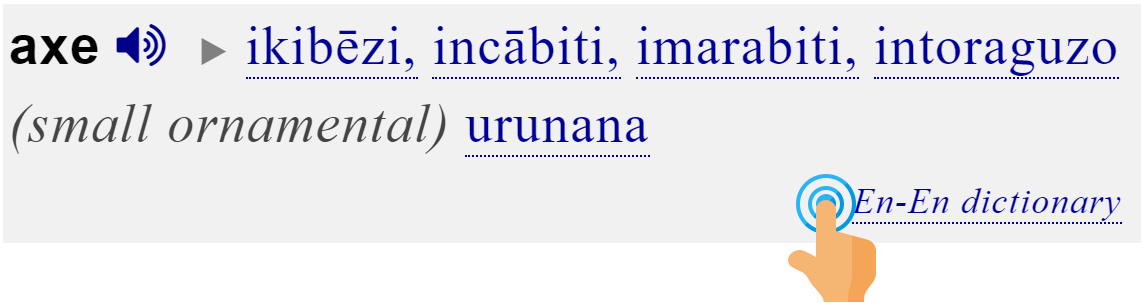

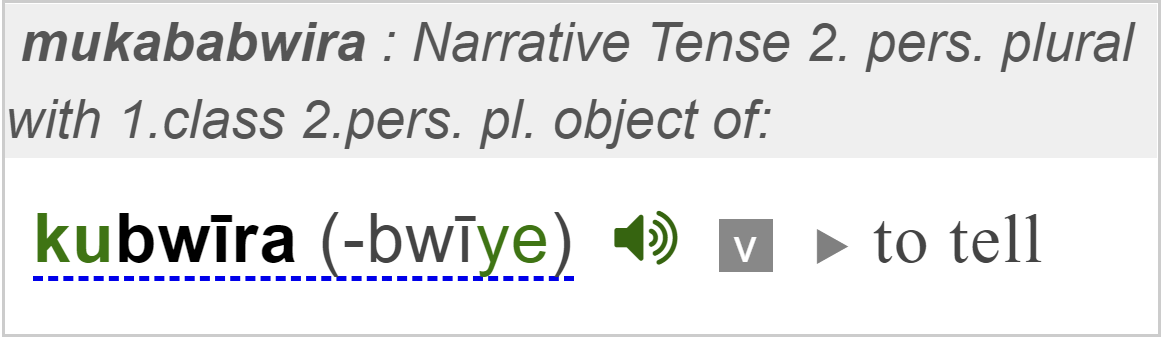
 printable PDF files.

 This unique dictionary by Betty Cox is known for the deep cultural insight it provides to many Kirundi terms. It has been thouroughly revised, adapted to present-day Kirundi orthography rules and many new words and meanings have been added.
 The Kirundi self study course guides you through 125 lessons and makes you learn both the necessary vocabulary and basic grammar.
 English pronunciation by